Efficient Parallel Binary Operations on
Homomorphic Encrypted Real Numbers
Jim Basilakis1and Bahman Javadi2
1
Western Sydney University,[email protected] 2
Western Sydney University
Abstract. A number of homomorphic encryption application areas, such as privacy-preserving machine learning analysis in the cloud, could be better enabled if there existed a general solution for combining suffi-ciently expressive logical and numerical circuit primitives to form higher-level algorithms relevant to the application domain. Logical primitives are more efficient in a binary plaintext message space, whereas numeric primitives favour a word-based message space before encryption. In a step closer to an overall strategy of combining logical and numeric operation types, this paper examines accelerating binary operations on real num-bers suitable for somewhat homomorphic encryption. A parallel solution based on SIMD can be used to efficiently perform addition, subtraction and comparison operations in a single step. The result maximises com-putational efficiency, memory space usage and minimises multiplicative circuit depth. Performance of these primitives and their application in min-max and sorting operations are demonstrated. In sorting real num-bers, a speed up of 25-30 times is observed.
Keywords: homomorphic encryption, SWHE, FHE, comparison, sort-ing
1
Introduction
Homomorphic Encryption (HE) is seen as an important technology for enabling computation and analytical processing on encrypted data outsourced to third parties. This would greatly facilitate mainstream utilisation of public cloud re-sources for sensitive data analysis with a significantly reduced chance of informa-tion leakage should any system breach occur. Fully Homomorphic Encrypinforma-tion (FHE) schemes, which support addition and multiplication operations on the same ciphertext, have only recently come about starting from the work on ideal lattices by Craig Gentry in 2009 [1]. Although the original scheme was highly inefficient, newer generation FHE schemes have since rapidly evolved that are several orders more efficient though not yet practical enough to be considered for mainstream application use.
Somewhat Homomorphic Encryption (SWHE) schemes remove the require-ment ofbootstrapping or recryption which typically takes up a very significant amount of the total FHE execution time. This however places a limit on the num-ber of combined operations that can be performed on the ‘noisy’ ciphertexts be-fore successful decryption is no longer possible. Considerable research has been dedicated so far to developing various optimisations and batching techniques to improve the efficiency of SWHE schemes and to maximise the depth of the circuits that can be evaluated without bootstrapping. A number of newer gen-eration schemes were developed based on the more efficient and simple Learning with Error (LWE) problem introduced by Regev in 2009 [2] (and its later ring variant) rather than on lattices, although the hardness problems were related [3]. A FHE scheme based onkey-switching andmodulus-switching optimisation techniques (see Section 3.2) became known as the BGV scheme named after its authors Brakerski, Gentry and Vaikuntanathan. Other SWHE scheme variants include Ring-LWE (RLWE) scale-invariant versions and NTRU-based schemes [4].
Despite the aforementioned optimisations, there are still significant (space and time) demands on computational resources and network bandwidth to over-come. The fact is that SWHE schemes are obliged to have either a massive ciphertext expansion or an ‘ugly’ algebraic structure in order to maintain their security [5]. Ciphertext expansion ratios are typically in the order of GBs in size for only a relatively small amount of plaintext input, resulting in high com-putational and communication costs [6]. Ciphertext packing techniques such as homomorphic Single Instruction Multiple Data (SIMD) proposed by Smart and Vercauteren [7], maximise memory space usage and achieve parallelism of re-peated operations by enabling the combination of multiple smaller ciphertexts into a single larger ciphertext.
Currently available SWHE implementations include additional optimisations to improve efficiency of processing large ciphertexts. A prominent open-source RLWE implementation of the BGV scheme called HElib1by Halevi and Shoup [8] incorporates many such optimisations (see Section 3.3), and is used to efficiently implement algorithms described in this paper.
Much research effort has also been dedicated around circuit design to support various HE application areas. The main aim is to optimise use of the SWHE tools as much as possible by designing algorithms in a way that reduces both the consecutive and total number of multiplications. The former minimises circuit depth to avoid bootstrapping while the latter reduces overall computational cost. SIMD techniques can be used to reduce the occurrence of both multiplication instances, in addition to maximising memory space usage. SWHE tools are often applied in highly tailored ways against the particular application scenarios, in order to deal with narrow parameter and computational efficiency constraints. Tightly coupling HE methods in this way limits their generalisability. The extent to which a HE solution can support general computing functions across a wide scope of application areas depends on the availability of sufficiently expressive
composable cryptographic primitives designed to work efficiently within a HE context.
Developing even the most basic primitives such as simple numeric and logical operations require non-trivial choices, including whether to perform evaluations over binary or arithmetic circuits (or polynomial rings), as well as the choice of data encoding. These factors have a significant bearing on low-level primitive circuit performance, which have a further flow-on effect on the performance of higher-level algorithms (eg., min-max and sorting methods), more directly relevant to practical use cases [9].
Binary circuits, which rely on encoding data at the bit-level before encrypting (ie., use a plaintext message space ofZ2) naturally support boolean comparison operations, whereas they are very slow in performing arithmetic operations [10]. Word-based encoding (ie., encrypting as elements of a plaintext modulus ofpor a Zp message space, for a large enoughp) allows for simpler and more efficient ciphertext multiplication and addition that are easily parallelised; this is however at the cost of more complex comparison and thresholding operations which are fundamental to many of the HE application areas [10].
In the area of data encoding, ciphertexts encoded as real numbers represent the most practical solution for most application areas. Techniques to represent fixed point numbers (encoded as polynomials) include scaled integer and frac-tional representations [11]. Encoding floating point numbers require independent storage of the encrypted significand from the exponent, necessitating separate homomorphic operations on each during calculations [12, 13]. Options also exist for encoding negative numbers, using either a sign-magnitude or two’s comple-ment approach [9]. The approaches used to represent real numbers (fixed or floating point) in either type of plaintext message space (Z2 or Zp) can have a significant impact on the efficiency of numeric and/or logical operations [9].
1.1 Our Contribution
2
Related Work
Related work on encoding, addition, equality and comparison HE operations will be discussed during development of our binary circuit primitives in relevant parts of Sections 3 and 4. The outcome of our circuit development is to enable more efficient complex homomorphic operations, which are derived from these basic circuits, using parallel batching techniques. Two candidate algorithms for demonstrating potential application of these primitives including sorting and finding the minimum or maximum (min-max) from a group of encrypted num-bers.
The task of sorting encrypted numbers using FHE was first implemented in 2013 by Aguilar-Melchor et al. [14] using a Bubble sort, and by Chatterjee et al.[15] using a two-stage Bubble and Insertion sort. The hcrypt2 library, based on the work of Smart and Verteceuran [16] was used in both cases, although the former also experimented with an early BGV-based scheme. Chatterjee examined minimising the recryption operation and as was able to achieve sorting of 40 (32-bit) integers in 1399 seconds. The hcrypt library however does not take advantage of modern noise reduction or SIMD batching techniques [17], which are factors both relevant to additional improvements in sorting performance.
The seminal work by C¸ etin et al. [18] in 2015 implemented two low-depth sorting algorithms both relying on a matrix to perform all comparisons at the outset, and achieving a multiplicative circuit depth ofO(logN+ logn), whereN
is the total number elements to be sorted, andnis the number of bits encoding each element. C¸ etin also introduced the concept of using SIMD to accelerate sorting performance, although it is used in this case to sort multiple lists rather than accelerate sorting of a single list. The amortised running time per sort is reduced since it takes the same amount of time to sort one list compared to multiple groups of similar-sized lists up to the total number of available cipher-text slots, s. Sorting one list however inefficiently uses one ciphertext per bit, therefore the implementation is computationally expensive. Using an NTRU-based SWHE scheme, sorting 16 (32-bit) integers is inferred to take about 45 mins. Dai & Sunar [19] boosted the SWHE scheme’s sorting performance using a GPU-accelerated library3 to achieve a speed-up of 12-41 times (reportedly, 1 min 38 sec to sort 16 integers of size 32 bits).
Kimet al.[20], appears to be the first work to report using SIMD batching to accelerate sorting performance within a single list. The authors employ HElib to implement a bitonic sorting algorithm, which is a data independent (ie.constant number of comparisons irrespective of input) sorting algorithm, consisting of recursive sort and merge operations. Only half of the available data slots are used to insert elements within its ciphertext packing structure. The sorting network is made up of two bitonic (ie. increasing then decreasing) sub-sequences, each initially with two elements for the base case. The bitonic sort algorithm has a O(Nlog2N) comparison complexity and a multiplicative depth of O(logn·
2 github.com/hcrypt-project/libScarab 3
log2N). Additional details can be found in [20, 21]. Whilst benchmarking C¸ etin’s work, [20] argues that the multiplicative circuit width in addition to its depth are important in determining the number of recryptions required for sorting large lists, which is the most dominant bottleneck in all FHE operations. The sorting algorithm based on the comparison matrix (havingO(N2) comparators) was shown to have a large width, and ultimately requiring more recryptions compared to the bitonic sort, despite the latter having a larger multiplicative circuit depth. An improvement in the number of recryptions was confirmed using real implementations of the sorting algorithms, although performance statistics on smaller sorting sets was not shown.
Literature specifically looking at finding min-max on encrypted number sets using FHE is limited. Kocaba¸s et al. [22] uses the HElib library for min-max heart rate computation involving a logical comparison circuit examined later in Section 5.3. A log2Nstage binary tree is used to repeatedly applying min-max on N ciphertexts packed with a vector ofn-bit integers, resulting in an overall circuit depth of (log2n+ 2)· dlog2Ne. It would appear further processing is necessary (additional circuit depth of log2n) to extract the final minimum or maximum value within the output ciphertext in a step not apparently described; perhaps being recovered after decryption. The min-max algorithm described by Toganet al.[23] uses a recursive strategy to combine, in the base case, a one bit integer ‘greater than’ comparison relation with a selection operator both expressed in polynomial form. The overall circuit depth is similar to the approach by Kocaba¸s, although no ciphertext packing is involved. A HElib-based implementation finds the maximum value from 16, 8-bit integers in 21 minutes. Set at a 140 bit security level, the implementation is very memory intensive at 3.8 GB.
It is noteworthy that all literature reviewed only examines sorting and finding min-max from sets of encrypted integers rather than real numbers, despite both number types requiring an identical amount of processing time to sort when correctly encoded, for a given bit size.
3
Preliminaries
3.1 Homomorphic Encryption
Any HE scheme consists of four probabilistic polynomial time algorithmsKeygen, Enc, Dec, Eval. In this case, all algorithms implicitly take in a number of pa-rameters as input including dimension n, modulus q and error distributions, according to RLWE constructions:
– Key generation (pk, sk ← Keygen(1λ)): takes in security parameter λ as input and outputs a public encryption keypk and a secret decryption key sk.
– Encryption(c←Enc(pk, µ)): takespkand a plaintextµin a message space Mdefined by some ringRM. The output is a ciphertextc in spaceC (and
ringRC).
– Evaluation(cf ←Eval(pk, f, c)): characterises a HE scheme, taking as input the public keypk, a function f : Rl
M → RM and a tuple of l ciphertexts
c1, ..., cl, to output a ciphertextcf.
In this work,f will be represented by an arithmetic circuit overGF(2)that can be evaluated by a SWHE scheme to a limited depth so thatDeccan recover
µcorrectly without requiring bootstrapping.
3.2 The BGV SWHE Scheme
The RLWE variant of the BGV scheme can be represented as follows [3, 8]: With λ as the security parameter (ie., all known valid attacks taking Ω(2λ) bit operations) and an integer m = Ω(λ) that defines the m-th cyclotomic polynomialΦm(X), we define the polynomial ring A=Z[X]/Φm(X).m, which roughly corresponds to the dimension of the underlying lattice, determines the size of computation and hence represents efficiency of the encryption scheme. The plaintext message space is set toAp :=A/pA=Z[X]/(Φm(X), p) forp>2 (although in this work we will always use A2). The ciphertext space is set to Aq := A/qA for an odd integer modulus q with a degree up to φ(m)−14. Ciphertexts are 2-element vectors defined overAqi(or ringRqi) at any particular
leveli,ie.,c= (c0, c1)∈R2qi. In themodulus-switching procedure, by switching
to a ciphertext with a smaller modulus (from qi to qi−1), an increase in the number of multiplications could occur from logLtoLlevels before bootstrapping is required and without involving a secret key [3, 24]. At each ciphertext level (L, ...1,0), the modulus decreases with every application of modulus-switching to reduce the noise during homomorphic evaluation. No further noise reduction is possible in level 0, requiring bootstrapping to enable further computation.
As there are a few variations to the RLWE assumptions involved in encryp-tion, we use that proposed by Lyubashevsky, Peikert, Regev (LPR) as a practical approach [25]. In set-up of the scheme, a (discrete Gaussian) noise distribution
χ is defined over the set of all ring elementsAq with a small norm bounded by some B. Sample s← χ and e← χ. Generate a1 ← RqL uniformly at random
and calculatea0= [−(a1s+pe)]qL. Set the secret keysk=sand the public key pk= (a0, a1).
To encrypt a plaintext polynomialm∈Ap, sampleu, g, h←χand compute the ciphertext which is initially in level L:
c= (c0, c1) = (a0u+pg+m, a1u+ph) modqL (1)
At any level, ithe equality over Aholds, m = [[c0+sc1]qi]p
5, which is the
decryption formula. The term [c0+sc1]qi is the ‘noise’ in the ciphertext that
grows with each homomorphic evaluation. The ciphertext is valid as long as this noise does not wrap around modulo qi, which gives bound on the norm of the noise to be always belowB. Under the RLWE assumption, the encryption scheme
4
φ(m) is the Euler’s totient function 5 [·]
is semantically secure (ie., against honest-but-curious adversary behaviour) if the public key (a0=−(a1s+pe), a1)∈R2q, and by extension the ciphertext (c0, c1), are computationally indistinguishable from uniform in R2
q.
Homomorphic addition involves simply adding two ciphertext vectors under the same key sover Aqi. The noise of the added vector is at most 2B.
Homo-morphic multiplication involves a tensor product overAqi resulting in squaring
of both ciphertext and (new self-tensored) secret key dimensions. While the cur-rent modulus remains unchanged, the noise of the product ciphertext is bounded byB2. Akey-switching (or relinearisation) technique is required to reduce the dimension of tensored secret key and ciphertexts back to original dimensions. At each multiplication level, the tensored secret key would be encrypted under a different secret key as a hint to facilitate conversion to the new valid encryption. A single key however is only required for all levels if it can be assumed safe to encrypt the secret key under its own public key (circular security assumption) [3].
SIMD makes use of the fact that smaller plaintext spaces could collectively be considered a vector of independent plaintext slots (for performing component-wise addition or multiplication) when encrypted into much larger ciphertext spaces by virtue of the Chinese Remainder Theorem (CRT). Since the plaintext space is overAp,Φm(X) factors modulopinto sirreducible factors,Fi(X) (ie.,
Φm(X) =Qs
i=1Fi(X)). Each factor corresponds to a ‘plaintext slot’ of degree
d, which is the smallest integer such thatpd = 1 modm, and thus the number of slots,s=φ(m)/d. The plaintext polynomiala∈Ap therefore can be viewed as a vector ofs different small polynomials, (amodFi)si=1. The slot values can represent elements of the extension fieldFpd(or embedded elements of the
sub-field Fpn wherendividesd), rather than individual bits [26].
Implementing linear rotations and shifts to move data across plaintext slots can be achieved with an automorphism operation without any increase in ci-phertext noise [8]. The automorphism is represented by the transform, a7→a(i) where a(i)(X) = a(Xi) modΦ
m(X) for a(X)∈ A and somei ∈ Z∗m. Often a combination of automorphism operations with selective slots masked out is nec-essary to achieve arbitrary permutations on packed ciphertexts. Key-switching is also required to transform a ciphertext involved in an automorphism into an-other valid ciphertext that is decryptable with respect to the original secret key. In this case, secret key and ciphertext dimensions remain unchanged. Note, there is a computational cost involved in combining automorphisms followed by key switching to achieve permutations on plaintext slots. For further details, refer to [26].
3.3 HElib
HElib includes many optimisations over the basic BGV scheme, including sup-port for recryption and SIMD. Due to a specialised key-switching procedure, eachqi is a product of smaller set of primespj, (ie.,qi=Q
i
j=0pj). As a result, ciphertext elements of the ring Aqi are represented with respect to both
evaluations generated using the Fast Fourier Transform (FFT). This so-called DoubleCRT format allows point-wise addition and multiplication of elements in Aqi in linear time [27, 8]. The encryption method involved in HElib varies
slightly compared to the aforementioned LPR method: It uses a native plaintext space ofRpr for a prime power pr. The secret key,sis the 2-vector (1, s)∈R2,
where s is chosen randomly from {0,±1}φ(m) with a recommended Hamming-weight (ie., number of non-zero coefficients) of 64. If Qct is the product of all ciphertext primes, initially generatec1←AQct uniformly at random ande←χ
where χ ∈ AQct, and set c0 = [p
re−c
1s]. Then at any level i, the ciphertext
c= (c0, c1) satisfies [hs,ci]qi = [c0+c1s]qi=m+p
reinRwherem∈R
pr is the
message plaintext andpreis the error term, which has a small norm relative to
qi [8].
4
Encoding Real Numbers
As mentioned, ease of implementation and efficiency of operations on binary circuits relies on the specific encoding method used to represent real numbers. A fixed point representation is the simplest one for demonstrating circuit opera-tions, which can be applied to the polynomial plaintext ring,Rpand whose coef-ficients representbits in a binary sequence. Two methods proposed by Dowling et al.[11] use scaled-to-integer and fractional encoding representations of fixed point real numbers, which are demonstrated by Costacheet al.[28] to be isomor-phic under the same power of two cyclotomic ring. Strictly speaking, fractional encoding cannot operate under a binary message space whereas the scaled-to-integer approach can perform computations over both binary or arithmetic cir-cuits. It is nevertheless worthwhile considering both fixed point representations as researchers have previously sought to avoid costly bit operations by turning to the plaintext space,Rp [28].
The scaled-to-integer approach scales a binary representation of a real num-ber by some power of 10 into an integer according to some fixed digit precision. Despite literature criticism about the requirement for complex book-keeping in order to ensure ciphertexts are correctly scaled in homomorphic operations [11, 28], we use the approach suggested by J¨aschke et al. [9] of multiplying a real number by a power of two according to k bits of precision. In this case, the output of each homomorphic multiplication between two real numbers should be truncated by deleting the lastk bits (equivalent to dividing by 2k), to bring the product back to the required precision. Under this approach, there is no requirement to keep track of scaled products involved in computations before final conversion to the decrypted output, which could otherwise potentially leak data or computation information to an adversary.
The fractional encoding scheme is implemented over the cyclotomic ringR= Z[X]/(Xd+ 1) whered is a power of two. The integer portion to the left of a decimal point can be represented in binary as usual while the fractional part of a real number to the right of a decimal point are represented by the highest polynomial coefficients. The latter are designated−Xd−ib
position to the right of the decimal point. Intuitively, due to the modulus of
R,Xd=−1 and so the highest coefficients can also be represented asX−ib
−i, which is as desired. Under this scheme, a number of coefficients are set aside for the fractional part of the encoded polynomial,p∈R. Negative numbers are represented by swapping coefficient signs. Under p, addition and multiplication work as expected andp(2) decodes to the original real number [11, 28].
The problem with a fractional encoding scheme is that it does not appear to be compatible with SIMD operations, since the plaintext slots depend on irreducible modulus factors, Fi(X), which is not the case with the modulus of R. The fractional encoding scheme can handle wrap-around modulo Xd+ 1 with operations involvingp, although with too many multiplications, coefficients reserved for the fractional and integral parts quickly grow towards each other to yield unexpected results when the two parts coalesce. In a power of two scaled-to-integer encoding, wrapping around slot values moduloFi(X) will yield unexpected results, placing a lower bound on the ring degree of polynomials involved in operations. In practice, this usually means ensuring that the degree of two polynomial inputs involved in multiplication are each less than half of the degree, d of the plaintext slots in order to prevent wrap-around. Due to truncation of the last k bits to correct for precision in multiplication, this has the effect of lowering the degree of the polynomial product, hence multiplication can continue indefinitely in this way, albeit within ciphertext noise limits.
We choose a slight refinement to J¨aschke’s approach when considering the scaled-to-integer representation of real numbers which, despite having identical encoding to the original method, is conceptuality simpler when applied compu-tationally and for descriptive purposes. After scaling a real number by 2k and encoding it in binary, dedicatekof the lowest polynomial coefficients to encode the fractional part of a real number with binary digits b−1b−2...b−k, followed by the integral portion encoded with binary digits bI+...b1b0, and represented as:P
I+6i6−kXibi. Although binary digits are shown, any base (b >2) can be chosen to represent a real number using this scheme (whether balanced or not), similar to fractional encoding.
For negative numbers, a two’s complement rather than a sign-magnitude encoding is chosen since the former is more efficient in comparison and addition operations [9], which have relevance to the circuit primitives discussed in the following section. A two’s complement encoding of a negative real number is computed by inverting the scaled binary encoding of the positive real number and adding one. In this case, the ‘highest’ polynomial coefficient is reserved for encoding the negative value−2d−k−1, and sign extension is used to extend the bit length of the encoding to d. Using an example, the real value -1.25 within a plaintext slot where d = 8 and 4 bits of precision are required, can be two’s complement encoded as a ring polynomial under extension field F28
result can be decoded as:p(2) =−23+ 22+ 21+ 2−1+ 2−2=−1.25. Under this scheme, addition and multiplication also work as expected.
5
Circuit Primitives
Ultimately, primitive binary circuits for addition and equality are alone necessary to combine a range of logical operations together with addition and subtraction on real numbers under a binary plaintext space. Finding efficient versions of these primitives has a flow-on effect to more complex homomorphic operations that are derived from these two basic circuits. At a bit level, XOR (⊕) and AND (·) logic gates are implemented slot-wise over a binary plaintext space via corresponding homomorphic addition (+h) and multiplication (×h) operations between ciphertexts respectively. All other logic functions can be derived from these two logic gates. This includes an OR operation which is implemented as the binary inverse (by adding 1 in binary) of an AND (ie., NAND) operation. When combining a number of AND operations, ciphertexts are commonly arranged into a binary tree formation so that terms are multiplied from base to root rather than sequentially [29, 30, 6]. The effect is to reduce the multiplication depth of the circuit from n−1 to logn, and can be readily implemented using SIMD operations.
The following sections describe various primitive circuits that can perform binary addition and equality operations, with the aim of finding optimal parallel designs to minimise the three resource parameters: memory usage, multiplicative depth and total number of multiplications. Circuits will be described generally with focus being given to the final most competitive versions. All circuits assume a ciphertext structure that takes up one slot per plaintext bit to work correctly including SIMD operations.
5.1 Addition Circuit
The most basic adder implementation is the n-bit Ripple Carry Adder (RCA) which employs n full adders, with the carry bit output from one adder acting as input into the next adder along a chain from least to most significant bits. This ‘rippling’ dependency of carry bits means that the circuit is unsuitable for parallel operations. The logic for a sum of two bits, ai, bi and carry-in bit,ci of the full adder is expressed as, si =ai⊕bi⊕ci. Logic for the carry-out bit,
ci+1 =ai·bi⊕ci·(ai⊕bi) can be reduced to one AND gate per bit, ci+1 = (ai⊕ci)·(bi⊕ci)⊕ci[29]. The multiplicative depth of this adder hence is limited to
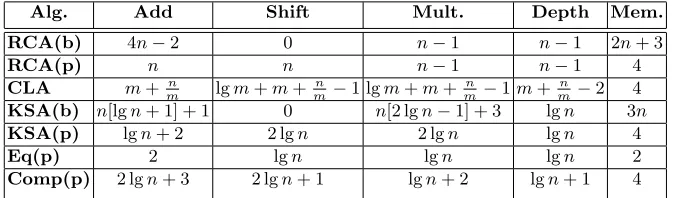
n−1. There are bit-wise and packed ciphertext RCA protocol implementations available [31]. Despite the latter potentially making use of SIMD operations, there is no real benefit conferred with respect to resource parameters used and circuit depth (refer to Table 1).
generate term, andpi=ai⊕bi, is called thepropagate term. According to the carry-out logic, ifgi is one (ai andbi are both one), ci+1 is one; and ifpi is one (at least one of ai or bi is one), thenci is propagated toci+1. Since neither gi norpi depend on the carry, they can be determined beforehand and in parallel. A pattern emerges whereby for each carry bit:
ci+1=gi⊕(pi·gi−1)⊕(pi·pi−1·gi−2)⊕
...⊕(pi·...·p2·p1·g0)⊕(pi·...·p1·p0·cin) (2)
The final sum is computed as si = pi⊕ci. A CLA has a lower multiplicative depth but a higher computational cost compared to the RCA. By sub-dividing
n-bits into smaller equalm-bit sized blocks, this cost can be reduced. The smaller
m-bit adders can be arranged into a CLA between blocks while carries within a block are rippled (or vice-versa) to realise Equation 2. In this case, the circuit depth is Θ(m+ n
m) and minimised when m=Θ( √
n) [31]. Summary statistics for a CLA with anm-bit block ripple adder design [31] are presented in Table 1. CLAs form the basis of another group of adders called Parallel Prefix Adders (PPAs), which perform parallel group carry operations. These adders are known to be amongst the most efficient of all digital binary addition circuits [32]. The Kogge-Stone Adder (KSA) is one of the fastest adders of this type where every propagate and generate bit is computed in parallel. The circuit has a minimum possible multiplication depth and scales logarithmically, although at the expense of long wiring, more gates and a larger area requirement in digital hardware implementations [32]. These disadvantages tend to be much less significant in computing systems. In fact, the KSA appears particularly amenable to homo-morphic SIMD operations as the protocol entails applying identical instructions uniformly across all plaintext slots, staged between shifting slots relative to two interacting ciphertexts. An 8-bit KSA circuit is illustrated in Fig. 1.
As shown, each circuit node combines p and g recursively from two ‘bit’ columns to form a new set, (g=g00⊕p00·g0, p=p00·p0). Starting at level 0, column
i is combined with column i+ 2k up to level k = d(log
2n)−1eto eventually realise Equation 2. There are bit-wise and packed ciphertext protocol versions of the KSA [31]. In the latter case, all bits from a set of slots encoded within a base ciphertext can be combined in one step with another ciphertext whose set of slots are shifted in each level by 2k towards the MSBs. To compute the final sum in parallel, a single multiplication depth is required initially to compute all
g’s, and subsequently between allklevel carry operations, resulting in an overall multiplication depth ofdlog2neand a total cost of 2· dlog2nemultiplications. The KSA appears to be the most efficient binary addition circuit that minimises all three main resource parameters (Table 1). These findings are reasonably comparable with those by King [31] and Kocaba¸s et al. [30] who employ the KSA. This adder appears to outperform various alternative techniques used for binary addition outlined in [9, 29, 34, 6].
Binary addition can also be used to perform subtraction using the trick of adding the first number with the two’s complement negative encoding of the second number. This calculation can be incorporated into the adder algorithm by inverting the second encoded real number in addition to setting the first carry-in bit (cin in Equation 2), to 1. The circuit requires only one further addition operation without any increase in its multiplicative depth.
Table 1. Comparison of addition and equality binary circuit parameter costs. n -bit number input;m - bits per block. Algorithms (Alg.) shown: RCA - Ripple Carry Adder; CLA - Carry Lookahead Adder; KSA - Kogge-Stone Adder; Eq - Equality; and Comp - Comparison Logic; includes bit-wise (b) and packed (p) ciphertext versions. Memory (Mem.) is the minimum number of ciphertexts required to fulfil the protocol. lgnrepresentsdlog2ne.
Alg. Add Shift Mult. Depth Mem.
RCA(b) 4n−2 0 n−1 n−1 2n+ 3
RCA(p) n n n−1 n−1 4
CLA m+ n
m lgm+m+
n
m−1 lgm+m+ n
m−1m+
n
m−2 4
KSA(b) n[lgn+ 1] + 1 0 n[2 lgn−1] + 3 lgn 3n
KSA(p) lgn+ 2 2 lgn 2 lgn lgn 4
Eq(p) 2 lgn lgn lgn 2
Comp(p) 2 lgn+ 3 2 lgn+ 1 lgn+ 2 lgn+ 1 4
5.2 Equality Circuit
and is depicted as:equal(a,b) =Qn−1
i=0(ai⊕bi⊕1). The output is 1 ifaandb are equal, otherwise it is 0. In this case,n−1 multiplications are required which can be reduced to a multiplicative depth ofdlog2neusing a binary tree structure. The application of SIMD involves accumulating products of a packed ciphertext containing initial bit-wise values ofai⊕bi⊕1. The slots are progressively shifted by 2kin each level towards the MSBs and multiplied in parallel with the previous level’s result. The MSB will contain the final output for theequal circuit after dlog2nelevels [34]. An alternative divide-and-conquer strategy for determining integer equality with a similar multiplicative depth is described in [23], although
n−1 homomorphic multiplications are required instead of log2n.
5.3 Comparison Circuit
A comparison circuit compares the magnitude between two real numbers, indi-cating one number is larger or smaller compared to the other. Only one type of comparison circuit is required in combination with theequal circuit, to derive all other comparison relationships (ie., <, >,6,>; see below). To enable a less-than comparison, there are two binary circuits of note [22, 18]. One determines the comparison logically while the other is derived from the addition circuit.
The comparison logic can be depicted in the following way: comp(a,b) = Pn−1
i=0[(ai < bi)Qi<j<n(aj =bj)], where (ai < bi) = (bi·(ai⊕1)) and (aj =
bj) = (aj ⊕bj ⊕1). An implementation of the circuit using SIMD involves progressively shifting slots containing the term aj = bj by 2k in each level towards the Least Significant Bits (LSBs) and multiplied with the previous level’s results. The final slot output is multiplied by the expressionai< bi resulting in a multiplicative depth ofdlog2ne+ 1 and a total ofdlog2ne+ 2 multiplications (extra AND gate in the ‘<’ term) [22]. Calculating a final sum of products using a binary tree structure, requires an additional dlog2neshifts and homomorphic additions to reveal the comp output. Comparison logic furthermore needs to address signed numbers in two’s complement encoding. In particular, the inverse of the comp output should be returned when the signs differ between the two real numbers being compared. The final output therefore should be modified to, comp(a,b)⊕an−1⊕bn−1 (not accounted for in Table 1).
Comparisons based on the binary addition circuit use subtraction to compare two real numbers followed by testing of the sign bit of the result [30]. In a less-than comparison, the following relationship holds: comp(a,b) = (a−b)n−1. Subtraction can be readily implemented using the KSA described earlier.
total number of homomorphic multiplications, albeit of similar multiplicative depth, appear in [34, 23].
Once c = comp(a,b) and e = equal(a,b) have been determined, all re-maining comparison relationships can be derived using binary logic and at little additional cost as follows:a6b=c + e; a>b=c + e; anda>b=c.
5.4 Further Optimisation
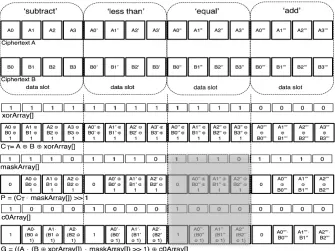
the relevant data slots of G. The final outputs of ParallelAdderSubtrac-tor and ParallelEquality are contained in respective ciphertexts of CT. Both CT outputs are homomorphically combined in a trivial post-processing stage to derive the final encrypted evaluations of all parallel sub-operations. The circuit block of parallel primitives illustrated in Fig. 2 from now will be referred to as Parallel Primitive Circuits (PPCs).
BothParallelAdderSubtractor andParallelEqualitycan flexibly process anyn-bit number groups, not just powers of 2. The latter case however makes most efficient use of available slot resources. As a further optimisation, if the maximum bit length of numbers in all data slots is l < n, then this knowledge can reduce the multiplicative depth and computational cost of both parallel functions (eg.depth ofdlog2leinstead ofdlog2ne). This property is used to significantly reduce the parameter costs of an accumulator function discussed in Section 6.1.
Algorithm 1 Preprocessing packed inputs to ParallelAdderSubtractor (Alg. 2) andParallelEquality(Alg. 3)
INPUT: A,B,s,nandOp[], whereAandB are packed ciphertexts withsslots and each encoding an (n−1)-bit real number in each of itsbs/nc data slots. Op[] is an unencrypted array of strings of sizebs/ncspecifying the sub-operation types to occur in corresponding data slots betweenAandB (eg.‘add’, ‘subtr’, ‘eq’,etc.). OUTPUT: CT,GandP: packed ciphertexts providing input to Algs. 2 (all 3
param-eters) and 3 (onlyCT required).
1: functionParallelPacking(A, B, n, Op[]) 2: xorArray[s], maskArray[s], c0Array[s]
3: fori←0tobs/ncdo .for each data slot 4: maskArray.insert((n−1)·[1] + [0]) .MSB = 0 5: if Op[i]6= ‘add’then
6: xorArray.insert(n·[1])
7: c0Array.insert([1] + (n−1)·[0]) .LSB = 1
8: else
9: xorArray.insert(n·[0]) 10: c0Array.insert(n·[0]) 11: end if
12: end for
13: B=B⊕xorArray[]
14: G←A·B ;P ←A⊕B;CT ←P
15: G=G·maskArray[];P =P·maskArray[] 16: G1;P 1
17: G=G⊕c0Array[] 18: returnCT,G,P 19: end function
6
Implementation
Algorithm 2Parallel Kogge-Stone Adder-Subtractor
INPUT: G,P, CT and l, where G, P,CT are packed ciphertexts with s slots and bs/nc data slots, packed according to Algorithm 1. l is the maximum input bit length contained in alln-bit data slots (l6n).
OUTPUT: CT: a ciphertext with component-wise addition or subtraction performed on every data slot pair.
1: functionParallelAdderSubtractor(G, P, CT, l)
. G,P,CT - ciphertext memory objects 1,2,3 2: fori←0todlog2ledo
3: tmp←G .ciphertext memory object 4
4: tmp=P·(tmp2i) 5: G=G⊕tmp
6: if i6=dlog2le −1then
7: tmp←P
8: P=P·(tmp2i) 9: end if
10: end for
11: returnCT =CT⊕G 12: end function
6.1 Sorting
The following demonstrators will look at accelerating sorting methods including the odd-even transposition sort and the Direct Sorting algorithm of C¸ etin’s work [18]. Both are ideal candidates for the parallel primitive algorithms described in this paper.
Algorithm 3Parallel Equality
INPUT: CT andl, whereCT is a packed ciphertext withsslots andbs/ncdata slots, packed according to Algorithm 1.lis the maximum input bit length contained in alln-bit data slots (l6n).
OUTPUT: CT: a ciphertext with component-wise equality performed on every data slot pair. Results are located in the MSB of each data slot ofCT.
1: functionParallelEquality(CT, l)
. CT - ciphertext memory object 1 2: fori←0todlog2ledo
3: if i=dlog2le −1and(lmod 2i)6= 0then 4: shif tamt=lmod 2i
5: else
6: shif tamt= 2i 7: end if
8: tmp←CT .ciphertext memory object 2
9: CT =CT·(tmpshif tamt) 10: end for
11: returnCT 12: end function
circuit depth, which involves computing parallel (SIMD) odd-even transposition sort spanning across multi-threaded packed ciphertext blocks. This particular sorting method will not be further considered in this paper.
Matrix Comparison Sort C¸ etin’s work implemented two shallow circuit sort-ing algorithms, Direct and Greedy Sort, which both initially make use of a com-parison matrix and have an overall circuit depth ofO(log2N+ log2n). Only the former sorting algorithm will be examined for PPC integration. The comparison matrix, m(ijγ) for a given encrypted input vector, E(X) = hX0(α), ..., XN(α−)1i is described as:
m(ijγ)= (
mij = 1 ifXi< Xj.
mij = 0 else.
(3)
where i, j < N, i < j, and mii = 0 (the diagonal elements). The lower triangular part of the matrix,j < iis computed asm(jiγ)= (Xi >Xj) =m
(γ) ij ⊕1. The Direct Sort algorithm relies on calculating the sum of all elements within each matrix column, which returns the index of eachXj in the sorted array. For further details see [18].
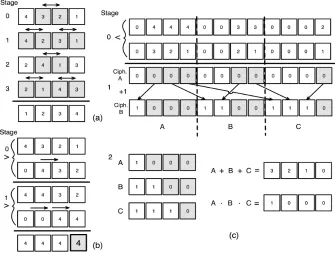
Fig. 3.Demonstrator algorithms: (a) Odd-Even Sort, (b) Min-Max, (c) Depth Opti-mised Min-Max and Sort. Squares represent data slots.
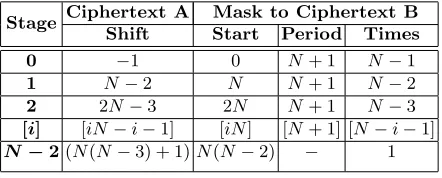
N·(N−1) instead ofN2. These steps are represented in Fig. 3(c). As shown, sorting an array of four numbers requires setting up all relevant input combi-nations across twelve n-bit data slots. In this case, all number combinations are contained in two input ciphertexts within one block. Parallel ‘less than’ sub-operations are performed on all input data slots by applying the PPCs to compute the upper triangular portion of the matrix. Remaining values are cal-culated by adding 1 (XOR) to the partial matrix and transforming the relevant data slots to complete the lower triangular portion of the matrix. Transposing half the comparison matrix in this way involves N−1 stages of slot shifts and insertions of XORed values at periodic intervals from the partial to completed matrix, represented by data slots within packed ciphertexts A and B respectively (as shown in Fig. 3(c)). The shift amount of ciphertext A and the periodic slot insertions to ciphertext B required at each stage are represented in Table 2. The steps in each stage are performed in parallel using SIMD and the algorithm can work to transform data slots across multiple ciphertext blocks. The algorithm has an overall circuit depth of one constant multiplication per stage due to the mask operation on ciphertext B.
Table 2. Algorithm to transpose upper triangular portion of matrix encoded in Ci-phertext A to form comparison matrix in CiCi-phertext B
Stage Ciphertext A Mask to Ciphertext B Shift Start Period Times
0 −1 0 N+ 1 N−1
1 N−2 N N+ 1 N−2
2 2N−3 2N N+ 1 N−3 [i] [iN−i−1] [iN] [N+ 1] [N−i−1]
N−2(N(N−3) + 1)N(N−2) − 1
corresponding columns are aligned withN−2 shifts of the data slots byN·neach shift. Elements in aligned columns require binary addition to compute the sorted indices. Thisaccumulator operation (counting of elements) can be performed in parallel with an application of the PPCs, with all sub-operations set to ‘add’. Since the highest index count resulting from the accumulator is expected to be
N −1, the circuit depth of one application of the KSA is log2(dlog2(N −1)e) instead of log2n(notel < nin Alg. 2). The accumulator function is appliedN−2 times, therefore the overall circuit depth becomes (N−2)·log2(dlog2(N−1)e). This circuit depth is relatively high. We consider instead using C¸ etin’s approach to calculate the Hamming distance of the matrix columns by replacing the KSA with a Wallace Tree Adder (WTA) [36] to perform the accumulation. The latter adder itself is not computed in parallel using SIMD, but since it is applied n
times - once for each matrix column, this part can be multi-threaded. The WTA has an overall minimal circuit depth of log2(N/2).
Finally, the computed sorted index values need to be converted into an actual sorted array, which requires comparing each sorted index value, σi(γ) with an ascending list of all indices in the interval [0, N−1]. This function returns the encrypted output vector, Yβ = hY(β)
0 , ..., Y (β)
N−1i and is described by C¸ etin as follows:
Yβ= X
i∈[N]
(σ(iδ)=j)Xi(α)forj∈[N]. (4)
The equality expression in equation 4 can be computed in parallel with a second application of the PPCs, where all sub-operations are set to ’equal’. Similar to the accumulator, the maximum number of bits to be compared for equality are dlog2(N−1)e, therefore the overall minimum multiplicative depth for the equality circuit becomes log2(dlog2(N−1)e).
a comparison matrix spanning 7 segments across 4 blocks. Sorting 16 x 32-bit numbers requires 15 blocks using one segment per block. Similarly, multiple blocks are required to process the equality circuit in addition to the compari-son matrix. As blocks are processed independently, there is significant potential for multi-threaded block processing to further accelerate sorting times. Data slot preparations across single or multiple blocks add more operations, such as slot shifting and masking, to achieve equivalent bit manipulations compared to unpacked ciphertexts (ie. encoding individual bits or numbers). These factors increase overall circuit depth estimations in homomorphic procedures involving packed ciphertexts.
6.2 Min-Max
Depth unoptimised Min-Max To simplify analysis of a depth unoptimised min-max circuit, we initially look at processing encrypted real numbers encoded within one ciphertext block. In this case, two ciphertexts are packed with iden-tical data slot inputs. As shown in Fig. 3(b), slots of the lower ciphertext are progressively shifted by 2k in each stage towards the MSB. ‘Less than’ compar-ison sub-operations are computed in parallel from the previous stage’s output using a single application of the PPCs per stage. In each stage, the PPCs’ output is used as a selection mask to choose data slots from either upper or lower ci-phertext inputs depending on whether the final desired output is a minimum or maximum value, respectively. Each stage therefore has a minimum circuit depth of dlog2ne+ 1. The MSB will contain the final min-max output afterdlog2Ne stages, resulting in an overall minimum circuit depth ofdlog2Ne ·(dlog2ne+ 1). To determine the min-max value over large number sets, the ‘less than’ PPCs are first repeatedly applied across B multiple ciphertext blocks using a log2B stage binary tree similar to [30]. This process has a minimum cir-cuit depth of dlog2Be ·(dlog2ne+ 1). Output from this stage is subsequently reduced onto one ciphertext block which can be processed finally by the single-block min-max circuit of similar depth; resulting in an overall minimum depth of (dlog2Be+dlog2Ne)·(dlog2ne+ 1). Despite the relative lower complexity of depth unoptimised min-max compared to the corresponding sorting algorithm, recryption would likely be required to process one ciphertext block of inputs. We therefore turn our attention to the depth optimised min-max algorithm and do not further consider the unoptimised version in this paper.
resulting in a minimum circuit depth of dlog2(B·N)e in the final stage. This stage replaces the combined accumulator and equality circuit stages present in sorting, resulting in an overall reduced circuit depth for the optimised version of min-max compared to sorting. Multi-threaded processes could accelerate ho-momorphic multiplication of multiple ciphertext blocks at each binary tree level (with the lowest potential closest to the root), in addition to the multi-threaded computation of the comparison matrix blocks.
7
Evaluation
We evaluate performance of the accelerated matrix comparison sort against C¸ etin’s standard open source implementation6, in addition to evaluating the depth optimised version of min-max. Our implementations are in C++ and use the HElib library for homomorphic operations with multi-threading turned on, and compiled using the NTL library version 10.5.0 and GMP version 6.1.2. All simulations are conducted using a m2.4xlarge AWS EC27 execution environ-ment, which is reported to use an Intel Xeon E5-2686 v4 processor with 8 vCPU cores at 2.30GHz and 32GB RAM, running Ubuntu 16.04.3 LTS. As shown in Table 3, parameters are derived to ensure that the security of HElib’s BGV-based SWHE scheme is conservatively higher than that of the NTRU-BGV-based LTV-SWHE scheme used in C¸ etin’s work. It should be noted that matching the security of differing SWHE schemes is a tricky problem [37], including having potential issues surrounding NTRU’s security assumptions [38, 39]. The security level of all conducted tests are upwards from 108-bit, estimated according to [27]. HElib defaults are used for parameters not listed in Table 3.
Table 3.Selected HElib parameters for evaluation:m- cyclotomic ring,φ(m) - lattice dimension,λ- security level,L- levels,s- number of slots.
m φ(m) λ L Plaintext Space s
1570915004 108.5 15 GF(222) 682 2331123310 172.5-134.1 17-20 GF(245) 518
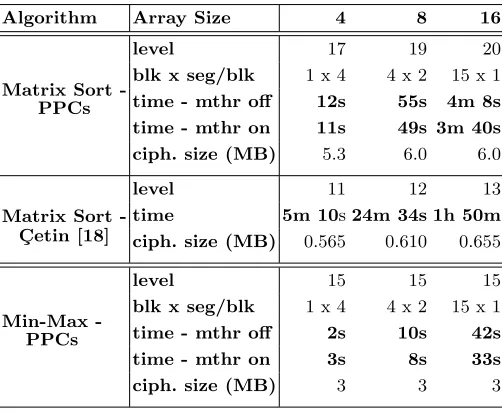
Table 4 displays sorting and min-max performance statistics on 4, 8 and 16 elements encoding 31-bit real numbers (1 bit less due to ciphertext packing structure). Average execution times are shown for each algorithm, where 20 runs are conducted for each array size test. This amount is adequate given the low coefficient of variance shown for executions times within each test (normally
< 0.01). Depth optimised algorithms are accelerated using multi-threaded op-erations across blocks involving PPCs, the impact of which is explicitly demon-strated (multi-threading ‘off’ vs ‘on’ in Table 4). Although WTA accumulator
6
multi-threading could potentially accelerateNrepeated Hamming distance com-putations of the matrix columns, this was not done to allow focus on parallel effects of the PPCs alone. For comparison purposes, C¸ etin’s sorting code is run within the same execution environment as the PPC implementation.
Table 4 demonstrates a significant speed up of sorting performance by a factor of approximately 25-30 times as a result of batched SIMD binary operations. The circuit depth associated with each array size input is higher in the PPC version due to overheads associated with processing packed ciphertexts. Ciphertext sizes are also compared for each array size. In the case of C¸ etin’s matrix sort, despite being 101 the size comparatively, one ciphertext is generated per bit of input, therefore N ·n ciphertexts are processed initially during input (∼ 335MB for
N=16, 32-bit numbers). In the PPC matrix sort, only 2 ciphertexts per block,
Bare necessary to process inputs according to Alg. 1 (∼180MB forN=16, 32-bit numbers). Subsequently, only 4·Band 2·Bciphertexts are required to compute Algs. 2 and 3 respectively. Processing fewer packed ciphertexts effectively reduces memory and communication costs associated with a homomorphic application.
Table 4. Performance results for depth-optimised sorting (comparison with C¸ etin results) and min-max using 31-bit real number array inputs. blk - block, seg - segment, mthr - multi-threading
Algorithm Array Size 4 8 16
Matrix Sort -PPCs
level 17 19 20
blk x seg/blk 1 x 4 4 x 2 15 x 1 time - mthr off 12s 55s 4m 8s time - mthr on 11s 49s 3m 40s ciph. size (MB) 5.3 6.0 6.0
Matrix Sort -C¸ etin [18]
level 11 12 13
time 5m 10s24m 34s 1h 50m ciph. size (MB) 0.565 0.610 0.655
MinMax -PPCs
level 15 15 15
blk x seg/blk 1 x 4 4 x 2 15 x 1 time - mthr off 2s 10s 42s time - mthr on 3s 8s 33s
ciph. size (MB) 3 3 3
8
Conclusion
(=, <, >,6,>) and numerical (+,−) binary operations on real numbers. The PPCs aggregate parallel KSA and equality circuits that operate on almost fully packed ciphertexts (ie.less one bit per data slot). The general applicability and versatility of the design is demonstrated through its application to problems such as homomorphic sorting and min-max. In matrix comparison sorting, two separate applications of the PPCs involved are comparison (<) and equality (=), whereas only the former is used in the depth optimised min-max algorithm. For the first time, input elements are real numbers and a competitive speed-up is achieved compared to more specialised existing schemes through flexible primi-tive circuit design, SIMD batching of densely packed ciphertexts, and a potential for multi-threading operations across ciphertext blocks. Data slot arrangements involved in parallel design normally result in higher multiplicative circuit depths compared to more memory-intensive, non-batched implementations. The circuit depth, multiplication cost and memory footprint of the PPCs were minimised as much as possible by analysing several primitive circuit designs before select-ing a final combination. The challenge of developselect-ing efficient FHE applications that optimise computational resource and communication requirements is under-pinned by primitive circuit combinations that balance effective parallel design with a minimum total number of recryptions.
References
[1] Craig Gentry. “A fully homomorphic encryption scheme”. PhD thesis. Stanford University, 2009.
[2] Oded Regev. “On lattices, learning with errors, random linear codes, and cryptography”. In:Journal of the ACM (JACM) 56.6 (Sept. 2009), p. 34. doi:10.1145/1568318.1568324.
[3] Zvika Brakerski, Craig Gentry, and Vinod Vaikuntanathan. “(Leveled) fully homomorphic encryption without bootstrapping”. In:Proceedings of the 3rd Innovations in Theoretical Computer Science Conference. Associ-ation for Computing Machinery (ACM), 2012, pp. 309–325.doi:10.1145/ 2090236.2090262.
[4] Shai Halevi and Victor Shoup. “Algorithms in HElib”. In: International Cryptology Conference. Springer Nature, 2014, pp. 554–571.doi:10.1007/ 978-3-662-44371-2 31.
[5] Kristian Gjøsteen and Martin Strand. “Can there be efficient and natural FHE schemes?” In: IACR Cryptology ePrint Archive, Report 2016/105 (2016).
[6] Mihai Togan, Cristian Lupascu, and Cezar Plesca. “Homomorphic Eval-uation of the Speck Cipher”. In: Proceedings of the Romanian Academy, Series A16 (2015), pp. 375–383.
[7] Nigel P Smart and Frederik Vercauteren. “Fully homomorphic SIMD op-erations”. In:Designs, codes and cryptography (2014), pp. 1–25.
[9] Angela J¨aschke and Frederik Armknecht. “Accelerating homomorphic com-putations on rational numbers”. In: International Conference on Applied Cryptography and Network Security. Springer. 2016, pp. 405–423.
[10] Gizem S C¸ etin et al. “Arithmetic using word-wise homomorphic encryp-tion”. In: IACR Cryptology ePrint Archive, Report 2015/1195 (2016). [11] Nathan Dowlin et al.Manual for using homomorphic encryption for
bioin-formatics. Tech. rep. Technical report MSR-TR-2015-87, Microsoft Re-search, 2015.
[12] Jung Hee Cheon et al. “Homomorphic Encryption for Arithmetic of Ap-proximate Numbers.” In:IACR Cryptology ePrint Archive, Report 2016/421 (2016).
[13] Seiko Arita and Shota Nakasato. “Fully Homomorphic Encryption for Point Numbers.” In: IACR Cryptology ePrint Archive, Report 2016/402 (2016).
[14] Carlos Aguilar-Melchor et al. “Recent advances in homomorphic encryp-tion: A possible future for signal processing in the encrypted domain”. In:IEEE Signal Processing Magazine 30.2 (Mar. 2013), pp. 108–117.doi: 10.1109/msp.2012.2230219.
[15] Ayantika Chatterjee, Manish Kaushal, and Indranil Sengupta. “Accelerat-ing Sort“Accelerat-ing of Fully Homomorphic Encrypted Data.” In: Lecture Notes in Computer Science. Springer. 2013, pp. 262–273.doi: 10.1007/978-3-319-03515-4 17.
[16] Nigel P Smart and Frederik Vercauteren. “Fully homomorphic encryption with relatively small key and ciphertext sizes”. In:International Workshop on Public Key Cryptography. Springer Nature, 2010, pp. 420–443. doi: 10.1007/978-3-642-13013-7 25.
[17] Abbas Acar et al. “A Survey on Homomorphic Encryption Schemes: The-ory and Implementation”. In: CoRRabs/1704.03578 (2017). arXiv: 1704. 03578.
[18] Gizem S C¸ etin et al. “Depth optimized efficient homomorphic sorting”. In: International Conference on Cryptology and Information Security in Latin America. Springer. Springer International Publishing, 2015, pp. 61– 80.doi:10.1007/978-3-319-22174-8 4.
[19] Wei Dai and Berk Sunar. “cuHE: A homomorphic encryption accelerator library”. In: International Conference on Cryptography and Information Security in the Balkans. Springer. 2015, pp. 169–186.doi: 10.1007/978-3-319-29172-7 11.
[20] Pyung Kim, Younho Lee, and Hyunsoo Yoon. “Sorting Method for Fully Homomorphic Encrypted Data Using the Cryptographic Single-Instruction Multiple-Data Operation”. In: IEICE Transactions on Communications 99.5 (2016), pp. 1070–1086. doi:10.1587/transcom.2015ebp3359.
[22] Ovunc Kocaba¸s and Tolga Soyata. “Utilizing homomorphic encryption to implement secure and private medical cloud computing”. In: Cloud Computing (CLOUD), 2015 IEEE 8th International Conference on. IEEE. IEEE, June 2015, pp. 540–547.doi:10.1109/cloud.2015.78.
[23] Mihai Togan, Luciana Morogan, and Cezar Plesca. “Comparison-Based Applications for Fully Homomorphic Encrypted Data”. In:Proceedings of the Romanian Academy Series A16 (2015), pp. 329–338.
[24] Vinod Vaikuntanathan. “Computing blindfolded: New developments in fully homomorphic encryption”. In:Foundations of Computer Science (FOCS), 2011 IEEE 52nd Annual Symposium on. IEEE. Institute of Electrical and Electronics Engineers (IEEE), Oct. 2011, pp. 5–16. doi: 10 . 1109 / focs . 2011.98.
[25] Vadim Lyubashevsky, Chris Peikert, and Oded Regev. “On ideal lattices and learning with errors over rings”. In:Annual International Conference on the Theory and Applications of Cryptographic Techniques. Springer. 2010, pp. 1–23.
[26] Craig Gentry, Shai Halevi, and Nigel P Smart. “Fully homomorphic en-cryption with polylog overhead”. In:Annual International Conference on the Theory and Applications of Cryptographic Techniques. Springer. 2012, pp. 465–482.
[27] C Gentry, S Halevi, and NP Smart. “Homomorphic evaluation of the AES circuit (updated implementation)”. In: IACR Cryptology ePrint Archive, Report 2012/099 (2015).
[28] Anamaria Costache et al. “Fixed Point Arithmetic in SHE Scheme.” In: IACR Cryptology ePrint Archive, Report 2016/250 (2016).
[29] Chen Xu et al. “Homomorphically Encrypted Arithmetic Operations Over the Integer Ring”. In: International Conference on Information Security Practice and Experience. Springer. 2016, pp. 167–181.
[30] Ov¨¨ un¸c Kocaba¸s. “Design and Analysis of Privacy-Preserving Medical Cloud Computing System”. PhD thesis. 2016.
[31] Kevin C King. “Optimizing Fully Homomorphic Encryption”. MA thesis. 2016.
[32] Megha Talsania and Eugene John. “A comparative analysis of parallel pre-fix adders”. In: Proceedings of the International Conference on Computer Design (CDES). 2013, p. 1.
[33] Tohoku University. Hardware algorithms for arithmetic modules. Tohoku University. Jan. 5, 2018. url:http://www.aoki.ecei.tohoku.ac.jp/arith/ mg/algorithm.html(visited on 01/05/2018).
[34] Jung Hee Cheon, Miran Kim, and Myungsun Kim. “Optimized search-and-compute circuits and their application to query evaluation on encrypted data”. In:IEEE Transactions on Information Forensics and Security 11.1 (2016), pp. 188–199.
[36] Christopher S Wallace. “A suggestion for a fast multiplier”. In: IEEE Transactions on electronic Computers EC-13.1 (Feb. 1964), pp. 14–17. doi:10.1109/pgec.1964.263830.
[37] Ana Costache and Nigel P Smart. “Which ring based somewhat homomor-phic encryption scheme is best?” In: Cryptographers’ Track at the RSA Conference. Springer. 2016, pp. 325–340. doi: 10.1007/978-3-319-29485-8 19.
[38] Martin Albrecht, Shi Bai, and L´eo Ducas. “A subfield lattice attack on overstretched NTRU assumptions”. In: Annual Cryptology Conference. Springer. Springer Berlin Heidelberg, 2016, pp. 153–178.doi: 10.1007/978-3-662-53018-4 6.
![Fig. 1. The Kogge-Stone Adder Circuit [33].](https://thumb-us.123doks.com/thumbv2/123dok_us/7985395.1324888/11.612.190.424.479.615/fig-the-kogge-stone-adder-circuit.webp)