43 Abstract— In this work, the CO2 release and scaling in MSF distillers was investigated for different feed water composition in different intakes from the Arabian Gulf for once-through (OT) and brine recycle (BR) MSF distillers. The results were calculated from a previously developed model. The model was applied to two 20-stage reference MSF once-through and recycles distillers. The CO2 release rates decreased exponentially from the first stage to the last stage. The CO2 release rates increased with increasing top brine temperature (TBT) and so CaCO3 deposition rates did. It also increases with HCO3- content and salinity while it decreases with increasing the seawater pH value. The sulfate scale potential increases with increasing top brine temperature. It increases with Ca2+, SO
4 2-and salinity as well.
Index Terms—Feed composition, MSF distillers, CO2 release, sulfate scale potential.
I. INTRODUCTION
Desalination systems are desirable in many arid regions and in marine applications where fresh water supplies are limited but large amounts of seawater or brackish water are available. Fresh water is also needed in large scale for many commercial processes, including agriculture, and electric power generation. Most conventional desalination systems utilize distillation or reverse osmosis processes. Both of these processes typically result in recovery ratios of approximately 50%. Multistage flash (MSF) distillation is a widespread desalination method with more than half of the desalination market. Plants, which use this process, are of complex, large-scale and costly. The major problem encountered in MSF distillers is the deposition of scale onto the heat transfer surfaces which results in a serious loss of efficiency and production [1]. Without effective scale control, this can lead to the eventual shutdown of the plant for cleaning. Controlling scale needs accurate estimation of the scale formation.
The release of non-condensable (NC) gases, essentially carbon dioxide, oxygen and nitrogen, from the evaporating brine in desalination distillers notably affects the heat transfer for condensation, the energy consumption, the performance and the material lifetime of the distillers. Moreover, CO2 release considerably influences the
concentrations of HCO3–, CO32–, CO2, H+ and OH– in the
Manuscript received April 14, 2010.
A. E. Al-Rawajfeh is with Tafila Technical University, Department of Chemical Engineering, P.O. Box 179, 66110 Tafila, Jordan ( Tel.: +962 (3) 2250034, Fax: +962 (3) 2250431, e-mail: [email protected])
carbonate system of the brine and thus plays an important role in alkaline scale formation. Seawater is an aqueous mixed electrolyte. It attains its chemical composition through a variety of chemical reactions and physicochemical processes. Among these are: acid–base reactions, gas absorption and desorption processes, precipitation and dissolution of solids and adsorption processes at interfaces. The pH of seawater is usually in the range from 7.7 to 8.3 in surface waters. The pH is buffered by a set of reactions that take place between carbon dioxide and water. Components of desalination feed waters can adversely impact the efficiency and/or useful life of desalination systems and their components. For example, the presence of divalent cations in the feed water can cause scaling, the magnesium and calcium ions react to form CaSO4, MgSO4, CaCO3, Mg(OH)2 and
MgCO3. The formation of the alkaline scales CaCO3 and
Mg(OH)2 strongly depends on temperature, pH, the release
rate of CO2 as well as on the concentrations of HCO3– , CO32–,
Ca2+, and Mg2+ ions. Scaling in industrial processes is
affected by the following factors: (i) bulk variables and composition, i.e. CaCO3 precipitation potential, pH buffering
capacity, chloride and sulfate concentrations and concentration of dissolved oxygen, (ii) thermal effect, i.e. heat flux, surface temperature and bulk temperature, (iii) flow field, i.e. velocity of flow and solid/liquid interface conditions and (iv) substrate properties, i.e. materials properties and surface conditions [2-7].
In previous works, Al-Rawajfeh et. al. [2-4] have modeled the CO2 release rates in MED distillers. This model
did not account for the deposition of alkaline scale and its effect on CO2 release rates. Calcium carbonate and
magnesium hydroxide were assumed to precipitate at negligible rates. Recently, Al-Rawajfeh [5,6] developed a model to simulate the simultaneous release of CO2 with the
deposition of CaCO3 and investigated their mutual
release-deposition relationship in MED [5] and MSF distillers [6]. The influence of CO2 injection on the carbonate chemistry
and the scale formation were also studied [7].
The purpose of the present work is to investigate the influence of feed water composition on the release rates of CO2 and the precipitation rates of CaCO3 from evaporation of
seawater in MSF distillers.
II. SCALING AND CO2 RELEASE IN MSF DISTILLERS
The pH of seawater is usually in the range from 7.7 to 8.3 in surface waters. The pH is buffered by a set of reactions that take place between carbon dioxide and water [2-7]. At
Influence of Seawater Composition on CO
2
Release and Scaling in Multi-Stage Flash (MSF)
Distillers from Different Arabian Gulf Intakes
44 high pH values, the following reactions of CaCO3-CO2-H2O
system predominate: − − − − ⎯ ⎯ → ← + 3
2 OH ' HCO
CO
OH OH k
k , (1)
O H CO OH HCO 2 2 3
3− + − ↔ − + , (2)
2 2
2
3 H O 2OH CO
CO − + ↔ − + . (3)
The solubility of calcium carbonate CaCO3 decreases as
temperature rises, reduced pressure and release of CO2. The
temperature sensitivity of the various constants of the CaCO3-CO2-H2O system results in the following net
reaction being driven to the right:
O H CO CO
HCO 2 2
3 2 3
2 − ↔ + − + . (4)
In the presence of Ca2+, and Mg2+ ions, calcium
carbonates and magnesium hydroxide precipitate:
) ( 3 2
3
2 CO CaCO s
Ca + + −↔ , (5)
) ( ) (
2 2
2 OH Mg OH s
Mg + + − ↔ . (6)
For describing the chemical release process, a differential volume element of liquid at the gas/liquid phase interface is considered. Reaction (1) is a reversible second order reaction. If the OH- ions are present in excess so that their
concentrations in the boundary layer at the gas/liquid interface are not considerably changed by the reaction and can be assumed to remain constant, reaction (1) can be considered to be a pseudo-first order reaction. The mathematical model of mass transfer in this process is defined by the following equations applying the film theory [8]: , 0 ] [ ] [ ] [ , 0 ] [ ] [ ] [ 3 2 2 3 2 3 2 2 2 2 3 2 = + − − = − + − − − Ι − − − Ι − − − HCO k CO k dx HCO d D HCO k CO k dx CO d D OH HCO OH CO (7)
with the boundary conditions:
B B Ph HCO HCO CO CO dx HCO d CO CO ] [ ) ( ] [ , ] [ ) ( ] [ , 0 ) 0 ( ] [ , ] [ ) 0 ]( [ 3 3 2 2 3 * 2 2 − − − = = = = δ δ
, (8)
and kI is the pseudo-first order reaction constant:
]
[ −
Ι = k − OH
k OH (9)
This problem can be solved, either analytically [9] or numerically. The analytical solution gives the molar release rate of CO2 (
2
CO
N ):
(
B Ph)
Ph o L
CO k A CO CO
N [ 2] [ 2]
2 = Φ −
(10)
(
1+Q)
/[1+Q•tanh(Ha 1+1/Q)/Ha 1+1/Q] =Φ (11)
2 1[OH ]/K
K
Q= − (12)
where is o L
k mass transfer coefficient in m/s, APh phase interface area, in m2,
Φ
is the acceleration factor and Ha isthe dimensionless Hatta number.
Sulfate scales (non-alkaline scale) result from the direct crystallization of anhydrite (CaSO4), hemi-hydrate
(CaSO4.½H2O) or gypsum (CaSO4.2H2O) from seawater,
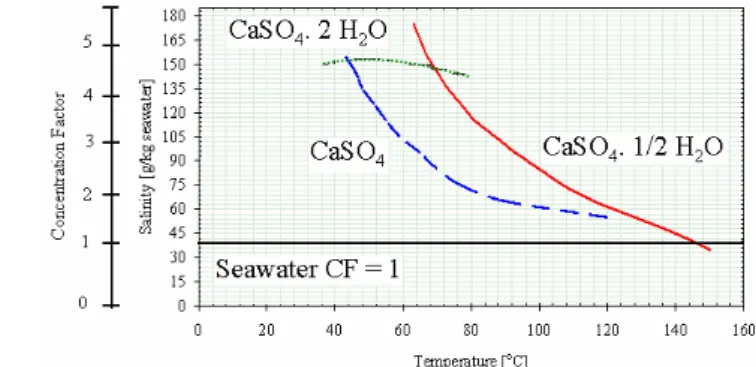
once their solubility limits are exceeded (Fig. 1). Most of the deposited calcium sulfate found in seawater desalination plants, is in the form of hemi-hydrate. The sulfate minerals are insoluble in common chemicals and their development inside a distiller should be avoided by all means. This is achieved by operating the plant at temperatures and/or brine concentrations not allowing saturation and precipitation conditions [10,11]. Calcium sulfate is two orders of magnitude more soluble than calcium carbonate. This means that the sulfate is much less likely to drop out of solution when both are present. At higher temperatures, calcium sulfate becomes more influencing, because calcium carbonate scale, if not inhibited, begins precipitate at lower temperature and can be easily cleaned, chemically by acids or mechanically, by sponge ball cleaning. The solubility of calcium sulfate is strongly affected by the presence and concentration of other ions in the system.
Fig. 1: Phase diagram of CaSO4.
Skillman [12] developed a simple sulfate solubility index for estimating the likelihood of calcium sulfate scaling. Skillman index (SI) is a ratio between the actual concentration, [i]actual, of either calcium or sulfate and its
theoretical or equilibrium concentration whichever is the limiting species:
(
2 4)
103] [ ⋅ − + = x K x i Index Skillman sp
actual (13)
45
5 2 4 2 ] 1.04[ ] 10 [
5 .
2 + − − ⋅ −
= Ca SO
x (14)
The solubility product constant (Ksp) can be determined
from the equation of solubility (s), in g/L, established by Linke and Seidell [13] as:
2 5 10 193 . 8 003173 . 0 091 .
2 T T
s= + − ⋅ − (15)
III. RESULTS AND DISCUSSIONS
In the MSF process, two different configurations can be differentiated (Fig. 2, from Al-Shayji [14]). In once-through distillers, the concentrated brine from the last stage is discharged to the sea. In recycle distillers, a portion of the concentrated brine from the last stage is mixed with the feed water. When the brine enters the first flash chamber in MSF distillers, due to the sudden reduction of the CO2 partial
pressure, CO2 is released into the vapour space.
Consequently, scales (CaCO3, Mg(OH)2 and CaSO4)
precipitate in the bottom of the flash chamber and inside the tubes.
On the basis of reaction (4), the total CO2 release in the
distiller has been found to directly proportional to fraction of HCO3- decomposition at a certain top brine temperature
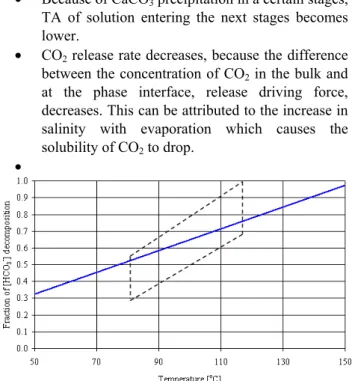
(TBT) and the flow rate of the make-up. Fig. 3 shows the fraction of bicarbonate decomposition versus top brine temperature. The dotted area represents various design estimates from the total CO2 release derived from data
provided by four manufacturers of MSF plants [15]. The solid line is a fitted line of the decomposition fraction calculated by the mentioned model. The design values show that considerable uncertainty exists about the degree of influence of the TBT on the total CO2 release. However,
there is a clear trend of the effect of TBT on total CO2
release and a clear agreement between the calculated and the design values.
Fig. 2: MSF process: (A) once-through distiller and (B) recycle distillers [14].
The values calculated in this work by correlating the CO2 release to the deposition of CaCO3 scale. The release
rates decrease exponentially from the first stage to the last stage. This may be attributed, according to Glade et al [16], to the drop in the concentration difference of CO2 in the
solution between the bulk and the phase interface because of the successive flow of the brine from the first stage to the last stage. The release of CO2 in a stage reduces the total
46 interface area decrease. Because part of the brine blow-down is recycled and remixed with the make-up, the release rates in the recycle distiller are lower than those rates in the once-through distiller. Consequently, CaCO3 deposition
rates, in the flash chambers, notably decreases from the first to the last stage [6] and this can be attributed to the following reasons:
• Because of CaCO3 precipitation in a certain stages,
TA of solution entering the next stages becomes lower.
• CO2 release rate decreases, because the difference
between the concentration of CO2 in the bulk and
at the phase interface, release driving force, decreases. This can be attributed to the increase in salinity with evaporation which causes the solubility of CO2 to drop.
•
Fig. 3: Comparison of the fraction of bicarbonate decomposition with the range of design estimates of four manufacturers of MSF plants.
The CO2 release rates increases with increasing top brine
temperature (TBT), as shown in Fig. 4, due to increasing the surface area and the mass transfer coefficient. Bubbling increases with increasing the temperature and hence surface area increases. Carbon dioxide and the other non-condensable gases act as an insulating blanket around the condenser tubes. Also, if it is left to accumulate within the stages, it would reduce the vapor partial pressure and its temperature [36]. This may explains the differences in the release rates with the top brine temperature in the high-temperature stages and the low-high-temperature stages. Consequently, the CaCO3 deposition rates increase to 76.9,
102.5 and 123.0 gram per ton distillate at 90, 100 and 110oC, respectively [6]. The CaCO
3 deposition rates
increases with increasing TBT due to the following reasons:
• Solubility of CaCO3 decreases with increasing
temperature.
• Mass transfer coefficient increases with increasing temperature
• CO2 release increases because the difference
between CO2 concentration in the bulk and at the
phase interface, the driving force for mass transfer, increases with the top brine temperature.
• The pH value increases with increasing CO2 release
rate.
Figure 4: Effect of top brine temperature on the CO2 release rates.
Fig. 5 shows the effect of bicarbonate concentration in the feed for different feed water composition in different intakes from the Arabian Gulf for once-through (OT) and brine recycle (BR) MSF distillers. The CO2 releases as well
as CaCO3 formation rates increase with increasing the
HCO3- content in the feed water. CaCO3 scale formation and
CO2 release occur simultaneously from the thermal
decomposition of bicarbonate ions according to the following equation:
O H CO CaCO
HCO
Ca2+ +2 3− ↔ 3 ↓+ 2↑+ 2 . (16)
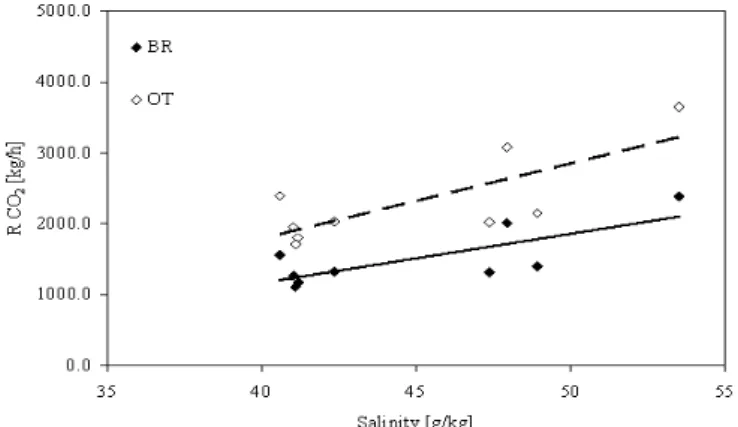
The effect of seawater salinity on the CO2 release rates, for
different feed water composition in different intakes from the Arabian Gulf for once-through (OT) and brine recycle (BR) MSF distillers, is shown in Fig. 6. The CO2 release
rates increase with increasing the salinity values. This can be attributed to the following reasons: (i) the total alkalinity (TA) increases with increasing salinity and (ii) the Henry’s law coefficient decreases with increasing salinity. The CO2
concentration in the brine at the phase interface decreases, because the concentration in the bulk increases and the concentration at the phase interface decreases, thus driving concentration difference for mass transfer increases.
47
Fig. 6: The effect of seawater salinity on the CO2 release rates for different feed water composition in different intakes from the Arabian Gulf.
The CO2 release rates decrease with increasing pH as
shown in Fig. 7. This is most likely because the CO2 content
was lower at higher pH values. At low seawater pH values more CO2 dissolved in seawater and reacted to carbonic acid
which dissociated into HCO3- and CO32- ions. Therefore, the
total carbon dioxide content was higher. Moreover, the fraction of the total carbon dioxide that is present as molecular CO2 is higher at low pH values. The CO2
concentration in the bulk flow and thus the driving concentration difference for mass transfer increases with decreasing pH value of the seawater and hence more CO2 is
released.
Fig. 7: The effect of seawater pH on the CO2 release rates for different feed
water composition in different intakes from the Arabian Gulf.
Fig. 8 shows the effect of calcium ion concentration in the feed for different feed water composition in different intakes from the Arabian Gulf for once-through (OT) and brine recycle (BR) MSF distillers. The CaSO4 scale
potential increases with increasing the calcium ion content in the feed water. The effect of sulfate ion concentration in the make-up is shown in Fig. 9. Similar trend and interpretation to the effect of Ca2+can be noticed.
The effect of seawater salinity on the CaSO4 scale
potential, for different feed water composition in different intakes from the Arabian Gulf for once-through (OT) and brine recycle (BR) MSF distillers, is shown in Fig. 10. The sulfate scale potential increases with increasing the salinity. This can be attributed to the fact that the contents of Ca2+
and SO42- in the feed increase with salinity, hence, the
saturation of sulfate increases with salinity.
Fig. 8: The effect of calcium ion concentration in the feed for different feed water composition in different intakes from the Arabian Gulf.
Fig. 9: The effect of sulfate ion concentration in the feed for different feed water composition in different intakes from the Arabian Gulf.
Fig. 10: The effect of seawater salinity for different feed water composition in different intakes from the Arabian Gulf.
IV. CONCLUSION
The CO2 release and scaling in MSF distillers was
investigated for different feed water composition in different intakes from the Arabian Gulf. The CO2 release rates
decreased exponentially from the first stage to the last stage. The CO2 release rates increased with increasing top brine
temperature (TBT), HCO3- content and salinity while it
48 REFERENCES
[1] Patel, S.; Finan, M. A.; New antifoulants for deposit control in MSF and MED plants, Desalination 124 (1999) 63–74.
[2] Al-Rawajfeh, A. E.; Glade, H.; Ulrich, J.; CO2 release in
multiple-effect distillers Controlled by mass transfer with chemical reaction.
Desalination, 156 (2003) 109-123.
[3] Al-Rawajfeh, A. E.; Glade, H.; Qiblawey, H. M.; Ulrich, J.; Simulation of CO2 release in multiple-effect distillers.
Desalination, 166 (2004) 41-52.
[4] Al-Rawajfeh, A. E.; Glade, H.; Ulrich, J.; Scaling in multiple-effect distillers: the role of CO2 release. Desalination, 182 (2005)
209-219.
[5] Al-Rawajfeh, A.E.; Modelling of Alkaline Scale Formation in Falling-Film Horizontal-Tubes Multiple-Effect Distillers.
Desalination, 205 (2007) 124-139.
[6] Al-Rawajfeh, A.E.; Simultaneous desorption-crystallization of CO2-
CaCO3 in multistage flash (MSF) distillers. Chem. Eng. Proc.,
Process Intensification, 47 (2008) 2262-2269.
[7] Al-Rawajfeh, A.E.; Al-Amaireh, M. N.; The influence of CO2
injection on the carbonate chemistry and scaling in multiple-effect distillers . Desalination and Water Treatment 7 (2009). 191-197. [8] Astarita, G.; Mass transfer with chemical reaction, Elsevier,
Amsterdam 1967.
[9] Huang, C.-J.; Kuo, C.-H.; Mathematical models for mass transfer accompanied by reversible chemical reaction. AIChE J., 11 (1965), 901-910.
[10] Shams E1 Din, A.M., E1-Dahshan, M.E., Mohammed, R.A.; Scale formation in flash chambers of high-temperature MSF distillers,
Desalination 177 (2005) 241-258
[11] Helalizadeh, A., Mueller-Steinhagen, H., Jamialahmadi, M.; Mixed salt crystallization fouling, Chem. Eng. Proc. 39 (2000) 29–43. [12] H.L. Skillman J.P. McDonald, Jr. and H.A. Stiff, Jr.; A simple,
accurate, fast method for calculating calcium sulfate solubility in oil field brine, Paper No. 906-14-I, Spring Meeting of the Southwestern District, Division of Production, American Petroleum Institute, Lubbock, Texas, 1969.
[13] W.F. Linke, A. Seidell, Solubilities of Inorganic and Metal-Organic Compounds, 4th ed., Van Nostrand-Reinhold , New York , 1965.
[14] Al-Shayji, K. A. M.; Modeling, Simulation, and Optimization of Large-Scale Commercial Desalination Plants, PhD Dissertation, Virginia Polytechnic Institute and State University (1998). [15] Ludwig, H; Hetschel, M.; Treatment of distillates and permeates
from sea water desalination plants to make potable water. In Saline Water Processing (ed. H. G. Heitmann), Weinheim: VCH Verlagsgesellschaft (1990).
[16] Glade, H.; Meyer, J.; Will, S.; The release of CO2 in MSF and ME
distillers and its use for the recarbonation of the distillate: a comparison. Desalination, 182 (2005) 95-106.
![Fig. 2: MSF process: (A) once-through distiller and (B) recycle distillers [14].](https://thumb-us.123doks.com/thumbv2/123dok_us/8074312.2139081/3.892.82.821.466.1041/fig-msf-process-distiller-b-recycle-distillers.webp)