Available Online atwww.ijcsmc.com
International Journal of Computer Science and Mobile Computing
A Monthly Journal of Computer Science and Information Technology
ISSN 2320–088X
IMPACT FACTOR: 5.258
IJCSMC, Vol. 5, Issue. 7, July 2016, pg.106 – 112
ALLOCATING RESOURCES IN
COLLABORATIVE CLOUD AND
GRID COMPUTING USING LIS
Mr. Siddanna M Yaranal
1,
Ms. Uma
2¹P.G Scholar Student Department of Computer Science and Engineering New Horizon College of Engineering
Bangalore, India
²Assistant Professor, Department of Computer Science and Engineering New Horizon College of Engineering
Bangalore, India
1
[email protected] ; [email protected]
Abstract-- A large resource of sharing system like collaborative cloud computing and grid computing generates way for sharing tremendous amount of resources distributed through Internet. Searching and locating desired resources is a critical component of resource sharing system. In addition with the resource discovery, efficiency and fidelity is also an important quality. Earlier systems either achieve high fidelity at low efficiency, or high efficiency at low fidelity .Proposed system introduces a resource information service that provides high efficiency and fidelity. Proposed service outperforms other services in terms of efficiency, fidelity, and flexibility without decreasing resource expressiveness. It reduces overhead and gives significant enrichment in efficiency and fidelity.
Keywords: Resources, Fidelity, Flexibility, Efficiency, Collaborative, Grid.
I. INTRODUCTION
computing (allows connection for multiple clouds and come forward to share resources) and grid computing (collection of computer resources from multiple locations to reach the common goal).
There are three challenges to get an effective resource information service
First challenge is to bring about high efficiency- achieved by large scale scattering of resources and dynamics.
Second challenge is to guarantee the high fidelity of resource location- achieved by locating the resources where it is kept and in which cloud.
Third challenge is to conclude flexibility- achieved by getting similar type of resource in spite of searching same resource.
II. LITERATURE SURVEY
1. Entropia: Architecture and Performance of an Enterprise Desktop Grid System
Authors Andrew A. Chien, Brad Calder, Stephen Elbert, and Karan Bhatia Explained, It has
ability to provide grid computing, distributed computing. It has some feature high-throughput computing,
and scientific computing. The problem with the paper is system architecture provides a solid foundation to
meet the technical challenges as the use of distributed computing matures-supporting the broadening the
problems supportable by increasing the breadth of computational structure, resource usage, and ease of
application integration.
2. MAAN: A Multi-Attribute Addressable Network for Grid Information Services
Authors Min Cai, Martin Frank, Jinbo Chen, Pedro Szekely Explained, It has ability to provide
Grid Computing, Peer-to-Peer, Information Services. It has feature of Multi-attribute Range Queries. The
problem with the paper is Centralized approaches have the inherent drawback of a single point of failure.
3. Cycloid: A constant-degree and lookup-efficient P2P overlay network
Authors Haiying Shena, Cheng-Zhong Xua, Guihai Chenb Explained, It has ability to provide
cycloid, Peer-to-peer, Viceroy, Koorde. It has some feature Distributed hash table, Constant-degree DHT.
The problem with the paper is choices are frequently more expensive than those of the cost-aware
approach.
4. Efficient Event-based Resource Discovery
Authors Wei Yan, Songlin Hu, Vinod Muthusamy, Hans-Arno Jacobsen, and Li Zha Explained, It
has ability to provide Service discovery, resource discovery, content-based publish/subscribe. It has some
feature publish/subscribe applications, covering, and subscription similarity. Problem with the paper is
limitation of the Mercury algorithm is that a multi-attribute query is decomposed into a set of single
attribute queries that must be processed sequentially or in parallel.
5. Goal-Based Request Cloud Resource Broker in Medical Application
Authors Mohamad Izuddin Nordin, Azween Abdullah, and Maham at Issa Hassan explained, it
Discovery, and Resource Selection. Problem with the paper is drawback from this action is the data owner
can restrict the usage of services provided to the certain number of data which has permission to see.
6. Javelin, scalability issues in global computing
Authors Michael O. Neary, Sean P. Brydon, Paul Kmiec, Sami Rollins and Peter Cappello Explained, It has ability to provide distributed computing. It has some feature high performance computing, Java; internet, scalable. Problem with the paper is choices are frequently more expensive than those of the cost-aware approach.
III. EXISTING SYSTEM
Present resource discovery approaches in clouds and traditional approaches for grids are in a centralized
manner. These centralized approaches are insufficiently scalable due to cannot share same space at a same time
(bottlenecks) and if a part of system fails entire system get stopped (single point of failure). Resource providers
report their available resource information to a resource information server (one or several brokers), and then
resource requesters contact the server for their desired resources [5]. The information server can be overloaded in a
large-scale system leading to service inefficiency in turn the entire resource discovery mechanism will fail.
Problems
Current DHT based resource information service systems either provide high fidelity at low efficiency or
achieve high efficiency at low fidelity.
Current systems have limited flexibility by only allowing exact-matching services or describing a resource
using a present attribute list.
Current approaches have high fidelity, they experience a high overhead for resource pooling, searching,
and merging.
One-point mapping systems allows high efficiency at the cost of low 0fidelity.
IV. PROPOSED SYSTEM
Distributed Hash Tables (DHTs) provide a favour solution for resource information services with their
permanent properties of high scalability, self-organization and fault-tolerance in large scale distributed systems [4].
Presenting LSH-based resource information Service (LIS) that combines efficiency, fidelity, and flexibility.LIS
offers high efficiency and fidelity without stopping resource expressiveness, while providing a similar-matching
service. It states to achieve high efficiency, fidelity and flexibility. Three algorithms are introduced to transform a
resource description for set of integers. Further building LSH functions by combining the algorithms with min-wise
independent permutations. LIS also includes a load balancing algorithm to balance the load for storing resource
Advantages
Proposed Scheme provides flexibility but also helps to reduce on high, since a requester only receives the
information of similar type of resources.
Get high efficiency (increase in the speed), fidelity (Finding exact location of resources) and flexibility
(sharing of resources).
It is successful in locating the resources in an environment with an large number of resource attributes.
System design
The system design process builds up general framework for generating design.
i) Design Consideration
The reason for the design is to arrange the problem determined by the necessities report. This stage is the start
phase in moving from issue to the arrangement space.
ii) System Architecture
The architectural configuration procedure is concerned with generating up a fundamental basic system for a
framework. It includes recognizing the existing parts of the framework and exchanges between these segments.
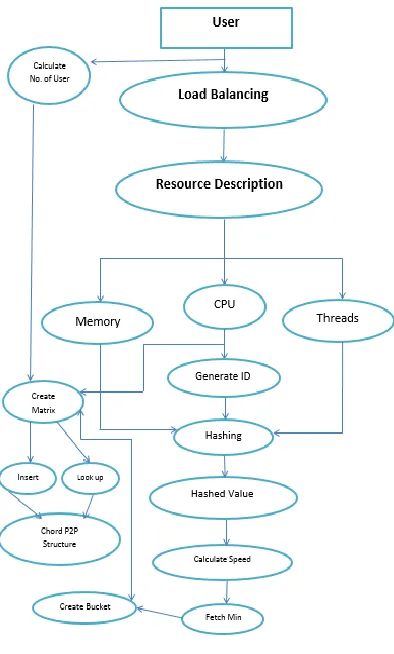
Data Flow Diagram
The DFD is straightforward graphical representation that can be used to speak to a framework as far as the
information to the framework, different preparing did on this information and the yield information generated by the
framework. A DFD model uses an exceptionally predetermined number of primitive images to speak to the
Fig 1. DFD of LIS
V. IMPLEMENTATION
Module 1: Resource Attribute Transformation
A resource description consists of a set of attributes (including values). To transform each attribute of a
resource into an integer, we propose three attribute transformation algorithms with similarity preserving features for
each attribute.
Algorithm 1: Building of min-wise independent permutation had been done. Later attributes are transformed in to
integers. A set of hash value is generated for resources, lastly using XOR operation ID is generated for resource.
Algorithm 2: Storing the resource predicates had been done by using generated ID’s of resource. Operating system while storage cloud provides database and large capacity hard disk to store [1].
Algorithm 3: Querying the resource had been done by using pseudo-code.
Module 2: Locality-Sensitive Resource Translation
Module 3: DHT-Based Resource Information Service
LIS is built on top of a DHT overlay formed by all nodes in the system to achieve multi-attribute resource
searching. In the above sections, we introduced how to translate resources to IDs. Using these resource IDs, resource
providers store the information of their available resources to the DHT, and resource requests will be forwarded to
the DHT nodes storing the information of the required resources. Thus, the DHT functions as a matchmaker between
resource providers and requesters. A DHT overlay is a decentralized system in the application level that partitions
ownership. We use Chord as a representative of DHT overlays to explain the LIS resource information service [3].
Load Balancing
To avoid overloading at any node, aim to achieve every node via load balancing algorithm [6].
VI. EXPERIMENTAL RESULTS
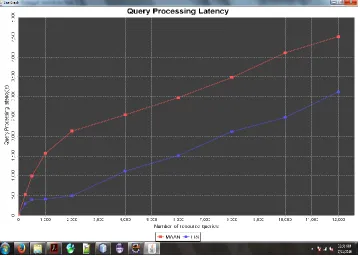
Graph depicts the query processing latency of different services. It shows that MAAN leads to dramatically
higher query processing latency than LIS. For a query consisting of attributes, MAAN generates l queries and
searches all resources owning each attribute. Therefore, MAAN needs a very long time satisfying resources in the
emerging phase. In LIS, the resource vector size is equal to the number of attributes in the resource description, so it
produces the lowest query processing latency among all methods. This result shows the benefits of avoiding building
a multi-dimensional space to produce resource IDs, and demonstrates that LIS outperforms all others in terms of
query processing latency.
VII. CONCLUSION AND FUTURE WORK
As earlier proposed resource information services for large scale resource sharing systems have limited flexibility. Presenting an efficient and high-fidelity LSH based resource Information service (LIS) effective in locating satisfying resources and Provides high flexibility. LIS built on DHT overlay which allows efficient resource data pooling and searching in large-scale resource sharing systems.. SHA-LIS only offers attribute exact-matching in resource discovery, similarity search that can find attributes with similar characters (e.g., MEM and memory). Future work is creating a cluster of users having similar type of resource.
REFERENCES
[1] M. Nordin, A. Abdullah, and M. Hassan,“Goal-based request cloud resource broker in medical application,”WASET, vol. 50, no. 74,pp. 770–774, 2011.
[2] W. Yan, S. Hu, V. Muthusamy, H. Jacobsen, and L. Zha,“Efficient event-based resource discovery,”in Proc. Int. Conf. Distrib. Event-Based Syst. (DEBS), 2009, pp. 1–10.
[3] H. Shen, C. Xu, and G. Chen,“Cycloid: A scalable constant-degree P2P overlay network,”Perform.Eval., vol. 63, no. 3, pp. 195–216, 2006.
[4] M. Cai, M. Frank, and P. Szekely,“MAAN: A multi-attribute addressable network for grid information services,”Grid Comput.,vol. 2, no. 1, pp. 3–14, 2004.
[5] A. Chien, B. Calder, S. Elbert, and K. Bhatia,“Entropia: Architecture and performance of an enterprise desktop grid system,”J. Parallel Distrib. Comput., vol. 63, no. 5, pp.597–610, May 2003.
[6] M. O. Neary, S. P. Brydon, P. Kmiec, S. Rollins, and P. Capello,“Javelin++: Scalability issues in global computing,”Future Gener. Comput. Syst. J., vol. 15, no. 5–6, pp. 659–674, 1999.
[7] S. Surana, B. Godfrey, K. Lakshminarayanan, R. Karp, and I. Stoica,“Load balancing in dynamic structured P2P systems,”Perform. Eval.,vol. 63, no. 3, pp. 217–240, 2006.
[8] R. Ranjan, B. Benatallah, and M. Wang,“A cloud resource orchestration framework for simplifying the management of web applications,”in Proc.Int.Conf.Service-Oriented Comput. (ICSOC), 2012, pp. 248–249.
[9] J.Li,B.Li,Z.Du,andL.Meng,“Cloudvo: Building a secure virtual organization for multiple clouds collaboration, ”In Proc. Int.Conf.Softw.Eng.Artif.Intell.Netw.Parallel/Distrib.Comput.(SNPD),2010, pp. 181–186.
[10] C.Liu,B.T.Loo,andY. Mao,“Declarative automatedcloud resource or chestration,”In Proc. Symp. Cloud Comput. (SOCC), 2011, p. 26.
[11] C. Liu, Y. Mao, J. E. Van der Merwe, and M. F. Fernandez,“Cloud resource orchestration: A datacentric approach,”In Proc. Conf. Innovat. Data Syst. Res. (CIDR), 2011, pp. 241–248.
[12] H. Bandara and A. Jayasumana,“On characteristics, and modeling of P2P resources with correlated static, and dynamic attributes,”In Proc. Global Commun. Conf. (GLOBECOM), 2011, pp. 1–6.
[13] K. Psounis, P. M. Fernandez, B. Prabhakar, and F. Papadopoulos,“Systems with multiple servers under heavy-tailed workloads,”Perform. Eval., vol. 62 (1–4), pp. 456–474, 2005.
[14] W. Willinger, M. S. Taqqu, R. Sherman, and D. V. Wilson,“Self-similarity through high-variability: Statistical analysis of Ethernet LAN traffic at the source level,”IEEE/ACM Trans. Netw., vol. 5,no. 1, pp. 71–86, Feb. 1997. [15] X. Zhang, Y. Qu, and L. Xiao,“Improving distributed workload performance by sharing both CPU, and memory resources,”In Proc.Int. Conf. Distrib. Comput. Syst. (ICDCS), 2000, pp. 233–241.