Solving Linear Equations Modulo Unknown
Divisors: Revisited
Yao Lu1,2, Rui Zhang1?, Liqiang Peng1, and Dongdai Lin1 1
State Key Laboratory of Information Security (SKLOIS), Institute of Information Engineering, Chinese Academy of Sciences,
Beijing 100093, China
2 The University of Tokyo, Japan
[email protected], {r-zhang,pengliqiang,ddlin}@iie.ac.cn
Abstract. We revisit the problem of finding small solutions to a col-lection of linear equations modulo an unknown divisorp for a known composite integerN. In CaLC 2001, Howgrave-Graham introduced an efficient algorithm for solving univariate linear equations; since then, two forms of multivariate generalizations have been considered in the context of cryptanalysis: modular multivariate linear equations by Herrmann and May (Asiacrypt’08) and simultaneous modular univariate linear equa-tions by Cohn and Heninger (ANTS’12). Their algorithms have many important applications in cryptanalysis, such as factoring with known bits problem, fault attacks on RSA signatures, analysis of approximate GCD problem, etc.
In this paper, by introducing multiple parameters, we propose several generalizations of the above equations. The motivation behind these extensions is that some attacks on RSA variants can be reduced to solving these generalized equations, and previous algorithms do not apply. We present new approaches to solve them, and compared with previous methods, our new algorithms are more flexible and especially suitable for some cases. Applying our algorithms, we obtain the best analytical/experimental results for some attacks on RSA and its variants, specifically,
– We improve May’s results (PKC’04) on small secret exponent attack on RSA variant with moduliN=prq(r≥2).
– We experimentally improve Boneh et al.’s algorithm (Crypto’98) on factoringN=prq(r≥2) with known bits problem.
– We significantly improve Jochemsz-May’ attack (Asiacrypt’06) on Common Prime RSA.
– We extend Nitaj’s result (Africacrypt’12) on weak encryption expo-nents of RSA and CRT-RSA.
Keywords:Lattice-based analysis, Linear modular equations, RSA
?
1
Introduction
Lattice-based cryptanalysis is a very useful tool in various cryptographic systems, e.g., historically, it was used to break the Merkle-Hellman knapsack cryptosys-tem [34]. The basic idea of the lattice-based approach is that if the system parameters of the target problem can be transformed into a basis of a certain lattice, one can find some short vectors in the desired lattice using dedicated algorithms, like the LLL-algorithm [20]. One may then hope that the secret key can be recovered once the solutions from these short vectors are extracted. Although in most cases this assumption is not rigorous in theory, it usually works well in practice.
In the above approach, a key step is to construct the desired lattice. In 1997, Coppersmith [5] presented a subtle lattice construction method, and used it to find small roots of modular equations of special forms. Since then, this approach has been widely applied in the analysis of RSA. Among them, one of the most important applications is to solve approximate integer common divisor problem (ACDP), namely, given two integers that are near-multiples of a hidden integer, output that hidden integer. We note that ACDP was first introduced by Howgrave-Graham [15], which in turn has many important applications such as building fully homomorphic cryptosystems [37].
Let us briefly explain Howgrave-Graham’s method. First, one reduces ACDP to solving a univariate modular polynomial:
f(x) =x+amodp
whereais a given integer, andp(p≥Nβ for some 0< β≤1) is unknown that divides the known modulusN. Then he proposed a polynomial-time algorithm to find small roots of the univariate polynomial over integer. Note that this type of polynomial can also be applied in other RSA-related problems, such as factoring with known bits problem [21].
In 2003, May [21] generalized Howgrave-Graham’s strategy by using a uni-variate linear polynomial to an arbitrary monic modular polynomial of degree δ, i.e. f(x) = xδ+a
δ−1xδ−1+. . .+a0modpwhere δ ≥ 1. As an important application, this algorithm can be used to solve the problem of factoring with known bits on Takagi’s moduliN =prq (r >1) [2].
In Asiacrypt’08, Herrmann and May [12] extended the univariate linear modular polynomial to polynomials with an arbitrary number of n variables. They presented a polynomial-time algorithm to find small roots of linear modular-polynomials
f(x1, . . . , xn) =a0+a1x1+· · ·+anxnmodp
On the other hand, in 2012, Cohn and Heninger [4] generalized Howgrave-Graham’s equations to the simultaneous modular univariate linear equations
f1(x1) =a1+x1= 0 modp f2(x2) =a2+x2= 0 modp
.. .
fn(xn) =an+xn= 0 modp
(1)
wherea1, . . . , an are given integers, and p(p≥Nβ for some 0< β <1) is an unknown factor of known modulusN. These equations have many applications in public-key cryptanalysis. For example, in 2010, van Dijk et al. [37] introduced fully homomorphic encryption over the integers, which the security of their scheme is based on the hardness of solving Equation (1). In 2011, Sarkar and Maitra [32] investigated implicit factorization problem [24] by solving Equations (1). In 2012, Fouque et al. [10] proposed fault attacks on CRT-RSA signatures,
which can also be reduced to solving Equations (1).
1.1 Our Contributions
In this paper, we focus on the following three types of extensions of previous equations.
The first is an extension of Herrmann-May’s equation, described in Section3, we focus on the equations
f(x1, x2, . . . , xn) =a0+a1x1+· · ·+anxnmodpv (2) for some unknown divisor pv (v ≥1) and known composite integer N (N ≡ 0 modpu,u≥1). Hereu, v are positive integers. Note that ifu= 1, v= 1, that is exactly Herrmann-May’s equation [12].
The second is a special case of Equations (2):a0= 0, described in Section4. The last is a generalized version of Equations (1), described in Section5; we focus on the equations
f1(x1) =a1+x1= 0 modpr1 f2(x2) =a2+x2= 0 modpr2
.. .
fn(xn) =an+xn= 0 modprn
(3)
wherep(p≥Nβfor some 0< β <1) is unknown that satisfiesN = 0 modprand a1, . . . , an,r, r1, . . . , rn are given integers. Herer, r1, . . . , rn are positive integers. Note that ifr=r1=· · ·=rn= 1, that is exactly Equations (1).
situation. The difficulty lies in how to wisely embed this algebraic information in the lattice construction.
We solve the above equations by introducing new techniques. More precisely, we present a novel way to select appropriate polynomials in constructing desired lattice. Compared with previous algorithms, our algorithms are more flexible and especially suitable for some cases. Applying our algorithms, we obtain the best analytical/experimental results for some attacks on RSA and its variants. We elaborate them below. We further conjecture that our new algorithms may find new applications in various other contexts.
Small Secret Exponent Attack on Multi-Power RSA. In multi-power RSA algorithm, suppose that the public key is (N, e), where N = prq for some fixed r ≥ 2 and p, q are of the same bit-size. The secret key d satisfies ed≡1 modφ(N), where φ(N) is Euler’sφ-function. In Crypto’99, Takagi [35] showed that when the secret exponentd < N2(r1+1), one can factorize N. Later
in PKC’04, May [22] improved Takagi’s bound to Nmax{(r+1)2r , (r−1)2
(r+1)2}. In this paper, we further improve May’s bound toN
r(r−1)
(r+1)2, which is better than May’s result when r >2, and is also independent of the value of public exponent e. Similar as [22], our result also directly implies an improved partial key exposure attack for secret exponentdwith known most significant bits (MSBs) or least significant bits (LSBs). Our improvements are based on our algorithm of solving the first type equations, with the observation that gcd(ed−1, N) =pr−1 but N ≡0 modpr.
Factoring Multi-Power Moduli with Known Bits. In 1999, Boneh et al. [2] extended factoring with high bits problem to moduli of the formN =prq(r≥2). They showed that this moduli can be factored in polynomial-time in the
bit-length of N ifr =Ω(qlog loglogNN). Applying our algorithm of solving the first type equations, we can directly get another method to settle the problem of [2]. Though we can not get an asymptotic improvement, in practice, expecially for larger, our new method performs better than [2].
Weak Encryption Exponents of RSA and CRT-RSA. In Africacrypt’12, Nitaj [26] presented some attacks on RSA and CRT-RSA (the public exponent e and the private CRT-exponents dp and dq satisfyedp ≡1 mod (p−1) and edq ≡1 mod (q−1)). His attacks are based on Herrmann-May’s technique [12] for finding small solutions of modular equations. In particular, he reduced his attacks to solving bivariate linear modular equations modulo unknown divisors: ex+y ≡ 0 modp for some unknown p that divides the known modulus N. Noticing that his equations are homogeneous, we can improve his results with our algorithm of solving second type equations.
variant was originally introduced by Wiener [38] as a countermeasure for his continued fraction attack. He suggested to choosepandqsuch thatp−1 and q−1 share a large common factor. In 2006, Hinek [13] revisited the security of Common Prime RSA, in the same year, Jochemsz and May [17] proposed a heuristic attack, and showed that parts of key space suggested by Hinek is insecure. In this paper, we further improve Jochemsz-May’s bound by using our algorithm of solving third type equations.
Experimental Results. For all these attacks, we carry out experiments to verify the validity of our algorithms. These experimental results show that our attacks are effective.
2
Preliminary
In 1982, Lenstra, Lenstra and Lov´asz proposed the LLL-algorithm [20] that can find vectors in polynomial-time whose norm is small enough to satisfy the following condition.
Lemma 1 (LLL [20]).LetL be a lattice of dimension w. Within polynomial-time, LLL-algorithm outputs a set of reduced basis vectors vi, 16i6w that
satisfies
||v1||6||v2||6· · ·6||vi||62
w(w−1)
4(w+1−i)det(L)w+1−1 i
In practice, it is widely known that the LLL-algorithm tends to output the vectors whose norms are much smaller than theoretically predicted.
In 1997, Coppersmith [5] described a lattice-based technique to find small roots of modular and integer equations. Later, Howgrave-Graham [14] reformulated Coppersmith’s ideas of finding modular roots. The main idea of Coppersmith’s method is to reduce the problem of finding small roots of f(x1, . . . , xn) modN to finding roots over the integers. Therefore, one can construct a collection of polynomials that share a common root modulo Nm for some well-chosen integer m. Then one can construct a lattice by defining a lattice basis via these polynomial’s coefficient vectors. Using lattice basis reduction algorithms (like LLL-algorithm [20]), one can find a number of linear equations with sufficiently small norm. Howgrave-Graham [14] showed a sufficient condition to quantify the term sufficiently small. Next we review this useful lemma.
Letg(x1,· · · , xk) =Pi1,···,ikai1,···,ikx
i1 1 · · ·x
ik
k. We define the norm of gby the Euclidean norm of its coefficient vector:||g||2=P
i1,···,ika
2 i1,···,ik.
Lemma 2 (Howgrave-Graham [14]). Let g(x1,· · · , xk) ∈ Z[x1,· · ·, xk] be
an integer polynomial that consists of at most wmonomials. Suppose that
1. g(y1,· · ·, yk) = 0 modpm for|y1|6X1,· · ·,|yk |6Xk and
2. ||g(x1X1,· · · , xkXk)||< p
m
√ w
Combining Lemma1 and Lemma2, we can get following theorem.
Theorem 1 (Coppersmith [5], May [23]). LetN be an integer of unknown factorization, which has a divisorp≥Nβ,0< β≤1. Let f(x)be a univariate monic polynomial of degree δ. Then we can find in time O(−7δ5log9
N) all solutions x0 for the equation
f(x) = 0 modp with |x0| ≤N
β2
δ−.
Additionally sometimes our attacks rely on a well-known assumption which was widely used in the literatures [1,9,12].
Assumption 1 The lattice-based construction yields algebraically independent polynomials. The common roots of these polynomials can be efficiently computed using theGr¨obner basis technique.
Note that the time complexity of Gr¨obner basis computation is in general doubly exponential in the degree of the polynomials.
We would like to point out that our subsequent complexity considerations solely refer to our lattice basis reduction algorithm, that turns the polynomial f(x1, . . . , xn) modN into the number of npolynomials over the integers. We assume that the running time of the Gr¨obner basis computation is negligible compared to the time complexity of the LLL-algorithm, since in general, our algorithm yields more than the number ofnpolynomials, so one can make use of these additional polynomials to speed up the Gr¨obner basis computation.
3
The First Type of Equations
In this section, we address how to solvef1(x) =a0+a1xmodpv (v≥1) for some unknownpwhere pu divides a known modulusN (i.e.N ≡0 modpu,u≥1). In particular, Howgrave-Graham’s result [15] can be viewed as a special case of our algorithm whenu= 1,v= 1.
3.1 Our Main Result
Theorem 2. For every >0, letN be a sufficiently large composite integer (of unknown factorization) with a divisor pu (p≥Nβ,u≥1). Letf1(x)∈Z[x] be
a univariate linear polynomial whose leading coefficient is coprime toN. Then one can find all the solutions y of the equation f1(x) = 0 modpv with v ≥ 1, |y| ≤Nγ ifγ < uvβ2−. The time complexity isO(−7v2log2
N).
Proof. Consider the following univariate linear polynomial:
f1(x) =a0+a1xmodpv
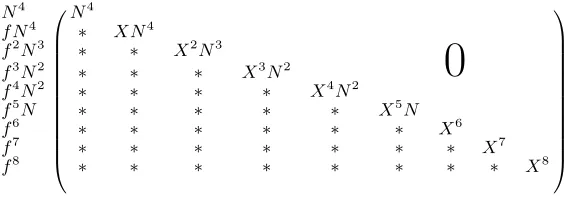
N4 N4 f N4 ∗ XN4
f2N3 ∗ ∗ X2N3
0
f3N2 ∗ ∗ ∗ X3N2f4N2 ∗ ∗ ∗ ∗ X4N2
f5N ∗ ∗ ∗ ∗ ∗ X5N
f6 ∗ ∗ ∗ ∗ ∗ ∗ X6
f7 ∗ ∗ ∗ ∗ ∗ ∗ ∗ X7
f8 ∗ ∗ ∗ ∗ ∗ ∗ ∗ ∗ X8
Fig. 1.The matrix for the caseβ= 0.25,u= 3,v= 2,t= 6,m= 8
We define a collection of polynomials as follows:
gk(x) :=fk(x)Nmax{d
v(t−k)
u e,0}
fork= 0, . . . , mand integer parameterstandmwitht=τ m(0≤τ <1), which will be optimized later. Note that for allk,gk(y)≡0 modpvt.
LetX :=Nuvβ2−(=Nγ) be the upper bound on the desired rooty. We will show that this bound can be achieved for any chosen value ofby ensuring that m≥m∗:=dβ(2u+v−uvβ) e −1
We build a latticeL of dimensiond=m+ 1 using the coefficient vectors of gk(xX) as basis vectors. We sort these polynomials according to the ascending order of g, i.e.,gk < gl if k < l. Fig. 1shows an example for the parameters β = 0.25, u= 3, v= 2, t= 6, m= 8.
From the triangular matrix of the lattice basis, we can compute the de-terminant as the product of the entries on the diagonal as det(L) =XsNsN
where
s= m
X
k=0
k= m(m+ 1) 2
sN = t−1
X
k=0
dv(t−k)
u e=
t−1
X
k=0
v(t−k) u +ck
= vτ m(τ m+ 1)
2u +
t−1
X
k=0 ck
Here we rewritedv(t−k)u easv(t−k)u +ck
whereck ∈[0,1). To obtain a polyno-mial with short coefficients that contains all small roots over integer, we apply LLL-basis reduction algorithm to the latticeL. Lemma1gives us an upper bound on the norm of the shortest vector in the LLL-reduced basis; if the bound is smaller than the bound given in Lemma2, we can obtain the desired polynomial. We require the following condition:
2d−14 det(L)1d < N
vβτ m √
whered=m+ 1. We plug in the values for det(L) andd, and obtain
2m(m4+1)(m+ 1)
m+1
2 X
m(m+1)
2 < Nvβτ m(m+1)−
vτ m(τ m+1)
2u −
Pt−1
k=0ck
To obtain the asymptotic bound, we letmgrow to infinity. Note that for suffi-ciently large N the powers of 2 andm+ 1 are negligible. Thus, we only consider the exponent ofN. Then we have
X < N2vβτ−
vτ(τ m+1)
u(m+1) −
2Pt−1
k=0ck
m(m+1)
Settingτ=uβ, and noting thatPt−1
k=0ck ≤t 3, the exponent of N can be lower bounded by
uvβ2−vβ(1−uβ) m+ 1 −
2uβ m+ 1 We appropriate the negative term m+1∗ by m∗ and obtain
uvβ2−β(2u+v−uvβ) m
Enduring thatm≥m∗will then gurantee thatX satifies the required bound for the chosen value of.
The running time of our method is dominated byLLL-algorithm, which is polynomial in the dimension of the lattice and in the maximal bit-size of the entries. We have a bound for the latticed
d=m+ 1≥ dβ(2u+v−uvβ)
e
Sinceuβ <1, then we obtaind=O(−1). The maximal bit-size of the entries is bounded by
max{vt
u log(N), duvβ
2log(N)}= max{vβdlog(N), duvβ2log(N)} Sinceuβ <1 andd=O(−1), the bit-size of the entries can be upperbounded by
max{O(vβ−1) log(N),O(vβ−1) log(N)}=O(v−1log(N))
Nguyen and Stehl´e [25] proposed a modified version of theLLL-algorithm called L2-algorithm. TheL2-algorithm achieves the same approximation quality for a shortest vectors as theLLL-algorithm, but has an improved worst case running time anlaysis. Its running time is O(d5(d+ logb
d) logbd), where logbd is the maximal bit-size of an entry in lattice. Thus, we can obtain the running time of our algorithm
O
1
51
+ vlogN
vlogN
!
Therefore, the running time of our algorithm isO(−7v2log2N). Eventually, the vector output byLLL-algorithm gives a univariate polynomialg(x) such that g(y) = 0, and one can find the root ofg(x) over the integers. ut
3
This estimation is rough, we can do it more precisely for specific parametersu, v. For example, forv= 1, we can getPt−1
Extension to Arbitrary Degree. We can generalize the result of Theorem2
to univariate polynomials with arbitrary degree.
Theorem 3. For every >0, letN be a sufficiently large composite integer (of unknown factorization) with a divisorpu (p≥Nβ,u≥1). Letf1(x)∈Z[x]be a
univariate polynomial of degree δwhose leading coefficient is coprime toN. Then one can find all the solutionsy of the equationf1(x) = 0 (mod pv)withv≥1, |y| ≤Nγ ifγ < uvβδ2 −. The time complexity isO(−7δ5v2log2
N).
In the proof of Theorem3, we use the following collection of polynomials:
gk(x) :=xjfk(x)Nmax{d
v(t−k)
u e,0}
fork= 0, . . . , m,j= 0, . . . , δ−1 and integer parameterst andmwitht=τ m (0≤τ <1). The rest of the proof is the same as Theorem2. We omit it here.
Specifically, the result in [23] can be viewed as a special case of our algorithm whenu=v.
Extension to More Variables. We also generalize the result of Theorem 2
from univariate linear equations to an arbitrary number ofnvariablesx1, . . . , xn (n≥2).
Proposition 1. For every >0, letN be a sufficiently large composite integer (of unknown factorization) with a divisor pu (p≥Nβ,u≥1). Furthermore, let f1(x1, . . . , xn)∈Z[x1, . . . , xn]be a monic linear polynomial inn(n≥2)variables.
Under Assumption1, we can find all the solutions (y1, . . . , yn) of the equation f1(x1, . . . , xn) = 0 (mod pv)withv≥1,|y1| ≤Nγ1, . . .|yn| ≤Nγn if
n
X
i=1 γi<
v u
1−(1−uβ)nn+1−(n+ 1)(1−uβ)
1−pn 1−uβ−
The running time of the algorithm is polynomial in−n and−nlogN.
Proof. We define the following collection of polynomials which share a common root modulopvt:
gi2,...,in,k=x
i2 2 · · ·x
in
nf1kNmax{d
v(t−k)
u e,0}
fork= 0, ..., mwhereij∈ {0, . . . , m}such thatP n
j=2ij ≤m−k, and the integer parametert=τ mhas to be optimized. The idea behind the above transformation is that we try to eliminate powers of N in the diagonal entries in order to keep the lattice determinant as small as possible.
Next we can construct the latticeL using the similar method of Herrmann-May [12], therefore, the lattice has triangular form, then the determinant det(L) is then simply the product of the entries on the diagonal:
det(L) = n
Y
i=1 Xsxi
Let d denote the dimension of L, t = r·h+c (h, c ∈ Z and 0 ≤ c < r). A straightforward but tedious computation yields that
sxi =
m+n m−1
= 1
(n+ 1)!m
n+1+o(mn+1)
sN = t−1
X
k=0
X
0≤Pn
j=2ij≤m−k
dv(t−k)
u e
= v u
(n+ 1)τ−1 + (1−τ)n+1
(n+ 1)! m
n+1+o(mn+1)
d=
m+n m
= 1 n!m
n+o(mn)
To obtain the number ofnpolynomial with short coefficients that contains all small roots over integer, we apply LLL-basis reduction algorithm to the lattice L. Combining Lemma 1with Lemma 2, we require the following condition:
2
d(d−1)
4(d+1−n)det(L)d−n1+1 < N vβτ m √
d
Let Xi =Nγi(1≤i≤n). Combining the values with the above condition, we obtain
n
X
i=1 γi<
v u
1−(1−τ)n+1−τ v(n+ 1)(1
u−β)−
By settingτ= 1−√n1−uβ, the condition reduces to
n
X
i=1 γi<
v u
1−(1−uβ)nn+1−(n+ 1)(1−uβ)
1−pn
1−uβ−
The running time is dominated by the time to runLLL-lattice reduction on a basis matrix of dimensiondand bit-size of the entries. Sinced=O(mn
n!) and the parametermdepends on−1only, therefore, our approach is polynomial in logN and−n. Besides, our attack relies on Assumption1.
u t
3.2 Analysis of Multi-Power RSA
We apply our algorithm to analyze an RSA variant, namely multi-power RSA, with moduliN=prq(r≥2). Compared to the standard RSA, the multi-power RSA is more efficient in both key generation and decryption. Besides, moduli of this type have been applied in many cryptographic designs, e.g., the Okamoto-Uchiyama cryptosystem [27], or better known via EPOC and ESIGN [8], which uses the modulusN =p2q.
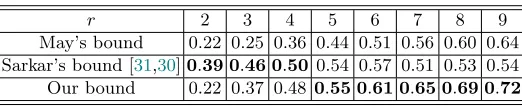
Table 1.Comparisons of May’s bound, Sarkar’s bound and ours onδ
r 2 3 4 5 6 7 8 9
May’s bound 0.22 0.25 0.36 0.44 0.51 0.56 0.60 0.64 Sarkar’s bound [31,30]0.39 0.46 0.50 0.54 0.57 0.51 0.53 0.54 Our bound 0.22 0.37 0.48 0.55 0.61 0.65 0.69 0.72
Small Secret Exponent Attack on Multi-Power RSA. There are two variants of multi-power RSA. In the first varianted≡1 modpr−1(p−1)(q−1), while in the second varianted≡1 mod (p−1)(q−1). In [16], the authors proved
that the second variant is vulnerable whend < N2− √
2
r+1 .
In this section, we focus on the first variant. In Crypto’99, Takagi [35] proved that when the decryption exponent d < N2(r1+1), one can factorize N in polynomial-time. Later, in PKC’04, May [22] improved Takagi’s bound to
Nmax{
r
(r+1)2, (r−1)2
(r+1)2}. Based on the technique of Theorem2, we can further improve May’s bound toN
r(r−1)
(r+1)2.
Theorem 4. LetN =prq, wherer≥2is a known integer and p, qare primes
of the same bit-size. Lete be the public key exponent and dbe the private key exponent, satisfyinged≡1 modφ(N). For every >0, suppose that
d < N
r(r−1)
(r+1)2−
thenN can be factored in polynomial-time.
Proof. Sinceφ(N) =pr−1(p−1)(q−1), we have the equationed−1 =kpr−1(p− 1)(q−1) for somek∈N. Then we want to find the rooty=dof the polynomial
f1(x) =ex−1 modpr−1
with the known multiple (of unknown divisorp)N (N ≡0 modpr). Letd≈Nδ. Applying Theorem2, settingβ= 1
r+1,u=r,v=r−1, we obtain the final result
δ < r(r−1)(r+1)2 − ut
Recently, Sarkar [31,30] improved May’s bound for modulusN =prq, however, unlike our method, his method can not applied for public key exponents e of arbitrary size. In addition, we get better experimental results for the case of r >2 (see Section3.2).
For smallr, we provide the comparison of May’s bound, Sarkar’s bound, and our bound onδ in Table1. Note that for r= 2, we obtain the same result as May’s bound.
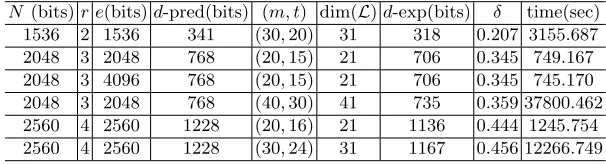
Table 2.Experimental results of the attack from Theorem4
N (bits)r e(bits)d-pred(bits) (m, t) dim(L)d-exp(bits) δ time(sec) 1536 2 1536 341 (30,20) 31 318 0.207 3155.687 2048 3 2048 768 (20,15) 21 706 0.345 749.167 2048 3 4096 768 (20,15) 21 706 0.345 745.170 2048 3 2048 768 (40,30) 41 735 0.359 37800.462 2560 4 2560 1228 (20,16) 21 1136 0.444 1245.754 2560 4 2560 1228 (30,24) 31 1167 0.456 12266.749
Theorem 5 (MSBs). LetN =prq, where r≥2is a known integer and p, q
are primes of the same bit-size. Let e be the public key exponent andd be the private key exponent, satisfying ed= 1 modφ(N). For every >0, given d˜such
that |d−d|˜ < N
r(r−1)
(r+1)2−, thenN can be factored in polynomial-time.
Proof. We have that
e(d−d) +˜ ed˜−1≡0 modpr−1
Then we want to find the rooty=d−d˜of the polynomial
f1(x) =ex+ed˜−1 modpr−1
with the known multiple (of unknown divisorp)N (N ≡0 modpr). Applying Theorem2, settingβ = 1
r+1,u=r,v=r−1, we obtain the final result. ut
Theorem 6 (LSBs). LetN =prq, wherer≥2is a known integer and p, qare primes of the same bit-size. Letebe the public key exponent andd be the private key exponent, satisfying ed= 1 modφ(N). For every >0, given d0, M with d=d0modM andM > N
3r+1
(r+1)2+, thenN can be factored in polynomial-time.
Proof. Rewrited=d1M+d0, then we have
ed1M+ed0−1≡0 modpr−1 Then we want to find the rooty=d1of the polynomial
f1(x) =eM x+ed0−1 modpr−1
we can recover the factorization ofN. Note that our attack is also effective for largee.
In [31], for 1024-bitN =p3q, Sarkar consideredδ= 0.27 using a lattice with dimension 220, while we can achieveδ= 0.359 using a lattice with dimension 41. Besides, Sarkar also stated that “forr= 4,5, lattice dimension in our approach becomes very large to achieve better results. Hence in these cases we can not present experiment results to show the improvements over existing results.” In Table2, we can see that our experimental results are better than Sarkar’s for r >2.
Factoring Multi-Power Moduli with Known Bits. In 1985, Rivest and Shamir [28] first introduced the factoring with high bits known problem, they presented an algorithm that factors N = pq given 23-fraction of the bits of p. Later, Coppersmith [5] gave a improved algorithm when half of the bits ofp are known. In 1999, Boneh, Durfee and Howgrave-Graham [2] (referred as BDH method) extended Coppersmith’s results to moduliN =prq(r≥2). Basically, they considered the scenario that a few MSBs of the primepare known to the attacker. Consider the univariate polynomial
f(x) = (˜p+x)rmodpr
For simplicity, we assume that p and q are of the same bit-size. Using the algorithm of Theorem1, Boneh et al. showed that they can recover all rootsx0 with
|x0| ≤N
β2
δ−=N
r
(r+1)2− in timeO(−7log2N)4. Thus we need a 1
r+1-fraction ofpin order to factorN in polynomial-time.
Applying our algorithm of Theorem2, and settingβ= 1
r+1, u=r, v= 1, we can also find all rootsx0with
|x0| ≤Nuvβ 2−
=N(r+1)2r −
in time O(−7log2 N).
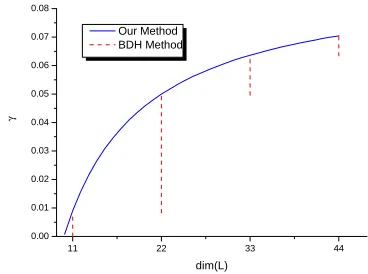
Note that we obtain the same asymptotic bound and running time complexity as BDH method. But, as opposed to BDH method, our algorithm is more flexible in choosing the lattice dimension. For example, in the case of r = 10, BDH method only works on the lattice dimension of 11∗m(m∈Z+) while our method can work on any lattice dimensionm (m∈Z+). Figure 2shows a comparsion of these two methods in terms of the size of ˜p(˜p=Nγ) that can be achieved. We can see that to achieve the same γ, we require smaller lattice dimensions than BDH method. Our algorithm is especially useful for larger. Actually our lattice is the same to the lattice of BDH method if the lattice dimensions are 11∗m (m∈Z+).
4
1 1 2 2 3 3 4 4 0 . 0 0
0 . 0 1 0 . 0 2 0 . 0 3 0 . 0 4 0 . 0 5 0 . 0 6 0 . 0 7 0 . 0 8
γ
d i m ( L ) O u r M e t h o d B D H M e t h o d
Fig. 2.Comparison of the achievable bound depending on the lattice dimension: the case of r= 10.
Table 3.Comparison of our experimental results with BDH method.
r Theo. Expt. BDH method Our method
Dim Time (in seconds) Dim Time (in seconds)
5 84 164 30 112.914 26 29.281
5 84 134 48 2874.849 46 1343.683
10 46 186 44 670.695 34 259.298
10 46 166 44 1214.281 41 917.801
We also give some experimental results. Table 3 shows the experimental results for multi-power RSA modulus N(N = prq) with 500-bit primes p, q. These experimental data confirmed our theoretical analysis. It is obvious that our method performs better than BDH method in practice.
4
The Second Type of Equations
In this section, we study the problem of finding small roots of homogeneous linear polynomialsf2(x1, x2) =a1x1+a2x2modpv (v≥1) for some unknownp wherepu divides a known modulusN (i.e.N ≡0 modpu, u≥1). Let (y1, y2) be a small solution off2(x1, x2). We assume that we also know an upper bound (X1, X2)∈Z2 for the root such that|y1| ≤X1,|y2| ≤X2.
4.1 Our Main Result
Theorem 7. For every > 0, let N be a sufficiently large composite integer (of unknown factorization) with a divisorpu (p≥Nβ,u≥1). Let f
are coprime to N. Then one can find all the solutions (y1, y2) of the equation f2(x1, x2) = 0 (mod pv)(v ≥1) with gcd(y1, y2) = 1,|y1| ≤Nγ1,|y2| ≤Nγ2 if γ1+γ2< uvβ2−, and the time complexity of our algorithm isO(−7v2log2N).
Proof. Since the proof is similar to that of Theorem2, we only give the sketch here. Consider the linear polynomial:
f2(x1, x2) =a1x1+a2x2modpv
whereN is known to be a multiple ofpu for knownuand unknownp. Here we assume thata1= 1, since otherwise we can multiplyf2 bya−11 modN. Let
f(x1, x2) =a1−1f2(x1, x2) modN
Fixm:=dβ(2u+v−uvβ) e, and define a collection of polynomials as follows:
gk(x1, x2) :=xm−k2 f k(x
1, x2)Nmax{d
v(t−k)
u e,0}
fork= 0, . . . , mand integer parameterstandmwitht=τ m(0≤τ <1), which will be optimized later. Note that for allk,gk(y1, y2)≡0 modpvt.
Let X1, X2(X1 = Nγ1, X2 = Nγ2) be upper bounds on the desired root (y1, y2), and defineX1X2:=Nuvβ
2−
. We build a latticeLof dimensiond=m+1 using the coefficient vectors of gk(x1X1, x2X2) as basis vectors. We sort the polynomials according to the order as following: Ifk < l, thengk < gl.
From the triangular matrix of the lattice, we can easily compute the deter-minant as the product of the entries on the diagonal as det(L) =Xs1
1 X s2 2 N
sN
where
s1=s2= m
X
k=0
k= m(m+ 1) 2
sN = t−1
X
k=0
dv(t−k)
u e=
t−1
X
k=0
v(t−k)
u +ck
= vt(t+ 1)
2u +
t−1
X
k=0 ck
Here we rewrite dv(t−k)u e as v(t−k)u +ck
where ck ∈ [0,1). Combining Lemma2 and Lemma1, after some calculations, we can get the final result
γ1+γ2≤uvβ2−
β(2u+v−uvβ) m
Similar to Theorem2, the time complexity of our algorithm isO(−7v2log2N). The vector output byLLL-algorithm gives a polynomialf0(x1, x2) such that f0(y1, y2) = 0. Let z=x1/x2, any rational root of the formy1/y2 can be found by extracting the rational roots off0(z) = 1/xm
2f 0
Comparisons with Previous Methods. For u= 1, v= 1, the upper bound δ1+δ2 of Theorem 7 is β2, that is exactly May’s results [21] on univariate linear polynomialf(x) =x+a. Actually the problem of finding a small root of homogeneous polynomialf(x1, x2) can be transformed to find small rational roots of univariate linear polynomialF(z) i.e. F(x2
x1) =f(x1, x2)/x1 (the discussions of the small rational roots can be found on pp. 413 of Joux’s book [18]).
Our result improves Herrmann-May’s bound 3β−2 + 2(1−β)32 up toβ2 if a0= 0. As a concrete example, for the caseβ= 0.5, our method improves the upper size ofX1X2from N0.207to N0.25.
Another important work to mention is that in [3], Castagnos, Joux, Laguillau-mie and Nguyen also considered homogeneous polynomials. Their algorithm can be directly applied to our attack scenario. They consider the following bivariate homogeneous polynomial
f(x1, x2) = (a1x1+a2x2)
u
v modp
However, their algorithm can only deal with the cases uv ∈Z, and our algorithm is more flexible: specially, for uv-degree polynomial with 2uv monomials (the
dimension of lattice is uvm), whereas our algorithm is for linear polynomial with two monomials (the dimension of lattice is m). Besides, in [3], they formed a lattice using the coefficients ofg(x, y) instead ofg(xX, yY). This modification enjoys the benefits in terms of real efficiency, since their lattice has smaller determinant than in the classical bivariate approach. However, their algorithm fails when the solutions are significantly unbalanced (X1X2). We highlight the idea that the factor X, Y should not only be used to balance the size of different power of x, ybut also to balance the variables x, y. That is why our algorithm is suitable for this unbalanced attack scenario.
Extension to More Variables. We generalize the result of Theorem7to an arbitrary number ofnvariablesx1, . . . , xn. The proof of the following result is similar to that for Proposition1, so we state only the result itself.
Proposition 2. For every >0, letN be a sufficiently large composite integer (of unknown factorization) with a divisor pu (p≥Nβ,u≥1). Furthermore, let
f2(x1, . . . , xn)∈Z[x1, . . . , xn]be a homogeneous linear polynomial in n(n≥3)
variables. Under Assumption 1, we can find all the solutions (y1, . . . , yn) of
the equation f2(x1, . . . , xn) = 0 mod pv (v ≥ 1) with gcd(y1, . . . , yn) = 1, |y1| ≤Nγ1, . . .|yn| ≤Nγn if
n
X
i=1 γi<
v u
1−(1−uβ)nn−1 −n(1−uβ)
1− n−1p
1−uβ−
The running time of the algorithm is polynomial inlogN and−nlogN.
4.2 Applications
linear equation. In particular, he showed that the public modulus N can be factored in polynomial-time for the RSA cryptosystem where the public exponent esatisfies an equation ex+y≡0 (mod p) with parametersxandy satisfying ex+y6≡0 (modN)|x|< Nγ and|y|< Nδ withδ+γ≤ √2−1
2 .
Note that the equation of [26] is homogeneous, thus we can improve the upper bound of γ+δ using our result in Theorem 7. In [29], Sarkar proposed another method to extend Nitaj’s weak encryption exponents. Here, the trick is to consider the fact that Nitaj’s bound can be improved when the unknown variables in the modular equation are unbalanced (xandy are of different bit-size). In general, Sarkar’s method is essentially Herrmann-May’s method, whereas our algorithm is simpler (see Theorem7). We present our result below.
Theorem 8. LetN =pqbe an RSA modulus with q < p <2q. Letebe a public exponent satisfying an equationex+y≡0 modpwith|x|< Nγ and |y|< Nδ.
If ex+y6≡0 modN andγ+δ≤0.25−,N can be factored in polynomial-time.
In [26], Nitaj also proposed a new attack on CRT-RSA. LetN =pq be an RSA
modulus withq < p <2q. Nitaj showed that ife < N √
2
2 andedp= 1 +kp(p−1) for somedp withdp< N
√ 2 4 √
e ,N can be factored in polynomial-time. His method is also based on Herrmann-May’s method. Similarly we can improve Nitaj’s result in some cases using our idea as Theorem7.
Theorem 9. LetN =pqbe an RSA modulus with q < p <2q. Letebe a public exponent satisfying e < N0.75 anded
p = 1 +kp(p−1) for somedp with
dp<
N0.75−2 √
e
Then,N can be factored in polynomial-time.
Proof. We rewrite the equationedp= 1 +kp(p−1) as edp+kp−1 =kpp Then we focus on the equation modulop
ex+y= 0 modp
with a root (x0, y0) = (dp, kp−1). Suppose thate=Nα,dp=Nδ, then we get
kp=
edp−1 p−1 <
edp p−1 < N
α+δ−0.5
Applying Theorem 7 with the desired equation where x0 = dp < Nδ and y0=kp−1< Nα+δ−0.5, setting β= 0.5,u= 1 andv= 1 we obtain
2δ+α <0.75−
Note that gcd(x0, y0) = gcd(dp, kp−1) = 1, kp < Nα+δ−0.5 < Nα+2δ−0.5 < N0.25 < p, hence ed
p+kp−1 6= 0 modN. Then we can factorize N with
Table 4.Experimental results for weak encryption exponents
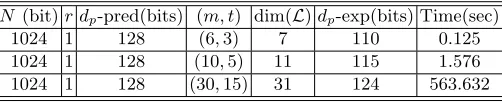
N (bit)r dp-pred(bits) (m, t) dim(L)dp-exp(bits) Time(sec)
1024 1 128 (6,3) 7 110 0.125
1024 1 128 (10,5) 11 115 1.576
1024 1 128 (30,15) 31 124 563.632
Note that Theorem9 requires the conditione < N0.75 for N = pq, hence we cannot be using small CRT exponents both modulo pand moduloq. Our attack is valid for the case that the cryptographic algorithm has a small CRT-exponent modulop, but a random CRT-exponent moduloq.
Experimental Results. Table4 shows the experimental results for RSA mod-ulusN with 512-bit primesp, q. In all of our experiments, we fixe’s length as 512-bit, and so the scheme does not have a small CRT exponent moduloq. We also compute the number bits that one should theoretically be able to attack for dp (columndp-pred of Table4).
That is actually the attack described in Theorem9. In [26], the author showed that for a 1024-bit modulus N, the CRT-exponentdpis typically of size at most 110. We obtain better results in our experiments as shown in Table4.
5
The Third Type of Equations
In this section, we give our main algorithm to find small roots of extended simultaneous modular univariate linear equations. At first, we introduce this kind of equations.
Extended Simultaneous Modular Univariate Linear Equations. Given positive integersr, r1, . . . , rn andN, a1, . . . , an and boundsγ1, . . . , γn, η∈(0,1). Suppose thatN = 0 modprandp≥Nη. We want to find all integers (x(0)
1 , . . . , x (0) n ) such that|x(0)1 | ≤Nγ1, . . . ,|x(0)n | ≤Nγn, and
f1(x (0)
1 ) =a1+x (0)
1 = 0 modp r1 f2(x
(0)
2 ) =a2+x (0)
2 = 0 modp r2 ..
. fn(x
(0)
n ) =an+x (0)
n = 0 modprn
5.1 Our Main Result
Our main result is as follows:
Theorem 10. Under Assumption1, the above equations can be solved provided that
n
rγ
1· · ·γn rr1· · ·rn
< ηnn+1 and η √ 1
The running time of the algorithm is polynomial inlogN but exponential inn.
Proof. First, for everyj (j∈ {1, . . . , n}), we check whether condition γj
rj ≤η is
met. If there existsksuch that γk
rk > η, then we throw away this corresponding
polynomialfk(x), since this polynomial could not offer any useful information. Here suppose that all the polynomials satisfy our criteria. Define a collection of polynomials as follows:
f[i1,...,in](x1, . . . , xn) = (a1+x1)
i1· · ·(a
n+xn)inNmax{d
t−Pn
j=1rj ij
r e,0}
Notice that for all indexes i1, . . . , in, f[i1,...,in](x
(0) 1 , . . . , x
(0)
n ) = 0 modpt. We select the collection of shift polynomials that satisfies
0≤ n
X
j=1
γjij ≤ηt
The reason we select these shift polynomials is that we try to select as many helpful polynomials as possible by taking into account the sizes of the root bounds.
We define the polynomial order≺asxi1 i x
i2
2 · · ·xinn ≺x i01 1x
i02 2 · · ·x
i0n n if n
X
j=1 ij<
n
X
j=1 i0j or
n
X
j=1 ij =
n
X
j=1
i0j, ij=i 0
j(j= 1, . . . , k), ik+1< i 0 k+1
Ordered in this way, the basis matrices become triangular in general. We compute the dimension of latticeLas wwhere
w= dim(L) = X
0≤γii1+···+γnin≤βt
1 = (ηt) n n!
1 γ1· · ·γn
+o(tn)
and the determinate det(L) =NsNXsX1 1 · · ·X
sXn n where
sN =
X
0≤r1i1+···+rnin≤t
dt−
Pn
j=1rjij
r e=
tn+1 (n+ 1)!
1 rr1· · ·rn
+o(tn+1)
sXj =
X
0≤γ1i1+···+γnin≤ηt
ij= tn+1 (n+ 1)!
1
γ1· · ·γj−1γ2jγj+1· · ·γn
+o(tn+1)
for eachsX1, sX2, . . . , sXn.
To obtain the number ofnpolynomials with short coefficients that contain all small roots over integer, we apply LLLbasis reduction algorithm to the lattice L. Lemma1gives us an upper bound on the norm of the shortest vector in the LLL-reduced basis; if the bound is smaller than the bound given in Lemma2, we can obtain the desired polynomial. We require the following condition:
2w−14 det(L)w1 < N
ηt √
Ignoring low order terms of mand the quantities that do not depend onN, we have the following result
sN + n
X
j=1
γjsXj < wηt
After some calculations, we can get the final result
n
rγ
1· · ·γn rr1· · ·rn
< ηn+1n
In particular, from the equation (4), in order to ignore the quantities that do not depend onN, we must have
2w4 Nηt and det(L)w1 < Nηt
and these inequations imply that
w4ηtlog2N and sN
w log2N < ηtlog2N Finally we have
1
4(n+ 1)rr1· · ·rn
η2log2N
Furthermore, one can check that in order to let the value 2w/4 become negligible compared withNηt, we must have
η2log2N 1
The running time is dominated byLLL-reduction, therefore, the total running time for this approach is polynomial in logN but exponential inn. ut
Like [4,36], we also consider the generalization to simultaneous linear equations of higher degree.
Extended Simultaneous Modular Univariate Equations. Suppose that N = 0 modpr, p≥Nη, we consider the simultaneous modular univariate equa-tions
h1(x1) =xδ11+aδ1x δ1−1
1 +· · ·+a1= 0 modpr1 h2(x2) =xδ12+bδ2x
δ2−1
1 +· · ·+b1= 0 modpr2 ..
. hn(xn) =xδ1n+cδnx
δn−1
1 +· · ·+c1= 0 modprn
Here each equationhj(xj) has one variable and the degree ofhj(xj) isδj. We give the following result.
Theorem 11. Under Assumption1, the above generalised problem can be solved provided that
n r
δ1γ1· · ·δnγn rr1· · ·rn
< ηn+1n and η √ 1
logN
The running time of the algorithm is polynomial inlogN but exponential inn.
5.2 Common Prime RSA
In [13], Hinek revisited a new variant of RSA, called Common Prime RSA, where the modulusN=pq is chosen such thatp−1 andq−1 have a large common factor. For convenience, we give a brief description on the property of Common Prime RSA. Without loss of generality, assume thatp= 2ga+ 1 andq= 2gb+ 1, whereg'Nγ anda, bare coprime integers, namely gcd(a, b) = 1. The decryption exponentdand encryption exponentesatisfy that
ed≡1 mod 2gab (5)
wheree'N1−γ andd'Nβ.
For a better comparison with the previous attacks, we give a brief review on all known attacks.
Wiener’s attack [38]. Using a continued fraction attack, Wiener proved that given any valid Common Prime RSA public key (N, e) with private exponent d < N14−
γ
2, namelyβ < 1 4−
γ
2, one can factorN in polynomial-time.
Hinek’s attack [13]. Hinek revisited this problem and proposed two lattice-based attacks. Due to Hinek’s work, whenβ < γ2or β <2
5γ,N can be factored in polynomial-time.
Jochemsz-May’s attack [17]. Jochemsz and May gave another look at the equation proposed by Hinek [13] and modified the unknown variables in the equation. The bound has been further improved as
β < 1
4(4 + 4γ−
p
13 + 20γ+ 4γ2).
Sarkar-Maitra’s attack [33]. Sarkar and Maitra proposed two improved at-tacks, one attack worked whenγ≤0.051, and another worked when 0.051< γ≤ 0.2087.
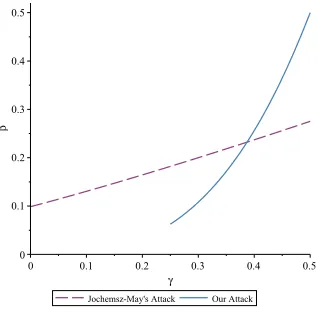
One can check that whenγ≥0.2087, Jochemsz-May’s attack [17] is superior to other attacks. We use the algorithm of Theorem10to make an improvement on previous attacks whenγ≥0.3872. We give a comparison with Jochemsz-May’s attack in Fig.3.
Our results improve Jochemsz-May’s attack dramatically whenγ is large, for instance, whenγis close to 0.5, we improve the bound onβ from 0.2752, which is the best result of previous attacks, to 0.5. Below is our main result.
Theorem 12. Assume that there exists instance of Common Prime RSAN =pq
with the above-mentioned parameters. Under Assumption1,N can be factored in polynomial-time provided
Fig. 3.Comparison of our theoretical bounds with Jochemsz-May’s work.
Proof. According to the property of Common Prime RSA, we haveN =pq= (2ga+ 1)(2gb+ 1) which implies N−1≡0 modg. On the other hand, from
Equation (5) one can obtain
ed−1≡0 modg
Multiplying by the inverse of e modulo N −1, we can obtain the following equation,
E−x≡0 modg
whereEdenotes the inverse ofemoduloN−1 andxdenotes the unknown d. Moreover, since (p−1)(q−1) = 4g2ab, we have another equation,
N−y≡0 modg2 wherey denotes the unknownp+q−1.
In summary, simultaneous modular univariate linear equations can be listed as
E−x≡0 modg N−y≡0 modg2
Note thatN−1 is a multiple ofg and (d, p+q−1) is the desired solution of above equations, where g'Nγ,d'Nβ andp+q−1'N12. Obviously, this kind of modular equations is what we considered in Theorem10. Setting
n= 2, r= 1, r1= 1, r2= 2, γ1=β, γ2= 1 2, η=γ
We have
γ > β γ > 1
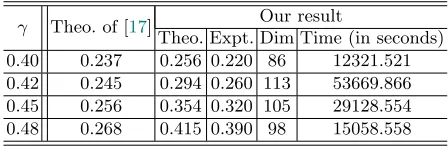
Table 5.Comparison of our theoretical and experimental results with existing works.
γ Theo. of [17] Our result
Theo. Expt. Dim Time (in seconds) 0.40 0.237 0.256 0.220 86 12321.521 0.42 0.245 0.294 0.260 113 53669.866 0.45 0.256 0.354 0.320 105 29128.554 0.48 0.268 0.415 0.390 98 15058.558
Then we can obtain
β <4γ3 and γ > 1 4
Under Assumption1, one can solve the desired solution. This concludes the proof
of Theorem12. ut
Experimental Results. Some experimental data on the different size ofg are listed in Table5. Here we used 1000-bitN. Assumption1 worked perfectly in all the cases. We always succeed to find out our desired roots.
6
Conclusion
In this paper, we consider three type of generalized equations and propose some new techniques to find small root of these equations. Applying our algorithms, we obtain the best analytical/experimental results for some attacks on RSA and its variants. Besides, we believe that our new algorithms may find new applications in various other contexts.
Acknowledgments
We would like to thank the anonymous reviewers for helpful comments. This research was supported by CREST, JST. Part of this work was also supported by Strategic Priority Research Program of the Chinese Academy of Sciences (No. XDA06010703, No. XDA06010701 and No. XDA06010702), the National Key Basic Research Project of China (No. 2011CB302400 and No. 2013CB834203), and National Science Foundation of China (No. 61379139 and No. 61472417).
References
1. D. Boneh and G. Durfee. Cryptanalysis of RSA with private keydless thanN0.292.
IEEE Transactions on Information Theory, 46(4):1339–1349, 2000.
3. G. Castagnos, A. Joux, F. Laguillaumie, and P. Nguyen. Factoring pq2 with
quadratic forms: Nice cryptanalyses. ASIACRYPT 2009, LNCS, vol.5912, pages 469–486. Springer, 2009.
4. H. Cohn and N. Heninger. Approximate common divisors via lattices. ANTS-X, 2012.
5. D. Coppersmith. Small solutions to polynomial equations, and low exponent RSA vulnerabilities. Journal of Cryptology, 10(4):233–260, 1997.
6. J.S. Coron, A. Joux, I. Kizhvatov, D. Naccache, and P. Paillier. Fault attacks on RSA signatures with partially unknown messages. CHES 2009, LNCS, vol.5747, pages 444–456. Springer, 2009.
7. J.S. Coron, D. Naccache, and M. Tibouchi. Fault attacks against EMV signatures. CT-RSA 2010, LNCS, vol.5985, pages 208–220. Springer, 2010.
8. The EPOC and the ESIGN Algorithms. IEEE P1363: Protocols from Other Families of Public-Key Algorithms, 1998.
http://grouper.ieee.org/groups/1363/StudyGroup/NewFam.html
9. M. Ernst, E. Jochemsz, A. May, and B. De Weger. Partial key exposure attacks on RSA up to full size exponents. EUROCRYPT 2005, LNCS, vol.3494, pages 555–555. Springer, 2005.
10. P.A. Fouque, N. Guillermin, D. Leresteux, M. Tibouchi, and J.C. Zapalowicz. Attacking RSA–CRT signatures with faults on montgomery multiplication. Journal of Cryptographic Engineering, 3(1):59–72. Springer, 2013.
11. M. Herrmann. Improved cryptanalysis of the multi-primeΦ-hiding assumption. AFRICACRYPT 2011, LNCS, vol.6737, pages 92–99. Springer, 2011.
12. M. Herrmann and A. May. Solving linear equations modulo divisors: On factoring given any bits. ASIACRYPT 2008, LNCS, vol.5350, pages 406–424. Springer, 2008. 13. M. Hinek. Another look at small RSA exponents. CT-RSA 2006, LNCS, vol.3860,
pages 82–98. Springer, 2006.
14. N. Howgrave-Graham. Finding small roots of univariate modular equations revisited. IMACC 1997, LNCS, vol.1355, pages 131–142. Springer, 1997.
15. N. Howgrave-Graham. Approximate integer common divisors. Cryptography and Lattices, LNCS, vol.2146, pages 51–66. Springer, 2001.
16. K. Itoh, N. Kunihiro, and K. Kurosawa. Small secret key attack on a variant of RSA (due to Takagi). CT-RSA 2008, LNCS, vol.4964, pages 387–406. Springer, 2008.
17. E. Jochemsz and A. May. A strategy for finding roots of multivariate polynomials with new applications in attacking RSA variants. ASIACRYPT 2006, LNCS, vol.4284, pages 267–282. Springer, 2006.
18. A. Joux. Algorithmic cryptanalysis. Chapman & Hall/CRC, 2009.
19. K. Tosu and N. Kunihiro. Optimal bounds for multi-primeΦ-hiding assumption. ACISP 2012, LNCS, vol.4450, pages 55–69. Springer, 2012.
20. A.K. Lenstra, H.W. Lenstra, and L. Lov´asz. Factoring polynomials with rational coefficients. Mathematische Annalen, 261(4):515–534, 1982.
21. A. May. New RSA vulnerabilities using lattice reduction methods. PhD thesis, 2003.
22. A. May. Secret exponent attacks on RSA-type schemes with moduliN=prq. PKC 2004, LNCS, vol.2947, pages 218–230. Springer, 2004.
23. A. May. Using LLL-reduction for solving RSA and factorization problems. The LLL algorithm, pages 315–348, 2010.
25. P. Nguyen and D. Stehl´e. Floating-Point LLL revisited. EUROCRYPT 2005, LNCS, vol.3494, pages 215–233. Springer, 2005.
26. A. Nitaj. A new attack on RSA and CRT-RSA. AFRICACRYPT 2012, LNCS, vol.7374, pages 221–233. Springer, 2012.
27. T. Okamoto and S. Uchiyama. A new public-key cryptosystem as secure as factoring. Eurocrypt 1998, LNCS, vol.1403, pages 308–318. Springer, 1998.
28. R. Rivest and A. Shamir. Efficient factoring based on partial information. EURO-CRYPT 1985, LNCS, vol.219, pages 31–34. Springer, 1986.
29. S. Sarkar. Reduction in lossiness of RSA trapdoor permutation. SPACE 2012, LNCS, vol.7644, pages 144–152. Springer, 2012.
30. S. Sarkar. Revisiting prime power RSA. Cryptology ePrint Archive, Report 2015/774, 2015. http://eprint.iacr.org/
31. S. Sarkar. Small secret exponent attack on RSA variant with modulusN =prq. Designs, Codes and Cryptography, pages 1–10, 2014.
32. S. Sarkar and S. Maitra. Approximate integer common divisor problem relates to implicit factorization. IEEE Transactions on Information Theory, 57(6):4002–4013, 2011.
33. S. Sarkar and S. Maitra. Cryptanalytic results on Dual CRT and Common Prime RSA. Designs, Codes and Cryptography, 66(1-3):157–174, 2013.
34. A. Shamir. A polynomial time algorithm for breaking the basic Merkle-Hellman cryptosystem. FOCS 1982, pages 145–152. IEEE, 1982.
35. T. Takagi. Fast RSA-type cryptosystem modulopkq. Crypto 1998, LNCS, vol.1462, pages 318–326. Springer, 1998.
36. A. Takayasu and N. Kunihiro. Better lattice constructions for solving multivariate linear equations modulo unknown divisors. ACISP 2013, LNCS, vol.7959, pages 118–135. Springer, 2013.
37. M. Van Dijk, C. Gentry, S. Halevi, and V. Vaikuntanathan. Fully homomorphic encryption over the integers. EUROCRYPT 2010, LNCS, vol.6110, pages 24–43. Springer, 2010.