Lattice-Based Zero-Knowledge Arguments for
Integer Relations
Benoˆıt Libert1,2, San Ling3, Khoa Nguyen3, and Huaxiong Wang3 1
CNRS, Laboratoire LIP, France
2
ENS de Lyon, Laboratoire LIP (U. Lyon, CNRS, ENSL, INRIA, UCBL), France
3 School of Physical and Mathematical Sciences, Nanyang Technological University,
Singapore
Abstract. We provide lattice-based protocols allowing to prove relations among committed integers. While the most general zero-knowledge proof techniques can handle arithmetic circuits in the lattice setting, adapting them to prove statements over the integers is non-trivial, at least if we want to handle exponentially large integers while working with a polynomial-size modulusq. For a polynomialL, we provide zero-knowledge arguments allowing a prover to convince a verifier that committedL-bit bitstringsx,
yandz are the binary representations of integersX,Y andZ satisfying
Z =X+Y overZ. The complexity of our arguments is only linear in L. Using them, we construct arguments allowing to prove inequalities
X < Z among committed integers, as well as arguments showing that a committedX belongs to a public interval [α, β], whereαandβcan be arbitrarily large. Our range arguments have logarithmic cost (i.e., linear inL) in the maximal range magnitude. Using these tools, we obtain zero-knowledge arguments showing that a committed elementX doesnot
belong to a public setS usingOe(n·log|S|) bits of communication, where
nis the security parameter. We finally give a protocol allowing to argue that committedL-bit integersX,Y andZsatisfy multiplicative relations
Z=XY over the integers, with communication cost subquadratic inL. To this end, we use our protocol for integer addition to prove the correct recursive execution of Karatsuba’s multiplication algorithm. The security of our protocols relies on standard lattice assumptions with polynomial modulus and polynomial approximation factor.
1
Introduction
Lattice-based cryptography has been an extremely active area since the celebrated results of Ajtai [3] and Regev [59]. In comparison with discrete-logarithm and factoring-based techniques, it indeed offers numerous advantages like simpler arithmetic operations, a better asymptotic efficiency, advanced functionalities or a conjectured resistance to quantum computing. Its development was further boosted by breakthrough results of [27,54] showing how to safely use lattice trapdoors, which have been the cornerstone of many advanced primitives.
realization of certain fundamental tasks, like efficient zero-knowledge proofs. Zero-knowledge protocols [31] make it possible to prove properties about certain secret witnesses in order to have users demonstrate their correct behavior while protecting their privacy. For simple statements such as proving knowledge of a secret key, efficient solutions have been reported in [56,51,40,48]. In order to prove relations among committed values, the best known methods rely on the extra algebraic structure [61,8,5] offered by the ring-LWEor ring-SISproblems [52] and no truly efficient solution is known for standard (i.e., non-ideal) lattices.
In this paper, we investigate the problem of proving, under standard lattice assumptions, that large committed integerssatisfy certain algebraic relations. Namely, if cx,cy andcz are commitments to integers X, Y, Zof arbitrary
poly-nomial bit-sizeL=poly(n), where nis the security parameter, we consider the problem of proving statements of the formZ=X+Y andZ=X·Y overZ. Note that this problem is different from the case of arithmetic circuits addressed in [8]: here, we are interested in proving relations over the integers. Furthermore, we would like to design zero-knowledge arguments for various other relations among large committed integers. As specific applications, we consider the problems of: (i) Proving that a committed integer X belongs to a publicly known range [α, β]; (ii) Proving order relations Y < X < Zbetween committed integersY, X, Z; (iii) Proving that a committed element X does not belong to a public set (which allows users to prove their non-blacklisting).
While these problems received much attention in the literature, the most efficient solutions [49,35,21] handling large integers appeal to integer commit-ments [26,22] based on hidden-order groups (e.g., RSA groups), which are vul-nerable to quantum computing. In particular, designing a solution based on mild assumptions in standard lattices is a completely open problem to our knowl-edge. Even in ideal lattices, handling integers of polynomial lengthLrequires to work with exponentially large moduli, which affects both the efficiency and the approximation factor of the lattice assumption. Here, our goal is to realize the aforementioned protocols using polynomial moduli and approximation factors.
If we were to use known zero-knowledge proof systems [61,8,5] in ideal lattices to handle additive relations over Z, we would need (super-)exponentially large moduli. In particular, in order to prove that committed integersX, Y, Zof bit-size
L = poly(n) satisfy Z = X +Y, these protocols would require to prove that
Z =X+Y modqfor a large modulus q= 2poly(n). With current techniques, this would imply to work with a commitment scheme over ringsRq, for the same
modulusq. In terms of efficiency, a single ring element would cost thousand times
Lbits to represent since the modulus should contain more thanLbits. When it comes to proving smallness of committed values (in order to proveZ=X+Y
factors for the underlying ideal-lattice problems. Moreover, ensuring soundness may be non-trivial as the protocols of [8,5] only guarantee relaxed soundness.
Our Contributions. We provide statistical zero-knowledge arguments
allow-ing to prove additive and multiplicative relations among committed integers of bit-sizeL=poly(n) under mild assumptions in standard (i.e., non-ideal) lattices. Our protocols can work with two flavors of the commitment scheme by Kawachi, Tanaka and Xagawa (KTX) [40]. If we commit to integers in a bit-by-bit fashion, the modulusqcan be as small asOe(n) and the security of our protocols can rely
on the worst-case hardness ofSIVPγ with γ=Oe(n), which turns out to be one
the weakest assumptions in the entire literature on lattice-based cryptography. On the other hand, if we rely on a stronger assumption withγ=Oe(
√
L·n) for a modulusq=Oe(
√
L·n), then we can commit to Lbits at once and reduce the communication cost. For this all-at-once commitment variant, the complexities of our protocols are summarized as follows.
The protocol for integer additions has communication cost (ζ+ 20L)·κbits, whereζ = Oe(n) + 6Llogq is the cost of proving knowledge of valid openings
for the commitments to X, Y, Z and κ = ω(logn) is the number of protocol repetitions to make the soundness error negligibly small. Thus, the actual cost for proving the additive relation is 20L·κbits. In terms of computation complexity, both the prover and the verifier only performO(L) simple operations.
We offer two options for proving integer multiplications. For practically interesting values of L, e.g., L≤8000, we can emulate the schoolbook multi-plication algorithm by provingL additive relations, and obtain communication costOe(n+L2)·κas well as computation costsO(L2) for both parties. To our
knowledge, all known methods for proving integer multiplications (sometimes implicitly) involveO(L2) computation and/or communication complexities. Can we break this quadratic barrier?
As a theoretical contribution, we put forward the first protocol for multiplica-tive relations that does not incur any quadratic costs. Specifically, by proving in zero-knowledge the correct execution of a Karatsuba multiplication algorithm [39], we obtain both computation and communication complexities of orderO(Llog23). Applications. While our protocol for additive relations only handles non-negative integers, it suffices for many applications, such as arguments of inequali-ties among committed integers, range membership for public/hidden ranges, and set non-membership. Moreover, it can also be used in higher-level protocols like zero-knowledge lists [28].4 or privacy-preserving certificate transparency [25].
In particular, for a set ofN elements with bit-size Oe(n), our zero-knowledge
protocol for proving non-membership of a committed value only costOe(n·logN)
bits. In the lattice setting, this is the first non-membership proof that achieves communication cost logarithmic in the cardinality of the set. Meanwhile, in our protocol for proving that a committed L-bit integer belongs to a given range [α, β], whereβ−α≈2L, besides the cost of proving knowledge of a valid opening
4
for the commitment, the prover only has to send 23L·κbits to the verifier. In Table 1, we provide the concrete cost of the protocol variant achieving soundness error 2−80, for commonly used lattice parameters.
We remark that, if we only had to prove the correct evaluation of binary addition circuits, MPC-based techniques [37,29,20] could perform slightly better than our protocols. However, they become much less efficient for the algebraic parts of the statements we have to prove (in particular, we also need to prove knowledge of openings ofSIS-based commitments). Indeed, the MPC-in-the head paradigm [37] and its follow-ups [29,20] have linear complexities in the size of the circuit, which is much larger than the witness size as the commitment relation entails Θ(n(L+m)) additions and multiplications over Zq. In our protocols,
proving knowledge of an opening takesΘ((L+m) logq) bits of communication.
Range size 21000 22000 24000 28000
Proving knowledge of committedX 3.16 3.65 4.63 6.59
Proving range membership ofX 0.38 0.75 1.5 3
Total communication cost 3.54 MB 4.4 MB 6.13 MB 9.59 MB
Table 1.Concrete communication cost of our lattice-based zero-knowledge argument (Section 5.1) for proving knowledge of committed integerX belonging to a given range, w.r.t. various range sizes. We work with lattice parametersn= 256,q≈215,m= 4608. To achieve soundness error 2−80, we setκ= 137.
Our Techniques.We proceed by emulating integer commitments by means of bit commitments. To commit to anL-bit integerX in an all-in-one fashion, we generate a KTX commitmentcx=P
L−1
i=0 ai·xi+B·r∈Znq to its binary
representation (xL−1, . . . , x0)2 using public matricesA= [a0|. . .|aL−1]∈Znq×L
andB∈Znq×m and random coinsr←- U({0,1}m).
Integer Additions. To prove additive relations among committed integers, we come up with an idea that may sound natural for computer processors, but, to the best of our knowledge, has not been considered in the context of zero-knowledge proofs. The idea is to view integer additions as binary additions with carries. Suppose that we add two bits xandy with carry-incin to obtain a bitz and
carry-outcout. Then, the relations among these bits are captured by equations
z=x+y+cinmod 2, cout=x·y+z·cin+cinmod 2,
the carry-out of thei-th addition and definecL=zL. The equations become
z0+x0+y0= 0 mod 2
c1+x0·y0= 0 mod 2
z1+x1+y1+c1= 0 mod 2
c2+x1·y1+z1·c1+c1= 0 mod 2 ..
.
zL−1+xL−1+yL−1+cL−1= 0 mod 2
zL+xL−1·yL−1+zL−1·cL−1+cL−1= 0 mod 2.
We observe that all the terms in the above equations are either bits or products of two bits. By adapting the Stern-like [60] techniques for hiding secret bits [45] and handling quadratic relations [43], we manage to prove that the bits ofX, Y, Z
satisfy the above equations modulo 2, which is equivalent toX+Y =Z overZ. Meanwhile, to prove that those bits coincide with the values committed under the KTX commitment requires to additionally prove a linear equation moduloq. Interestingly, we show that, not only the problem of proving additive relations among committed integers can be reduced to proving secret bits satisfying linear and quadratic equations modulo 2 and one linear equation moduloq, such type of reduction is doable for all subsequently considered relations (multiplications, range membership, set non-membership). To handle the reduced statements in a modular manner, we thus design (in Section 3) a general zero-knowledge protocol that subsumes all argument systems of this work. In comparison with previous protocols [40,48,44,46] built on Stern’s framework [60], this general protocol introduces a technical novelty which allows to reduce the communication cost. Range Membership and Set Non-Membership. Our techniques for addi-tions of non-negative integers directly yield a method for proving inequalities of the formX ≤Z, where it suffices to show the existence of non-negative integer
Y such thatX+Y =Z. This method can be further adapted to handle strict inequalities. To prove thatX < Z, we demonstrate the existence of non-negative
Y such thatX+Y + 1 =Z, for which only a small additional treatment for the least significant bits ofX, Y, Zis needed. Then, by combining two sub-protocols for inequalities, we can obtain range arguments for the statements “X ∈[α, β]”, “X ∈[α, β)”, “X ∈(α, β]” and “X ∈(α, β)”, whereX is committed under the
KTX commitment, andα, βcan be hidden/committed or public.
Given the techniques for proving inequalities, we can further obtain arguments of non-membership. In order to prove that a committed stringX ∈ {0,1}k does
not belong to a public setS = {s1, . . . , sN}, the prover generates a (publicly
computable) Merkle tree [53] whose leaves are the elements of S arranged in lexicographical order. Then, the prover can use the technique of Libertet al.[45] – which allows arguing possession of a path in a lattice-based Merkle tree – to prove knowledge of two paths leading to adjacent leaves for which the corresponding set elementsY, Z ∈ {0,1}k satisfyY < X < Z in lexicographical order. Here,
additions, which allows proving that their labels (i.e., the binary encoding of the path that connects them to the root) encode integersV, W such thatW =V + 1. Subquadratic Integer Multiplications. Proving multiplicative relations among L-bit committed integers with subquadratic complexity requires some additional tricks. Karatsuba’s technique [39] divides integers X, Y into equal halvesX =X1|X0 andY =Y1|Y0, each of which has lengthL/2. If the length is odd, the factors must be padded with zeroes in the left halves, which raises technical difficulties as will be explained below. We haveX = 2L/2·X
1+X0and
Y = 2L/2·Y
1+Y0, so thatX·Y can be written
X·Y = (2L−2L/2)(X1Y1) + (1−2L/2)(X0Y0) + 2L/2(X1+X0)(Y1+Y0). (1) To prove this equation, we first prove knowledge of 3 partial products and then prove their correct shifting w.r.t. multiplication by powers of 2 before proving the correctness of additions. Each of the factorsX1, Y1, X0, Y0, X1+X0, Y1+Y0 of (1) is recursively broken into 3 smaller products until reaching an easy-to-prove “base multiplication”. One difficulty is that the length ofX1+X0 andY1+Y0 are one bit longer than the length L/2 of X0, X1, Y0, Y1. SinceL/2 + 1 is odd, we need to pad with a zero before dividing any further and the same issue arises when dividingX1, Y1, X0, Y0. In the context of zero-knowledge proofs, it makes it very complicated to keep track of the lengths of witnesses in the underlying equations and determine where the original bits ofX andY should be.
To address the problems caused by carry-on bits in additions, Knuth [41] suggested to use subtractions and re-write the productX·Y as
(2L+ 2L/2)·(X1·Y1) + (1 + 2L/2)·(X0·Y0)−2L/2·(X1−X0)·(Y1−Y0). (2) The differenceX1−X0is now guaranteed to have lengthL/2, which allows using
L= 2k and recursively come down to base multiplications of two-bit integers. However, this modification introduces another problem asX1−X0andY1−Y0 can now be negative integers, which are more difficult to handle in our setting. For this reason, we need to make sure that we always subtract a smaller integer from a larger one, while preserving the ability to prove correct computations.
To this end, our idea is to compareX1 andX0 and let the smaller one be subtracted from the larger one. To do this, we define auxiliary variablesX10, X00
such that X10 > X00 and{X10, X00}= {X1, X0}. Letting b be the bit such that
b= 1 ifX10 ≥X00 andb= 0 otherwise, this can be expressed by the equation: (X10 −X00) =b·(X1−X0) + (1−b)·(X0−X1),
which is provable in zero-knowledge using our techniques for integer additions. If we repeat the above process and define variablesY10, Y00 such that{Y10, Y00}= {Y1, Y0}and an order control bitc∈ {0,1}, if we defined=b+cmod 2, we have
(X1−X0)·(Y1−Y0) = (X10 −X 0 0)·(Y
0 1−Y
0
0) if d= 0
(X1−X0)·(Y1−Y0) =−(X10 −X00)·(Y10−Y00) if d= 1.
The term (X1−X0)·(Y1−Y0) appearing in equation (2) can thus be written as (X1−X0)·(Y1−Y0) = (1−d)·(X10−X
0 0)·(Y
0 1−Y
0
0)−d·(X 0 1−X
0 0)·(Y
0 1−Y
which yields an equation compatible our techniques while avoiding to handle negative integers. At each recursive step, we further divide the differencesX10−X00
andY10−Y00and keep track of the control bitsb, c, dwhich are part of the witnesses.
Related Work.The first integer commitment scheme was proposed by Fujisaki
and Okamoto [26] who suggested to use it to prove relation over the integers. They underlined the importance of zero-knowledge arguments over the integers in order to be able to prove modular relations when the modulus is not known in advance, when the commitment key is generated. Damg˚ard and Fujisaki [22] corrected a flaw in the Fujisaki-Okamoto commitment and generalized it to abelian groups satisfying specific properties.
Lipmaa [49] highlighted the cryptographic importance of the classDof Dio-phantine sets5[1] and gave improved constructions of zero-knowledge proofs for Diophantine equations. As special cases, he obtained efficient zero-knowledge arguments for intervals, unions of intervals, exponential relations and gcd rela-tions. In [34], Groth suggested another integer commitment scheme based on the Strong RSA assumption [4] which, like [26,22], relies on groups of hidden order. Couteau, Peters and Pointcheval [21] recently suggested to combine integer commitments with a commitment scheme to field elements in order to improve the efficiency of zero-knowledge proofs over the integers. They also revisited the Damg˚ard-Fujisaki commitment [22] and proved it the security of its companion argument system under the standard RSA assumption. While our results are not as general as those of [49,21] as we do not handle negative integers, they suffice for many applications of integer commitments, as we previously mentioned.
Range proofs were introduced by Brickellet al.[10] and received a permanent attention [19,12,9,49,36,18,21,32] since then. They served as a building block of countless cryptographic applications, which include anonymous credentials [14], anonymous e-cash [13], auction protocols [50], e-voting [35] privacy-preserving certificate transparency [25] and many more.
Currently known range proofs proceed via two distinct approaches. The first one proceeds by breaking integers into bits or small digits [10,7,23,12,36,32], which allows communicating a sub-logarithmic (in the range size) number of group elements in the best known constructions [12,36,32]. The second approach [9,49,35,21] appeals to integer commitments and groups of hidden order. This approach is usually preferred for very large ranges (which often arise in appli-cations like anonymous credentials [14], where range elements are comprised of thousands of bits) where it tends to be more efficient and it does not require the maximal range length to be known when the commitment key is chosen.
Despite three decades of research, all known efficient range proofs (by “effi-cient”, we mean that the communication complexity should be only logarithmic in the range size) build on quantum-vulnerable assumptions and the only candi-dates supporting very large integers rely on groups of hidden order. By proving knowledge of small secret vectors, lattice-based protocols [40,48] can be seen as
5 For k, ` ∈
providing a limited form of range proofs: if we can prove that a committedx∈Zm
has infinity norm kxk∞ < B for some basis B < q of a B-ary representation, we can prove thatx encodes an integer X in the range [0, Bm−1]. However,
it is not clear how to deal with arbitrary ranges. Using homomorphic integer commitments, any range [α, β] can be handled (see [17] and references therein) by exploiting the homomorphic properties of the commitment scheme and proving thatX−α∈[0, β−α]. With homomorphic commitments used in the context of lattice-based cryptography, there is no obvious way to shift the committed value by an integerαwhenα > q. Even with a sub-exponential modulusq, the sizeLof integers can be at most sub-linear inn. To our knowledge, no flexible solution has been proposed in the lattice setting, let alone under standard lattice assumptions with polynomial approximation factors and polynomial-size moduli. Our schemes thus provide a first answer to this question.
In the context of set non-membership, our construction bears resemblance with a technique used by Nakanishiet al.[57] to handle revocation in privacy-preserving protocols by proving inequalities over the integers. For a public set
S ={s1, . . . , sN} arranged in lexicographical order, they rely on a trusted
au-thority to create Camenisch-Lysyanskaya signatures [16] on all ordered pairs {Msgi = (si, si+1)}Ni=1−1 of adjacent set elements. To prove that a committed
s is not inS, the prover proceeds with a proof of knowledge of two message-signature pairs (Msgj, sigj), (Msgj+1, sigj+1) for which Msgj = (sj, sj+1) and
Msgj+1= (sj+1, sj+2) contain elements sj, sj+1 such thatsj < s < sj+1. While this approach could be instantiated with our technique for proving integer inequal-ities, it would require proofs of knowledge of signatures and thus lattice trapdoors (indeed, all known lattice-based signatures compatible with proofs of knowledge rely on lattice trapdoors [27,54]). By using proofs of knowledge of a Merkle tree path [45] instead of signatures, our solution eliminates the need for lattice trapdoors, which allows for a better efficiency (note that proving inequalities
sj < s < sj+1 incurs a complexityΩ(logN) in both cases, so that using Merkle trees does not affect the asymptotic complexity). Moreover, the technique of Nakanishiet al.[57] involves a trusted entity to sign all pairs (si, si+1)}Ni=1−1in a setup phase whereas no trusted setup is required in our construction. Eskandarian et al.[25] recently used proofs of integer inequalities and hash trees in their proofs of non-membership. Still, they prove inequalities by using signatures issued by some TTP. In contrast, our approach does not require any TTP.
Other approaches to prove (non-)membership of a public set were suggested in [15,42,12,47]. However, they rely on a trusted entity to approve the sets of which (non-)membership must be proven during a setup phase. Setup-free accumulator-based set membership proofs were described in [11,45], but they are not known to support non-membership proofs.
lack of a lattice-based commitment scheme with similar properties, their approach does not seem readily instantiable under lattice assumptions.
2
Preliminaries
Notations. When working with an integerX∈[0,2L−1], we use the notation X = (xL−1, . . . , x0)2 to describe its bits, and use bold lower-case letter x to denote the representation ofX as binary column vector (xL−1, . . . , x0)∈ {0,1}L. The column concatenation of matricesA∈Zn×k and B∈Zn×mis denoted by [A|B]∈Zn×(k+m). When concatenating column vectorsx∈Zk andy∈Zm, for simplicity, we often use the notation (xky)∈Zk+m(instead of (x>ky>)>).
2.1 Lattice-Based Cryptographic Building Blocks
We first recall the average-case problemSISand its hardness.
Definition 1 (SIS∞n,m,q,β [2][27]). Given uniformly random matrixA∈Zn×m
q ,
find a non-zero vectorx∈Zmsuch that kxk
∞≤β andA·x=0modq.
Ifm, β=poly(n), andq > β·Oe(
√
n), theSIS∞n,m,q,β problem is at least as hard as worst-case lattice problemSIVPγ for someγ=β·Oe(
√
nm) (see, e.g., [27][55]). We will use twoSIS-based cryptographic ingredients: the commitment scheme of Kawachi, Tanaka and Xagawa [40] (KTX) and the Merkle hash tree from [45].
The KTX commitment scheme.The scheme works with security parameter
n, prime modulusq=O(√L·n), and dimensionm=n(dlog2qe+ 3). We will consider several flavours of the scheme.
In the variant that allows committing toL≤poly(n) bits, the commitment key is (a0, . . . ,aL−1,B)←- U(Zqn×(m+L)). To commit to a bitstringx0, . . . , xL−1, one samplesr←- U({0,1}m), and outputsc=PL−1
i=0 ai·xi+B·rmodq. Then, to
open the commitment, one simply revealsx0, . . . , xL−1∈ {0,1} andr∈ {0,1}m. If one can compute two valid openings (x0
0, . . . , x0L−1,r0) and (x000, . . . , x00L−1,r00) for the same commitmentc, where (x0
0, . . . , x0L−1)6= (x000, . . . , x00L−1), then one can compute a solution to theSIS∞n,m+L,q,1 problem associated with the uniformly random matrix [a0|. . .|B]∈Znq×(m+L). Thus, the scheme is computationally
binding, assuming the worst-case hardness ofSIVP e
O(√L·n). On the other hand, by the Leftover Hash Lemma [30], the distribution of a commitmentcis statistically close to uniform overZn
q. This implies that the scheme is statistically hiding.
In the special case whenL= 1, the scheme becomes a bit commitment scheme, in which case it can use a small modulus q =Oe(n) and rely on a weak SIVP
assumption withγ=Oe(n).
Kawachiet al.[40] extended the above fixed-length commitment scheme to a string commitment scheme COM:{0,1}∗× {0,1}m→
Znq. The obtained scheme
is also statistically hiding for the given setting of parameters, and computationally binding assuming thatSIVP
e
Here, we will use the first commitment variant to commit to secret bits and the string commitment schemeCOMas a building block for Stern-like protocols. Lattice-based Merkle hash tree. The construction relies on the following collision-resistant hash function. Let n be the security parameter, q = Oe(n),
k=ndlog2qeandm= 2k. Define the “powers-of-2” matrix
G=In⊗[1 2 4 . . . 2dlog2qe−1]∈Znq×k.
Note that for every v ∈ Znq, we have v = G·bin(v), where bin(v) ∈ {0,1}k
denotes the binary representation of v.
For matrixB = [B0 | B1] ←- U(Zqn×m), where B0,B1 ∈ Znq×k, define the
functionhB:{0,1}k× {0,1}k→ {0,1}k as follows:
(u0,u1) 7→ hB(u0,u1) =bin B0·u0+B1·u1modq.
Note thathB(u0,u1) = u⇔ B0·u0+B1·u1 = G·umodq. This hash function was shown collision-resistant ifSIVP
e
O(n)is hard [2,45]. It allows building Merkle trees to securely accumulate data. In particular, for an ordered set
S={d0, . . . ,d2`−1}consisting of 2`∈poly(n) elements of bit-sizek, one builds the binary tree of depth`on top of elements of the set, as follows. First, associate the 2` leaf nodes with elements of the set, with respect to the order of these elements. Then, every non-leaf node of the tree is associated with the hash value of its two children. Finally, output the root of the treeu∈ {0,1}k. Note that,
the collision resistance of the hash functionhBguarantees that it is infeasible to find a tree path starting from the rootuand ending withd0 6∈S.
2.2 Zero-Knowledge Argument Systems and Stern-like Protocols
We will work with statistical zero-knowledge argument systems, where remain zero-knowledge forany cheating verifier while the soundness property only holds against computationally bounded cheating provers. More formally, let the set of statements-witnesses R = {(y, w)} ∈ {0,1}∗× {0,1}∗ be anNPrelation. A two-party gamehP,Viis called an interactive argument system for the relation R with soundness erroreif the following conditions hold:
– Completeness.If (y, w)∈R then Pr
hP(y, w),V(y)i= 1
= 1.
– Soundness.If (y, w)6∈R, then∀PPTPb: Pr[hPb(y, w),V(y)i= 1]≤e.
An argument system is called statistical zero-knowledge if there exists a PPT simulator S(y) having oracle access to any Vb(y) and producing a simulated
transcript that is statistically close to the one of the real interaction between P(y, w) and Vb(y). A related notion is argument of knowledge, which requires
The statistical zero-knowledge arguments of knowledge presented in this work are Stern-like [60] protocols. In particular, they areΣ-protocols in the general-ized sense defined in [38] (where 3 valid transcripts are needed for extraction, instead of just 2). The basic protocol consists of 3 moves: commitment, challenge, response. If a statistically hiding and computationally binding string commitment scheme, such as the KTX scheme [40], is employed in the first move, then one obtains a statistical zero-knowledge argument of knowledge (ZKAoK) with perfect completeness, constant soundness error 2/3. In many applications, the protocol is repeatedκ=ω(logn) times to make the soundness error negligibly small inn.
3
A General Zero-Knowledge Argument of Knowledge
This section presents a general Stern-like zero-knowledge argument system that subsumes all the subsequent constructions in Sections 4, 5 and 6. Before describing the protocol, we first recall two previous Stern-like techniques that it will use.
3.1 Some Previous Extending-then-Permuting Techniques
Let us recall the techniques for proving knowledge of a single secret bitx, and for proving knowledge of bit productx1·x2, from [45] and [43], respectively. These techniques will be employed in the protocol presented in Section 3.2.
For any bitb∈ {0,1}, denote bybthe bitb=b+ 1 mod 2, and byext2(b) the 2-dimensional vector (b, b)∈ {0,1}2.
For any bit c ∈ {0,1}, define P2
c as the permutation that transforms the
integer vectorv= (v0, v1)∈Z2 intoPc2(v) = (vc, vc). Namely, ifc= 0 thenPc2
keeps the arrangement the coordinates ofv; or swaps them ifc= 1. Note that:
v=ext2(b) ⇐⇒ Pc2(v) =ext2(b+cmod 2). (3)
As shown in [45], the equivalence (3) helps proving knowledge of a secret bitx
that may appear in several correlated linear equations. To this end, one extends
xtoext2(x)∈ {0,1}2, and permutes the latter usingPc2, where cis a uniformly
random bit. Seeing the permuted vectorext2(x+cmod 2) convinces the verifier that the original vectorext2(x) is well-formed – which in turn implies knowledge of some bitx– while cacts as a “one-time pad” that completely hidesx.
To prove that a bit is the productx1·x2of two secret bits, Libertet al.[43] introduced the following t echnique. For any two bits b1, b2, define
ext4(b1, b2) = (b1·b2, b1·b2, b1·b2, b1·b2)∈ {0,1}4,
which is an extension of the bit productb1·b2. Next, define a specific type of permutation associated with two bits, as follows.
For any two bitsc1, c2∈ {0,1}, definePc41,c2 as the permutation that trans-forms the integer vectorv= (v0,0, v0,1, v1,0, v1,1)∈Z4 into
Pc41,c2(v) = vc1,c2, vc1,c2, vc1,c2, vc1,c2
For any bitsb1, b2, c1, c2 and any vectorv= (v0,0, v0,1, v1,0, v1,1)∈Z4, we have
v=ext4(b1, b2) ⇐⇒ Pc41,c2(v) =ext4(b1+c1mod 2, b2+c2mod 2). (4)
As a result, to prove the well-formedness ofx1·x2, one can extend it to the vectorext4(x1, x2), permute the latter usingPc41,c2, where c1, c2 are uniformly random bits, and send the permuted vector to the verifier who should be convinced that the original vector, i.e.,ext4(x1, x2), is well-formed, while learning nothing else aboutx1 andx2, thanks to the randomness ofc1 andc2. Furthermore, this sub-protocol can be combined with other Stern-like protocols, where one has to additionally prove that x1, x2 satisfy other conditions. This is done by using the same “one-time pads”c1, c2 at all occurrences ofx1andx2, respectively.
3.2 Our General Protocol
LetN,m1,m2be positive integers, wherem1≤N. LetT ={(i1, j1), . . . ,(i|T|, j|T|)} be a non-empty subset of [N]×[N]. Defined1= 2(m1+m2),d2= 2N+ 4|T|and
d=d1+d2. Letn1≤d1, n2≤d2 andq >2 be positive integers. The argument system we aim to construct can be summarized as follows.
Public input consists of g1, . . . ,gm1,b1, . . . ,bm2,u1∈Z
n1
q and
{h`,k}(`,k)∈[n2]×[N]; {f`,t}(`,t)∈[n2]×[|T|]; v1, . . . , vn2 ∈Z2.
Prover’s witness is (N+m2)-bit vectors= (s1, . . . , sm1, . . . , sN, . . . , sN+m2). Prover’s goal is to prove in zero-knowledge that:
1. The first m1 bitss1, . . . , sm1 and the last m2 bits sN+1, . . . , sN+m2 satisfy the following linear equation moduloq.
X
i∈[m1]
gi·si+
X
j∈[m2]
bj·sN+j =u1modq. (5)
2. The firstNbitss1, . . . , sm1, . . . , sN satisfy the followingn2equations modulo 2 that containN linear terms and a total of|T|quadratic terms{sit·sjt}
|T|
t=1.
∀`∈[n2] :
N
X
k=1
h`,k·sk+
|T|
X
t=1
f`,t·(sit·sjt) =v`mod 2. (6)
Looking ahead, all the statements that we will consider in Sections 4, 5 and 6 can be handled as special cases of the above general protocol, which will serve as an “umbrella” for all of our subsequent constructions.
As a preparation for the protocol construction, let us first introduce a few notations and techniques.
anyb= (b1, . . . , bm1, . . . , bN, . . . , bN+m2)∈ {0,1}
N+m2, we denote byENC(b)∈ {0,1}d the vector encodingbas follows:
ENC(b) = ext2(b1) k. . .kext2(bm1)kext2(bN+1)k. . .kext2(bN+m2) kext2(b1) k. . .kext2(bN)kext4(bi1, bj1)k. . .kext4(bi|T|, bj|T|)
,
whereext2(·) andext4(·,·) are as in Section 3.1.
Permutation Γ. To prove in zero-knowledge of a vector that has the form
ENC(·), we will need to a specific type of permutation. To this end, we associate eachc= (c1, . . . , cN, . . . , cN+m2)∈ {0,1}
N+m2 with a permutationΓc that acts as follows. When being applied to vector
v= v1k. . .kvm1 kvm1+1k. . .kvm1+m2kvm1+m2+1k. . .kvm1+m2+Nk kvm1+m2+N+1k. . .kvm1+m2+N+|T|
∈Zd,
whose firstm1+m2+N blocks are of length 2 and last|T|blocks are of length 4, it transforms these blocks as described below.
vi7→Pc2i(vi), ∀i∈[m1]; vm1+j 7→P 2
cN+j(vm1+j), ∀j∈[m2]; vm1+m2+k7→P
2
ck(vm1+m2+k), ∀k∈[N]; vm1+m2+N+t7→P
4
cit,cjt(vm1+m2+N+t), ∀t∈[|T|].
Based on the equivalences observed in (3)-(4), it can be checked that the following holds. For allb,c∈ {0,1}N+m2, allv∈
Zd,
v=ENC(b) ⇐⇒ Γc(v) =ENC(b+cmod 2). (7)
Let us now present the protocol, based on the above notations and techniques. First, we perform the following extensions for the secret objects:
(
∀k∈[N+m2] :sk =ext2(sk)∈ {0,1}2
∀(it, jt)∈T :yit,jt =ext4(sit, sjt)∈ {0,1}
4. (8)
Now, we will perform some transformations regarding equation (5). Observe that, for each i ∈ [m1], if we form matrix Gi = [0n1 | gi] ∈ Zn1×2
q , then
we will have Gi·si = gi·simodq. Similarly, for each j ∈ [m2], if we form Bj = [0n1|bj]∈Zn1×2
q , then we will haveBj·sN+j=bj·sN+jmodq.
Therefore, if we build matrix M1 = [G1 | . . . | Gm1 | B1 | . . . | Bm2] ∈ Znq1×d1, equation (5) can be expressed as M1·w1 = u1modq, where w1 =
s1k . . .ksm1ksN+1k . . .ksN+m2
∈ {0,1}d1.
Next, we will unify all then2equations in (6) into just one equation modulo 2, in the following manner. We form matrices
(
and note that H`,k·sk =h`,k·sk mod 2 andF`,t·yit,jt =f`,t·(sij ·sit) mod 2. Thus, (6) can be rewritten as:
H1,1·s1+. . .+H1,N ·sN +F1,1·yi1,j1+· · ·+F1,|T|·yi|T|,j|T| =v1mod 2
H2,1·s1+. . .+H2,N ·sN +F2,1·yi1,j1+· · ·+F2,|T|·yi|T|,j|T| =v2mod 2
..
. ... ...
Hn2,1·s1+· · ·+Hn2,N·sN +Fn2,1·yi1,j1+· · ·+Fn2,|T|·yi|T|,j|T| =vn2 mod 2.
Lettingu2= (v1, . . . , vn2) >∈
Zn22, the above equations can be unified into
M2·w2=u2mod 2, (9)
where matrixM2∈Z2n2×d2 is built fromH`,k,F`,t, and
w2= s1k. . .ksNkyi1,j1k . . .kyi|T|,j|T|
∈ {0,1}2N+4|T|.
Now, let us construct the vectorw= (w1kw2)∈ {0,1}d, which has the form
s1k. . .ksm1ksN+1k. . .ksN+m2ks1k. . .ksNkyi1,j1k . . .kyi|T|,j|T|
,
where its components blocks are as described in (8). Then, by our above definition of encoding vectors, we havew=ENC(s).
The transformations we have done so far allow us to reduce the original statement to proving knowledge of vectors∈ {0,1}N+m2, such that the compo-nent vectors w1∈ {0,1}d1,w2 ∈ {0,1}d2 of w=ENC(s) satisfy the equations M1·w1 =u1modq andM2·w2=u2mod 2. The derived statement can be handled in Stern’s framework, based on the following main ideas.
– To prove thatw = ENC(s), we will use the equivalence (7). To this end, we sample a uniformly random c ∈ {0,1}N+m2 and prove instead that
Γc(w) =ENC(s+cmod 2). Seeing this, the verifier is convinced inZKthat w indeed satisfies the required constraint, thanks to the randomness ofc. – To prove that equationsM1·w1=u1modqandM2·w2=u2mod 2 hold,
we sample uniformly randomr1∈Zd1
q ,r2∈Zd22, and demonstrate that M1·(w1+r1) =u1+M1·r1modq; M2·(w2+r2) =u2+M2·r2mod 2.
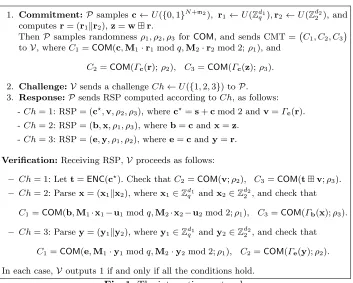
The interactive protocol. Our interactive protocol goes as follows.
– The public input consists of matricesM1,M2 and vectorsu1,u2, which are constructed from the original public input, as discussed above.
– The prover’s witness consists of the original secret vectors∈ {0,1}N+m2 and vectorw= (w1kw2) =ENC(s) derived froms, as described above.
and computationally binding. For simplicity of presentation, for vectors w = w1kw2
∈Zd andr = r
1kr2
∈ Zd, we denote by w
r the operation that computesz1=w1+r1modq, z2=w2+r2mod 2, and outputsd-dimensional integer vector z= z1kz2. We note that, for allc∈ {0,1}N+m2, if t=Γc(w) ands=Γc(r), then we haveΓc(wr) =ts.
The described protocol can be seen as an improved version of a Stern-like protocol presented in [46], in the following aspect. In the caseCh= 1, instead of sendingΓc(w) =ENC(c?) - which costsd= 2(m1+m2) + 2N+ 4|T|bits, we let the prover sendc? which enables the verifier to compute the valueENC(c?) and
which costs onlyN+m2 bits. Due to this modification, the results from [46] are not directly applicable to our protocol, and thus, in the proof of Theorem 1, we will analyze the protocol from scratch.
1. Commitment:Psamplesc←U({0,1}N+m2), r1←U(
Zdq1),r2 ←U(Z d2 2 ), and
computesr= (r1kr2),z=wr.
ThenP samples randomnessρ1, ρ2, ρ3 forCOM, and sends CMT = C1, C2, C3
toV, whereC1=COM(c,M1·r1modq,M2·r2mod 2;ρ1), and
C2=COM(Γc(r);ρ2), C3=COM(Γc(z);ρ3).
2. Challenge:Vsends a challengeCh←U({1,2,3}) toP. 3. Response:Psends RSP computed according toCh, as follows:
-Ch= 1: RSP = (c?,v, ρ2, ρ3), wherec?=s+cmod 2 andv=Γc(r).
-Ch= 2: RSP = (b,x, ρ1, ρ3), whereb=candx=z.
-Ch= 3: RSP = (e,y, ρ1, ρ2), wheree=candy=r.
Verification:Receiving RSP,Vproceeds as follows:
– Ch= 1: Lett=ENC(c?). Check thatC2 =COM(v;ρ2), C3=COM(tv;ρ3). – Ch= 2: Parsex= (x1kx2), wherex1∈Zqd1 andx2∈Zd22, and check that
C1=COM(b,M1·x1−u1modq,M2·x2−u2 mod 2;ρ1), C3=COM(Γb(x);ρ3).
– Ch= 3: Parsey= (y1ky2), wherey1 ∈Zqd1 andy2∈Zd22, and check that
C1=COM(e,M1·y1modq,M2·y2mod 2;ρ1), C2=COM(Γe(y);ρ2).
In each case,Voutputs 1 if and only if all the conditions hold.
Fig. 1: The interactive protocol.
Theorem 1. Suppose that COMis a statistically hiding and computationally binding string commitment. Then, the protocol described above is a statistical
ZKAoKfor the considered relation, with perfect completeness, soundness error2/3 and communication costζ+ 2 +N+m2+ 2(m1+m2)dlog2qe+ 2N+ 4|T|, where
Proof. We first analyze the completeness and efficiency of the protocol. Then we prove that it is a zero-knowledge argument of knowledge.
Completeness. Suppose that the prover is honest and follows the protocol. Then, observe that the verifier outputs 1 under the following conditions.
1. tv = Γc(z). This conditions holds, since w = ENC(s), and by
equiva-lence (7), we havet=ENC(c?) =ENC(s+cmod 2) =Γ
c(ENC(s)) =Γc(w).
Hence,tv=Γc(w)Γc(r) =Γc(wr) =Γc(z).
2. M1·x1−u1 = M1·r1modq and M2·x2−u2 = M2·r2mod 2. These two equations hold, becausex1=w1+r1modq,x2=w2+r2mod 2 and M1·w1=u1modq,M2·w2=u2mod 2.
Therefore, the protocol has perfect completeness.
Efficiency. Both prover and verifier only have to carry out O(d) simple operations modulo q and modulo 2. In terms of communication cost, apart from ζ bits needed for transferring CMT and two commitment randomness, the prover has to send a vector in {0,1}N+m2, a vector in
Zdq1 and a
vec-tor in Zd2
2 , while the verifier only has to send 2 bits. Thus, the total cost is
ζ+ 2 +N+m2+ 2(m1+m2)dlog2qe+ 2N+ 4|T|bits. (WhenCOMis the KTX string commitment scheme, we haveζ= 3ndlog2qe+ 2m.)
Zero-Knowledge Property. We construct aPPTsimulatorSIMinteracting with a (possibly dishonest) verifierVb, such that, given only the public input, it
outputs with probability negligibly close to 2/3 a simulated transcript that is statistically close to the one produced by the honest prover in the real interaction.
The simulator first chooses a randomCh ∈ {1,2,3} as a prediction of the challenge value thatVb willnot choose.
Case Ch = 1: The simulator uses linear algebra over Zq andZ2 to compute vectorsw01∈Zdq1 andw02∈Z
d2
2 such thatM1·w01=u1modq andM2·w02= u2mod 2. Letw0 = (w01kw20).
Next, it samples c ← U({0,1}N+m2), r
1 ← U(Zdq1),r2 ← U(Zd22), and computesr= (r1kr2),z0 =w0r. Then, it samples randomnessρ1, ρ2, ρ3 for
COMand sends the commitment CMT = C10, C20, C30
toVb, where
C10 =COM(c,M1·r1modq,M2·r2mod 2; ρ1),
C20 =COM(Γc(r);ρ2), C30 =COM(Γc(z 0);ρ
3).
Receiving a challengeChfromVb, the simulator responds as follows:
– IfCh= 1: Output⊥and abort. – IfCh= 2: Send RSP = c,z0, ρ1, ρ3
. – IfCh= 3: Send RSP = c,r, ρ1, ρ2.
Case Ch= 2: SIMsampless0 ← U({0,1}N+m2) and computes w0 =ENC(s0). Next, it picksc←U({0,1}N+m2), andr
1←U(Zd1
r= (r1kr2), z0 =w0r. Then, it samples randomness ρ1, ρ2, ρ3 forCOMand sends the commitment CMT = C10, C20, C30
toVb, where
C10 =COM(c,M1·r1modq,M2·r2mod 2; ρ1),
C20 =COM(Γc(r);ρ2), C30 =COM(Γc(z0);ρ3).
Receiving a challengeCh fromVb, the simulator responds as follows:
– IfCh= 1: Send RSP = s0+cmod 2, Γc(r), ρ2, ρ3
. – IfCh= 2: Output⊥and abort.
– IfCh= 3: Send RSP = c,r, ρ1, ρ2.
Case Ch= 3:SIMprepares CMT = C10, C20, C30
as in the caseCh= 2 above, except thatC10 is computed as
C10 =COM(c,M1·(w10 +r1)−u1modq,M2·(w20 +r2)−u2mod 2;ρ1).
Receiving a challengeChfromVb, it responds as follows:
– IfCh= 1: Send RSP computed as in the case (Ch= 2, Ch= 1). – IfCh= 2: Send RSP computed as in the case (Ch= 1, Ch= 2). – IfCh= 3: Output⊥and abort.
In all the above cases, since COMis statistically hiding, the distribution of the commitment CMT and that of the challenge ChfromVb are statistically close to
those of the real interaction. Hence, the probability that the simulator outputs⊥ is negligibly far from 1/3. Moreover, whenever the simulator does not halt, it provides an accepting transcript, of which the distribution is statistically close to that of the prover in a real interaction. We thus described a simulator that can successfully emulate the honest prover with probability negligibly close to 2/3.
Argument of Knowledge. Suppose that we have RSP1 = (c?,v, ρ (1) 2 , ρ
(1) 3 ), RSP2= (b,x, ρ
(2) 1 , ρ
(2)
3 ), and RSP3= (e,y, ρ (3) 1 , ρ
(3)
2 ), which are accepting tran-scripts for the three possible values of the challenge and the same commitment CMT = (C1, C2, C3). Let us parsexandyas x= (x1kx2),y= (y1ky2), where x1,y1∈Zdq1 andx2,y2∈Zd22.
The validity of the given responses implies that:
C1=COM(b,M1·x1−u1modq,M2·x2−u2mod 2;ρ (2) 1 );
C1=COM(e,M1·y1modq,M2·y2mod 2;ρ (3) 1 );
C2=COM(v;ρ (1)
2 ) =COM(Γe(y);ρ32);
C3=COM(tv;ρ (1)
3 ) =COM(Γb(x);ρ
(2) 3 ),
wheret=ENC(c?). Since COMis computationally binding, we can deduce that:
b=e; v=Γe(y); tv=Γb(x);
Lets0=c?+emod 2 andw0= [Γ
e]−1(t). Sincet=ENC(c?), by equivalence (7),
we have thatw0 =ENC(s0). Furthermore, note thatΓe(w0)Γe(y) = Γe(x),
which implies thatw0y=x.
Now, parsew0 as w0 = (w01kw02), where w01 ∈ {0,1}d1 and w0
2 ∈ {0,1}
d2. Then, we havew01+y1=x1modq,w02+y2=x2mod 2, and
M1·w01=M1·x1−M1·y1=u1modq; M2·w02=M2·x2−M2·y2=u2mod 2.
This implies w0 = (w01kw20) = ENC(s0), as well as M1·w01 = u1modq and M2·w02 = u2mod 2. Let s0 = (s01, . . . , s0m1, . . . , s
0
N, . . . , s0N+m2) ∈ {0,1}
N+m2. By reversing the transformations, it can be seen that the bits ofs0 satisfy
X
i∈[m1]
gi·s0i+
X
j∈[m2]
bj·s0N+j=u1modq;
∀`∈[n2] :
N
X
k=1
h`,k·s0k+
|T|
X
t=1
f`,t·(s0it·s 0
jt) =v`mod 2.
Hence, we have extracteds0= (s0
1, . . . , s0m1, . . . , s 0
N, . . . , s0N+m2), which is a valid
witness for the considered relation. ut
As we mentioned earlier, all the statements we will consider in the next sections will be reduced into instances of the presented general protocol. For each of them, we will employ the same strategy. First, we demonstrate that the considered statement can be expressed as an equation moduloqof the form (5) and equations modulo 2 of the form (6). This implies that we can run the general protocol to handle the statement, and obtain a statisticalZKAoKvia Theorem 1. Next, as the complexity of the protocol depends onm1+m2, N,|T|, we count these respective numbers in order to evaluate its communication cost.
4
Zero-Knowledge Arguments for Integer Additions
This section presents our lattice-based ZK argument system for additive re-lation among committed integers. Let n be the security parameter, and let
L=poly(n). Given KTX commitments toL-bit integers X = (xL−1, . . . , x0)2,
Y = (yL−1, . . . , y0)2and (L+ 1)-bit integerZ= (zL, zL−1, . . . , z0)2, the protocol allows the prover to convince the verifier inZKthatX+Y =Z overZ.
to handle the bit-wise commitment variant, which yields complexityOe(L·n),
but allows smaller parameters, smaller keys and weaker lattice assumption.
Commitments. Let a primeq=Oe(
√
L·n) andm=n(dlog2qe+ 3). Choose a commitment key (a0, . . . ,aL−1,aL,b1, . . . ,bm)←- U(Znq×(L+m+1)). To commit
toX, Y, Z, sampleri,1, . . . , ri,m,←- U({0,1}), fori∈ {1,2,3}, and compute
PL−1
i=0 ai·xi+P m
j=1bj·r1,j =cxmodq;
PL−1
i=0 ai·yi+
Pm
j=1bj·r2,j =cymodq;
PL
i=0ai·zi+P m
j=1bj·r3,j =czmodq,
(10)
and output commitments cx,cy,cz∈Znq. The scheme relies on the worst-case
hardness ofSIVPγ, forγ=Oe(
√
L·n).
Before presenting our protocol, we note that the three equations (10) can be unified into one equation of the form
L−1
X
i=0
a(1)i ·xi+ L−1
X
i=0
a(2)i ·yi+ L
X
i=0
a(3)i ·zi+
X
(i,j)∈[3]×[m]
b(ji)·ri,j=cmodq, (11)
wherea(1)i ,a(2)i ,ai(3) ∈Z3qn are extensions ofai;b
(1)
j ,b
(2)
j ,b
(3)
j ∈Z
3n
q are
exten-sions ofbj; andc= (cxkcykcz)∈Z3qn. Having done this simple transformation,
we observe that equation (11) does have the form captured by equation (5) in the protocol we put forward in Section 3. Here, the secret bits contained in the equations are the bits ofX, Y, Z and those of the commitment randomness.
Proving integer additions. At a high level, our main idea consists in trans-lating the addition operationX+Y over the integers into the binary addition operationwith carries of (xL−1, . . . , x0)2 and (yL−1, . . . , y0)2 and proving that this process indeed yields result (zL, zL−1, . . . , z0)2. For the latter statement, we capture the whole process as equations modulo 2 that contain linear and quadratic terms, and show how this statement, when combined with the commit-ment equations (11), reduces to an instance of the protocol of Section 3.
Let us first consider the addition of two bitsx, ywith carry-in bitcin. Let the
output be bit z and the carry-out bit becout. Then, observe that the relation
amongx, y, z, cin, cout∈ {0,1} is captured by equations
(
z=x+y+cin mod 2
cout=x·y+z·cin+cinmod 2
⇐⇒
(
z+x+y+cin = 0 mod 2
Therefore, the addition with carries of (xL−1, . . . , x0)2and (yL−1, . . . , y0)2results in (zL, zL−1, . . . , z0)2if and only if the following equations hold:
z0+x0+y0= 0 mod 2;
c1+x0·y0= 0 mod 2;
z1+x1+y1+c1= 0 mod 2;
c2+x1·y1+z1·c1+c1= 0 mod 2; ..
.
zL−1+xL−1+yL−1+cL−1= 0 mod 2;
zL+xL−1·yL−1+zL−1·cL−1+cL−1= 0 mod 2.
(12)
Here, for eachi∈ {1, . . . , L−1}, ci denotes the carry-out bit at the i-th step
which is also the carry-in bit at the (i+ 1)-th step. (The last carry-out bit iszL.)
Now, observe that, together with equation (11), the 2Lequations in (12) lead us to an instance of the protocol of Section 3. It indeed fits the pattern if we letN := 4L, m1:= 3L+ 1,m2:= 3mand denote the ordered tuple of N+m2 secret bits x0, . . . , xL−1, y0, . . . , yL−1, z0, . . . , zL, c1, . . . , cL−1, r1,1, . . . , r3,m
by
s1, . . . , sN+m2
. Then, note that the first m1 bitss1, . . . , sm1 and the last m2 bits sN+1, . . . , sN+m2 satisfy the linear equation moduloqfrom (11), while the firstN bitss1, . . . , sN satisfy the equations modulo 2 in (12), which containN
linear terms and a total of |T|:= 2L−1 quadratic terms, i.e.:
x0·y0, x1·y1, z1·c1, . . . , xL−1·yL−1, zL−1·cL−1.
As a result, our ZK argument system can be obtained from the protocol constructed in Section 3. The protocol is a statistical ZKAoK assuming the security of two variants of the KTX commitment scheme: the variant used to commit to X, Y, Z - which relies on the hardness of SIVP
e
O(√L·n), and the commitmentCOMused in the interaction between two parties - which relies on the hardness of SIVP
e
O(n). By Theorem 1, each execution of the protocol has perfect completeness, soundness error 2/3 and communication cost
O(nlogn) + 3m+ 2(3L+ 1 + 3m)dlog2qe+ 20L
bits, whereO(nlogn) is the total bit-size of 3 KTX commitments (sent by the prover in the first move) and 2 commitment randomness. Here, it is important to note that the cost of proving knowledge of valid openings for cx,cy,cz is
O(nlogn) + 3m+ 2(3L+ 1 + 3m)dlog2qebits. Thus, the actual cost for proving the addition relation is 20Lbits.
We further remark that the protocol can easily be adapted to less challenging situations such as: (i) The bit-size of the sumZ is public known to be exactlyL
5
Logarithmic-Size Arguments for Range Membership
and Set Non-Membership
We present two applications of our zero-knowledge protocol for integer additions from Section 4: range membership and set non-membership arguments.
5.1 Range Membership Arguments
Our range arguments build on the integer addition protocol of Section 4. We consider the problem of proving in ZK that a committed integer X satisfies
X ∈[α, β], i.e.,α≤X≤β, for publicly known integersα, β. LetL=poly(n),q=Oe(
√
L·n) andm=n(dlog2qe+ 3). Suppose thatL-bit integer X = (xL−1, . . . , x0)2 is committed via the KTX commitment scheme, using a public commitment keya0, . . . ,aL−1,b1, . . . ,bm∈Znq and randomness r1, . . . , rm∈ {0,1}. Namely, the commitmentc∈Znq is computed as
L−1
X
i=0
ai·xi+ m
X
j=1
bj·rj=cmodq. (13)
Our goal is to prove in ZK that X ∈ [α, β], for publicly givenL-bit integers
α= (αL−1, . . . , α0)2andβ = (βL−1, . . . , β0)2.
The main idea. We observe thatX satisfiesα≤X ≤β if and only if there exist non-negative L-bit integersY, Z such that
α+Y =X and X+Z=β. (14)
We thus reduce the task of proving X∈[α, β[ to proving two addition relations among integers, which can be achieved using the techniques of Section 4. To this end, it suffices to demonstrate that the relations among the secret bits ofX, Y, Z
and public bits ofα, β can be expressed as equations modulo 2 of the form (6).
The underlying equations modulo 2. Let the bits of integers Y, Z be (yL−1, . . . , y0)2and (zL−1, . . . , z0)2, respectively. The additionα+Y =X overZ, when viewed as a binary addition with carries, can be expressed as the following 2Lequations modulo 2 which containL−1 quadratic termsx1·c1, . . . , xL−1·cL−1.
x0+y0=α0mod 2;
c1+α0·y0= 0 mod 2; //First carry-bit
x1+y1+c1=α1mod 2;
c2+α1·y1+x1·c1+c1= 0 mod 2; //Second carry-bit ..
.
cL−1+αL−2·yL−2+xL−2·cL−2+cL−2= 0 mod 2;
xL−1+yL−1+cL−1=αL−1mod 2;
αL−1·yL−1+xL−1·cL−1+cL−1= 0 mod 2. //Last carry-bit is0.
The relationX +Z = β is handled similarly. We obtain the following 2L
equations modulo 2, which containLquadratic termsx0·z0, x1·z1, . . . , xL−1·zL−1.
x0+z0=β0mod 2;
e1+x0·z0= 0 mod 2; //First carry-bit
x1+z1+e1=β1mod 2;
e2+x1·z1+β1·e1+e1= 0 mod 2; //Second carry-bit ..
.
eL−1+xL−2·zL−2+βL−2·eL−2+eL−2= 0 mod 2;
xL−1+zL−1+eL−1=βL−1mod 2;
xL−1·zL−1+βL−1·eL−1+eL−1= 0 mod 2. //Last carry-bit is0.
(16)
Combining (15) and (16), we obtain a system of 4L equations modulo 2, which containN := 5L−2 linear terms
x0, . . . , xL−1, y0, . . . , yL−1, z0, . . . , zL−1, c1, . . . , cL−1, e1, . . . , eL−1,
and a total of|T|= 2L−1 quadratic terms
x1·c1, . . . , xL−1·cL−1, x0·z0, x1·z1, . . . , xL−1·zL−1.
Putting it altogether. Based on the above transformations, we have translated the task of proving that committed integer X satisfies X ∈[α, β] to proving knowledge ofN+m2= 5L−2 +msecret bits
x0, . . . , xL−1, y0, . . . , yL−1, z0, . . . , zL−1, c1, . . . , cL−1, e1, . . . , eL−1, r1, . . . , rm,(17)
where the first m1 = L bits and the last m2 = m bits satisfy equation (13) moduloq, while the firstN = 5L−2 bits satisfy a system of equations modulo 2 containingN linear terms and|T|= 2L−1 quadratic terms. In other words, we have reduced the considered statement to an instance of the general protocol of Section 3.2. By running the latter with the witness described in (17), we obtain a statistical ZKAoK hardness of based on the hardness of SIVPγ with
factorγ≤Oe(
√
L·n). Each execution of the protocol has perfect completeness, soundness error 2/3 and communication cost
O(nlogn) +m+ 2(L+m)dlog2qe+ 23L
bits, whereO(nlogn) is the total bit-size of 3 KTX commitments (sent by the prover in the first move) and 2 commitment randomness. Here, the cost of proving knowledge of a valid opening forcisO(nlogn) +m+ 2(L+m)dlog2qebits. The actual cost for proving the range membership thus amounts to 23L bits.
case of hidden ranges, e.g., when we need prove thatY < X < Z whereX, Y, Z
are all committed, then we proceed by proving the existence of non-negative
L-bit integersY1, Z1 such thatY +Y1+ 1 =X andX+Z1+ 1 =Z. This can be done by executing two instances of the protocol for addition relation among committed integers from Section 4.
5.2 Set Non-Membership Arguments
In this section, we construct a protocol allowing to prove that a committed element is not in a public setSet. The goal is to do this without relying on a trusted third party to approve the description of Setby signing its elements or any other means. To this end, we combine our protocols for integer addition and inequalities with arguments of knowledge of a path in a Merkle tree [45]. While Merkle trees were introduced for proving set membership, we (somewhat counter-intuitively) use them for dual purposes.
For security parameter n, choose q = Oe(n), k = ndlog2qe and m = 2k.
Sample uniformly random matricesA,B0,B1∈Znq×k, and denote their columns
asa0, . . . ,ak−1,b0,0, . . . ,b0,k−1,b1,0, . . . ,b1,k−1 ∈Znq. These vectors will serve
as public key for the KTX commitment scheme with k-bit committed values, while matrixB = [B0 |B1] ∈Znq×2k will also serve as the public key for the
Merkle tree from [44]. LetG∈Zn×k
q be the “powers-of-2” matrix of Section 2.1.
Let X = (xk−1, . . . , x0)2 be a k-bit integer, and let c ∈ Znq be a KTX
commitment toX, i.e., we have the following equation moduloq:
k−1
X
i=0
ai·xi+
X
(i,j)∈{0,1}×k
bi,j·ri,j=cmodq, (18)
where bitsr0,1, . . . , r1,k∈ {0,1} are the commitment randomness.
LetSet={S1, . . . , SM} be a public set containingM =poly(n) integers of
bit-sizek, whereS1< S2< . . . < SM. We wish to prove inZKthat an integer X, which has been committed to viac∈Zn
q, does not belong toSet. We aim at
communication complexityO(logM), so that the protocol scales well for large sets. To this end, we will use the lattice-based Merkle hash tree from [45].
Without loss of generality, assuming thatM = 2`−2 for some positive
inte-ger`.6For eachi= 0, . . . , M, lets
i∈ {0,1}k be the binary-vector representation
of Si. Let s0 = (0, . . . ,0) and sM+1 = (1, . . . ,1) be the all-zero and all-one vectors of lengthk, which represent 0 and 2k−1, the smallest and the largest
non-negative integers of bit-sizek, respectively. Using theSIS-based hash function
hB (see Section 2.1), we build a Merkle tree of depth ` on top of 2` vectors s0,s1, . . . ,sM,sM+1 and obtain the rootu∈ {0,1}k. For eachi∈[0, M+ 1], the tree path from leafsi to rootuis determined by the`bits representing integeri.
We prove knowledge of twoconsecutive paths from leavesy ∈ {0,1}k and
z∈ {0,1}kto the public rootusuch that thek-bit integersY andZcorresponding
6
IfM does not have this form, one can duplicateS1 sufficiently many times until the
toy andzsatisfyY < X < Z, whereX is the integer committed inc.
Letv`−1, . . . , v0 andw`−1, . . . , w0be the bits determining the paths from the leavesyandz, respectively, to rootu. Then, by “consecutive”, we mean that the
`-bit integersV = (v`−1, . . . , v0)2 andW = (w`−1, . . . , w0)2satisfyV + 1 =W. We remark that the truth of the statement – which is ensured by the soundness of the argument – implies that the integer committed in cdoes not belong to
Set, assuming the collision-resistance of the Merkle hash tree and the security of the commitment scheme. This is because: (i) The existence of the two tree paths guarantees thaty,z∈Set; (ii) The fact that they are consecutive further ensures that (y,z) = (si,si+1), for somei∈ [0, M]; (iii) The inequalities Y < X < Z then implies that either X < S1 or SM < X or Sj < X < Sj+1, for some
j∈[1, M−1]. In either case, it must be true thatX 6∈Set.
The considered statement can be divided into 4 steps: (1) Proving knowledge of X committed in c; (2) Proving knowledge of the tree paths from y and z; (3) Proving the range membership Y < Z < X; (4) Proving the addition relationV + 1 =W. We show that the entire statement can be expressed as one linear equation moduloqtogether with linear and quadratic equations modulo 2, which allows reducing it to an instance of the general protocol from Section 3.2. Regarding (1), we have obtained equation (18). As for (2), we use the techniques from [45] to translate Merkle tree inclusions into a set of provable equations moduloqand modulo 2. The sub-statement (3) can be handled as in Section 5.1. Finally, (4) can easily be expressed as 2`−1 simple equations modulo 2.
The details of these steps are provided in Appendix A. We finally remark that set elements can have a longer representation thank=ndlogqebits if we hash them into k-bit string before building the Merkle tree. For this purpose, a
SIS-based hash functionHSIS:{0,1}m→Znq like [2] should be used to preserve
the compatibility with zero-knowledge proofs.
6
Subquadratic Arguments for Integer Multiplications
For L=poly(n), we consider the problem of proving that committed integers
X = (xL−1, . . . , x0)2,Y = (yL−1, . . . , y0)2,Z= (z2L−1, . . . , z0)2satisfy the multi-plicative relationZ =XY. This task can be realized by runningLinstances of the protocol for integer additions from Section 4, but this naive method would yield complexity at leastO(L2). Our target here is to design an asymptotically more efficient protocol with computation/communication cost subquadratic inL. From a theoretical point of view, such a protocol is particularly interesting, because its execution must somehow employ a subquadratic multiplication algorithm. This inspires us to consider for the first time in the context of ZKproofs the Karatsuba multiplication algorithm [39] that achieves subquadratic complexity O(Llog23). Specifically, we will prove that the result of applying the Karatsuba algorithm to committed integers X, Y is exactly the committed integerZ.
Commitments. Choose a primeq=Oe(
√
-U(Znq×(2L+m)). Letcx,cy,cz∈Znq be commitments to X, Y, Z, where
PL−1
i=0 ai·xi+
Pm
j=1bj·r1,j =cxmodq;
PL−1
i=0 ai·yi+P m
j=1bj·r2,j =cymodq;
P2L−1
i=0 ai·zi+P m
j=1bj·r3,j =czmodq,
where bits{ri,j}(i,j)∈[3]×[m] are the commitment randomness. Then, as in Sec-tion 4, we can unify the 3 equaSec-tions into one linear equaSec-tion moduloq:
L−1
X
i=0
a(1)i ·xi+ L−1
X
i=0
a(2)i ·yi+
2L−1
X
i=0
a(3)i ·zi+
X
(i,j)∈[3]×[m]
b(ji)·ri,j =cmodq. (19)
6.1 An Interpretation of the Karatsuba Algorithm
LetL= 2kfor some positive integerk. We will employ a variant of the Karatsuba
algorithm, suggested by Knuth [41, Section 4.3.3]. First, we need to interpret the execution of the algorithm in a fashion compatible with ourZKtechnique. The First Iteration. For the first application of Karatsuba algorithm, we breakX andY into their “most significant” and “least significant” halves:
X = [X(1), X(0)] and Y = [Y(1), Y(0)], (20)
whereX(1), X(0), Y(1), Y(0) areL/2-bit integers. Then, as suggested by Knuth, the productZ can be written as:
Z=XY = (2L+ 2L/2) · X(1)Y(1)+ (2L/2+ 1)·X(0)Y(0)
−2L/2·(X(1)−X(0))(Y(1)−Y(0)). (21)
The advantage of Knuth’s approach over Karatsuba’s is that it allows working with the differences (X(1)−X(0)), (Y(1)−Y(0)) that guarantee to have bit-size
L/2, rather than working with the sums (X(1)+X(0)), (Y(1)+Y(0)) that cause a burden of carry-on bits. However, this modification introduces a new issue as these differences may be negative, which are more difficult to handle in our setting. For this reason, we need to make sure that we always subtract a smaller integer from a larger one, while preserving the ability to prove correct computations.
LetXb(1),Xb(0) such thatXb(1)≥Xb(0) and{Xb(1),Xb(0)}={X(1), X(0)}. If we
use an order control bit b that is assigned value 1 if X(1) ≥X(0), or value 0 otherwise, and letX(2)=
b
X(1)−
b
X(0) ≥0, then we have the relations
b
X(1)=b·X(1)+b·X(0); Xb(0) =b·X(1)+b·X(0); X(2)+Xb(0) =Xb(1). (22)
Conversely, if non-negative integers X(1), X(0),
b
X(1),
b
X(0), X(2) and bit b sat-isfy (22), then it holds that {Xb(1),Xb(0)}={X(1), X(0)} andXb(1) ≥Xb(0) and
X(2)=
b
X(1)−
b
Similarly, we can obtainYb(1),Yb(0) such thatYb(1)≥Yb(0), non-negativeY(2)
such thatY(2)=
b
Y(1)−
b
Y(0), as well as a control bitdsatisfying
b
Y(1)=d·Y(1)+d·Y(0); Yb(0)=d·Y(1)+d·Y(0); Y(2)+Yb(0)=Yb(1). (23)
Relations (22)-(23) essentially establish a “bridge” that allows us to work (in the subtractionsX(1)−X(0) andY(1)−Y(0) incurring in (21)) with non-negative integers X(2) and Y(2) instead of possibly negative integers. Indeed, letting
s=b+dmod 2, we have
(X(1)−X(0))(Y(1)−Y(0)) =s·X(2)Y(2)−s·X(2)Y(2).
Then, equation (21) can be expressed as
Z =XY = (2L+ 2L/2)Z(1)+ (2L/2+ 1)Z(0)+ 2L/2(s·Z(2))−2L/2(s·Z(2)),
(24)
whereZ(1)=X(1)Y(1),Z(0)=X(0)Y(0) andZ(2)=X(2)Y(2) areL-bit integers. These values are computed based on recursive applications of the Karatsuba algorithm until we reach integers of bit-sizeL/2k−1= 2, as described below.
The Recursion. For t= 1 tok−2, and for string α∈ {0,1,2}t, on input of L/2t-bit integersX(α)and Y(α), we recursively obtainL/2t+1-bit integers
X(α1); X(α0); Xb(α1); Xb(α0); X(α2); Y(α1); Y(α0); Yb(α1); Yb(α0); Y(α2),
and bitsb(α), d(α), s(α)satisfying the following relations.
X(α)= [X(α1), X(α0)];
b
X(α1)=b(α)·X(α1)+b(α)·X(α0);
b
X(α0)=b(α)·X(α1)+b(α)·X(α0);
X(α2)+
b
X(α0)=
b
X(α1);
Y(α)= [Y(α1), Y(α0)];
b
Y(α1)=d(α)·Y(α1)+d(α)·Y(α0); Yb(α0)=d
(α)
·Y(α1)+d(α)·Y(α0);
Y(α2)+
b
Y(α0)=
b
Y(α1);
s(α)=b(α)+d(α)mod 2.
(25)
LetZ(α1)=X(α1)Y(α1),Z(α0)=X(α0)Y(α0),Z(α2)=X(α2)Y(α2). Note that theseL/2t-bit integers satisfy the equation:
Z(α):=X(α)Y(α)= 2L/2t+ 2L/2t+1
·Z(α1)+ (2L/2t+1+ 1)·Z(α0)
+ 2L/2t+1·(s(α)·Z(α2))−2L/2t+1·(s(α)·Z(α2)). (26)
We remark that the number of secret bits contained in the integers