State of the art survey of deep learning and machine
learning models for smart cities and urban sustainability
Saeed Nosratabadi1, Amir Mosavi2,3*, Ramin Keivani2, Sina Ardabili4, Farshid
Aram5
1 Institute of Business Studies, Szent Istvan University, Godollo, Hungary 2
School of the Built Environment, Oxford Brookes University, Oxford, UK
3
Kalman Kando Faculty of Electrical Engineering, Obuda University, Buda-pest, Hungary
4
Institute of Advanced Studies Koszeg, Koszeg, Hungary
5Escuela Técnica Superior de Arquitectura, Universidad Politécnica de
Ma-drid-UPM, 28040 Madrid, Spain
*
Abstract. Deep learning (DL) and machine learning (ML) methods have re-cently contributed to the advancement of models in the various aspects of pre-diction, planning, and uncertainty analysis of smart cities and urban develop-ment. This paper presents the state of the art of DL and ML methods used in this realm. Through a novel taxonomy, the advances in model development and new application domains in urban sustainability and smart cities are presented. Findings reveal that five DL and ML methods have been most applied to ad-dress the different aspects of smart cities. These are artificial neural networks; support vector machines; decision trees; ensembles, Bayesians, hybrids, and neuro-fuzzy; and deep learning. It is also disclosed that energy, health, and ur-ban transport are the main domains of smart cities that DL and ML methods contributed in to address their problems.
Keywords: Deep learning, machine learning, smart cities, urban sustainabil-ity, cities of future, internet of things (IoT), data science, big data
1 Introduction
Global urbanization is growing at a fast pace [1]. In the near future, major pop-ulation of the world will be moving to the cities [2]. This trend will be extremely challenging for the land use management, sustainable urban development, food supply, safety, security, and human well-being in general [3, 4].
The emerging technologies and novel concepts for smart cities have been very promising to encourage a brighter future in dealing with the cities of the future. The artificial intelligence applications such as internet of things (IoT) [5], machine learning (ML) [6-9], deep learning (DL) [10] and big data [7, 11-15], have been essential in supporting the smart cities evolution and technolog-ical advancement. Among them, ML methods have been contributing to various application domains with promising results in, e.g., mobility management and monitoring, city planning, resource allocation, energy demand and consump-tion predicconsump-tion, food supply and producconsump-tion predicconsump-tion, air polluconsump-tion monitoring and prediction, etc. [16-21].
re-view them in individual groups according to the methods used. This paper fur-ther contributes to identifying future trends in the advancement of learning al-gorithms for smart cities. Unlike in other fields, e.g., atmospheric sciences and hydrology were hybrids, and ensemble ML models have increased in popular-ity, in the smart city domain DL applications are dominant.
2 ML And DL Models for Smart Cities
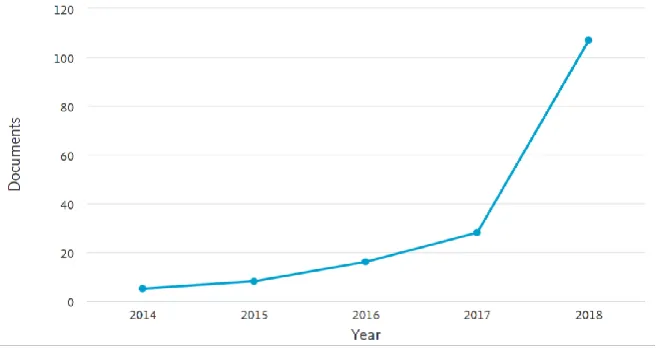
To identify the most relevant literature in the realm of using ML and DL meth-ods for smart cities and sustainable urban development we explored the web of science (WoS) and Scopus with the following search keywords: “smart cities” or “sustainable urban development” and all the existing ML and DL methods [12]. Figure.1 represents the overall research results showing the exponential growth in using the ML and DL methods for smart cities and sustainable urban development. The search in the major research databases revealed that the pop-ularity of machine learning is still limited in only a handful of ML and DL methods.
In the following the popular ML and DL methods are identified and reviewed in the classified tables based on the methods used.
2.1 Artificial neural networks in smart cities
As it is summarized in table 1, several research papers have applied artificial neural networks (ANNs) in the context of smart cities. ANNs have many appli-cations in smart cities, including hazard detection, water supply, energy, and urban transport. Ullah et al. [55], for instance, develop infrastructures for smart lightning detection system aided by ANNs. Yuan et al. [56] provide an ap-proach to improve the stability of wind turbines in smart cities. Rojek I., Studzinski J. [57] design a method to detect water leaks in smart cities utilizing neural networks. Pan et al. [58] and Vlahogianni et al. [59] have applied ANNs to provide solutions for urban transport in smart cities.
Table 1. Notable applications and contributions of ANNs in the smart cities
Literature refer-ences
Contributions Application
do-mains
Ullah et al. 2019 [55]
Utilizing artificial neural network to develop Infrastructures for the smart lightning detection system
Hazard Detection
Yuan et al. 2019 [56]
Increasing the stability of wind
Rojek and Studzinski, 2019 [57]
Providing a solution for water leaks detection utilizing neural net-works in smart cities
Water supply and energy
Pan, et al. 2019 [58]
Network traffic prediction for the smart cities using DE-BP neural network
Urban transport
Vlahogianni, et al. 2016 [59]
Developing a prediction system for
real-time parking in smart cities Urban transport
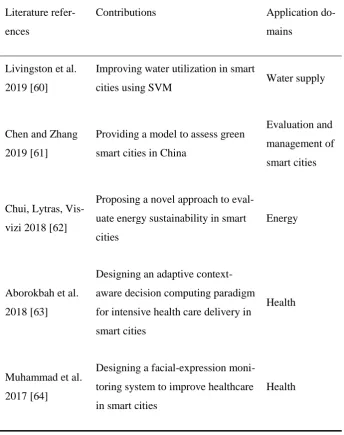
2.2 Support vector machines
Table 2. Notable applications and contributions of SVMs in the smart cities
Literature refer-ences
Contributions Application
do-mains
Livingston et al. 2019 [60]
Improving water utilization in smart
cities using SVM Water supply
Chen and Zhang 2019 [61]
Providing a model to assess green smart cities in China
Evaluation and management of smart cities
Chui, Lytras, Vis-vizi 2018 [62]
Proposing a novel approach to eval-uate energy sustainability in smart cities
Energy
Aborokbah et al. 2018 [63]
Designing an adaptive context-aware decision computing paradigm for intensive health care delivery in smart cities
Health
Muhammad et al. 2017 [64]
Designing a facial-expression moni-toring system to improve healthcare in smart cities
2.3 Tree-based models (Decision trees)
Another ML method which has been applied to solve problems of different as-pects of smart cities is Decision trees (DTs) method. As it is detailed in table 3, researchers have applied DTs to address the issues related to businesses, air pollution, urban transport, and food to develop a smart city. Ilapakurti et al. [65] formulate adaptive edge analytics for creating a memorable customer experi-ence and venue brand engagement for smart cities. Orlowski et al. [66] design business models to measure air quality for smart cities for using IoT (Internet of Things) and SaaS (software as a service). Mei, Poslad, and Du [67] design an incentive framework for an intelligent traffic system based on initiative game-theory. Vuppalapati et al. [68] design a smart dairy model using IoT sen-sor network measuring cattle’s health issues, milk production prediction, and productivity improvement.
Table 3. Notable applications and contributions of Decision trees in the smart cities
Literature refer-ences
Contributions Application
do-mains
Ilapakurti et al. 2018 [65]
Formulating adaptive edge analytics for creating a memorable customer experience and venue brand engage-ment for smart cities
Orlowski et al. 2018 [66]
Designing business models to meas-ure air quality for smart cities for us-ing IoT (Internet of Thus-ings) and SaaS (Software as a Service).
Air Pollution
Mei, Poslad, Du 2017 [67]
Designing an incentive framework for an intelligent traffic system based on initiative game-theory
Urban Transport
Vuppalapati et al. 2017 [68]
Designing a smart dairy model using IoT sensor network measuring cat-tle’s health issues, milk production prediction and productivity improve-ment
Food
2.4 Ensembles, Bayesian, hybrids, and neuro-fuzzy
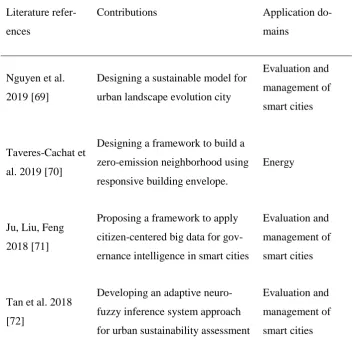
et al. [72] develop an adaptive neuro-fuzzy inference system approach for urban sustainability assessment. Finally, Sajjad et al. [73] provide a quality computer-aided blood analysis system to discover and count the white blood cells in blood samples. Their approach contributes to making the healthcare industry smart in the smart city (see table 4).
Table 4. Notable applications and contributions of ensembles, Bayesian, hy-brids, and neuro-fuzzy in the smart cities
Literature refer-ences
Contributions Application
do-mains
Nguyen et al. 2019 [69]
Designing a sustainable model for urban landscape evolution city
Evaluation and management of smart cities
Taveres-Cachat et al. 2019 [70]
Designing a framework to build a zero-emission neighborhood using responsive building envelope.
Energy
Ju, Liu, Feng 2018 [71]
Proposing a framework to apply citizen-centered big data for gov-ernance intelligence in smart cities
Evaluation and management of smart cities
Tan et al. 2018 [72]
Developing an adaptive neuro-fuzzy inference system approach for urban sustainability assessment
Sajjad et al. 2017 [73]
providing a quality computer-aided blood analysis system to the dis-cover and count the white blood cells in blood samples
Health
2.5 Deep learning
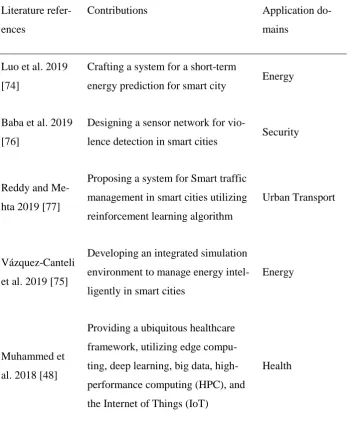
Table 5. Notable applications and contributions of Deep learning in the smart cities
Literature refer-ences
Contributions Application
do-mains
Luo et al. 2019 [74]
Crafting a system for a short-term
energy prediction for smart city Energy
Baba et al. 2019 [76]
Designing a sensor network for
vio-lence detection in smart cities Security
Reddy and Me-hta 2019 [77]
Proposing a system for Smart traffic management in smart cities utilizing reinforcement learning algorithm
Urban Transport
Vázquez-Canteli et al. 2019 [75]
Developing an integrated simulation environment to manage energy intel-ligently in smart cities
Energy
Muhammed et al. 2018 [48]
Providing a ubiquitous healthcare framework, utilizing edge compu-ting, deep learning, big data, high-performance computing (HPC), and the Internet of Things (IoT)
Obinikpo and Kantarci 2017 [78]
Providing all the applications of deep learning methods used in sensed data for prediction in smart health ser-vices
Health
Madu, Kuei, and Lee 2017 [79]
Providing a framework to evaluate urban sustainability utilizing deep learning
Evaluation and management of smart cities
3 Discussion and Conclusions
The current paper provided a comprehensive state-of-the-art of ML and DL methods used for smart cities toward urban sustainability. A novel classifica-tion is used to identify the most popular ML and DL model and review them in individual groups according to the methods used. The ANNs, SVMs, DTs, En-sembles, Bayesians, and neuro-fuzzy methods have been seen as the most used machine learning methods. The finding revealed that ML and DL methods had had remarkable contributions to the development of smart cities. It is also shown that energy, health, urban transport, evaluation and management of smart cities, water supply, businesses, air pollution, food, urban governance, security, and hazard detection are different domains of smart cities have bor-rowed ML and DL methods to deal with the similar problems.
Bayesians, hybrids, and neuro-fuzzy, deep learning) are applied to provide dif-ferent solutions for this sector. After energy, health, urban transport, and eval-uation and management of smart cities are the other smart cities domains that have had most attention by the researchers in the standard fields of ML and DL methods and smart cities where at least three different ML and DL methods are applied to address their research questions. This paper also reveals an unex-pected result, i.e., the immense popularity of DL methods. The DL methods have been seen dramatically popular in smart city applications mainly pub-lished in 2018 and 2019. This paper further identified future trends in the ad-vancement of learning algorithms for smart cities. The trend in smart cities have shown to follow the trend in the overall trend which is a shift toward the ad-vancement of the more sophisticated hybrid, ensemble and deep learning mod-els, as also shown in [80-88].
References
1. Haase, D., et al., Global Urbanization. The Urban Planet: Knowledge Towards Sustainable Cities, 2018. 19.
2. Galea, S., C.K. Ettman, and D. Vlahov, The Present and Future of Cities. Urban Health, 2019: p. 1.
3. Wang, S.J. and P. Moriarty, Urban Health and Well-Being Challenges, in Big Data for Urban Sustainability. 2018, Springer. p. 23-43.
4. Nosratabadi, S., et al., Sustainable business models: A review.
Sustainability, 2019. 11(6): p. 1663.
6. Dineva, A., et al., Review of soft computing models in design and control of rotating electrical machines. Energies, 2019. 12(6).
7. Ghalandari, M., et al., Investigation of submerged structures’ flexibility
on sloshing frequency using a boundary element method and finite
element analysis. Engineering Applications of Computational Fluid Mechanics, 2019. 13(1): p. 519-528.
8. Qasem, S.N., et al., Estimating daily dew point temperature using machine learning algorithms. Water (Switzerland), 2019. 11(3).
9. Taherei Ghazvinei, P., et al., Sugarcane growth prediction based on meteorological parameters using extreme learning machine and artificial neural network. Engineering Applications of Computational Fluid Mechanics, 2018. 12(1): p. 738-749.
10. Vargas, R., A. Mosavi, and R. Ruiz, Deep learning: a review.
Advances in Intelligent Systems and Computing, 2017.
11. Mosavi, A., A. Lopez, and A.R. Varkonyi-Koczy, Industrial applications of big data: State of the art survey, D. Luca, L. Sirghi, and C. Costin, Editors. 2018, Springer Verlag. p. 225-232.
12. Mosavi, A., P. Ozturk, and K.W. Chau, Flood prediction using machine learning models: Literature review. Water (Switzerland), 2018. 10(11).
14. Mosavi, A. and A.R. Varkonyi-Koczy, Integration of machine learning and optimization for robot learning, R. Jablonski and R. Szewczyk, Editors. 2017, Springer Verlag. p. 349-355.
15. Torabi, M., et al., A Hybrid clustering and classification technique for forecasting short-term energy consumption. Environmental Progress and Sustainable Energy, 2019. 38(1): p. 66-76.
16. Audu, A.R.A., et al., An Intelligent Predictive Analytics System for Transportation Analytics on Open Data Towards the Development of a Smart City, F.K. Hussain, L. Barolli, and M. Ikeda, Editors. 2020, Springer Verlag. p. 224-236.
17. Rebelo, F., P. Noriega, and T. Oliveira, Evaluation of the Concept of a Smart City Gamification from a User Centered Design Perspective, M.M. Soares and F. Rebelo, Editors. 2020, Springer Verlag. p. 207-219.
18. Ruzina, E.I., From information city to smart city: Russian experience of state entrepreneurship, D.B. Solovev, Editor. 2020, Springer Science and Business Media Deutschland GmbH. p. 419-430.
19. Sharifi, A., A critical review of selected smart city assessment tools and indicator sets. Journal of Cleaner Production, 2019. 233: p. 1269-1283.
20. Valdeolmillos, D., Y. Mezquita, and A.R. Ludeiro, Sensing as a service: An architecture proposal for big data environments in smart
cities, P. Novais, et al., Editors. 2020, Springer Verlag. p. 97-104.
22. Aram, F., et al., Design and validation of a computational program for analysing mental maps: Aram mental map analyzer. Sustainability (Switzerland), 2019. 11(14).
23. Asadi, E., et al., Groundwater Quality Assessment for Drinking and Agricultural Purposes in Tabriz Aquifer, Iran. 2019.
24. Asghar, M. Z.; Subhan, F.; Imran, M.; Kundi, F.M.; Shamshirband, S.; Mosavi, A.; Csiba, P.; R. Várkonyi-Kóczy, A. Performance Evaluation of Supervised Machine Learning Techniques for Efficient Detection of Emotions from Online Content. Pre-prints 2019, 2019080019 (doi: 10.20944/preprints201908.0019.v1).
25. Bemani, A.; Baghban, A.; Shamshirband, S.; Mosavi, A.; Csiba, P.; Várkonyi-Kóczy, A.R. Applying ANN, ANFIS, and LSSVM Models for Estimation of Acid Sol-vent Solubility in Supercritical CO2. Preprints 2019, 2019060055 (doi: 10.20944/preprints201906.0055.v2).
26. Choubin, B., et al., Snow avalanche hazard prediction using machine learning methods. Journal of Hydrology, 2019. 577.
27. Choubin, B., et al., An ensemble prediction of flood susceptibility using multivariate discriminant analysis, classification and regression trees, and support vector machines. Science of the Total Environment, 2019.
651: p. 2087-2096.
29. Dineva, A., et al., Multi-Label Classification for Fault Diagnosis of Rotating Electrical Machines. 2019.
30. Farzaneh-Gord, M., et al., Numerical simulation of pressure pulsation effects of a snubber in a CNG station for increasing measurement
accuracy. Engineering Applications of Computational Fluid Mechanics, 2019. 13(1): p. 642-663.
31. Ghalandari, M., et al., Flutter speed estimation using presented differential quadrature method formulation. Engineering Applications of Computational Fluid Mechanics, 2019. 13(1): p. 804-810.
32. Karballaeezadeh, N., et al., Prediction of remaining service life of pavement using an optimized support vector machine (case study of
Semnan–Firuzkuh road). Engineering Applications of Computational Fluid Mechanics, 2019. 13(1): p. 188-198.
33. Menad, N.A., et al., Modeling temperature dependency of oil - water relative permeability in thermal enhanced oil recovery processes using
group method of data handling and gene expression programming.
Engineering Applications of Computational Fluid Mechanics, 2019.
13(1): p. 724-743.
34. Mohammadzadeh, S., et al., Prediction of Compression Index of Fine-Grained Soils Using a Gene Expression Programming Model.
Infrastructures, 2019. 4(2): p. 26.
36. Mosavi, A., T. Rabczuk, and A.R. Varkonyi-Koczy, Reviewing the novel machine learning tools for materials design, D. Luca, L. Sirghi, and C. Costin, Editors. 2018, Springer Verlag. p. 50-58.
37. Mosavi, A., et al., State of the art of machine learning models in energy systems, a systematic review. Energies, 2019. 12(7).
38. Mosavi, A., et al., Prediction of multi-inputs bubble column reactor using a novel hybrid model of computational fluid dynamics and machine learning. Engineering Applications of Computational Fluid Mechanics, 2019. 13(1): p. 482-492.
39. Nosratabadi, S., et al., Sustainable business models: A review.
Sustainability (Switzerland), 2019. 11(6).
40. Rezakazemi, M., A. Mosavi, and S. Shirazian, ANFIS pattern for molecular membranes separation optimization. Journal of Molecular Liquids, 2019. 274: p. 470-476.
41. Riahi-Madvar, H., et al., Comparative analysis of soft computing techniques RBF, MLP, and ANFIS with MLR and MNLR for predicting grade-control scour hole geometry. Engineering Applications of Computational Fluid Mechanics, 2019. 13(1): p. 529-550.
42. Shabani, S.; Samadianfard, S.; Taghi Sattari, M.; Shamshirband, S.; Mosavi, A.; Kmet, T.; R. Várkonyi-Kóczy, A. Modeling Daily Pan Evaporation in Humid Cli-mates Using Gaussian Process Regression. Preprints 2019, 2019070351 (doi: 10.20944/preprints201907.0351.v1).
predict mercury emissions in Combustion Flue Gases. Preprints 2019, 2019070165 (doi: 10.20944/preprints201907.0165.v1).
44. Shamshirband, S., et al., Ensemble models with uncertainty analysis for multi-day ahead forecasting of chlorophyll a concentration in coastal
waters. Engineering Applications of Computational Fluid Mechanics, 2019. 13(1): p. 91-101.
45. Shamshirband, S., A. Mosavi, and T. Rabczuk, Particle swarm optimization model to predict scour depth around bridge pier. arXiv preprint arXiv:1906.08863, 2019.
46. Torabi, M., et al., A Hybrid Machine Learning Approach for Daily Prediction of Solar Radiation, in Lecture Notes in Networks and Systems. 2019, Springer. p. 266-274.
47. de Souza, J.T., et al., Data mining and machine learning to promote smart cities: A systematic review from 2000 to 2018. Sustainability (Switzerland), 2019. 11(4).
48. Muhammed, T., et al., UbeHealth: A personalized ubiquitous cloud and edge-enabled networked healthcare system for smart cities. IEEE Access, 2018. 6: p. 32258-32285.
49. Nagy, A.M. and V. Simon, Survey on traffic prediction in smart cities.
Pervasive and Mobile Computing, 2018. 50: p. 148-163.
51. Soomro, K., et al., Smart city big data analytics: An advanced review.
Wiley Interdisciplinary Reviews: Data Mining and Knowledge Discovery, 2019.
52. Usman, M., et al., A survey on big multimedia data processing and management in smart cities. ACM Computing Surveys, 2019. 52(3).
53. Zhao, L., et al., Routing for crowd management in smart cities: A deep reinforcement learning perspective. IEEE Communications Magazine, 2019. 57(4): p. 88-93.
54. Aram, F., et al., Design and Validation of a Computational Program for Analysing Mental Maps: Aram Mental Map Analyzer.
Sustainability, 2019. 11(14): p. 3790.
55. Ullah, I., et al., Smart Lightning Detection System for Smart-City Infrastructure Using Artificial Neural Network. Wireless Personal Communications, 2019. 106(4): p. 1743-1766.
56. Yuan, Z., W. Wang, and X. Fan, Back propagation neural network clustering architecture for stability enhancement and harmonic suppression in wind turbines for smart cities. Computers and Electrical Engineering, 2019. 74: p. 105-116.
57. Rojek, I. and J. Studzinski, Detection and localization of water leaks in water nets supported by an ICT system with artificial intelligence
methods as away forward for smart cities. Sustainability (Switzerland), 2019. 11(2).
59. Vlahogianni, E.I., et al., A Real-Time Parking Prediction System for Smart Cities. Journal of Intelligent Transportation Systems: Technology, Planning, and Operations, 2016. 20(2): p. 192-204.
60. Livingston, S.J., et al., A hybrid approach for water utilization in smart cities using machine learning techniques. International Journal of Innovative Technology and Exploring Engineering, 2019. 8(6): p. 488-493.
61. Chen, L. and H. Zhang, Evaluation of Green Smart Cities in China Based on Entropy Weight - Cloud Model. Xitong Fangzhen Xuebao / Journal of System Simulation, 2019. 31(1): p. 136-144.
62. Chui, K.T., M.D. Lytras, and A. Visvizi, Energy sustainability in smart cities: Artificial intelligence, smart monitoring, and optimization of energy consumption. Energies, 2018. 11(11).
63. Aborokbah, M.M., et al., Adaptive context aware decision computing paradigm for intensive health care delivery in smart cities—A case
analysis. Sustainable Cities and Society, 2018. 41: p. 919-924.
64. Muhammad, G., et al., A Facial-Expression Monitoring System for Improved Healthcare in Smart Cities. IEEE Access, 2017. 5: p. 10871-10881.
65. Ilapakurti, A., et al. Adaptive edge analytics for creating memorable customer experience and venue brand engagement, a scented case for
66. Orlowski, C., et al., Decision processes based on IoT data for sustainable smart cities, in Lecture Notes in Computer Science (including subseries Lecture Notes in Artificial Intelligence and Lecture Notes in Bioinformatics). 2018, Springer Verlag. p. 136-146.
67. Mei, H., S. Poslad, and S. Du, A game-theory based incentive framework for an intelligent traffic system as part of a smart city
initiative. Sensors (Switzerland), 2017. 17(12).
68. Vuppalapati, J.S., et al. Smart dairies-enablement of smart city at gross root level. 2017. Institute of Electrical and Electronics Engineers Inc.
69. Nguyen, T.A., et al., Toward a sustainable city of tomorrow: a hybrid Markov–Cellular Automata modeling for urban landscape evolution in
the Hanoi city (Vietnam) during 1990–2030. Environment, Development and Sustainability, 2019. 21(1): p. 429-446.
70. Taveres-Cachat, E., et al., Responsive building envelope concepts in zero emission neighborhoods and smart cities - A roadmap to
implementation. Building and Environment, 2019. 149: p. 446-457.
71. Ju, J., L. Liu, and Y. Feng, Citizen-centered big data analysis-driven governance intelligence framework for smart cities.
Telecommunications Policy, 2018. 42(10): p. 881-896.
73. Sajjad, M., et al., Leukocytes Classification and Segmentation in Microscopic Blood Smear: A Resource-Aware Healthcare Service in
Smart Cities. IEEE Access, 2017. 5: p. 3475-3489.
74. Luo, H., et al., A short-term energy prediction system based on edge computing for smart city. Future Generation Computer Systems, 2019.
101: p. 444-457.
75. Vázquez-Canteli, J.R., et al., Fusing TensorFlow with building energy simulation for intelligent energy management in smart cities.
Sustainable Cities and Society, 2019. 45: p. 243-257.
76. Baba, M., et al., A sensor network approach for violence detection in smart cities using deep learning. Sensors (Switzerland), 2019. 19(7).
77. Reddy, D.V.S. and R.V.K. Mehta, Smart traffic management system for smart cities using reinforcement learning algorithm. International Journal of Recent Technology and Engineering, 2019. 7(6): p. 12-15.
78. Obinikpo, A.A. and B. Kantarci, Big sensed data meets deep learning for smarter health care in smart cities. Journal of Sensor and Actuator Networks, 2017. 6(4).
79. Madu, C.N., C.H. Kuei, and P. Lee, Urban sustainability management: A deep learning perspective. Sustainable Cities and Society, 2017. 30: p. 1-17.
81. Mesri Gundoshmian, T., Ardabili, S., Mosavi, A., Varkonyi-Koczy, A.,
Prediction of combine harvester performance using hybrid machine
learning modeling and re-sponse surface methodology, Preprints 2019.
82. Ardabili, S., Mosavi, A., Varkonyi-Koczy, A., Systematic review of deep learning and machine learning models in biofuels research,
Preprints 2019.
83. Ardabili, S., Mosavi, A., Varkonyi-Koczy, A., Advances in machine learning model-ing reviewing hybrid and ensemble methods, Preprints 2019.
84. Ardabili, S., Mosavi, A., Varkonyi-Koczy, A., Building Energy information: demand and consumption prediction with Machine
Learning models for sustainable and smart cities, Preprints 2019.
85. Ardabili, S., Mosavi, A., Dehghani, M., Varkonyi-Koczy, A., Deep learning and machine learning in hydrological processes climate change and earth systems a systematic review, Preprints 2019.
86. Mohammadzadeh D., Karballaeezadeh, N., Mohemmi, M., Mosavi, A., Varkonyi-Koczy A., Urban Train Soil-Structure Interaction Modeling and Analysis, Preprints 2019.
87. Mosavi, A., Ardabili, S., Varkonyi-Koczy, A., List of deep learning models, Preprints 2019.