© 2015, IJCSMC All Rights Reserved 353 Available Online atwww.ijcsmc.com
International Journal of Computer Science and Mobile Computing
A Monthly Journal of Computer Science and Information Technology
ISSN 2320–088X
IJCSMC, Vol. 4, Issue. 4, April 2015, pg.353 – 360
RESEARCH ARTICLE
Implementation of Efficient Aggregation
Scheduling In Multihop Wireless Sensor Networks
Assistant Professor T.N.Prabhu, C.Anubharathi, B.Brindha, S.Kanchana
Information Technology, Sri Ramakrishna Engineering College, Coimbatore, India
[email protected], [email protected], [email protected], [email protected]
Abstract: Wireless sensor network consist of small sized low powered wireless nodes has spreading over a geographical area which can collaborate each other for control application. Each application consists of a control center which aggregates data from all the sensor nodes within the network. Usually data aggregation is done to compress data and save energy which introduces a possibility of time efficient method to gather data. Delay occurs often during data aggregation due to the wireless interference. The existing graph based model facilitated the improvement of efficiency, but could not reflect the superimposed effect in wireless interference and it neglected the interference of nodes beyond a certain range. The proposed physical method comprises of two algorithms which study delay efficient data aggregation scheduling with signal to interference plus noise ratio (SINR) constraints and this accounts in maximizing the throughput. The grid and partitioning method is used in the improved aggregation scheduling method which allows the transmission of data between the same color nodes while the rest of the nodes remain stable. When all the data is collected to the single hop nodes, it gets aggregated to the control centre. To further maximize the throughput greedy method called compressive scheduling where as many link as possible in each time slot can be scheduled is presented.
© 2015, IJCSMC All Rights Reserved 354 I. INTROCUTION
Introduction about Wireless Sensor Networks
A Wireless sensor networks is a group of specialized transducers with a communications infrastructure intended to monitor and record conditions at diverse locations. Commonly monitored parameters are temperature, humidity, pressure, wind direction and speed, illumination intensity, vibration intensity, sound intensity, power-line voltage, chemical concentrations, pollutant levels and vital body functions
Overview
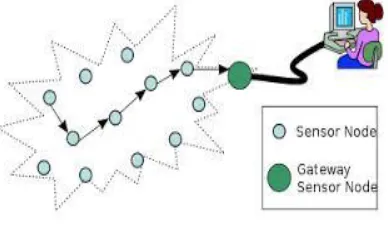
A sensor network consists of multiple detection stations called sensor nodes, each of which is small, lightweight and portable. Every sensor node is equipped with a transducer, microcomputer, transceiver and power source. The transducer generates electrical signals based on sensed physical effects and phenomena. The microcomputer processes and stores the sensor output. The transceiver, which can be hard-wired or wireless, receives commands from a central computer and transmits data to that computer. The power for each sensor node is derived from the electric utility or from a battery.
Fig 1: Network Model for WSN
The WSN is built of "nodes" – from a few to several hundreds or even thousands, where each node is connected to one or several sensors. A sensor node might vary in size from that of a shoebox down to the size of a grain of dust, although functioning "motes" of genuine microscopic dimensions have yet to be created. The topology of the WSNs can vary from a simple star network to an advanced multi-hop wireless mesh network. Size and cost constraints on sensor nodes result in corresponding constraints on resources such as energy, memory, computational speed and communications bandwidth.
Significance of Wireless Sensor Networks
Wireless sensor networks refers to a group of spatially dispersed and dedicated sensors for monitoring and recording the phys ical conditions of the environment and organizing the collected data at a central location.
Data Fusion and Dynamic Inference of Network Information
Integration of Sensor Networks and Web-Based Services
Location and Time Services
New Applications of Sensor Network: Environmental Monitoring, Healthcare, Home Automation.
QoS Issues in WSN-Based Integrated Networks
Reliability of Sensor Network and Failure Analysis
Routing Protocols for Cross Networks
Sensor Tasking, Control and Actuation
© 2015, IJCSMC All Rights Reserved 355 Architecture of Wireless Sensor Networks
A sensor node in a wireless sensor networks that is capable of performing some processing, gathering sensory information and communicating with other connected nodes in the network.
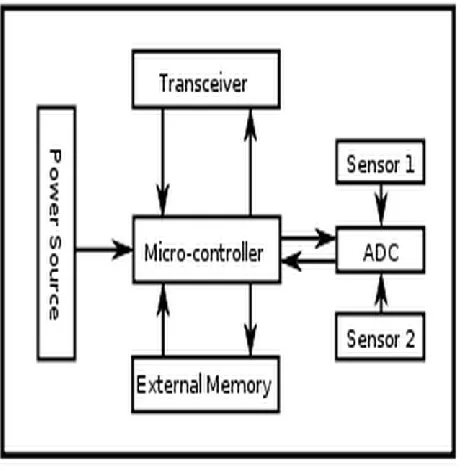
Fig 2: The Typical Architecture of the Sensor Node
The main components of a sensor node are a microcontroller, transceiver, external memory, power source and one or more
sensors. The
controller performs tasks, processes data and controls the functionality of other components in the sensornode. The functionality of both transmitter and receiver are combined into a single device known as a transceiver. The operational states are transmit, receive, idle, and sleep. Most transceivers operating in idle mode have a power consumption almost equal to the power consumed in receive mode. External memory used for storing application related or personal data, and program memory used for programming the device. An important aspect in the development of a wireless sensor node is ensuring that there is always adequate energy available to power the system. The sensor node consumes power for sensing, communicating and data processing. More energy is required for data communication than any other process. Sensors are hardware devices that produce a measurable response to a change in a physical condition like temperature or pressure. Sensors measure physical data of the parameter to be monitored. The continual analog signal produced by the sensors is digitized by an analog-to-digital converter and sent to controllers for further processing.
Applications of Wireless Sensor Networks
Area Monitoring
Area monitoring is a common application of WSNs. In area monitoring, the WSN is deployed over a region where some phenomenon is to be monitored. A military example is the use of sensors detects enemy intrusion; a civilian example is the geo-fencing of gas or oil pipelines.
Environmental/Earth Monitoring
© 2015, IJCSMC All Rights Reserved 356 Air Quality Monitoring
The degree of pollution in the air has to be measured frequently in order to safeguard people and the environment from any kind of damages due to air pollution. In dangerous surroundings, real time monitoring of harmful gases is a concerning process because the weather can change with severe consequences in an immediate manner.
Interior Monitoring
Observing the gas levels at vulnerable areas needs the usage of high-end, sophisticated equipment, capable to satisfy industrial regulations. Wireless internal monitoring solutions facilitate keep tabs on large areas as well as ensure the precise gas concentration degree.
Exterior Monitoring
External air quality monitoring needs the use of precise wireless sensors, rain & wind resistant solutions as well as energy reaping methods to assure extensive liberty to machine that will likely have tough access.
Machine Health Monitoring
Wireless sensor networks have been developed for machinery condition-based maintenance (CBM) as they offer significant cost savings and enable new functionality. In wired systems, the installation of enough sensors is often limited by the cost of wiring. Previously inaccessible locations, rotating machinery, hazardous or restricted areas, and mobile assets can now be reached with wireless sensors.
Natural Disaster Prevention
Wireless sensor networks can effectively act to prevent the consequences of natural disasters, like floods. Wireless nodes have successfully been deployed in rivers where changes of the water levels have to be monitored in real time.
Industrial Sense and Control Applications
In recent research a vast number of wireless sensor network communication protocols have been developed. While previous research was primarily focused on power awareness, more recent research have begun to consider a wider range of aspects, such as wireless link reliability, real-time capabilities, or quality-of-service. These new aspects are considered as an enabler for future applications in industrial and related wireless sense and control applications, and partially replacing or enhancing conventional wire-based networks by WSN techniques.
Overview of the Project
© 2015, IJCSMC All Rights Reserved 357
sink’s moving trajectory in advance to achieve optimized network performance, or target at collecting a small portion of sensed data in the network. A large class of Wireless Sensor Networks (WSN) applications involve a set of isolated urban areas (e.g., urban parks or building blocks) covered by sensor nodes (SNs) monitoring environmental parameters. Mobile sinks (MSs) mounted upon urban vehicles with fixed trajectories (e.g., buses) provide the ideal infrastructure to effectively retrieve sensory data from such isolated WSN fields. Existing approaches involve either single-hop transfer of data from SNs that lie within the MS’s range or heavy involvement of network periphery nodes in data retrieval, processing, buffering, and delivering tasks. These nodes run the risk of rapid energy exhaustion resulting in loss of network connectivity and decreased network life.
II. EXISTING SYSTEM
In most of the control applications in wireless sensor networks (WSN), the time of utilizing the data is critical under data aggregation task often comes with a stringent delay constraint imposed by applications. Here, the delay of data aggregation is the duration from the time when the first wireless node transmits for the task, to the time when the control centre receives all aggregated data. One promising way of minimizing the delay is to maximize the throughput while the data transmissions in wireless sensor networks face a fundamental challenge of wireless interference. The previous works focused on graph based models [1], [2] which served as a useful abstraction of WSNs which facilitates the process of designing protocols and proving their efficiency but they cannot reflect the superimposed effect of wireless interference. Although the interference from one transmitter may be relatively small, the accumulated interference of several nodes can be sufficiently high to corrupt the transmission. Also graph based models are localized interference models and simply neglect interference of nodes beyond a certain range. The other model used was, the physical model [3] which represented wireless interference more realistically and practically. In this model, a signal is received successfully if the signal to interference-plus-noise ratio (SINR) is above the hardware defined threshold. This definition of a successful transmission accounts for interference generated by distant transmitters, thus can capture the interference between links more accurately. For data aggregation with SINR constraints, the superimposed interference must be taken care of. The effect of potential interference from far-away nodes makes it difficult to ensure that all active links satisfy SINR constraints. The SINR at each receiver node depends on which the transmissions are being scheduled concurrently in each time slot. This makes the construction of simple conflict graph tedious and so the analysis of algorithm becomes more challenging than in graph-based models.
III. SCHEDULING ALGORITHM
Creating multi hop wireless sensor network
Wireless sensor networks are created with a control center (sink node). All the nodes send the data to the control center, where the data aggregation takes place. The transmission range for each node is calculated and it is seen that no interference takes place. Before the algorithm is designed the routing tree is constructed.
Routing
© 2015, IJCSMC All Rights Reserved 358 Constructing Distributed Scheduling Algorithm (DSA)
Distributed aggregation scheduling algorithm is constructed based on the routing tree T. Algorithm consists of two phases: 1) dominators gather data from dominatees, 2) data gathering toward the sink node vs. In the first phase, the single-hop data transmissions from dominatees to dominators is scheduled and it is split into several rounds. In each round, every dominator u selects a link from one of its neighbouring dominatees to itself and a set of selected links is transmitted. To avoid interference of data transmission, a pair of links transmitting concurrently, are to be separated well apart. The second phase is proceeded in bottom-up manner that is from lower level to bottom-upper level. This process consists of two steps: 1) every dominator aggregates its data to its corresponding connectors; 2) every connector transmits its data to the dominator in the upper level.
Each node u maintains some local variables in its buffer:
Type. Type[u] ϵ {L, D, C}: To indicate the type of the node u. The character “L” represents leaf node in the routing tree T, “D” represents dominator, and “C” represents connector.
Level. Level[u] ϵ IN,: To indicate the level of the node u in the BFS tree.
Color. color[u] ϵ {0, 1, . . k2-1}: To indicate the color of the grid where the node u lies.
Number of children. NoC[u]: The number of children nodes of u in tree T.
Time slot to transmit.TST[u]: The assigned time slot that node u indeed sends its data to its parent.
The TST of all nodes are initialized to 0. By running the algorithm, the TST of all nodes are set gradually. If each node transmits at the time slot equal to TST, the sink node will receive the aggregated data of all nodes correctly.
Designing Improved Aggregation Scheduling (IAS)
The improved aggregation scheduling algorithm improves the delay of the distributed algorithm. This algorithm also consists of two phases Similar to our distributed scheduling algorithm. In the first phase, every dominator aggregates the data from all its dominatees, as same as the method as used in the distributed algorithm. In the second phase, dominators aggregate their data toward the sink node vs via the routing tree. The main idea of the second phase is to proceed data transmissions level by level in the routing tree. For each level, the dominators at this level will try to gather all the data from other dominators in lower levels that have not been aggregated. This process consists of two steps: 1) every dominator aggregates its data to its corresponding connectors. The grid partitioning and colouring method is applied. Each dominator is assigned a time slot to transmit based on its colour. Each grid contain at most one dominator, and so two dominators of the same colour will transmit concurrently. 2) Every connector transmits its data to the dominator in the upper level. In this step, for each connector, transmission time is assigned based on the colour of one of its children instead of itself.
IV. SIMULATION RESULTS
© 2015, IJCSMC All Rights Reserved 359 Fig 3:End to End Latency of sensor nodes
Fig 4 : Packet Drop
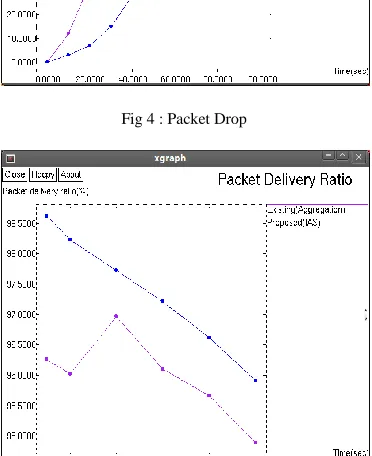
Fig 5 : Packet Delivery Ratio
© 2015, IJCSMC All Rights Reserved 360 V. CONCLUSION AND FUTURE ENHANCEMENT
CONCLUSION
The two delay efficient aggregation scheduling algorithms namely, distributed aggregation scheduling and improved aggregation scheduling was proposed under the physical interference model in Wireless Sensor Network. It made use of the grid and partitioning method which allowed the transmission of data only between two same coloured nodes. This reduced the packet loss due to wireless interference which was considered as the major problem in wireless sensor networks.
FUTURE ENHANCEMENT
The future enhancements includes, the improvement of approximation ratio of the proposed algorithm, to design efficient data
aggregation method that has the asymptotically optimum performance guarantee compared with the optimum delay using G(V,r) and to
extend the proposed algorithms to deal with a more general path-loss model.
REFERENCES
[1] P. Wan, C. Scott, L. Wang, Z. Wan, and X. Jia, “Minimum-Latency Aggregation Scheduling in Multihop Wireless Networks”, Proc. ACM MobiHoc, 2009.
[2] L.J. Yu Bo and Y. Li, “Distributed Data Aggregation Scheduling in Wireless Sensor Networks”, Proc. IEEE INFOCOM, 2009.
[3] X. Xu, X. Li, P. Wan, and S. Tang, “Efficient Scheduling for Periodic Aggregation Queries in Multihop Sensor Networks”, IEEE/ACM Trans. Networking, vol. 20, no. 3, pp. 690-698, June 2012.
[4]X. Xu, X. Li, X. Mao, S. Tang, and S. Wang, “A Delay Efficient Algorithm for Data Aggregation in Multi-Hop Wireless Sensor
Networks”, IEEE Trans. Parallel Distributed Systems, vol. 22, no. 1, pp. 163-175, Jan. 2011.