Co-Parsing with Competitive Models
Lidia KhmylkoNatural Language Systems Group University of Hamburg, Germany [email protected]
Kilian A. Foth
smartSpeed GmbH & Co. KG Hamburg, Germany [email protected]
Wolfgang Menzel
Natural Language Systems Group University of Hamburg, Germany [email protected]
Abstract
We present an asymmetric approach to a run-time combination of two parsers where one component serves as a predic-tor to the other one. Predictions are inte-grated by means of weighted constraints and therefore are subject to preferential decisions. Previously, the same architec-ture has been successfully used with pre-dictors providing partial or inferior infor-mation about the parsing problem. It has now been applied to a situation where the predictor produces exactly the same type of information at a fully competitive qual-ity level. Results show that the combined system outperforms its individual compo-nents, even though their performance in isolation is already fairly high.
1 Introduction
Machine learning techniques for automatically ac-quiring processing models from a data collec-tion and tradicollec-tional methods of eliciting linguistic knowledge from human experts are usually con-sidered as two alternative roadmaps towards nat-ural language processing solutions. Since the re-sulting components exhibit quite different perfor-mance characteristics with respect to coverage, ro-bustness and output quality, they might be able to provide some kind of complementary information, which could even lead to a notable degree of syn-ergy between them when combined within a single system solution.
For the task of dependency parsing, the high potential for such a synergy has indeed been demonstrated already (e.g. Zeman and ˇZabokrtsk´y (2005), Foth and Menzel (2006)).
A popular approach for combining alterna-tive decision procedures is voting (Zeman and ˇZabokrtsk´y, 2005). It makes use of a symmet-ric architecture, where a meta component chooses from among the available candidate hypotheses by means of a (weighted) voting scheme. Such an ap-proach not only requires the target structures of all components to be of the same kind, but in case of complex structures like parse trees also requires sophisticated decision procedures which are able to select the optimal hypotheses with respect to ad-ditional global constraints (e.g. the tree property). Since this optimization problem has to be solved by the individual parser anyhow, an asymmetric architecture suggests itself as an alternative.
In asymmetric architectures, a master compo-nent, i.e. a full fledged parser, is solely in charge of deciding on the target structure, whilst the others (so called helper or predictor components) provide additional evidence which is integrated into the global decision by suitable means. Such a scheme has been extensively investigated for the Weighted Constraint Dependency Grammar, WCDG (Foth, 2006). External evidence from the predictor com-ponents is integrated by means of constraints, which check for compatibility between a local structure and a prediction, and penalize this hy-pothesis in case of a conflict. So far, however, all the additional information sources which have been considered in this research differed consider-ably from the master component: They either fo-cused on particular aspects of the parsing problem (e.g. POS tagging, chunking, PP attachment), or used a simplified scheme for structural annotation (e.g. projective instead of non-projective trees).
This paper takes one step further by investigat-ing the same architecture under the additional con-dition that (1) the helper component provides the
very same kind of target structure as the master, and (2) the quality levels of each of the compo-nents in isolation are considered.
As a helper component MSTParser (McDon-ald, 2006), a state-of-the-art dependency parser for non-projective structures based on a discrimina-tive learning paradigm, is considered. The accu-racy of MSTParser differs insignificatly from that of WCDG with all the previously used helper com-ponents active.
Section two introduces WCDG with a special emphasis on the soft integration of external ev-idence while section three describes MSTParser which is used as a new predictor component. Since parsing results for these systems have been re-ported in quite different experimental settings we first evaluate them under comparable conditions and provide the results of using MSTParser as a guiding predictor for WCDG in section four and discuss whether the expected synergies have re-ally materialized. Section five concentrates on a comparative error analysis.
2 WCDG
The formalism of a Constraint Dependency Gram-mar was first introduced by Maruyama (1990) and suggests modeling natural language with the help of constraints. Schr¨oder (2002) has extended the approach to Weighted Constraint Dependency Grammar, WCDG, where weights are used to fur-ther disambiguate between competing structural alternatives. A WCDG models natural language as labeled dependency trees and is entirely declar-ative. It has no derivation rules — instead, con-straints license well-formed tree structures. The reference implementation of WCDG for the Ger-man language used for the experiments described below contains about 1,000 manually compiled constraints.1
Every constraint of the WCDG carries aweight, also referred to as apenalty, in the interval from zero to one, a lower value of the weight re-flects its greater importance. Constraints having zero weights are referred to ashard and are used for prohibitive rules. Constraints with a weight greater than zero, also calleddefeasible, may ex-press universal principles or vague preferences for language phenomena.
1Freely available from http://nats-www. informatik.uni-hamburg.de/view/CDG/ DownloadPage
Attempts have been made to compute the weights of a WCDG automatically by observing which weight vectors perform best on a given cor-pus, but the computations did not bring any sig-nificant improvements to the manually assigned scored (Schr¨oder et al., 2001). Empirically, the absolute values of defeasible constraints usually do not matter greatly as long as the relative impor-tance of the rules remains preserved so that typical constructions are preferred, but seldom variations are also allowed. Thus, the values of weights of the WCDG constraints have to be determined by the grammar writer experimentally.
If a set of dependency edges in a parse found by the system violates any of the constraints, it is reg-istered as aconstraint violationbetween the struc-ture and the rules of the language. Thescoreof an analysis is the product of all the weights for con-straint violations occurring in the structure. It be-comes possible to differentiate between the qual-ity of different parse results: the analysis with a higher score is considered preferable. Although, under these conditions, an analysis having only a few grave conflicts may be preferred by the system against another one with a great number of smaller constraint violations, but it ensures that an analysis which violates any of the hard constraints always receives the lowest possible score.
The parsing problem is being treated in the WCDG system as a Constraint Satisfaction Prob-lem. While a complete search is intractable for such a problem, transformation-based solution methods provide a reliable heuristic alternative. Starting with an initial guess about the optimal tree, changes of labels, subordinations, or lexi-cal variants are applied, with constraint violations used as a control mechanism guiding the transfor-mation process (Foth et al., 2000).
A transformation-based search cannot guaran-tee to find the best solution to the constraint sat-isfaction problem. Compared to the resource re-quirements of a complete search, however, it is not only more efficient, but can also be interrupted at any time. Even if interrupted, it will always return an analysis, together with a list of constraint viola-tions it was not able to remove. The algorithm ter-minates on its own if no violated constraints with a weight above a predefined threshold remain. Al-ternatively, a timeout condition can be imposed.
to external predictor components. Thus, the for-malism turned out to be flexible enough to incor-porate other sources of knowledge into the de-cision process on the optimal structural interpre-tation. Foth and Menzel (2006) have reported about five additional statistical components that have been successfully integrated into WCDG: POS tagger, chunker, supertagger, PP attacher and a shift-reduce oracle parser. They have also shown that the accuracy improves if multiple compo-nents interact and consistent predictions no longer can be guaranteed. Even thought previously in-tegrated predictor components have an accuracy that is mostly — with the exception of the tag-ger — below that of the parser itself, WCDG not only avoids error propagation successfully, it also improves its results consistently with each compo-nent added.
3 MSTParser
MSTParser (McDonald, 2006) is a state-of-the-art language independent data-driven parser. It pro-cesses the input in two separate stages. In the first, the dependency structure is determined, labeling is applied to it successively in the second. The rea-sons of its efficiency lie in the successful combi-nation of discriminative learning with graph-based solution methods for the parsing problem.
In this edge-factored graph-based model, each edge of the dependency graph is assigned a real-valued score by its linear model. The score of the graph is defined as the sum of its edge scores.
If a scoring function for edges is known, the parsing problem becomes equivalent to finding the highest scoring directed spanning tree in the com-plete graph over the given sentence, and the cor-rect parse can be obtained by searching the space of valid dependency graphs for a tree with a max-imum score.
This formalism allows to find efficient solutions for both projective and non-projective trees. When only features over single edges are taken into ac-count, the complexity falls to O(n2) (McDonald et al., 2005).
Not only a single edge, but also adjacent edges may be included into the scoring function. As a result, intractability problems arise for the non-projective algorithm, but an efficient approximate algorithm based on exhaustive search is provided for this case (McDonald et al., 2006). This
algo-rithm was also used for our experiments.2
The parsing model of MSTParser has the advan-tage that it can be trained globally and eventually be applied with an exact inference algorithm. On the other hand, the parser has only limited access to the history of parsing decisions. To avoid com-plexity problems, the scores (and the feature rep-resentations) are restricted to a single edge or ad-jacent edges. Outsourcing labeling into a separate stage comes at the price of not being able to com-bine knowledge about the label and the structure it is attached to. Such combined evidence, however, might be helpful for some disambiguation prob-lems.
4 Guiding WCDG by Predictions of MSTParser
MSTParser predictions are integrated into the de-cision procedure of WCDG by means of two ad-ditional constraints, which monitor each depen-dency hypothesis for being in accord with the pre-diction and penalize it if a mismatch has been found. One of the constraints checks the attach-ment point being the same, while the other takes care of the dependency label.
To properly adjust the weights of these con-straints, it has to be determined how valuable the information of the predictor is relative to the infor-mation already present in the system. This grada-tion is needed to establish a balance between the influence of the grammar and the predictor. Ac-cording to the scoring principles of WCDG, a low weight strongly deprecates all deviations from the prediction, thus forcing the system to follow them almost without exception. Higher weights, on the other hand, enable the grammar to override a pre-diction. This, however, also means that predic-tions have less guiding effect of the transformation process. Typically for WCDG, the best suitable weights have to be tuned on development data.
To determine the best constraint weights the WCDG grammar has been extended with three additional constraints similar to those used for the shift-reduce predictor in the previous experi-ments (Foth, 2006). Two of them advise WCDG on the structural information available from the MSTParser result and one fetches the edge label predicted.
weight for the attachment predictions has been ad-justed to 0.75. Compared to a weight of 0.9 for the shift-reduce parser, this is a rather strong in-fluence, which also reflects the differences in the reliability of these two information sources. With a weight of 0.9, the integration of the label predic-tions is considerably weaker, which is consistent with their lower degree of accuracy.
Evaluation
The most common general measures for the qual-ity of dependency trees are structural accuracy
that points out the percentage of words correctly attached to their head word, andlabeled accuracy
which is the ratio of the correctly attached words which also have the correct label. Still, it is dif-ficult to directly compare the results reported for different parsers, as the evaluation results are in-fluenced by the data used during the experiment, the domain of the data, and different annotation guidelines. Moreover, the particular kind of POS information might be relevant, which either can be obtained from the manual annotations or be pro-vided by a real tagger. Even such a condition as the treatment of punctuation has not yet be-come a standard. Following the evaluation proce-dure in the CoNLL-X shared task (Buchholz and Marsi, 2006), we will not include punctuation into the performance measures, as was done in previ-ous WCDG experiments (Foth and Menzel, 2006). The source of POS tagging information will need to be specified in each individual case.
All the evaluations were performed on a thou-sand sentences (18,602 – 19,601) from the NEGRA treebank, the same data set that was pre-viously used in the performance evaluations of WCDG, e.g. in (Foth, 2006). The NEGRA treebank is a collection of newspaper articles; in the original, it stores phrase structure annotations. These have been automatically translated into de-pendency trees and then manually corrected to bring them in accord with the annotation guide-lines of WCDG. The major difference consists in a different treatment of non-projectivity, where WCDG only allows non-projectivity in the attach-ment of verbal arguattach-ments, relative clauses and co-ordinations, i.e., the cases where it helps to de-crease ambiguity. Furthermore, corrections were applied when the annotations of NEGRA itself turned out to be inconsistent (usually in connec-tion with co-ordinated or elliptical structures,
ad-verbs and subclauses).
Unfortunately, these manually corrected data were only available for a small part (3,000 sen-tences) of the NEGRA corpus, which is not sufficient for training MSTParser on WCDG-conforming tree structures. Previous evaluations of the MSTParser have used much larger train-ing sets. E.g., during the CoNLL-X shared task 39,216 sentences from the TIGER Treebank (Brants et al., 2002) were used.
Therefore, we used20,000sentences from the online archive ofwww.heise.deas an alterna-tive training set. They have been manually an-notated according to the WCDG guidelines (and are referred toheisetickerin the following)3.
The texts in this corpus are all from roughly the same domain as in NEGRA, and although very many technical terms and proper nouns are used, the sentences have only a slightly longer mean length compared to the NEGRA corpus.
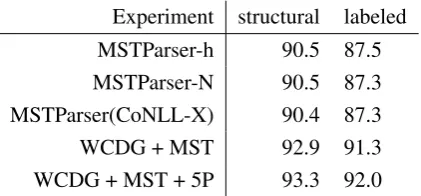
Using POS tags from the gold annotations, MSTParser achieves 90.5% structural and87.5% labeled accuracy on the aforementioned NEGRA test set (Table 1). Even a model trained on the inconsistent NEGRA data excluding the test set reaches state-of-the-art90.5and87.3%for struc-tural and labeled accuracy respectively, despite the obvious mismatch between training and test data. This performance is almost the same as the 90.4%/87.3%reported on the TIGER data during the CoNLL-X 2006 shared task.
Experiment structural labeled MSTParser-h 90.5 87.5 MSTParser-N 90.5 87.3 MSTParser(CoNLL-X) 90.4 87.3 WCDG + MST 92.9 91.3 WCDG + MST + 5P 93.3 92.0
Table 1: Structural/labeled accuracy results with POS tagging from the gold standard. WCDG — no statistical enhancements used. MSTParser-h — MSTParser trained on tMSTParser-heheiseticker. MSTParser-N — MSTParser trained on NEGRA. 5P — with all five statistical predictors of WCDG.
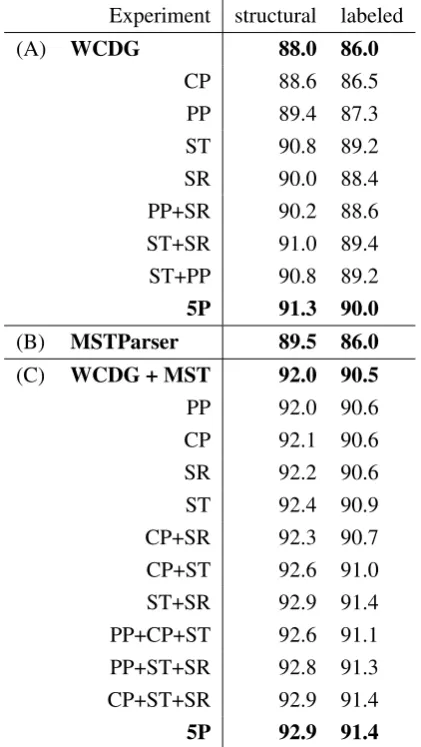
percent to89.5%/86.0%(Table 2 (B)). All the re-sults obtained with a real POS tagger are summa-rized in Table 2. For comparison, under the same evaluation conditions, the performance of WCDG with different predictors is summarized in Table 2 (A).
Experiment structural labeled
(A) WCDG 88.0 86.0
CP 88.6 86.5 PP 89.4 87.3 ST 90.8 89.2 SR 90.0 88.4 PP+SR 90.2 88.6 ST+SR 91.0 89.4 ST+PP 90.8 89.2
5P 91.3 90.0
(B) MSTParser 89.5 86.0
(C) WCDG + MST 92.0 90.5
PP 92.0 90.6 CP 92.1 90.6 SR 92.2 90.6 ST 92.4 90.9 CP+SR 92.3 90.7 CP+ST 92.6 91.0 ST+SR 92.9 91.4 PP+CP+ST 92.6 91.1 PP+ST+SR 92.8 91.3 CP+ST+SR 92.9 91.4
5P 92.9 91.4
Table 2: Structural/labeled accuracy results with a real POS tagger. (A) WCDG experiments with different statistical enhancements (B) MSTParser experiment with a real POS tagger. (C) Com-bined experiments of WCDG and MSTParser with other statistical enhancements of WCDG. CP — chunker, ST — supertagger, PP — prepositional attacher, SR — shift-reduce oracle parser, 5P — POS + CP + PP + ST + SR.
The combined experiments in which MSTParser was used as a predictor for WCDG have achieved higher accuracy than each of the combined com-ponents in isolation: the structural accuracy rises to92.0%while the labeled accuracy also gets over the90%-boundary (WCDG + MST experiment in
Table 2 (C)) .
Finally, the MSTParser predictor was evaluated in combination with the other predictors avail-able for WCDG. The results of the experiments are shown in Table 2 (C). Every combination of MSTParser with other predictors (first four exper-iments) improves the accuracy. The increase is highest (0.4%) for the combination with the su-pertagger. This confirms earlier experiments with WCDG, in which the supertagger also contributed the largest gains.
The experimental results again confirm that WCDG is a reliable platform for information in-tegration. Although the use of multiple predictors does not lead to an accumulation of the individual improvements, the performance of predictor com-binations is always higher that using them sepa-rately. A maximum performance of92.9%/91.4% is reached with all the six available predictors ac-tive. For comparison, the same experiment with POS tags from the gold standard has achieved even better results of93.3%/92.0%(Table 1).
Unfortunately, the PP attacher brings accuracy reductions when it is working parallel to the shift-reduce predictor (experiment PP + CP + SR in Ta-ble 2 (C)). This effect has already been observed in the experiments that combined the two alone (experiment PP + SR in Table 2 (A)). When MST was combined with the PP attacher (experiment PP in Table 2 (C)), the increase of the performance was also below a tenth of a percent. The possible reasons why the use of an additional information source does not improve the performance in this case may be the disadvantages of the PP attacher compared to a full parser.
5 Error Analysis
A very useful property of WCDG is that it not only can be used as a parser, but also as a diagnostic tool for dependency structures. Applied to a given dependency tree, any constraint violation reported by the constraint solver indicates an inconsistency between the structure and the WCDG constraint grammar.
Among the most frequent hard constraint vio-lations found in the MSTParser results are double subjects, double objects and direct objects in pas-sive, projectivity violations, conjunctions without a clause as well as subordinate clause without con-junction.
McDonald and Nivre (2007). For example, the errors in distinguishing noun complements of the verb may be due to the fact that MSTParser is more precise for longer dependency arcs and has no access to the parsing history.
In absolute figures, MSTParser commits 1509 attachment errors of which 902 are corrected by WCDG. On the other hand, WCDG adds another 542 errors of its own, so that the final result still contains 1149 errors.
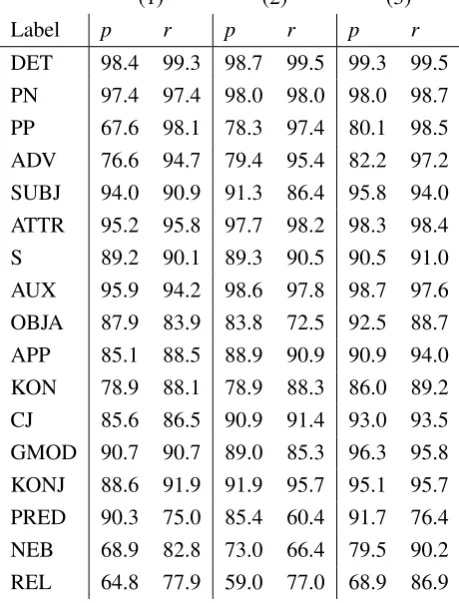
For most labels, accuracy of the predictor com-bination is higher than in each of the parsers alone. A particularly large gain has been observed for coordinated elements (KON and CJ), subor-dinate (NEB) and relative (REL) clauses, indi-rect accusative objects (OBJA), genitive modifiers (GMOD) and apposition (APP). Table 3) summa-rizes the values of structural precision, the ratio of the number of correct attachment of a given label to the number of all the predictions for that label made by the parser, and label recall, the ratio be-tween the number of correct labeling decisions and desired labeling.
In this respect, the increase in the structural pre-cision of the PP attachment seems worth men-tioning. MSTParser attaches 79.3% of PPs cor-rectly on the used test set. Although MSTParser does not use any special PP-attachment resolu-tion mechanisms, it is comparable with the re-sult of WCDG combined with the PP attacher that achieves78.7%structural precision for PP edges.
If MSTParser is trained on NEGRA exclud-ing the test set — the rest of NEGRA lackexclud-ing consistence mentioned above — it performs even better, attaching 80.4% of PP-s correctly. Thus, MSTParser as a statistical parser trained on a full corpus becomes a strong competitor for a PP at-tacher that has been trained on restricted four-tuples input.
As for the errors in the MSTParser output that are most often corrected in the hybrid experiment, this happens for both the structural precision and label recall of most verb complements, such as di-rect and indidi-rect objects, or clausal objects as well as for subordinate and relative clauses for such subordinate clauses.
It even comes to one case in which the synergy took place in spite of the incorrect predictions. Al-though MSTParser has predicted possessive modi-fiers more seldom than WCDG alone (the label re-call of MSTParser for possessive modification was
(1) (2) (3)
Label p r p r p r
DET 98.4 99.3 98.7 99.5 99.3 99.5 PN 97.4 97.4 98.0 98.0 98.0 98.7 PP 67.6 98.1 78.3 97.4 80.1 98.5 ADV 76.6 94.7 79.4 95.4 82.2 97.2 SUBJ 94.0 90.9 91.3 86.4 95.8 94.0 ATTR 95.2 95.8 97.7 98.2 98.3 98.4 S 89.2 90.1 89.3 90.5 90.5 91.0 AUX 95.9 94.2 98.6 97.8 98.7 97.6 OBJA 87.9 83.9 83.8 72.5 92.5 88.7 APP 85.1 88.5 88.9 90.9 90.9 94.0 KON 78.9 88.1 78.9 88.3 86.0 89.2 CJ 85.6 86.5 90.9 91.4 93.0 93.5 GMOD 90.7 90.7 89.0 85.3 96.3 95.8 KONJ 88.6 91.9 91.9 95.7 95.1 95.7 PRED 90.3 75.0 85.4 60.4 91.7 76.4 NEB 68.9 82.8 73.0 66.4 79.5 90.2 REL 64.8 77.9 59.0 77.0 68.9 86.9
Table 3: Per label structural precision (p, %) and label recal (r, %) in comparison for the experiments with the real POS tagger (1) WCDG, (2) MSTParser, (3) WCDG combined with MSTParser
over5%below that of WCDG) its structural pre-cision and label recall in the combined experiment are by around6%greater than WCDG result.
Cases in which WCDG performs worse with the predictor than its predictor alone can hardly be found. Still, one may observe many cases in which the predictor has a negative influence on the per-formance of WCDG, such as for different kinds of objects (indirect objects, object clauses and infini-tive objects) and parenthetic matrix clauses. For all, the result of MSTParser was below that of the baseline WCDG with only the POS tagger ac-tive. Same can be said about the labeled accu-racy for split verb prefixes and nominal time ex-pressions. This worsening effect can be attributed to the lower values of the WCDG constraints for the corresponding labels and edges than for the MSTParser predictor. Thus, the search could not find a decision scoring better than that when the MSTParser prediction has been followed.
not projective. The accuracy of MSTParser on the projective sentences of the test set is higher than that on the non-projective sentences by more than 3 percent (Table 4), although these values can-not be compared directly as the mean length of non-projective sentences is longer (25.0vs. 15.3 words).
Experiment Non-proj. Proj. MSTParser (POS) 88.2 91.7
WCDG (POS) 87.2 90.2
WCDG (POS + SR) 88.7 92.2 WCDG (POS + MST) 91.3 93.6
Table 4: Structural accuracy, (%), for different parsing runs for non-projective vs. projective sen-tences.
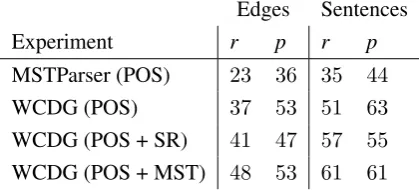
MSTParser generally tends to find many more non-projective edges than the data has, while the precision remains restricted. The number of non-projective edges was determined by counting how often an edge crosses some other edge. Thus, if a non-projective edge crossed three other edges the number of non-projective edges equals three. For MSTParser experiments with a real POS tag-ger (MSTParser POS-experiment in Table 5), the projective edge recall, the ratio of the non-projective edges found in the experiment to the corresponding value in the gold standard, is at 23% and non-projective edge precision, the ratio of the correctly found non-projective edges to all non-projective edges found, is also only36% (sec-ond column in Table 5).
Edges Sentences
Experiment r p r p
MSTParser (POS) 23 36 35 44
WCDG (POS) 37 53 51 63
WCDG (POS + SR) 41 47 57 55 WCDG (POS + MST) 48 53 61 61
Table 5: Recall (r,%) and precision (p,%) of the non-projective edges and sentences for different parsing runs.
Precision and recall of non-projective sentences is a less rigid measure. If at least one edge-crossing is correctly identified in a non-projective sentence, it is added to the correctly identified
non-projective sentences, even if the identified edge-crossing is not the one annotated in the gold standard and the ratios are calculated respectively (right column of Table 5). Under these relaxed conditions, MSTParser correctly identifies slightly less than a half of the non-projective sentences and over a third of non-projective edges. In fact, WCDG under the same conditions (WCDG POS-experiment in Table 5) has a non-projective sen-tence precision of63%and a non-projective edge precision of53%. Still, WCDG misses a consid-erable amount of non-projectivities. More impor-tantly, as the present shift-reduce predictor has not been designed for non-projective parsing, its in-clusion reduces the non-projective sentence and edge precision of WCDG — to55%and47% re-spectively — WCDG (POS+SR) in Table 5.
The expected benefits for the non-projective sentences have not yet been observed to the full extent. The precision of the combined system to find non-projective sentences and edges remained limited by the performance that WCDG was able to achieve alone (WCDG (POS+MST) in Table 5). While MSTParser in many cases predicts non-projectivity correctly WCDG is seldom capable of accepting this external evidence. On the contrary, WCDG often accepts an incorrect projective solu-tion of the predictor instead of relying on its own cues. In its interaction with external predictors WCDG should typically decide about the alterna-tives.
6 Related Work
So far, approaches to hybrid parsing have been mainly based on the idea of a post-hoc selec-tion which can be carried out for either complete parses, or individual constituents and dependency edges, respectively. The selection component it-self can be based on heuristics, like a majority vote. Alternatively, a second-level classifier is trained to decide which component to trust under which conditions and therefore the approach is of-ten referred to as classifier stacking.
similarity-based measure for complete trees. Tests on Penn Treebank data showed a clear improve-ment of the combined results over the best individ-ual parser. Constituent selection outperformed the complete parse selection scheme, and Bayesian se-lection was slightly superior.
Instead of coupling different data-driven parsers which all provide comparable analyses for com-plete sentences, Rupp et al. (2000) combined dif-ferently elaborated structural descriptions (namely chunks and phrase structure trees) obtained by data-driven components with the output of a HPSG-parser. Driven by the requirements of the particular application (speech-to-speech transla-tion), the focus was not only on parse selection, but also on combining incomplete results. How-ever, no quantitative evaluation of the results has been published.
Zeman and ˇZabokrtsk´y (2005) applied the se-lection idea to dependency structures and extended it by using more context features. They com-bined seven different parsers for Czech, among them also a system based on a manually com-piled rule set. Some of the individual parsers had a fairly poor performance, but even a simple vot-ing scheme on svot-ingle edges contributed a signifi-cant improvement while the best results have been obtained for a combination that did not include the worst components. Alternatively the authors experimented with a trained selection component which not only had access to the alternative local parsing results, but also to their structural context. Neither a memory-based approach nor a model based on decision trees did result in further gains. In two separate experiments, Sagae and Lavie (2006) combined a number of dependency and constituent parsers, respectively. They created a new weighted search space from the results of the individual component parsers using different weighting schemes for the candidates. They then reparsed this search space and found a consistent improvement for the dependency structures, but not for the constituent-based ones.
While all these approaches attempt to integrate the available evidence at parse time, Nivre and McDonald (2008) pursued an alternative architec-ture, where integration is achieved already at train-ing time. They combined the two state-of-the-art data-driven dependency parsers, MaltParser (Nivre et al., 2006) and MSTParser (McDonald et al., 2006), by integrating the features of each of the
classifiers into the parsing model of the other one at training time. Since the two parsers are based on quite different model types (namely a history-based vs. a structure-history-based one), they exhibit a remarkable complementary behavior (McDonald and Nivre, 2007). Accordingly, significant mutual benefits have been observed. Note, however, that one of the major benefits of MaltParser, its incre-mental left-to-right processing, is sacrificed under such a combination scheme.
Martins et al. (2008) use stacked learning to overcome the restriction to the single-edge fea-tures in both MaltParser and MSTParser. They suggest an architecture with two layers, where the output of a standard parser in the first level pro-vides new features for a parser in the subsequent level. During the training phase, the second parser learns to correct mistakes made by the first one. It allows to involve higher-order predicted edges to simulate non-local features in the second parser. The results are competitive with McDonald and Nivre (2007) whileO(n2)runtime of the spanning tree algorithm is preserved.
7 Conclusion
Integrating MSTParser as a full predictor with WCDG is beneficial for both of them. Since these systems take their decisions based on completely different sources of knowledge, combining both helps avoid many mistakes each of them commits in isolation. Altogether, with a real POS tagger, an accuracy level of92.9%/91.3%has been reached (the last row in Table 2 (C)), which is higher than what any of the parsers achieved alone. With POS tagging from the gold standard, the accuracy has been at93.3%/92.0%(the last row in Table 1). To the knowledge of the authors, these accuracy val-ues are also better than any previous parsing re-sults on the NEGRA test set.
WCDG can profit from the combination not only with ancillary predictors for specific parsing subtasks, but also with another full parser. This result was achieved even though the second parser is very similar to WCDG with respect to both the richness and the accuracy of its target structures. The probable reason lies in the considerable dif-ference in the error profiles of both systems as re-gards specific linguistic phenomena. WCDG was also used as a diagnostic tool for the errors of MSTParser.
achieved if a stronger coupling of the compo-nents were established by also using the scores of MSTParser as additional information for WCDG, reflecting the intuitive notion of preference or plausibility of the predictions. This could be done for the optimal parse tree alone as well as for the complete hypothesis space. Alternatively, the out-put of MSTParser can be used as a initial state for the transformation procedure of WCDG. Vice versa, MSTParser could be enriched with addi-tional features based on the output of WCDG, sim-ilar to the feature-based integration of data-driven parsers evaluated by Nivre and McDonald (2008). At the moment, the integration constraints treats all attachment and label predictions as being uni-formly reliable. To individualize them with re-spect to their type or origin could not only make the system sensitive to qualitative differences be-tween predictions (for instance, with respect to different labels). It would also allow the parser to accommodate multiple oracle predictors and to carefully distinguish between typical configura-tions in which one prediction should be preferred over an alternative one. MaltParser (Nivre et al., 2006) is certainly a good candidate for carrying out such experiments.
References
Sabine Brants, Stefanie Dipper, Silvia Hansen, Wolf-gang Lezius, and George Smith. 2002. The TIGER treebank. In:Proceedings of the First Workshop on Treebanks and Linguistic Theories (TLT), pages 24– 41.
Sabine Buchholz and Erwin Marsi. 2006. CoNLL-X shared task on multilingual dependency parsing. In Proc. CoNLL, pages 149 – 164.
Kilian A. Foth and Wolfgang Menzel. 2006. Hybrid parsing: using probabilistic models as predictors for a symbolic parser. InProc. 21st Int. Conference on Computational Linguistics and ACL-44, pages 321– 328.
Kilian A. Foth, Wolfgang Menzel, and Ingo Schr¨oder. 2000. A Transformation-based Parsing Technique with Anytime Properties. In 4th Int. Workshop on Parsing Technologies, IWPT-2000, pages 89 – 100. Kilian A. Foth. 2006.Hybrid Methods of Natural
Lan-guage Analysis. Doctoral thesis, Hamburg Univer-sity.
John C. Henderson and Eric Brill. 1999. Exploiting diversity in natural language processing: Combining parsers. InProceedings 4th Conference on Empiri-cal Methods in Natural Language Processing, pages 187–194.
Andr´e F. T. Martins, Dipanjan Das, Noah A. Smith, and Eric P. Xing. 2008. Stacking Dependency Parsers. InProc. of the 2008 Conf. on Empirical Methods in Natural Language Processing, pages 157 – 166.
Hiroshi Maruyama. 1990. Structural disambiguation with constraint propagation. InProc. 28th Annual Meeting of the ACL (ACL-90), pages 31–38.
Ryan McDonald and Joakim Nivre. 2007. Character-izing the errors of data-driven dependency parsing models. InProc. EMNLP-CoNLL, pages 122 – 131.
Ryan McDonald, Fernando Pereira, Kiril Ribarov, and Jan Haji˘c. 2005. Non-projective dependency parsing using spanning tree algorithms. In Proc. HLT/EMNLP, pages 523 – 530.
Ryan McDonald, Kevin Lerman, and Fernando Pereira. 2006. Multilingual dependency analysis with a two-stage discriminative parser. InProc. CoNLL, pages 216 – 220.
Ryan McDonald. 2006. Discriminative Learning and Spanning Tree Algorithms for Dependency Parsing. PhD dissertation, University of Pennsylvania.
Joakim Nivre and Ryan McDonald. 2008. Integrat-ing graph-based and transition-based dependency parsers. InProc. ACL-08: HLT, pages 950–958.
Joakim Nivre, Johan Hall, Jens Nilsson, G¨ulsen Eryiˇgit, and Svetoslav Marinov. 2006. Labelled pseudo-projective dependency parsing with support vector machines. InProc. CoNLL-2006, pages 221– 225.
Christopher G. Rupp, J¨org Spilker, Martin Klarner, and Karsten L. Worm. 2000. Combining analyses from various parsers. In Wolfgang Wahlster, editor, Verb-mobil: Foundations of Speech-to-Speech Transla-tion, pages 311–320. Springer-Verlag, Berlin etc.
Kenji Sagae and Alon Lavie. 2006. Parser combi-nations by reparsing. In Proc. HLT/NAACL, pages 129–132.
Ingo Schr¨oder. 2002. Natural Language Parsing with Graded Constraints. Ph.D. thesis, Dept. of Com-puter Science, University of Hamburg, Germany.
Ingo Schr¨oder, Horia F. Pop, Wolfgang Menzel, and Kilian A. Foth. 2001. Learning grammar weights using genetic algorithms. InProc. Euroconference Recent Advances in Natural Language Processing, pages 235 – 239.