Volume 8, No. 3, March – April 2017
International Journal of Advanced Research in Computer Science REVIEW ARTICLE
Available Online at www.ijarcs.info
A Study on Smart Home Network Architecture and Technologies
Nandhana Simon
Department of Computer Science Christ University
Bangalore, India
Kavitha .R
Department of Computer Science Christ University
Bangalore, India
Abstract: Home automation is the process of controlling electronic devices automatically through other electronic devices which includes cell phones, controllers etc. Home automation can be classified into three types on the basis of networks: power line based, wired and wireless home automation system. This paper speaks about the home automation system, a comparison of the features and architectures which have been used in the various technologies of home automation system. The purpose of this paper is to help the people to understand about the home automation system and to get an overall view about the technology. The intention of this paper is to help the reader to understand the home automation system.
Keywords: Zigbee, WiFi, Smart Home, GSM, Routing
I. INTRODUCTION
utomation is one of the emerging technologies which is commonly used currently. Automation is the operation of electronic items automatically, with limited or no human involvement, compared to others. The automation process includes switching on telephone networks, boilers and heat treating ovens, aircrafts and other applications where some other processes are completely automated, are the examples for automation. The main advantage with automation is that it conserves a lot of energy and materials used. It also improves quality and accuracy by reducing the time, labor cost and eradicating the errors that are the results of human interaction. Automation can be categorized based on its various forms into mechanical, hydraulic, pneumatic, electrical, electronic devices and computers which are generally found in combination. Complicated systems such as airplanes, cruise ships and modern mega factories typically use a combination of all these techniques. In terms of industrialization, we can safely say that the scope of automation has always been a step ahead of mechanization. Home Automation is one of the main types of automation which is commonly used. Home automation is the process of controlling the electrical equipment in the home with a single device, which helps to reduce human effort. Home Automation can be classified on the basis of network they use. It includes power line based, wired and wireless home automations. Home Automation in fact, reduced even the need for a human’s presence or involvement in the entire process. Nowadays, preference is given more to Automatic systems over manual systems.
II. HOME AUTOMATION
utomation is the process of controlling a system using different operating equipment. Automation system can be broadly divided into three types: fixed automation, programmable automation and flexible automation. Fixed automations are basically considered when high demand volume is used and which is commonly applied because it reduces the cost and increases the efficiency. Programmable Automation is used when batch productions are found and are commonly used because it is flexible to use and low cost for
large batches. Flexible automation is used when low production rate and short production life cycle and is flexible to deal with design variation [3].
The main reasons for Automation includes: Shortage of labor, High cost of labor, Increased productivity, reduced scrap rate due to Lower costs, significantly lowered Intra-process inventory, unmatched quality, fast reaction and response to changes in the overall design, response time taken to respond to a consumer’s needs was reduced by shorter lines that lowered manufacturing lead time [1][3].
Home Automation can be rather viewed as the residential extension of the automation that we come across in a building. In Home Automation, automation refers to the automatic and electric control of household features, activities and appliances. It includes home and household activities, the centralized control on several area which includes lighting of entire house, weather control, air conditioning and ventilation, utilities and other devices which includes home weather station etc. Home Automation System provides various services to the remote operations on numerous home appliances. The system receives commands from a remote device that are manipulated by the user. Home Automation can be classified based on the network used.
Types of Home Automation:
1) Power Line Based Home Automation 2) Wired Based Home Automation 3) Wireless Based Home Automation
Power Line based system is a very inexpensive system and it does not required any kind of additional cables to exchange information. Power Line automation, as the name suggests, makes use of power lines that are already existing for transferring data. However, this is a system that involves a large complexity. Converter circuits and devices are necessitated by power line based automation [9].
Wired automation is a system where all of the equipment in a home are all interconnected to a controller through communication cables which controls the entire household. A
All of the devices or the equipment is connected to actuators that is responsible for communication with the devices and the main controller. All of the operations are centralized and controlled by a computer which continuously communicates with the main controller of the system. [9].
Wireless systems are an enhanced or the advanced version of the wired system. This system makes use of wireless technologies like infrared, Zigbee, Wi-Fi, GSM, Bluetooth etc.. This wireless system is thus able to achieve remote operations. An example can be the control of a GSM based automation system that can be controlled by sending SMS from a GSM based mobile telephone. [9].
[image:2.595.46.296.249.384.2]III. NETWORK ARCHITECTURE
Fig 1 Network Architecture
The Home Automation network Architecture gives information about how the home automation system is structured. The diagram consists of home controller, controllers and devices. The devices are the different types of electrical devices connected to the controllers. Examples of devices include lights, fan, heaters, washing machine, television, printer, microwave oven, geyser etc. The controller is the one which controls all of these devices. The connection between the controllers and devices can be of any of the tree different type of home automation systems which include the power line system, wired system and the wireless system. Home Controller is the main controller which controls the sub controllers. It acts an interface for the modem and the other routing mechanisms through which communication is established. Signals that are sent and received, pass through this controller.
The different network architectures include GSM Based and Bluetooth based. Real time monitoring is one of the added features within a network architecture.
In a GSM based system, the user generated commands are sent to the server and the server processes these commands and forwards them to the relevant units. GSM acts as a communicator which helps to establish links where there might not be a proper connection. This system is also used for sending messages that can send and receive data.
In Bluetooth based system, the Bluetooth controller is used as the controller. The user or the client can be a computer that is connected to the Bluetooth module, the sensors and a pulse
width modulation circuit, through USB. The entire circuit is controlled by the various sensors and the actuators. Commands that are prompted by the Bluetooth controller are all received by the circuit using the Bluetooth module which converts the signals received. The advantages of using a Bluetooth system is that it can detect, connect and engage which multiple devices quite easily. An illumination sensor, which enables an internal lighting when the external light source is dim and a temperature sensor are all part of the circuit. The Bluetooth system’s advantage is that it can be added onto any existing system. The disadvantages of the system is that its range is very low.
In the phone based system, the automation of home devices can be achieved by making use of the Dual Tone Multi Frequency (DTMF) module that is used in the telephone lines. The system makes use of standard public switched telephone lines. The system has three major components which include the DTMF receiver and the ringer, the input/output interface unit and the PC which takes care of the operations that are performed online. When the line rings, the PC is able to detect this and it is responsible for authenticating the user. The user can then use the dial pad or the keypad tones to control the various devices. [12]
IV. TECHNOLOGIES
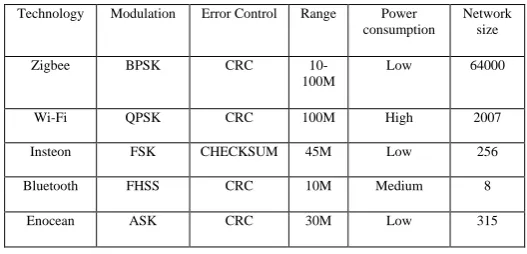
The aim of this paper is to collect all the details about the different types of network architecture and the various technologies that are used in automating systems and their related entities. The different technologies in wireless home automation system includes Zigbee, Insteon, Bluetooth, WiFi, and Z-wave. The Zigbee technology which is commonly used because of low cost and effectiveness. The table which is given below lists the differences between them on the basis of common features. The features using which they are compared include: Range, Power Consumption, Network Size, Error Control and Modulation.[3]
Table I. Features of Technologies
Technology Modulation Error Control Range Power consumption
Network size
Zigbee BPSK CRC
10-100M
Low 64000
Wi-Fi QPSK CRC 100M High 2007
Insteon FSK CHECKSUM 45M Low 256
Bluetooth FHSS CRC 10M Medium 8
Enocean ASK CRC 30M Low 315
A. Zigbee
[image:2.595.299.563.534.661.2]telecomm, building automations, toys that are user interactive, management and conservation of energy and increasing the efficiency have all been solved with the solution called Zigbee. [1] [2]. Zigbee Alliance created Zigbee technology and the technology is supported by a number of companies such as Samsung, Honeywell, Philips, Chipcon, Mitsubishi, Ember and Free scale and Motorola. Zigbee is preferred for quite a number of reasons including the security it provides due to its higher end encryption techniques.
It supports a very large number of nodes (upto 65000 in a single network). Due its low cost of implementation and its global availability, it is preferred over other technologies. Due to its low duty cycle, provides a longer battery life. It is very easily deployable.
Router, coordinator and an end device are the three different kinds of nodes that Zigbee supports. The first two nodes, the router and the coordinator are together referred to as a Fully Function Device (FFD), while an end device is called a Reduced Function Device (RFD).[3]
B. Enocean
This standard was brought forward in March 2012. In Europe it makes use of the ASK (Amplitude Shift Key) and it operates on a 868MHz frequency. In North America it operates on a 315 MHz frequency. The protocol stack for Enocean is composed of three layers: the physical layer, the data link layer and the network layer. Secured data is transmitted through the physical layer which operates at either 315MHz or 868mMHz with data rate 125kb/s, using ASK. Harvesting energy at extremely low power is the main goal of Enocean. The advantage of this technology that majorly stands out is that it is simple to install it no connecting cables are required, thus saving a lot of time and money. Building automation was the one area which Enocean was effectively used for but later on, it applied to various categories of solutions including smart homes, heavy industries, transportation and logistics. Although Enocean devices have no battery, they offer superior performance to operate hassle free and maintenance free. Radio signals are transmitted from sensors and switches upto 30m. When Multiple signals are being transmitted on the same network, there is always a risk of collision or interference. Enocean mitigates both of these risks [3] [4].
C. Insteon
Insteon alliance promoted this creation of smart labs. Radio frequencies and power line links are both used to network simple low cost nodes using mesh topology. Each of the devices are inter connected with each other by a point to point link. This very well means that each of the device can send and receive, repeat messages by putting them into various time slots that are synchronized to the zero crossing of the power line. Multi hops, which can be performed using time slot synchronization can be used for those devices that are kept in an irregular fashion to communicate easily amongst themselves. A limit of four hops is provided to each message. Data that is transmitted at the rate of 38.4 kb/s is provided with security using the rolling code encryption. A signal sent from an Insteon can activate a very large number of devices at the same time. The use of simulcast instead of routing avoids the necessity to store states for making multihop communication possible. Data can be reached through ann alternate path
whenever there is an unavailability of an intermediate device and this is one of the pros of using simulcast. [5]
D. Wi-Fi
Wi-Fi (implementing the IEEE 802.11 standard) is the communication standard that is chosen at homes for multimedia applications. It is also used as an alternative for the Zigbee based local controller to provide access to home automation system from devices that are able to connect to Wi-Fi. This approach to home automation was chosen as a growing number of homes have access Wi-Fi networks and to Wi-Fi enabled devices such as PDA’s and mobile phones. A Zigbee based controller’s additional cost in such a scenario is an unwarranted expense. Interface design is largely flexible due to the high data rates in a Wi-Fi network. Using radio frequency, wireless networking is provided by Wi-Fi. [4]
E. Bluetooth
Communication takes place through channels or signals and if a room is noisy, in an industrial environment it is not a feasible solution. Thus, for short range communications, we come across a technology called as Bluetooth. The operations of Bluetooth is based on the technologies like AFH (Advanced Frequency Hopping) and FEC (Forward Error Control). Bluetooth has been successful in providing a universal short range wireless capability. Bluetooth makes use of short range radio link that is optimized for small-size personal devices. It is an ad hoc type network which is capable of communications within a short range. Bluetooth can be used to connect up to 8 devices at a particular time. It operates in the range of 2.4 GHz frequency. Bluetooth is also secure where in the sender and receiver are both required to acknowledge the transfer of data across. [12]
V. ROUTING PROTOCOLS
The protocols for routing have been developed so far to enhance the performance of the network and to increase the efficiency of the system. Few of them include Flat Based routing, Hierarchical Based routing and Location Based Routing protocols. Hierarchical routing protocols which is used in wireless network is known as cluster-based routing too. Hierarchical routing protocols are used in techniques that are related to scalability and efficient communication. Energy efficient routing in Wireless sensor networks is performed by utilizing the concept of hierarchical routing. Processing information and dispatching them is done in the higher energy nodes while sensing the proximity of a target within which clusters which has given off a higher rate of scalability and efficiency is performed in the lower energy nodes. Energy consumption within a cluster can be drastically reduced using Hierarchical routing. Energy can be saved by also performing aggregation of data and the fusion so as to reduce the number of messages that are sent across to the Base Station.
Hierarchical routing is mainly a two-layered routing. Selection of the cluster heads is performed by one layer while the other is responsible for routing.
The different types of routing includes:
Location Based protocol-
SPAR, SPEED, ENERGY AWARE ROUTING Hetrogenicity Based Protocol-
IDSQ, CADR, HR Multipath Based Protocol-
SENSOR DISJOINT MULTIPATH, N to 1 MULTIPATH DISCOVERY.
Hierarchical based protocol-
LEACH, HEED, TEEN, APTEEN.[7]
A. Location Based Protocols
• Geographic adaptive fidelity (GAF) is an energy aware protocol.
• Geographic and energy aware routing is an energy efficient routing protocol. Routing that is in cooperation with power saving is yet another energy consumption protocol. • Trajectory based forwarding which stands for (TBF) is a
resource discovery. BVGF is taken as the next hop node which can be considered as a shortest Euclidean distance to the destination.
• Geographic random forwarding (GeRaF) is geographic routing where the sender does not know where the sensor that acts as the relay is located, in prior.
• Minimum energy communication network (MECN) is a location based protocol that is used for ad hoc networks that are deployed in random order to achieve minimum energy.
•Small minimum energy communication network (SMECN) is used to better MECN.[8]
B. Hierarchial Protocols
• LEACH (Low Energy Adaptive Clustering Hierarchy) It is an adaptive clustering protocol that can organize by itself.
• TEEN (Threshold sensitive Energy Efficient sensor Network) cluster based protocol for routing which is based on LEACH.
• APTEEN (Adaptive Threshold TEEN) improved version of TEEN that can be used to analyze and enable monitoring of the environment, which is also reliable.
• PEGASIS (Power efficient Gathering Sensor Information System). Amount of energy that is generated per round is reduced tremendously by using PEGASIS where each node communicates only with its closest neighbor and each of these nodes take turns in transmitting messages to the base station.[7]
QoS Based Protocol
There is an increase in the necessity for real time applications within Wireless Sensor Networks and this has paved the way for the requirement of Quality of Service based communication protocols. There are certain restrictions and challenges that are raised due to the various conditions for satisfying Quality of Service requirements (e.g. bandwidth, delays etc. ) that are considered for different QoS based applications. Specifically, the networking protocols provides precise QoS guarantee and also addresses the the ability to adapt with the constraints based on energy. Thus, enabling QoS applications within sensor requires the awareness of QoS in the various layers of the protocol stack and also requires energy. In various application related to multimedia, real-time applications, critical applications etc., there is a mixture of delay sensitive and delay tolerant flow of traffic in the
network. An Energy Efficient and QoS aware multipath routing protocol (abbreviated shortly as EQSR) was proposed by Jalel Ben-Othman and Bashir Yahya in their paper titled “Energy efficient and QoS based routing protocol for wireless sensor networks”. EQSR works towards maximizing the lifetime of a network by balancing the amount of energy that is being consumed across different nodes. The concept of differentiation of services is used by this method which allows the traffic which is sensitive to delay to reach the sink nodes within a time with delay of acceptable duration, thus reducing the end to end delay time by spreading out the traffic across various paths, and by introducing data redundancy, the throughput is maximized. Prediction of the next best hop or the next best node through paths construction phase is Residual energy makes use of EQSR, node available buffer size, and Signal-to-Noise Ratio (SNR) to predict the best next hop through the paths construction phase. Based on the concept of service differentiation, handling real-time and non-real time traffic is done by the EQSR protocol which makes use of a queuing model.
By making use of simulated environments, they evaluated and compared the performance of the suggested protocol for routing with the MCMP (Multi-Constraint Multi-Path) protocol. Results from the simulated environment proved that the protocols achieved a much lower delay time average, an increase in energy conservation and a larger delivery of packets ratio with respect to the MCMP protocol.[10]
VI. CONCLUSION
This paper focuses on the different types of wireless technologies used in the home automation system. It also contains an overview and the comparison of features and architectures which has been used in the different technologies of home automation system. Now a days almost all technologies make use of CRC method for error control, Insteon makes use of Checksum for error checking. WiFi is the technology that makes maximum use of the network but it also has the highest range. Out of the three automation methods (Power line based home automation, Wired automation, Wireless automation) it can be understood that Wireless based automation is the most efficient and most used method of automation. Various routing protocols are available out of which the QoS based protocols have proved to be a lot more divergent and efficient.
REFERENCES
[1] Wireless Home Automation Networks: A Survey of Architectures and Technologies, Carles Gomez and Josep Paradells, Technical University of Catalonia
[2] Status of Wireless Technologies Used For Designing Home Automation System - A Review Ashish J. Ingle, Bharti W. Gawali Department of Computer Science and Information Technology Dr.Babasaheb Ambedkar Marathwada University, Aurangabad, India.
[3] Zigbee technology and its application in wireless home automation systems: A Survey,Thoraya Obaid, HaleemahRashed, Ali Abou-Elnour, Muhammad Rehan Mussab Muhammad Saleh, and Mohammed Tarique.
Mani Roja 2 1Students, Department of Electronics and Telecommunication 2Associate Professor,Department of Electronics and Telecommunicat
[5] A Comparative Study of Wireless Technologies: Zigbee, Bluetooth LE, Enocean, Wavenis, Insteon and UWB, Ms. Harneet kaur, #Ms. Sukesha Sharma
[6] Home Automation using ZigBee Protocol Pankaj Jadhav ,Amit Chaudhari , Swapnil Vavale Department of Computer Engineering, University of Pune
[7] Classification of Hierarchical Based Routing Protocols for Wireless Sensor Networks Abdul Gani Khan, Mahamaya Technical University, Noida, Abdur Rahman, Mahamaya Technical University, Noida, Neeti Bisht Sharda University, Greater Noida
[8] Home Automation Systems and Applications – Structure, Types,Tarun Agarwal, https//www.elprocus.com/home-automation-systems-applications/
[9] Home Automation Device Protocol (HADP): Protocol Standard for Unified Device Interaction, Thomas Gonnot, Won-Jae Yi, Ehsan Monsef, Jafar Saniie
[10]Location-Based Routing Protocol in Wireless Sensor Network- A Survey G.V Rama Lakshmi V., Professor KL University, Andhra Pradesh, India Srikanth M.Tech (CNS), Dept of CSE KL University Andhra Pradesh, India.