Volume 8, No. 5, May-June 2017
International Journal of Advanced Research in Computer Science RESEARCH PAPER
Available Online at www.ijarcs.info
Improving forgery detection technique using SURF & Segmentation algorithm
Ajay Sahay
Research Scholar Computer Science BBAU University Lucknow Uttar Pradesh India
Ms. Sarita Soni
Assistant Professor Computer Science BBAU University, Lucknow Uttar Pradesh India
Abstract: Picture imitation discovery expects to confirm the genuineness of a computerized picture. Picture validation arrangement is grouped into two sorts. A dynamic phony identification systems, for example, advanced watermarking or computerized marks utilizes a known validation code inserted into the picture content before the pictures are sent through an untrustworthy open channel. By confirming the nearness of such validation code confirmation might be demonstrated by contrasting and the first embedded code. Be that as it may, this technique requires uncommon equipment or programming to embed the verification code inside the picture before the picture is being circulated. Uninvolved or daze phony discovery procedure utilizes the got picture just to assess its legitimacy or uprightness, with no signature or watermark of the first picture from the sender. It depends on the presumption that albeit advanced fabrications may leave no visual pieces of information of having been messed with, they may very likely irritate the hidden measurements property or picture consistency of a characteristic scene picture which presents new antiquities bringing about different types of irregularities. These irregularities can be utilized to recognize the phony. This procedure is mainstream as it needn't bother with any earlier data about the picture. Existing systems recognize different hints of altering and identify them independently with confinement of altered locale. Duplicate move is the most widely recognized picture altering procedure utilized because of its straightforwardness and adequacy, in which parts of the first picture is replicated, moved to a coveted area and glued. On the off chance that the altered pictures are mishandled, it might prompt potential social, legitimate or private outcomes. To this end, it's exceptionally essential and furthermore difficult to discover compelling strategies to distinguish computerized picture fabrications. In this Work, a quick keypoint based technique to identify picture duplicate move falsification is proposed in light of the SURF (Speed up Robust Features) descriptors, which are invariant to pivot, scaling and so forth. Consequences of trials show that the proposed strategy is substantial in distinguishing the picture area duplication and very vigorous to added substance clamor and obscuring.
Keywords: Image Forensics, Oriented Gradient, Scale Invariant Features Transform, Speed up Robust Features.
I.
INTRODUCTION
TO
IMAGE
FORGERY
The fast development of picture process programming's and furthermore the headway in advanced cameras has offered ascend to mammoth measures of doctored pictures with no undeniable follows, producing an incredible interest for programmed fabrication discovery calculations to see the quality of a competitor picture. A falsification discovery calculation should be detached, requiring no earlier information concerning the picture content or any defensive systems like watermarks.
[image:1.595.306.558.423.610.2]As indicated by the Wall Street Journal, 10% of every single shading picture uncovered in United States were truly carefully changed and modified. Established researchers has likewise been liable to falsifications. The validness of pictures has relate basic part as these photographs are prevalently utilized as supporting confirmations and chronicled records in developing reach and enormous determination of uses from logical examination, journalistic photography, criminal examination, law implementation, protection cases and therapeutic imaging[1]. Picture falsification has a long history. As appeared in Fig. 1, in today's computerized world it is conceivable to make, adjust and change the data delineated by a photo awfully essentially while not going any undeniable hints of those operations.
Fig. 1: Recent image forgeries reported (a) Composite of Cher and Brad Pitt (b) collage of John Kerry and Jane Fonda (c) Jeffrey Wong Su linear unit receiving the award from Queen Queen of England (d) Asian country prime minister Yousaf Gilani (e) Iranian image of missiles (f) Time covers reportage on the O.J. Simpson case [1].
II.
IMAGE
FORGERY
CLASSIFICATION
Picture fraud identification expects to check the genuineness of a computerized picture. Picture validation arrangement is characterized into 2 assortments.
1. Active and 2. Blind or passive
A dynamic fraud identification systems, for example, advanced watermarking or computerized marks utilizes a known validation code installed into the picture content before the photos range unit sent through A problematic open channel. By confirming the nearness of such verification code confirmation
Might be confirmed by investigation with the principal embedded code. Notwithstanding, this strategy needs uncommon equipment or programming bundle to embed the confirmation code inside the picture before the picture is being conveyed.
Aloof or dazzle falsification discovery method utilizes the got picture just to assess its believability or respectability, with no signature or watermark of the principal picture from the sender. It is upheld albeit advanced frauds could leave no visual signs of getting been messed with, they may to a great degree without a doubt irritate the basic insights property or picture consistency of a characteristic scene picture that acquaints new ancient rarities driving with various sorts of irregularities. These irregularities can be acclimated locate the phony. This system is mainstream since it doesn't need any past information concerning the picture. Existing systems recognize various hints of progress of state and sight them independently with restriction of altered area.
III.
GENERAL
STRUCTURE
OF
IMAGE
FORGERY
DETECTION
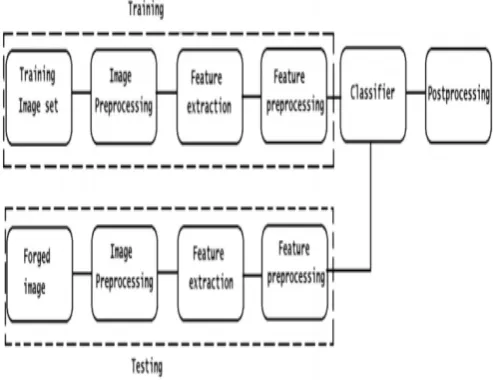
Picture imitation recognition systems are two-class arrangement methods. Goal of visually impaired or aloof recognition is to characterize given pictures into 2 classes: unique (or legitimate) and cast pictures. For the most part existing visually impaired picture fabrication discovery approaches extricate alternatives from pictures starting, then select a classifier and prepare the classifier misuse the choices separated from honing picture sets, lastly arrange the elements. Here, we depict a summed up structure of visually impaired picture fabrication location approach probably, which comprises of the accompanying real strides:
1. Image preprocessing: Before highlight extraction prepare a few operations ar performed over the photos into record, for example, trimming, changing RGB picture into grayscale, DCT or DWT change to enhance the order execution.
2. Feature extraction: An arrangement of elements are separated for each classification that recognizes it from option classifications, while staying invariant to trademark varieties inside the class from the info cast data. Specifically, remove instructive elements and pick include that must be delicate to picture control. One of the attractive normal for choose
choices and made component vector should be with low measurement, which can decrease the method nature of training and arrangement.
3. Classifier chooseion and highlight preprocessing: upheld the separated arrangement of alternatives select or style material classifiers and select a larger than usual arrangement of pictures to mentor classifiers. Acquire some important parameters of classifiers, which will be utilized for the arrangement. Highlight preprocessing is utilized to curtail the dimensionality of choices while not diminishing the machine learning based generally characterization execution at indistinguishable time lessening in strategy quality.
4. Classification: The reason for classifier is to separate the given pictures and group them into 2 classifications: unique and cast pictures. Different classifiers are utilized, for example, SVM and LDA for picture fabrication Detection.
5. Post processing: In a portion of the phonies like duplicate move and grafting, post preparing operation includes restriction of cast district as indicated by the means depict on top of, the structure of visually impaired picture fabrication recognition is displayed.
IV.
COPY-MOVE
OR
REGION
DUPLICATION
FORGERY
Duplicate move is the commonest picture altering system utilized due to its effortlessness and adequacy, in which components of the principal picture is followed, moved to a coveted area and stuck. This is generally exhausted request to cover bound subtle elements or to copy bound parts of a photo. Finished districts are utilized as perfect components for copy move fraud, since finished areas have comparative shading and clamor variety properties to that of the picture that are in cognoscible for human eye testing for irregularities in picture connected math properties. Obscuring is generally utilized on the outskirt of the changed district to decrease the effect of anomalies between the first and stuck locale.
Nb ¼ the scope of pieces (which might be a work of info picture with determination MN). Zero-standardized cross [2]
Fig. 2: Generalized structure of image forgery detection
Correlation (ZNCC) was used as a similarity measure and correct detection results obtained through looking out inside at most one hundred neighboring blocks within the sorted block array.
A copy-move forgery detection and localization method primarily based on dividing a picture into little overlapped blocks, then comparing the similarity of these blocks and eventually distinctive potential duplicated regions victimization intensity primarily based characteristics options was introduced. Illustrated algorithm has lower machine complexness and is a lot of sturdy against stronger attacks and varied sorts of after-copying manipulations, such as lossy compression, noise contamination, blurring and a combination of those operations. All the Copy-move or region duplication forgery methods mentioned ar in a position to find and find police work copy move forgery and close to duplicates regions of the image, these are computationally dear and a human interpretation of the results is important. Also, they introduce high false positives. Further, few techniques often fails to find the forgery once the size of the solid space is far smaller than image dimensions.
V.
IMAGE
SPLICE
OR
IMAGE
COMPOSITES
Picture grafting includes substitution of picture pieces from one or a considerable measure of very surprising pictures on to another picture. Picture joining is one of the clear and conventionally utilized picture change of state plans. Picture grafting recognition is of the rudimentary assignment in picture phony discovery.
The strategy bolstered bi-spectral investigation will discover un-normal higher-arrange connections brought into the flag by the change of state technique and with achievement utilized for police work human-discourse graft. Bi-coherence is a standardized bi-spectrum. Picture joining location flops once disguising measures, for example, obscure is connected after graft once the sting sharpness prompts ar utilized for discovery
reason. Additionally it needs straight edges and edges should be sufficiently wide subsequently that edge profiles will be dependably separated. Now and then manual marking of picture locales makes a particular approach a self-loader one. Encourage, very confined and minor change of state can most without a doubt go unnoted and troublesome to discover. The pressure ancient rarities make the restriction of the fraud troublesome once the picture being broke down is packed by a low quality issue.
1. Image forgery detection victimization JPEG compression properties
JPEG is most famous and customarily utilized pressure typical that has been found in style of uses. Most computerized cameras send out JPEG record design. To recognize regardless of whether a photo in symbol organize has been aforesaid JPEG packed or not is a crucial} issue for a couple picture handle applications and assumes imperative part in picture change of state identification. A technique for the most extreme possibility estimation will be conceived to gauge what quantization table was utilized. The method abuses the way that twofold JPEG2000 pressure adds up to particular twofold quantization of the sub-band DWT coefficients, which presents particular relics obvious in the Fourier changes of DWT consistent histograms.
2. Photographic pictures and photorealistic pc graphic (PRCG) pictures classification
As PC representation (CG) advances expediently create, refined pc design rendering programming framework will produce astoundingly photorealistic pictures. Photorealistic pictures will be made that ar troublesome to separate outwardly from photographic pictures. As the rendering innovation develops, photorealistic pictures will be formed and rendered just. One of the testing and prompt downside is to separate between photorealistic pc created (PRCG) pictures from genuine (photographic) pictures. This strategy arranges photographic pictures (PIM) from PRCG exploitation common picture insights (NIS). Three sorts of NIS with very surprising connected math arrange, i.e. NIS gotten from the power range, wavelet modify and local fix of pictures were considered. Grouping photographic pictures and photorealistic pc design upheld a geometry-based picture demonstrate incited by the physical picture era strategy. This procedure functions admirably for uncompressed pictures or JPEG pictures with a top quality issue. Execution of different courses diminishes with higher degrees of JPEG pressure and down-examining operation. Likewise from a rendering reason for read, couple of strategies don't basically give any understanding into anyway one would perhaps render a considerable measure of photorealistic pictures.
3. Lighting inconsistency
different objects/people in a picture, inconsistencies in lighting can be used as proof of digital change of state.
VI.
INTERPOLATION
AND
GEOMETRIC
TRANSFORMATIONS
When making image composites, to give the image a additional uniform side geometric transformations are required. These geometric transformations typically involve re-sampling (e.g., scaling or rotating) which in flip entails interpolation (e.g., nearest neighbor, bilinear, bi-cubic). Detecting the specific applied mathematics changes attributable to interpolation step are often known as potential image forgery. The Interpolation and geometric transformations performs well when the image being analyzed is in uncompressed format. The detection accuracy lowers in JPEG images compressed exploitation lower QF as the artifacts of JPEG compression conceal the traces of interpolation.
VII.
BLUR
AND
SHARPENING
Blurring is a common process in digital image manipulation that is employed to scale back the degree of separation or to get rid of unwanted defects. Furthermore, blur operation is one of the commonly used strategies to cover the presence of forgery. So distinctive blur inconsistencies in numerous image regions will be useful in detection image forgeries. Tampering detection theme primarily based on blur region detection exploitation image DCT coefficients and facultative morphological operations. To detect image change of state operations that involve sharpness/blurriness adjustment primarily based on the regularity properties of ripple remodel coefficients that involves mensuration the decay of ripple remodel coefficients across scales. It is particularly helpful to make a sleek transition between the chosen region and its surroundings. The forged region are often determined by the worth of weighted native entropy at a 17 November false positive rate. A blur edge detection scheme is used in Chow et al. (2007) based on the sting process and analysis exploitation edge protective smoothing filtering and mathematical morphology with average accuracy of ninetieth. Major drawback is most of the projected techniques needs a human interpretation of the output.
VIII.
ACQUISITION
DEVICE
ANALYSIS
AND
IDENTIFICATION
Digital image may return from numerous imaging devices, e.g., various cameras, scanners, computer graphics technology. In order to see integrity and authenticity of a given image, identifying the device used for its acquisition is of major interest. Different image forgery notice ion techniques detect the traces left by the totally different process steps within the image acquisition and storage phases. These traces mark the image with some kind of inherent “fingerprints” of the imaging devices, which will be wont to determine the supply of the image. Imaging sensors used in capturing devices tends
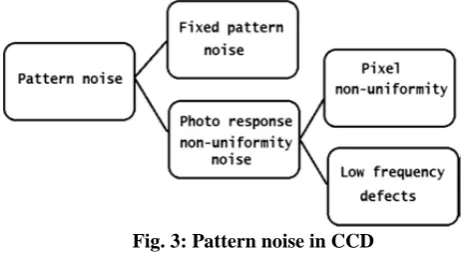
[image:4.595.306.540.147.276.2]to introduce various defects and to make noise within the pel values. The sensor noise is the results of 3 main elements, i.e. pixel defects, fixed pattern noise (FPN), and photo response non uniformity (PRNU). FPN and PNRU are the 2 elements of the alleged pattern noise as illustrated in Fig. 5 and rely on dark currents within the device and pel non-uniformities severally.
Fig. 3: Pattern noise in CCD
IX.
RELATED
WORK
Zhang, Guangcheng et al. (2004) [3] In this paper presents a novel approach for face recognition by boosting statistical local features based classifiers. The face image is scanned with a scalable sub-window from which the Local Binary Pattern (LBP) histograms [14] are obtained to describe the local features of a face image. The multi-class problem of face recognition is transformed into a two-class one by classifying every two face images as intra-personal or extra-personal ones [9]. The Chi square distance between corresponding Local Binary Pattern histograms of two face images is used as discriminative feature for intra/extra-personal classification. We use AdaBoost algorithm to learn a similarity of every face image pairs. The proposed method was tested on the FERET FA/FB image sets and yielded an exciting recognition rate of 97.9%.
Johnson, Micah K., et al. (2006) [5] in this paper, virtually all optical imaging systems introduce a variety of aberrations into an image. Chromatic aberration, for example, results from the failure of an optical system to perfectly focus light of different wavelengths. Lateral chromatic aberration manifests itself, to a first-order approximation, as an expansion/contraction of color channels with respect to one another. When tampering with an image, this aberration is often disturbed and fails to be consistent across the image. We describe a computational technique for automatically estimating lateral chromatic aberration and show its efficacy in detecting digital tampering.
Sokolova, Marina et al. (2006) [6] in this paper, different evaluation measures assess different characteristics of machine learning algorithms. The empirical evaluation of algorithms and classifiers is a matter of on-going debate among researchers. Most measures in use today focus on a classifier’s ability to identify classes correctly. We note other useful properties, such as failure avoidance or class discrimination, and they suggest measures to evaluate such properties. These measures – Youden’s index, likelihood, Discriminant power – are used in medical diagnosis. We show that they are interrelated, and they apply them to a case study from the field of electronic negotiations. We also list other learning problems which may benefit from the application of these measures.
Hsu, Yu-Feng et al. (2006) [7] In this paper, recent advances in computer technology have made digital image tampering more and more common. In this paper, they propose an authentic vs. spliced image classification method making use of geometry invariants in a semi-automatic manner. For a given image, they identify suspicious splicing areas, compute the geometry invariants from the pixels within each region, and then estimate the camera response function (CRF) from these geometry invariants. The cross-fitting errors are fed into a statistical classifier. Experiments show a very promising accuracy, 87%, over a large data set of 363 natural and spliced images. To the best of Their knowledge, this is the first work detecting image splicing by verifying camera characteristic consistency from a single-channel image
Shi, Yun Q., et al. (2007) [8] In this paper, image splicing detection is of fundamental importance in digital forensics and therefore has attracted increasing attention recently. In this paper, they propose a blind, passive, yet effective splicing detection approach based on a natural image model. This natural image model consists of statistical features extracted from the given test image as well as 2-D arrays generated by applying to the test images multi-size block discrete cosine transform (MBDCT). The statistical features include moments of characteristic functions of wavelet subbands and Markov transition probabilities of difference 2-D arrays. To evaluate the performance of their proposed model, they further present a concrete implementation of this model that has been designed for and applied to the Columbia Image Splicing Detection Evaluation Dataset. Our experimental works have demonstrated that this new splicing detection scheme outperforms the state of the art by a significant margin when applied to the above-mentioned dataset, indicating that the proposed approach possesses promising capability in splicing detection.
Zhang, Zhen et al. (2008) [9] In this paper, to implement image splicing detection a blind, passive and effective splicing detection scheme was proposed in this paper. The model was based on moment features extracted from the multi-size block discrete cosine transform (MBDCT) and some image quality metrics (IQMs) extracted from the given test image, which are sensitive to spliced image. This model can measure statistical differences between original image and spliced image. Experimental results demonstrate that this new splicing detection algorithm is effective and reliable; indicating that the proposed approach has a broad application prospect.
Dong, Jing et al. (2008) [10] In this paper, a simple but efficient approach for blind image splicing detection is proposed. Image splicing is a common and fundamental operation used for image forgery. The detection of image splicing is a preliminary but desirable study for image forensics. Passive detection approaches of image splicing are usually regarded as pattern recognition problems based on features which are sensitive to splicing. In the proposed approach, they analyze the discontinuity of image pixel correlation and coherency caused by splicing in terms of image run-length representation and sharp image characteristics. The statistical features extracted from image run-length representation and image edge statistics are used for splicing detection. The support vector machine (SVM) is used as the classifier. Our experimental results demonstrate that the two proposed features outperform existing ones both in detection accuracy and computational complexity.
Farid, Hany et al. (2009) [11] In this paper, they are undoubtedly living in an age where they are exposed to a remarkable array of visual imagery. While they may have historically had confidence in the integrity of this imagery, today's digital technology has begun to erode this trust. From the tabloid magazines to the fashion industry and in mainstream media outlets, scientific journals, political campaigns, courtrooms, and the photo hoaxes that land in their e-mail in-boxes, doctored photographs are appearing with a growing frequency and sophistication. Over the past five years, the field of digital forensics has emerged to help restore some trust to digital images. The author reviews the state of the art in this new and exciting field.
Mahdian, Babak, et al. (2010) [12] In this paper, verifying the integrity of digital images and detecting the traces of tampering without using any protecting extracted or pre-embedded information have become an important and hot research field. The popularity of this field and the rapid growth in papers published during the last years have put considerable need on creating a complete bibliography addressing published papers in this area. In this paper, an extensive list of blind methods for detecting image forgery is presented. By the word blind they refer to those methods that use only the image function. An attempt has been made to make this paper complete by listing most of the existing references and by providing a detailed classification group.
steps. In this guide, they propose a simple procedure which usually gives reasonable results
Wang, Wei et al. (2010) [14] In this paper, they propose a passive image tampering detection method based on modeling edge information. We model the edge image of image chroma component as a finite-state Markov chain and extract low dimensional feature vector from its stationary distribution for tampering detection. The support vector machine (SVM) is utilized as classifier to evaluate the effectiveness of the proposed algorithm. The experimental results in a large scale of evaluation database illustrates that Their proposed method is promising.
Zhao, Xudong et al. (2010) [15] In this paper, detecting splicing traces in the tampering color space is usually a tough work. However, it is found that image splicing which is difficult to be detected in one color space is probably much easier to be detected in another one. In this paper, an efficient approach for passive color image splicing detection is proposed. Chroma spaces are introduced in Their work compared with commonly used RGB and luminance spaces. FTheir gray level run-length run-number (RLRN) vectors with different directions extracted from de-correlated chroma channels are employed as distinguishing features for image splicing detection. Support vector machine (SVM) is used as a classifier to demonstrate the performance of the proposed feature extraction method. Experimental results have shown that that RLRN features extracted from chroma channels provide much better performance than that extracted from R, G, B and luminance channels.
Shivakumar, B. L., et al. (2010) [16] In this paper, as one of the most successful applications of image analysis and understanding, digital image forgery detection has recently received significant attention, especially during the past few years. At least two trend account for this: the first accepting digital image as official document has become a common practice, and the second the availability of low cost technology in which the image could be easily manipulated. Even though there are many systems to detect the digital image forgery, their success is limited by the conditions imposed by many applications. For example, detecting duplicated region that have been rotated in different angles remains largely unsolved problem. In an attempt to assist these efforts, this paper surveys the recent development in the field of Copy-Move digital image forgery detection.
Huang, Di, et al. (2011) [17] In this paper, local binary pattern (LBP) is a nonparametric descriptor, which efficiently summarizes the local structures of images. In recent years, it has aroused increasing interest in many areas of image processing and computer vision and has shown its effectiveness in a number of applications, in particular for facial image analysis, including tasks as diverse as face detection, face recognition, facial expression analysis, and demographic classification. This paper presents a comprehensive survey of LBP methodology, including several more recent variations. As a typical application of the LBP approach, LBP-based facial image analysis is extensively reviewed, while its successful extensions, which deal with various tasks of facial image analysis, are also highlighted.
Hussain, Muhammad et al. (2011) [18] In this paper, support vector machines outperform other classification methods for breast cancer detection. However the performance of SVM is greatly affected by the choice of a kernel function among other factors. This article presents a comparative study of different kernel functions for breast cancer detection. The focus is on classification using SVM with different kernel functions. The comparison with neural network based method using MLP is also given. Furthermore, they examine the affect of selecting feature subsets before applying classification with different kernels. For features subset selection they used genetic algorithm. The evaluation is based on 5 X 2 cross validation.
Muhammad, Ghulam et al. (2012) [19] In this paper, a blind copy move image forgery detection method using undecimated dyadic wavelet transform (DyWT) is proposed. DyWT is shift invariant and therefore more suitable than discrete wavelet transform (DWT) for data analysis. First, the input image is decomposed into approximation (LL1) and detail (HH1) subbands. Then the LL1 and HH1 subbands are divided into overlapping blocks and the similarity between blocks is calculated. The key idea is that the similarity between the copied and moved blocks from the LL1 subband should be high, while that from the HH1 subband should be low due to noise inconsistency in the moved block. Therefore, pairs of blocks are sorted based on high similarity using the LL1 subband and high dissimilarity using the HH1 subband. Using thresholding, matched pairs are obtained from the sorted list as copied and moved blocks. Experimental results show the effectiveness of the proposed method over competitive methods using DWT and the LL1 or HH1 subbands only.
Zhang, Yujin, et al. (2012) [20] In this paper, the wide use of powerful image processing software has made it easy to tamper images for malicious purposes. Image splicing, which has constituted a menace to integrity and authenticity of images, is a very common and simple trick in image tampering. Therefore, image splicing detection is of great importance in digital forensics. In this chapter, an effective framework for revealing image splicing forgery is proposed. The local binary pattern (LBP) operator is used to model magnitude components of 2-D arrays obtained by applying multi-size block discrete cosine transform (MBDCT) to the test images, all of bins of histograms computed from LBP codes are served as discriminative features for image splicing detection. To avoid the high computational complexity and possible over fitting for support vector machine (SVM) classifier, principal component analysis (PCA) is utilized to reduce the dimensionality of the proposed features. Our experiment results demonstrate the efficiency of the proposed method over the Columbia image splicing detection evaluation dataset.
X.
SURF
1. SURF keypoints generation
used for orientation undertaking, earlier than the keypoint descriptor is shaped from the wave responses in a very sure encompassing of the keypoint.
2. Quick Interest purpose Detection
The SURF feature detector is based on the Wellington boot matrix. Given a point x =(x, y) in an image I, the Hessian matrix H(x, s) in x at scale s is defined as follows
Where is the convolution of the Gaussian second order derivative with the image I in point x, and similarly for and In assessment to SIFT, which approximates Laplacian of Gaussian (LoG) with Difference of Gaussians (DoG), SURF approximates 2nd order Gaussian derivatives with container filters. Image convolutions with those container filters can be computed hastily by way of the usage of quintessential photos. The entry of an essential image IΣ (x) at location x = (x, y) T represents the sum of all pixels in the base photo I of a rectangular region formed through the starting place and x. Once we have computed the integral image, it is strait forward to calculate the sum of the intensities of pixels over any upright, rectangular area. The location and scale of interest points are designated by hoping on the determinant of the Wellington boot. Hereby, the approximation of the second order derivatives is denoted as Dxx , Dyy, and Dxy. By choosing the weights for the box filters adequately, an approximation for the Hessian’s determinant is found
Det(Happrox)=DxxDyy-(0.9Dxy)
XI.
SURF
FEATURE
DESCRIPTORS
MATCHING
2Interest points are localized in scale and image area by applying non-maximum suppression in a three × three × three neighborhood. Finally, the found maxima of the determinant of the approximated Hessian matrix ar interpolated in scale and image area.
Keypoints match is done between two pictures generally. Given a pair of pictures Ii ,Ij with their respective interest points and feature descriptors, for every interest purpose within the 1st image Ii, we calculate the euclidean distance to all feature descriptors within the second image Ii . If the ratio of the nearest neighbor and also the second-nearest neighbor is smaller than a predefined threshold, which is mentioned in the experiment, a match is assumed to be correct and is therefore additional to the list of reputed matches. In our paper, the match process of keypoints is done by matching between 2 subsets of the keypoints set of the check image, as described in follows.
1. Given a keypoints set of test image as S , randomly divide the set into 2 subsets as S1 , S2, S1 ∪S2 = S . Find the nearest neighbors in S1 , S2, and save the matching records.
2. Applying step (1), (2) to S1, S2 respectively and repeatedly till one S , 2 S solely contains one component.
By using the on top of matching methodology, the keypoints matches can be found, and the duplication are often further determined.
XII.
SEGMENTATION
TECHNIQUES
1. Thresholding-based segmentation
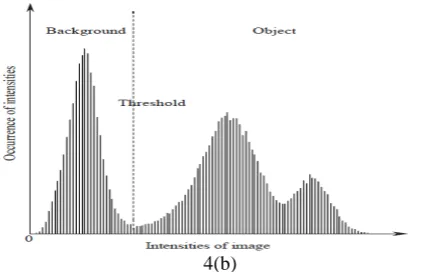
In thresholding-based segmentation the image histogram is partitioned off into 2 categories victimisation a single price, called bi-level thresholding (Figure 4.6), or into multiple classes victimisation multiple values, called structure thresholding, based on the characteristics of the bar graph. In bi-level thresholding, pixels with intensity values less than the edge square measure set as background (object) whereas others are set as object (background). In multiplelevel thresholding, pixels with intensity values between two serial thresholds square measure appointed as a category. However, in tri-level thresholding, only 2 categories square measure usually outlined – i.e. one with intensity values between the two thresholds, and the other with intensity values outside the 2 thresholds. Theoretically, the levels of thresholding are often increased limitlessly in line with the quantity of objects gift in images; but, the computation load will be multiplied exponentially. For example, for searching the four-level thresholding in a grey image, the calculation would be as large as O (L3), where L is the grey level of the image (typically 256 for a grey image). The large calculation implies that structure (more than tri-) thresholding is impracticable, and therefore solely bi-level and tri-level thresholding square measure utilized in apply.
It is obvious that the edge for the segmentation described higher than may be a mounted price (called the world threshold) across the complete image. There is another quite threshold, called the native threshold, which is associate adaptative price determined by the native characteristics of pixels. However, only the international threshold is popularly utilized in the food trade, mainly as a result of the international threshold is chosen from the image bar graph instead of the image itself. Therefore the computing speed is not laid low with the image size, as might be the case in local-threshold ways.As the adaptive threshold is hardly utilized in the food trade, it is not further mentioned here. However, for the segmentation of complex food pictures, such as toppings of pizzas (see Figure 4.6), the global threshold isn't competent. One explanation for this is that the quantity of categories outlined by the world threshold is restricted to 2 (object and background), which is way but those needed to section the advanced food pictures, since there are several food merchandise with completely different intensity-level values to be segmental
4(b)
Fig.4: Thresholding the histogram of a beef image: (a) image of beef; (b) thresholding the histogram; (c)
[image:8.595.67.229.245.329.2]binarized (a) by the threshold.
[image:8.595.28.335.523.746.2]Fig. 5: Final Detected Forgery Location using SURF Analysis
Table 5.1: Various Measures of Accuracy of Proposed Work Compared
Metric Segmentation and Surf DCT LBP
Accuracy 96.45 91.86 86.88
TPR 97.83 89.94 93.86
TNR 94.87 89.57 83.41
Fig 5.12: Various Measures of Accuracy of Proposed Work Compared
XIII.
C
ONCLUSIONAND
F
UTUREW
ORKMost existing strategies for picture duplicate move imitation identification work on grayscale pictures. In spite of the fact that the keypoint-based systems have the advantages of hearty solidness and low technique cost,they can't build up the level copied areas while not dependable extricated choices. In this paper, we propose another strategy by abuse speeded-up tough feature(SURF) and picture division inside the rival shading region. Our technique begins by changing the investigated picture from RGB to the rival shading territory. The shading angle per pixel is figured and brought in light of the fact that the work zone for SURF to remove the keypoints. The coordinated keypoints square measure grouped and their geometric changes are measurable. At long last, the false matches are evacuated. Trial comes about demonstrate that the proposed method will adequately uncover the copied areas with various changes, notwithstanding when the duplication locales square measure level. Our calculation is snappy in any case strong system to notice picture duplicate move fabrication. Distinguishing and separating the strong SURF intrigue focuses and their descriptors by introductory, the conceivable copied locales within proper limits pictures will be found by coordinating the descriptors vectors. Analyze result demonstrate that this strategy will see the duplicate move falsification rapidly, and can stand beyond any doubt changes and post handle like, scaling, turn, commotion obscuring et cetera. Be that as it may, advance examination is as yet required to programmed discover the altered district and its limit.
REFERENCES
[1] Zhang, Guangcheng, Xiangsheng Huang, Stan Z. Li, Yangsheng Wang, and Xihong Wu. "Boosting local binary pattern (LBP)-based face recognition." In Advances in biometric person authentication, pp. 179-186. Springer Berlin Heidelberg, 2004.
[2] Ng, Tian-Tsong, Shih-Fu Chang, and Q. Sun. "A data set of authentic and spliced image blocks." Columbia University, ADVENT Technical Report (2004): 203-2004.
[3] Johnson, Micah K., and Hany Farid. "Exposing digital forgeries through chromatic aberration." In Proceedings of the 8th workshop on Multimedia and security, pp. 48-55. ACM, 2006.
[4] Sokolova, Marina, Nathalie Japkowicz, and Stan Szpakowicz. "Beyond accuracy, F-score and ROC: a family of discriminant measures for performance evaluation." In Australasian Joint Conference on Artificial Intelligence, pp. 1015-1021. Springer Berlin Heidelberg, 2006.
[5] Hsu, Yu-Feng, and Shih-Fu Chang. "Detecting image splicing using geometry invariants and camera characteristics consistency." In Multimedia and Expo, 2006 IEEE International Conference on, pp. 549-552. IEEE, 2006.
[6] Shi, Yun Q., Chunhua Chen, and Wen Chen. "A natural image model approach to splicing detection." In Proceedings of the 9th workshop on Multimedia & security, pp. 51-62. ACM, 2007.
[7] Zhang, Zhen, Jiquan Kang, and Yuan Ren. "An effective algorithm of image splicing detection." In Computer Science and Software Engineering, 2008 International Conference on, vol. 1, pp. 1035-1039. IEEE, 2008.
Watermarking, pp. 76-87. Springer Berlin Heidelberg, 2008.
[9] Zhang, Zhen, Jiquan Kang, and Yuan Ren. "An effective algorithm of image splicing detection." In Computer Science and Software Engineering, 2008 International Conference on, vol. 1, pp. 1035-1039. IEEE, 2008
[10] Dong, Jing, Wei Wang, Tieniu Tan, and Yun Q. Shi. "Run-length and edge statistics based approach for image splicing detection." In International Workshop on Digital Watermarking, pp. 76-87. Springer Berlin Heidelberg, 2008.
[11] Farid, Hany. "Image forgery detection." IEEE Signal processing magazine 26, no. 2 (2009): 16-25.
[12] Mahdian, Babak, and Stanislav Saic. "A bibliography on blind methods for identifying image forgery." Signal Processing: Image Communication 25, no. 6 (2010): 389-399.
[13] Chih-wei Hsu , Chih-chung Chang , Chih-jen Lin, A practical guide to support vector classification, (2010). [14] Wang, Wei, Jing Dong, and Tieniu Tan. "Image tampering
detection based on stationary distribution of Markov chain." In Image Processing (ICIP), 2010 17th IEEE International Conference on, pp. 2101-2104. IEEE, 2010.
[15] Zhao, Xudong, Jianhua Li, Shenghong Li, and Shilin Wang. "Detecting digital image splicing in chroma spaces."
In International Workshop on Digital Watermarking, pp. 12-22. Springer Berlin Heidelberg, 2010.
[16] Shivakumar, B. L., and Lt Dr S. Santhosh Baboo. "Detecting copy-move forgery in digital images: a survey and analysis of current methods." Global Journal of Computer Science and Technology 10, no. 7 (2010). [17] Huang, Di, Caifeng Shan, Mohsen Ardabilian, Yunhong
Wang, and Liming Chen. "Local binary patterns and its application to facial image analysis: a survey." IEEE Transactions on Systems, Man, and Cybernetics, Part C (Applications and Reviews) 41, no. 6 (2011): 765-781. [18] Hussain, Muhammad, Summrina Kanwal Wajid, Ali
Elzaart, and Mohammed Berbar. "A comparison of SVM kernel functions for breast cancer detection." In Computer Graphics, Imaging and Visualization (CGIV), 2011 Eighth International Conference on, pp. 145-150. IEEE, 2011. [19] Muhammad, Ghulam, Muhammad Hussain, and George
Bebis. "Passive copy move image forgery detection using undecimated dyadic wavelet transform." Digital Investigation 9, no. 1 (2012): 49-57.