Fluency Constraints for Minimum Bayes-Risk Decoding
of Statistical Machine Translation Lattices
Graeme Blackwood and Adri`a de Gispert and William Byrne
Machine Intelligence Laboratory, Department of Engineering, Cambridge University {gwb24|ad465|wjb31}@cam.ac.uk
Abstract
A novel and robust approach to improv-ing statistical machine translation fluency is developed within a minimum Bayes-risk decoding framework. By segment-ing translation lattices accordsegment-ing to con-fidence measures over the maximum like-lihood translation hypothesis we are able to focus on regions with potential transla-tion errors. Hypothesis space constraints based on monolingual coverage are ap-plied to the low confidence regions to im-prove overall translation fluency.
1 Introduction and Motivation
Translation quality is often described in terms of
fluency and adequacy. Fluency reflects the
‘na-tiveness’ of the translation while adequacy indi-cates how well a translation captures the meaning of the original text (Ma and Cieri, 2006).
From a purely utilitarian view, adequacy should be more important than fluency. But fluency and adequacy are subjective and not easy to tease apart (Callison-Burch et al., 2009; Vilar et al., 2007). There is a human tendency to rate less fluent trans-lations as less adequate. One explanation is that errors in grammar cause readers to be more crit-ical. A related phenomenon is that the nature of translation errors changes as fluency improves so that any errors in fluent translations must be rel-atively subtle. It is therefore not enough to fo-cus solely on adequacy. SMT systems must also be fluent if they are to be accepted and trusted. It is possible that the reliance on automatic met-rics may have led SMT researchers to pay insuffi-cient attention to fluency: BLEU (Papineni et al., 2002), TER (Snover et al., 2006), and METEOR (Lavie and Denkowski, 2009) show broad corre-lation with human rankings of MT quality, but are
incapable of fine distinctions between fluency and adequacy.
There is concern that the fluency of current SMT is inadequate (Knight, 2007b). SMT is ro-bust, in that a translation is nearly always pro-duced. But unlike translators who should be skilled in at least one of the languages, SMT sys-tems are limited in both source and target lan-guage competence. Fluency and accuracy there-fore tend to suffer together as translation quality degrades. This should not be the case. Ideally, an SMT system should never be any less fluent than the best stochastic text generation system avail-able in the target language (Oberlander and Brew, 2000). What is needed is a good way to enhance the fluency of SMT hypotheses.
The maximum likelihood (ML) formulation (Brown et al., 1990) of translation of source lan-guage sentenceFto target language sentenceEˆ
ˆ
E= argmax
E
P(F|E)P(E) (1)
makes it clear why improving SMT fluency is a difficult modelling problem. The language model P(E), the closest thing to a ‘fluency component’ in the original formulation, only affects candidates likely under the translation modelP(F|E). Given the weakness of current translation models this is a severe limitation. It often happens that SMT sys-tems assign P(F|E¯) = 0to a correct reference translation E¯ ofF (see the discussion in Section 9). The problem is that in ML decoding the lan-guage model can only encourage the production of fluent translations; it cannot easily enforce con-straints on fluency or introduce new hypotheses.
this does not force them to be grammatical in the way that a typical human sentence is grammati-cal; they produce many translations which are not fluent. The problem is robustness. Generating fluent translations demands a tightly constraining target language grammar but such a grammar is at odds with broad-coverage parsing needed for ro-bust translation.
We have described two problems in transla-tion fluency: (1) SMT may fail to generate flu-ent hypotheses and there is no simple way to in-troduce them into the search; (2) SMT produces many translations which are not fluent but enforc-ing constraints to improve fluency can hurt robust-ness. Both problems are rooted in the ML decod-ing framework in which robustness and fluency are conflicting objectives.
We propose a novel framework to improve the fluency of any SMT system, whether syntactic or phrase-based. We will perform Minimum Bayes-risk search (Kumar and Byrne, 2004) over a space of fluent hypothesesH:
ˆ
EMBR= argmin
E′∈H
X
E∈E
L(E, E′)P(E|F) (2)
In this approach the MBR evidence space E is generated by an SMT system as ak-best list or lat-tice. The system runs in its best possible config-uration, ensuring both translation robustness and good baselines. Rather than decoding in the out-put of the baseline SMT system, translations will be sought among a collection of fluent sentences that are close to the top SMT hypotheses as deter-mined by the loss functionL(E, E′).
Decoupling the MBR hypothesis space from first-pass translation offers great flexibility. Hy-potheses in H may be arbitrarily constrained ac-cording to lexical, syntactic, semantic, or other considerations, with no effect on translation ro-bustness. This is because constraints on fluency do not affect the production of the evidence space by the baseline system. Robustness and fluency are no longer conflicting objectives. This frame-work also allows the MBR hypothesis space to be augmented with hypotheses produced by an NLG system, although this is beyond the scope of the present paper.
This paper focuses on searching out fluent
strings amongst the vast number of hypotheses en-coded in SMT lattices. Oracle BLEU scores com-puted over k-best lists (Och et al., 2004) show that many high quality hypotheses are produced by first-pass SMT decoding. We propose reducing the difficulty of enhancing the fluency of complete hypotheses by first identifying regions of high-confidence in the ML translations and using these to guide the fluency refinement process. This has two advantages: (1) we keep portions of the base-line hypotheses that we trust and search for alter-natives elsewhere, and (2) the task is made much easier since the fluency of sentence fragments can be refined in context.
In what follows, we use posterior probabilities over SMT lattices to identify useful subsequences in the ML translations (Sections 2 & 3). These subsequences drive the segmentation and transfor-mation of lattices into smaller subproblems (Sec-tions 4 & 5). Subproblems are mined for fluent strings (Section 6), resulting in improved transla-tion fluency (Sectransla-tions 7 & 8). Our results show that, when guided by the careful selection of sub-problems, fluency can be improved with no real degradation of the BLEU score.
2 Lattice MBR Decoding
The formulation of the MBR decoder in Equation (2) separates the hypothesis space from the evi-dence space. We apply the linearised lattice MBR decision rule (Tromble et al., 2008)
ˆ
ELMBR = argmax
E′∈H
θ0|E′|+X
u∈N
θu#u(E′)p(u|E)
,
(3) whereHis the hypothesis space,Eis the evidence space,N is the set of alln-grams inH(typically, n = 1. . .4), and θ are constants estimated on held-out data. The quantityp(u|E)is the path pos-terior probability ofn-gramu
p(u|E) = X
E∈Eu
P(E|F), (4)
whereEu = {E ∈ E : #u(E) > 0} is the
0 0.1 0.2 0.3 0.4 0.5 0.6 0.7 0.8 0.9 1 0
0.1 0.2 0.3 0.4 0.5 0.6 0.7 0.8 0.9 1
Posterior probability threshold β
Average per−sentence precision p
n,
β
1−gram 2−gram 3−gram 4−gram
0 0.1 0.2 0.3 0.4 0.5 0.6 0.7 0.8 0.9 1 0
5 10 15 20 25 30
Posterior probability threshold β
Average per−sentence n−gram counts
1−grams 2−grams 3−grams 4−grams
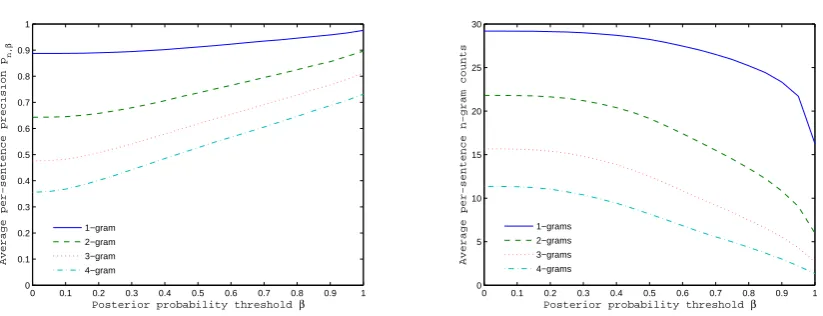
Figure 1: Average n-gram precisions (left) and counts (right) for 2075 sentences of NIST Arabic→English ML translations at a range of posterior probability thresholds 0 ≤ β ≤ 1. The left plot shows atβ = 0then-gram precisions used in the BLEU score of the ML baseline system.
3 Posterior Probability Confidence Measures
In the formulation of Equations (3) and (4) the path posteriorn-gram probabilities play a crucial role. MBR decoding under the linear approxima-tion to BLEU is driven mainly by the presence of high posterior n-grams in the lattice; the low posteriorn-grams contribute relatively little to the MBR decision criterion. Here we investigate the predictive power of these statistics. We will show that then-gram posterior is a good predictor as to whether or not ann-gram is to be found in a set of reference translations.
Let Nn denote the set of n-grams of order n
in the ML hypothesis E, and letˆ Rn denote the
set ofn-grams of ordernin the union of the ref-erences. For confidence threshold β, letNn,β =
{u∈ Nn:p(u|E)≥β}denote then-grams inNn
with posterior probability greater than or equal to β, wherep(u|E)is computed using Equation (4). This is equivalent to identifying all substrings of length n in the translation hypotheses for which the system assigns a posterior probability ofβ or higher. The precision at ordernfor thresholdβis the proportion ofn-grams inNn,β also present in
the references:
Pn,β = |Rn∩ Nn,β|
|Nn,β|
(5)
The left plot in Figure 1 shows average per-sentence n-gram precisions Pn,β at orders 1. . .4
for an Arabic→English translation task at a range
of thresholds0 ≤ β ≤1. Sentence start and end tokens are ignored when computing unigram pre-cisions. We note that precision at all orders im-proves as the thresholdβincreases. This confirms that these intrinsic measures of translation confi-dence have strong predictive power.
The right-hand side of the figure shows the av-erage number of n-grams per sentence for the same range ofβ. We see that for highβ, there are fewn-grams withp(u|E)≥β; this is as expected. However, even at a high threshold of β = 0.9
there are still on average three 4-grams per sen-tence with posterior probabilities that exceed β. Even at this very high confidence level, high pos-terior n-grams occur frequently enough that we can expect them to be useful.
These precision results motivate our use of path posterior n-gram probabilities as a confidence measure. We assign confidence p( ˆEij|E) to sub-sequencesEˆi. . .Eˆj of the ML hypothesis.
Prior work focuses on word-level confidence extracted from k-best lists and lattices (Ueffing and Ney, 2007), while Zens and Ney (2006) rescorek-best lists with n-gram posterior proba-bilities. Similar experiments with a slightly dif-ferent motivation are reported by DeNero et al. (2009); they show that expectedn-gram counts in a lattice can be used to predict whichn-grams ap-pear in the references.
4 Lattice Segmentation
par-the newspaper “ constitution ” quoted brigadier abdullah krishan , par-the chief of police in karak governorate ( 521 km
south @-@ west of amman ) as saying that the seizure took place after police received information that there were
attempts by the group to sell for more than $ 100 thousand dollars , the police rushed to the arrest in possession .
01/313.691
309/3.695387 515/3.8184 95850/0.21289 138
9 12 1001159
160
158121641001172 177 20 1976179 368 154/0.9873
20
182 1976/5.3818 13 185
192 138332229/0.15527
63 3848/3.56648369 5/1.5518 370 11/1.7031 371 1579
3848 374
11 9/1.3047 537
1704/1.7061
775/2.91781 583
1191/0.5625672 143 489331729
730 1631191
143/1.6924
8
1191 143/1.5361 3/2.4316
71/1.3447
1716/2.3975 789
3
272328
3
4345614
335
8615 63 58332
183230293296342953029
6194
25351191
143 26445935265
4376
Figure 2: ML translation E, word latticeˆ E, and decomposition as a sequence of four string and five sublattice regionsH1. . .H9using n-gram posterior probability thresholdp(u|E)≥0.8.
tial hypotheses that can be trusted. We wish to constrain MBR decoding to include these trusted partial hypotheses but allow decoding to consider alternatives in regions of low confidence. In this way we aim to improve the best possible output of the best available systems.
We use the path posteriorn-gram probabilities of Equation (4) to segment latticeEinto regions of high and low confidence. As shown in the exam-ple of Figure 2, the lattice segmentation process is performed relative to the ML hypothesisE, i.e.ˆ relative to the best path throughE.
For confidence thresholdβ, we find all4-grams u= ˆEi, . . . ,Eˆi+3in the ML translation for which
p(u|E) > β. We then segment Eˆ into regions of high and low confidence where the high confi-dence regions are identified by consecutive, over-lapping high confidence4-grams. The high confi-dence regions are contiguous strings of words for which there is consensus amongst the translations in the lattice. If we trust the path posteriorn-gram probabilities, any hypothesised translation should include these high confidence substrings. This ap-proach differs from simple posterior-based prun-ing in that we discard paths, rather than words
orn-grams, which are not consistent with high-confidence regions of the ML hypothesis.
The hypothesis string Eˆ is in this way seg-mented into R alternating subsequences of high and low confidence. The segment boundaries are ir and jr so that Eˆijrr is either a high confidence
or a low confidence subsequence. Each subse-quence is associated with an unweighted subspace
Hr; this subspace has the form of a string for high
confidence regions and the form of a lattice for low confidence regions.
If the rth segment is a high confidence region
then Hr accepts only the string Eˆjirr. If the rth
segment is a region of low confidence, then Hr
is built to accept relevant substrings fromE. It is constructed as follows. The rth low confidence regionEˆjr
ir has a high confidence left contexteˆr−1
and a high confidence right context ˆer+1 formed
from subsequences of the ML translation hypoth-esisEˆ as
empty string and whenr = R the right context
ˆ
Trfor the regular expression/.∗eˆr−1(.∗)ˆer+1.∗
/\1/.1 Composition withEyieldsH
r=E ◦Tr, so
thatHr contains all the reasonable alternatives to
ˆ
Ejr
ir inE consistent with the high confidence left
and right contextseˆr−1andeˆr+1. IfHris aligned
to a high confidence subsequence of E, we callˆ it a string region since it contains a single path; if it is aligned to a low confidence region it is a lattice and we call it a sublattice region. The se-ries of high and low confidence subspace regions
H1, . . . ,HRdefines the lattice segmentation.
5 Hypothesis Space Construction
We now describe a general framework for improv-ing the fluency of the MBR hypothesis space.
The segmentation of the lattice described in Section 4 considerably simplifies the problem of improving the fluency of its hypotheses since each region of low confidence may be considered in-dependently. The low confidence regions can be transformed one-by-one and then reassembled to form a new MBR hypothesis space.
In order to transform the hypothesis regionHr
it is important to know the context in which it oc-curs, i.e. the sequences of words that form its pre-fix and sufpre-fix. Some transformations might need only a short context; others may need a sentence-level context, i.e. the full sequence of ML words
ˆ
Ejr−1
1 andEˆiNr+1 to the left and right of the region Hrthat is to be transformed.
To put this formally, each low confidence sub-lattice region is transformed by the application of some functionΨ:
Hr←Ψ( ˆE1jr−1, Hr, EˆiNr+1) (6)
The hypothesis space is then constructed from the concatenation of high confidence string and trans-formed low confidence sublattice regions
H=E ◦ O
1≤r≤R
Hr (7)
The composition with the original lattice E dis-cards any new hypotheses that might be created via the unconstrained concatenation of strings from theHr. It may be that in some circumstances
1In this notation parentheses indicate string matches so
that/.∗y(a∗)w.∗/\1/applied toxyaaawzzyieldsaaa.
the introduction of new paths is good, but in what follows we test the ability to improve fluency by searching among existing hypotheses, and this en-sures that nothing new is introduced.
Size of the Hypothesis Space If no new hy-potheses are introduced by the operations Ψ, the size of the hypothesis spaceH is determined by the posterior probability threshold β. Only the ML hypothesis remains at β = 0, since all its subsequences are of high confidence, i.e. can be covered byn-grams with non-zero path posterior probability. At the other extreme, for β = 1, it follows that H = E and no paths are removed, since any string regions created are formed from subsequences that occur on every path inE.
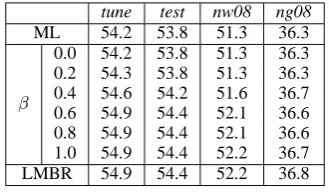
We can therefore use β to tighten or relax constraints on the LMBR hypothesis space. At β = 0, LMBR returns only the ML hypothesis; at β = 1, LMBR is done over the full transla-tion lattice. This is shown in Table 1, where the BLEU score approaches the BLEU score of un-constrained LMBR asβincreases.
Note also that the size of the resulting hypoth-esis space is the product of the number of se-quences in the sublattice regions. For Figure 2 at β = 0.8, this product is∼5.4 billion hypotheses. Even for fairly aggressive constraints on the hy-pothesis space, many hypotheses remain.
6 Monolingual Coverage Constraints
This section describes one implementation of the transformation functionΨthat we will show leads to improved fluency of machine translation out-put. This transformation is based onn-gram cov-erage in a large target language text collection: where possible, we filter the sublattice regions so that they contain only long-span n-grams ob-served in the text. Our motivation is that large monolingual text collections are good guides to fluency. If a hypothesis is composed entirely of previously seen high ordern-grams, it is likely to be fluent and should be favoured.
LM Translation hypothesisEandn-gram orders used by the LM to score each word Score
4g <s>1the2reactor3produces3plutonium2needed2to3manufacture4atomic3bomb2.3</s>4 -22.59 <s>1the2reactor3produces3plutonium2needed2to3manufacture4the4atomic2bomb3.4</s>4 -23.61
5g <s>1the2reactor3produces4plutonium5needed3to3manufacture4atomic5bomb2.3</s>4 -16.04 <s>1the2reactor3produces4plutonium5needed3to3manufacture4the4atomic4bomb5.4</s>5 -17.96
Figure 3: Scores and n-gram orders for hypotheses using 4-gram Kneser-Ney and 5-gram stupid-backoff (estimated from 1.1B and 6.6B tokens, resp.) LMs. Low confidence regions are in italics.
favour the shorter but disfluent hypothesis; nor-malising by length was not effective. However, the stupid-backoff LM has better coverage and the backing-off behaviour is a clue to the presence of disfluency. Similar cues have been observed in ASR analysis (Chase, 1997). The shorter hy-pothesis backs off to a bigram for “atomic bomb”, whereas the longer hypothesis covers the same words with 4-grams and 5-grams. We therefore disregard the language model scores and focus on n-gram coverage. This is an example where ro-bustness and fluency are at odds. The n-gram models are robust, but often favour less fluent hy-potheses.
LetSdenote the set of alln-grams in the mono-lingual training data. To identify partial hypothe-ses in sublattice regions that have complete mono-lingual coverage at the maximum order n, we build a coverage acceptor Cnwith a similar form
to the WFST representation of ann-gram backoff language model (Allauzen et al., 2003). Cn
as-signs a penalty to every n-gram not found inS. InCnword arcs have no cost and backoff arcs are
assigned a fixed cost of 1. Firstly, arcs from the start state are added for each unigramw∈ N1:
w
w/0 ∅
Then for n-grams u ∈ S ∩ {∪n
i=2 Ni}, where
u=w1nconsisting of historyh=w1n−1and target wordwn, arcs are added
wn/0
h h+
whereh+=wn2−1ifuhas ordernandh+=wn1 ifuhas order less thann. Backoff arcs are added for eachuas
φ/1
h h−
where h− = wn2−1 if u has order > 2, and bi-grams backoff to the null history start state∅.
For each sublattice regionHr, we wish to
pe-nalise each path proportionally to the number of
itsn-grams not found in the monolingual text col-lection S. We wish to do this in context, so that we include the effect of the neighbouring high confidence regions Hr−1 and Hr+1. Given that
we are counting n-grams at ordernwe form the left context machine Lr which accepts the last
n−1 words in Hr−1; similarly, Rr accepts the
first n− 1 words of Hr+1. The concatenation
Xr=Lr⊗ Hr⊗ Rrrepresents the partial
transla-tion hypotheses inHrpadded withn−1words of
left and right context from the neighbouring high confidence regions. Composing Xr◦ Cn assigns
each partial hypothesis a cost equal to the number of times it was necessary to back off to lower order n-grams while reading the string. Partial hypothe-ses with cost 0 did not back off at all and contain only maximum ordern-grams.
In the following experiments, we look at each
Xn◦ Cn and if there are paths with cost 0, only
these are kept and all others discarded. We intro-duce this as a constraint on the hypothesis space which we will evaluate for improvement on flu-ency. Here the transformation functionΨreturns
HrasXr◦Cnafter pruning. IfXr◦Cnhas no zero
cost paths, the transformation function Ψreturns
Hras we find it, since there is not enough
mono-lingual coverage to guide the selection of fluent hypotheses. After applying monolingual coverage constraints to each region, the modified hypothe-sis space used for MBR search is formed by con-catenation using Equation (7).
We note thatCnis a simplistic NLG system. It
generates strings by concatenatingn-grams found inS. We do not allow it to run ‘open loop’ in these experiments, but instead use it to find the strings inXrwith goodn-gram coverage.
7 LMBR Over Segmented Lattices
ML ... view , especially with the open chinese economy to the world and ... +LMBR ... view , especially with the open chinese economy to the world and ... +LMBR+CC ... view , especially with the opening of the chinese economy to the world and ... ML ... revision of the constitution of the japanese public , which dates back ...
+LMBR ... revision of the constitution of the japanese public , which dates back ... +LMBR+CC ... revision of the constitution of japan , which dates back ...
Figure 4: Improved fluency through the application of monolingual coverage constraints to the hypoth-esis space in MBR decoding of NIST MT 08 Arabic→English newswire lattices.
of the odd numbered sentences of the MT02– MT05 testsets; the even numbered sentences form
test. MT08 performance on nw08 (newswire) and ng08 (newsgroup) data is also reported.
First-pass translation is performed using HiFST (Iglesias et al., 2009), a hierarchical phrase-based decoder. The first-pass LM is a modified Kneser-Ney (Kneser and Kneser-Ney, 1995) 4-gram estimated over the English side of the parallel text and an 881M word subset of the English GigaWord 3rd Edition. Prior to LMBR, the first-pass lattices are rescored with zero-cutoff stupid-backoff 5-gram language models (Brants et al., 2007) estimated over more than 6B words of English text. The LMBR factorsθ0, . . . , θ4 are set as in Tromble et
al. (2008) using unigram precision p = 0.85and recall ratior= 0.74.
The effect of performing LMBR over the seg-mented hypothesis space is shown in Table 1. The hypothesis subspaces Hr are constructed at
var-ious confidence thresholds as described in Sec-tion 4 withHformed via Equation (7); no cover-age constraints are applied yet. Constraining the search space using β = 0.6 leads to little degra-dation in LMBR performance under BLEU. This shows lattice segmentation works as intended.
We next investigate the effect of monolingual coverage constraints on BLEU. We build accep-tors Cn as described in Section 6 with S
con-sisting of all n-grams in the English GigaWord. At β = 0.6 we found 181 sentences with sub-lattices Hr spanned by maximum ordern-grams
from S, i.e. for which Xr ◦ Cn have paths with
cost 0; these are filtered as described. LMBR over these coverage-constrained sublattices is de-noted LMBR+CC. On nw08 the BLEU score for LMBR+CC is 52.0 which is +0.7 over the ML de-coder and only -0.2 BLEU below unconstrained LMBR decoding. Done in this way, constraining hypotheses to have 5-grams from the GigaWord
tune test nw08 ng08
ML 54.2 53.8 51.3 36.3
β
0.0 54.2 53.8 51.3 36.3
0.2 54.3 53.8 51.3 36.3
0.4 54.6 54.2 51.6 36.7
0.6 54.9 54.4 52.1 36.6
0.8 54.9 54.4 52.1 36.6
1.0 54.9 54.4 52.2 36.7
LMBR 54.9 54.4 52.2 36.8
Table 1: BLEU scores for ML hypotheses and LMBR decoding inHover0≤β ≤1.
has little impact on BLEU.
At this value of β, 116 of the 813 nw08 sen-tences have a low confidence region (1) com-pletely covered by5-grams, and (2) within which the ML hypothesis and the LMBR+CC hypothe-sis differ. It is these regions which we will inspect for improved fluency.
8 Human Fluency Evaluation
We asked 17 native speakers to judge the fluency of sentence fragments from nw08. We compared hypotheses from the ML and the LMBR+CC de-coders. Each fragment consisted of the partial translation hypothesis from a low confidence re-gion together with its left and right high confi-dence contexts (examples given in Figure 4). For each sample, judges were asked: “Could this frag-ment occur in a fluent sentence?”
LMBR+CC Fluent Not Fluent
ML Fluent 1175 (59.6%) 192 (9.7%)
Not Fluent 530 (26.9%) 75 (3.8%)
Table 2: Partial hypothesis fluency judgements.
to have improved the fluency of the low confi-dence region more than twice as often as a fluent hypothesis was made disfluent.
Some examples of improved fluency are shown in Figure 4. Although both the ML and un-constrained LMBR hypotheses might satisfy ad-equacy, they lack the fluency of the LMBR+CC hypotheses generated using monolingual fluency constraints.
9 Summary and Discussion
We have described a general framework for im-proving SMT fluency. Decoupling the hypothesis space from the evidence space allows for much greater flexibility in lattice MBR search.
We have shown that high path posterior proba-bilityn-grams in the ML translation can be used to guide the segmentation of a lattice into regions of high and low confidence. Segmenting the lattice simplifies the process of refining the hypothesis space since low confidence regions can be refined in the context of their high confidence neighbours. This can be done independently before reassem-bling the refined regions. Lattice segmentation facilitates the application of post-processing and rescoring techniques targeted to address particu-lar deficiencies in ML decoding.
The techniques we presented are related to con-sensus decoding and system combination for SMT (Matusov et al., 2006; Sim et al., 2007), and to segmental MBR for automatic speech recognition (Goel et al., 2004). Mohit et al. (2009) describe an alternative approach to improving specific por-tions of translation hypotheses. They use an SVM classifier to identify a single phrase in each source language sentence that is “difficult to translate”; such phrases are then translated using an adapted language model estimated from parallel data. In contrast to their approach, our approach is able to exploit large collections of monolingual data to refine multiple low confidence regions using pos-terior probabilities obtained from a high-quality evidence space of first-pass translations.
Testset Sentences Reachability
tune 2075 15%
test 2040 14%
nw08 813 11%
ng08 547 9%
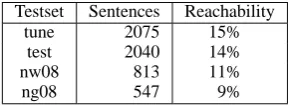
Table 3: Arabic→English reference reachability.
We applied hypothesis space constraints based on monolingual coverage to low confidence re-gions resulting in improved fluency with no real degradation in BLEU score relative to uncon-strained LMBR decoding. This approach is lim-ited by the coverage of sublattices using monolin-gual text. We expect this to improve with larger text collections or in tightly focused scenarios where in-domain text is less diverse.
However, fluency will be best improved by inte-grating more sophisticated natural language gen-eration. NLG systems capable of generating sen-tence fragments in context can be incorporated di-rectly into this framework. If the MBR hypothe-sis spaceHcontains a generated hypothesisE¯for whichP(F|E¯) = 0,E¯ could still be produced as a translation, since it can be ‘voted for’ by nearby hypotheses produced by the underlying system.
Table 3 shows the proportion of NIST testset sentences that can be aligned to any of the ref-erence translations using our high quality base-line hierarchical decoder with a powerful gram-mar. The low level of reachability suggests that NLG may be required to achieve high levels of translation quality and fluency. Other rescoring approaches (Kumar et al., 2009; Li et al., 2009) may also benefit from NLG when the baseline is incapable of generating the reference.
We note that our approach could also be used to improve the fluency of ASR, OCR and other lan-guage processing tasks where the goal is to pro-duce fluent natural language output.
Acknowledgments
References
Allauzen, Cyril, Mehryar Mohri, and Brian Roark. 2003. Generalized algorithms for constructing statistical lan-guage models. In Proceedings of ACL 2003.
Blackwood, Graeme, Adri`a de Gispert, and William Byrne. 2010. Efficient path counting transducers for minimum Bayes-risk decoding of statistical machine translation lat-tices. In Proceedings of ACL 2010.
Brants, Thorsten, Ashok C. Popat, Peng Xu, Franz J. Och, and Jeffrey Dean. 2007. Large language models in ma-chine translation. In Proceedings of the EMNLP 2007.
Brown, Peter F., John Cocke, Stephen A. Della Pietra, Vin-cent J. Della Pietra, Fredrick Jelinek, John D. Lafferty, Robert L. Mercer, and Paul S. Roossin. 1990. A sta-tistical approach to machine translation. Computational
Linguistics, 16(2):79–85.
Callison-Burch, Chris, Philipp Koehn, Christof Monz, and Josh Schroeder. 2009. Findings of the 2009 Workshop on Statistical Machine Translation. In WMT 2009.
Chase, Lin Lawrance. 1997. Error-responsive feed-back mechanisms for speech recognizers, Ph.D. Thesis, Carnegie Mellon University.
Chiang, David. 2007. Hierarchical phrase-based translation.
Computational Linguistics, 33(2):201–228.
DeNero, John, David Chiang, and Kevin Knight. 2009. Fast consensus decoding over translation forests. In
Proceed-ings of ACL-IJCNLP 2009.
Goel, V., S. Kumar, and W. Byrne. 2004. Segmental mini-mum Bayes-risk decoding for automatic speech recogni-tion. IEEE Transactions on Speech and Audio
Process-ing, 12:234–249.
Iglesias, Gonzalo, Adri`a de Gispert, Eduardo R. Banga, and William Byrne. 2009. Hierarchical phrase-based trans-lation with weighted finite state transducers. In
Proceed-ings of the 2009 Annual Conference of the NAACL.
Kneser, R. and H. Ney. 1995. Improved backing-off for m-gram language modeling. In Acoustics, Speech, and
Signal Processing.
Knight, K and J Graehl. 2005. An overview of probabilis-tic tree transducers for natural language processing. In
Proceedings of CICLING 2005.
Knight, K. 2007a. Capturing practical natural language transformations. Machine Translation, 21(2).
Knight, Kevin. 2007b. Automatic language translation gen-eration help needs badly. In MT Summit XI Workshop on
Using Corpora for NLG: Keynote Address.
Kumar, Shankar and William Byrne. 2004. Minimum Bayes-risk decoding for statistical machine translation. In
NAACL 2004.
Kumar, Shankar, Wolfgang Macherey, Chris Dyer, and Franz Och. 2009. Efficient minimum error rate training and minimum bayes-risk decoding for translation hypergraphs and lattices. In Proceedings of ACL-IJCNLP 2009.
Lavie, Alon and Michael J. Denkowski. 2009. The ME-TEOR metric for automatic evaluation of machine trans-lation. Machine Translation Journal.
Li, Zhifei, Jason Eisner, and Sanjeev Khudanpur. 2009. Variational decoding for statistical machine translation. In Proceedings of ACL-IJCNLP 2009.
Ma, Xiaoyi and Christopher Cieri. 2006. Corpus support for machine translation at LDC. In LREC 2006.
Matusov, Evgeny, Nicola Ueffing, and Hermann Ney. 2006. Computing consensus translation from multiple machine translation systems using enhanced hypotheses align-ment. In 11th Conference of the EACL.
Mohit, B., F. Liberato, and R. Hwa. 2009. Language model adaptation for difficult-to-translate phrases. In
Proceed-ings of the 13th Annual Conference of the EAMT.
Mohri, Mehryar, Fernando Pereira, and Michael Riley. 2002. Weighted finite-state transducers in speech recognition. In CSL, volume 16, pages 69–88.
Oberlander, Jon and Chris Brew. 2000. Stochastic text gen-eration. In Philosophical Transactions of the Royal
Soci-ety.
Och, F., D. Gildea, S. Khudanpur, A. Sarkar, K. Yamada, A. Fraser, S. Kumar, L. Shen, D. Smith, K. Eng, V. Jain, Z. Jin, and D. Radev. 2004. A smorgasbord of features for statistical machine translation. In Proceedings of the
HLT Conference of the NAACL.
Papineni, Kishore, Salim Roukos, Todd Ward, and Wei-Jing Zhu. 2002. BLEU: a method for automatic evaluation of machine translation. In Proceedings of ACL 2002.
Sim, K.-C., W. Byrne, M. Gales, H. Sahbi, and P.C. Wood-land. 2007. Consensus network decoding for statisti-cal machine translation system combination. In ICASSP
2007.
Snover, Matthew, Bonnie Dorr, Richard Schwartz, Linnea Micciulla, , and John Makhoul. 2006. A study of trans-lation edit rate with targeted human annotation. In
Pro-ceedings of AMTA.
Tromble, Roy, Shankar Kumar, Franz Och, and Wolfgang Macherey. 2008. Lattice minimum Bayes-risk decoding for statistical machine translation. In Proceedings of the
2008 Conference on EMNLP.
Ueffing, Nicola and Hermann Ney. 2007. Word-level confi-dence estimation for machine translation. Computational
Linguistics, 33(1):9–40.
Vilar, D, G Leusch, H Ney, and R Banchs. 2007. Human evaluation of machine translation through binary system comparisons. In Proceedings of WMT 2007.
Zens, Richard and Hermann Ney. 2006. N -gram posterior probabilities for statistical machine translation. In