Annotating Chinese Collocations with Multi Information
Ruifeng Xu
1, Qin Lu
1, Kam-Fai Wong
2, Wenjie Li
11
Department of Computing,
2Department of Systems Engineering and
Engineering Management
The Hong Kong Polytechnic University, The Chinese University of Hong Kong,
Kowloon, Hong Kong N.T., Hong Kong
{csrfxu,csluqin,cswjli}@comp.polyu.edu.hk [email protected]
Abstract
This paper presents the design and construc-tion of an annotated Chinese collocaconstruc-tion bank as the resource to support systematic research on Chinese collocations. With the help of computational tools, the bi-gram and n-gram collocations corresponding to 3,643 head-words are manually identified. Furthermore, annotations for bi-gram collocations include dependency relation, chunking relation and classification of collocation types. Currently, the collocation bank annotated 23,581
bi-gram collocations and 2,752 n-gram colloca-tions extracted from a 5-million-word corpus. Through statistical analysis on the collocation bank, some characteristics of Chinese
bi-gram collocations are examined which is es-sential to collocation research, especially for Chinese.
1
Introduction
Collocation is a lexical phenomenon in which two or more words are habitually combined and com-monly used in a language to express certain seman-tic meaning. For example, in Chinese, people will say 历史-包袱 (historical baggage) rather than 历 史 -行李 (historical luggage) even though 包袱 (baggage) and 行 李(luggage) are synonymous. However, no one can argue why 历史must collo-cate with包袱. Briefly speaking, collocations are frequently used word combinations. The collocated words always have syntactic or semantic relations but they cannot be generated directly by syntactic or semantic rules. Collocation can bring out differ-ent meanings a word can carry and it plays an
in-dispensable role in expressing the most appropriate meaning in a given context. Consequently, colloca-tion knowledge is widely employed in natural lan-guage processing tasks such as word sense disam-biguation, machine translation, information re-trieval and natural language generation (Manning et al. 1999).
In this paper, we present the design and con-struction of a Chinese collocation bank (acrony-med CCB). This is the first attempt to build a large-scale Chinese collocation bank as a Chinese NLP resource with multiple linguistic information for each collocation including: (1) annotating the collocated words for each given headword; (2) dis-tinguishing n-gram and bi-gram collocations for the headword; (3) for bi-gram collocations, CCB provides their syntactic dependencies, chunking relation and classification of collocation types which is proposed by (Xu and Lu 2006). In addi-tion, we introduce the quality assurance mecha-nism used for CCB. CCB currently contains for 3,643 common headwords taken from “The Dic-tionary of Modern Chinese Collocations” (Mei 1999) with 23,581 unique bi-gram collocations and 2,752 unique n-gram collocations extracted from a five-million-word segmented and chunked Chinese corpus (Xu and Lu, 2005).
The rest of this paper is organized as follows. Section 2 presents some basic concepts. Section 3 describes the annotation guideline. Section 4 de-scribes the practical issues in the annotation proc-ess including corpus preparation, headword prepa-ration, annotation flow, and the quality assurance mechanism. Section 5 gives current status of CCB and characteristics analysis of the annotated collo-cations. Section 6 concludes this paper.
2
Basic Concepts
Although collocations are habitual expressions in natural language use and they can be easily under-stood by people, a precise definition of collocation is still far-reaching (Manning et al. 1999). In this study, we define a collocation as a recurrent and conventional expression of two or more content words that holds syntactic and semantic relation. Content words in Chinese include noun, verb, ad-jective, adverb, determiner, directional word, and gerund. Collocations with only two words are called bi-gram collocations and others are called n -gram collocations.
From a linguistic view point, collocations have a number of characteristics. Firstly, collocations are recurrent as they are of habitual use. Collocations occur frequently in similar contexts and they ap-pear in certain fixed patterns. However, they can-not be described by the same set of syntactic or semantic rules. Secondly, free word combinations
which can be generated by linguistic rules are normally considered compositional. In contrast, collocations should be limited compositional (Manning et al. 1999) and they usually carry addi-tional meanings when used as a collocation. Thirdly, collocations are also limited substitutable and limited modifiable. Limited substitutable here means that a word cannot be freely substituted by other words with similar linguistic functions in the same context such as synonyms. Also, many collo-cations cannot be modified freely by adding modi-fiers or through grammatical transformations. Lastly, collocations are domain-dependent (Smadja 1993) and language-dependent.
3
Annotation Guideline Design
The guideline firstly determines the annotation strategy.
(1) The annotation of CCB follows the head-word-driven strategy. The annotation uses selected headwords as the starting point. In each circle, the collocations corresponding to one headword are annotated. Headword-driven strategy makes a more efficient annotation as it is helpful to estimate and compare the relevant collocations.
(2) CCB is manually annotated with the help of automatic estimation of computational features, i.e. semi-automatic software tools are used to generate parsing and chunking candidates and to estimate the classification features. These data are present to the annotators for determination. The use of assis-tive tools is helpful to produce accurate annota-tions with efficiency.
The guideline also specifies the information to be annotated and the labels used in the annotation.
For a given headword, CCB annotates both bi -gram collocations and n-gram collocations. Con-sidering the fact that n-gram collocations consist-ing of continuous significant bi-grams as a whole and, the n-gram annotation is based on the identifi-cation and verifiidentifi-cation of bi-gram word combina-tions and is prior to the annotation of bi-gram col-locations.
as dependent (or modifier) (Lin 1998).Totally, 10 types of dependencies are annotated in CCB. They are listed in Table 1 below.
Dependency Description Example
ADA Adjective and its adverbial modifier 极其/d 惨痛/a greatly painful ADV Predicate and its adverbial modifier in
which the predicate serves as head 沉重/ad 打击/v heavily strike AN Noun and its adjective modifier 合法/a 收入/n lawful incoming CMP Predicate and its complement in which
the predicate serves as head 医治/v无效/v ineffectively treat NJX Juxtaposition structure 公正/a合理/a fair and reasonable NN Noun and its nominal modifier 人身/n 安全/n personal safety SBV Predicate and its subject 财产/n 转移/v property transfer VO Predicate and its object in which the
predicate serves as head 转换/v 机制/n change mechanism VV Serial verb constructions which
[image:3.612.71.307.107.247.2]indi-cates that there are serial actions 跟踪/v 报导/v trace and report OT Others
Table 1. The dependency categories The second one is the syntactic chunking informa-tion (a chunk is defined as a minimum non-nesting or non-overlapping phrase) (Xu and Lu, 2005). Chunking information identifies all the words for a collocation within the context of an enclosed chunk. Thus, it is a way to identify its proper con-text at the most immediate syntactic structure. 11 types of syntactic chunking categories given in (Xu and 2006) are used as listed in Table 2.
Description Examples
BNP Base noun phrase [市场/n 经济/n]NP market economy BAP Base adjective phrase [公正/a合理/a]BAP fair and reasonable BVP Base verb phrase [顺利/a启动/v]BVP successfully start BDP Base adverb phrase [已/d 不再/d]BDP no longer BQP Base quantifier phrase [数千/m名/q]BQP 士兵/n several
thou-sand soldiers
BTP Base time phrase [早上/t 8时/t]BTP 8:00 in the morning BFP Base position phrase [蒙古/ns东北部/f]BFP Northeast of
Mon-golia
BNT Name of an organization [烟台/ns 大学/n]BNT Yantai University BNS Name of a place [江苏/ns铜山/ns]BNS Tongshan, Jiangsu
Province
BNZ Other proper noun phrase [诺贝尔/nr奖/n]BNZ The Nobel Prize BSV S-V structure [领土/n 完整/a]BSV territorial integrity
Table 2. The chunking categories
The third one is the classification of collocation types. Collocations cover a wide spectrum of ha-bitual word combinations ranging from idioms to free word combinations. Some collocations are very rigid and some are more flexible. (Xu and Lu 2006) proposed a scheme to classify collocations into four types according to the internal association of collocations including compositionality, non-substitutability, non-modifiability, and statistical significance. They are,
Type 0: Idiomatic Collocation
Type 0 collocations are fully non-compositional as its meaning cannot be predicted from the
mean-ings of its components such as缘木求鱼 (climbing a tree to catch a fish, which is a metaphor for a fruitless endeavour). Some terminologies are also Type 0 collocations such as 蓝 牙(Blue-tooth ) which refers to a wireless communication protocol. Type 0 collocations must have fixed forms. Their components are substitutable and non-modifiable allowing no syntactic transformation and no internal lexical variation. This type of col-locations has very strong internal associations and co-occurrence statistics is not important.
Type 1: Fixed Collocation
Type 1 collocations are very limited composi-tional with fixed forms which are non-substitutable and non-modifiable. However, this type can be compositional. None of the words in a Type 1 col-location can be substituted by any other words to retain the same meaning such as in外交/n 豁免权 /n (diplomatic immunity). Finally, Type 1 colloca-tions normally have strong co-occurrence statistics to support them.
Type 2: Strong Collocation
Type 2 collocations are limitedly compositional. They allow very limited substitutability. In other words, their components can only be substituted by few synonyms and the newly generated word com-binations have similar meaning, e.g., 缔结/v 同盟 /n (alliance formation) and 缔结/v 联盟/n (alliance formation). Furthermore, Type 2 collocations al-low limited modifier insertion and the order of components must be maintained. Type2 colloca-tions normally have strong statistical support.
Type 3: Loose Collocation
Type 3 collocations have loose restrictions. They are nearly compositional. Their components may be substituted by some of their synonyms and the newly generated word combinations usually have very similar meanings. Type 3 collocations are modifiable meaning that they allow modifier insertions. Type 3 collocations have weak internal associations and they must have statistically sig-nificant co-occurrence.
[image:3.612.76.299.378.523.2]4
Annotation of
CCB
4.1 Data Preparation
CCB is based on the PolyU chunk bank (Xu and Lu, 2005) which contains chunking information on the People’s Daily corpus with both segmentation and part-of-speech tags. The accuracies of word segmentation and POS tagging are claimed to be higher than 99.9% and 99.5%, respectively (Yu et al. 2001). The use of this popular and accurate raw resource helped to reduce the cost of annotation significantly, and ensured maximal sharing of our output.
The set of 3, 643 headwords are selected from “The Dictionary of Modern Chinese Collocation” (Mei 1999) among about 6,000 headwords in the dictionary. The selection was based both on the judgment by linguistic experts as well as the statis-tical information that they are commonly used.
4.2 Corpus Preprocessing
The CCB annotations are represented in XML. Since collocations are practical word combinations and word is the basic unit in collocation research, a preprocessing module is devised to transfer the chunked sentences in the PolyU chunk bank to word sequences with the appropriate labels to indi-cate the corresponding chunking information. This preprocessing module indexes the words and chunks in the sentences and encodes the chunking information of each word in two steps. Consider the following sample sentence extracted from the PolyU chunk bank:
确保/v[人民/n群众/n]BNP的/u[生命/n财产/n安全
/an ]BNP
(ensure life and property safety of the people)
The first step in preprocessing is to index each word and the chunk in the sentence by giving in-cremental word ids and chunk ids from left to right. That is,,
[W1]确保/v [W2]人民/n [W3]群众/n [W4]的/u
[W5]生命/n [W6]财产/n [W7]安全/an [C1]BNP [C2]BNP
where, [W1] to [W7]are the words and [C1] to [C2] are chunks although chunking positions are not included in this step. One Chinese word may occur in a sentence for more than one times, the unique word ids are helpful to avoid ambiguities in the collocation annotation on these words.
The second step is to represent the chunking formation of each word. Chunking boundary in-formation is labeled by following initial/final
rep-resentation scheme. Four labels, O/B/I/E, are used to mark the isolated words outsides any chunks, chunk-initial words, words in the middle of chunks, and chunk-final words, respectively. Finally, a la-bel H is used to mark the identified head of chunks and N to mark the non-head words.
The above sample sentence is then transferred to a sequence of words with labels as shown below,
<labeled> [W1][O_O_N][O]确保/v [W2][B_BNP_N][C1]
人民/n [W3][E_BNP_H][C1]群众/n [W4][O_O_N][O]的/u [W5][B_BNP_N][C2]生命/n [W6][I_BNP_N][C2]财产/n
[W7][E_BNP_N][C2]安全/an </labeled>
For each word, the first label is the word ID. The second one is a hybrid tag for describing its chunk-ing status. The hybrid tags are ordinal with respect to the chunking status of boundary, syntactic cate-gory and head, For example, B_BNP_N indicates that current word is the beginning or a BNP and this word is not the head of this chunk. The third one is the chunk ID if applicable. For the word out of any chunks, a fixed chunk ID O is given.
4.3 Collocation Annotation
Collocation annotation is conducted on one head-word at a time. For a given headhead-word, an annota-tors examines its context to determine if its co-occurred word(s) forms a collocation with it and if so, also annotate the collocation’s dependency, chunking and classification information. The anno-tation procedure, requires three passes. We use a headword 安全/an (safe), as an illustrative exam-ple.
Pass 1. Concordance and dependency identifica-tion
In the first pass, the concordance of the given headword is performed. Sentences containing the headwords are obtained, e.g.
S1: 遵循/v [确保/v 安全/an]BVP 的/u 原则/n (follow the principles for ensuring the safety)
S2: 确保/v [人民/n 群众/n]BNP 的/u[生命/n 财产/n 安 全/an]BNP
(ensure life and property safety of people)
S3: 确保/v 长江/ns [安全/an 度汛/v]BVP (ensure the flood pass through Yangzi River safely)
With the help of an automatic dependency pars-er, the annotator determines all syntactically and semantically dependent words in the chunking con-text of the observing headword. The annotation output of S1 is given below in which XML tags are used for the dependency annotation.
<labeled> [W1][O_O_N][O]遵循/v [W2][B_BVP_H][C1]
确保/v [W3][E_BNP_N][C1]安全/an [W4][O_O_N][O]的
/u [W5][O_O_N][O]原则/n </labeled>
<dependency no="1" observing="安全/an" head="确保
/v" head_wordid="W2" head_chunk ="B_BVP_H" head_chunkid="C1" modifier=" 安 全 /an" modi-fier_wordid="W3" modifier _chunk="E_BVP_N" modifer_chunkid="C1" relation="VO" > </dependency> </sentence>
Dependency of word combination is annotated with the tag <dependency> which includes the fol-lowing attributes:
-<dependency> indicates an identified depend-ency
-no is the id of identified dependency within cur-rent sentence according to ordinal sequence
-observing indicates the current observing
headword
-head indicates the head of the identified word dependency
-head_wordid is the word id of the head
-head_chunk is the hybrid tags for labeling the chunking information of the head
-head_chunkid is the chunk id of the head
-modifier indicates the modifier of the identified dependency
-modifier_wordid is the word id of the modifier
-modifier_chunk is the hybrid tags for labeling chunking information of the modifier
-modifier_chunkid is the chunk id of the modi-fier
-relation gives the syntactic dependency rela-tions labeled according to the dependency labels listed in Table 1.
In S1 and S2, the word combination 确保/v安全 /an has direct dependency, and in S3, such a de-pendency does not exist as确保/v only determines 度汛/v and 安全/an depends on 度汛/v. The qual-ity of CCB highly depends on the accuracy of de-pendency annotation. This is very important for effective characteristics analysis of collocations and for the collocation extraction algorithms.
Pass 2. N-gram collocations annotation
It is relatively easy to identify n-gram colloca-tions since an n-gram collocation is of habitual and recurrent use of a series of bi-grams. This means that n-gram collocations can be identified by find-ing consecutive occurrence of significant bi-grams in certain position. In the second pass, the annota-tors focus on the sentences where the headword has more than one dependency. The percentage of
all appearances of each dependent word at each position around the headword is estimated with the help of a program (Xu and Lu, 2006). Finally, word dependencies frequently co-occurring in con-secutive positions in a fixed order are extracted as n-gram collocations.
For the headword, an n-gram collocation生命/n 财 产/n 安 全/an is identified since the co-occurrence percentage of dependency生命/-NN-安 全/an and dependency财产/n-NN-安全/an is 0.74 is greater than a empirical threshold suggest in (Xu and Lu, 2006). This n-gram is annotated in S2 as follows:
<ncolloc observing="安全/an" w1="生命/n" w2="财产/n" w3="安全/an" start_wordid="5"> </ncolloc>
where,
-<ncolloc> indicates an n-gram collocation
-w1, w2,..wn give the components of the n-gram collocation according to the ordinal sequence.
-start_wordid indicates the word id of the first component of the n-gram collocation.
Since n-gram collocation is regarded as a whole, its internal dependencies are ignored in the output file of pass 2. That is, if the dependencies of sev-eral components are associated with an n-gram collocation in one sentence, the n-gram collocation is annotated and these dependencies are filtered out so as not to disturb the bi-gram dependencies.
Pass 3. Bi-gram collocations annotation
In this pass, all the word dependencies are ex-amined to identify bi-gram collocations. Further-more, if a dependent word combination is regarded as a collocation by the annotators, it will be further labeled based on the type determined. The identifi-cation is based on expert knowledge combined with the use of several computational features as discussed in (Xu and Lu, 2006).
An assistive tool is developed to estimate the computational features. We use the program to ob-tain feature data based on two sets of data. The first data set is the annotated dependencies in the 5-million-word corpus which is obtained through
collected from a 100-million segmented and tagged corpus (Xu and Lu, 2006). With this large corpus, data sparseness is no longer a serious problem. But, the collected statistics are quite noisy since they are directly retrieved from text without any verifi-cation. By analyzing the statistical features from both sets, the annotator can use his/her professional judgment to determine whether a bi-gram is a col-location and its colcol-location type.
In the example sentences, two collocations are identified. Firstly, 安全/an 度汛/v is classified as a Type 1 collocation as they have only one peak co-occurrence, very low substitution ratio and their co-occurrence order nearly never altered. Secondly, 确保/v 安全/an is identified as a collocation. They have frequent co-occurrences and they are always co-occurred in fixed order among the verified de-pendencies. However, their co-occurrences are dis-tributed evenly and they have two peak co-occurrences. Therefore, 确保/v 安全/an is classi-fied as a Type 3 collocation. These bi-gram collo-cations are annotated as illustrated below,
<bcolloc observing="安全/an" col="度汛/v" head="度汛
/v" type= "1" relation="ADV">
<dependency no="1" observing="安全/an" head="度汛/v" head_wordid="W4" head_chunk ="E_BVP_H" head_chunkid="C1" modifier=" 安 全 /an" modi-fier_wordid="W3" modifier _chunk="B_BVP_N"
modifer_chunkid="C1" relation="ADV" ></dependency></bcolloc>
where,
-<bcolloc> indicates a bi-gram collocation.
-col is for the collocated word.
-head indicates the head of an identified colloca-tion
-type is the classified collocation type.
-relation gives the syntactic dependency rela-tions of this bi-gram collocation.
Note that the dependency annotations within the bi-gram collocations are reserved.
4.4 Quality Assurance
The annotators of CCB are three post-graduate stu-dents majoring in linguistics. In the first annotation stage, 20% headwords of the whole set was anno-tated in duplicates by all three of them. Their out-puts were checked by a program. Annotated collo-cation including classified dependencies and types accepted by at least two annotators are reserved in the final data as the Golden Standard while the others are considered incorrect. The
inconsisten-cies between different annotators were discussed to clarify any misunderstanding in order to come up with the most appropriate annotations. In the sec-ond annotation stage, 80% of the whole annota-tions were then divided into three parts and sepa-rately distributed to the annotators with 5% dupli-cate headwords were distributed blindly. The du-plicate annotation data were used to estimate the annotation consistency between annotators.
5
Collocation Characteristic Analysis
5.1 Progress and Quality of CCB
Up to now, the first version of CCB is completed. We have obtained 23,581 unique bi-gram colloca-tions and 2,752 unique n-gram collocations corre-sponding to the 3,643 observing headwords. Meanwhile, their occurrences in the corpus are an-notated and verified. With the help of a computer program, the annotators manually classified bi-gram collocations into three types. The numbers of Type 0/1, Type 2 and Type 3 collocations are 152, 3,982 and 19,447, respectively.
For the 3,643 headwords in The Dictionary of Modern Chinese Collocations (Mei 1999) with 35,742 bi-gram collocations, 20,035 collocations appear in the corpus. We call this collection as Mei’s Collocation Collection (MCC). There are 19,967 common entries in MCC and CCB, which means 99.7% collocations in MCC appear in CCB indicating a good linguistic consistency. Further-more, 3,614 additional collocations are found in CCB which enriches the static collocation diction-ary.
5.2 Dependencies Numbers Statistics of
Col-locations
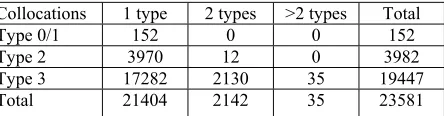
Firstly, we study the statistics of how many types of dependencies a bi-gram collocation may have. The numbers of dependency types with respect to different collocation types are listed in Table 3.
Collocations 1 type 2 types >2 types Total
Type 0/1 152 0 0 152
Type 2 3970 12 0 3982
Type 3 17282 2130 35 19447
[image:6.612.316.538.602.660.2]Total 21404 2142 35 23581
It is observed that about 90% bi-gram collocations have only one dependency type. This indicates that a collocation normally has only one fixed syntactic dependency. It is also observed that about 10% bi-gram collocations have more than one dependency type, especially Type 3 collocations. For example, two types of dependencies are identified in the bi-gram collocation 安全/an-国家/n. They are 安全 /an-AN-国家/n (a safe nation) which indicates the dependency of a noun and its nominal modifier where 国家/n serves as the head, and国家 /n-NN-安 全/an (national security) which indicates the dependency of a noun and its nominal modifier where 安全/an serves as the head. It is attributed to the fact that the use of Chinese words is flexible. A Chinese word may support different part-of-speech. A collocation with different dependencies results in different distribution trends and most of these collocations are classified as Type 3. On the other hand, Type 0/1 and Type 2 collocations seldom have more than one dependency type.
5.3 Syntactic Dependency Statistics of Collo-cations
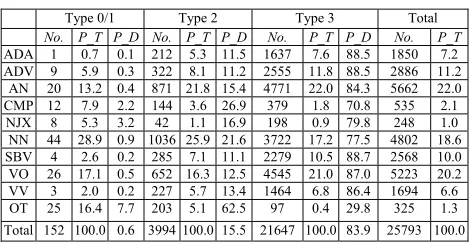
The statistics of the 10 types of syntactic depend-encies with respect to different types of bi-gram collocations are shown in Table 4. No. is the num-ber of collocations with a given dependency type D and a given collocation type T. The percentage of No. among all collocations with the same collo-cation type T is labeled as P_T, and the percentage of No. among all of the collocations with the same dependency D is labeled as P_D.
Type 0/1 Type 2 Type 3 Total
No. P_T P_D No. P_T P_D No. P_T P_D No. P_T ADA 1 0.7 0.1 212 5.3 11.5 1637 7.6 88.5 1850 7.2 ADV 9 5.9 0.3 322 8.1 11.2 2555 11.8 88.5 2886 11.2
[image:7.612.72.307.493.616.2]AN 20 13.2 0.4 871 21.8 15.4 4771 22.0 84.3 5662 22.0 CMP 12 7.9 2.2 144 3.6 26.9 379 1.8 70.8 535 2.1 NJX 8 5.3 3.2 42 1.1 16.9 198 0.9 79.8 248 1.0 NN 44 28.9 0.9 1036 25.9 21.6 3722 17.2 77.5 4802 18.6 SBV 4 2.6 0.2 285 7.1 11.1 2279 10.5 88.7 2568 10.0 VO 26 17.1 0.5 652 16.3 12.5 4545 21.0 87.0 5223 20.2 VV 3 2.0 0.2 227 5.7 13.4 1464 6.8 86.4 1694 6.6 OT 25 16.4 7.7 203 5.1 62.5 97 0.4 29.8 325 1.3 Total 152 100.0 0.6 3994 100.0 15.5 21647 100.0 83.9 25793 100.0
Table 4. The statistics of collocations with dif-ferent collocation type and dependency
Corresponding to 23,581 bi-gram collocations, 25,793 types of dependencies are identified (some collocations have more than one types of depend-ency). In which, about 82% belongs to five major
dependency types. They are AN, VO, NN, ADV and SBV. It is note-worthy that the percentage of NN collocation is much higher than that in English. This is because nouns are more often used in paral-lel to serve as one syntactic component in Chinese sentences than in English.
The percentages of Type 0/1, Type 2 and Type 3 collocations in CCB are 0.6%, 16.9% and 82.5%, respectively. However, the collocations with dif-ferent types of dependencies have shown their own characteristics with respect to different collocation types. The collocations with CMP, NJX and NN dependencies on average have higher percentage to be classified into Type 0/1 and Type 2 collocations. This indicates that CMP, NJX and NN collocations in Chinese are always used in fixed patterns and these kinds of collocations are not freely modifi-able and substitutmodifi-able. In the contrary, many ADV and AN collocations are classified as Type 3. This is partially due to the special usage of auxiliary words in Chinese. Many AN Chinese collocations can be inserted by a meaningless auxiliary word的
/u and many ADV Chinese collocations can be in-serted by an auxiliary word地/u. This means that many AN and ADV collocations can be modified and thus, they always have two peak co-occurrences. Therefore, they are classified as Type 3 collocations. 7.7% and 62.5% of the collocations with dependency OT are classified as Type 0/1 and Type2 collocations, respectively. Such percentages are much higher than the average. This is attributed by the fact that some Type 0/1 and Type 2 colloca-tions have strong semantic relacolloca-tions rather than syntactic relations and thus their dependencies are difficult to label.
5.4 Chunking Statistics of Collocations
ADA ADV AN CMP NJX NN SBV VO VV OT 0 chunk 56.8 53.1 65.7 48.5 70.2 62.4 46.5 41.1 47.2 86.4 1 chunk 38.2 43.7 28.5 37.2 15.4 27.9 41.2 35.7 41.1 13.5 2 chunks 5.0 3.2 3.7 14.2 14.4 9.7 11.0 17.6 9.6 0.1 >2chunks 0.0 0.0 2.1 0.1 0.0 0.0 1.3 5.6 2.1 0.0 Table 5. Chunking distances of Type 3 collocations
It is shown that the co-occurrence of collocations decreases with increased chunking distance. Yet, the behavior for decrease is different for colloca-tions with different dependencies. Generally speak-ing, the ADA, ADV, CMP, NJX, NN and OT collo-cations seldom co-occur cross two words or two chunks. Furthermore, the occurrences of AN, NJX and OT collocations quickly drops when the chunking distance is greater than 0, i.e. these col-locations tends to co-occur within the same chunk. In the contrary, the co-occurrences of ADA, ADV, CMP, SBV and VV collocations corresponding to chunking distance equals 0 and 1 decrease steadily. It means that these four kinds of collocations are more evenly distributed within the same chunk or between neighboring words or chunks. The occur-rences of VO collocations corresponding to chunk-ing distance from 0 to 3 with a much flatter reduc-tion. This indicates that a verb may govern its ob-ject in a long range.
6
Conclusions
This paper describes the design and construction of a manually annotated Chinese collocation bank. Following a set of well-designed annotation guide-line, the collocations corresponding to 3,643 headwords are identified from a chunked five-million word corpus. 2,752 unique n-gram colloca-tions and 23,581 unique bi-gram collocations are annotated. Furthermore, each bi-gram collocation is annotated with its syntactic dependency informa-tion, classification information and chunking in-formation. Based on CCB, characteristics of collo-cations with different types and different depend-encies are examined. The obtained result is essen-tial for improving research related to Chinese col-location. Also, CCB may be used as a standard an-swer set for evaluating the performance of differ-ent collocation extraction algorithms. In the future, collocations of all unvisited headwords will be an-notated to produce a complete 5-million-word Chi-nese collocation bank.
Acknowledgement
This research is supported by The Hong Kong Polytechnic University (A-P203), CERG Grant (5087/01E) and Chinese University of Hong Kong under the Direct Grant Scheme project (2050330) and Strategic Grant Scheme project (4410001).
References
Bedin N. et al. 2003. The Annotation Process in the Turkish Treebank. In Proc. 11th Conference of the EACL-4th Linguistically Interpreted Corpora Work-shop- LINC.
Kosho S. et al. 2000. Collocations as Word Co-occurrence Restriction Data - An Application to Japanese Word Processor. In Proc. Second Interna-tional Conference on Language Resources and Evaluation
Lin D.K. 1998. Extracting collocations from text cor-pora. In Proc. First Workshop on Computational Terminology, Montreal
Manning, C.D., Schütze, H. 1999: Foundations of Sta-tistical Natural Language Processing, MIT Press Mei J.J. 1999. Dictionary of Modern Chinese
Colloca-tions, Hanyu Dictionary Press
Pecina P. 2005. An Extensive Empirical Study of Collo-cation Extraction Methods. In Proc. 2005 ACL Stu-dent Research Workshop. 13-18
Smadja. F. 1993. Retrieving collocations from text: Xtract, Computational Linguistics. 19. 1. 143-177 Tutin A. 2005. Annotating Lexical Functions in Corpora:
Showing Collocations in Context. In Proc. 2nd Inter-national Conference on the Meaning – Text Theory
Xu R. F. and Lu Q. 2005. Improving Collocation Ex-traction by Using Syntactic Patterns, In Proc. IEEE International Conference on Natural Language Proc-essing and Knowledge Engineering. 52-57
Xu, R.F. and Lu, Q. 2006. A Multi-stage Chinese Col-location Extraction System. Lecture Notes in Com-puter Science, Vol. 3930, Springer-Verlag. 740-749 Yu S.W. et al. 2001. Guideline of People’s Daily