A Combination of Topic Models with Max-margin Learning for Relation
Detection
Dingcheng Li University of Minnesota
Twin Cities, MN 55455 [email protected]
Swapna Somasundaran Siemens Corporate Research
Princeton, NJ 08540 [email protected]
Amit Chakraborty Siemens Corporate Research
Princeton, NJ 08540 [email protected]
Abstract
This paper proposes a novel application of a supervised topic model to do entity rela-tion detecrela-tion (ERD). We adapt Maximum En-tropy Discriminant Latent Dirichlet Alloca-tion (MEDLDA) with mixed membership for relation detection. The ERD task is refor-mulated to fit into the topic modeling frame-work. Our approach combines the benefits of both, maximum-likelihood estimation (MLE) and max-margin estimation (MME), and the mixed membership formulation enables the system to incorporate heterogeneous features. We incorporate different features into the sys-tem and perform experiments on the ACE 2005 corpus. Our approach achieves better overall performance for precision, recall and Fmeasure metrics as compared to SVM-based and LLDA-based models.
1 Introduction
Entity relation detection (ERD) aims at finding rela-tions between pairs of Named Entities (NEs) in text. Availability of annotated corpora (NIST, 2003; Dod-dington et al., 2004) and introduction of shared tasks (e.g. (Farkas et al., 2010; Carreras and M`arquez, 2005)) has spurred a large amount of research in this field in recent times. Researchers have used super-vised and semi-supersuper-vised approaches (Hasegawa et al., 2004; Mintz et al., 2009; Jiang, 2009), and ex-plored rich features (Kambhatla, 2004), kernel de-sign (Culotta and Sorensen, 2004; Zhou et al., 2005; Bunescu and Mooney, 2005; Qian et al., 2008) and inference algorithms (Chan and Roth, 2011), to de-tect predefined relations between NEs.
In this work, we explore if and how the latent se-mantics of the text can help in detecting entity rela-tions. For this, we adapt the Latent Dirichlet Alloca-tion (LDA) approach to solve the ERD task. Specif-ically, we present a ERD system based on Maxi-mum Entropy Discriminant Latent Dirichlet Alloca-tion (MEDLDA). MEDLDA (Zhu et al., 2009), is an extension of Latent Dirichlet Allocation (LDA) that combines capability of capturing latent seman-tics with the discriminative capabilities of SVM.
There are a number of challenges in employing the LDA framework for ERD. Latent Dirichlet Allo-cation and its supervised extensions such as Labeled LDA (LLDA) (Ramage et al., 2009) and supervised LDA (sLDA) (Blei and McAuliffe, 2008) are pow-erful generative models that capture the underlying semantics of texts. However, they have trouble dis-covering marginal classes and easily employing rich feature sets, both of which are important for ERD. We overcome the first drawback by employing a MEDLDA framework, which integrates maximum likelihood estimation (MLE) and maximum margin estimation (MME). Specifically, it is a combination of sLDA and support vector machines (SVMs). Fur-ther, in order to employ rich and heterogeneous fea-tures we introduce a separate exponential family dis-tribution for each feature, similar to (Shan et al., 2009), into our MEDLDA model.
We formulate the relation detection task within the topic model framework as follows. Pairs of NE mentions1 and the text between them is considered
1Adopting the terminology used in the Automatic Context
Extraction (ACE) program (NIST, 2003), specific NE instances are called mentions.
as mini-document. Each mini-document has a re-lation type (analogous to the response variable in the supervised topic model). The topic model in-fers the topic (relation type) distribution of the mini-documents. The supervised topic model discovers a latent topic representation of the mini-documents and a response parameter distribution. The topic representation is discovered with observed response variables during training. During testing, the topic distribution of each mini-document can form a pre-diction of the relation types.
We carry out experiments to measure the effec-tiveness of our approach and compare it to SVM-based and LLDA-SVM-based models, as well as to a pre-vious work using the same corpora. We also mea-sure and analyze the effectiveness of incorporating different features in our model relative to other mod-els. Our approach exhibits better overall precision, recall and Fmeasure than baseline systems. We also find that the MEDLDA-based approach shows con-sistent capability for incorporation and improvement due to a variety of heterogeneous features.
The rest of the paper is organized as follows. We describe the proposed model in Section 2 and the features that we explore in this work in Section 3. Section 4 describes the data, experiments, results and analyses. We discuss the related work in Sec-tion 5 before concluding in SecSec-tion 6.
2 MEDLDA for Relation Detection
MEDLDA is an extension of LDA proposed by Zhu, Ahmed and Xing (2009). LDA is itself unsuper-vised and the results are often hard to interpret. However, with the addition of supervised informa-tion (such as response variables), the resulting topic models have much better predictive power for classi-fication and regression. In our work, we use relation annotations from the ACE (ACE, 2000 2005) corpus to provide the supervision. NE pairs within a sen-tence, and the text between them are considered as a mini-document. Each mini-document is assumed to be composed of a set of topics. The topic model trained with these mini-documents given their rela-tion type label can generate topics biased toward re-lation types. Thus, the trained topic model will have good predictive power on relation types.
We first describe the MEDLDA model from (Zhu
et al., 2009) and then describe how we adapt it for relation detection using mixed membership exten-sions.
[image:2.612.329.516.118.229.2]2.1 MEDLDA
Figure 1: MEDLDA
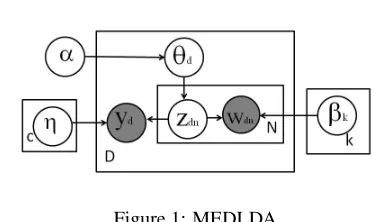
The MEDLDA model described in (Zhu et al., 2009) is illustrated in Figure 12.
Here,αis ak-dimensional parameter of a Dirich-let distribution,β1:kare the parameters fork compo-nent distribution over the words. Each compocompo-nent refers to a topic. In a collection of documents D, each documentw1:N is generated from a sequence of topicsz1:N. θ is ak-dimensional topic distribu-tion variable, which is sampled from a Dirichlet dis-tributionDir(α). Like common LDAs, MEDLDA uses independence assumption for a finite set of ran-dom variablesz1, ..., znwhich are independent and identically distributed, conditioned on the parame-terθ. Like sLDA, MEDLDA is a supervised model. A response variableY connected to each document is added for incorporating supervised side informa-tion. The supervised side information is expected to make MEDLDA topic discoveries more inter-pretable. Zhu, Ahmed and Xing’s (2009) MEDLDA model can be used in both regression and classifi-cation. Concretely, Y is drawn from η1:c, a c k -dimensional vector which can be derived from suit-able statistical model. In our work, c is the num-ber of relation types. Note that the plate diagram for MEDLDA is quite similar to sLDA (Blei and McAuliffe, 2008). But there is a difference – sLDA focuses on building regression models, and thus the response variableY in sLDA is generated by a nor-mal distribution.
Based on the plate diagram, the joint distribution of latent and observable variables for our
MEDLDA-2(Zhu et al., 2009) do not have this plate digram in their
based relation detection is given by
p(θ,z,w,y|α, β1:k, η1:c)
= D
Y
d=1
p(θd|α)× N
Y
n=1
p(zdn|θd)p(wdn|zdn, β1:k)
×p(yd|zd1:dN, η1:c) (1)
Another important difference from sLDA lies in the fact that MEDLDA does joint learning with both MME and MLE. The joint learning is done in two stages, unsupervised topic discovery and multi-class classification (we refer the reader to (Zhu et al., 2009) for details). During training, EM algorithms are utilized to infer the posterior distribution of the hidden variablesθ, z andη. In testing, the trained models are used to predict relation typesy.
2.2 Mixed Membership MEDLDA
[image:3.612.97.275.390.465.2]Although the MEDLDA model described above can be applied to the relation detection and classification task, a few modifications are necessary before it can be effective in predicting relation types. Mainly, a
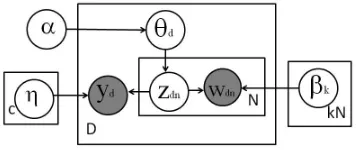
Figure 2: Mixed Membership MEDLDA limitation of LDA or other existing topic models is the difficulty in incorporating rich features. This is because LDA is designed to handle data points with homogeneous features such as words. But for rela-tion detecrela-tion, like many other NLP tasks, it is im-portant to have the flexibility of incorporating part-of-speech tags, named entities, grammatical depen-dencies and other linguistic features. We overcome this limitation by introducing a separate exponential family distribution for each feature similar to (Shan et al., 2009). Thus, our MEDLDA-based relation detection model is really a mixed-member Bayesian network. Figure 2 illustrates our model with this ex-tension.
Figure 2 is very similar to Figure 1; the only dif-ference is that the topic component numberkis now
kN. The generative process for each document this model is as follows:
1. Sample a component proportion θd ∼
Dirichlet(α),
2. For each feature like word, part-of-speech, named entity in the document,
(a) For n ∈ {1, ..., N}, sample zdn = i ∼
Discrete(θd)
(b) For n ∈ {1,...,N}, sample wdn ∼
P(wdn|βnid)
3. Sample the relation type label from a softmax(z¯,η) where yd ∼
sof tmax( exp(η
T h¯z)
Pc−1
h=1exp(ηThz)¯
)
In the sampling, indexiis the number of the topic component which ranges from1 :k.P(wdn|βnid)in 2(b) is an exponential family distribution whereiis from1...k. Note that now we haveβnid rather than onlyβidsince we have drawn separate distributions for each word (or feature)n.
Now, our MEDLDA-based relation-detection model can integrate diverse features of different types or the same features with different parameters. Following the generative process, parameter es-timation and inferences can be made with either Gibbs sampling or variational methods. We use vari-ational methods since we adapt MEDLDA package3 to mixed-membership MEDLDA and train relation detection models.
2.3 Relation Detection
With the generative process, inference and parame-ter estimation in place, we are ready to perform rela-tion detecrela-tion. The first step is to perform variarela-tional inference given the testing instances.
In classification, we estimate the probability of the relation type given topics and the response pa-rameters, i.e. p(yd|zd1:dN, η1:c−1). With variational approximation, we can derive the prediction rule as
F(y, z1:N, η) = ηTf(y,z¯) where f(y,z¯) is a fea-ture vector. Now, SVM can be used to derive the
3
this package is downloaded from
prediction rule. The final prediction can be general-ized exactly the same as Zhu, Ahmed and Xing (Zhu et al., 2009):
ˆ
y=argmaxyE[ηTf(y,Z¯)|α, β] (2)
3 Features
We explore the effectiveness of incorporating fea-tures into our systems as well as the baselines. For this, we construct feature sets similar to Jiang and Zhai (2007) and Zhou (2005). Three kinds of fea-tures are employed:
1. BOWThe Bag of Words (BOW) feature cap-tures all the words in our mini-document. It comprises of the words of the two NE mentions and the words between them.
2. SYNThe SYN features are constructed to cap-ture syntactic, semantic and structural infor-mation of the mini-document. They include features such as HM1 (the head word of the first mention), HM2 (the head word of the sec-ond mention), ET1, ET2, M1 and M2 (Entity types and mention types of the two mentions involved), #MB (number of other mentions in between the two mentions), #WB (number of words in between the two mentions).
3. COMPThe COMP features are composite fea-tures that are similar to SYN, but they addition-ally capture language order and dependencies between the features mentioned above. These include features such as HM1HM2 (combining head word of mention 1 and head word of men-tion 2) , ET12 (combinamen-tions of menmen-tion entity type), ML12 (combination of mention levels), M1InM2 or M2InM1 (flag indicating whether M2/M1 is included in M1/M2).
The main intuitions behind employing composite features, COMP, are as follows. First, they capture the ordering information. The ordering of words are not captured by BOW. That is, BOW features as-sume exchangeability. This works for models based on random or seeded sampling (e.g. LDA) – as long as words sampled are associated with a topic, the hidden topics of the documents can be discovered. In the case of ERD, this assumption might work
with symmetric relations. However, when the rela-tions are asymmetric, ordering information is impor-tant. Composite features such as HM1HM2 encodes what mention head word precedes the other. Second, features such as M1InM2 or M2InM1 capture token dependencies. Besides exchangeability, LDA-based models also assume that words are conditionally in-dependent. Consequently, the system cannot capture the knowledge that some mentions may be included in other mentions. By constructing features such as M1InM2 or M2InM1, we encode the dependency in-formation explicitly.
4 Experiments
As MEDLDA is a combination of maximum mar-gin principle with maximum likelihood estimation for topic modes, we compare it with two baseline systems. The first, SVM, uses only the maximum margin principle, while the second,LLDA, uses only maximum likelihood estimation for topic modeling.
4.1 Data
We use the ACE corpus (Phase 2, 2005) for eval-uation. The ACE corpus has annotations for both entities and relations. The corpus has six major re-lations types, 23 subtypes and 7 entity types. In this work, we focus only on the six high-level relation types listed in Table 1. In addition to the the 6 ma-jor types, we have an additional category, no relation (NO-REL), that exists between entities that are not related.
The data for our experiments consists of pairs of NEs from a sentence, and the gold standard annota-tion of their relaannota-tion type (or NO-REL). All relaannota-tions in the ACE corpus are intra-sentential and hence we do not create NE pairs that cross sentence bound-aries. Also, almost all positive instances are within two mentions of each other. Hence, we create NE pairs for only those NEs that have at most 2 interven-ing NEs in between. This gives us a total of 38,342 relation instances of which 32,640 are negative stances (NO-REL) and 5702 are positive relation in-stances belonging to one of the 6 categories.
4.2 Experimental Setup
Major Type Definition Example
ART artifact User, owner, inventor or the makers of the Kursk manufacturer
GEN-AFF citizen, resident, religion, U.S. Companies ethnicity and organization-location
ORG-AFF employment, founder, ownership, The CEO of Siemens (Org-affiliation) sports-affiliation, investor-shareholder
student-alumni and membership
PART-WHOLE geographical, subsidiary and so on a branch of U.S bank
PER-SOC business, family and a spokesman for the senator (person-social) lasting personal relationship
[image:5.612.106.505.53.222.2]PHYS (physical) located or near a military base in Germany
Table 1: Relation types for ACE 05 corpus
for each of the models (wherever applicable) using the training data. Best parameters are determined for the three conditions: 1) BOW features alone BOW, 2) BOW plus SYN features (PlusSYN) and 3) BOW plus SYN and COMP features (PlusCOMP). All systems achieved their overall best performance with PlusCOMP features (see Section 4.4 for a de-tailed analysis).
4.2.1 MEDLDA
The number of topics are determined using the equation 2K0 + K1 following Zhu, Ahmed and Xing (2009) and K1 = 2K0. K0 is the number of topics per class andK1 is the number of topics shared by all relation types. The choice of topics is based on the intuition that the shared componentK1 should use all class labels to model common latent structure while non-overlapping components should model specific characteristics data from each class. The ratio of topics is based on the understanding that shared topics may be more than topics of each class. The specific numbers do not produce much variation in the final results. We experimented with the fol-lowing number of topics: 20, 40, 70, 80, 90, 100, 110. BOW, PlusSYN, and PlusCOMP configura-tions obtain the best performance for 90 topics, 80 topics, and 70 topics respectively.
Since SVMs are employed in the MEDLDA im-plementation, we need to determine the penalty pa-rameter of the cost function, C. We used 5 fold cross-validation to locate the parameter C. The best values for C are 25, 28, 30 respectively for BOW, PlusSYN
and PlusCOMP configurations. We used a linear kernel as it is the most commonly used kernel for text classification tasks. Since MEDLDA is run by sampling, the result may be different each time. We ran it 5 times for each setting and took the average as the final results.
4.2.2 LLDA and SVM
The setting of topics for LLDA is similar to MEDLDA. As LLDA is also run by sampling, we ran it 5 times for each setting and took the average as the final results. In SVMlight, a grid search tool is provided to locate the the best value for parame-ter C. The best C for all three conditions was found to be 1. All other settings for the two models are similar to those of MEDLDA.
4.3 Results
Prec% Rec% F% SVM 53.2 35.2 40.3 LLDA 28.3 51.6 36.6 MEDLDA 57.8 53.2 55.4
Table 2: Overall performance of the 3 systems
[image:5.612.327.512.511.573.2]Labels SVM LLDA MEDLDA Pre% Rec% F% Pre% Rec% F% Pre% Rec% F%
ART 30 8 14 1.5 33 3 49 36 41
GEN-AFF 53 48 50 3 32 6 40 39 40
ORG-AFF 55 35 43 59 58 59 53 59 56
PART-WHOLE 39 08 14 31 82 45 44 52 48
PER-SOC 50 17 25 7 92 13 73 76 75
PHYS 55 35 43 26 47 33 56 19 29
[image:6.612.114.498.52.184.2]NO-REL 90 95 93 70 17 27 89 91 90
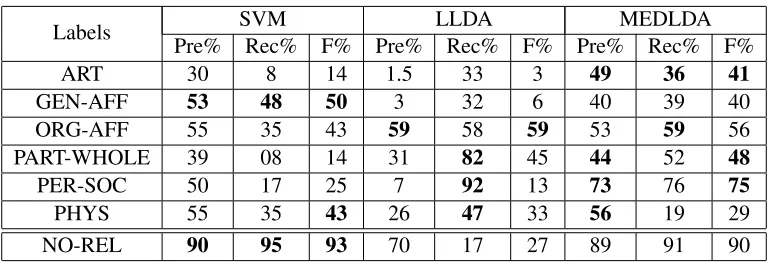
Table 3: Multi-class Classification Results with PlusCOMP for SVM, LLDA and MEDLDA for the six ACE 05 categories and NO-REL
SVM across all metrics. Specifically, there is a 15 percentage point improvement in Fmeasure over the best performing baseline. This result indicates that our approach of combining topic model with max-margin learning is effective for relation detection.
Now, looking at the results for each individual relationship category (see Table 3; the best num-bers for each category and metric are highlighted inbold) we see that the Fmeasure for MEDLDA is better than that for SVM for 4 out of the 6 ACE re-lation types; and better than the Fmeasure obtained by LLDA for all relation types except ORG-AFF. Specifically, comparing with the best performing baseline, MEDLDA produces a Fmeasure improve-ment 27 percentage points for ART, 3 percentage points for PART-WHOLE and 50 percentage points for PER-SOC. Also, for four of the six ACE rela-tion types, MEDLDA achieves the best precision. Even in the cases where MEDLDA is not the best performer for a relation category, its performance is not very poor (unlike, for example, SVM for PART-WHOLE and LLDA for ART, respectively).
Interestingly, the NO-REL category reveals a sharp contrast in the performance of SVM and LLDA. NO-REL is a difficult, catch-all category that is a mixture of data with diverse distributions. This is a category where maximum-margin learning is more effective than maximum-likelihood estima-tion. Notice that MEDLDA achieves performance close to SVM for this category. This is because, even though both LLDA and MEDLDA model hid-den topics and then employ discovered hidhid-den topics to predict relation types, MEDLDA does joint infer-ence of MLE and MME. This joint inferinfer-ence helps
to improve the detection of NO-REL.
Finally, we also compare our system’s results (us-ing PlusCOMP features) with the results of previ-ous research on the same corpus (Khayyamian et al., 2009). They use similar experimental settings: ev-ery pair of entities within a sentence is regarded to involve a negative relation instance unless it is anno-tated as positive in the corpus. A similar filter (they use a distance filter) is used to sift out unrelated neg-ative instances. Their train/test ratio of data split is also the same as ours.
Khayyamian, Mirroshandel and Abolhas-sani (2009) employ state-of-art kernel methods developed by Collins and Duffy (2002) and only report Fmeasures over the six ACE relation types. For clarity, we reproduce their results in Table 4 and repeat MEDLDA Fmeasures from Table 3 in the last column. The last row (Overall) reports the macro-averages computed over all relation types for each system. Here we see that overall, MEDLDA outperforms all kernels. MEDLDA also performs better than the best kernel for four of the six relation types.
4.4 Analysis
Labels CD’01 AAP AAPD TSAAPD-0 TSAAPD-01 MEDLDA
ART% 51 49 50 48 47 41
GEN-AFF % 9 10 12 11 11 40
ORG-AFF % 43 43 43 43 45 56
PART-WHOLE % 30 28 29 30 28 48
PER-SOC % 62 58 70 63 73 75
PHYS % 32 36 29 33 33 29
[image:7.612.105.510.53.171.2]Overall (Avg) 38 37 39 38 40 48
[image:7.612.92.280.224.335.2]Table 4: F-measures for every kernel in (Khayyamian et al., 2009) and MEDLDA
Figure 3: SVM Fmeausres for 3 feature conditions
Figure 4: LLDA Fmeausres for 3 feature conditions
Figure 5: MEDLDA Fmeausres for 3 feature conditions
Let us first look at the best systems (based on Fmeasure) for each of the six ACE relation types in Table 3, and look at what feature set
pro-duces the best result for that system and relation. MEDLDA is the best performer for ART, PART-WHOLE and PER-SOC in Table 3. Figure 5 veals that MEDLDA’s best performance for these re-lation types are obtained using PlusCOMP features. Similarly SVM obtains the best Fmeasure for GEN-AFF and PHYS relations and Figure 3 shows that SVM achieves its best performance for these cate-gories using PlusCOMP. We also see a similar trend with LLDA and the ORG-AFF relation type. These results corroborate intuition from previous research that informative features are important for relation type recognition. The only exception to this is the performance of SVM for NO-REL. This is not sur-prising, as the features we use are focused on deter-mining true relation types and NO-REL is a mixture of all cases (and features) where relations do not ex-ist.
[image:7.612.92.280.375.486.2] [image:7.612.93.279.523.635.2]the gains are more substantial. This is encouraging and opens up avenues for further exploration.
5 Related Work
Previous research has explored various methods and features for relationship detection and mining. Ker-nel methods have been popularly used for rela-tion detecrela-tion. Some examples are are dependency tree kernels (Culotta and Sorensen, 2004), short-est dependency path kernels (Bunescu and Mooney, 2005), and more recently, convolution tree kernels (Zhao and Grishman, 2005; Zhang et al., 2006) context-sensitive convolution tree kernels (Zhou et al., 2007) and dynamic syntax tree kernels (Qian et al., 2008). Kernel methods for relation extraction focus on representing and capturing the structured information of the text between the entities. In our MEDLDA model, instead of computing distances between subtrees, we sample topics based on their distributions. The sampling is not only on the (mini) document level, but also on the word level or on the syntactic or semantic level. Our model focuses on addressing the underlying semantics more directly than typical kernel-based methods.
Chan and Roth (2011) employ constraints us-ing an integer linear programmus-ing (ILP) framework. Using this, they apply rich linguistic and knowledge-based constraints knowledge-based on coreference annotations, a hierarchy of relations, syntacto-semantic structure, and knowledge from Wikipedia. In our work, we focus on capturing the latent semantics of the text between the NEs.
A variety of features have been explored for ERD in previous research (Zhou et al., 2005; Zhou et al., 2008; Jiang and Zhai, 2007; Miller et al., 2000). Syntactic features such as POS tags and dependency path between entities; semantic features such as Word-Net relations, semantic parse trees and types of NEs; and structural features such as which entity came first in the sentence have been found useful for ERD. We too observe the utility of informative tures for this task. However, exploration of the fea-ture space is not the main focus of this work. Rather, our focus is on whether the models are capable of incorporating rich features. A fuller exploration of rich heterogeneous features is the focus of our fu-ture work.
A closely related task is that of relation min-ing and discovery, where unsupervised, semi-supervised approaches have been effectively em-ployed (Hasegawa et al., 2004; Mintz et al., 2009; Jiang, 2009). For example, Hasegawa et al. (2004) use clustering and entity type information, while Mintz et al. (2009) employ distant supervision. Our ERD task is different from these as we focus on classifying the relation types into predefined relation types in the ACE05 corpus.
Topic models have been applied previously for a number of NLP tasks (e.g. (Lin et al., 2006; Titov and McDonald, 2008). LDAs have also been em-ployed to reduce feature dimensions in relation de-tection systems (Hachey, 2006). However, to the best of our knowledge, this is the first work to make use of topic models to perform relation detection.
6 Conclusion and Future Work
In this work, we presented a system for en-tity relation detection based on mixed-membership MEDLDA. Our approach was motivated by the idea that combination of max margin and maximum like-lihood can help to improve relation detection task. For this, we adapted the existing work on MEDLDA and mixed membership models and formulated ERD as a topic detection task. To the best of our knowl-edge, this is the first work to make full use of topic models for relation detection.
Our experiments show that the proposed approach achieves better overall performance than SVM-based and LLDA-SVM-based approaches across all met-rics. We also experimented with different features and the effectiveness of the different models for har-nessing these features. Our analysis show that our MEDLDA-based approach is able to effectively and consistently incorporate informative features.
References
ACE. 2000-2005. Automatic Content Extraction.
http://www.ldc.upenn.edu/Projects/ACE/.
D.M. Blei and J. McAuliffe. 2008. Supervised topic models. Advances in Neural Information Processing Systems, 20:121–128.
R.C. Bunescu and R.J. Mooney. 2005. A shortest path dependency kernel for relation extraction. In HLT & EMNLP.
X. Carreras and L. M`arquez. 2005. Introduction to the CoNLL-2005 shared task: Semantic role labeling. In
CONLL, pages 152–164. ACL.
Y. Chan and D. Roth. 2011. Exploiting syntactico-semantic structures for relation extraction. InACL. M. Collins and N. Duffy. 2002. Convolution kernels for
natural language. Advances in neural information pro-cessing systems, 1:625–632.
A. Culotta and J. Sorensen. 2004. Dependency tree kernels for relation extraction. In Proceedings of the 42nd Annual Meeting on Association for Computa-tional Linguistics, page 423. ACL.
G. Doddington, A. Mitchell, M. Przybocki, L. Ramshaw, S. Strassel, and R. Weischedel. 2004. The auto-matic content extraction (ACE) program–tasks, data, and evaluation. In Proceedings of LREC, volume 4, pages 837–840.
R. Farkas, V. Vincze, G. M´ora, J. Csirik, and G. Szarvas. 2010. The CoNLL-2010 Shared Task: Learning to De-tect Hedges and their Scope in Natural Language Text. InCoNLL-2010, pages 1–12.
B. Hachey. 2006. Comparison of similarity models for the relation discovery task. InCOLING & ACL 2006, page 25.
T Hasegawa, S Sekine, and Ralph Grishman. 2004. Dis-covering relations among named entities from large corpora. In42nd ACL.
J. Jiang and C.X. Zhai. 2007. A systematic explo-ration of the feature space for relation extraction. In
NAACL/HLT, pages 113–120.
J. Jiang. 2009. Multi-task transfer learning for weakly-supervised relation extraction. In 47th ACL & 4th AFNLP, pages 1012–1020. ACL.
N. Kambhatla. 2004. Combining lexical, syntactic, and semantic features with maximum entropy models for extracting relations. In ACL 2004 Interactive poster and demonstration sessions.
M. Khayyamian, S.A. Mirroshandel, and H. Abolhassani. 2009. Syntactic tree-based relation extraction using a generalization of Collins and Duffy convolution tree kernel. InHLT/NAACL,: Student Research Workshop. Wei-Hao Lin, Theresa Wilson, Janyce Wiebe, and Alexander Hauptmann. 2006. Which side are you on?
Identifying perspectives at the document and sentence levels. InCoNLL-2006.
S. Miller, H. Fox, L. Ramshaw, and R. Weischedel. 2000. A novel use of statistical parsing to extract information from text. InNAACL.
M Mintz, S Bills, R Snow, and D Jurafsky. 2009. Dis-tant supervision for relation extraction without labeled data. In47th ACL & 4th AFNLP.
US NIST. 2003. The ACE 2003 Evaluation Plan.US Na-tional Institute for Standards and Technology (NIST), pages 2003–08.
L. Qian, G. Zhou, F. Kong, Q. Zhu, and P. Qian. 2008. Exploiting constituent dependencies for tree kernel-based semantic relation extraction. In22nd ACL. D. Ramage, D. Hall, R. Nallapati, and C.D. Manning.
2009. Labeled LDA: A supervised topic model for credit attribution in multi-labeled corpora. InEMNLP. H. Shan, A. Banerjee, and N.C. Oza. 2009. Discrim-inative Mixed-membership Models. InICDM, pages 466–475. IEEE.
Ivan Titov and Ryan McDonald. 2008. A joint model of text and aspect ratings for sentiment summarization. InACL-08: HLT.
M. Zhang, J. Zhang, J. Su, and G. Zhou. 2006. A com-posite kernel to extract relations between entities with both flat and structured features. In21st ICCL & 44th ACL.
S. Zhao and R. Grishman. 2005. Extracting relations with integrated information using kernel methods. In
43rd ACL.
G Zhou, S. Jian, Z. Jie, and Z. Min. 2005. Exploring various knowledge in relation extraction. In In 43rd ACL.
G Zhou, M. Zhang, D.H. Ji, and Q Zhu. 2007. Tree kernel-based relation extraction with context-sensitive structured parse tree information. In EMNLP/CoNLL-2007, pages 728–736.
G.D. Zhou, M. Zhang, D.H. Ji, and Q.M. Zhu. 2008. Hierarchical learning strategy in semantic relation ex-traction. Information Processing & Management, 44(3):1008–1021.
J. Zhu and E.P. Xing. 2010. Conditional Topic Random Fields. InICML. ACM.