Creating a Systemic Functional Grammar Corpus from the Penn Treebank
Matthew Honnibal and James R. Curran
School of Information Technologies University of Sydney
NSW 2006, Australia
{mhonn, james}@it.usyd.edu.au
Abstract
The lack of a large annotated systemic func-tional grammar (SFG) corpus has posed a
significant challenge for the development of the theory. Automating SFG annotation is challenging because the theory uses a mini-mal constituency model, allocating as much of the work as possible to a set of hierarchi-cally organised features.
In this paper we show that despite the un-orthodox organisation of SFG, adapting
ex-isting resources remains the most practical way to create an annotated corpus. We present and analyse SFGBank, an automated conversion of the Penn Treebank into sys-temic functional grammar. The corpus is comparable to those available for other lin-guistic theories, offering many opportunities for new research.
1 Introduction
Systemic functional grammar (Halliday and Matthiessen, 2004) aims to describe the set of meaningful choices a speaker makes when putting a thought into words. Each of these choices is seen as a resource for shaping the meaning in a particular way, and the selection will have a distinct grammat-ical outcome as well as a semantic implication. The choices are presented hierarchically, so that early selections restrict other choices. For instance, if a speaker chooses imperative mood for a clause, they cannot choose a tense. Each selection is linked to a syntactic expression rule. When imperative mood is selected, the subject of the clause is suppressed;
when interrogative mood is selected, the order of the subject and first auxiliary are reversed.
Systemic grammars are very different from gram-mars influenced by the formalist tradition. Systemic analysis locates a constituent within a typology, and yields a set of features that describe its salient prop-erties. These features have proven useful for re-search in applied linguistics, on topics such as stylis-tics, discourse analysis and translation. As a gener-ative theory, systemic grammars are less effective. There have been a few attempts, such as those dis-cussed by O’Donnell and Bateman (2005), but as yet a wide coverage systemic grammar that can be used for tractable parsing has not been developed.
The lack of a corpus and parser has limited re-search on systemic grammars, as corpus studies have been restricted to small samples of manually coded examples, or imprecise queries of unannotated data. The corpus we present, obtained by converting the Penn Treebank, addresses this issue. It also suggests a way to automatically code novel text, by convert-ing the output of a parser for a different formalism. This would also allow the use of SFG features for
NLPapplications to be explored, and support current research usingSFGfor applied linguistics.
The conversion process relies on a set of manually coded rules. The first step of the process is to col-lectSFGclauses and their constituents from parses in the Penn Treebank. Each clause constituent is then assigned up to three function labels, for the three si-multaneous semantic and pragmatic structures Hal-liday (1970) describes. Finally, the system features are calculated, using rules referring to the function labels assigned in the previous step. This paper ex-tends the work described in Honnibal (2004).
2 Related Work
Converting the Penn Treebank is the standard ap-proach to creating a corpus annotated according to a specific linguistic theory. This has been the method used to create LTAG (Frank, 2001), LFG (Frank
et al., 2003) andCCG(Hockenmaier and Steedman, 2005) corpora, among others. We employ a similar methodology, converting the corpus using manually specified rules.
Since theSFGannotation is semantically oriented, the work also bears some resemblance to Prop-bank (Palmer et al., 2005). However, PropProp-bank is concerned with manually adding information to the Penn Treebank, rather than automatically reinter-preting the same information through the lens of a different linguistic theory.
We chose not to base our conversion on the Prop-bank annotation, as it does not currently cover the Brown or Switchboard sections of the Treebank. The wider variety of genres provided by these sec-tions makes the corpus much more useful for SFG, since the theory devotes significant attention to prag-matic phenomena and stylistic variation.
3 Systemic Functional Grammar
Generating a constituent using a systemic func-tional grammar involves traversing a decision-tree-like structure referred to as a system network. The nodes of this tree are referred to as systems, and the options from the systems are referred to as features. At each system, the feature selected may add con-straints on the type, number or order of the internal structure of the constituent. When the entire net-work has been traversed, the constraints are unified, and the required constituents generated.
In order to annotate a sentence according to a sys-temic functional grammar, we must specify the set of features encountered as the system network is tra-versed, and apply function labels to each constituent. The function labeling is required because the con-straints are always specified according to the child constituents’ function, rather than their form.
Constituents may have more than one function label, as SFG describes three metafunctions, fol-lowing Halliday’s (1969) argument that a clause is structured simultaneously as a communicative act, a piece of information, and a representation of reality.
Interpersonal function labels are assigned to clause
constituents in determining the clause’s communica-tive status. The most important interpersonal func-tions are Subject and Finite, since the relative posi-tion of the constituents bearing these labels largely determines whether the clause will be a question, statement or command.
The textual structure of the clause includes the functions Theme and Rheme, following Halliday’s (1970) theory of information structure.
Finally, the experiential function of a constituent is its semantic role, described in terms of a small set of labels that are only minimally sensitive to the semantics of the predicate.
4 Annotation Implemented
We base our annotation on the clause network in the Nigel grammar (Mann and Matthiessen, 1983), as it is freely available and discussed at length in Matthiessen (1995). It is difficult to include annota-tion from the group and phrase networks, because of the flat bracketing of constituents in the Penn Tree-bank. The converted corpus has full coverage over all sections of the Penn Treebank 3 corpus.
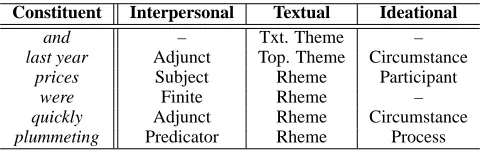
We implement features from 41 systems from the clause network, out of a possible 62. The most prominent missing features relate to process type. The process type system classifies clauses as one of four broad semantic types: material, mental, verbal or relational, with subsequent systems making finer grained distinctions. This is mostly determined by the argument structure of the verb, but also depends on its lexical semantics. Process type assignment therefore suffers from word sense ambiguity, so we are unable to select from this system or others which depend on its result. Figure 1 gives an example of a clause with interpersonal, textual and experiential function labels applied to its constituents.
5 Creating the Corpus
Constituent Interpersonal Textual Ideational
and – Txt. Theme –
last year Adjunct Top. Theme Circumstance prices Subject Rheme Participant
were Finite Rheme –
[image:3.612.186.427.59.135.2]quickly Adjunct Rheme Circumstance plummeting Predicator Rheme Process
Table 1:SFGfunction labels assigned to clause constituents.
preprocess(parse) clauses = []
for word in parse.words(): if isPredicate(word):
constituents = getConstituents(word) clauses.append(constituents)
Figure 2: Conversion algorithm.
The Penn Treebank provides rich syntactic trees, specifying the structure of the sentence. We there-fore proceed from ‘below’, using the Penn Treebank to find clauses and their constituents, then applying function labels to them, and using the function labels as the basis for rules to traverse the system network.
5.1 Finding Constituents
In this stage, we search the Treebank parse for
SFGclauses, and collect their constituents. Clauses are identified by searching for predicates that head them, and constituents are collecting by traversing upwards from the predicate, collecting the nodes’ siblings until we hit an S node.
There are a few common constructions which present problems for one or both of these pro-cedures. These exceptions are handled by pre-processing the Treebank tree, changing its structure to be compatible with the predicate and constituent extraction algorithms. Figure 2 describes the con-version process more formally.
5.1.1 Finding predicates
A predicate is the main verb in the clause. In the Treebank annotation, the predicate will be the word attached to the lowest node in a VP chain, because auxiliaries attach higher up. Figure 3 describes the function to decide whether a word is a predicate. Es-sentially, we want words that are the last word at-tached to a VP, that do not have a VP sibling.
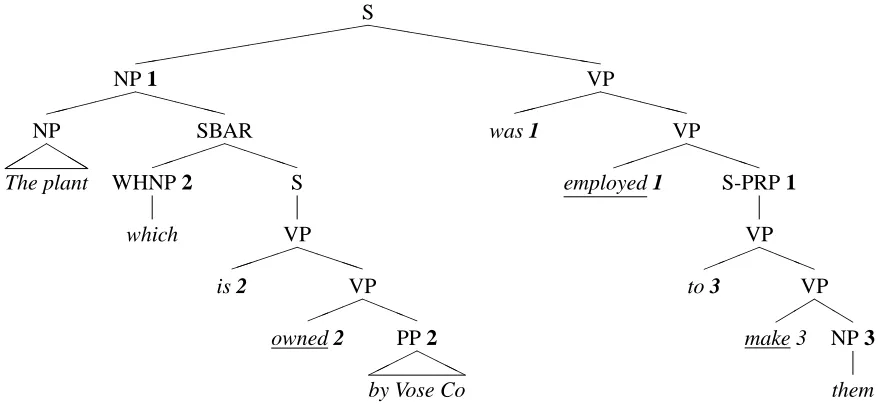
Figure 1 marks the predicates and constituents in a Treebank parse. The predicates are underlined, and the constituents numbered to match the predicate.
if verb.parent.label == ’VP’:
for sibling in verb.parent.children: if sibling.isWord():
if sibling.offset > verb.offset: return False
if sibling.label == ’VP’: return False
return True
Figure 3: Determining whether a word is a predicate.
node = predicate
constituents = [predicate]
while node.label not in clauseLabels: for sibling in node.parent.children:
if sibling != node:
constituents.append(sibling) for sibling in node.parent.children:
if sibling != node
and sibling.label in conjOrWHLabels: constituents.append(sibling)
Figure 4: Finding constituents.
5.1.2 Getting Constituents
Once we have a predicate, we can traverse the tree around it to collect the constituents in the clause it heads. We do this by collecting its siblings and mov-ing up the tree, collectmov-ing the ‘uncle’ nodes, until we hit the top of the clause. Figure 4 describes the pro-cess more formally. The final loop collects conjunc-tions and WH constituents that attach alongside the clause node, such as the ‘which’ in Figure 1.
5.1.3 Pre-processing Ellipsis and Gapping
S hhhhhh hhhhhh ( ( ( ( ( ( ( ( ( ( ( ( NP 1 XX XXX NP b bb " " " The plant SBAR P P PP WHNP 2 which S VP P P PP
is 2 VP
a aa ! ! !
owned 2 PP 2
H HH
by Vose Co
VP XX XXX
was 1 VP
P P PP
employed 1 S-PRP 1
VP a aa ! ! !
to 3 VP
b b " "
make 3 NP 3
[image:4.612.86.525.62.264.2]them
Figure 1: A parse tree with predicates underlined and constituents numbered.
In gapping constructions, the shared constituent is the predicate itself, and what differs between the two clauses are the arguments. The Treebank uses special trace rules to describe which arguments must be copied across to the gapped clause. We create traces to the shared constituents and add them to each gapped clause, so that the trace of the verb will be picked up as a predicate later on. Gapping is a very rare phenomenon – only 0.02% clauses have gapped predicates.
5.1.4 Pre-processing Semi-auxiliaries
In Figure 6 the verb ‘continue’ will match our rules for predicate extraction, described in Section 5.1. SFGanalyses this and other ‘semi-auxiliaries’ (Quirk et al., 1991) as a serial verb construction, rather than a matrix clause and a complement clause. Since we want to treat the finite verb as though it were an auxiliary, we pre-process these cases by simply deleting the S node, and attaching its chil-dren directly to the semi-auxiliary’s VP.
Defining the semi-auxiliary constructions is not so simple, however. Quirk et al. note that some of these verbs are more like auxiliaries than others, and organise them into a rough gradient according to their formal properties. The problem is that there is not clear agreement in the SFG literature about where the line should be drawn. Matthiessen (1995) describes all non-finite sentential complements as serial-verb constructions. Martin et al. (1997) argue that verbs such as ‘want’ impose selectional
restric-S P P PP NP Prices VP H HH continue S VP l l , , to rise
Figure 6: Treebank representation of a sentence with a semi-auxiliary.
tions on the subject, and therefore should be treated as full verbs with a clause complement. Other com-promises are possible as well.
Using Matthiessen’s definition, we collect 5.3% fewer predicates than if we treated all semi-auxiliaries as main verbs. If the complement clause has a different subject from the parent clause, when the two are merged the new verb will seem to have extra arguments. 58% of these mergings introduce an extra argument in this way. For example,
Investors want the market to boom
[image:4.612.369.482.299.413.2]S
XX XXX
X
NP
Asbestos
VP
hhhhhh h (
( ( ( ( ( (
was VP
hhhhhh hh @
@ ( ( ( ( ( ( ( (
VP
a a
aa ! ! ! !
used PP
P P
P P
in the early 1950s
and VP
H HH
replaced PP
Z Z
[image:5.612.147.462.61.206.2]in 1956
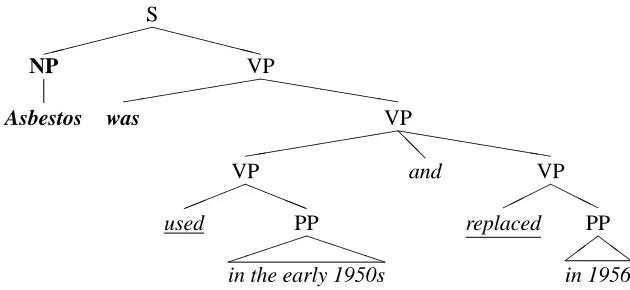
Figure 5: Treebank representation of ellipsis. Predicates are underlined, shared items are in bold.
5.2 Constituent functions
As discussed above, we attach up to three function labels to each clause constituent, one for each
meta-function. The rules to do this rely on the order of
constituents and the function dash-tags in the Penn Treebank. Some experiential function rules also re-fer to interpersonal labels, and some textual function rules refer to experiential labels.
5.2.1 Interpersonal Function Labels
The possible interpersonal function labels we as-sign are Subject, Complement, Adjunct, Finite, and
Predicator. The Finite and Predicator are the first
tensed verb, and the predicate respectively. If there are no auxiliary verbs, Halliday and Matthiessen (2004) describes the predicate as functioning both as Finite and Predicator. Since this is the only case in which a constituent would receive multiple labels from a single metafunction, we instead assign the single label Finite/Predicator.
For NPs, Subjects, Complements and Adjuncts are distinguished using the Penn Treebank’s dash-tag function labels. SFG always assigns
preposi-tional phrases the label Adjunct. All NP constituents that are not marked with an adverbial function tag in the Treebank are labeled Complement. Conjunctions are not assigned interpersonal functions.
5.2.2 Experiential Function Labels
The experiential function labels we assign are
Participant, Process and Circumstance. This is a
simplification of the function labels described by Halliday and Matthiessen (2004), as Participants are usually subdivided into what other linguistic theo-ries refer to as semantic roles. SFG has its own
se-mantic role description, which relies on process type features. For instance, Participants in a verbal pro-cess like ‘say’ have the role options Sayer, Target,
Receiver and Verbiage.
Distinguishing process types requires a word sense disambiguated corpus and a word sense sen-sitive process type lexicon. While there is a signifi-cant intersection between the Penn Treebank and the Semcor word sense disambiguated corpus, there is currently no suitable process type lexicon. Conse-quently, Participants have not been subtyped. The Process is simply the verb phrase, while the Subject and Complements are Participants.
5.2.3 Textual Function labels
The textual metafunction describes the informa-tion structure of the clause. Halliday’s textual func-tion labels are Textual Theme, Interpersonal Theme,
Topical Theme and Rheme. Theme and Rheme are
often referred to as Topic and Comment in other the-ories of information structure (Vallduvi, 1993). The-ories also disagree about exactly where to draw the boundary between the two.
System Null % Feature 1 Feature 2
clause class 0% major (86%) minor (13%) agency 13% effective (52%) middle (34%) conjunction 13% non-conjuncted (64%) conjuncted (21%)
finiteness 13% finite (67%) non-finite (19%) polarity 13% positive (81%) negative (4%)
rank 13% ranking (66%) shifted (19%) secondary/beta clause 13% false (58%) true (28%)
status 13% bound (45%) free (41%) deicticity 32% temporal (60%) modal (7%)
person 32% non-interactant (54%) interactant (13%) theme selection 32% unmarked (58%) marked (9%)
voice 47% active (45%) passive (6%) embed type 80% nominal qualifier (15%) other qualifier (3%)
[image:6.612.150.463.58.224.2]theme role 90% as adjunct (7%) as process (1%) passive agency 93% non-agentive (5%) agentive (1%)
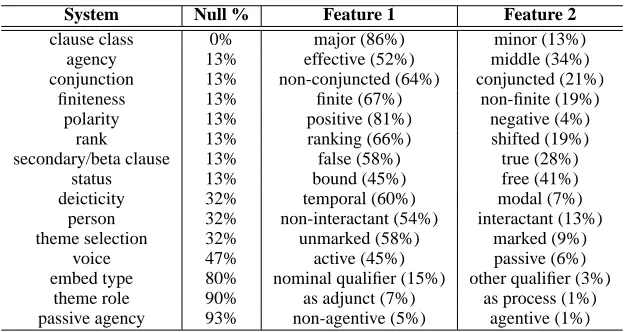
Table 2: Selected systems and how often their features are selected.
5.3 System Selections
As discussed above, the system features are organ-ised into hierarchies, with every feature assuming a null value unless its system’s entry condition is met. We therefore approach the system network much like a decision tree, using rules to control how the network is traversed.
The rules used to traverse the network cannot be explained here in full, as there are 41 such decision functions currently implemented. Table 2 lists a few of the systems we implement, along with how of-ten their features are selected. Because the system network is organised hierarchically, a selection will not always be made from a given system, since the ‘entry condition’ may not be met. For instance, the feature agency=effective is an entry condition for the voice system, so if a clause is middle, no voice will be selected. The Null % column describes how of-ten the entry condition of the clause is not met. Sys-tems further down the heirarchy will obviously be relevant less often, as will systems which describe a finer grained distinction for an already rare feature.
The following sections describe the system net-work in terms of four general regions. The systems within each region largely sub-categorise each other, or relate to the same grammatical phenomenon.
5.4 Mood systems
Assuming the clause is independent, the major mood options are declarative, interrogative and imperative. Deciding between these is quite simple: in interrog-ative clauses, the Subject occurs after the first auxil-iary. Imperative clauses have no Subject.
There are a few more granular systems for in-terrogative clauses, recording whether the question is polar or WH. If the clause is WH interrogative, there are two further features recording whether the requested constituent functions as Subject, Adjunct or Complement. The values of these features are quite simple to calculate, by finding the WH element among the constituents and retrieving its interper-sonal function.
If the clause is not imperative, there are systems recording the person (first, second or third) of the subject, and whether the first auxiliary is modal, present tense, past tense, or future tense. SFG de-scribes three tenses in English, regarding ‘will’ and ‘shall’ auxiliaries as future tense markers, rather than modals.
If the clause is imperative, there is a further sys-tem recording whether the clause is the ‘jussive’ im-perative with ‘let’s’, an ‘oblative’ imim-perative with ‘let me’, or a second person imperative. If the im-perative is second person, a further feature records whether the ‘you’ is explicit or implied.
There are also features recording the ‘polarity’ of the clause: whether it is positive or negative, and, if negative, whether the negative marker is full-formed or cliticised as -n’t.
5.5 Voice systems
carve these off first. If the clause is transitive, an-other system records whether it is active or passive. The rules to draw this distinction simply look at the verb phrase, checking whether the last auxiliary is a form of the verb ‘be’ and the lexical verb has a past participle part-of-speech tag. Finally, a further sys-tem records whether passive clauses have an agent introduced by ‘by’.
5.6 Theme systems
Theme systems record what occurs at the start of the clause. Typically in English, the first major con-stituent will be the logical subject, and hence also the Topical Theme. A system records whether this is or is not the case. If the clause is finite and the log-ical subject is not the Toplog-ical Theme, the clause is said to have a ‘marked’ theme. Verb phrase Topical Themes are considered unmarked if the clause is im-perative. A further system records whether the Top-ical Theme is the logTop-ical object (as in passivisation), or whether it is a fronted Adjunct. Passive clauses may have a fronted Adjunct, so does not necessar-ily have a logical object as Topical Theme. There are two further systems recording whether the clause has a Textual Theme and/or an Interpersonal Theme.
5.7 Taxis systems
Taxis systems record dependency relationships be-tween clauses. There are two types of information: whether the attachment is made through coordina-tion or subordinacoordina-tion, and the semantic type of the attachment. Broadly, semantic type is between ‘ex-pansion’ and ‘projection’, projection being reported (or quoted) speech or thought. A further system records the subtype of expansion clauses, which is quite a subtle distinction. Unfortunately Halliday chose thoroughly unhelpful terminology for this dis-tinction: his subtypes of expansion are elaboration, enhancement and extension. Enhancing clauses are essentially adverbial, and are almost always subor-dinate. Extending clauses, by contrast, are approxi-mately the ‘and’ relationship, and are almost always coordinate. Elaborating clauses qualify or further define the information in the clause they are attached to. Elaborating clauses can be either subordinate or coordinate. Subordinate elaborating clauses are non-defining relative clauses, while coordinate elab-orating clauses are usually introduced by a
conjunc-tive adjunct, like ‘particularly’.
6 Accuracy
In order to evaluate the accuracy of the conversion process, we manually evaluated the constituency structure of a randomly selected sample of 200 clauses. The conversion heuristics were developed on section 00 of the Wall Street Journal and section 2 of Switchboard, while the evaluation sentences were sampled from the rest of the Penn Treebank.
We limited evaluation to the constituency conver-sion process, in order to examine more clauses. The function labels are calculated from the constituency conversion, while the system features are calculated from the function labels and other system features. Since the system network is like a decision tree, whether a feature is null-valued depends on prior feature decisions. These dependencies in the anno-tation mean that evaluating all of it involves some re-dundancy. We therefore evaluated the constituency structure, since it did not depend on any of the other annotation, and the conversion heuristics involved in calculating it were more complicated than those for the function labels and system features.
In the 200 clause sample, we found three clauses with faulty constituency structures. One of these was the result of a part-of-speech tag error in the Treebank. The other two errors were conjunctions that were incorrectly replicated in ellipsis clauses.
7 Conclusion
The Penn Treebank was designed as a largely the-ory neutral corpus. In deciding on an annotation scheme, it emphasised the need to have its annota-tors work quickly and consistent, rather than fidelity to any particular linguistic theory (Marcus et al., 1994).
feature structures and less work to the syntactic rep-resentation.
Now that a sizable SFGcorpus has been created, it can be put to use for linguistic andNLP research. Linguistically, we suggest that it would be interest-ing to use the corpus to explore some of the as-sertions in the literature that have until now been untestable. For instance, Halliday and Matthiessen (2004) suggests that the motivation for passivisation is largely structural — what comes first in a clause is an important choice in English. This implies that the combination of passive voice and a fronted adjunct should be unlikely. There should be many such sim-ple queries that can shed interesting light on abstract claims in the literature.
Large annotated corpora are currently very impor-tant for parsing research, making this work a vital first step towards exploring whetherSFGannotation can be automated. The fact that Treebank parses can be converted intoSFGannotation suggests it can be,
although most parsers do not replicate the dash-tags attached to Treebank labels, which are necessary to distinguishSFGcategories in our conversion system.
Even without automating annotation, the corpus offers some potential for investigating how useful
SFGfeatures are forNLP tasks. The Penn Treebank
includes texts from a variety of genres, including newspaper text, literature and spoken dialogue. The Switchboard section of the corpus also comes with various demographic properties about the speakers, and is over a million words. We therefore suggest that gold standard SFG features could be used in
some simple document classification experiments, such as predicting the gender or education level of speakers in the Switchboard corpus.
8 Acknowledgments
We would like to thanks the anonymous review-ers for their helpful comments. James Curran was funded under ARC Discovery grants DP0453131 and DP0665973.
References
Anette Frank. 2001. Treebank conversion: Converting the NE-GRA treebank to an LTAG grammar. In Proceedings of the EUROLAN Workshop on Multi-layer Corpus-based Analy-sis. Iasi, Romania.
Anette Frank, Louisa Sadler, Josef van Genabith, and Andy Way. 2003. From Treebank Resources To LFG F-Structures
- Automatic F-Structure Annotation of Treebank Trees and CFGs extracted from Treebanks. Kluwer, Dordrecht. Michael A. K. Halliday. 1969. Options and functions in the
English clause. Brno Studies in English, 8:82–88. Reprinted in Halliday and Martin (eds.)(1981) Readings in Systemic Linguistics, Batsford, London.
Michael A. K. Halliday. 1970. Language structure and language function. In John Lyons, editor, New Horizons in Linguistics. Penguin, Harmondsworth.
Michael A. K. Halliday and Christian M. I. M. Matthiessen. 2004. An Introduction to Functional Grammar. Edward Arnold, London, third edition.
Julia Hockenmaier and Mark Steedman. 2005. Ccgbank man-ual. Technical Report MS-CIS-05-09, University of Penn-sylvania.
Matthew Honnibal. 2004. Converting the Penn Treebank to Systemic Sunctional Grammar. In Proceedings of the Aus-tralasian Language Technology Workshop (ALTW04). William C. Mann and Christian M. I. M. Matthiessen. 1983. An
overview of the Nigel text generation grammar. Technical Report RR-83-113, USC/Information Sciences Institute. Mitchell P. Marcus, Beatrice Santorini, and Mary Ann
Marcinkiewicz. 1994. Building a large annotated corpus of English: The Penn Treebank. Computational Linguistics, 19(2):313–330.
James R. Martin, Christian M. I. M. Matthiessen, and Clare Painter. 1997. Working with Functional Grammar. Arnold, London.
Christian Matthiessen. 1995. Lexicogrammatical Cartography. International Language Sciences Publishers, Tokyo, Taipei and Dallas.
Michael O’Donnell and John A. Bateman. 2005. SFL in com-putational contexts: a contemporary history. In J. Webster, R. Hasan, and C. M. I. M. Matthiessen, editors, Continu-ing Discourse on Language: A functional perspective, pages 343–382. Equinox, London.
Martha Palmer, Daniel Gildea, and Paul Kingsbury. 2005. The proposition bank: An annotated corpus of semantic roles. Computational Linguistics, 31(1):71–106.
Randolph Quirk, Sidney Greenbaum, Geoffrey Leech, and Jan Svartvik. 1991. A Grammar of Contemporary English. Longman, London.