Is Well-being U-Shaped over the Life Cycle?
David G. Blanchflower and Andrew J. Oswald
No 826
WARWICK ECONOMIC RESEARCH PAPERS
Is Well-being U-Shaped over the Life Cycle?
David G. Blanchflower
Bruce V. Rauner Professor of Economics Dartmouth College, USA,
University of Stirling, NBER, IZA, CESifo and Member, Monetary Policy Committee
Bank of England
Email: [email protected]
Andrew J. Oswald
Department of Economics University of Warwick UK Email: [email protected]
Abstract
We present evidence that psychological well-being is U-shaped through life. A difficulty with research on this issue is that there are likely to be omitted cohort effects (earlier generations may have been born in, say, particularly good or bad times). First, using data on 500,000 randomly sampled Americans and West Europeans, the paper designs a test that can control for cohort effects. Holding other factors constant, we show that a typical individual’s happiness reaches its minimum -- on both sides of the Atlantic and for both males and females -- in middle age. Second, evidence is provided for the existence of a similar U-shape through the life-course in East European, Latin American and Asian nations. Third, a U-shape in age is found in separate well-being regression equations in 72 developed and developing nations. Fourth, using measures that are closer to psychiatric scores, we document a comparable well-being curve across the life cycle in two other data sets: (i) in GHQ-N6 mental health levels among a sample of 16,000 Europeans, and (ii) in reported depression and anxiety levels among 1 million U.K. citizens. Fifth, we discuss some apparent exceptions, particularly in developing nations, to the U-shape. Sixth, we note that American male birth-cohorts seem to have become progressively less content with their lives. Our paper’s results are based on regression equations in which other influences, such as demographic variables and income, are held constant.
Word count: 7400 approx + tables
Keywords: Happiness; aging; well-being; GHQ; cohorts; mental-health; depression; life-course JEL codes: D1, I3
Corresponding author: [email protected].
Address: Department of Economics, University of Warwick, Coventry CV4 7AL, United Kingdom. Telephone: (+44) 02476 523510
1
Is Well-being U-Shaped over the Life Cycle?
1. Introduction
A large empirical literature is emerging on the determinants of happiness and mental well-being. As would be expected, this topic has attracted attention from medical statisticians, psychologists, economists, and other investigators (including recently Easterlin 2003, Blanchflower and Oswald 2004, Helliwell and Putnam 2004, Lucas et al 2004, Layard 2005, Smith et al 2005, Ubel et al 2005, Gilbert 2006, and Kahneman et al 2006). However, a fundamental research question remains poorly understood. What is the relationship between well-being and age?
2
conflicting results on how the probability of depression alters through the life course. Glaeser et al (2002) finds evidence that ‘social capital’ appears to be hill-shaped over the life cycle.
There is an important difficulty with the U-shape conclusion. A variable that measures how old someone is may be standing in for omitted cohort effects (earlier generations may have been born in, say, particularly good or bad times). Hence the U-shape in age could be an artifact of the data.
This is more than a theoretical possibility. Suicide levels seem to vary across cohorts (Stockard and O’Brien 2002). Moreover, Blanchflower and Oswald (2000) find some evidence of rising well-being among young people. There is also evidence -- for example, in Sacker and Wiggins (2002) -- that rates of depression and psychiatric distress, measured consistently across cohorts, have risen in a country such as Great Britain. Oswald and Powdthavee (2007) document worsening mental distress GHQ scores through time in Britain. These matters are still the subject of debate (Murphy et al 2000, Paykel 2000).
3
precisely determined. In total we document a statistically significant U-shape in happiness or life satisfaction by age estimated separately for 72 countries --Albania; Argentina; Australia; Azerbaijan; Belarus; Belgium; Bosnia; Brazil; Brunei; Bulgaria; Cambodia; Canada; Chile; China; Colombia; Costa Rica; Croatia; Czech Republic; Denmark; Dominican Republic; Ecuador; El Salvador; Estonia; Finland; France; Germany; Greece; Honduras; Hungary; Iceland; Iraq; Ireland; Israel; Italy; Japan; Kyrgyzstan; Laos; Latvia; Lithuania; Luxembourg; Macedonia; Malta; Mexico; Myanmar; Netherlands; Nicaragua; Nigeria; Norway; Paraguay; Peru; Philippines; Poland; Portugal; Puerto Rico; Romania; Russia; Serbia; Singapore; Slovakia; South Africa; South Korea; Spain; Sweden; Switzerland; Tanzania; Turkey; United Kingdom; Ukraine; Uruguay; USA; Uzbekistan; and Zimbabwe.
One point should perhaps be made clear from the outset. It is that the paper will concentrate mostly on so-called single-item measures of well-being, so cannot allow subtle differentiation -- as favoured in some psychology journals -- into what might be thought of as different types of, or sides to, human happiness or mental health. Nevertheless, the patterns that emerge seem of interest.
The paper’s concern is with the ceteris paribus correlation between well-being and age. Hence we later partial out some other confounding factors, such as income and marital-status, that alter over a typical person’s lifetime and have an effect upon well-being. This follows one tradition of empirical research. We read the effect of a variable’s coefficient from a long regression equation in which other influences have been controlled for as effectively as possible.
4
other influences upon well-being, and instead scrutinize the aggregate uncorrected relationship between happiness and age. These authors focus on a reduced-form issue. That asks a descriptive question: how does observed happiness vary over the life cycle? Related work is that of Mroczek and Spiro (2005), who establish in a data set on American veterans, where the youngest person in the data set is 40 years old -- making it hard to draw a full comparison with our later random samples -- that happiness rises into the person’s early 60s, and then appears to decline.
As common observation shows, the quality of a person’s health and physical abilities can depend sensitively on the point in the life cycle. Most diseases, and the probability of getting them, worsen with age. An 80 year old man cannot in general do the same number of push-ups as a 20 year old man. Hence an important issue is whether in happiness equations it is desirable to control in some way for physical vitality. The approach taken in the paper is not to include independent variables that measure physical health. This is partly pragmatic: our data sets have no objective measures and few subjective ones. But the decision is partly substantive: it seems interesting to ask whether people become happier as they age once only demographic and economic variables are held constant.
2. Theoretical issues
5
in any natural way. Instead, perhaps the most natural conclusion is that well-being might be predicted to be independent of age. To see why, assume the individual agent tries to maximize lifetime utility V by choosing a consumption path c(a) where a is the individual’s age. Assume that lifespan runs deterministically from time t to time T, and that there is no discounting. Let income, y, be fixed and given by the agent’s talent endowment, and for simplicity normalize this to unity. Then the agent chooses consumption, c, at each age, a, to maximize lifetime happiness
∫
= T t da a c uV ( , ) (1)
subject to an inter-temporal borrowing constraint
∫
= T t da a c( )1 (2)
where the endowment of income to be allocated across all the periods has been normalized to one. Assume that u, utility, or well-being, is an increasing and concave function of consumption, c. Spending, by assumption, makes people happier, but at a diminishing rate.
This is the simplest form of isoperimetric problem. The first-order condition for a maximum is the usual one: the marginal utility of consumption must be the same at each age. Solving a Lagrangean L constructed from (1) and (2):
0 ) , ( = − ∂ ∂ = ∂ ∂ λ c a c u c L (3)
where, from the underlying mathematical structure, the multiplier lambda is constant across the different ages from t to T. Individuals thus allocate their discretionary spending to the points in time when they enjoy it most.
6
Consumption will rationally be flat through time (because under separability u = u(c)) + v(a)). Therefore utility will also be flat through the lifespan if the non-consumption part of utility, v(.), is independent of age. Happiness will be flat over the life course.
The presumption that u(..) is additively separable in its two arguments is a large, and probably unwarranted, step. There seems no reason why the marginal utility of consumption would be independent of a person’s age. One might believe that young people wish to signal their status to obtain mates, and therefore might have a greater return from units of consumption than the old. Then the cross-partial derivative of u(c, a) would then be negative. Alternatively, older people may have more need of health and medical spending, so the marginal utility of consumption is greatest in old age. Then the cross-partial of u(c, a) is positive. While it would be possible to assume that early in life the first effect dominates and then in later life the second one dominates, and thus get to a model where well-being was curved through the lifespan, to do so seems too ad hoc (or post-hoc) to be persuasive theoretically.
Hence textbook economic analysis is not capable -- without extra assumptions about v(a) that could mechanically lead to any shape -- of producing unambiguous predictions about the pattern of well-being through life.
3. Empirical Results
7
The early evidence starts with four tables. These give regression equation results in which the dependent variable is derived from two kinds of survey answers. The data sets are the U.S. General Social Surveys (GSS) from 1972-2006 and the Eurobarometers from 1976-2002. The exact wording of the GSS well-being question is: “Taken all together, how would you say things are these days – would you say that you are very happy, pretty happy, or not too happy?” In the Eurobarometer survey it
is: “On the whole, are you very satisfied, fairly satisfied, not very satisfied, or not at all satisfied with the life you lead?”
To give a feel for the raw patterns in the data, happiness in the United States is expressed in a cardinal way by assigning 1 to 3 to the three answers, where ‘very happy’ is a 3. The mean of US happiness in the data is 2.2, with a standard deviation of 0.6. Similarly, European life satisfaction is cardinalized using the integers 1 to 4, where ‘very satisfied’ is a 4. Here the mean of life satisfaction is 3.0, with a standard deviation of 0.8. Well-being answers are skewed, in both data sets, towards the upper end of the possible distribution.
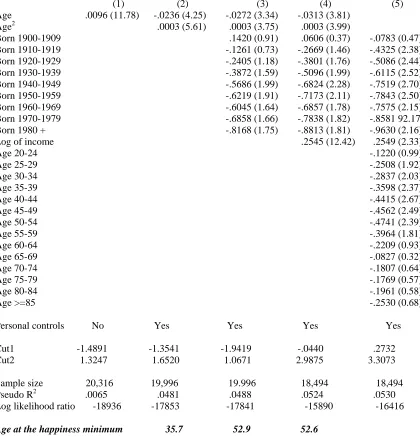
Table 1 takes all the males in the U.S. General Social Survey from 1972-2006. It estimates a happiness regression equation for this sub-sample, and reveals in its early columns that well-being is U-shaped in age. Then cohort variables are introduced. These take the form of a set of dummy variables – one dummy for each decade of birth. Although the introduction of the cohort dummies affects the turning point of the quadratic function in age, it does not do so in a way that changes the thrust of the idea that psychological well-being follows a U-shaped path.
U-8
shape by examining whether the data take a quadratic form in age. The coefficients on age-squared variables are usually statistically significant at the 0.0001 level.
In the first column of Table 1, a GSS happiness ordered logit equation is estimated on the pooled sample of 20,316 American males with age entered as an independent variable. It has, as further independent regressors, a separate dummy variable for each year in the data set, and for each region of the United States. These are to mop up year-by-year variation in national well-being and unchanging spatial characteristics (such as, say, regions’ climatic conditions).
9
However, Table 1 then explores the possibility that the U-shape in age is a product merely of omitted cohort effects. Column 3 of Table 1 extends the specification by introducing separate dummy variables -- termed in the table Born<1910-1919, Born 1920-1929, and so on -- for each decade of birth (to avoid complete collinearity, we cannot enter a full set of individual birth-year dummies). The outcome of this exercise is a U-shape in age, but, interestingly, one where the turning point for Americans males is now later in the typical individual’s life. According to the evidence in column 3 of Table 1, subjective well-being among American males bottoms out at an estimated 52.9 years. This is to be thought of, it should be emphasized, as the minimum-happiness age after controlling for other influences such as income, education and marital-status. Column 4 then adds the logarithm of household income, to allow for the influence of income upon reported happiness (although the causal interpretation here is perhaps open to debate, Gardner and Oswald 2007 find longitudinal evidence that windfalls raise mental well-being). Income enters positively with a t-statistic of approximately 12; the age minimum is 52.6, and thus barely alters.
A quadratic is restrictive. Column 5 thus tests for a U-shape without imposing any functional form. To do so, the age and age squared variables are replaced with a series of dummy variables representing five-year age bands. Despite the non-parametric form of the test, something fairly close to a quadratic emerges over most of the life course, although it turns over again slightly in late life. The happiness minimum in column 5 of Table 1 occurs in the age band 50-54 years.
10
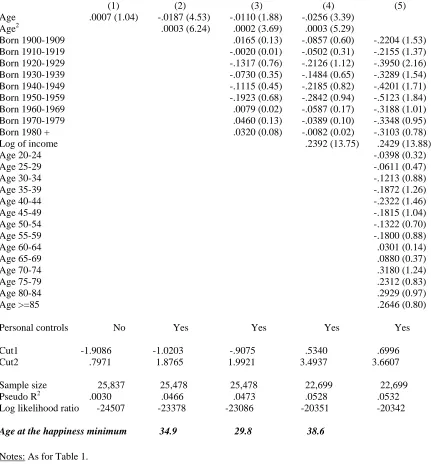
little larger (because women live longer than men) at 25,837 individuals. In Table 2, for women, well-being is at first increasing in age. But once a squared term in age is introduced, in the third column, it is clear that the data favour the quadratic form, and once again happiness is strongly U-shaped in age. When the same set of cohort dummies are incorporated into the equation, in column 4 of Table 2, the turning point of the happiness function is at age of 38.6 years, which is well below the value for men obtained in column 4 of Table 1 of 52.9 years.
11
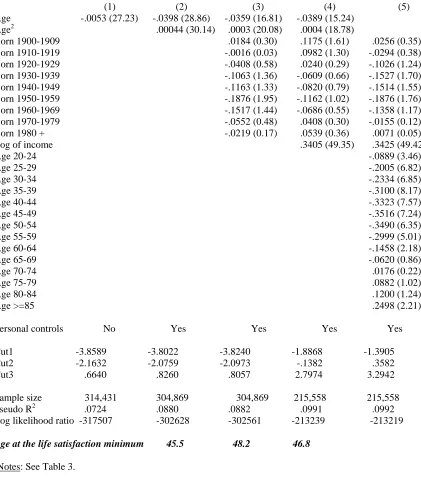
produces similar figures, and equations, for the female sub-sample of 314,431 randomly sampled European women.
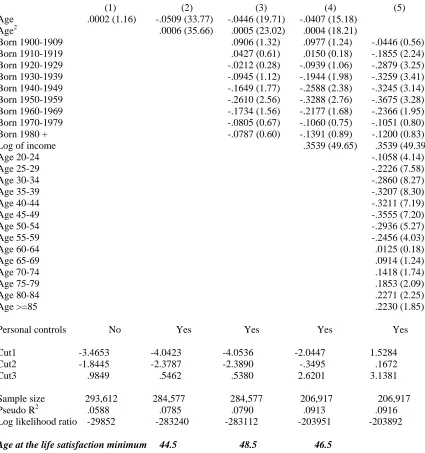
Although, probably unsurprisingly, the birth-cohort coefficients (on Born<1910-1919, etc) are not always individually well-defined, there are signs from the tables that the United States and Europe differ in the time structure of the cohort effects. In Tables 1 and 2, there is evidence that successive American birth cohorts have become progressively less happy between 1900 and today. This finding is reminiscent of one of Easterlin’s (2006), although he uses a different statistical method. In Europe, by contrast, Tables 3 and 4 suggest that well-being is broadly similar across birth-generations. This seems particularly clear for males. A full set of interaction terms – where both the age and age squared terms were interacted with the other independent variables -- was also tried, as a robustness check, but these were found to have coefficients that were almost always insignificantly different from zero at the 95% confidence level.
Even if statistically significant, is such a U-shape in age large enough to be important empirically? The answer seems to be yes.
12
Although the birth-cohort coefficients are not always individually well-defined, there are signs from the early Tables that the United States and Europe differ quite strongly in the time structure of the cohort effects upon happiness. In Tables 1 and 2, there is evidence that successive American generations became progressively less happy from 1900 to today. This conclusion is reminiscent of one of Easterlin’s (2006), although he uses a different statistical method.
In Europe, by contrast, Tables 3 and 4 suggest that cohort well-being falls initially from the beginning of the century but, after bottoming out in the 1950s (which is the omitted base category), has actually been rising slightly throughout the most recent generations.
As with the effect of moving along the quadratic function in age, cohort dummy variables are here large in magnitude; they are not merely different from zero on a formal significance test. Put loosely, cohort effects are two or three times as large as the effect from the U-shape in age. The single greatest effect is visible in the equations for US males in Table 1. Here, comparing the happiest cohort of Americans to the least happy, the cardinalized well-being difference through the generations exceeds half of one standard-deviation of the happiness measure. In all the tables, whilst the details differ, estimated cohort effects are quantitatively significant and not merely statistically significant.
13
such a view comes out of the difference between the continents’ results. The estimated pattern of the cohort effects is different between the US and Europe. As -- because of common trends in technology -- both continents’ ways of living have changed in broadly similar ways since 1900, it is not easy to see how the coefficients on the cohort dummies could be explained solely by some form of changed use of language in the modern world. Thus the cohort effects seem unlikely to be simply a mirage caused by alterations in the way that different generations use, and perceive the meaning of, words.
Does the U-shape in age hold in developing countries? Clearly mean life-spans are different, so it would be a surprise if exactly the same pattern emerged. No long time series is available to allow a test for cohort effects, but data are available, from four sweeps of the World Values Survey, on eighty countries covering the years 1981-1984; 1989-1993; 1994-1999; and 1999-2004. These data are drawn from twenty five Western countries such as the USA, Canada and the UK; fourteen East European countries (e.g. the Czech Republic, Hungary and Poland); and thirty seven developing countries (e.g. China, Uganda, Uruguay and Vietnam). Table 5 reports estimates of a series of life satisfaction equations with well-being scored from 1 at the dissatisfied end to 10 at the completely satisfied end; we report them separately for each of the three groups of countries. The controls here include work-force-status, marital-status, education, country and year dummies, and the person’s income (grouped into appropriate deciles for his or her country).
14
of developing countries in it, including, with the numbers in parentheses being the age minima from Appendix Table 1, the following nations: Azerbaijan (45.8); Brazil (36.5); China (46.5); Iraq (51.7); Mexico (41.4); Nigeria (42.4); Peru (39.5); Tanzania (46.2) and Zimbabwe (46.2).
We feel it would be unwise to overstate this finding. A group that did not have a U-shape in age, where either or both of the age terms were insignificant, often included countries where sample sizes were small, but were mostly developing countries (Armenia; Bangladesh; Chile; Colombia; Dominican Republic; Egypt; India; Indonesia; Iran; Jordan; Moldova; Morocco; Pakistan; Saudi Arabia; Singapore; Slovenia; Taiwan; Uganda; Venezuela and Vietnam).
When separate results are run by country, using Eurobarometer data 1976-2002, with both sexes pooled, the results are as follows -- where controls are log of income, year-of-birth dummies, gender, income, education, year, country, year, marital-status and work-force status as in column 4 in Tables 3 and 4.
Age at minimum Sample size
Belgium 46.4 33,035
Denmark 50.1 39,010
Finland 49.9 8,978
France 49.5 38,843
Germany 42.9 54,946
Greece 53.4 30,469
Ireland 38.4 25,191
Italy 64.2 35,327
Luxembourg 41.3 9,761
Netherlands 46.9 39,239
Portugal 66.1 25,529
Spain 50.1 20,854
Sweden 49.6 8,566
UK 35.8 40,668
Total 47.0 422,475
USA (Gen. Soc. Survey) 44.5 41,193
15
For the USA, a similar equation was run with controls for log of income, year and year-of-birth dummies, gender, region, family, marital and work-force status dummies (as in column 5 of Tables 1 and 2).
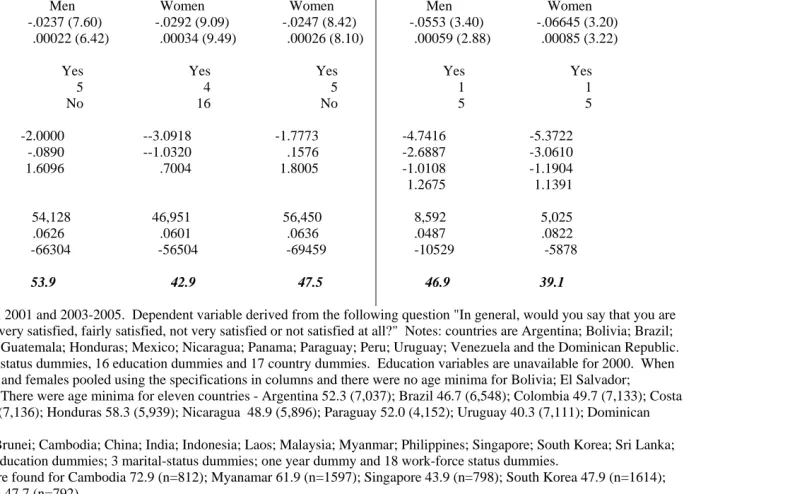
Columns 1-4 of Table 6 make use of data from eighteen Latin American countries. They are Argentina; Bolivia; Brazil; Colombia; Costa Rica; Chile; Ecuador; El Salvador; Guatemala; Honduras; Mexico; Nicaragua; Panama; Paraguay; Peru; Uruguay; Venezuela and the Dominican Republic. This sample is for the years 1997, 2000-2001 and 2003-2005, and, like Graham (2007), draws on the Latinobarometers. The life satisfaction question used in the Latinobarometers is identical to the one used in the Eurobarometers. Columns 1 and 3 include education dummies which were unavailable in 2000, hence the smaller sample size; the results are similar when the education variables are omitted and the additional year of data are added. There are estimated age minima for both men and women. As was found above using the World Values Survey, there are age minima for a majority, but not all, countries if separate equations are estimated. The countries where turning points are found, with the estimated minima in parentheses -- here excluding education dummies to help the sample sizes -- were Argentina (turning at age 52.3); Brazil (46.7); Colombia (49.7); Costa Rica (44.2); Chile (44.0); Ecuador (61.9); Honduras (58.3); Nicaragua (48.9); Paraguay (52.0); Uruguay (40.3); and Dominican Republic (48.7).
16
days? 1=very unhappy; 2=not too happy 3=neither happy or unhappy; 4=pretty
happy and 5=very happy". The regression controls are 5 education dummies; 3
marital-status dummies; one year dummy; and 18 work-force status dummies. In column 5, an age minimum for men is found at 46.9; and at age 39.1 for women in column 6. Separate minima in individual country equations are found in seven out of the fifteen countries -- for Cambodia (72.9); Myanmar (61.9); Singapore (43.9); South Korea (47.9); Laos (37.7); Brunei (37.3); and Uzbekistan (47.7)
It seems useful to ask whether a life course U-shape also emerges when a well-being variable is closer to a measure of mental health. Figure 1 plots the incidence of self-reported depression in the UK Labour Force Survey. Here the data are pooled for men and women across the period 2004Q2-2007Q1. The sample is for those aged 16-70. There are approximately one million observations (n=972,464), and the estimates are weighted using the person weights so are nationally representative. Respondents in the LFS are asked to report on any health problems they have had, and then to identify the most important of these and that is what is examined here. What is graphed in Figure 1 is the mean incidence of depression-and-anxiety by age. The figure has an average of 17,068 observations per cell (i.e. per dot). The outcome is a hill-shaped relationship between age and a measure of mental ill-health, which turns around age 46 in these raw data. This pattern is consistent with the paper’s earlier, and qualitatively different, life-satisfaction evidence.
17
maximum is finally estimated at 44.0 in column 3 with a full set of controls for month, year, region, race, education, marital and work-force status. March is the month in which the highest depression rates are reported.
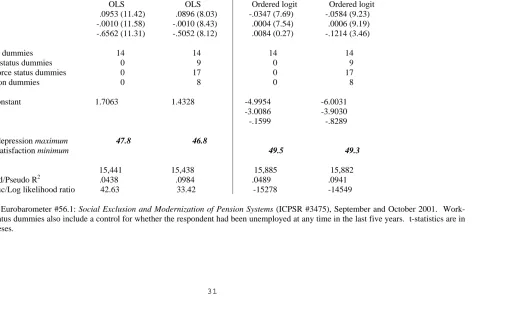
Table 8 performs a similar exercise for a different measure of mental health. The table draws upon data from Eurobarometer #56.1: Social Exclusion and Modernization of Pension Systems (ICPSR #3475). Between September and October
2001, this survey collected identical survey information from approximately 15,500 individuals living in Austria, Belgium Denmark, East Germany, Finland, France, Greece, Italy, Ireland, Luxembourg, the Netherlands, Portugal, Spain, the United Kingdom, Sweden and West Germany. This data file has data for the same individuals on mental strain and on life satisfaction. It was included within one of our Eurobarometers used in Tables 3 and 4.
In the first two columns of Table 8, the dependent variable is psychological distress constructed (in the spirit of the well-known General Health Questionnaire score) by amalgamating answers to the questions:
Have you recently:
1. Lost much sleep over worry?
2. Felt constantly under strain?
3. Felt you could not overcome your difficulties?
4. Been feeling unhappy and depressed?
5. Been losing confidence in yourself?
6. Been thinking of yourself as a worthless person?
18
summed, and we term the result a ‘GHQ-N6’ measure, where N is for ‘negative’. These questions are the 6 negatively worded ones from the fuller General Health Questionnaire GHQ-12 measure of psychological distress. Our data set does not provide data on the other six ‘positive’ questions. Thus our focus is upon negative affect.
The GHQ-N6 score lies between 0 and 18. Across Europe, the mean of this variable is 3.6 (standard deviation 3.7). Clark and Oswald (1994, 2002) show in British data that GHQ is quadratic in age. Blanchflower and Oswald (2007) has more on an international ranking of mental distress.
There is a precedent for exploring negative and positive elements within GHQ (see Huppert and Whittington, 2003). Column 1 of Table 7 just contains age and its square as controls, and the function reaches a maximum at age 47.8. Adding additional controls reduces this marginally. Columns 3 and 4 of Table 8 use the same sample of individuals and the same controls as in columns 1 and 2; but now ordered logit is the method of estimation, and life satisfaction is the dependent variable. In column 3, without controlling for confounders, satisfaction minimises at 49.5 (and age 49.3 in column 4).
4. Conclusions
19
regression methods. Our main conclusion is meant as a broad characterization of the data, and should be kept in perspective. We have not presented detailed findings from the fitting of high-order polynomials. There is, for example, a little evidence from our non-parametric work for a further flattening, and a turn down, towards the end of a person’s life.
The paper’s results, which draw upon ordered-logit regression equations, and use data sets long enough to distinguish age effects from cohort effects, suggest that the convex structure of the curve is fairly similar across different parts of the world. The happiness U-shape finding in United States data stems originally from results in Blanchflower et al (1993), which became Blanchflower and Oswald (2004). Early British evidence for an equivalent U-shape, using instead GHQ scores, appears in Clark and Oswald (1994).
Do cohort effects matter? Our correction for birth-cohort influences makes some difference to the results claimed in the earlier literature, especially in American well-being equations, but the broad spirit of a U-shape seems to be unaffected by cohort influences. On these estimates, happiness among American males and females reaches a minimum in, respectively, approximately the individuals’ early 50s and late 30s. Reported life satisfaction levels among European men and women minimize around the mid 40s. What explains such differences remains an open question.
20
international data sets do not follow the same individuals each year. As far as we know, there is no internationally comparable panel data set on multiple nations in which general happiness or well-being questions are asked (a European Household Panel is currently being constructed but asks only questions such as income-satisfaction and housing-income-satisfaction). Further longitudinal inquiry will be valuable. What causes the apparently U-shaped curve, and the rough regularity of its mathematical shape in different parts of the developed and developing world, is unknown. Tentatively:
• One possibility is that individuals learn to adapt to their strengths and weaknesses, and in mid-life quell their infeasible aspirations.
• Another -- though it could presumably only be a small part of the explanation -- is that cheerful people live systematically longer than the miserable, for reasons not currently understood, and that the well-being U-shape in age thus traces out in part a selection effect.
• A third is that a kind of comparison process is at work: I have seen school-friends die and come eventually to value my blessings during my remaining years.
21
References
Argyle, M. (2001). The psychology of happiness. London: Routledge, Second edition. Bell, D., & Blanchflower, D.G. (2007). The Scots may be brave but they are neither
healthy nor happy. Scottish Journal of Political Economy, 54, 166-194.
Blanchflower, D.G. (2001). Unemployment, well-being and wage curves in Eastern and Central Europe. Journal of Japanese and International Economies, 15, 364-402.
Blanchflower, D.G., & Oswald, A.J. (2000). The rising well-being of the young. In Youth employment and joblessness in advanced countries, eds. D.G. Blanchflower and R. Freeman, Chicago: NBER and University of Chicago Press.
Blanchflower, D.G., & Oswald, A.J. (2004). Well-being over time in Britain and the USA. Journal of Public Economics, 88, 1359-1386.
Blanchflower, D.G., & Oswald, A.J. (2007). Hypertension and happiness across nations. Journal of Health Economics, forthcoming.
Blanchflower, D.G., Oswald, A.J., & Warr, P. (1993). Well-being over time in Britain and the USA. Unpublished paper presented at a Happiness conference at the London School of Economics.
Carstensen, L.L., Isaacowitz, D.M., & Turk-Charles, S. (1999). Taking time seriously: A theory of socioeconomic selectivity. American Psychologist, 54, 165-181.
Charles, S.T., Reynolds, C.A., & Gatz, M. (2001). Age-related differences and change in positive and negative affect over 23 years. Journal of Personality and Social Psychology, 80, 136-151.
Clark, A.E. (2007). Born to be mild. Working paper, PSE, Paris.
Clark, A.E., & Oswald, A.J. (1994). Unhappiness and unemployment. Economic Journal, 104, 648-659.
Clark, A.E., Oswald, A., & Warr, P. (1996). Is job satisfaction U-shaped in age? Journal of Occupational and Organizational Psychology, 69, 57-81.
Clark, A.E., & Oswald, A.J. (2002) A simple statistical method for measuring how life events affect happiness, International Journal of Epidemiology, 31, 1139-1144.
Clark, A.E., & Oswald, A.J. (2007). The curved relationship between age and subjective well-being. Working paper, PSE, Paris.
Diener, E., Suh, E.M., Lucas, R.E., & Smith, H.L. (1999). Subjective well-being: Three decades of progress. Psychological Bulletin, 125(2), 276-302.
Di Tella, R., MacCulloch, R.J., & Oswald, A.J. (2001). Preferences over inflation and unemployment: Evidence from surveys of happiness. American Economic Review, 91, 335-341.
Di Tella, R., MacCulloch, R.J., & Oswald, A.J. (2003). The macroeconomics of happiness. Review of Economics and Statistics, 85, 809-827.
Easterlin, R.A. (2003). Explaining happiness. Proceedings of the National Academy of Sciences, 100, 11176-11183.
Easterlin, R.A. (2006). Life cycle happiness and its sources: Intersections of psychology, economics and demography. Journal of Economic Psychology, 27, 463-482.
22
Frijters, P., Haisken-DeNew, J.P., & Shields, M.A. (2004). Money does matter! Evidence from increasing real income and life satisfaction in East Germany following reunification. American Economic Review, 94, 730-740.
Frijters, P., Haisken-DeNew, J.P., & Shields, M.A. (2005). The causal effect of income on health: Evidence from German reunification. Journal of Health Economics, 24, 997-1017.
Gardner, J., & Oswald, A.J. (2007). Money and mental well-being: A longitudinal study of medium-sized lottery wins. Journal of Health Economics; 26; 49-60. Gerlach, K., & Stephan, G. (1996). A paper on unhappiness and unemployment in
Germany. Economics Letters, 52, 325-330.
Gilbert, D. (2006). Stumbling on happiness. New York: Alfred A Knopf.
Glaeser, E.L., Laibson, D., & Sacerdote, B. (2002). An economic approach to social capital. Economic Journal, 112, F437-458.
Graham, C. (2005). Insights on development from the economics of happiness. World Bank Research Observer, 20, 201-231.
Graham, C. (2007). Happiness and health: Lessons – and questions – for public policy. Health Affairs, forthcoming.
Hayo, B., & Seifert, W. (2003). Subjective economic well-being in Eastern Europe. Journal of Economic Psychology, 24, 329-348.
Helliwell, J., & Putnam, R.D. (2004). The social context of well-being. Philosophical Transactions of the Royal Society, 359, 1435-1446.
Huppert, F.A., & Whittington, J.E. (2003). Evidence for the independence of positive and negative well-being: Implications for quality of life assessment. British Journal of Health Psychology, 8, 107-122.
Jorm, A.F. (2000). Does old age reduce the risk of anxiety and depression? A review of epidemiological studies across the adult life span. Psychological Medicine, 30, 11-22.
Kahneman, D., Krueger, A.B., Schkade, D., Schwarz, N., & Stone, A.A. (2006). Would you be happier if you were richer? A focusing illusion. Science, 312, 1908-1910.
Layard, R. (2005). Happiness: Lessons from a new science. London: Allen Lane. Lucas, R.E., Clark, A.E., Georgellis, Y., & Diener, E. (2004). Unemployment alters
the set point for life satisfaction. Psychological Science, 15 (1), 8-13.
Mroczek, D.K., & Kolanz, C.M. (1998). The effect of age on positive and negative affect: A developmental perspective on happiness. Journal of Personality and Social Psychology, 75, 1333-1349.
Mroczek, D.K., & Spiro, A. (2005). Change in life satisfaction during adulthood: Findings from the Veterans Affairs Normative Aging study. Journal of Personality and Social Psychology, 88, 189-202.
Murphy, J.M., Laird, N.M., Monson, R.R., Sobol, A.M., & Leighton, A.H. (2000). A 40-year perspective on the prevalence of depression – The Stirling County study. Archives of General Psychiatry, 57, 209-215.
Myers, D.M. (1992). The pursuit of happiness. New York: Morrow.
Oswald, A.J. (1997). Happiness and economic performance. Economic Journal, 107, 1815-1831.
Oswald, A.J., & Powdthavee, N. (2005). Does happiness adapt? A longitudinal study of disability with implications for economists and judges. University of Warwick: working paper.
23
Paykel, E.S. (2000). Not an age of depression after all? Incidence rates may be stable over time. Psychological Medicine, 30, 489-490.
Pinquart, M., & Sorensen, S. (2001). Influences on loneliness in older adults: A meta-analysis. Basic and Applied Social Psychology, 23, 245-266.
Powdthavee, N. (2005). Unhappiness and crime: Evidence from South Africa. Economica, 72, 531-547.
Propper, C., Jones, K., Bolster, A., Burgess, S., Johnston, R., & Sarker, R. (2005). Local neighbourhood and mental health: Evidence from the UK. Social Science and Medicine, 61, 2065-2083.
Sacker, A., & Wiggins, R.D. (2002). Age-period-cohort effects on inequalities in psychological distress, 1981-2000. Psychological Medicine, 32, 977-990.
Senik, C. (2004). When information dominates comparison – Learning from Russian subjective panel data. Journal of Public Economics, 88, 2099-2123.
Shields, M.A., & Wheatley Price, S. (2005). Exploring the economic and social determinants of psychological well-being and perceived social support in England. Journal of the Royal Statistical Society (Series A), 168, 513-537.
Smith, D.M., Langa, M., Kabeto, M.U., & Ubel, P.A. (2005). Health, wealth and happiness. Psychological Science, 16, 663-666.
Stockard, J., & O’Brien, R.M. (2002). Cohort variations and changes in age-specific suicide rates over time: Explaining variations in youth suicide. Social Forces, 81, 605-642.
Theodossiou, I. (1998). The effects of low-pay and unemployment on psychological well-being: A logistic regression approach. Journal of Health Economics, 17, 85-104.
Ubel, P.A., Loewenstein, G., & Jepson, C. (2005). Disability and sunshine: Can hedonic predictions be improved by drawing attention to focusing illusions or emotional adaptation? Journal of Experimental Psychology: Appl, 11, 111-123. Uppal, S. (2006). Impact of the timing and severity of disability on the subjective
well-being of individuals with disabilities. Social Science and Medicine, 63, 525-539.
Van Praag, B., & Ferrer-i-Carbonell, A. (2004). Happiness quantified: A satisfaction calculus approach. Oxford: Oxford University Press.
Winkelmann, L., & Winkelmann, R. (1998). Why are the unemployed so unhappy? Evidence from panel data. Economica, 65, 1-15.
24
Table 1. Happiness Equations for Men in the USA: Pooled Data 1972-2006
(1) (2) (3) (4) (5) Age .0096 (11.78) -.0236 (4.25) -.0272 (3.34) -.0313 (3.81)
Age2 .0003 (5.61) .0003 (3.75) .0003 (3.99)
Born 1900-1909 .1420 (0.91) .0606 (0.37) -.0783 (0.47) Born 1910-1919 -.1261 (0.73) -.2669 (1.46) -.4325 (2.38) Born 1920-1929 -.2405 (1.18) -.3801 (1.76) -.5086 (2.44) Born 1930-1939 -.3872 (1.59) -.5096 (1.99) -.6115 (2.52) Born 1940-1949 -.5686 (1.99) -.6824 (2.28) -.7519 (2.70) Born 1950-1959 -.6219 (1.91) -.7173 (2.11) -.7843 (2.50) Born 1960-1969 -.6045 (1.64) -.6857 (1.78) -.7575 (2.15) Born 1970-1979 -.6858 (1.66) -.7838 (1.82) -.8581 92.17) Born 1980 + -.8168 (1.75) -.8813 (1.81) -.9630 (2.16) Log of income .2545 (12.42) .2549 (2.33) Age 20-24 -.1220 (0.99) Age 25-29 -.2508 (1.92) Age 30-34 -.2837 (2.03) Age 35-39 -.3598 (2.37) Age 40-44 -.4415 (2.67) Age 45-49 -.4562 (2.49) Age 50-54 -.4741 (2.39) Age 55-59 -.3964 (1.81) Age 60-64 -.2209 (0.93) Age 65-69 -.0827 (0.32) Age 70-74 -.1807 (0.64) Age 75-79 -.1769 (0.57) Age 80-84 -.1961 (0.58) Age >=85 -.2530 (0.68)
Personal controls No Yes Yes Yes Yes
Cut1 -1.4891 -1.3541 -1.9419 -.0440 .2732 Cut2 1.3247 1.6520 1.0671 2.9875 3.3073
Sample size 20,316 19,996 19.996 18,494 18,494
Pseudo R2 .0065 .0481 .0488 .0524 .0530 Log likelihood ratio -18936 -17853 -17841 -15890 -16416
Age at the happiness minimum 35.7 52.9 52.6
25
Table 2. Happiness Equations for Women in the USA: Pooled Data 1972-2006
(1) (2) (3) (4) (5) Age .0007 (1.04) -.0187 (4.53) -.0110 (1.88) -.0256 (3.39)
Age2 .0003 (6.24) .0002 (3.69) .0003 (5.29)
Born 1900-1909 .0165 (0.13) -.0857 (0.60) -.2204 (1.53) Born 1910-1919 -.0020 (0.01) -.0502 (0.31) -.2155 (1.37) Born 1920-1929 -.1317 (0.76) -.2126 (1.12) -.3950 (2.16) Born 1930-1939 -.0730 (0.35) -.1484 (0.65) -.3289 (1.54) Born 1940-1949 -.1115 (0.45) -.2185 (0.82) -.4201 (1.71) Born 1950-1959 -.1923 (0.68) -.2842 (0.94) -.5123 (1.84) Born 1960-1969 .0079 (0.02) -.0587 (0.17) -.3188 (1.01) Born 1970-1979 .0460 (0.13) -.0389 (0.10) -.3348 (0.95) Born 1980 + .0320 (0.08) -.0082 (0.02) -.3103 (0.78) Log of income .2392 (13.75) .2429 (13.88) Age 20-24 -.0398 (0.32) Age 25-29 -.0611 (0.47) Age 30-34 -.1213 (0.88) Age 35-39 -.1872 (1.26) Age 40-44 -.2322 (1.46) Age 45-49 -.1815 (1.04) Age 50-54 -.1322 (0.70) Age 55-59 -.1800 (0.88) Age 60-64 .0301 (0.14) Age 65-69 .0880 (0.37) Age 70-74 .3180 (1.24) Age 75-79 .2312 (0.83) Age 80-84 .2929 (0.97) Age >=85 .2646 (0.80)
Personal controls No Yes Yes Yes Yes
Cut1 -1.9086 -1.0203 -.9075 .5340 .6996 Cut2 .7971 1.8765 1.9921 3.4937 3.6607
Sample size 25,837 25,478 25,478 22,699 22,699
Pseudo R2 .0030 .0466 .0473 .0528 .0532 Log likelihood ratio -24507 -23378 -23086 -20351 -20342
Age at the happiness minimum 34.9 29.8 38.6
26
Table 3. Life Satisfaction Equations for Men in Europe: Pooled Data 1976-2002
(1) (2) (3) (4) (5) Age .0002 (1.16) -.0509 (33.77) -.0446 (19.71) -.0407 (15.18)
Age2 .0006 (35.66) .0005 (23.02) .0004 (18.21)
Born 1900-1909 .0906 (1.32) .0977 (1.24) -.0446 (0.56) Born 1910-1919 .0427 (0.61) .0150 (0.18) -.1855 (2.24) Born 1920-1929 -.0212 (0.28) -.0939 (1.06) -.2879 (3.25) Born 1930-1939 -.0945 (1.12) -.1944 (1.98) -.3259 (3.41) Born 1940-1949 -.1649 (1.77) -.2588 (2.38) -.3245 (3.14) Born 1950-1959 -.2610 (2.56) -.3288 (2.76) -.3675 (3.28) Born 1960-1969 -.1734 (1.56) -.2177 (1.68) -.2366 (1.95) Born 1970-1979 -.0805 (0.67) -.1060 (0.75) -.1051 (0.80) Born 1980 + -.0787 (0.60) -.1391 (0.89) -.1200 (0.83)
Log of income .3539 (49.65) .3539 (49.39) Age 20-24 -.1058 (4.14)
Age 25-29 -.2226 (7.58) Age 30-34 -.2860 (8.27) Age 35-39 -.3207 (8.30) Age 40-44 -.3211 (7.19) Age 45-49 -.3555 (7.20) Age 50-54 -.2936 (5.27) Age 55-59 -.2456 (4.03) Age 60-64 .0125 (0.18) Age 65-69 .0914 (1.24) Age 70-74 .1418 (1.74) Age 75-79 .1853 (2.09) Age 80-84 .2271 (2.25) Age >=85 .2230 (1.85)
Personal controls No Yes Yes Yes Yes
Cut1 -3.4653 -4.0423 -4.0536 -2.0447 1.5284 Cut2 -1.8445 -2.3787 -2.3890 -.3495 .1672 Cut3 .9849 .5462 .5380 2.6201 3.1381
Sample size 293,612 284,577 284,577 206,917 206,917
Pseudo R2 .0588 .0785 .0790 .0913 .0916 Log likelihood ratio -29852 -283240 -283112 -203951 -203892
Age at the life satisfaction minimum 44.5 48.5 46.5
Notes: The numbers in parentheses are t-statistics. All equations are ordered logits and include 16 country-dummies and 23 year-country-dummies. ‘Personal controls’ are 9 educational-qualification country-dummies, 6 work-force-status dummies, and 5 marital-work-force-status dummies. The ‘base’ cohort is that for people born pre-1900. The data set excludes 1981, and columns 2-4 also exclude 1979 and 1981, 1995 and 1996 because there are no income variables for those years. The exact wording of the well-being question is: “On the whole, are you very satisfied, fairly satisfied, not very satisfied, or not at all satisfied with the life you lead?” The countries are Austria., Belgium, Denmark, Finland, Great Britain, Greece, East Germany, France, Ireland, Italy, Luxembourg, Netherlands, Norway, Portugal, Spain, Sweden and West Germany,.
27
Table 4. Life Satisfaction Equations for Women in Europe: Pooled Data 1976-2002
(1) (2) (3) (4) (5) Age -.0053 (27.23) -.0398 (28.86) -.0359 (16.81) -.0389 (15.24)
Age2 .00044 (30.14) .0003 (20.08) .0004 (18.78)
Born 1900-1909 .0184 (0.30) .1175 (1.61) .0256 (0.35) Born 1910-1919 -.0016 (0.03) .0982 (1.30) -.0294 (0.38) Born 1920-1929 -.0408 (0.58) .0240 (0.29) -.1026 (1.24) Born 1930-1939 -.1063 (1.36) -.0609 (0.66) -.1527 (1.70) Born 1940-1949 -.1163 (1.33) -.0820 (0.79) -.1514 (1.55) Born 1950-1959 -.1876 (1.95) -.1162 (1.02) -.1876 (1.76) Born 1960-1969 -.1517 (1.44) -.0686 (0.55) -.1358 (1.17) Born 1970-1979 -.0552 (0.48) .0408 (0.30) -.0155 (0.12) Born 1980 + -.0219 (0.17) .0539 (0.36) .0071 (0.05) Log of income .3405 (49.35) .3425 (49.42) Age 20-24 -.0889 (3.46) Age 25-29 -.2005 (6.82) Age 30-34 -.2334 (6.85) Age 35-39 -.3100 (8.17) Age 40-44 -.3323 (7.57) Age 45-49 -.3516 (7.24) Age 50-54 -.3490 (6.35) Age 55-59 -.2999 (5.01) Age 60-64 -.1458 (2.18) Age 65-69 -.0620 (0.86) Age 70-74 .0176 (0.22) Age 75-79 .0882 (1.02) Age 80-84 .1200 (1.24) Age >=85 .2498 (2.21)
Personal controls No Yes Yes Yes Yes
Cut1 -3.8589 -3.8022 -3.8240 -1.8868 -1.3905 Cut2 -2.1632 -2.0759 -2.0973 -.1382 .3582 Cut3 .6640 .8260 .8057 2.7974 3.2942
Sample size 314,431 304,869 304,869 215,558 215,558
Pseudo R2 .0724 .0880 .0882 .0991 .0992 Log likelihood ratio -317507 -302628 -302561 -213239 -213219
Age at the life satisfaction minimum 45.5 48.2 46.8
28
Table 5. Life Satisfaction Equations: World Values Survey Data 1981-2004
(1) (2) (3) (4) (5) (6) Men Women Men Women Men Women Western Europe Eastern Europe Developing Countries
Age -.0570 (13.74) -.0371 (9.70) -.0772 (10.68) -.0593 (9.20) -.0414 (8.95) -.0360 (8.12)
Age2 .0006 (14.24) .0004 (9.72) .0008 (10.67) .0006 (8.83) .0005 (9.29) .0004 (7.86)
Cut1 -4.9134 -4.4746 -4.0432 -3.7387 -2.5244 -2.1663
Cut2 -4.2999 -3.8588 -3.4915 -3.1577 -1.9276 -1.5718
Cut3 -3.4685 -3.0849 -2.7613 -2.4412 -1.3525 -1.0131
Cut4 -2.8399 -2.4890 -2.2223 -1.9426 -.9067 -.5640
Cut5 -1.9622 -1.5927 -1.3586 -1.0357 -.0194 .3228
Cut6 -1.3187 -.9949 -.8194 -.4997 .4750 .8155
Cut7 -.4274 -.2169 -.1014 .0982 1.0796 1.3702
Cut8 .8268 .9366 .9300 1.0265 1.8427 2.1340
Cut9 1.7985 1.9007 1.6424 1.7271 2.5311 2.7979
Sample size 33,470 35,448 12,806 14,419 33,631 33,072
Pseudo R2 .0324 .0279 .0284 .0274 .0488 .0464
Log likelihood ratio -62681 -67801 -27268 -30959 -70942 -69561
Life satisfaction minima 45.2 47.0 46.5 48.2 42.6 44.3
29
Table 6. Life Satisfaction Equations: Latinobarometers and Asianbarometers, 1997-2005.
(1) (2) (3) (4) (5) (6)
Latin America
Asia
Men Men Women Women Men Women
Age -.0260 (7.60) -.0237 (7.60) -.0292 (9.09) -.0247 (8.42) -.0553 (3.40) -.06645 (3.20)
Age2 .00026 (6.87) .00022 (6.42) .00034 (9.49) .00026 (8.10) .00059 (2.88) .00085 (3.22)
Personal controls Yes Yes Yes Yes Yes Yes
Year dummies 4 5 4 5 1 1
Education dummies 16 No 16 No 5 5
Cut1 --3.2229 -2.0000 --3.0918 -1.7773 -4.7416 -5.3722
Cut2 -1.2003 -.0890 --1.0320 .1576 -2.6887 -3.0610
Cut3 .5909 1.6096 .7004 1.8005 -1.0108 -1.1904
Cut4 1.2675 1.1391
Sample size 45,177 54,128 46,951 56,450 8,592 5,025
Pseudo R2 .0587 .0626 .0601 .0636 .0487 .0822
Log likelihood ratio -54111 -66304 -56504 -69459 -10529 -5878
Life satisfaction minima 50.0 53.9 42.9 47.5 46.9 39.1
Source: Columns 1-4 Latino Barometers 1997, 2000, 2001 and 2003-2005. Dependent variable derived from the following question "In general, would you say that you are satisfied with your life? Would you say that you are very satisfied, fairly satisfied, not very satisfied or not satisfied at all?" Notes: countries are Argentina; Bolivia; Brazil; Colombia; Costa Rica; Chile; Ecuador; El Salvador; Guatemala; Honduras; Mexico; Nicaragua; Panama; Paraguay; Peru; Uruguay; Venezuela and the Dominican Republic. Controls are 6 work-force status dummies, 2 marital status dummies, 16 education dummies and 17 country dummies. Education variables are unavailable for 2000. When separate country equations were estimated for males and females pooled using the specifications in columns and there were no age minima for Bolivia; El Salvador;
Guatemala; Mexico: Panama; Peru and Venezuela. There were age minima for eleven countries - Argentina 52.3 (7,037); Brazil 46.7 (6,548); Colombia 49.7 (7,133); Costa Rica 44.2 (5,856); Chile 44.0 (7,104); Ecuador 61.9 (7,136); Honduras 58.3 (5,939); Nicaragua 48.9 (5,896); Paraguay 52.0 (4,152); Uruguay 40.3 (7,111); Dominican Republic 48.7 (1,989).
Columns 5 and 6 Asian Barometers. Countries are Brunei; Cambodia; China; India; Indonesia; Laos; Malaysia; Myanmar; Philippines; Singapore; South Korea; Sri Lanka; Thailand; Uzbekistan and Vietnam. Controls are 5 education dummies; 3 marital-status dummies; one year dummy and 18 work-force status dummies.
Separate minima in individual country equations were found for Cambodia 72.9 (n=812); Myanamar 61.9 (n=1597); Singapore 43.9 (n=798); South Korea 47.9 (n=1614); Laos 37.7 (n=799); Brunei 37.3 (n=802); Uzbekistan 47.7 (n=792)
30
Table 7. Depression-and-Anxiety Equations, UK 2004Q2-2007Q1
(1) (2) (3)
Age .00214 (39.11) .00210 (38.34) .00273 (53.89) Age2 -.00002 (38.33) -.00002 (37.91) -.00003 (51.26)
Male -.0059 (24.38) -.0014 (7.66)
Mixed race .0045 (2.71) .0005 (0.50)
Asian -.0017 (2.27) -.0033 (6.50)
Black -.0034 (3.55) -.0046 (7.22)
Chinese -.0077 (3.75) -.0061 (4.50)
Other races .0034 (2.66) -.0008 (0.94)
Immigrant -.0037 (7.58) -.0030 (8.33)
January -.0009 (1.72) -.0008 (2.06)
February -.0011 (2.07) -.0010 (2.36)
April -.0001 (0.16) -.0002 (0.45)
May -.0014 (2.23) -.0011 (2.48)
June -.0005 (0.85) -.0003 (0.79)
July -.0005 (0.96) -.0004 (0.95)
August -.0015 (2.65) -.0012 (2.78)
September -.0010 (1.66) -.0006 (1.47)
October -.0008 (1.43) -.0006 (1.53)
November -.0016 (2.65) -.0012 (2.69)
December -.0004 (0.82) -.0002 (0.61)
Region of residence dummies 19 19 19
Year dummies 3 3 3
Marital-status dummies 0 0 5
Work-force status dummies 0 0 5
Education dummies 0 0 8
Age at depression maximum 44.6 51.5 44.0
N 972,464 939,039 938,337
Pseudo R2 .0110 .0217 .1181
Log likelihood -765455 -75172 -67720
31
Table 8. Equations for GHQ-N6 Mental Distress and Life Satisfaction in European Data, 2001-2002
(1) (2) (3) (4)
GHQ-N6 GHQ-N6 Life satisfaction
OLS OLS Ordered logit Ordered logit
Age .0953 (11.42) .0896 (8.03) -.0347 (7.69) -.0584 (9.23)
Age2 -.0010 (11.58) -.0010 (8.43) .0004 (7.54) .0006 (9.19)
Male -.6562 (11.31) -.5052 (8.12) .0084 (0.27) -.1214 (3.46)
Country dummies 14 14 14 14
Marital-status dummies 0 9 0 9
Work-force status dummies 0 17 0 17
Education dummies 0 8 0 8
Cut1/Constant 1.7063 1.4328 -4.9954 -6.0031
Cut2 -3.0086 -3.9030
Cut3 -.1599 -.8289
Age at depression maximum 47.8 46.8
Age at satisfaction minimum 49.5 49.3
N 15,441 15,438 15,885 15,882
Adjusted/Pseudo R2 .0438 .0984 .0489 .0941
F statistic/Log likelihood ratio 42.63 33.42 -15278 -14549
Source: Eurobarometer #56.1: Social Exclusion and Modernization of Pension Systems (ICPSR #3475), September and October 2001.
32
Appendix Table 1. Life Satisfaction U-Shape-in-Age Minima: World Values Surveys A) Countries with age & age2 significant (55)
Country Minimum N Country Minimum N
All countries 46.1 151298 Romania 51.2 2119
Albania 40.0 1834 Russia 55.3 7356
Argentina 49.3 2143 South Africa 41.8 826
Australia 40.2 1772 Serbia 49.0 2519
Azerbaijan 45.8 1710 Slovakia 46.0 1906
Belarus 52.6 2895 Spain 50.2 2029
Belgium 52.2 1462 Sweden 49.0 6885
Bosnia 55.6 2251 Switzerland 35.2 3303
Brazil 36.6 2748 Tanzania 46.2 1640
Bulgaria 53.4 1802 Turkey 45.0 1303
Canada 54.0 1676 Ukraine 62.1 1001
China 46.5 2385 Uruguay 53.1 2452
Croatia 48.1 892 USA 40.1 927
Czech Republic 47.2 2612 Zimbabwe 42.9 3172
Denmark 46.1 847
El Salvador 47.8 1024 b) Countries with no age minimum (25) Estonia 45.1 1851 Country N
Finland 44.9 1759 Algeria 1012
France 61.9 1250 Armenia 1863
Great Britain 48.1 3168 Austria 1207
Germany 47.5 939 Bangladesh 2630
Hungary 52.3 879 Chile 2069
Iceland 49.3 2226 Colombia 2985
Iraq 51.7 827 Dominican Republic 309
Ireland 50.3 943 Egypt 2676
Israel 58.3 1500 Greece 917
Italy 50.7 1071 India 5786
Japan 49.8 1173 Indonesia 878
Korea 40.0 917 Iran 1910
Kyrgyzstan 47.7 205 Jordan 1126
Latvia 51.0 1716 Luxembourg 592
Lithuania 50.4 716 Moldova 1850
Macedonia 49.8 3182 Morocco 1382
Malta 49.9 927 New Zealand 1002
Mexico 41.4 4433 Pakistan 1594
Netherlands 54.6 1036 Saudi Arabia 1356
Nigeria 42.4 2484 Singapore 1427
Norway 43.9 1191 Slovenia 639
Peru 39.5 1057 Taiwan 719
Philippines 40.4 1710 Uganda 544
Poland 50.2 2242 Venezuela 2131
Puerto Rico 35.6 4221 Vietnam 963
33
Figure 1. Depression probability, LFS 2004Q2-2007Q1
0 0.001 0.002 0.003 0.004 0.005 0.006 0.007 0.008 0.009 0.01 0.011 0.012 0.013 0.014 0.015 0.016 0.017 0.018 0.019 0.02 0.021 0.022 0.023
16 18 20 22 24 26 28 30 32 34 36 38 40 42 44 46 48 50 52 54 56 58 60 62 64 66 68 70
Age
Prob
a
b
ility of depressio