Data Selection in Semi-supervised Learning for Name Tagging
Heng Ji
Ralph Grishman
Department of Computer Science
New York University
New York, NY, 10003, USA
[email protected] [email protected]
Abstract
We present two semi-supervised learning techniques to improve a state-of-the-art multi-lingual name tagger. For English and Chinese, the overall system obtains 1.7% - 2.1% improvement in F-measure, representing a 13.5% - 17.4% relative re-duction in the spurious, missing, and in-correct tags. We also conclude that simply relying upon large corpora is not in itself sufficient: we must pay attention to unlabeled data selection too. We de-scribe effective measures to automatically select documents and sentences.
1
Introduction
When applying machine learning approaches to natural language processing tasks, it is time-consuming and expensive to hand-label the large amounts of training data necessary for good per-formance. Unlabeled data can be collected in much larger quantities. Therefore, a natural ques-tion is whether we can use unlabeled data to build a more accurate learner, given the same amount of labeled data. This problem is often referred to as semi-supervised learning. It signifi-cantly reduces the effort needed to develop a training set. It has shown promise in improving the performance of many tasks such as name tag-ging (Miller et al., 2004), semantic class extrac-tion (Lin et al., 2003), chunking (Ando and Zhang, 2005), coreference resolution (Bean and Riloff, 2004) and text classification (Blum and Mitchell, 1998).
However, it is not clear, when semi-supervised learning is applied to improve a learner, how the system should effectively select unlabeled data, and how the size and relevance of data impact the performance.
In this paper we apply two semi-supervised learning algorithms to improve a state-of-the-art name tagger. We run the baseline name tagger on a large unlabeled corpus (bootstrapping) and the test set (self-training), and automatically generate high-confidence machine-labeled sentences as additional ‘training data’. We then iteratively re-train the model on the increased ‘re-training data’.
We first investigated whether we can improve the system by simply using a lot of unlabeled data. By dramatically increasing the size of the corpus with unlabeled data, we did get a signifi-cant improvement compared to the baseline sys-tem. But we found that adding off-topic unlabeled data sometimes makes the performance worse. Then we tried to select relevant docu-ments from the unlabeled data in advance, and got clear further improvements. We also obtained significant improvement by self-training (boot-strapping on the test data) without any additional unlabeled data.
Therefore, in contrast to the claim in (Banko and Brill, 2001), we concluded that, for some applications, effective use of large unlabeled cor-pora demands good data selection measures. We propose and quantify some effective measures to select documents and sentences in this paper.
The rest of this paper is structured as follows. Section 2 briefly describes the efforts made by previous researchers to use semi-supervised learning as well as the work of (Banko and Brill, 2001). Section 3 presents our baseline name tag-ger. Section 4 describes the motivation for our approach while Section 5 presents the details of two semi-supervised learning methods. Section 6 presents and discusses the experimental results on both English and Chinese. Section 7 presents our conclusions and directions for future work.
2
Prior Work
This work presented here extends a substantial body of previous work (Blum and Mitchell, 1998; Riloff and Jones, 1999; Ando and Zhang, 2005)
that all focus on reducing annotation require-ments. For the specific task of named entity an-notation, some researchers have emphasized the creation of taggers from minimal seed sets (Strzalkowski and Wang, 1996; Collins and Singer, 1999; Lin et al., 2003) while another line of inquiry (which we are pursuing) has sought to improve on high-performance baseline taggers (Miller et al., 2004).
Banko and Brill (2001) suggested that the de-velopment of very large training corpora may be most effective for progress in empirical natural language processing. Their experiments show a logarithmic trend in performance as corpus size increases without performance reaching an upper bound. Recent work has replicated their work on thesaurus extraction (Curran and Moens, 2002) and is-a relation extraction (Ravichandran et al., 2004), showing that collecting data over a very large corpus significantly improves system per-formance. However, (Curran, 2002) and (Curran and Osborne, 2002) claimed that the choice of statistical model is more important than relying upon large corpora.
3
Motivation
The performance of name taggers has been lim-ited in part by the amount of labeled training data available. How can an unlabeled corpus help to address this problem? Based on its original train-ing (on the labeled corpus), there will be some tags (in the unlabeled corpus) that the tagger will be very sure about. For example, there will be contexts that were always followed by a person name (e.g., "Capt.") in the training corpus. If we find a new token T in this context in the unla-beled corpus, we can be quite certain it is a per-son name. If the tagger can learn this fact about
T, it can successfully tag T when it appears in the test corpus without any indicative context. In the same way, if a previously-unseen context appears consistently in the unlabeled corpus before known person names, the tagger should learn that this is a predictive context.
We have adopted a simple learning approach: we take the unlabeled text about which the tagger has greatest confidence in its decisions, tag it, add it to the training set, and retrain the tagger. This process is performed repeatedly to bootstrap ourselves to higher performance. This approach can be used with any supervised-learning tagger that can produce some reliable measure of confi-dence in its decisions.
4
Baseline Multi-lingual Name Tagger
Our baseline name tagger is based on an HMM that generally follows the Nymble model (Bikel et al, 1997). Then it uses best-first search to gen-erate NBest hypotheses, and also computes the margin – the difference between the log prob-abilities of the top two hypotheses. This is used as a rough measure of confidence in our name tagging.1
In processing Chinese, to take advantage of name structures, we do name structure parsing using an extended HMM which includes a larger number of states (14). This new HMM can han-dle name prefixes and suffixes, and transliterated foreign names separately. We also augmented the HMM model with a set of post-processing rules to correct some omissions and systematic errors. The name tagger identifies three name types: Person (PER), Organization (ORG) and Geo-political (GPE) entities (locations which are also political units, such as countries, counties, and cities).
5
Two Semi-Supervised Learning
Meth-ods for Name Tagging
We have applied this bootstrapping approach to two sources of data: first, to a large corpus of unlabeled data and second, to the test set. To distinguish the two, we shall label the first "boot-strapping" and the second "self-training".
We begin (Sections 5.1 and 5.2) by describing the basic algorithms used for these two processes. We expected that these basic methods would provide a substantial performance boost, but our experiments showed that, for best gain, the addi-tional training data should be related to the target problem, namely, our test set. We present meas-ures to select documents (Section 5.3) and sen-tences (Section 5.4), and show (in Section 6) the effectiveness of these measures.
5.1
BootstrappingWe divided the large unlabeled corpus into seg-ments based on news sources and dates in order to: 1) create segments of manageable size; 2) separately evaluate the contribution of each seg-ment (using a labeled developseg-ment test set) and reject those which do not help; and 3) apply the latest updated best model to each subsequent
1
segment. The procedure can be formalized as follows.
1. Select a related set RelatedC from a large cor-pus of unlabeled data with respect to the test set
TestT, using the document selection method de-scribed in section 5.3.
2. Split RelatedC into n subsets and mark them
C1, C2…Cn. Call the updated HMM name tagger NameM (initially the baseline tagger), and a de-velopment test set DevT.
3. For i=1 to n
(1) Run NameM on Ci;
(2) For each tagged sentence S in Ci, if S is
tagged with high confidence, then keep S; otherwise remove S;
(3) Relabel the current name tagger (NameM) as OldNameM, add Ci to the training data,
and retrain the name tagger, producing an updated model NameM;
(4) Run NameM on DevT; if the performance gets worse, don’t use Ci and reset NameM = OldNameM;
5.2
Self-trainingAn analogous approach can be used to tag the test set. The basic intuition is that the sentences in which the learner has low confidence may get support from those sentences previously labeled with high confidence.
Initially, we build the baseline name tagger from the labeled examples, then gradually add the most confidently tagged test sentences into the training corpus, and reuse them for the next iteration, until all sentences are labeled. The pro-cedure can be formalized as follows.
1. Cluster the test set TestT into n clusters T1, T2, …,Tn, by collecting document pairs with low
cross entropy (described in section 5.3.2) into the same cluster.
2. For i=1 to n
(1) NameM = baseline HMM name tagger;
(2) While (there are new sentences tagged with confidence higher than a threshold)
a. Run NameM on Ti;
b. Set an appropriate threshold for margin;
c. For each tagged sentence S in Ti, if S is
tagged with high confidence, add S to the training data;
d. Retrain the name tagger NameM with augmented training data.
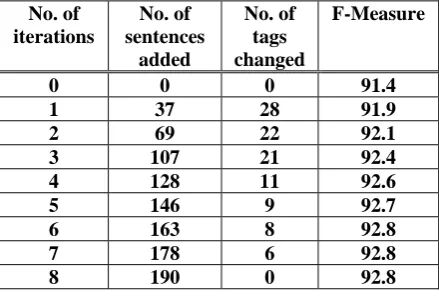
At each iteration, we lower the threshold so that about 5% of the sentences (with the largest margin) are added to the training corpus.2 As an example, this yielded the following gradually improving performance for one English cluster including 7 documents and 190 sentences.
No. of iterations
No. of sentences
added
No. of tags changed
F-Measure
0 0 0 91.4
1 37 28 91.9
2 69 22 92.1
3 107 21 92.4
4 128 11 92.6
[image:3.595.305.525.235.386.2]5 146 9 92.7 6 163 8 92.8 7 178 6 92.8 8 190 0 92.8
Table 1. Incremental Improvement from Self-training (English)
Self-training can be considered a cache model variant, operating across the entire test collection. But it uses confidence measures as weights for each name candidate, and relies on names tagged with high confidence to re-adjust the prediction of the remaining names, while in a cache model, all name candidates are equally weighted for vot-ing (independent of the learner’s confidence).
5.3
Unlabeled Document SelectionTo further investigate the benefits of using very large corpora in bootstrapping, and also inspired by the gain from the “essence” of self-training, which aims to gradually emphasize the predic-tions from related sentences within the test set, we reconsidered the assumptions of our approach. The bootstrapping method implicitly assumes that the unlabeled data is reliable (not noisy) and uniformly useful, namely:
2
• The unlabeled data supports the acquisition of new names and contexts, to provide new evidence to be incorporated in HMM and re-duce the sparse data problem;
• The unlabeled data won’t make the old esti-mates worse by adding too many names whose tags are incorrect, or at least are incor-rect in the context of the labeled training data and the test data.
If the unlabeled data is noisy or unrelated to the test data, it can hurt rather than improve the learner’s performance on the test set. So it is necessary to coarsely measure the relevance of the unlabeled data to our target test set. We de-fine an IR (information retrieval) - style rele-vance measure between the test set TestT and an unlabeled document d as follows.
5.3.1 ‘Query set’ construction
We model the information expected from the unlabeled data by a 'bag of words' technique. We construct a query term set from the test corpus
TestT to check whether each unlabeled document
d is useful or not.
• We prefer not to use all the words in TestT as key words, since we are only concerned about the distribution of name candidates.
(Adding off-topic documents may in fact in-troduce noise into the model). For example, if one document in TestT talks about the presidential election in France while d talks about the presidential election in the US, they may share many common words such as 'election', ’voting’, 'poll', and ‘camp’, but we would expect more gain from other unlabeled documents talking about the French election, since they may share many name candidates.
• On the other hand it is insufficient to only take the name candidates in the top one hy-pothesis for each sentence (since we are par-ticularly concerned with tokens which might
be names but are not so labeled in the top hypothesis).
So our solution is to take all the name candi-dates in the top N best hypotheses for each sen-tence to construct a query set Q.
5.3.2
Cross-entropy MeasureUsing Q, we compute the cross entropy H(TestT, d) between TestT and d by:
∑
∈× −
=
Q x
d x prob TestT
x prob d
TestT
H( , ) ( | ) log2 ( | )
where x is a name candidate in Q, and
prob(x|TestT) is the probability (frequency) of x
appearing in TestT while prob(x|d) is the prob-ability of x in d. If H(T, d) is smaller than a threshold then we consider d a useful unlabeled document3.
5.4
Sentence SelectionWe don’t want to add all the tagged sentences in a relevant document to the training corpus be-cause incorrectly tagged or irrelevant sentences can lead to degradation in model performance. The value of larger corpora is partly dependent on how much new information is extracted from each sentence of the unlabeled data compared to the training corpus that we already have.
The following confidence measures were ap-plied to assist the semi-supervised learning algo-rithm in selecting useful sentences for re-training the model.
5.4.1
Margin to find reliable sentencesFor each sentence, we compute the HMM hy-pothesis margin (the difference in log probabili-ties) between the first hypothesis and the second hypothesis. We select the sentences with margins larger than a threshold4 to be added to the train-ing data.
Unfortunately, the margin often comes down to whether a specific word has previously been observed in training; if the system has seen the word, it is certain, if not, it is uncertain. There-fore the sentences with high margins are a mix of interesting and uninteresting samples. We need to apply additional measures to remove the uninter-esting ones. On the other hand, we may have confidence in a tagging due to evidence external to the HMM, so we explored measures beyond the HMM margin in order to recover additional sentences.
3
We also tried a single match method, using the query set to find all the relevant documents that include any names be-longing to Q, and got approximately the same result as cross-entropy. In addition to this relevance selection, we used one other simple filter: we removed a document if it includes fewer than five names, because it is unlikely to be news.
4
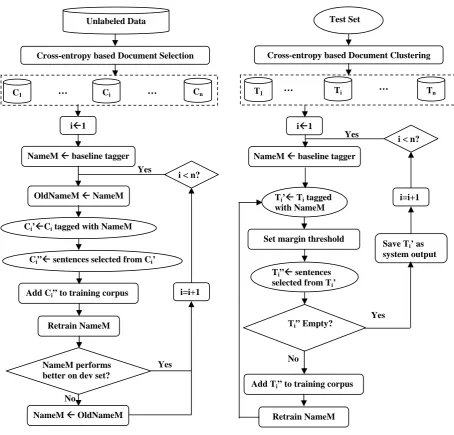
Figure 1. Bootstrapping for Name Tagging
Figure 2. Self-Training for Name Tagging
Data English Chinese
Baseline Training data
ACE02,03,04 989,003 words Beijing Corpus +ACE03,04,05
1,460,648 words Total 196,494 docs in Mar-Jun of 2003
(69M words) from ACE05 unlabeled data
41061 docs in Nov,Dec of 2000, and Jan of 2001 (25M words) from ACE05 and TDT4 transcripts
Selected Docs
62584 docs (1,314,148 Sentences) 14,537 docs (222,359 sentences) Unlabeled
Data
Selected Sentences
290,973 sentences (6,049,378 words) 55,385 sentences (1,128,505 words)
Dev Set 20 ACE04 texts in Oct of 2000 90 ACE05 texts in Oct of 2000
Test Set 20 ACE04 texts in Oct of 2000
and 80 ACE05 texts in Mar-May of 2003 (3093 names, 1205 PERs, 1021GPEs, 867 ORGs)
90 ACE05 texts in Oct of 2000
(3093 names, 1013 PERs, 695 GPEs, 769 ORGs)
Table 2. Data Description
C1 … Ci …
Unlabeled Data
Cross-entropy based Document Selection
i=i+1
Save Ti’ as
system output
T1 … Ti …
Test Set
Cross-entropy based Document Clustering
Ti’Å Ti tagged
with NameM
Yes
Add Ti” to training corpus
Retrain NameM Ti” Empty?
TiӁ sentences
selected from Ti’
No
NameM Å baseline tagger iÅ1
i < n? Yes
iÅ1
NameM performs better on dev set?
Yes
No
OldNameM Å NameM
Ci’ÅCi tagged with NameM
Add Ci” to training corpus
Retrain NameM
i=i+1 i < n?
Ci”Å sentences selected from Ci’
Yes NameM Å baseline tagger
Cn Tn
NameM Å OldNameM
[image:5.595.70.525.562.722.2]5.4.2 Name coreference to find more reliable sentences
Names introduced in an article are likely to be referred to again, so a name coreferred to by more other names is more likely to have been correctly tagged. In this paper, we use simple coreference resolution between names such as substring matching and name abbreviation reso-lution.
In the bootstrapping method we apply single-document coreference for each individual unla-beled text. In self-training, in order to further benefit from global contexts, we consider each cluster of relevant texts as one single big docu-ment, and then apply cross-document coreference.
Assume S is one sentence in the document, and there are k names tagged in S: {N1, N2 .….. Nk},
which are coreferred to by {CorefNum1, Coref-Num2, …CorefNumk} other names separately.
Then we use the following average name coreference count AveCoref as a confidence measure for tagging S:5
∑
== k
i
i k
CorefNum AveCoref
1
/ ) (
5.4.3
Name count and sentence length to re-move uninteresting sentencesIn bootstrapping on unlabeled data, the margin criterion often selects some sentences which are too short or don’t include any names. Although they are tagged with high confidence, they may make the model worse if added into the training data (for example, by artificially increasing the probability of non-names). In our experiments we don’t use a sentence if it includes fewer than six words, or doesn’t include any names.
5.5
Data FlowWe depict the above two semi-supervised learn-ing methods in Figure 1 and Figure 2.
6
Evaluation Results and Discussions
6.1
DataWe evaluated our system on two languages: En- glish and Chinese. Table 2 shows the data used in our experiments.
5
For the experiments reported here, sentences were selected if AveCoref > 3.1 (or 3.1×number of documents for cross-document coreference) or the sentence margin exceeded the margin threshold.
We present in section 6.2 – 6.4 the overall per-formance of precision (P), recall (R) and F-measure (F) for both languages, and also some diagnostic experiment results. For significance testing (using the sign test), we split the test set into 5 folders, 20 texts in each folder of English, and 18 texts in each folder of Chinese.
[image:6.595.305.527.250.335.2]6.2
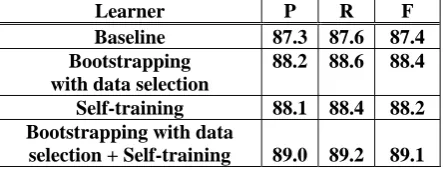
Overall PerformanceTable 3 and Table 4 present the overall perform-ance6 by applying the two semi-supervised learn-ing methods, separately and in combination, to our baseline name tagger.
Learner P R F
Baseline 87.3 87.6 87.4 Bootstrapping
with data selection
88.2 88.6 88.4
Self-training 88.1 88.4 88.2 Bootstrapping with data
[image:6.595.302.526.369.457.2]selection + Self-training 89.0 89.2 89.1
Table 3. English Name Tagger
Learner P R F
Baseline 88.2 87.6 87.9 Bootstrapping
with data selection
89.8 89.5 89.6
Self-training 89.5 88.3 88.9 Bootstrapping with data
selection + Self-training 90.2 89.7 90.0
Table 4. Chinese Name Tagger
For English, the overall system achieves a 13.4% relative reduction on the spurious and in-correct tags, and 12.9% reduction in the missing rate. For Chinese, it achieves a 16.9% relative reduction on the spurious and incorrect tags, and 16.9% reduction in the missing rate.7 For each of the five folders, we found that both bootstrapping and self-training produced an improvement in F score for each folder, and the combination of two methods is always better than each method alone. This allows us to reject the hypothesis that these
6
Only names which exactly match the key in both extent and type are counted as correct; unlike MUC scoring, no partial credit is given.
7
improvements were random at a 95% confidence level.
6.3
Analysis of Bootstrapping6.3.1 Impact of Data Size
Figure 3 and 4 below show the results as each segment of the unlabeled data is added to the training corpus.
Figure 3. Impact of Data Size (English)
Figure 4. Impact of Data Size (Chinese)
We can see some flattening of the gain at the end, particularly for the larger English corpus, and that some segments do not help to boost the performance (reflected as dips in the Dev Set curve and gaps in the Test Set curve).
6.3.2 Impact of Data Selection
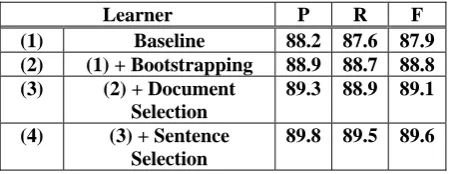
In order to investigate the contribution of docu-ment selection in bootstrapping, we performed diagnostic experiments for Chinese, whose re-sults are shown in Table 5. All the bootstrapping tests (rows 2 - 4) use margin for sentence selec-tion; row 4 augments this with the selection methods described in sections 5.4.2 and 5.4.3.
Learner P R F
(1) Baseline 88.2 87.6 87.9 (2) (1) + Bootstrapping 88.9 88.7 88.8 (3) (2) + Document
Selection
89.3 88.9 89.1
(4) (3) + Sentence Selection
[image:7.595.303.528.70.157.2]89.8 89.5 89.6
Table 5. Impact of Data Selection (Chinese)
Comparing row 2 with row 3, we find that not using document selection, even though it multi-plies the size of the corpus, results in 0.3% lower performance (0.3-0.4% loss for each folder). This leads us to conclude that simply relying upon large corpora is not in itself sufficient. Effective use of large corpora demands good confidence measures for document selection to remove off-topic material. By adding sentence selection (re-sults in row 4) the system obtained 0.5% further improvement in F-Measure (0.4-0.7% for each folder). All improvements are statistically sig-nificant at the 95% confidence level.
6.4
Analysis of Self-trainingWe have applied and evaluated different meas-ures to extract high-confidence sentences in self-training. The contributions of these confidence measures to F-Measure are presented in Table 6.
Confidence Measure English Chinese
Baseline 87.4 87.9 Margin 87.8 88.3 Margin + single-doc
name coreference
88.0 88.7
Margin + cross-doc name coreference
88.2 88.9
Table 6. Impact of Confidence Measures
It shows that Chinese benefits more from add-ing name coreference, mainly because there are more coreference links between name abbrevia-tions and full names. And we also can see that the margin is an important measure for both lan-guages. All differences are statistically signifi-cant at the 95% confidence level except for the gain using cross-document information for the Chinese name tagging.
7
Conclusions and Future Work
investigates the importance of data selection for this application.
Banko and Brill (2001) suggested that the de-velopment of very large training corpora may be central to progress in empirical natural language processing. When using large amounts of unla-beled data, as expected, we did get improvement by using unsupervised bootstrapping. However, exploiting a very large corpus did not by itself produce the greatest performance gain. Rather, we observed that good measures to select rele-vant unlabeled documents and useful labeled sen-tences are important.
The work described here complements the ac-tive learning research described by (Scheffer et al., 2001). They presented an effective active learning approach that selects “difficult” (small margin) sentences to label by hand and then add to the training set. Our approach selects “easy” sentences – those with large margins – to add automatically to the training set. Combining these methods can magnify the gains possible with active learning.
In the future we plan to try topic identification techniques to select relevant unlabeled docu-ments, and use the downstream information ex-traction components such as coreference resolution and relation detection to measure the confidence of the tagging for sentences. We are also interested in applying clustering as a pre-processing step for bootstrapping.
Acknowledgment
This material is based upon work supported by the Defense Advanced Research Projects Agency under Contract No. HR0011-06-C-0023, and the National Science Foundation under Grant IIS-00325657. Any opinions, findings and conclu-sions expressed in this material are those of the authors and do not necessarily reflect the views of the U. S. Government.
References
Rie Ando and Tong Zhang. 2005. A High-Performance Semi-Supervised Learning Methods for Text Chunking. Proc. ACL2005. pp. 1-8. Ann Arbor, USA
Michele Banko and Eric Brill. 2001. Scaling to very very large corpora for natural language disam-biguation. Proc. ACL2001. pp. 26-33. Toulouse, France
David Bean and Ellen Riloff. 2004. Unsupervised Learning of Contextual Role Knowledge for
Coreference Resolution. Proc. HLT-NAACL2004. pp. 297-304. Boston, USA
Daniel M. Bikel, Scott Miller, Richard Schwartz, and Ralph Weischedel. 1997. Nymble: a high-performance Learning Name-finder. Proc. Fifth Conf. on Applied Natural Language Processing. pp.194-201. Washington D.C., USA
Avrim Blum and Tom Mitchell. 1998. Combining Labeled and Unlabeled Data with Co-training. Proc. of the Workshop on Computational Learning The-ory. Morgan Kaufmann Publishers
Michael Collins and Yoram Singer. 1999. Unsuper-vised Models for Named Entity Classification. Proc. of EMNLP/VLC-99.
James R. Curran and Marc Moens. 2002. Scaling con-text space. Proc. ACL 2002. Philadelphia, USA
James R. Curran. 2002. Ensemble Methods for Auto-matic Thesaurus Extraction. Proc. EMNLP 2002. Philadelphia, USA
James R. Curran and Miles Osborne. 2002. A very very large corpus doesn’t always yield reliable es-timates. Proc. ACL 2002 Workshop on Effective Tools and Methodologies for Teaching Natural Language Processing and Computational Linguis-tics. Philadelphia, USA
Heng Ji and Ralph Grishman. 2005. Improving Name Tagging by Reference Resolution and Relation De-tection. Proc. ACL2005. pp. 411-418. Ann Arbor, USA.
Winston Lin, Roman Yangarber and Ralph Grishman. 2003. Bootstrapping Learning of Semantic Classes from Positive and Negative Examples. Proc. ICML-2003 Workshop on The Continuum from La-beled to UnlaLa-beled Data. Washington, D.C.
Scott Miller, Jethran Guinness and Alex Zamanian. 2004. Name Tagging with Word Clusters and Dis-criminative Training. Proc. HLT-NAACL2004. pp. 337-342. Boston, USA
Deepak Ravichandran, Patrick Pantel, and Eduard Hovy. 2004. The Terascale Challenge. Proc. KDD Workshop on Mining for and from the Semantic Web (MSW-04). pp. 1-11. Seattle, WA, USA
Ellen Riloff and Rosie Jones. 1999. Learning Diction-aries for Information Extraction by Multi-Level Bootstrapping. Proc. AAAI/IAAI
Tobias Scheffer, Christian Decomain, and Stefan Wrobel. 2001. Active Hidden Markov Models for Information Extraction. Proc. Int’l Symposium on Intelligent Data Analysis (IDA-2001).