Screening Of Potential Soil Bacteria For Detection Of
Polyhydroxyalkanoate (PHA) Accumulation
Padma Singh
1,Richa Prasad Mahato
2Department of Microbiology, Kanya Gurukul Campus Gurukul Kangri University,Haridwar-249407, India Email: [email protected]
Abstract:Polyhydroxyalkanoate (PHAs) have focused much attention because of their complete biodegradability and their material resemblance with synthetic plastics. For this purpose, the present study aims on isolation of those bacteria that have the potential to synthesize intracellular PHA and characterisation of PHA producing bacterial isolates so as to obtain the greatest PHA yield. 36 bacterial isolates were isolated and screened by Sudan black staining, Nile blue staining and Tributyrine hydrolysis. Out of 36 bacterial isolates, 8 isolates were screened as effective PHA producers. The selected isolates were identified phenotypically as Pseudomonas sp.EO1,
Aneurinibacillus sp.EO8, Brevibacterium sp.EO9, Bacillus sp.EO11, Pseudomonas sp.EO18, Bacillus sp.LO1,
Achromobacter sp.LO8, Pseudomonas sp.LO10.
Keywords: Polyhydroxyalkanoate; plastics; Sudan Black; Nile blue; Tributyrine hydrolysis
1. INTRODUCTION
Traditional petrochemical derived plastics are resistant to microbial attack and deposit in environment at a rate of 28 million tons per year [1]. In 2011, almost 280 million tons of petrochemicals-based polymers were manufactured with assumed increased in 4% per annum to 2016. Their utility are almost general as parts in automobiles, home appliances, computer equipments, packages and even medical applications are areas, where plastics clearly have become indispensable. However, its qualities of durability have caused significant problems since plastic waste gather in the environment. The accumulation of excessive plastics have arisen a global environmental problem. Plastic wastes are not generally organized by nature, as the most of plastics are not degraded by microorganisms. With the impending fossil fuel crisis, the alarming prices of petroleum and environmental impact associated with the products, the search for substitutes is necessary in reducing mankind's dependencies in non-renewable resources [2]. Biodegradable plastics provide the best replacement to prevent the environment from hazards caused by conventional petroleum based plastics, as they are 'eco-friendly' in nature. Biodegradable plastics are of many kinds with different levels of biodegradability. As biodegradable plastic, PHA was the first chief kinds of biomaterial discovered in
Bacillus megaterium and characterized by French microbiologist Lemoeigne in 1926 [3]. Much attention has focused to PHAs because of their entire biodegradability and the affinity of their material characteristics to synthetic plastics [4]. Polyhydroxyalkanoates (PHAs) is biological polyesteric macromolecules that is naturally
accumulation. Keeping this point in view, the present study was focused on isolation of PHA-producing bacteria from oil enriched soils to produce sufficient amount of polymer as a microbial novel end product PHA which is cost effective and ecofriendly.
2. MATERIALS AND METHODS
2.1. Sample collection
Soil samples were collected from edible oil and lubricating oil enriched soil from expeller and garage workshop located in the Haridwar (India) and its adjoining places. The samples were collected and kept in sterilized plastic bags, marked with collection details and stored at 4°C temperature.
2.2. Bacterial isolation
For isolation of PHA producing bacteria, six oil contaminated soil samples were screened from different regions of Haridwar. The isolation of bacteria was carried out by serial dilution, spread plate and enrichment technique. For this, sterile nutrient broth containing a gram of soil sample was incubated at 30° for 24 h. Then different dilutions (10-4, 10-5, 10-6 and 10-7) were prepared by diluting broth culture in 0.9% normal saline. After this, plate of nutrient agar containing different dilutions was incubated at 30 + 2°C for 24 h [11].
2.3. Analysis of lipase enzyme activity in bacterial isolates
Tributyrine agar plate method (Hi media) was used to check the oil utilising capability of oil enriched soil isolated bacteria. Isolates were also screened to examine the activity of lipase enzyme by growing them on Tributyrine agar plate [12].
2.4. Primary screening of bacteria for the detection of PHA granules by Sudan Black B staining
To check PHA accumulating ability in bacteria, Sudan Black B stain was used as a primary screening stain. Briefly smear of colonies taken from nutrient agar medium were stained for 15 min with 0.3% (w/v) Sudan Black B dissolved in 70% ethanol then de-colourised the stain with 50% (v/v) alcohol and counterstained with 0.5% (w/v) safranin solution. To select potential PHA producing bacteria, Sudan Black B stain was used for screening. Then safranin was washed off with distilled water and observed the slide under 100x of compound microscope [13].
2.5. Secondary screening by Fluorescence screening
Sudan Black B positive colonies were purified and the isolates were further confirmed by Nile blue A staining. In short, Nile blue A stain (0.5 µg/ml) suspended in carbon rich nutrient agar media containing were used for the streaking of isolated colonies. Stained plates were examined for development of fluorescence under UV-transilluminator (Biogen) at 312 nm after incubation of 24h at 30 + 2°C[14].
2.6. Isolates Identification and characterization by phenotypic characters
Characterization and identification of PHA producing bacterial isolates were based on morphological as well as biochemical test according to Bergey's manual [15]. Based on the screening results, two potential PHA-producing strains were selected for further studies. The cultural characteristics including structure, shape, colour, cell's arrangement and Gram staining of the bacterial colonies were observed to characterize the bacterial colonies. Bacterial morphology was observed under 1000x resolution of Microscope (Olympus). Different biochemical tests such as methyl red and Voges-Proskauer, H2S production, amylase, citrate, sucrose, dextrose, fructose, mannitol and lactose utilisation test were performed on selected bacterial isolates for 48 h at 37°C.
3. RESULT AND DISCUSSION
3.1. Isolation of PHA Producing bacteria
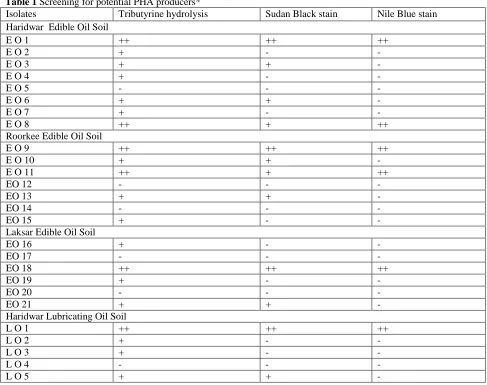
There are broad varieties of taxonomically and physiologically different natural bacteria and some archaea that have the capability to accumulate PHAs as bacterial storage reserve materials and accumulate them in the cytoplasm as insoluble granules. For the selection of potential PHA producers, bacterial colonies were isolated from different oil enriched soil as it was assumed to be rich in carbon source that was necessary component for the accumulation of PHA in their surrounding growth environment. A total of 36 different types of colonies (21 from edible oil and 15 from lubricating oil) were picked up from six different soil samples for further evaluation of PHA production using Sudan Black dye, Nile Blue dye and Tributyrine agar plate method.
3.2. Screening of PHA Producing bacteria
et al. screened the presence of PHA inducing bacteria by observing the fluorescent colonies flourish on nutrient rich medium under ultraviolet (UV) [17]. Sasidharan et al. worked on screening of polyhydroxyalkanoate (PHA) synthesizing bacteria by spot inoculation of cell culture on complex nitrogen limiting agar plates containing Nile Blue A (1 μg/ml) and agar (2%) in PHA production medium
[image:3.612.76.538.173.307.2][18]. Munir and Jamil, confirmed the presence of PHA accumulating bacteria isolated from contaminated soil nearby industrial wastewater drain by using Sudan Black B method [19]. Bacteria were isolated to check the oil utilizing ability and lipase enzyme activity over tributyrine agar by Tufail et al. [20].
Fig.1. Sudan black B staining containing PHA inclusions in selected bacterial cells
Table 1 Screening for potential PHA producers*
Isolates Tributyrine hydrolysis Sudan Black stain Nile Blue stain Haridwar Edible Oil Soil
E O 1 ++ ++ ++
E O 2 + - -
E O 3 + + -
E O 4 + - -
E O 5 - - -
E O 6 + + -
E O 7 + - -
E O 8 ++ + ++
Roorkee Edible Oil Soil
E O 9 ++ ++ ++
E O 10 + + -
E O 11 ++ + ++
EO 12 - - -
EO 13 + + -
EO 14 - - -
EO 15 + - -
Laksar Edible Oil Soil
EO 16 + - -
EO 17 - - -
EO 18 ++ ++ ++
EO 19 + - -
EO 20 - - -
EO 21 + + -
Haridwar Lubricating Oil Soil
L O 1 ++ ++ ++
L O 2 + - -
L O 3 + - -
L O 4 - - -
L O 5 + + -
EO8
EO1 EO9 EO11
[image:3.612.67.554.336.721.2]Available online at www.ijrat.org
1601 Roorkee Lubricating Oil Soil
L O 6 - - -
L O 7 - - -
L O 8 ++ ++ ++
L O 9 - - -
Laksar Lubricating Oil Soil
L O 10 ++ ++ ++
L O 11 - - -
L O 12 + - -
L O 13 - - -
L O 14 ++ + -
L O 15 + - -
*Legend: ++ = granules fully observed, ++ = granules slightly observed, - = no granules observed, ++ = fully florescence, + = slightly fluorescence, - = no fluorescence, ++ = zone fully observed, + = Zone slightly observed, - = no zone observed
Fig.2. PHA inclusions in eight bacterial cells illuminated through Nile Blue staining under UV light and E.coli kept as negative control
3.3. Identification of Polyhydroxyalkanoate (PHA) producing bacteria
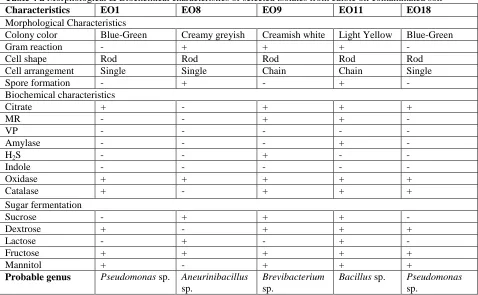
Out of 21 isolates from edible oil soil, 9 Gram negative & 12 Gram positive rods whereas 15 isolates from lubricating oil soil were isolated, out of which 3 Gram positive cocci, 7 Gram positive rods & 5 Gram negative rods were observed (Table 4 a and b). Classification of selected isolates up to genus level was according to morphological and biochemical characteristics based on bergey's manual of determinative bacteriology and were identified as
Pseudomonas sp. EO1, Aneurinibacillus sp. EO8,
Brevibacterium sp. EO9, Bacillus sp. EO11,
Pseudomonas sp. EO18, Bacillus sp. LO1,
Achromobacter sp. LO8, Pseudomonas sp. LO10
(Fig. 2). Many of the isolates were Bacillus sp. and
Pseudomonas sp. Both the isolates are reported to be ideal PHA producers in many previous studies by Tufail et al., [20]. Potential strains were selected for later studies. Hwan et al., [21] isolated and observed greater amount of PHA in Pseudomonas sp. strain DR2 accumulation than other well-studied strains. Chaudhary et al., [22] selected Pseudomonas sp. due to its high production ability. Mainly Pseudomonas
spp. was isolated from Antarctic soil byGoh et al., [17].Industrial production of PHA was achieved via
Available online at www.ijrat.org
[image:5.612.67.545.273.568.2]Fig.2. Gram staining of selected bacterial cells.
Table 4 a Morphological & Biochemical characteristics of selected isolates from edible oil contaminated soil
Characteristics EO1 EO8 EO9 EO11 EO18
Morphological Characteristics
Colony color Blue-Green Creamy greyish Creamish white Light Yellow Blue-Green
Gram reaction - + + + -
Cell shape Rod Rod Rod Rod Rod
Cell arrangement Single Single Chain Chain Single
Spore formation - + - + -
Biochemical characteristics
Citrate + - + + +
MR - - + + -
VP - - - - -
Amylase - - - + -
H2S - - + - -
Indole - - - - -
Oxidase + + + + +
Catalase + - + + +
Sugar fermentation
Sucrose - + + + -
Dextrose + - + + +
Lactose - + - + -
Fructose + + + + +
Mannitol + - + + +
Probable genus Pseudomonas sp. Aneurinibacillus
sp.
Brevibacterium
sp.
Bacillus sp. Pseudomonas
sp.
Table 4 b Morphological & Biochemical characteristics of selected isolates from lubricating oil contaminated soil
Characteristics LO1 LO8 LO10
Morphological Characteristics
Colony color Creamy White White Fluorescent yellow
Gram reaction + - -
Cell shape Rod Rod Rod
Cell arrangement Short chain Pairs Single
Spore formation + - -
Biochemical characteristics
Citrate + + +
MR - - -
EO1 EO8 EO9 EO11
[image:5.612.69.546.589.712.2]Available online at www.ijrat.org
1603
VP + - -
Amylase + - -
H2S - - -
Indole - - -
Oxidase - + +
Catalase + + +
Sugar fermentation
Sucrose + - +
Dextrose + + +
Lactose - - -
Fructose + - +
Mannitol + - +
Probable genus Bacillus sp. Achromobacter sp. Pseudomonas sp.
4. CONCLUSION
The objective of the current study was to isolate and characterise efficient PHA inducing bacteria so as to obtain the maximum PHA yield. According to present findings, 36 bacteria were isolated from different oil contaminated soil and the best eight screened isolates were identified at phenotypic level. All the eight isolates EO1, EO8, EO9, EO11, EO18 and LO1, LO8, LO10 can be regarded as potential PHA producing bacteria.
ACKNOWLEDGEMENT
The authors would like to acknowledge financial support to Department of Microbiology, Kanya Gurukul Campus, Gurukul Kangri University, Haridwar, India.
REFERENCES
[1] Kalaivani, R.; Sukumaran, V. (2013): Isolation and identification of new strains to enhance the production of biopolymers from marine sample in Karankura, Tamil Nadu Eur. J. Exp. Biol, 3(3): 56–64.
[2] Tan, G-YA.; Chen, C-L.; Li, L.; Ge, L; Wang, L.; Razaad, I.M.N.; Li, Y.; Zhao, L.; Mo, Y.; Wang, J-Y. (2014): Start a
research on biopolymer
polyhydroxyalkanoate (PHA): a review.
Polymers 6:706–754.
doi: 10.3390/polym6030706.
[3] Lemoigne, M. (1926): Products of dehydration and polymerization of the acid- oxybutyric, Bulletin society chemistry biology 8.
[4] Luengo, J.M.; García, B.; Sandoval, A.; Naharro, G.,; Olivera, E.R. (2003): Bioplastics from microorganisms. Curr Opin Microbiol, 6: 251–260.
[5] Keshavarz, T.; Roy, I.; (2010): Polyhydroxyalkanoates: bioplastics with a green agenda. Current opinion in
microbiology. Current Opinion in Microbiology, 13: 321–326.
[6] Hazer, B.; Steinbuchel, A.; (2007): Increased diversification of polyhydroxyalkanoates by modification reactions for industrial and medical applications. Applied Microbiology and Biotechnology, 74(1):1–12.
[7] Lee, Y.U.; Yoo, Y.J. (1991): Kinetics for the growth of Alcaligenes eutrophus and the biosynthesis of poly-β-hydoxybutyrate. Korean J Appl. Microbiol. Biotechnol, 19:186–92.
[8] Gao, X.; Chen, J.; Wu, Q.; Chen, G. (2011): Polyhydroxyalkanoates as a source of chemicals, polymers, and biofuels. Current Opinion in Biotechnology, 22(6): 768–774. [9] Yamane, T.; Chen, X.F.; Ueda, S.; (1996):
Growth associated production of poly(3hydroxyvalerate) from n-pentanol by a methylotrophic bacterium, Paracoccus denitificans. Appl Environ Microbiol: 62: 380–384.
[10] Grothe, E.; Moo-Young, M.; Chisti, Y. (1999): Fermentation optimization for the production of poly(beta-hydroxybutyric acid) microbial thermoplastic. Enzyme and Microbial Technology, 25: 132-141.
[11] Tanamool, V.; Imai, T.; Danvirutai, P.; Kaewkannetra, P. (2011): Biosynthesis of poly hydroxylalkanoate (PHA) by
Hydrogenophaga sp. isolated from soil environments during batch fermentation. Journal of Life Sciences, 5(12): 1003-1012. [12] Tufail, S.; Munir, S.; Jamil, N. (2017):
[13] Wani, S.J.; Sayyed, R.Z. (2015): Production, efficient recovery and partial characterization of biodegradable polymer produced by soil Streptomyces sp. Indian journal of biotechnology, 15: 127-129. [14] Bhuwal, A.K.; Singh, G.; Aggarwal, N.K.;
Goyal, V.; and Yadav, A. (2013): Isolation and Screening of Polyhydroxyalkanoates Producing Bacteria from Pulp, Paper, and Cardboard Industry Wastes. International Journal of Biomaterials Volume 2013, Article ID 752821, 10 pages.
[15] Holt, J.G.; Kreigh, N.R.; Sneath, P.H.A.; Staley, J.T.; Williams, S.T. (1994): Gram positive Cocci. In: Bergey’s Manual of Determinative Microbiology, Hensyl, W.R. (Ed.). 9th Edn., Williams & Wilkins, Baltimore, USA., pp: 527-558.
[16] Spiekermann, P.; Rehm, B.H.; Kalscheuer, R.; Baumeister, D.; Steinbuchel, A.; (1999): A sensitive viable-colony staining method using Nile red for direct screening of bacteria that accumulate polyhydroxyalkanoic acids & Other lipid storage compounds. Arch. Microbial, 171: 73-80.
[17] Goh, Y.S.; Tan, I.K.P.; (2012): Polyhydroxyalkanoate production by Antarctic soil bacteria isolated from Casey station and Signy Island. Microbiological research, 167: 211-219.
[18] Sasidharan, R.S.; Bhat, S.G.; Chandrasekaran M. (2014): Biocompatible polyhydroxybutyrate (PHB) production by marine Vibrio azureus BTKB33 under submerged fermentation. Ann Microbiol. DOI 10.1007/s13213-014-0878-z
[19] Munir, S; Jamil, N. (2015): Characterization of Polyhydroxyalkanoates Produced by Contaminated Soil Bacteria using Wastewater and Glucose as Carbon Sources. Tropical Journal of Pharmaceutical Research September, 14 (9): 1605-1611.
[20] Tufail, S.; Munir, S.; Jamil, N. (2017): Variation analysis of bacterial polyhydroxyalkanoates production using saturated and unsaturated hydrocarbons. Brazilian journal of microbiology, 48: 629– 636.
[21] Hwan, S.J.; Jeon, C.O.; Choi, M.H.; Yoon, S.C.; Park, W. (2008): Polyhyroxyalkanoate (PHA) Production Using Waste Vegetable Oil by Pseudomonas sp. Strain DR2. Journal of Microbiology and Biotechnology, 18(8): 1408-1415.