A Walk on the Other Side:
Adding Statistical Components to a Transfer-Based Translation System
Ariadna Font Llitjós
Carnegie Mellon University
5000 Forbes Ave.
Pittsburgh, PA, 15213
[email protected]
Stephan Vogel
Carnegie Mellon University
5000 Forbes Ave.
Pittsburgh, PA, 15213
[email protected]
Abstract
This paper seeks to complement the cur-rent trend of adding more structure to Sta-tistical Machine Translation systems, by exploring the opposite direction: adding statistical components to a Transfer-Based MT system. Initial results on the BTEC data show significant improvement ac-cording to three automatic evaluation metrics (BLEU, NIST and METEOR).
1
Introduction
In recent years the machine translation research community has seen a remarkable paradigm shift. It is not the first one, but it has been a very dra-matic one: statistical machine translation has taken the center stage. Conferences like ACL or HLT are virtually flooded with papers on various flavors of SMT. In international machine translation evalua-tion like NIST (NIST MT Evaluaevalua-tion), TC-Star (TC-STAR Evaluation) or IWSLT (IWSLT 2006) evaluations, most participating systems are SMT systems, with a few Example-Based systems sprin-kled in. Rule-Based systems seem to have for the most part disappeared. There may be many reasons for this paradigm shift. One obvious reason is the comparable ease, which with data-driven systems can be built once some parallel data is available. Another reason is that the performance of statisti-cal translation systems has dramatistatisti-cally improved over the last 5 to 10 years.
Does this mean that work on grammar-based systems should be stopped? Should all the insight into the structure of languages be neglected? This might be too drastic a reaction. Actually, now that SMT has reached some maturity, we see several
attempts to integrate more structure into these sys-tems, ranging from simple hierarchical alignment models (Wu 1997, Chiang 2005) to syntax-based statistical systems (Yamada and Knight 2001, Zollmann and Venugopal 2006). What can tradi-tional Rule-Based translation systems learn from these approaches? And would it not make sense to work from both sides towards that common goal: structurally rich statistical translation models. In this paper we study some enhancements for a Transfer-Based translation system, using tech-niques and even components developed for statisti-cal machine translation. While the core engine remains virtually untouched, additional features are added to re-score the n-best list generated by the transfer engine. Statistical alignment techniques are used to lower the burden in building a lexicon for a new domain. Minimum error rate training is used to optimize the system. We show that this leads to significant improvements in performance.
2
A Transfer-Based Translation System
2.1 The Lexicon and Grammar
In our Rule-Based MT (RBMT) system, translation rules include parsing, transfer, and generation in-formation, similar to the modified transfer ap-proach used in the early Metal system (Hutchins and Somers, 1992).
The initial lexicon (479 entries) and grammar (40 rules) used in our experiments were manually written to cover the syntactic structures and the vocabulary of the first 400 sentences of the AVENUE Elicitation Corpus (Probst et al 2001). The Elicitation Corpus contains sets of minimal pairs in English and it was designed to cover a va-riety of linguistic phenomena. Building these two language-dependent components took a computa-tional linguist 2-3 months. Figures 1 and 2 show
examples of a translation rules in the grammar and the lexicon.
{S,4}
S::S : [NP VP] -> [NP VP] ((X1::Y1) (X2::Y2) (x0 = x2)
((y2 subj) = -) ((y1 case) = nom) ((y1 agr) = (x1 agr)) ((y2 tense) = (x2 tense)) ((y2 agr pers) = (y1 agr pers)) ((y2 agr num) = (y1 agr num)) )
Figure 1: EnglishÆSpanish translation rule with agreement constraints for subject (NP) and verb (VP).
V::V |: ["prefer"] -> ["prefiero"] ((X1::Y1)
((x0 form) = prefer) ((x0 tense) = pres) ((y0 agr pers) = 1) ((y0 agr num) = sg))
Figure 2: EnglishÆSpanish lexical entry for the verb “prefer”.
2.2 Refined MT System
The original grammar and lexicon were automati-cally improved with an Automatic Rule Refiner, guided by a few bilingual speaker corrections (Font Llitjós & Ridmann 2007). In this approach, automatic refinements only affect the target lan-guage side of translation rules, namely transfer and generation information.
The refined MT system used in our experiments is the result of adding 30 agreement constraints to the grammar rules, which makes the grammar tighter (leading to an increase in precision), as well as adding three new rules to cover new syntactic structures and five lexical entries for new senses and forms of existing words (leading to an increase in recall).
2.3 The Transfer Engine
The Transfer Engine, or Xfer engine for short, combines the translation grammar and lexicon in order to produce translations of a source language sentence into a target language. The Xfer engine incorporates the three main processes involved in Transfer-based MT: parsing of the source language input, transfer of the parsed constituents of the source sentence to their corresponding structured constituents on the target language side, and gen-eration of the target sentence.
The currently implemented algorithm is similar to bottom-up chart parsing as described for exam-ple in Allen (1995). A chart is first populated with all constituent structures that were created in the course of parsing the source language sentence with the source-side portion of the transfer gram-mar. Transfer and generation are applied to each constituent entry. The transfer rules associated with each entry in the chart are used in order to determine the corresponding constituent structure on the target language side. At the word level, lexi-cal transfer rules are used in order to get the differ-ent lexical choices.
Often, no parse for the entire source sentence can be found. Partial parses are concatenated se-quentially to generate complete translations.
In the current version of the Xfer system, the output can be a first-best translation or a n-best list, which can be used for additional n-best list rescor-ing. The alternatives arise from lexical ambiguity and multiple synonymous choices for lexical items in the dictionary, but also from syntactic ambiguity and multiple competing hypotheses from the grammar.
For our experiments, we used version 3 of the Xfer engine. An older version of the Xfer engine is described in detail in Peterson (2002).
2.4 Ranking Translations
The Xfer engine can generate multiple translations. This requires a quality score to be assigned to all the alternatives. Based on these scores, the 1-best translation will be selected by the system.
Fragmentation Penalty
In the original Xfer system the only score used to rank translation alternatives was a heuristic frag-mentation penalty. The fragfrag-mentation penalty is essentially the number of different chunks (rules or lexical entries not embedded in another rule) that span the whole translation. The intuition behind this score is that the more partial parses are neces-sary to span the entire sentence the less likely the resulting translation will be a good one.
N-gram LM
sen-tences which are not only grammatically correct, but also use words and word sequences that are more natural and more common, data-driven ma-chine translation systems use a n-gram language model. To get the same benefit in the Xfer system, an n-gram LM has been integrated with the engine.
This has the advantage that in the case of prun-ing, the LM score can be used to avoid pruning good hypotheses, in addition to re re-rank the final translations.
For our experiments, a suffix array language model based on the SALM toolkit (Zhang & Vo-gel, 2006) is used.
Length Model
To adjust for the length of the translations gener-ated by the system, the difference between the number of words generated and the expected num-ber of words is added as a very simple feature. The expected length is calculated by multiplying the source sentence length by the ratio of the number of target and source words in the training corpus. The effect of this feature is to balance globally the length of the translations.
2.5 Pruning
To deal with the combinatorial explosion during the parsing/translation process, pruning has to be applied. Only the n top-ranking hypotheses are kept in each cell of the chart. The ranking of these partial translations is based on their language model score, which at this time is only an ap-proximation, as the true history has not been seen and cannot be taken into account.
3
Building a Xfer System for a New
Do-main
A major bottleneck in developing a RBMT system for a new translation task (a new language pair or a new domain) is writing the grammar and building the lexicon. Automatic grammar induction using statistical alignments has been studied in (Probst 2005).
Here, we start with an existing grammar and augment the baseline lexicon with entries to cover the new domain. We explore semi-automatic lexi-con generation for fast adaptation to the travel do-main (Section 3.2).
3.1 Test Data: BTEC Corpus
For initial evaluation on unseen data, we selected the Basic Travel Expression Corpus (BTEC) (Takezawa et al. 2002), which has been used in the evaluation campaigns in connection with the Inter-national Workshop on Spoken Language Transla-tion (IWSLT 2006). Besides still being currently used to build real systems (Shimizu et al. 2006; Nakamura, et al. 2006), this corpus contains rela-tively simple sentences that are comparable to the ones initially corrected by users, and which are covered by the baseline manual grammar.
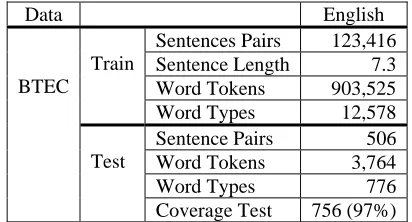
As our test set, we used 506 English sentences for which two sets of Spanish reference transla-tions were available. Table 1 shows corpus statis-tics for the BTEC data.
Data English
Sentences Pairs 123,416
Sentence Length 7.3
Word Tokens 903,525
Train
Word Types 12,578
Sentence Pairs 506
Word Tokens 3,764
Word Types 776
BTEC
Test
Coverage Test 756 (97%)
Table 1: Corpus Statistics for the BTEC corpus
3.2 Semi-Automatic Generation of the
Transfer Lexicon
The Transfer-Based system relies on a lexicon that contains POS, gender and number agreement, among other linguistic features. To adjust the sys-tem quickly to a new task, we decided to leverage from statistical alignment models to generate word and phrase alignments as candidates for the trans-fer lexicon.
ta-ble was generated. This first step took about 5 hours.
The next step, manually cleaning the translation table, annotating them with parts-of-speech, and with agreement and tense constraints, was initially restricted to those items that overlapped with the vocabulary of our development test set, and took two days.
The statistically generated lexicon comprises 1,248 lexical entries, whereas the initial manual lexicon contained 479 lexical entries. For our BTEC experiments, we combined both lexicons.
3.3 Xfer Results with No Ranking
To determine how the Xfer system would perform only on the basis of the lexicon and grammar, we ran one translation experiment in which no lan-guage model was used. This experiment was also intended to see if the refined grammar would lead to better translations. We took the first-best transla-tion output by the system without using any statis-tical components to rank alternative translations.
System METEOR BLEU NIST Baseline 0.5666 0.2745 5.88
Refined 0.5676 0.2559 5.62
Table 2: Automatic metric scores for a purely Rule-Based MT System.
Table 2 shows that, in this crude setting, differ-ent automatic metrics do not agree on the transla-tion accuracy of both systems. On one hand, METEOR (Lavie et al. 2004), which has been shown to correlate well with human judgments (Snover et al. 2006), indicates that the refined sys-tem outperforms the baseline syssys-tem (as measured by the latest version v0.5.1,). On the other hand, both BLEU (Papineni et al., 2002) and NIST (Doddington 2002) scores are higher for the base-line system (mteval-v11b.pl).
However, human inspection revealed that the re-fined grammar is able to augment the n-best list with correct translations that the baseline system was not able to generate. This suggests that these results reflect poor re-ranking and not n-best list quality. In the next section, we describe an oracle experiment to measure n-best list quality of both systems.
3.4 Oracle Experiment
Oracle scores provide an upper-bound in perform-ance. For the BTEC test set, we approximated a human oracle by calculating automatic metric scores for METEOR and for BLEU and NIST.
Given 100-best lists for each source language sentence, we selected the best translation hypothe-sis for each automatic metric separately.
These scores reflect the fact that automatic re-finements are able to feed the n-best list with better translations, as evulated by comparison against human reference translations. Even with a small set of independent user corrections, the refined system shows potential improved translation quality as indicated by higher scores for all three automatic evaluation metrics in Table 3.
System METEOR BLEU NIST Baseline 0.6863 0.4068 7.42
Refined 0.6954 0.4215 7.51 Table 3: Automatic metric oracle scores based on a 100-best list
Moreover, oracle scores provide the margin that we can gain when improving on the re-ranking of the n-best list produced by the Xfer engine.
3.5 Xfer Results with Initial Ranking
As expected, when the Xfer system is run in com-bination with a LM1 as well as the fragmentation penalty, automatic metric scores for the 1-best hy-pothesis are significantly higher (Table 4), than when just using the first translation output by the Xfer system alone (Table 2).
System METEOR BLEU NIST Baseline 0.6176 0.3425 6.53
Refined 0.6222 0.3513 6.56
Table 4: Automatic metric scores for 1-best de-coder hypothesis.
These results are lower than the oracle scores for both the baseline and the refined system (Table 3), which is also to be expected. However, the impor-tant thing to notice from these results is that, like in the oracle case, the refined system consistently outperforms the baseline MT system for all three automatic metrics.
1
The difference between the baseline and the re-fined system in terms of 1-best scores is slightly smaller than the difference between oracle scores, which means that the decoder can not fully lever-age the improvements made in the grammar. This indicates that the decoder fails to select the best translation in most cases.
4
Adding Statistical Components to a
Re-Ranker
The information used in the Xfer system to rank alternative translations is limited. Essentially, it is the n-gram LM, which is the most important com-ponent, a simple sentence length model, and the fragmentation score, which measures if a com-pletely spanning parse could be found or if the translation is glued together from partial parses. Given an n-best list of translations for each source sentence, we can apply additional models to re-rank these n-best list, hopefully pushing more good translations into the first rank. We studied the ef-fect of adding different features to the n-best lists: lexical features and rule (type) probability features.
4.1 Word-To-Word Probabilities
In SMT systems, rescoring with an IBM1 model-like word alignment score has become a standard feature. We use two word-to-word lexicons (Eng-lishÆSpanish and SpanishÆEnglish) to calculate sentence translation probabilities, based on word-to-word probabilities: Spanish words with s, the sentence lengths are given by I and J. In the IBM1 alignment model, the position alignment is a uniform distribution p( i | j ) = 1/I for Spanish to English and p( j | i ) = 1/J for English to Spanish. For Spanish to English, we have the additional factor of (1/I)J, i.e. longer translations get a smaller probability, and for En-Sp we have (1/J)I, which again gives a bias to-wards shorter translations. To compensate for this bias, we use probabilities normalized to the sen-tence length. Table 5 shows that adding the lexical
probabilities improves the 1-best translation score. However, there is no significant difference when using different normalization of the lexicon prob-abilities. The length bias introduced by different lexicon features can be balanced by the decoder’s length feature.
BLEU NIST
Refined 0.3513 6.56 +Lex Prob 0.3755 6.88
Table 5: Comparing 1-best scores with scores result of rescoring the n-best list with lexical fea-tures.
4.2 Rule Probabilities
The Xfer MT system can display the derivation tree showing the rules applied during translation. This allows rescoring the translations with rule probabilities. However, there is no annotated cor-pus from which the rule probabilities could be es-timated. As an approximation to such a training corpus, we decided to run the Xfer system over the training data and to generate n-best lists with trans-lations and translation trees. Overall, about 6 mil-lion parse trees were generated. Using this data to estimate rule probabilities is definitely not ideal, as the translation on the training data are far from per-fect, especially as not all the vocabulary has so far been added to the Xfer lexicon. By averaging over all n-best translations a reasonable smoothing is to be expected.
We used this information in three ways. We es-timated conditional probabilities rule r given rule-type R, i.e. the distribution over different VP rules or NP rules. For each derivation D the overall probability was then calculated as:
∏
= ( | ) )
(D p r R
P Eq. 3 As an alternative, we just build n-gram language models, one on the rule level and on the rule type level:
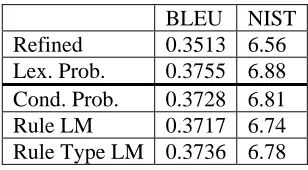
In Table 6, we can see the effect of adding these LMs as additional features to the system and run-ning MER trairun-ning.
BLEU NIST
Refined 0.3513 6.56
Lex. Prob. 0.3755 6.88 Cond. Prob. 0.3728 6.81 Rule LM 0.3717 6.74 Rule Type LM 0.3736 6.78
Table 6: BLEU scores when rescoring the n-best list with different rule probability features (as well as the n-gram LM).
5
MER Training
Like in SMT systems, in the Xfer engine transla-tions are ranked to their total cost, which is a weighted linear combination of the individual costs. When adding more features to the translation system, a careful balancing of the individual con-tributions can make a significant difference. How-ever, with each feature added, manually tuning the system becomes less and less practical, and auto-matic optimization becomes necessary.
Different optimization techniques are available, like the Simplex algorithm or the special Minimum Error Training as described in (Och 2003). In Minimum Error Rate (MER) training, the n-best list generated by the translation system is used to find feature weight, thereby re-ranking the n-best list. This improves the match between the 1-best
translation and given reference translations. Opti-mization can use any metric as objective function. Typically, systems are tuned towards high BLEU or high NIST scores, more recently also towards METEOR or TER (Snover et al. 2006).
We used a MER training module (Venugopal), originally developed for an SMT system, to run MER training on the n-best lists generated by the Xfer system. This implementation allows for opti-mization towards BLEU and NIST mteval metrics.
5.1 Results
In Table 7, we summarize some of the results from different n-best list rescoring experiments. Using only the Xfer engine, without language model, gives a very low score, as the selection is based only on the fragmentation score.
Adding the n-gram language model gives a huge improvement. Adding additional features leads to more then 2 BLEU points improvement. However, there is not much difference when using different feature combinations. It seems that the rather small size of the n-best list is a limiting factor.
When setting the optimal weights in the Xfer engine for the LM and fragmentation penalty scores obtained from MER training, both the base-line and the refined system get higher scores, not only according to BLEU, which was used as the objective function, but also according to METEOR and NIST automatic evaluation metrics (Table 8).
System + Statistical Components 1-best
Rule Based Xfer 0.2559
+ Stat. Comp. Xfer + LM + Frag 0.3513
POS LM 0.3180
Rule Probabilities (Prob.) 0.2593
LM + Rule Type LM 0.3736
LM + Frag/Len + Rule Type LM 0.3737
LM + POS + Rule LM 0.3744
LM + Frag + Rule Type LM + Cond. Rule Prob. 0.3743 LM + Len + Rule Type LM + Cond. Rule Prob. 0.3745 LM + POS + Rule LM + Cond. Rule Prob. 0.3741 LM + Frag + Len + Rule Type LM + Rule Prob. 0.3746 Optimizing
weights with MER training
LM + Frag + Len + POS + Rule LM + Rule Prob. 0.3741
Moreover, the difference between the Baseline and the Refined system after MER training is sta-tistically significant2, whereas this was not the case for the initial ranking results (Table 4).
Table 8: Automatic metric scores for 1-best de-coder hypothesis, after LM and Fragmentation weights have been optimized.
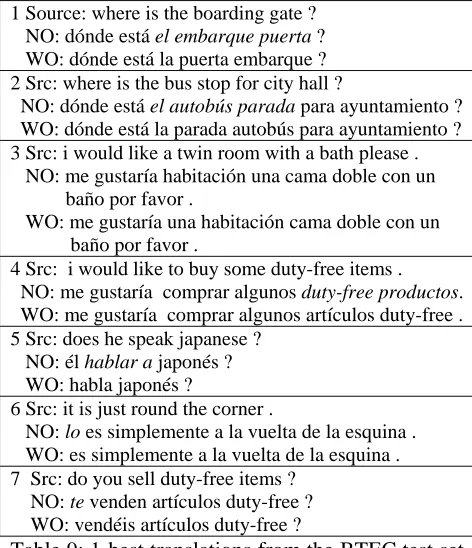
Table 9 shows a few examples from the BTEC cor-pus with 1-best translations output by the Refined MT system before (No Optimization) and after (With Optimization) MER training, given LM and Fragmentation penalty scores. From these exam-ples, it can be observed that re-ranking improves after optimizing the LM and fragmentation weights. In particular, order issues get resolved (examples 1, 2 and 4), which result in correct de-terminer agreement (1 and 2); dede-terminer insertion (3); correct verb form (5 and 7) and omission of incorrect pronouns (6 and 7).
6
Conclusion
Starting from a Transfer-Based translation system, we explored techniques currently used in statistical translation systems to rapidly adapt to a new do-main and to improve its performance. Using word and phrase alignment techniques allowed us to quickly augment the transfer lexicon. Adding a statistical language model is crucial in selecting good translations from the n-best lists generated by the Xfer engine. Adding additional features, such as word-to-word probabilities and rule (type) prob-abilities, further improves performance.
While this information would ideally be used in the parsing and transfer steps of the translation sys-tem, our initial experiments were targeted at using this in an n-best list rescoring setup. As rule prob-abilities were estimated from noisy training data, these models are far from optimal.
To facilitate the experiments with the Xfer sys-tem, especially when adding more and more fea-tures, we added a Minimum Error Rate training
2
According to the standard paired two-tailed t-Test, the de-coder METEOR scores with optimized weights are statisti-cally significant, with a p value of 0.0051.
component. Having such a component will defi-nitely boost the development of the Xfer engine.
We see statistically significant improvements over the baseline system when using optimized weights for the word-level language model and the fragmentation score.
System METEOR BLEU NIST Baseline
0.6184
0.3609
6.68
Refined
0.6231
0.3780
6.79
1 Source: where is the boarding gate ?NO: dónde está el embarque puerta ? WO: dónde está la puerta embarque ? 2 Src: where is the bus stop for city hall ?
NO: dónde está el autobús parada para ayuntamiento ? WO: dónde está la parada autobús para ayuntamiento ? 3 Src: i would like a twin room with a bath please . NO: me gustaría habitación una cama doble con un baño por favor .
WO: me gustaría una habitación cama doble con un baño por favor .
4 Src: i would like to buy some duty-free items . NO: me gustaría comprar algunos duty-free productos. WO: me gustaría comprar algunos artículos duty-free . 5 Src: does he speak japanese ?
NO: él hablar a japonés ? WO: habla japonés ?
6 Src: it is just round the corner .
NO: lo es simplemente a la vuelta de la esquina . WO: es simplemente a la vuelta de la esquina . 7 Src: do you sell duty-free items ?
NO: te venden artículos duty-free ? WO: vendéis artículos duty-free ?
Table 9: 1-best translations from the BTEC test set output by the Refined MT system before and after MER training. NO stands for No Optimization of LM and Fragmentation weights, and WO stands for With Optimization of weights.
7
Future Work
Using rule probabilities has shown to be a promis-ing extension to the current Xfer system. We plan to improve these models by selecting the oracle best translations from the n-best list generated on the training data. This will reduce the noise in the training stage. Ultimately, the rule probabilities should be applied not as an n-best list rescoring step, but directly in the Xfer engine decoder.
chose to only include few alternatives, mainly to limit the manual labor when adding POS and con-straint. We expect that the Xfer system will sig-nificantly benefit from further expanding the lexicon.
References
Allen, J. 1995. Natural Language Understanding.
Sec-ond Edition ed. Benjamin Cummings.
Chiang, D. 2005. A hierarchical phrase-based model
for statistical machine translation. In Proceedings of the 43rd Annual Meeting of the Association for Computational Linguistics (ACL), Ann Arbor, USA.
Doddington G. 2002. Automatic evaluation of machine
translation quality using n-gram co-occurrence sta-tistics. In Proc. of the HLT 2002, San Diego, USA.
Hutchins, W. J., and H. L. Somers. 1992. An
Introduc-tion to Machine TranslaIntroduc-tion. London: Academic Press.
Font Llitjós, A. and W. Ridmann. 2007 The Inner
Works of an Automatic Rule Refiner for Machine Translation. METIS-II Workshop, Leuven, Belgium.
IWSLT 2006: http://www.slt.atr.jp/IWSLT2006/
Lavie, A., K. Sagae and S. Jayaraman. 2004. The
Sig-nificance of Recall in Automatic Metrics for MT Evaluation. AMTA, Washington DC, USA.
Nakamura, S., K. Markov, H. Nakaiwa, G. Kikui, H. Kawai, T. Jitsuhiro, J. Zhang, H. Yamamoto, E.
Sumita, and S. Yamamoto. 2006. The ATR
multilin-gual speech-to-speech translation system. IEEE Trans. on Audio, Speech, and Language Processing, 14, No.2:365–376.
NIST MT Evaluations:
http://www.nist.gov/speech/tests/mt/
Och, F. J. 2003. Minimum error rate training in statisti-cal machine translation. In Proc. of the 41st Annual Meeting of the Association for Computational Lin-guistics (ACL), Sapporo, Japan.
Papineni, K, S. Roukos, T. Ward, and W. Zhu. 2002.
BLEU: a method for automatic evaluation of ma-chine translation. In Proc. of the 40th ACL, Phila-delphia, USA.
Peterson, E. 2002. Adapting a transfer engine for rapid machine translation development. M.S. Thesis, Georgetown University.
Probst, K., Brown, R., Carbonell, J., Lavie, A. Levin,
and L., Peterson, E., 2001. Design and
Implementa-tion of Controlled ElicitaImplementa-tion for Machine
Transla-tion of Low density Languages. Proceedings of the MT2001 workshop at MT Summit, Santiago de Compostela, Spain.
SALM Toolkit:
http://projectile.is.cs.cmu.edu/research/public/tools/s alm/salm.htm
Shimizu T., Y. Ashikari, E. Sumita, H. Kashioka and S.
Nakamura. 2006. Development of client-server
speech translation system on a multi-lingual speech communication platform. IWSLT, Kyoto, Japan.
Snover, M; B. Dorr, R. Schwartz, L. Micciulla, 2006.
Targeted Human Annotation. AMTA, Boston, USA.
Takezawa, T, E. Sumita, F. Sugaya, H. Yamamoto, and
S. Yamamoto, 2002. Toward a Broad-Coverage
Bi-lingual Corpus for Speech Translation of Travel Conversations in the Real World. In Proceedings of 3rd LREC, Las Palmas, Spain.
TC-STAR Evaluations: http://www.tc-star.org/
Venugopal, A.: MER Training Toolkit.
http://www.cs.cmu.edu/~ashishv/mer.html
Wu, D. 1997. Stochastic inversion transduction
gram-mars and bilingual parsing of parallel corpora. Computational Linguistics, 23:377–404.
Yamada, Kenji and Kevin Knight. 2001. A syntax-based
statistical translation model. In Proceedings of the 39th Annual Meeting of the ACL, Toulouse, France.
Zhang, Y and S. Vogel. 2006. Suffix Array and its
Ap-plications in Empirical Natural Language
Process-ing,. Technical Report CMU-LTI-06-010, Pittsburgh
PA, USA.
Zhang, Y, A. S. Hildebrand and S. Vogel. 2006.
Dis-tributed Language Modeling for N-best List Re-ranking. Empirical Methods in Natural Language Processing (EMNLP), Sydney, Australia.
Zollmann A. and A. Venugopal. 2006. Syntax