Structural Integrity of Glass and Basalt in
Thermoplastic Laminates
Dr Hireni R Mankodi1, Harshash Patel2
Associate Professor, Principal Investigator GOJCOST MRP Project, Department of Textile Engineering, The M.S
University of Baroda, Vadodara, India1
M. E Student, Department of Textile Engineering, The M.S University of Baroda, Vadodara, India 2
ABSTRACT: The glass is well known reinforced material for composite. Today the basalt fiber reinforcement, a renewable and natural resource based composite can be produced with good mechanical properties suitable for various engineering applications. Basalt fiber is a possible polymer reinforcing material and can be applied in polymer matrix composites instead of glass fibers in thermoset as well as in thermoplastic matrix composites. The present work is focused on hybridization of different Glass preforms structure with Polypropylene and basalt to study the structural integrity in Laminates.. The objective of this work is to investigate the applicability of different glass structure and basalt fiber combined in Laminates. The laminates have been prepared with different layers, which consist of either same material, different material or different structures. The preforms are consolidated to form thermoplastic laminates using polypropylene non-woven needle punched fabric as a matrix under hydraulic press. The mechanical properties of laminates like strength, flexural rigidity, shear strength and puncture resistance evaluated as per ASTM standards.This study gives the idea about the selection parameters of preforms to improve the quality and performance of laminates.
KEYWORDS: Thermoplastic, Basalt Fiber, Hybrid Structure, Hybridization, Laminates
I. INTRODUCTION
Thermoplastic composites are relatively more flexible compared to thermoset matrix. Due to this impact resistance is improved resulting in increased damage tolerance. Thermoplastic matrix currently that allows the new intermediate modulus, high-strength, high-strain carbon fibers to be used in addition to their fullest potential in composite. Thermoplastics has become the important part of the automotive industry the reason behind this is at the end of the product life the thermoplastic composite can be converted to the pellet size process able material, whereas major thermoset can only be ground and used as a filler material. Also the processing methods are having lower impact on environment than thermosets. [1, 3, 4]
II. CONCEPTOFHYBRIDIZATION
Hybridization is the process of combining different varieties of materials to create a hybrid material. Hybridization is proved to be a promising strategy for the toughening of composite materials. Appropriate combination of two or more fiber types these hybrid composites can offer a better balance in mechanical properties than non-hybrid composites. But their mechanical properties prediction is a challenge due to uneven distribution created between different fibers. The term “Hybrid-composite” is generally used to describe a matrix containing two or more than two types of reinforcements. [5, 7]
To take full advantage of individual fibers and realize an innovative structure with integrated and synthesized structural performances, one feasible way is to hybridize different types of fibers having different mechanical properties, stiffness, modulus, temperature resistance, etc. the damage. Damage tolerance and impact resistance have become key parameters for composite materials in structural applications. The hybridization concept is used for thermoset and thermoplastic but the hybrid materials used in thermoplastic composites are offering two functions.
(1) The hybrid material used with the combination of high performance and thermoplastic material where thermoplastic material will melt during consolidation.
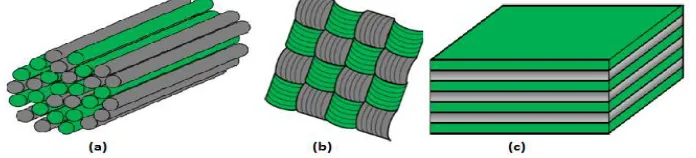
(2) The high performance remains intact during consolidation due to the high temperature resistance improves impregnation and structural integrity. The stages of hybridization and the three main hybrid configurations are as shown in figure 1. [5-10]
Figure 1: Stages of hybridization (a) At yarn stage (b) At fabric stage (c) At laminate stage
(a) HYBRIDIZATION AT YARN STAGE
The hybrid yarn is basically manufactured by two different types of material, where the one fiber gives performance properties and another gives cover. In thermoplastic composite the concept of hybrid yarn use by combining high performance yarns like glass, carbon, basalt, etc. with Polypropylene, polyester, nylon like thermoplastic material where the thermoplastic material will consolidate during the process as shown in figure 1(a).
(b) HYBRIDIZATION AT PREFORM STAGE
The textile fibers/yarns are integrated in single entity by interlacing in fabric as shown in figure 1(b). There are different fabric structures specially developed known as a preform used in composite process as a backbone structure this preforms having a different structures like woven, biaxial, multiaxial, 3D preform, etc. this structures are mainly constructed using single material in thermoset composite but for thermoplastic composite this fabric is constructed using hybrid yarn or combination of hybrid and thermoplastic yarn in new methods. Conventionally used process to manufacture the thermoplastic the preform used are same as what’s used in thermoset. The hybrid preforms are specially designed structure based on the final requirement of the product.
(C) HYBRIDIZATION AT LAMINATE STAGE
been made to study the behaviour of the preforms in thermoplastic laminates and study the structural integrity of Glass/Basalt combination.
The main objective of this project is to study the effect of preform combination on thermoplastic laminates for this laminates were fabricated using different reinforced material combinations. The properties of laminates like thickness, GSM, strength, shear strength, flexural rigidity and puncture resistance has been studied with different reinforced material. Also the behaviour of reinforced material combination with PP Nonwoven needle punched fabric in thermoplastic laminates has been studied. SEM and DSC analysis has been done to study the performance of laminates. The study is mainly highlighting the consolidated method for thermoplastic laminates. The limitation of this study is the sample availability, machine limitation, sample size and preform manufacturing. It is difficult to get tailor made preforms as industries are making the preforms as per there requirements in mass scale. The process need to be standardized when the material parameters are changing. So the standard process is taken to produce laminates.
III.MATERIAL AND METHODOLOGY
The materials used to manufacture thermoplastic laminates were selected based on different preform structures and materials. The preform having glass and basalt with plain weave have been selected initially and then further for further investigation glass biaxial and multiaxial structures to make thermoplastic laminates in all above manufacturing of the laminate polypropylene fiber mat (non-woven fabric) has been taken as matrix material. The Table 1 gives the specification of reinforced material used in laminate. This consolidates during heat pressing. The preform material has been procured under GUJCOST MRP project.
Table1. Specifications of Preforms
Code Specification GSM Thickness (mm)
SGp Glass plain woven fabric 300 0.38
SCp Carbon plain woven fabric 300 0.29
SBp Basalt plain woven fabric 300 0.27
The laminates comprising of different combinations of preforms were produced on the hydraulic press machine as shown in figure 2. The samples of polypropylene non-woven and the reinforced glass and basalt have been stacked as per sequence given in Table 2. Allow the plates to reach the 190 0c temperature and keep it for the decided time, in this the viscous matrix material binds with the reinforcement under 15kg/cm2 pressure. The whole assembly has been kept for curing.
Table 2: Specifications and Coding of Fabrics
Code Specification GSM Thickness
(mm) Laminates with different combination of materials
LG2 3layers of SGp + 2layers of PP 1630 1.34
LB2 3layers of SBp + 2layers of PP` 1450 1.25
LC2 3layers of SCp + 2layers of PP 1110 1.20 Laminates with combinations of Glass/Basalt preforms
LGBG SGp2,90/0 + SBp + SGp2,90/0 1523 1.05
LGBGBG SGp2,90/0+ SBp+SGp2,90/0+ SBp+ SGp2,90/0 2204 1.65
LGBGBGBG SGp2,90/0+ SBp+SGp2,90/0+ SBp+ SGp2,90/0+ SBp +SGp2,90/0 2928 1.89
IV.EXPERIMENTAL RESULTS
The laminate has been prepared using different combination of Glass and basalt reinforcement and PP as a matrix material. The number of layers of reinforcement ranging from two to seven and glass with different structure like plain biaxial and multiaxial has been has been tried. The comparative analysis and effect of different Glass/Basalt combinations are discussed below.
A. PROPERTIES OF LAMINATES WITH DIFFERENT MATERIALS
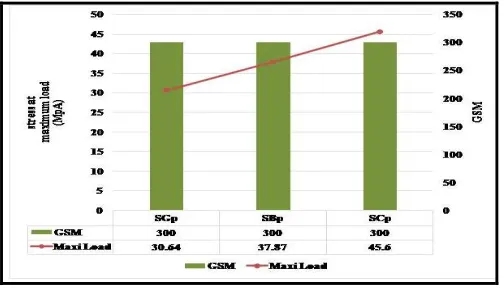
The laminate properties are greatly influenced by the preform properties like thread density, GSM, strength, thickness and structure of preform. The Figure 3 shows that out of all plain structure carbon is having the highest strength with respect to GSM because carbon is having inherent properties of high strength to weight ratio. The same reason rolls out for basalt also.
Figure 3: Properties of Preform From Different Materials
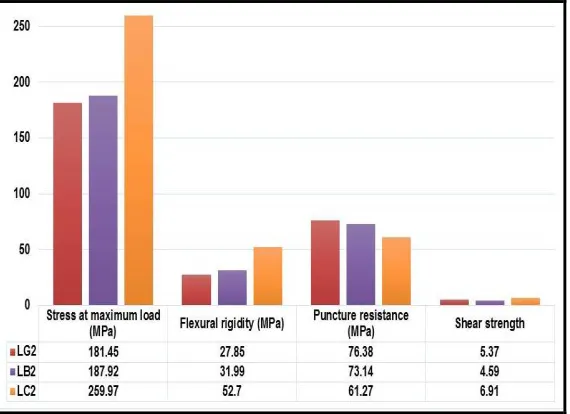
low pp % gives higher strength and puncture resistance. It also improves shear resistance but significantly deteriorates the flexural characteristics of the material the value shows in figure 4 is significantly low compared to three layer laminates.
Figure 4: Properties of laminates from different materials
The figure 4 shows the comparative value of strength, flexural rigidity, puncture resistance and shear. It has been clearly observed that the carbon laminates gives maximum strength due to its inherent property. The flexural rigidity is defined as the resistance offered by a structure while undergoing bending. Higher the value less is the bending. The flexural rigidity of laminates mainly depends on the consolidation of the sample, adhesion between reinforced and matrix material and bending property of preforms (number of layers). The three laminate samples (glass, basalt and carbon) having around 30% resin content due to it shows nearer value of flexural rigidity. The basalt laminate shows lower value compared to glass and carbon that may be due to poor adhesion between basalt and polypropylene or inherent properties of basalt.
Similarly, puncture resistance is a measure of maximum force or energy required to penetrate the material. This is one of the major mechanical properties required as the composite exposed to different types of environment and impact forces. The puncture resistance of the laminates mainly depends on preform structure (unidirectional, bidirectional, multidirectional, etc) and stiffness of the laminates and percentage matrix material which helps in transferring the load. The puncture resistance of the carbon laminates shows the lower value in spite of having higher laminate strength that may be due to less compact preform structure and uneven distribution of matrix material between and within the layer.
B. PROPERTIES OF GLASS/BASALT LAMINATES
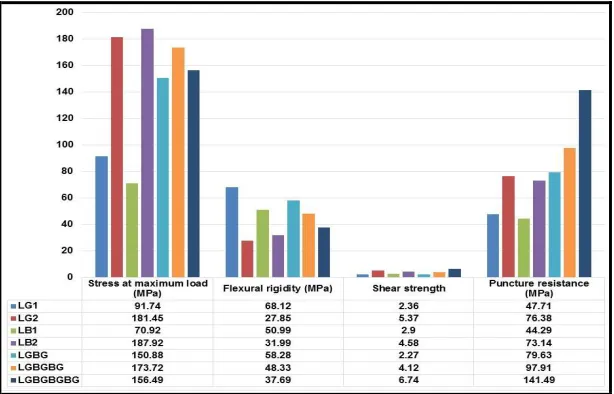
The laminates have been prepared using different combinations of glass and basalt reinforcement and pp as the matrix material. The laminates prepared from glass and basalt the basalt shows higher strength than glass. The glass/basalt combination prepared with 3, 5 and 7 layers.
The 100% basalt shows highest strength compare to Glass and its combination. The flexural rigidity of laminates improves with Glass/Basalt combination compare to 100% glass and basalt laminates. The flexural rigidity of the LGBG
laminate is superior amongst all the combination of different preforms. It has been observed that as the numbers of layers are increased in the combination the flexural rigidity gets decreased due to the subsequent increase in percentage of polypropylene, as polypropylene has elevated flexible property. The same effect has been observed amongst LG1, LG2,
LB1 and LB2 laminates, LG1 and LB1 shows elevated flexural rigidity as it has less number of layers as compared to LG2
and LB2.
Figure 5: Properties of laminates with different combinations.
The shear strength is visibly high as the numbers of layers are increasing. Due to the contribution of seven layers the resultant value of shear increases due to resistance offered by the other layers which are under action and still the bond has not been break. The material breaks only once all layers fails. The puncture resistance is directly proportional to the number of layers in laminates. Hence, as the number of layers increases puncture resistance increases which is clearly indicated in figure 5.
V. CONCLUSION
ACKNOWLEDGMENT
The authors gratefully acknowledge the Member Secretary of Gujarat Council of Science and Technology for providing financial support for this project. Also thanks to weaving and testing lab staff of Textile Engineering Department for helping during sample making and testing
REFERENCES
1. Hireni Mankodi, Pravin Patel, “Study The Effect of Commingling Parameters on Glass / Polypropylene Hybrid Yarns Properties”, Autex Research Journal, Vol. 9, No3, September 2009.
2. Dr Hireni Mankodi, Dr Pravin Patel,“Effect of Nozzle Design and Processing Parameter on Characteristics of Glass/Polypropylene Hybrid Yarns” S.R. Verma Int. Journal of Engineering Research and Applications”, Vol. 4, Issue 12( Part 6), pp.144-149,December 2014,.
3. Hireni Mankodi, Pravin Patel,”New Advance Manufacturing Technique for Textile Based Thermoplastic Composites”, Proceedings of an International Conference ‘Processing and Fabrication of Advanced Materials XIX’, Pp 1153-1161, January 2010.
4. Hireni Mankodi,” Multiaxial Multiply Structures For Textile Composites”, Proceedings of an International Conference, Processing and Fabrication of Advanced Materials XIX’, Pp 1145-1152, January 2010.
5. Hireni Mankodi, Pravin Patel, “Hybrid Yarn for Textile Flexible” composite International Conference Technical Textile: A Innovative Approach, UMIST, Manchester, April 2006.
6. Hireni Mankodi, Pravin Patel,“Hybrid Yarns For Thermoplastic Composites: A scope of Technical Textile Application” World conference (83rd TIWC) on Quality Textile for Quality Life, organized by The Textile Institute and Donghua University, shanghai, China, 23rd-27th May 2004
7. Hireni Mankodi, D J Chudasama, “Effect of Non-Crimp Fabric Structure on Mechanical Properties of Laminates”, 17th International
Conference on Textile Composite Material and Processes, NY, waste publication, June 2015.
8. Ali Hasan Mahmood, Rong Hung Gong,” Use of fabric and Composite made from Airjet Textured core-and-effect glass yarn for improved properties of Textile Composites”, NED University Journal of Research-Structural Mechanics, Vol XI, No 3,2014.
9. V.B.Gupta, “Fiber reinforced composites: Their fabrication, properties and applications”, Indian journal of fiber and textile research, Vol.26, pp. 327-340, September 2001.
10. M.Dutta, “Composite-Future in progress”, Man-Made textile in India, pp.421-422, December 2008.
11. Gururaja M N and A N Hari Rao, “A review on recent applications and future prospectus of hybrid composites”, International journal of soft computing and engineering, Vol-1, Issue-6, pp.352-355, January 2012.
12. J. Stabik, A. Dybowska, M. Chomiak, “Polymer compounds filled with powders as polymer materials”, Journal of achievements in materials and manufacturing engineering, Volume-43, Issue-1, pp.153-161, November 2010.
13. Praveenkumar.A., et.al, “Hybridisation of polymer composites”, International journal of advanced materials science, Research india publications, Volume-3, pp.173-182, November 2012.
14. Diego Pedrazzoli and Alessandro Pegoretti, “Hybridisation of short glass fiber polypropylene composites with nanosilica and graphite nanoplatelets”, Journal of reinforced plastics and composites, Volume-33(18), pp.1682-1695, August 2014.