DOI: 10.1534/genetics.110.118315
Comparative Transcriptome Analysis of the CO
2Sensing Pathway
Via Differential Expression of Carbonic Anhydrase
in
Cryptococcus neoformans
Min Su Kim,*
,1Young-Joon Ko,*
,1Shinae Maeng,* Anna Floyd,
†Joseph Heitman
†and Yong-Sun Bahn*
,2*Department of Biotechnology, Center for Fungal Pathogenesis, Yonsei University, Seoul 120-749, Korea and†Departments of Molecular Genetics and Microbiology, Medicine, and Pharmacology and Cancer Biology, Duke University Medical Center, Durham, North Carolina 27710
Manuscript received April 29, 2010 Accepted for publication May 24, 2010
ABSTRACT
Carbon dioxide (CO2) sensing and metabolism via carbonic anhydrases (CAs) play pivotal roles in survival and proliferation of pathogenic fungi infecting human hosts from natural environments due to the drastic difference in CO2 levels. In Cryptococcus neoformans, which causes fatal fungal meningoen-cephalitis, the Can2 CA plays essential roles during both cellular growth in air and sexual differentiation of the pathogen. However the signaling networks downstream of Can2 are largely unknown. To address this question, the present study employed comparative transcriptome DNA microarray analysis of a C. neoformans strain in which CAN2 expression is artificially controlled by theCTR4 (copper transporter) promoter. The PCTR4TCAN2strain showed growth defects in a CO2-dependent manner whenCAN2was repressed but resumed normal growth when CAN2 was overexpressed. The Can2-dependent genes identified by the transcriptome analysis include FAS1 (fatty acid synthase 1) and GPB1 (G-protein b
subunit), supporting the roles of Can2 in fatty acid biosynthesis and sexual differentiation. Cas3, a capsular structure designer protein, was also discovered to be Can2-dependent and yet was not involved in CO2-mediated capsule induction. Most notably, a majority of Can2-dependent genes were environmental stress-regulated (ESR) genes. Supporting this, the CAN2 overexpression strain was hypersensitive to oxidative and genotoxic stress as well as antifungal drugs, such as polyene and azole drugs, potentially due to defective membrane integrity. Finally, an oxidative stress-responsive Atf1 transcription factor was also found to be Can2-dependent. Atf1 not only plays an important role in diverse stress responses, including thermotolerance and antifungal drug resistance, but also represses melanin and capsule production inC. neoformans. In conclusion, this study provides insights into the comprehensive signaling networks orchestrated by CA/CO2-sensing pathways in pathogenic fungi.
C
ARBON dioxide (CO2) sensing, transport, andmetabolism are critical in survival, proliferation, and differentiation in diverse microbes, including pathogenic fungi (Bahn and Mu¨ hlschlegel 2006). Opportunistic fungal pathogens exposed to ambient air in a natural environmental setting must overcome dramatic changes in CO2levels during infection (150-fold change from 0.036 to 5%). In Candida albicans, which causes superficial and systemic candidiasis in immunocompromised patients, high CO2levels induce the morphological transition from yeast to hypha that is an important virulence attribute contributing to tissue adhesion and invasion of the pathogen (Sims 1986; Mocket al. 1990). Recently it has been reported that
CO2 sensing by C. albicans is mediated by adenylyl cyclase, which produces cAMP, thereby activating protein kinase A (PKA) to trigger filamentous growth (Klengel et al. 2005). Another striking example of fungal CO2-mediated signaling has also been demon-strated in Cryptococcus neoformans, which causes fatal fungal meningoencephalitis in both immunocompe-tent and immunocompromised individuals. High CO2 levels enhance antiphagocytic polysaccharide capsule production during infection (Granger et al. 1985; Vartivarian et al. 1993) and inhibit sexual differen-tiation by blocking cell–cell fusion via repression of pheromone production (Bahnet al. 2005).
During CO2sensing and metabolism, carbonic anhy-drase (CA), a zinc-containing metalloenzyme, is the key enzyme that catalyzes hydration of CO2and produces bicarbonate (HCO3 ) and a proton (H1
). Since the soluble form of CO2, bicarbonate, is likely to be a key intracellular CO2signaling molecule as well as a sub-strate for diverse carboxylating enzymes essential for lipid, amino acid, and pyrimidine synthesis, CAs are Supporting information is available online athttp://www.genetics.org/
cgi/content/full/genetics.110.118315/DC1. 1These authors contributed equally to this work.
2Corresponding author:Department of Biotechnology, Yonsei University, 134 Shinchon-dong, Seodaemun-gu, Seoul 120-749, Korea.
E-mail: [email protected]
considered to play pivotal roles in the metabolic pro-cess. CA is ubiquitously found in all organisms, catalyz-ing diverse cellular processes includcatalyz-ing carbon fixation in plants, and tumor development, respiration, pH and ion homeostasis, and electrical activity in the retinal and nervous systems in mammals (Bahnand Mu¨ hlschlegel 2006). The CA enzyme family can be broadly grouped into four classes:a-CA,b-CA,g-CA, andd-CA (for reviews, see Henry1996; Trippet al. 2001). Thea-CAs are widely distributed in bacteria, plants, and mammals. In humans, 14 a-class CAs have been identified including four membrane-associated (IV, IX, XII, and XIV) and extra-cellularly secreted (VI) CAs. Particularly, CA IV and XIV were found to be extracellular membrane-bound CAs expressed in the lung and brain (Wang et al. 1997; Parkkilaet al. 2001).
b-CAs are found in bacteria, algae, plants, and fungi, but not in mammals (Henry1996; Watsonet al. 2003). Fungal b-CA was first characterized in the nonpatho-genic model yeast, Saccharomyces cerevisiae, called Nce103, and found to be essential for growth in ambient CO2levels (Gotzet al. 1999; Clarket al. 2004; Amoroso et al. 2005). The requirement of Nce103 for growth can be relieved by enriching air with 5% CO2(Amoroso et al. 2005), which appears to result in spontaneous hydration of CO2into bicarbonate. The role of fungal CA in pathogenic fungi has been recently uncovered in C. albicansandC. neoformans(Bahnet al. 2005; Klengel et al. 2005; Mogensenet al. 2006).C. albicanscontains a single functional CA, called Nce103 (Klengel et al. 2005), whereasC. neoformanspossesses two CAs, named Can1 and Can2, although the latter is the major form of CA (Bahnet al. 2005; Mogensenet al. 2006). Disruption of genes encoding Nce103 and Can2 causes growth arrest ofC. albicansandC. neoformans, respectively, under ambient air conditions (Bahnet al. 2005; Klengelet al. 2005; Mogensenet al. 2006). Normal growth of those CA mutants can be restored by incubating them in either high CO2conditions or an animal host (Bahnet al. 2005; Klengelet al. 2005). Interestingly, these studies raised the hypothesis that CAs might be directly or indirectly involved in fungal CO2signaling pathways. InC. albicans, the activity of adenylyl cyclase (AC) to produce cAMP and thus activate the cAMP-signaling pathway is enhanced by bicarbonate (Klengelet al. 2005; Mogensenet al. 2006). InC. neoformans, the mating inhibition by high CO2can be partially reversed by mutation of the CAN2 gene (Bahn et al. 2005). Therefore, fungal CA is not only crucial for cell survival and proliferation, but also mediates various CO2-related signaling cascades that are important for virulence and differentiation of path-ogenic fungi. On the basis of recent analysis of crystal structure of Can2 (Schlickeret al. 2009), Can2 belongs to the ‘‘plant-type’’b-CA and carries a unique N-terminal extension consisting of four antiparallela-helices. The N-terminal extension of Can2 appears to interact with the active site entrance of the dimer (Schlickeret al. 2009).
Although lipid biosynthesis was found to be one of the essential cellular processes affected by mutation of the CA gene (Bahn et al. 2005), downstream genes and signaling networks regulated by CO2and CAs remained to be elucidated.
To elucidate downstream target genes of a signaling network, genome-wide comparative transcriptome anal-ysis by using the wild-type (WT) strain and the corre-sponding mutant strain is normally employed. However, this type of comparative analysis is not appropriate for identifying target genes downstream of Can2 since the can2D deletion mutant exhibits severe growth defects under ambient air conditions, and growth restoration of the can2D mutant by enrichment with high CO2 will bypass the requirement of Can2 by spontaneous hydra-tion of CO2into bicarbonate (HCO3 ). To circumvent this problem, we constructed a C. neoformansstrain in which expression levels of theCAN2gene are artificially controlled by an alternative promoter system. For this purpose, we used the copper-regulatedCTR4promoter system that has been successfully utilized to condition-ally modulate expression levels of genes of interest (Ory et al. 2004; Chayakulkeereeet al. 2007). We employed this strain to elucidate its transcriptome patterns by DNA microarray to identify and characterize genes whose transcript levels are regulated directly or in-directly by Can2 in C. neoformans. This transcriptome analysis discovered a number of CA-dependent genes, including those involved in fatty acid biosynthesis (FAS1), organization of polysaccharide capsule (CAS3), and sexual differentiation (GPB1), although a majority of them do not have any known function. Furthermore, among the Can2-dependent genes, a number of environ-mental stress-response (ESR) genes and the oxidative stress-responsive Atf1 transcription factor were included, suggesting that differential CA expression could be correlated with stress-response regulation inC. neofor-mans. Therefore, this study not only elucidates CA-dependent genes on a genome-wide scale for the first time, but also provides further insights into the signal-ing network of CA/CO2-senssignal-ing pathway in pathogenic fungi.
MATERIALS AND METHODS
Strains and media:The strains used in this study are listed in supporting information, Table S1. All C. neoformans strains were cultured in YPD (yeast extract-peptone-dextrose) me-dium unless indicated separately. L-DOPA or Niger seed medium for melanin production and agar-based Dulbecco’s modified Eagle’s (DME) medium for capsule production were all as described (Grangeret al. 1985; Alspaughet al. 1997;
Bahnet al. 2004; Hickset al. 2004).
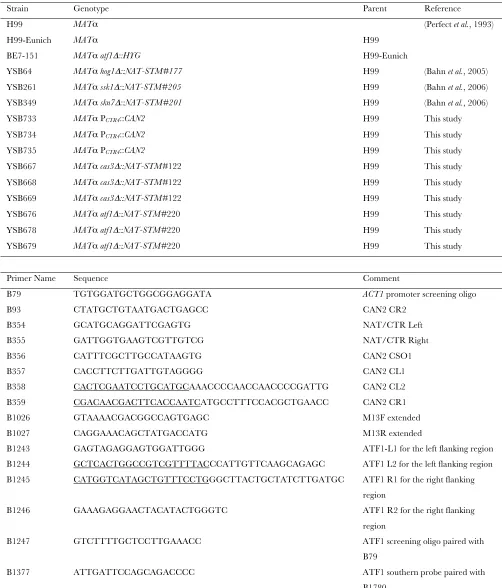
(CAN2gene,11 to11147 region) were PCR amplified with primer pairs B357/B358 and B359/B93, respectively. The underlined sequences of primers B358 and B359 inTable S1 overlap with those of the NAT-CTR4 promoter insert of plasmid pNAT-CTR4-2 (kindly provided by John Perfect, Duke University). The NAT-CTR4 promoter fragment was PCR-amplified with two primers B354 and B355. The CAN2 promoter replacement cassette was generated by overlap PCR with two primers B357 and B93, gel extracted, pre-cipitated onto 600-mg of gold microcarrier beads (0.6 mm, BioRad), and introduced into the serotype AC. neoformans strain H99 strain via biolistic transformation (Davidsonet al.
2002). Stable transformants were selected on YPD medium containing nourseothricin (100 mg/liter). The PCTR4TCAN2 promoter replacement strains were screened by diagnostic PCR and Southern blot analysis using aCAN2-specific probe generated by PCR with primers B359 and B93.
Total RNA isolation: For total RNA isolation used in DNA microarray analyses, the WT H99 and PCTR4TCAN2strains were cultured in 50 ml YPD medium at 30°for 24 hr, washed with sterile PBS buffer twice, and resuspended with sterile water. Then 1 ml of resuspended cells was innoculated into 100 ml of YNB medium (optical density at 600 nm is0.2) and incubated for 12 hr. For zero-time samples, 50 ml out of the 100-ml culture was used. Then 20 ml of the resuspended culture was inoculated into 200 ml of fresh YNB medium containing either 200mm
bathocuproinedisulfonic acid (BCS) for induction ofCAN2or 25mM copper sulfate (CuSO4) for repression of CAN2, and further incubated for up to 36 hr at 30°. During incubation, 50 ml of the culture was sampled after 6, 12, 24, and 36 hr and used for total RNA isolation. As biological replicates for DNA microarray, three independent cultures for each strain and growth condition were prepared for total RNA isolation. Total RNAs were isolated by using TRizol reagent as previously described (Koet al. 2009).
DNA microarray and data analysis:For an experimental set of total RNAs (Cy5 labeling), we used three independent total RNA samples that were isolated from each WT H99 and PCTR4TCAN2strain grown for 12 hr in YNB containing either BCS or CdSO4. For control total RNA (Cy3 labeling), all of the total RNAs prepared from WT and PCTR4TCAN2strains grown in the conditions described above were pooled (pooled reference RNAs). For cDNA synthesis, Cy5/Cy3 labeling, prehybridization, hybridization, and slide washing, we fol-lowed the protocols described previously (Koet al. 2009). For
DNA microarray slides, we utilizedC. neoformansserotype D ( JEC21) 70-mer oligonucleotide microarray slides containing 7936 spots (Duke University). Three independent DNA microarrays with three independent biological replicates were performed.
The DNA microarray slides were scanned with a GenePix 4100A scanner (Axon Instrument) and the scanned images were analyzed with GenePix Pro (ver. 6.0) and gal file (http:// genomeold.wustl.edu/activity/ma/cneoformans/array_spec. cgi). For array data analysis, we used the serotype A gene identification (ID) database that has been mapped to each corresponding 70-mer oligonucleotide sequence printed on the array slides as previously described (Ko et al. 2009). The
JEC21 oligomer chip covers 6302 genes of the total 6980 genes in the H99 strain with ane-value 1e6(90% coverage) by blastn
search. EachS. cerevisiaegene name or ID listed inTable S1, Table S2, Table S3, Table S4, andTable S5was identified by blastp search with the serotype A gene sequence, (e-value cutoff: e 6). For hierarchical and statistical analysis, data transported
from GenePix software were analyzed with Acuity software by employing LOWESS normalization, reliable gene filtering (.95% filtering), hierarchical clustering, zero transformation, ANOVA analysis (P,0.05), and Excel software (Microsoft).
Construction of the cas3Dand atf1Dmutant strains:The gene disruption cassettes for theCAS3andATF1genes were constructed by double joint PCR with NATsplit marker or overlap PCR by using primers listed inTable S1as previously described (Davidson et al. 2002; Kim et al. 2009). For
amplification of NAT marker, plasmid pNATSTM#220 for ATF1 and pNATSTM#122 forCAS3 were used as templates (Table S1). Purified gene disruption cassettes were introduced into the H99 strain by biolistic transformation. Each mutant was screened and confirmed by both diagnostic PCR and by Southern blot analysis.
Northern hybridization: Northern blot analysis was per-formed with 10mg of total RNA from each strain that was used for DNA microarray analysis. Electrophoresis, probe prepara-tion and radiolabeling, hybridizaprepara-tion, and development were carried out by following the standard protocols previously described (Ausubelet al. 1994; Koet al. 2009).
Growth and stress-response assay:For quantitative growth assays, the WT H99 and PCTR4TCAN2(YSB734) strains were cultured overnight at 30°in liquid YPD medium, inoculated into YNB liquid medium containing 200mmBCS and 25mm
CuSO4, and further incubated at 30°for 6, 12, and 24 hr. After the indicated time of incubation, a portion of the cultures was sampled, serially diluted, spread onto duplicate YPD agar plates, and incubated at 30°. After 2 days, colony-forming units (CFUs) per each plate were determined. Stress and antifungal drug sensitivity tests were performed as previously described (Koet al. 2009; Maenget al. 2010).
Capsule and melanin assays:Qualitative visualization and quantitative measurement of capsule and melanin production was performed as described previously (Bahnet al. 2004). For
additional quantitative measurement of capsule size, packed cell volume was also measured by using hematocrit capillary tubes. Briefly, cells grown on DME medium for 2 days were scraped, washed with PBS buffer to remove released poly-saccharide, and fixed with 10% formalin. Cell concentration was determined by using hemocytometer and adjusted to 13 109 cells/ml with PBS buffer. Forty microliters of the cell
suspension was loaded into microhematocrit capillary tubes (Hirschmann Labogera¨te, no. 9100275), of which tips were sealed with clay and parafilm to prevent evaporation of medium during incubation. The capillary tubes were placed vertically overnight at room temperature to allow cell packing by gravity. The packed volume of cells was measured by ratio length of packed cell volume phase/length of total volume phase. Two or three independent experiments were per-formed in triplicate. Statistical difference in relative capsule size between strains was determined by Bonferroni’s multiple comparison test by using Prism 4 software (GraphPad).
Microarray data accession number: The microarray data generated by this study was submitted to the Gene Expression Omnibus (GEO) (http://www.ncbi.nlm.nih.gov/geo/) with accession number GSE21192.
RESULTS
Construction of the PCTR4TCAN2 strain for
indepen-dent PCTR4TCAN2 strains were confirmed and em-ployed for further analyses.
We further verified whetherCAN2expression levels in the PCTR4TCAN2strains are modulated by adding ‘‘BCS (a copper chelator) or CuSO4,’’ which activates or represses the CTR4 promoter, respectively. Northern blot analysis showed thatCAN2expression levels in the PCTR4TCAN2strains were strongly induced by addition of BCS and repressed by addition of CuSO4(Figure 1C), indicating that CAN2 expression levels can be modu-lated by controlling copper levels in the growth media. CAN2 expression levels in the PCTR4TCAN2 strains grown in the presence of BCS were even higher than nativeCAN2expression levels in the WT strain grown in the presence of BCS (Figure 1C), suggesting that the CTR4 promoter is stronger than the CAN2 promoter under copper-depleted conditions.
The PCTR4TCAN2 strain exhibited conditional
growth defects in response to copper levels: We addressed whether the growth of PCTR4TCAN2 strains could be controlled under ambient air conditions by changing copper levels in the medium. The PCTR4TCAN2 strains did not show any growth defects in YNB medium containing BCS, which activates the CTR4 promoter, whereas the strains exhibited severe growth defects in YNB medium containing CuSO4, which represses the CTR4 promoter (Figure 2A). A normal growth ability of the PCTR4TCAN2 strains was restored in the presence of high CO2 concentrations (5%) (Figure 2A), further confirming that the growth defects observed in the PCTR4TCAN2strains under the copper-depleted conditions were caused by reduced
expression of CAN2. The growth defect of the
PCTR4TCAN2 strains was also quantitatively measured Figure1.—Construction of the PCTR4TCAN2promoter replacement strain. (A) The strategy for construction of theCAN2
pro-moter replacement allele with theCTR4promoter. The first five exons of theCAN2gene are illustrated as open boxes and an arrow for exon 6 depicts the direction of transcription. Primers for overlap PCR and diagnostic PCR are indicated as bent arrows. The shaded arrow box illustrates aNATselectable marker, which consists ofACT1promoter,NAT(nourseothricin acetyltransfer-ase) gene, andTRP1terminator, and the shaded, striped arrow box illustrates theCTR4promoter as previously described (Ory
et al.2004). (B) Verification of the PCTR4TCAN2strain by Southern hybridization. Each genomic DNA was digested withXbaI and XhoI and blotted membrane was probed withCAN2-specific probe that was PCR amplified with primers B359 and B93. WT in-dicates the H99 strain and lanes 1 to 4 indicate the independently isolated PCTR4TCAN2 strains (YSB733, YSB734, YSB735, and YSB736, respectively). (C) Northern hybridization of the controlledCAN2 expression by the CTR4 promoter. The WT H99 strain and the PCTR4TCAN2strain (YSB734) were grown overnight at 30°in liquid YPD medium and subcultured into a fresh YNB liquid medium containing 200mmBCS (1BCS) and 25mmCuSO4 (1Cu). After a 12 hr-incubation, a portion of cultures was
in liquid YNB medium containing either BCS or CuSO4 at different time points. In agreement with results described above, the PCTR4TCAN2strains also showed growth defects in the liquid YNB medium containing CuSO4, but not BCS (Figure 2B). Taken together, our results demonstrate that CAN2 expression is tightly controlled by the replaced CTR4 promoter, which enables the precise control of C. neoformans growth under ambient air conditions, depending on copper levels in the culture medium.
Identification of Can2-dependent genes by compar-ative transcriptome analysis of the PCTR4TCAN2
strain and the wild-type C. neoformans: To identify CA-regulated genes, we performed genome-wide compara-tive transcriptome analysis of the WT and PCTR4TCAN2 strains grown in the presence of BCS or CuSO4by using
DNA microarrays as described in materials and
methods.
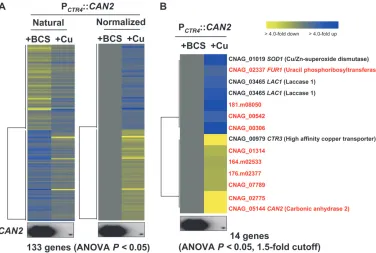
First we compared genome-wide expression profiles of the PCTR4TCAN2 strains under copper-depleted conditions (1BCS), which showed normal growth patterns with induced CAN2 expression, with those under copper-enriched conditions (1Cu), which showed retarded growth patterns with repressedCAN2 expression. A total of 133 genes (120 genes with serotype A gene ID) exhibited significantly different expression levels (ANOVA, P , 0.05) (Figure 3A). Among these, 9 genes were differentially regulated in the WT strain between BCS and CuSO4-containing media, indicating that these genes are copper-dependent genes. These genes include theSOD1,LAC1, andCTR3 genes. The CTR3 gene that encodes a copper trans-porter was most downregulated, mainly due to the increased copper concentrations in the growth me-dium. TheSOD1andLAC1genes are also known to be induced by copper (Culotta et al. 1995; Jiang et al. 2009). Therefore, a total of 123 genes appeared to be
CAN2-dependent genes. Among these, only 10 genes exhibited.1.5-fold induction or reduction whenCAN2 is repressed. As expected, theCAN2gene was the most highly repressed gene (Figure 3B), further verifying the quality of our microarray results. Upregulation of the FUR1gene, encoding uracil phosphoribosyltransferase, upon repression of theCAN2gene is notable. Previously we have hypothesized that the can2 mutation inhibits cellular growth by affecting a variety of decarboxylating enzymes that use bicarbonate as a substrate and are required for biosynthesis of lipid, amino acids, and pyrimidines (Bahnet al. 2005). Therefore, it is conceiv-able that reduced pyrimidine biosynthesis by CAN2 repression allows cells to induce theFUR1gene, which is one of the genes in the pyrimidine salvage pathway.
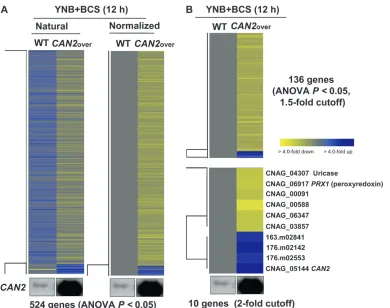
CAN2 expression levels induced by the CTR4 pro-moter were higher than those by the CAN2 native promoter in the presence of BCS (Figure 1C). There-fore, we compared transcriptome profiles of the WT and CAN2-promoter replacement strains in the presence of BCS. A greater number of genes (524 genes) were significantly and differentially regulated (ANOVA,P, 0.05) (Figure 4A). Among these, a total of 136 genes (128 genes with serotype A ID) showed .1.5-fold induction or reduction and only 10 genes showed more than twofold regulation (Figure 4B). Except theCAN2 gene, only two genes, CNAG_04307.2 (uricase, named URI1) and CNAG_06917.2 (peroxiredoxin, named PRX1), have predicted functions based on sequence homology (Figure 4C). Regulation of the uricase gene appears to be related to CA and CO2 metabolism. Uricase catalyzes the oxidation of uric acid to 5-hydroxyisourate, which can interact with H2O2to pro-duce allantoin and carbon dioxide.
On the basis of these array results, we further defined a true Can2-dependent gene based on the following criteria. First a Can2-dependent gene should be identi-Figure2.—Growth of the PCTR4TCAN2 strain is tightly controlled by copper levels in a CO2-dependent manner. (A) The wild-type H99 and PCTR4TCAN2 (YSB734) strains were grown overnight at 30°in liq-uid YPD medium, 10-fold serially diluted (1–104dilutions), and spotted (3ml of
di-lution) on YNB agar containing 200 mm
BCS and 25 mmCuSO
4. Cells were incu-bated at 30°for 24 hr under either normal air or high CO2conditions (5%) and pho-tographed. (B) Quantitative growth assay of the PCTR4TCAN2 strain. The wild-type H99 and PCTR4TCAN2 (YSB734) strains were grown overnight at 30° in liquid YPD medium and inoculated into YNB liq-uid medium containing 200mmBCS and
25 mm CuSO4. Cells were incubated at
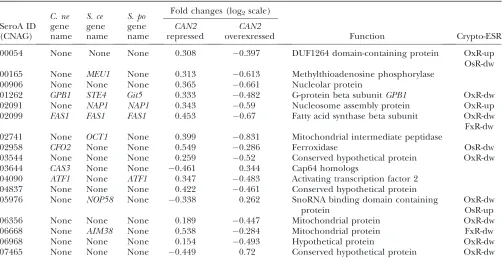
fied from both array data sets with statistical significance (ANOVA,P,0.05). Second, the Can2-dependent gene should exhibit opposite expression patterns in each data set. Following these criteria, we have selected 17 Can2-dependent genes except CAN2 itself (Table 1). These includeMEU1,GPB1,NAP1,FAS1,CFO2,CAS3, andATF1; a majority of these (9 of 17 genes) do not have orthologs in other fungi. TheFAS1gene encodes fatty acid synthase and has been reported to be essential for survival ofC. neoformans(Chayakulkeereeet al. 2007). The MEU1 gene encodes methylthioadenosine phos-phorylase, which is the initial enzyme catalyzing the methionine salvage pathway (Subhi et al. 2003). The GPB1gene encodes the Gb-subunit in the pheromone response MAPK pathway and positively controls sexual differentiation of C. neoformans (Wang et al. 2000). These data further confirm that the CO2-sensing car-bonic anhydrase signaling pathway is closely connected to the fatty acid and amino acid biosynthetic pathways and sexual differentiation ofC. neoformansas previously proposed (Bahnet al. 2005).
The role of Cas3 in capsule production of C. neoformans:CAS3is one of a few genes whose expression is positively regulated byCAN2 overexpression in our array analysis (Table 1). Although it is homologous to Cap64, which is required for capsule production, Cas3 is not directly involved in capsule formation but instead is required for O-acetylation of the capsule in C. neofor-mans(Moyrandet al. 2004). However it is still possible that Cas3 is indirectly involved in capsule production through regulation of other capsule genes as the authors speculated (Moyrand et al. 2004). Here we tested the possibility that Cas3 might be involved in
CO2-mediated capsule induction since it has been previously reported that capsule production of C. neoformans is increased by high CO2concentrations (Grangeret al. 1985; Vartivarianet al. 1993).
To address this hypothesis, we generated two in-dependent cas3D mutants and tested their ability to produce capsule in either ambient air or high CO2 concentrations (Figure S1). Based on quantitative measurements of capsule production, the WT strain exhibited greatly enhanced capsule production in the presence of high CO2(5%) conditions (Figure 5A). In contrast, thecac1Dmutant that is highly defective in capsule production under ambient air did not show any enhanced levels of capsule in response to high CO2 concentrations (Figure 5A), indicating that CO2-mediated capsule induction is required for activation of adenylyl cyclase, which has been proposed before (Bahn and Mu¨ hlschlegel 2006). The two indepen-dent cas3D mutants exhibited WT levels of capsule under ambient air conditions (Figure 5A), as pre-viously reported (Moyrand et al. 2004). In response to high CO2 concentration, the cas3D mutants also showed enhanced capsule production like the WT H99 strain (Figure 5A), indicating that Cas3 is not required for CO2-mediated capsule induction.
We also tested whether overexpression of CAN2 may enhance capsule production by growing the
PCTR4TCAN2 strains in DME 1 BCS medium. We
hypothesized that increased production of intracellular bicarbonate by CAN2 overexpression might activate adenylyl cyclase, resulting in enhanced capsule induc-tion. Unexpectedly, however, the PCTR4TCAN2 strains exhibited WT levels of capsule in DME1BCS medium Figure 3.—Genes
regu-lated by differentialCAN2 expression in the PCTR4T CAN2strain. (A) The hier-archical clustering analys-is of 133 genes, which exhibited significantly dif-ferent expression patterns (ANOVA test,P,0.05) by comparing the transcrip-tome of the PCTR4TCAN2 strain grown in YNB con-taining 200mmBCS (1BCS,
CAN2 overexpression) or 25mmCuSO4(1Cu,CAN2
under either ambient air or high CO2 conditions (Figure 5B). In conclusion,CAN2overexpression does not enhance capsule induction in C. neoformans, al-though adenylyl cyclase is required for CO2-mediated capsule induction.
ESR genes are regulated by Can2:A recent genome-wide transcriptome analysis of the stress-activated HOG pathway uncovered a number of ESR genes, whose expression is affected by osmotic shock, antifungal drug, or oxidative stress in C. neoformans (Ko et al. 2009). Interestingly, a majority of the Can2-dependent genes (11 of 17 genes) were found to be ESR genes ofC. neoformans (Table 1). This finding suggests thatCAN2 overexpression can be sensed as stress because in-creased levels of bicarbonate and protons may change normal cellular physiological conditions. To test this hypothesis, we performed diverse stress sensitivity tests with the PCTR4TCAN2 strains grown on YNB 1 BCS medium (Figure 6). The PCTR4TCAN2strains exhibited hypersensitivity to several stress-inducing agents, in-cluding H2O2, CdSO4, and methylmethane sulfonate (MMS) compared to the WT strain. This indicates that CAN2overexpression render cells hypersensitive to oxi-dative and genotoxic stress. However, the PCTR4TCAN2 strains were as sensitive to hydroxyurea (HU), which is another genotoxic stress agent, as the WT strain.
The PCTR4TCAN2 strains exhibited extreme sensitiv-ity to amphotericin B as well as azole drugs, such as fluconazole, ketoconazole, and itraconazole (Figure 6).
These indicate that increased antifungal drug susceptibil-ity of the PCTR4TCAN2strains appears to be independent of the ergosterol biosynthesis because the phenotypes of the PCTR4TCAN2strains were distinct from those ofhog1D mutants that are defective in ergosterol biosynthesis (Figure 6). Instead, hypersensitivity of the PCTR4TCAN2 strain to antifungal drugs may result from its defective membrane integrity because the PCTR4TCAN2 strains exhibited increased sensitivity to SDS. Taken together, CAN2 overexpression alters normal cellular physiology, which results in defective responses to diverse environ-mental stresses and antifungal drugs.
The role of the transcription factor Atf1 regulated by Can2: Among the Can2-dependent genes, the one encoding the transcription factor Atf1 was notable, although it does not belong to ESR genes (Table 1). Northern blot analysis confirmed that ATF1expression was slightly upregulated when CAN2 is repressed, but slightly downregulated when CAN2 is overexpressed (Figure S2), similar to the microarray results. Atf1 is a major transcription factor activated by the stress-activated Sty1 (a Hog1 MAPK homolog) MAPK in Schizosacchar-omyces pombe (Shiozaki and Russell 1996; Wilkinson et al. 1996; Degolsand Russell1997). InC. neoformans, the thioredoxin system is controlled by Atf1, indicating that Atf1 is involved in oxidative stress response (Missall and Lodge 2005). However, the function of Atf1 in diverse stress responses and its relationship with the HOG pathway in C. neoformans still remains unknown. Figure 4.—Genes
regu-lated byCAN2 overexpres-sion. (A) The hierarchical clustering analysis of 524 genes, which exhibited sig-nificantly different expres-sion patterns (ANOVA test,P, 0.05) by compar-ing the transcriptomes of the wild-type H99 (WT) and PCTR4TCAN2 strains ‘‘CAN2over’’ grown in YNB containing 200mmBCS
Therefore, we independently constructed the atf1D mutant strain in the WT H99 strain that retains full virulence (Figure S3) and tested various stress sensitivities and virulence factor production compared with the mutants of the stress-activated HOG pathway and other stress-related signaling pathways such as the Ras and cAMP pathways. As control strains, we used the atf1D mutant (here designated asatf1DE), which was previously constructed in the H99-Eunuch strain background (H99E) (Missalland Lodge2005).
The two independently generated atf1D mutants exhibited the expected hypersensitivity totert-butyl hy-droperoxide (tBOOH) similar to the atfDE mutant (Figure 7) as previously reported (Missalland Lodge 2005). Theatf1Dmutants also exhibited hypersensitivity to H2O2, but hyperresistance to diamide (Figure 7). Furthermore, theatf1Dmutant showed increased sensi-tivity to high temperature (40°) and the toxin methyl-glyoxal (Figure 7). These stress-response phenotypes of the atf1D mutant are similar to those of the hog1D mutant. In contrast, theatf1Dmutant did not show any increased sensitivity to osmotic shock, cell wall/mem-brane-destabilizing agents such as SDS, and genotoxic agents, such as hydroxyurea and methylmethane sulfo-nate (Figure 7 andFigure S4). As previously described (Koet al. 2009), thehog1Dandssk1Dmutants were more sensitive to osmotic shock under carbon-starvation con-ditions and the presence of hydroxyurea. Furthermore,
the atf1D mutant exhibited rather unique antifungal drug resistance patterns, which were also distinguished from those of the hog1D, ras1D, and cac1D mutants (Figure 7). As previously reported, the hog1D mutant exhibited hypersensitivity to amphotericin B, but in-creased resistance to fluconazole and fludioxonil (Figure 7). However, the atf1D mutant exhibited increased resistance to both amphotericin B and fluconazole, but showed slightly enhanced sensitivity to fludioxonil (Fig-ure 7). Notably, the atf1D mutant was much more sensitive to flucytosine treatment than the WT strain. Similarly, theras1Dmutant also exhibited hypersensitiv-ity to flucytosine. In contrast, thehog1D, but notcac1D, mutant exhibited only slightly increased sensitivity to flucytosine (Figure 7). The stress and antifungal drug response phenotypes of theatf1DE mutant in the H99E background were generally identical to those of theatf1D mutants in the WT H99 background, although we have found several phenotypic differences between H99 and H99E strains (Figure 7). Since the H99E strain was more thermosensitive than the H99 strain, thermosensitivity of theatf1DE strain was not observed (Figure 7).
The atf1D mutant exhibited increased melanin and capsule production (Figure 8), which is similar to the hog1D mutant. In capsule production, both atf1D and atf1DE mutants exhibited higher levels of capsule than the H99 and H99E strains, respectively (Figure 8A). Similarly, melanin production was more enhanced in TABLE 1
Can2-dependent genes inC. neoformans
SeroA ID (CNAG) C. ne gene name S. ce gene name S. po gene name
Fold changes (log2scale)
Function Crypto-ESR
CAN2 repressed
CAN2 overexressed
00054 None None None 0.308 0.397 DUF1264 domain-containing protein OxR-up
OsR-dw 00165 None MEU1 None 0.313 0.613 Methylthioadenosine phosphorylase
00906 None None None 0.365 0.661 Nucleolar protein
01262 GPB1 STE4 Git5 0.333 0.482 G-protein beta subunitGPB1 OxR-dw
02091 None NAP1 NAP1 0.343 0.59 Nucleosome assembly protein OxR-up
02099 FAS1 FAS1 FAS1 0.453 0.67 Fatty acid synthase beta subunit OxR-dw
FxR-dw 02741 None OCT1 None 0.399 0.831 Mitochondrial intermediate peptidase
02958 CFO2 None None 0.549 0.286 Ferroxidase OsR-dw
03544 None None None 0.259 0.52 Conserved hypothetical protein OxR-dw
03644 CAS3 None None 0.461 0.344 Cap64 homologs
04090 ATF1 None ATF1 0.347 0.483 Activating transcription factor 2 04837 None None None 0.422 0.461 Conserved hypothetical protein 05976 None NOP58 None 0.338 0.262 SnoRNA binding domain containing
protein
OxR-dw OsR-up
06356 None None None 0.189 0.447 Mitochondrial protein OxR-dw
06668 None AIM38 None 0.538 0.284 Mitochondrial protein FxR-dw
06968 None None None 0.154 0.493 Hypothetical protein OxR-dw
07465 None None None 0.449 0.72 Conserved hypothetical protein OxR-dw
bothatf1Dandaft1DE mutants than the H99 and H99E strains, respectively (Figure 8B). Interestingly, the H99E strain was found to be highly defective in melanin production, which is similar to thecac1D mutant, com-pared to the H99 strain (Figure 8B). In both Nigher seed and L-DOPA media, theatf1Dmutant exhibited increased melanin production (Figure 8B). Taken together, Atf1 appears to play important roles in response to environ-mental stress and antifungal drug treatment and pro-duction of melanin and capsule in a manner that is shared with and distinct from the HOG pathway inC. neoformans.
DISCUSSION
In this study, we aimed to elucidate the genes regulated by CA, which is essential for growth and differentiation ofC. neoformans, on a genome-wide scale. To achieve this goal, we constructed the conditional CAN2 expression mutant in which the native CAN2
promoter is replaced with theCTR4promoter, which is controlled by the copper levels in the growth medium (Ory et al. 2004). The PCTR4TCAN2 strain exhibited growth defects when CAN2 expression is repressed by addition of CuSO4, but grew normally when theCAN2 gene is overexpressed by addition of BCS. Expectedly, the growth defect was restored to normal by addition of high CO2. As an additional benefit from this study, we could monitor CAN2 overexpression phenotypes in media containing BCS becauseCAN2expression levels induced by theCTR4promoter were much higher than the nativeCAN2expression levels.
Through the comparative transcriptome analysis by DNA microarray with the PCTR4TCAN2strain, we found several Can2-dependent genes inC. neoformans, which have not been reported before. To the best of our knowledge, this is the first genome-wide transcriptome analysis to discover the target genes directly or in-directly regulated by carbonic anhydrase in the CO2-sensing and metabolic pathway. The majority of Can2-dependent genes appeared to be uniquely found in C. neoformans. However, the list of Can2-dependent genes that have predicted functions based on sequence homology, including FUR1, URI1, PRX1, FAS1, GPB1, CAS3, CFO1, ATF1, MEU1, NAP1, OCT1, NOP58, and AIM38, provided insight into the downstream signaling network modulated by CO2and CA inC. neoformans.
TheFAS1(fatty acid synthase 1) gene was upregulated whenCAN2is repressed, but downregulated whenCAN2 is overexpressed. This result may explain how fatty acid biosynthesis is regulated by CA. Previously we have shown that the growth defect of thecan2Dmutant can be partially restored to normal by exogenous addition of fatty acid, such as palmitate and myristate, indicating the role of Can2 in fatty acid biosythesis (Bahn et al. 2005). Therefore expression of the FAS1gene may be controlled as a compensatory mechanism for different CA activity and intracellular bicarbonate levels. Both Fas1 and Fas2 are known to be required for fatty acid biosynthesis and essential for growth of C. neoformans (Chayakulkeereeet al. 2007).
Differential expression ofGPB1, a Gb-subunit of the pheromone-responsive Cpk1 MAPK pathway, also helps us to understand the role of Can2 in sexual differenti-ation of C. neoformans. Can2 is involved in both initial and terminal stages of sexual cycles ofC. neoformansin negative and positive manners, respectively (Bahnet al. 2005). Our array data showing that basal expression levels of GPB1 is induced when CAN2 is repressed indicate that the Gpb1-mediated Cpk1 MAPK pathway can be controlled by Can2.
In C. neoformans, high CO2 enhances capsule pro-duction (Grangeret al. 1985; Vartivarianet al. 1993). Originally we hypothesized that Can2-mediated CAS3 induction may be responsible for enhancement of capsule production by high CO2 concentration. Cas3 has been identified as one of a seven-member family of Figure5.—The role of Cas3 and Can2 in CO2-mediated
capsule induction. Capsule synthesis levels of the following C. neoformansstrains were quantitatively measured by using hematocrit as described inmaterials and methods. The
Y-axis indicates the relative capsule volume, which is percent ratio of length of packed cell volume phase vs. length of total loading volume phase. (A)C. neoformans strains [the wild-type H99 andcac1D(YSB42) and cas3D (YSB667 and YSB668) mutant strains] were grown in DME medium under either ambient air ( CO2) or high CO2(5%,1CO2) condi-tions for capsule induction. (B)C. neoformans strains [the wild-type H99 and cac1D (YSB42) and PCTR4TCAN2 (YSB734) mutant strains] were grown in DME medium con-taining 200mm BCS under either ambient air ( CO2) or
capsular structure designer proteins, although it is not directly involved in capsule formation but instead required for O-acetylation of the capsule in C. neofor-mans(Moyrandet al. 2004). Our data showed that Cas3 is not required for CO2-mediated capsule induction. Mogensen and co-workers demonstrated that bicarbon-ate directly activbicarbon-ates Cac1 adenylyl cyclasein vitro, which is the key component of the cAMP-signaling pathway, which plays a major role in capsule biosynthesis (Mogensenet al. 2006). Supporting this, we also found that CO2-mediated capsule induction requires func-tional adenylyl cyclasein vivo. However, we have found that CAN2 overexpression did not enhance capsule production in either ambient air or high CO2 condi-tions. Therefore, it still remains elusive whether in-creased bicarbonate or activated Can2 directly activates adenylyl cyclase for capsule inductionin vivo. It is also possible that unnatural CAN2 overexpression by the CTR4promoter may affect other factors that counteract normal capsule induction.
One of the interesting findings of our array analysis is that a majority of Can2-dependent genes were ESR genes, whose expression is differentially regulated in response to environmental stresses, such as osmotic shock and oxidative stresses (Koet al. 2009). The reason for regulation of the ESR genes by theCAN2gene is not clear. Differential expression of the CAN2 gene will change intracellular levels of bicarbonate and proton, which affect intracellular pH and osmotic balance. xThese intracellular physiological changes can be
sensed as stress, which may trigger cells to induce or repress ESR genes to counterbalance the stress. Sup-porting this, the CAN2 overexpression strain was hypersensitive to oxidative stress (H2O2) and geno-toxic stress (MMS).
Related to this finding, the transcription factor Atf1 was found to be differentially regulated by Can2. Atf1 is orthologous toS. pombeAtf1, which is a key downstream transcription factor of the stress-activated Sty1 MAPK (Shiozakiand Russell1996; Wilkinsonet al. 1996; Degols and Russell 1997). Although Missall and Lodge previously reported that Atf1 is involved in regulation of the thioredoxin system during oxidative stress response, here we further characterized the role of Atf1 in diverse stress response by using indepen-dently constructedatf1Dmutants in the WT H99 strain background. The atf1D mutants that we generated generally exhibited identical phenotypes compared to theatf1DE mutants that Missall and Lodge generated in the H99E strain background. Minor phenotypic differences appear to result from the strain back-ground difference. At this point, it is not clear whether Atf1 is the transcription factor working downstream of the HOG pathway. Theatf1Dmutant shared some of stress-response phenotypes with thehog1Dmutant and yet exhibited phenotypes distinct from those of the hog1D mutant, including genotoxic stress and mem-brane-destabilizing response and antifungal drug re-sistance. It is possible that Atf1 may be responsible for a subset of HOG-dependent phenotypes. Whether Atf1 Figure 6.—The effect of CAN2 overexpression in stress response. EachC. neoformans strain [the wild-type H99 and ras1D
(YSB53),cac1D(YSB42),hog1D(YSB64), and PCTR4TCAN2(YSB733 and YSB734) mutant strains] was grown overnight at 30°
in liquid YPD medium, washed, 10-fold serially diluted (1–104dilutions), and spotted (3ml of dilution) on YNB agar medium
containing 200 mmBCS and the indicated concentrations of hydrogen peroxide (H2O2), CdSO4, methylmethane sulfonate
is a direct downstream effector for the Hog1 MAPK needs to be further addressed in future study.
Recently, Sheth and co-workers monitored global transcriptional response of C. albicans under 5.5% CO2, which mimics host physiological conditions. In-terestingly, among the 14 genes whose expressions are significantly changed by high CO2, three of them (HSP12,AAH1, andOPT1) are known to be regulated by the HOG pathway (Shethet al. 2008), indicating that CO2 sensing and metabolism could also be related to
the stress-response signaling pathway in C. albicans. Particularly, transcript abundance of HSP12, which encodes a small heat-shock protein involved in protein folding under stress conditions, are lowered by 5.5% CO2in an adenylyl cyclase/cAMP-dependent manner, suggesting thatC. albicansconsiders ambient air having 0.036% CO2 as stress. Supporting this finding, our recent transcriptome analysis of the cAMP-signaling pathway inC. neoformansdemonstrated that twoHSP12
orthologous genes, HSP12 and HSP122, are both
Figure7.—The role of Atf1 in stress response and resistance to antifungal drugs. EachC. neoformansstrain [the wild-type H99
and H99-Eunuch strains andras1D(YSB53),cac1D(YSB42),hog1D(YSB64),atf1D(YSB676 and YSB678), andatf1DE (BE7-151) mutant strains] was grown overnight at 30°in liquid YPD medium, 10-fold serially diluted (1–104dilutions), and spotted (3ml of
regulated by cAMP and HOG pathways in the pathogen (Maenget al. 2010).
The last notable finding of this study is a potential of Can2 and Atf1 as targets for combination antifungal therapy along with commercially known antifungal drugs. First, the CAN2 overexpression strains were extremely sensitive to amphotericin B (AmpB) and azole drugs. Therefore, a molecule(s) that is able to induce activity of Can2 or expression ofCAN2could be used for treatment of cryptococcosis along with AmpB and azole drugs. The synergistic mechanism betweenCAN2 over-expression and AmpB or azole drugs is not clear at this point. It is possible that decreasedFAS1expression in the CAN2overexpression strain may affect cell membrane integrity, which results in increased sensitivity to AmpB, which destroys membrane integrity or increased intra-cellular uptake of the antifungal drugs. Another benefit for the Can2-activating molecule could be decreased stress sensitivity of C. neoformans, which may result in rapid clearance during host infection. Second, theatf1D mutant was much more sensitive to flucytosine than the wild-type strain. Interestingly, theras1Dmutant was also found to be hypsersensitive to flucytosine. These data indicate that an inhibitor of Atf1 or Ras1 in combination with flucytosine could be effective for treatment of cryptococcosis. The reason for this synergism is not understood at this point.
In conclusion, our CA-transcriptome analysis not only discovered a number of Can2-dependent genes in C. neoformans, but also made the finding that perturbed CO2/bicarbonate homeostasis may cause impaired cellular response to diverse environmental stresses. Therefore, modulation of the signaling network of the CA/CO2-sensing pathway may provide a novel thera-peutic method for treatment of pathogenic fungi.
This work was supported by the Pioneer Research Center Program through the National Research Foundation of Korea, funded by the Ministry of Education, Science and Technology (no. 2009-0081512), the National Research Foundation of Korea grant, funded by the Korean government (MEST) (2009-0063344), and Yonsei University Research Fund of 2008 (2008-7-0285) (to Y.S.B). This work was also supported in part by RO1 grant AI50438 and R21 grant AI70230 from the National Institutes of Health/National Institute of Allergy and Infectious Diseases (to J.H.).
LITERATURE CITED
Alspaugh, J. A., J. R. Perfectand J. Heitman, 1997 Cryptococcus neoformansmating and virulence are regulated by the G-protein asubunit GPA1 and cAMP. Genes Dev.11:3206–3217. Amoroso, G., L. Morell-Avrahov, D. Muller, K. Klugand D.
Sultemeyer, 2005 The geneNCE103(YNL036w) from Saccha-romyces cerevisiaeencodes a functional carbonic anhydrase and its transcription is regulated by the concentration of inorganic carbon in the medium. Mol. Microbiol.56:549–558.
Ausubel, F. M., R. Brent, R. E. Kingston, D. D. Moore, J. G. Seidmanet al., 1994 Current Protocols in Molecular Biology.Greene Publishing Associates and John Wiley & Sons, New York, NY
Figure 8.—The role of Atf1 in caspule
and melanin production. (A) Capsule syn-thesis levels of C. neoformans strains [the wild-type H99 and H99-Eunuch strains and cac1D (YSB42), atf1D (YSB676), and atf1DE (BE7-151) mutant strains] were quantitatively measured by using hemato-crit as described inmaterials and meth-ods and Figure 5A. Two independent
Bahn, Y. S., G. M. Cox, J. R. Perfectand J. Heitman, 2005 Carbonic anhydrase and CO2sensing duringCryptococcus neoformansgrowth,
differentiation, and virulence. Curr. Biol.15:2013–2020. Bahn, Y. S., and F. A. Mu¨ hlschlegel, 2006 CO2sensing in fungi
and beyond. Curr. Opin. Microbiol.9:572–578.
Bahn, Y. S., J. K. Hicks, S. S. Giles, G. M. Coxand J. Heitman, 2004 Adenylyl cyclase-associated protein Aca1 regulates virulence and differentiation ofCryptococcus neoformansvia the cy-clic AMP-protein kinase A cascade. Eukaryot. Cell3:1476–1491. Chayakulkeeree, M., T. H. Rude, D. L. Toffaletti and J. R. Perfect, 2007 Fatty acid synthesis is essential for survival of Cryptococcus neoformansand a potential fungicidal target. Antimi-crob. Agents Chemother.51:3537–3545.
Clark, D., R. S. Rowlett, J. R. Coleman and D. F. Klessig, 2004 Complementation of the yeast deletion mutantDNCE103 by members of thebclass of carbonic anhydrases is dependent on carbonic anhydrase activity rather than on antioxidant activ-ity. Biochem. J.379:609–615.
Culotta, V. C., H. D. Joh, S. J. Lin, K. H. Slekarand J. Strain, 1995 A physiological role forSaccharomyces cerevisiae copper/ zinc superoxide dismutase in copper buffering. J. Biol. Chem. 270:29991–29997.
Davidson, R. C., J. R. Blankenship, P. R. Kraus, M. de Jesus Berrios, C. M. Hullet al., 2002 A PCR-based strategy to gen-erate integrative targeting alleles with large regions of homology. Microbiology148:2607–2615.
Degols, G., and P. Russell, 1997 Discrete roles of the Spc1 kinase and the Atf1 transcription factor in the UV response of Schizosac-charomyces pombe.Mol. Cell. Biol.17:3356–3363.
Gotz, R., A. Gnannand F. K. Zimmermann, 1999 Deletion of the car-bonic anhydrase-like geneNCE103of the yeastSaccharomyces cerevi-siaecauses an oxygen-sensitive growth defect. Yeast15:855–864. Granger, D. L., J. R. Perfectand D. T. Durack, 1985 Virulence of
Cryptococcus neoformans.Regulation of capsule synthesis by carbon dioxide. J. Clin. Invest.76:508–516.
Henry, R. P., 1996 Multiple roles of carbonic anhydrase in cellular transport and metabolism. Annu. Rev. Physiol.58:523–538. Hicks, J. K., C. A. D’Souza, G. M. Coxand J. Heitman, 2004 Cyclic
AMP-dependent protein kinase catalytic subunits have divergent roles in virulence factor production in two varieties of the fungal pathogenCryptococcus neoformans.Eukaryot. Cell3:14–26. Jiang, N., N. Sun, D. Xiao, J. Pan, Y. Wanget al., 2009 A
copper-responsive factor gene CUF1 is required for copper induction of laccase in Cryptococcus neoformans. FEMS Microbiol. Lett. 296:84–90.
Kim, M. S., S. Y. Kim, J. K. Yun, Y. W. Leeand Y. S. Bahn, 2009 An efficient gene disruption method inCryptococcus neoformansby double-joint PCR with NAT-split markers. Biochem. Biophys. Res. Commun.390:983–988.
Klengel, T., W. J. Liang, J. Chaloupka, C. Ruoff, K. Schroppel et al., 2005 Fungal adenylyl cyclase integrates CO2sensing with
cAMP signaling and virulence. Curr. Biol.15:2021–2026. Ko, Y. J., Y. M. Yu, G. B. Kim, G. W. Lee, P. J. Maeng et al.,
2009 Remodeling of global transcription patterns of Cryptococ-cus neoformansgenes mediated by the stress-activated HOG signal-ing pathways. Eukaryot Cell8:1197–1217.
Maeng, S., Y. J. Ko, G. B. Kim, K. W. Jung, A. Floyd et al., 2010 Comparative transcriptome analysis reveals novel roles of the Ras and cyclic AMP signaling pathways in environmental stress response and antifungal drug sensitivity inCryptococcus neo-formans.Eukaryot. Cell9:360–378.
Missall, T. A., and J. K. Lodge, 2005 Function of the thioredoxin proteins inCryptococcus neoformansduring stress or virulence and regulation by putative transcriptional modulators. Mol. Microbiol.57:847–858.
Mock, R. C., J. H. Pollackand T. Hashimoto, 1990 Carbon diox-ide induces endotrophic germ tube formation inCandida albi-cans.Can. J. Microbiol.36:249–253.
Mogensen, E. G., G. Janbon, J. Chaloupka, C. Steegborn, M. S. Fu et al., 2006 Cryptococcus neoformanssenses CO2through the
car-bonic anhydrase Can2 and the adenylyl cyclase Cac1. Eukaryot. Cell5:103–111.
Moyrand, F., Y. C. Chang, U. Himmelreich, K. J. Kwon-Chungand G. Janbon, 2004 Cas3p belongs to a seven-member family of capsule structure designer proteins. Eukaryot. Cell3:1513– 1524.
Ory, J. J., C. L. Griffithand T. L. Doering, 2004 An efficiently reg-ulated promoter system forCryptococcus neoformansutilizing the CTR4promoter. Yeast21:919–926.
Parkkila, S., A. K. Parkkila, H. Rajaniemi, G. N. Shah, J. H. Grubb et al., 2001 Expression of membrane-associated carbonic anhy-drase XIV on neurons and axons in mouse and human brain. Proc. Natl. Acad. Sci. USA98:1918–1923.
Schlicker, C., R. A. Hall, D. Vullo, S. Middelhaufe, M. Gertz et al., 2009 Structure and inhibition of the CO2-sensing
car-bonic anhydrase Can2 from the pathogenic fungusCryptococcus neoformans.J. Mol. Biol.385:1207–1220.
Sheth, C. C., E. G. Mogensen, M. S. Fu, I. C. Blomfieldand F. A. Mu¨ hlschlegel, 2008 Candida albicans HSP12is co-regulated by physiological CO2and pH. Fungal Genet. Biol.45:1075–1080.
Shiozaki, K., and P. Russell, 1996 Conjugation, meiosis, and the osmotic stress response are regulated by Spc1 kinase through Atf1 transcription factor in fission yeast. Genes Dev.10:2276– 2288.
Sims, W., 1986 Effect of carbon dioxide on the growth and form of Candida albicans.J. Med. Microbiol.22:203–208.
Subhi, A. L., P. Diegelman, C. W. Porter, B. Tang, Z. J. Luet al., 2003 Methylthioadenosine phosphorylase regulates ornithine decarboxylase by production of downstream metabolites. J. Biol. Chem.278:49868–49873.
Tripp, B. C., K. Smithand J. G. Ferry, 2001 Carbonic anhydrase: new insights for an ancient enzyme. J. Biol. Chem. 276: 48615–48618.
Vartivarian, S. E., E. J. Anaissie, R. E. Cowart, H. A. Sprigg, M. J. Tingleret al., 1993 Regulation of cryptococcal capsular poly-saccharide by iron. J. Infect. Dis.167:186–190.
Wang, L., P. Tornquistand A. Bill, 1997 Glucose metabolism in pig outer retina in light and darkness. Acta Physiol. Scand.160: 75–81.
Wang, P., J. R. Perfectand J. Heitman, 2000 The G-proteinb sub-unit GPB1 is required for mating and haploid fruiting in Crypto-coccus neoformans.Mol. Cell. Biol.20:352–362.
Watson, P. H., S. K. Chia, C. C. Wykoff, C. Han, R. D. Leeket al., 2003 Carbonic anhydrase XII is a marker of good prognosis in invasive breast carcinoma. Br. J. Cancer88:1065–1070. Wilkinson, M. G., M. Samuels, T. Takeda, W. M. Toone, J. C. Shieh
et al., 1996 The Atf1 transcription factor is a target for the Sty1 stress-activated MAP kinase pathway in fission yeast. Genes Dev. 10:2289–2301.
Supporting Information
http://www.genetics.org/cgi/content/full/genetics.110.118315/DC1
Comparative Transcriptome Analysis of the CO
2Sensing Pathway
Via Differential Expression of Carbonic Anhydrase
in Cryptococcus neoformans
Min Su Kim, Young-Joon Ko, Shinae Maeng, Anna Floyd, Joseph Heitman
and Yong-Sun Bahn
M. S. Kim et al.
2 SI
M. S. Kim et al. 3 SI
FIGURE S2.—Transcript levels of ATF1 by overexpression or suppression of CAN2 expression. Northern blot (top panel) and quantitative RT-PCR (qRT-PCR, bottom panel) show transcript levels of ATF1 in the wild-type and the PCTR4::CAN2 strains grown in YNB+BCS medium (left panel) or the PCTR4::CAN2 grown in YNB+BCS and YNB+CuSO4 medium. For qRT-PCR,
M. S. Kim et al. 4 SI
M. S. Kim et al. 5 SI
M. S. Kim et al.
6 SI
TABLE S1
C. neoformans strains and primers used in this study
Strain Genotype Parent Reference
H99 MAT (Perfect et al., 1993)
H99-Eunich MAT H99
BE7-151 MAT atf1::HYG H99-Eunich
YSB64 MAT hog1::NAT-STM#177 H99 (Bahn et al., 2005)
YSB261 MAT ssk1::NAT-STM#205 H99 (Bahn et al., 2006)
YSB349 MAT skn7::NAT-STM#201 H99 (Bahn et al., 2006)
YSB733 MATPCTR4::CAN2 H99 This study
YSB734 MATPCTR4::CAN2 H99 This study
YSB735 MATPCTR4::CAN2 H99 This study
YSB667 MAT cas3::NAT-STM#122 H99 This study
YSB668 MAT cas3::NAT-STM#122 H99 This study
YSB669 MAT cas3::NAT-STM#122 H99 This study
YSB676 MAT atf1::NAT-STM#220 H99 This study
YSB678 MAT atf1::NAT-STM#220 H99 This study
YSB679 MAT atf1::NAT-STM#220 H99 This study
Primer Name Sequence Comment
B79 TGTGGATGCTGGCGGAGGATA ACT1 promoter screening oligo
B93 CTATGCTGTAATGACTGAGCC CAN2 CR2
B354 GCATGCAGGATTCGAGTG NAT/CTR Left
B355 GATTGGTGAAGTCGTTGTCG NAT/CTR Right
B356 CATTTCGCTTGCCATAAGTG CAN2 CSO1
B357 CACCTTCTTGATTGTAGGGG CAN2 CL1
B358 CACTCGAATCCTGCATGCAAACCCCAACCAACCCCGATTG CAN2 CL2
B359 CGACAACGACTTCACCAATCATGCCTTTCCACGCTGAACC CAN2 CR1
B1026 GTAAAACGACGGCCAGTGAGC M13F extended
B1027 CAGGAAACAGCTATGACCATG M13R extended
B1243 GAGTAGAGGAGTGGATTGGG ATF1-L1 for the left flanking region
B1244 GCTCACTGGCCGTCGTTTTACCCATTGTTCAAGCAGAGC ATF1 L2 for the left flanking region B1245 CATGGTCATAGCTGTTTCCTGGGCTTACTGCTATCTTGATGC ATF1 R1 for the right flanking
region
B1246 GAAAGAGGAACTACATACTGGGTC ATF1 R2 for the right flanking
region
B1247 GTCTTTTGCTCCTTGAAACC ATF1 screening oligo paired with
B79
B1377 ATTGATTCCAGCAGACCCC ATF1 southern probe paired with
M. S. Kim et al. 7 SI
B1454 AAGGTGTTCCCCGACGACGAATCG NAT Split marker Right (NSR) B1455 AACTCCGTCGCGAGCCCCATCAAC NAT Split Marker Left (NSL) B1780 ACCAGGTGTAAACCCAGTCC ATF1 southern probe paired with
B1377
B1817 AAAACCTGGGCGGAACACAG CAS3 screening oligo paired with B79
B1818 CGTCGGACATTCATCAATCTAC CAS3 L1 for the left flanking region B1819 GCTCACTGGCCGTCGTTTTACTTGGCAGGAAGAGAGTTATG CAS3 L2 for the left flanking region B1820 CATGGTCATAGCTGTTTCCTGGCATAGTGTGGCTGACTTTAG CAS3 R1 for the right flanking
region
B1821 ATGGTCCCACTGCTCACTATCC CAS3 R2 for the right flanking region
M. S. Kim et al. 8 SI
References for Table S1
Bahn, Y.S., Geunes-Boyer, S., and Heitman, J. (2007). Ssk2 mitogen-activated protein kinase kinase kinase governs divergent patterns of the stress-activated Hog1 signaling pathway in Cryptococcus neoformans. Eukaryot. Cell 6, 2278-2289.
Bahn, Y.S., Hicks, J.K., Giles, S.S., Cox, G.M., and Heitman, J. (2004). Adenylyl cyclase-associated protein Aca1 regulates virulence and differentiation of Cryptococcus neoformans via the cyclic AMP-protein kinase A cascade. Eukaryot. Cell 3, 1476-1491.
Bahn, Y.S., Kojima, K., Cox, G.M., and Heitman, J. (2005). Specialization of the HOG pathway and its impact on differentiation and virulence of Cryptococcus neoformans. Mol. Biol. Cell 16, 2285-2300.
Bahn, Y.S., Kojima, K., Cox, G.M., and Heitman, J. (2006). A unique fungal two-component system regulates stress responses, drug sensitivity, sexual development, and virulence of Cryptococcus neoformans. Mol. Biol. Cell 17, 3122-3135.
Idnurm, A., Walton, F.J., Floyd, A., Reedy, J.L., and Heitman, J. (2009). Identification of ENA1 as a virulence gene of the human pathogenic fungus Cryptococcus neoformans through signature-tagged insertional mutagenesis. Eukaryot Cell 8, 315-326.
Kwon-Chung, K.J., Edman, J.C., and Wickes, B.L. (1992). Genetic association of mating types and virulence in Cryptococcus neoformans. Infect. Immun. 60, 602-605.
Liu, O.W., Chun, C.D., Chow, E.D., Chen, C., Madhani, H.D., and Noble, S.M. (2008).
Systematic genetic analysis of virulence in the human fungal pathogen Cryptococcus neoformans. Cell 135, 174-188. Perfect, J.R., Ketabchi, N., Cox, G.M., Ingram, C.W., and Beiser, C.L. (1993).
M. S. Kim et al. 9 SI
TABLE S2
Microarray data generated by this study
M. S. Kim et al.
10 SI
TABLE S3
Genes regulated by differential expression of CAN2 in the CAN2 promoter replacement strain growing in
either BCS or Copper-containing medium
M. S. Kim et al. 11 SI
TABLE S4
Genes regulated by differential expression of CAN2 between the wild-type strain and the CAN2 promoter
replacement strain growing in BCS-containing medium
M. S. Kim et al.
12 SI
TABLE S5
List of Can2-dependent genes in C. neoformans