IoT enabled Waste Collection and Fire
Detection System
Reeny Zackarias 1, Dr. S Brilly Sangeetha 2
M Tech Student, Dept. of CSE, IES College of Engineering, Chittilaappilly, Thrissur, India1
Associate Professor, Head, Dept. of CSE, IES College of Engineering, Chittilaappilly, Thrissur, India2
ABSTRACT: Waste management is a vital problem for the quality of life of citizens in terms of costs, health, and environmental impact. The majority of waste materials sent to landfills are resources that can be recycled or used for energy production. The importance of this service is increasing due to the growth of waste amount. The traditional way of manually monitoring the waste bins is a complex process and requires more human effort, time and cost. IoT based waste management and fire detection system helps us to make the cities clean, safe and efficient. The system provides intelligence to waste bins using IoT prototype with sensors. The ultrasonic sensor indicates the waste volume in the waste bins and alerts the server. The server optimizes the GIS data using R- tree algorithm. Then it finds the best path to all the filled waste bins using TSM algorithm and provides navigation to the driver. The system also detects the presence of fire in waste dumped areas because these areas are more prone to fire and alerts the authorities. The system analyses the image and detects the shape and colour of the fire. The system helps in auto management of waste and automatic detection of fire in waste dumped areas which helps in reducing air pollution, traffic flow, man power, time and money..
KEYWORDS: Genetic Algorithm, R- Tree Algorithm, IoT, Ultrasonic Sensor.
I. INTRODUCTION
“Cleanliness is next to godliness” is said and believed from the centuries. Whether it may a small home of four members or locality cleanliness is of equal importance. India being a huge and highly populated nation, effective waste management is the major concern in maintaining the health and hygiene of the people. Convectional waste management systems which are currently employed in India have static routes and schedules where garbage from containers is collected on fixed schedules, regardless if they are full or not. This type of situation is often seen where dustbin is not addressed even if it is filled and garbage is spread on open streets. This severely affects the health and hygiene of the people. So the efficient waste management system is also a major issue that is to be addressed in developing a smart city. The conventional way of manually monitoring the wastes in waste bins is a complex, cumbersome process and utilizes more human effort, time and cost which is not compatible with the present day technologies. The different types of wastes are domestic waste, industrial waste and environmental waste. The irregular management of such wastes is a root cause for many of the human problems. Waste dumped in public places will cause pollution, diseases and has adverse effects on the hygiene of living beings. In order to overcome all these problems Iot enabled waste collection system was proposed, which helps in auto management of waste without human interaction in order to maintain a clean environment. The cities which has high rate of waste production and the effort put to control is relatively low, then the concept of IoT waste management system can be implemented. This idea of IoT waste management system is compatible with the concept of smart cities. The congested collection of domestically generated waste will creates difficulty to manage its disposal. This smart system avoids the congested collection and helps the regular collection of wastes.
server to find the best route to these location and provides navigation for the collector vehicle. The system uses R-Tree algorithm and TSM to find the best route. The user or citizen can view the bins which are near to his location and can make the request to clean the bin in his or her home. The fire detection module in the system monitors the chance of fire by measuring the temperature using temperature sensor. When temperature exceeds the threshold value (50°C) the sensor gives the alert to the server. Also the system uses camera to identify the presence of fire in the waste dumped area because these area are prone to fire. The IoT waste management and fire detection system can be best used by Municipal Corporation for their betterment collection of wastes. The system also favors the “SMART CITY” project and “DIGITAL INDIA”.
II. RELATEDWORK
Mohammad Aazam, Marc St-Hilaire, Chung-Horng Lung, Ioannis Lambadaris (2016) provides the idea of sensors-based waste bins, capable of notifying waste level status. An automatic waste bin which make use of cloud computing paradigm to develop a more robust and effective smart waste management mechanism. Waste management is linked to different stakeholders, including recyclers, importers and exporters, food industry, healthcare, research, environment protection and related organizations, and tourism industry. Mohammad Aazam et al proposed CloudSWAM, in which each bin is equipped with sensors to notify its waste level. Different bins for each category of waste, namely: organic, plastic/paper/bottle, and metal. In this way, each type of waste is already separated and through the status, it is known that how much of waste is collected and of what type. The availability of data stored in the cloud can be useful for different entities and stakeholders in different ways. Analysis and planning can start from as soon as waste starts gathering and up to when recycling and import/export related matters are conducted.
Dr.N.Sathish Kumar, B.Vijayalakshmi, R. Jenifer Prarthana, A .Shankar (2016) utilizes the tremendous power of RFID technology to overcome the problems in the conventional approach of waste management and developed an electronic monitoring (e-monitoring) system. The e-monitoring system consist of RFID technology interfaced with Arduino micro-controller and a web base. Dr.N.Sathish Kumar et al. designed a smart dustbin in which the dust bin gets blocked when it reaches a threshold value. The ultrasonic sensor measures the waste volume .microcontroller reads the data from sensor and alerts the server. For the verification process RFID tag (ID card of the cleaner) interrupts the RFID reader, the ultrasonic sensor checks the status of the dustbin and sends it to the web server. An android application is used to view the alerts and status at the server end.
RFID technologies do not need line of sight and the RFID waste tag can be read without actually seeing it. An RFID-based waste management system proposed by Belal Chowdhury and Morshed U. Chowdhury mainly consists of a smart waste (RFID) tag, a Reader and a waste management IT system (i.e., WMITS). A load cell is used to record the weight of bulk waste from each waste bin. A reader device attached to the PDA (Personal Digital Assistant) or a smart phone placed in waste collector vehicle (garbage/recycling truck) enables the chip to transmit its unique identification to the reader device, allowing the bin to be remotely identified. A RFID reader on each waste collector vehicle will ensure that the weight and identity of the waste is passed to the PDA and automatically logged into an integrated database server. The RFID reader can also request any additional information from the waste tag that is encoded on it. When waste bin loaded onto the vehicle then the weighting measures the weight of each bin. The bin ID is then used to calculate actual waste disposal charges for each individual household.
III.SYSTEMARCHITECTURE
The IoT enabled smart waste collection solution is based on providing intelligence to waste bins, using an IoT prototype with sensors. It can read, collect, and transmit huge volume of data over the Internet. Such data, when processed by intelligent and optimized algorithms, can be used to dynamically manage waste collection mechanism. The design of the system mainly includes the system architecture and modules of the system. The figure 1 describes the system architecture and modules.
The architecture of smart waste management system mainly consists of 5 modules namely waste bin module, driver module, user module, fire detection module and a central controller called server or admin module. The different modules have their own functionalities and the admin module controls coordinates the functionalities of other modules.
Fig.1 Architecture of IoT enabled waste collection and fire detection system
The smart waste collection system provides intelligence to waste bins. The system contains waste bin in which a ultrasonic sensor is mounted on dustbin wall. The sensors act as transmitter and receiver. Also the waste bin contains microcontroller which transmits the data ie. waste volume obtained from the sensor to server over internet. Each bin has a unique Bin ID to identify the bins in different location.
The central controller of the system is the server module. It is also known as admin module or administrator module. The module is used by administrator or a single authorized user. It controls all the functionalities of other modules. The module stores the data from the microcontroller in a database. The message contains unique Bin ID and location of the bin. The following are the functionalities of admin module: database optimization, user management, bin management, driver management, and fire rescue action.
The user module is used by users in their smart phone. Through the application user can view the map view and status of the bins near to his location. The user can also make request for cleaning the waste bin through this application. At that time the user Id will be passed to the driver module. This location also considered during the calculation of best path through the locations of filled bins.
The fire detection module contains temperature sensor as well as camera for detecting the presence of fire. The camera and sensor are used for same purpose but operates these two components in two different situations. The camera is placed in a post near to waste dumped area or surveillance cameras that are available now in every place, so we can utilize that camera also. The camera takes the images of area and put them in a image processor for finding the presence of fire. The image processor applies blob analysis method for detection the fire and notification sends to the admin, admin takes necessary actions. The temperature sensor works when there is huge amount of smoke and fire can’t be detected from image. When the temperature exceeds the threshold temperature 50◦ C then sends notification to
admin for taking necessary action.
IV.ALGORITHMS
The system uses different algorithms for its functionality. The system uses following algorithm for identifying the filled bins in different locations
Inputs: waste level in waste bin, threshold distance Output: Message indicating whether the bin is filled or not Algorithm:
1. Install the ultrasonic sensor at the top of the bin 2. Fix the threshold distance as 5cm
3. Measure the waste level in waste bin in each 5ms
4. If the distance from sensor to top of the waste to is less than 5 cm then send message “Bin is full”
5. Otherwise return to step 3
The aim of the system is to efficient waste collection. This is done by the algorithm for waste collection. The algorithm describes as:
Inputs: Waste level from sensor
Output: Filled bins id, locations, route map. Algorithm:
1. Fetch the data from sensor. 2. If the message is “bin is full” then 3. update the status in the table to 1 4. send the bin_id, bin location to the driver
5. calculates the best route using Hybrid best path algorithm 6. send the best route to the driver application
7. The driver navigates and cleans the bin
8. Send empty message to server again set the status to 0 9. Repeats the steps from 3 to 8 for each bin full message.
The system have to find the best route for the optimization of fuel, time etc. So in order to calculate the best path the system uses the combination of three algorithms such as R-Tree algorithm, genetic algorithm and travelling salesman algorithm. So the new algorithm can be named as Hybrid best path algorithm. The algorithm describes as follows: Input: current location, filled bins locations
1. Assign Id for each locations randomly
2. Create R-tree using this randomly assigned Id as position in R-tree 3. Compare current location with p1 find the distance
4. For first location to last location Randomly select one location
Compare the distance between current location and selected one If the distance is less replace p1 with new selected one
5. Returns the best positions in the order of distance from small to large 6. The genetic algorithm groups the locations with same distance. 7. Calculates the fitness value that is considered as the cost in TSM
8. Then using travelling salesman algorithm it traverse the groups to find the best route
The system automatically identifies the presence of fire in waste dumped areas because these areas are more prone to fire. The following algorithm is used by the system to identify the fire from and video or image.
Input: image or video that contains fire Output: detects presence of fire
Algorithm:
1. Convert the image into gray scale
2. Detect the edges from the gray scale image 3. Identify feature points
4. Identify the shape of the fire from the image 5. Identify the fire colour pixel from the image 6. If shape and colour is identified
Send fire notification to the admin by email Updates the fire status in server
V. SYSTEMIMPLEMENTATION
The waste collection system is based on IoT prototype which consists of an ultrasonic sensor and Arduino micro controller. An Arduino Uno board is connected to the HC-SR04 ultrasonic sensor via digital I/O pin and attached at the top of the waste bin which measures the waste volume in terms of distance. If the distance is less than 5 cm then sends the message “bin full” to the server. Server contains the table that stores the information about bin such as bin Id, location, status. The server updates the status and sends such filled bin locations to the Driver application. The server is a webpage developed using JSP and driver and user applications are android applications. The driver module calculates the best path using Hybrid-best path algorithm. the best path is displayed to the driver using Google map
.
VI.RESULTSANDDISCUSSION
An Arduino Uno board is connected to the HC-SR04 ultrasonic sensor via digital I/O pin. The power supply 5 V is given to pin 5 which is programmed as Vcc. The first test is conducted in the situation that the bin is empty. So the distance measured is greater than threshold value (5cm). So the message was “not full”.
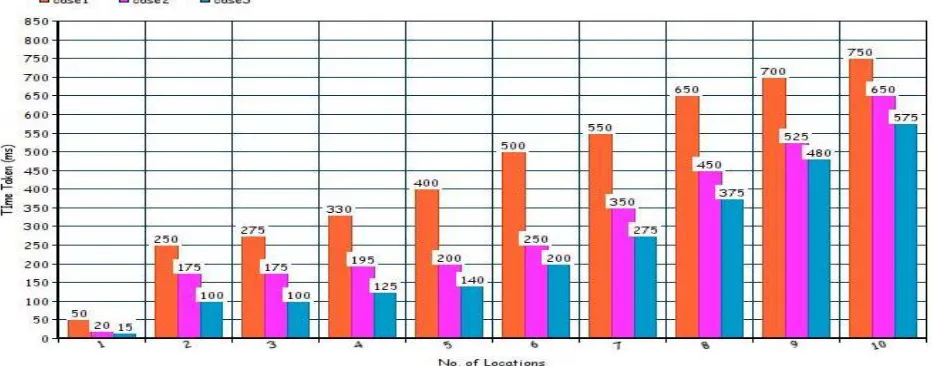
Here we are considering three cases: first case is traditional waste collection method where every bin has to be visited irrespective of whether the bin is filled or not. The second case is that in which vehicle visits only the filled bins locations through the best path obtained using shortest path spanning tree algorithm. The third case is the proposed case, where the vehicle visits only the filled bins locations through the best path obtained through the Hybrid Best path algorithm.
three cases in terms of distance covered to visit particular number of locations. The first case takes more time than other 2 cases because it visits all bins manually irrespective of whether the bins are filled or not. The second case has better performance compared to first case because it uses sensor based prototype to indicate bin fullness. It uses shortest path spanning tree algorithm to find the best rout which gives better performance than first case. The third case utilizes sensor based IoT prototype to indicate the waste level and estimates the best route by using hybrid best path algorithm which gives better performance than first and second case. The hybrid best path algorithm considers all factors such as traffic, obstacles etc during the best path calculation and gives best optimized path compared to shortest path shortest path spanning tree algorithm.
Fig 2. Distance covered versus Number of Locations
The Fig 3 shows the performance evaluation of three cases in terms of time taken to cover the filled bins at different locations. The calculation of best path completes within few milliseconds and can cover more number of locations within a few times because the vehicle navigates through the best path determined by the algorithm.
The IoT enabled waste collection system gives better performance than existing system by using hybrid best path algorithm. The advantage of the algorithm is that it consumes less time compared to other algorithms. When considers bulk amount of data the searching and traversing becomes more efficient and less time consumable in best path calculation. The system reduces the operational cost by saving fuel, time and also cost through visiting only the filled bins through the optimized path.
VII. CONCLUSION
We have implemented the IoT enabled waste collection and fire detection system which helps in auto-management of waste and automatic fire detection in order to reduce human intervention, cost, time and effort. The algorithm used in the implementation helps to find the best route with high speed and also speed up the waste collection process. The fire in waste dumped areas will increase the air pollution, so the system enables the automatic detection of the fire and alerts the authorities. The waste dumped in the public places has adverse effect on nature and human being and have negative impact on tourism. The implemented system helps us to make the cities clean, greener and efficient.
REFERENCES
[1] Gopal Kirshna Shyam, Sunilkumar S. Manvi, Priyanka Bharti, “Smart Waste Management using Internet-of-Things (IoT)” Second International Conference On Computing and Communications Technologies(ICCCT’17), pp. 199 – 203, 2017
[2] Davide Anghinolfi, Massimo Paolucci, and Michela Robba, “Optimal Planning of Door-to-Door Multiple Materials Separated Waste Collection” IEEE Transactions on Automation Science and Engineering, Vol. 13, pp. 1448 – 1457, 2016
[3] Belal Chowdhury, Morshed U. Chowdhury, “ RFID-based Real-timeSmart Waste Management System”, Australasian Telecommunication Networks and Applications Conference, December, Christchurch, New Zealand, pp. 175- 180, 2007
[4] Keerthana B, Sonali M Raghavendran, Kalyani S, Suja P, V.K.G.Kalaiselvi, “Internet of Bins Trash Management in India “, 2nd International Conference on Computing and Communications Technologies (ICCCT), pp. 248-251, 2017
[5] F achmin F olianto, Y ong Sheng Low, Wai Leong Yeow, “Smartbin: Smart Waste Management System”, Tenth International Conference on Intelligent Sensors, Sensor Networks and Information Processing (ISSNIP ) Singapore, pp. 1-2, 2015
[6] Bharadwaj B, M Kumudha, Gowri Chandra N, Chaithra G, “Automation of Smart Waste Management Using IoT to Support “Swachh Bharat Abhiyan” – a practical Approach “ , 2nd International Conference on Computing and Communications Technologies (ICCCT), pp. 318 – 320, 2017
[7] Dr. N. Sathish Kumar, B. Vijayalakshmi, R. Jenifer Prarthana, A .Shankar, “IoT Based Smart Garbage alert system using Arduino UNO “,IEEE Region 10 Conference (TENCON), IEEE, pp. 1028 – 1034, 2016
[8] Shubham Thakker, R.Narayanamoorthi, “Smart and Wireless Waste Management An innovative way to manage waste and also produce energy” 2nd International Conference on Innovations in Information Embedded and Communication Systems ICIIECS’15 , 2015
[9] Artemios G. Voyiatzis, John Gialelis, and Dimitrios Karadimas, “Dynamic Cargo Routing on-the-Go: The Case of Urban Solid Waste Collection” 2nd IEEE WiMob 2014 international workshop on smart city and ubiquitous computing application , pp.58 – 65, 2014
[10] Sahar Idwan, Junaid Ahmed Zubairi, Imran Mahmood, “ Smart Solutions for Smart Cities: Using Wireless Sensor Network for Smart Dumpster Management”, International Conference on Collaboration Technologies and Systems, pp. 493 - 497, 2016