Thermal Analysis of Heat Dissipating
Electronic Devices
Amjad Khan1, Abdul Razak Kaladgi2*, Sushma S3, Faheem Akthar3, Mohammed Rafeeq2, Farooq Indikar4
Research Scholar, Department of Electronics & Communication Engineering, P.A. College of Engineering Mangalore,
Karnataka, India.1
Research Scholar, Department of Mechanical Engineering, P.A. College of Engineering Mangalore, Karnataka, India2
Assistant Professor, Department of Mechanical Engineering, Channabasaveshwara Institute of Technology, Gubbi,
Karnataka, India3
Research Scholar, Department of Computer Science & Engineering, P.A. College of Engineering Mangalore,
Karnataka, India.4
ABSTRACT: The rapid increase in the growth and advancement of electronic technology leads to the miniaturization of the devices. As the compactness of the device increases the problem of heat transfer also increases. There is a limitation for the cooling with air in the devices with high heat dissipation. The compactness and limitation in air cooling forces the use of Minichannel and use of liquid coolants. The main aim of this work is to carryout experimentally, the heat transfer analysis of Square Minichannel (used as a heat sink) cooled with RO treated water. The study was conducted under turbulent, steady and forced flow condition. The important parameters of interest like Reynolds’s number, Nusselt number, friction factor, and pressure drop were calculated. From the obtained results, it was clearly observed that within the entry region, both local heat transfers coefficient and friction factor increases and after a short distance it becomes constant. Also with increase in Reynolds number, pressure drop increases. Hence enhancement does occurat the cost of pumping power.
KEYWORDS: Electronic devices, Square Minichannel, Turbulent flow, RO treated water.
I. INTRODUCTION
With the increase level of miniaturization in the electronic devices, the cooling requirement of these devices has increased considerably. And as the temperature increases, the stability and efficiency deteriorate. Hence the problem of heat dissipation has become a bottleneck for the development of chips in the electronic industry. Also there is a rapid increase in applications of devices requiring very high heat transfer rates and fluid flows in relatively small passages. For example-electronics cooling, space thermal management, MEMS devices for biological and chemical analyses etc. Due to the development of these devices which require cooling of high degree in small passages, the researchers are focussing their attention towards the prediction of thermal performance in these mini and micro channels like devices. Channels having dimensions of the order of mm can be defined as minichannels [1].
II. RELATEDWORK
overall heat transfer coefficient. Hai Trieu Phan et al [5] carried out an experiment to study the impact of surface wet ability on two-phase pressure drop of water at a pressure of 1 atm. They observed that as surface contact angle increases the two phase pressure drop also increases. They also proposed a model to find the pressure drop caused by the change in static contact angle. Xie et al. [6] numerically analyzed a Minichannel heat sink using water as a coolant. The analysis was carried out for single phase, laminar flow conditions and the heat flux was kept constant. They found that a narrow deep channel with thin bottom thickness improves the heat transfer even though the pressure drop is high. They also found an optimal configuration of mini channel to cool the chip.
From the literature it is abundantly clear that most of the work is carried out using ordinary water as a coolant in Minichannel. So the present work aims at analysing the heat transfer performance of Minichannel using RO treated water. The RO treated water is expected to decrease the thermal resistance and improve the heat transfer performance compared to ordinary water. In this project, an experimental study which comprises the heat transfer analysis of square Minichannel cooled with RO treated water as a coolant is carried out. The study was conducted under turbulent, forced flow condition. Steady state readings were noted. The important parameters of interest like, Nusselt number, friction factor, Reynolds number and pressure drop were calculated and compared using graphs.
III.EXPERIMENTAL SETUP
The test section [7] is made of Minichannel array (10 in number) as per the required geometry (Square in this case). It was fixed to strip heater at its base. The heat input to the Minichannel can be varied by using dimmer start but in this experiment it was kept constant. The Minichannel was connected to inlet header for inflow flow of coolant and outlet header for outflow of the coolant. A pump was used for continuous supply of coolant and for controlling the discharge. The upper face temperature of Minichannel was calculated using K-type thermocouples set at equal distance throughout the channel length..
Fig. 1 Experimental set up
The whole assembly was mounted on an iron frame which holds the pump and reservoir at the lower sections of the framed table, Minichannel test section was placed on the table. Coolant was first pumped from the reservoir tank to the test section. Inlet temperature and pressure were measured as soon as it gets into the inlet. Then the coolant flows in to the Minichannel tubes with defined cross sections and gets heated up. After that it was passed through the heat exchanger to retain its inlet temperature value. Again it is transported to the reservoir and the cycle is repeated for different flow rates.
IV.RESULTS AND DISCUSSION
In this project, an experimental study which comprises the heat transfer analysis of Square Minichannel cooled with Ro treated water as a coolant is carried out. The study was conducted under turbulent, steady and forced flow condition. The important parameters of interest like Reynolds number, Nusselt number, friction factor, and pressure drop were calculated and compared using graphs.
1. Effect of length to diameter ratio(X/D) on local Nusselt number
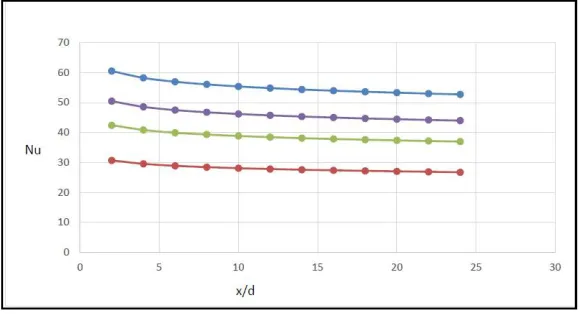
Fig. 2Effect of length to diameter ratio(X/D) on local Nusselt number
Figure 2 shows the variation of local Nusselt number with length to diameter ratio(X/D) of the channel. It can be seen that the Nusselt number and heat transfer coefficient are much higher at the entrance [8]. The Brownian motion, interaction of nanoparticles and the resulting disturbance in the boundary layer can be the possible reasons for the observed increments [9]. And it can also be seen that after certain length to diameter ratio(X/D) the variation is small and as the flow advances, the value becomes constant. So this region may be called as fully developed region and can be seen that the X/D ratio required to attain a fully developed flow is much shorter in mini channels. So a faster transition towards a fully developed flow can be achieved in mini channels.
2. Effect of length to diameter ratio(X/D) on local heat transfer coefficient
Fig 3. Effect of length to diameter ratio(X/D) on heat transfer coefficient
3. Effect of Reynolds Number on Nusselt Number
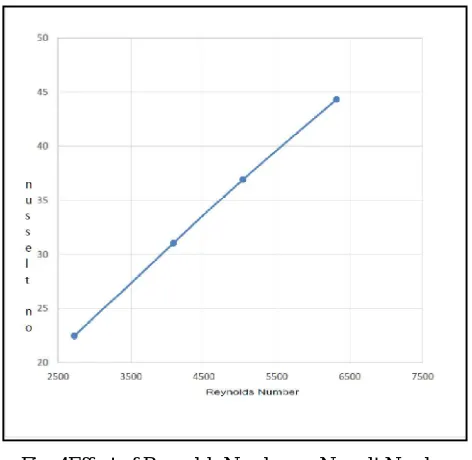
Figure 4 below depicts the variation of Reynolds number on average Nusselt number. It can be seen that as Reynolds number increases, obliviously the Nusselt number increases because with increase in Reynolds number, velocity of flowing fluid increases, this causes turbulence & increases the heat transfer coefficient. Hence the overall Nusselt number increases.
Fig. 4Effect of Reynolds Number on Nusselt Number
4. Effect of Reynolds number on pressure drop
Fig. 5Effect of Reynolds Number on Pressure drop
5. Effect of length to diameter ratio(X/D) on friction factor
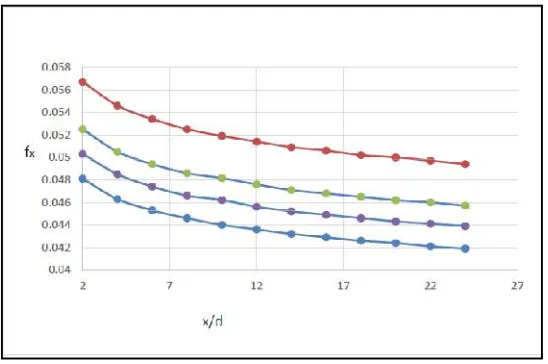
Figure 6 below shows variation of friction factor with length to diameter ratio(X/D) of the channel. It can be seen that when length to diameter ratio(X/D) increases the variation in friction factor decreases and finally reaches a constant
value, indicating a fully developed flow region. The ratio were it remain constant was found to be at x/d =12.
Fig. 6Effect of length to diameter ratio(X/D) on friction factor
V. CONCLUSION
An analysis was carried out using Square Minichannel with RO treated water as a coolant. The readings were taken by varying the discharge and maintaining heat flux as constant. Steady state, forced convection, turbulent flow conditions were also maintained throughout the experiment.
The following conclusion were drawn from the analysis
1. Nusselt number, heat transfer coefficient and friction factor varies very significantly at the inlet region but reaches a constant value after a very short distance from the inlet. So a faster transition towards the fully developed flow condition can be observed in these channels.
3. With increase in friction factor, a decrease in heat transfer coefficient was observed for the mini channel considered at different Reynolds numbers. This indicates that the pumping requirement to pump the fluid increases with Reynolds number.
REFERENCES
[1] Gaurav Agarwal, Manoj Kumar Moharana , Sameer Khandekar,"Thermo-hydrodynamics of developing flow in a rectangular mini-channel array. " in Proceedings of Twentieth National and Ninth International ISHMT-ASME Heat and Mass Transfer Conference, Bombay, India,pp.1342-1349, 2010.
[2] Tuckerman, David B and R. F. W. Pease. "High-performance heat sinking for VLSI." Electron Device Letters, IEEE 2.5, pp. 126-129, 1981. [3] Phillips, Richard J., Leon R. Glicksman, and Ralph Larson. Forced-convection, liquid-cooled, micro channel heat sinks.U.S. Patent No.
4,894,709, Jan1990.
[4] Jajja, Saad Ayub, et al. "Water cooled minichannel heat sinks for microprocessor cooling: Effect of fin spacing." Applied Thermal Engineering, Vol.64, No.1, pp.76-82, 2014.
[5] Phan, Hai Trieu, Nadia Caney, Philippe Marty, Stéphane Colasson, and Jérôme Gavillet. "Flow boiling of water in a minichannel: The effects of surface wettability on two-phase pressure drop." Applied Thermal Engineering, Vol .31, no. 11 pp.1894-1905, 2011.
[6] Xie, X. L., Z. J. Liu, Y. L. He, and W. Q. Tao. "Numerical study of laminar heat transfer and pressure drop characteristics in a water-cooled minichannel heat sink." Applied Thermal Engineering, Vol.29, No. 1, pp.64-74, 2009.
[7] Abdul razak.R.K,Abdullah Gubbi, Amjad Khan,Hasibur Rahman Sardar,Mohammed Rafeeq,Noble james and Mohammed Sami.A.D., " Heat transfer analysis of Minichannel cooled with water-based coolants: An Experimental approach", in Proceedings of ICETETS 2016, Kings College of Engineering, Thanjavur, India, February 2016.
[8] Yunus A. Cengel and Afshin .J.Ghajar. Heat and Mass Transfer,SiE,India,McGraw Hill Education Private Limited, 2011.