Creative Components Iowa State University Capstones, Theses and Dissertations
Spring 2019
COST OPTIMIZATION OF ALLOCATING VIRTUAL NETWORK
COST OPTIMIZATION OF ALLOCATING VIRTUAL NETWORK
FUNCTIONS WITH PRECEDENCE IN MULTICAST NETWORKS
FUNCTIONS WITH PRECEDENCE IN MULTICAST NETWORKS
Ramcharan ChalamalasettyIowa State University, [email protected]
Follow this and additional works at: https://lib.dr.iastate.edu/creativecomponents
Part of the Digital Communications and Networking Commons
Recommended Citation Recommended Citation
Chalamalasetty, Ramcharan, "COST OPTIMIZATION OF ALLOCATING VIRTUAL NETWORK FUNCTIONS WITH PRECEDENCE IN MULTICAST NETWORKS" (2019). Creative Components. 150.
https://lib.dr.iastate.edu/creativecomponents/150
COST OPTIMIZATION OF
ALLOCATING VIRTUAL NETWORK
FUNCTIONS WITH PRECEDENCE IN
MULTICAST NETWORKS
Creative Component
Master of Science, Computer Engineering
Iowa State University
By
Ramcharan Chalamalasetty
Major Professor
Abstract
In the past few years, Network Function Virtualization (NFV) has been widely
used to reduce the operational and capital costs of implementing network functions
with better performance and easier network management. NFV is a network
ar-chitecture completely built relying on Virtual Network Functions (VNFs). Quite
a few developments have been done for the optimization of resource allocation to
implement VNFs in various networks. In this report, an algorithm for reducing the
cost of placing the VNFs within a Multicast network along with a choice of selecting
the precedence of the VNFs is presented. The proposed approach is formulated as
a Mixed Integer Linear Programming (MILP) model based on a main objective of
minimizing the cost of resource allocation with Precedence in Multicast Networks.
Finally, we evaluate the algorithm through simulations in CPLEX and demonstrate
the results.
Contents
1. Introduction 6
2. Related Work 8
3. Problem and its Formulation 10
The Unicast Problem . . . 10
Objective Function . . . 12
Constraints . . . 12
4. Multicast Algorithm 15
Objective Function: . . . 15
Constraints . . . 17
5. Implementation and Results 21
Unicast Model . . . 21
Multicast Model . . . 23
NSF Network Model . . . 29
6. Conclusion 33
List of Figures
1 Unicast Network . . . 23
2 Unicast Results with No Precedence between VNFs . . . 24
3 Unicast Results with VNF Precedence . . . 25
4 Unicast Results without VNFs . . . 26
5 Multicast Network . . . 27
6 Multicast Results with No Precedence between VNFs . . . 28
7 Multicast Results with Precedence between VNFs . . . 28
8 Multicast Results with No VNFs . . . 29
9 NSF Network . . . 30
10 NSF Network Model Results with No Precedence between VNfs . . . 31
11 NSF Network Model Results with Precedence between VNfs . . . 31
List of Tables
1 Definitions of Parameters and Variables for a Unicast Network . . . . 11
1. Introduction
Multicasting is a process of communicating from a single source to multiple
des-tinations with each destination defined to have its own need. This has become
an emerging service mock that is used by many applications because of its
advan-tages across various networks. Let us consider a Mobile Service Provider (MSP) as
an example. There are various mobiles that support 4G/LTE cellular networks or
some other devices that only support 3G networks. Based on the requirement of
the destination device, the MSP has to configure the networks. So technically the
MSP has to send higher bandwidth signals from Source which can be split using
many types as per the customer’s usage. One more example would be TVs. Some
TVs support 4K UHD signals, while others might support SD signals,etc. In order
to handle all such requests from the destinations and fulfill them at a faster rate,
Multicast communication has been very effective when compared to that of Unicast
communication which happens from one source to one destination.
Nowadays, most of these multicast services are implemented using Network
Func-tions (NFs). Examples of NFs can be load balancers, firewalls, intrusion detection
systems, routers, etc. Many of the Service Providers (SP) currently use several
combinations of NFs to provide the services based on the functionality they wish to
achieve. These NFs are generally implemented using physical devices exclusively
de-signed for the NF’s purpose and these devices are connected to each other to satisfy
the service requirement. The deployment and management of NFs on the physical
devices have become very costly. So, with the main objective of reducing the capital
costs and the operational costs [1], Network Funtion Virtualisation (NFV) has been
proposed by ETSI (European Telecommunications Standards Institute) [2].
NFV is a technique to virtualize the NFs. In other words, it is a process of
as to be operated with efficient management, better performance and lower costs
[1]. These kind of NFs, which can be deployed on NFV infrastructure are known to
be as Virtualised Network Functions (VNFs) [3]. These VNFs can be cascaded and
can also be combined for providing the needed services at reduced operational and
investment costs.
The main aim of this report is to design an optimal routing and VNF placement
algorithm for the virtual networks that support multicasting topology, where the
optimality criterion is to minimize capital and operational costs. In order to meet
specific demands for each destination in a multicast topology, the order of VNFs
in which they will be deployed is also important. The algorithm that we propose
in this report has the ability to place the VNFs as per the destination needs. To
evaluate the proposed algorithm, we have used CPLEX as the optimization solver
of our MILP model.
Remaining chapters of the report are organized as follows. Chapter 2 provides
a review of the literature related to NFV and resource allocation in multicast
net-works. Chapter 3 describes the problem formulation for a Unicast model. Then
in Chapter 4, we show the generalization and development of formulation from a
Unicast model to a Multicast model. Chapter 5 presents simulation models and
the various implementations using those models along with the obtained results.
Finally, a ’Conclusion’ Chapter that discusses about what we have achieved from
2. Related Work
Multicast services involving NFV components (like VNFs) are being widely used
by many applications because of the advantages that we discussed in the previous
chapter. So the need of development in this field has grown a lot. There is a
huge amount of work that has been currently going on across the improvements of
various techniques of to implement NFV for lower network expenditures and better
maintenance. In this chapter, we present some of the works that have helped us
to understand NFV and multicasting. We also discuss some of the techniques that
we included for the solution approach which were already presented across different
papers.
The work presented in [4] explains NFV’s relationships with Software Defined
Networks (SDNs) and cloud computing, etc. So as to have a better understanding
of NFV and the key research areas in the field of NFV, this paper acts as a good
reference which also shows the architecture of NFV as well as state-of-the-art survey
on NFV. However, this paper do not contribute much towards the implementation
of Multicasting using NFV.
Many algorithms were developed for finding a minimum cost multicast tree
within a network. One such such work which also involves NFV on SDN is
pre-sented in [5]. It introduces the routing algorithms for building NFV-enabled
Mul-ticast topology on Software Defined Networks. The authors in [5] propose different
approximation algorithms considering the problem as a Steiner Tree problem.
An-other similar work in [6], presents a resource allocation algorithm for VNFs by
trans-forming the model into a queuing model in a Cloud Center (a SDNNFV enabled
network). However, either of the these contributions do not discuss the precedence
relationships between VNFs.
al-locating the same resources at the nodes across the flows to different destinations.
As this is a duplicate allocation at the nodes, the costs have to be calculated only
once in these cases. This can happen similarly with the flows as well. In order to
avoid such duplication in the network, we have to use some constraints which are
presented in the chapter 4 as Generalization constraints. Similar constraints are
in-troduced in [7]. Although, the approach in [7] solves the Multicast traffic grooming
problem by providing a MILP formulation.
Most of the works that we described here introduce various algorithms that can
be used for multicast services involving VNFs. As to our knowledge, we haven’t come
across an optimistic resource allocation algorithm that uses the defined precedence
between resources. Hence, we propose an optimal algorithm that can minimize the
network cost with the allocation of VNFs to VMs (nodes) in accordance to the
3. Problem and its Formulation
We define the problem as “Reducing the cost for the flow and placement of the
VNFs used along the flow paths within unicast and multicast networks”. Our model
is designed to optimize the flow within the network having VNFs with a minimal cost
and to follow the precedence realtionship between VNFs. The remaining categories
in this chapter will explain how the path is formulated to include the VNFs and the
different variables, constraints that we use to provision the flow with minimal cost
while observing precedence in a Unicast Network.
The Unicast Formulation
We model the network as a graph consisting of nodes and links that connect THE
VNFs which can be placed at any node. Generally, there can be preference within
networks to place a specific VNF before another VNF, as each VNF can have its
respective functions. So we include the precedence constraints and provide the
precedence relationship between VNFs as an input to the program.
Each flow within a network can have its own requirements like a flow from Source
to Destination 1 might probably need just a Firewall, but the flow from Source to
Destination 2 could need a Firewall and as well as deep packet inspection while the
other flow may not be needing any network function at all and so on. To handle all
these cases, we have included the choice of selecting the VNFs (from the pre-defined
set of VNFs) for each destination also as an input parameter to the program.
We started the development of the algorithm with the assumption to expand a
Unicast network into a Multi-cast network. So our initial work is done on a Unicast
network (with One Source and one Destination along with 2 VNFs) consisting of
constrained the objective function as shown in this section. We tested various cases
to check whether the expected results are obtained in every case.
Table 1: Definitions of Parameters and Variables for a Unicast Network
Name Description
N Set of Nodes
V N F Set of Virtual Network Functions (VNFs)
i, j, l, m, a, b Nodes ∈N
n, p VNFs where n, p∈ VNF
S Source Node∈ N
D Destination Node ∈ N
Wn Matrix of binary inputs defining the need of VNF ’n’ across the
path to the destination
Knp Matrix of binary inputs defining the precedence of ’n’ and ’p’ where
n, p∈ VNF
bij Cost of bandwidth on link i, j
V Cn
i Cost of placing VNF ’n’ on Node ’i’
M Large Constant Value
FSD
ij Binary Variable representing Flow between link (i, j) from S to D
Vin Binary Variable representing the allocation of VNF ’n’ at Node ’i’
Hi Number of Hops between S and i in the Flow from S to D
Xin An auxiliary variable used for linearization of the product between VNFs and Hops in the Flow
TC Total Cost
Our design helps in allocating the VNFs with precedence along the flow in these
models. So to construct our algorithm while satisfying all the possible scenarios,
we considered several variables and parameters that would be needed in a Unicast
Objective Function
The objective of this optimization problem is to minimize the Total Cost in a network
while allocating VNFs following the precedence relationship defined and is given by
equation (1):
T C =X
ij
(bij.FijSD)+
X
i
X
n
(V Cin.Vin)+X
i
Hi ∀ i, j, S, D ∈N;n∈V N F (1)
Here, the first term is for the sum of all the costs of bandwidths that are used in
the network which is a product of the flows on links and their cost. The second term
is the sum of all the installation costs over the nodes within the network wherever
there is a VNF placement at a node. The final term is the sum of the minimum
number of hops from the source to each of the nodes, which is used in the constraints
to enforce precedence of the allocation of VNFs.
Constraints
a) Flow Constraints:
In order to ensure that there is no incoming flow to the Source and there is no
Outgoing flow from the Destination, equations (2) - (5) are defined as below:
X
iS
FiSSD = 0 ∀ i, j, S, D∈N (2)
X
Si
FSiSD = 1 ∀ i, j, S, D∈N (3)
X
Dj
FDjSD = 0 ∀ i, j, S, D∈N (4)
X
iD
FiDSD = 1 ∀ i, j, S, D∈N (5) For the flow conservation within the network, equation (6) is defined.
X
j
FijSD =X
j
b) VNF Placement Constraints:
These constraints determine the placement of VNFs along the flow from S to D.
X
i
Vin=Wn ∀ i∈N;n∈V N F (7)
Wn is the binary input to determine whether we need the VNF ’n’ within the
network. If it is ’0’, then we do not use the VNF ’n’ in the flow from S to D. The
equation (7) will ensure it will be placed at node ’i’. The below equation (8) will
guarantee that the VNF ’n’ will be placed at node ’i’ along the flow from S to D.
X
i
Vin≤ ( P
ilFilSD+
P
aiFaiSD)
2 ∀ a, i, l, S, D∈N;n∈V N F (8) Eq. (9) shows that the number of hops at the Source node are zero, while the
eq. (10) guarantees the nodes ’j’ is exactly one hop farther from node ’i’ along the
path from the Source to the Destination, which helps to maintain the precedence
relationship between VNFs.
HS = 0 ∀ S ∈N (9)
1−FijSD− Hi+ 1−Hj
M ≥0 ∀ i, j, S, D ∈N (10)
The eq. (10) is observed in [8] and it is used here as one of the precedence
constraints that helps to determine the number of hops between 2 nodes where the
VNF can be allocated. This equation also makes sure that if there is a link ’ij’ used
in the flow from S to D, then the number of hops from S to node ’j’ is exactly one
hop greater than the number of hops from S to node ’i’. Equations (11) and (12)
helps to determine if the node (where the VNF placement can happen) is in the path
to the destination. If the number of hops to node ’i’ from S is zero, then theVn i will
be zero which indicates that the VNF ’n’ will not be placed at node ’i’. Similarly
with node ’j’ for VNF ’p’.
Vin ≤Hi ∀ i∈N;n ∈V N F (11)
Eq. (13) is the key equation that governs the Precedence in the network.
X
i
Vin.Hi ≤
X
j
Vjp.Hj ∀ i, j ∈N;n, p∈V N F (13)
The above equation is a product of two variables which is therefore non-linear.
This is linearized by introducing auxiliary variables Xn
i and X p
j, as shown below.
Xin=Vin.Hi ∀ i∈N;n∈V N F
Xjp =Vjp.Hj ∀ j ∈N;p∈V N F
With the above substitutions, equation (13) can be written as (14):
X
i
Xin ≤X
j
Xjp ∀ i, j ∈N;n, p ∈V N F (14)
c) Linearization Constraints:
The following constraints are used to evaluate Xn
i and X p
j, where M is a very large
number. Although used in [9], these constraints are standard.
Xin≥[M.Vin]−M +Hi ∀ i∈N;n ∈V N F (15)
Xjp ≥[M.Vjp]−M +Hj ∀ j ∈N;p∈V N F (16)
Xin ≤Hi ∀ i∈N, n∈V N F (17)
Xjp ≤Hj ∀ j ∈N, p∈V N F (18)
Xin ≥0 ∀ i, Dk∈N (19)
Xjp ≥0 ∀ j, Dk∈N (20)
Xin≤M.Vin ∀ i∈N;n ∈V N F (21)
4. Multicast Algorithm
The formulation from Chapter 3 for the Unicast model is improvised and generalized,
so that it can be used for developing a formulation for Multicast Networks. The
parameters and variables needed for this model are shown in Table 2. The model
doesn’t quite have to be changed except some additional generalization constraints
shown towards the end of this chapter which are used to avoid the costs of duplicate
links and the costs of placing VNFs at same nodes across several flows to multiple
destinations.
We considered a 10 Node network (with one Source, three Destinations and 3
VNFs) to implement all our test cases while designing the algorithm for a Multicast
Network.
Objective Function
The objective of this optimization model is to minimize the Total Cost in a network
while allocating VNFs for each destination by following the precedence relationship
defined between VNFs. It is given by equation (23):
T C =X
ij
(bij.Gij)+
X
i
X
n
(V Cin.Uin)+X
i
X
Dk
Hi(Dk) ∀ i, j, Dk ∈N;n∈V N F
(23)
However, this is similar to eq. (1) defined in the previous Chapter. But here
we sum up the cost of the links and the VNFs that are used in the flows for each
destination and the final term is similarly used for the sum of minimum number
of hops from the Source to each of the nodes used across flows to each Destination
from Source, which is used in the constraints to enforce precedence of the allocation
Table 2: Definitions of Parameters and Variables for a Multicast Network
Name Description
N Set of Nodes
V N F Set of Virtual Network Functions (VNFs)
i, j, l, m, a, b Nodes ∈ N
n, p VNFs where n, p∈ VNF
Dk Set of Destination Nodes
bij Cost of bandwidth on link i, j
V Cn
i Cost of placing VNF ’n’ on Node ’i’
Wn(Dk) Matrix of binary inputs defining the need of VNF ’n’ across the
path to each destination
Knp Matrix of binary inputs defining the precedence of ’n’ and ’p’ where
n, p∈ VNF
M Large Constant Value
FSDk
ij Binary Variable representing Flow between link (i, j) from S to Dk
Vn
i (Dk) Binary Variable representing the allocation of VNF ’n’ at Node ’i’
used in Dk
Hi(Dk) Number of Hops between S and i in the Flow to each Dk
Xn
i (Dk) An auxiliary variable used for linearization of the product between
VNFs and Hops in the Flow to each Dk
Gij An auxiliary variable used for generalization of Link Costs
Ui(Dk) An auxiliary variable used for generalization of VNF Costs
Constraints
a) Flow Constraints
Moreover, equations (24) - (27) are alike to eq. (2) - (5). But these are defined for
each destination as below:
X
iS
FSDk
iS = 0 ∀ i, j, S, Dk ∈N (24)
X
Si
FSDk
Si = 1 ∀ i, j, S, Dk ∈N (25)
X
Dkj
FSDk
Dkj = 0 ∀ i, j, S, Dk ∈N (26)
X
iDk
FSDk
iDk = 1 ∀ i, j, S, Dk ∈N (27)
For the flow conservation within the network for each flow from Source to each
Destination, eq. (28) is defined.
X
j
FSDk
ij =
X
j
FSDk
jl ∀ i, j, S, Dk ∈N;j 6=S, Dk (28)
b) VNF Placement and Precedence Constraints
Eq. (29) will be the important one which inputs the selection of VNFs for each
destination. Wn(Dk) is the matrix of binary inputs to determine whether we need
the VNF ’n’ within the network for destinationDk. Equation (29) will ensure it will
be placed at node ’i’ and equation (30) guarantees that the VNF ’n’ will be placed
at node ’i’ along the flows from S to each Destination.
X
i
Vin(Dk) =Wn(Dk) ∀ i, Dk ∈N;n∈V N F (29)
X
i
Vin(Dk)≤
(P ilF SDk il + P aiF SDk ai )
2 ∀ a, i, l, S, Dk ∈N;n ∈V N F (30) Eq. (31) shows that the number of hops at the Source node are zero and eq.
Source when compared to the number of hops to node ’i’ from Source along the
paths from Source to each of the Destinations.
HS(Dk) = 0 ∀ S, Dk∈N (31)
1−FSDk
ij −
Hi(Dk) + 1−Hj(Dk)
M ≥0 ∀ i, j, S, Dk ∈N (32)
Equations (33) and (34) help to determine if the node (where the VNF placement
can happen) is used in the path to each destination. If the number of hops to node
’i’ from S is zero, then Vn
i (Dk) will be zero which indicates that the VNF ’n’ will
not be placed at node ’i’ in the flow from Source to Destination Dk. Similarly with
node ’j’ for VNF ’p’ is shown in (34).
Vin(Dk)≤Hi(Dk) ∀ i, Dk ∈N;n ∈V N F (33)
Vjp(Dk)≤Hj(Dk) ∀ j, Dk∈N;p∈V N F (34)
Eq. (35) plays a significant role which in fact governs the Precedence in the
network for each destination.
X
i
Vin(Dk).Hi(Dk)≤
X
j
Vjp(Dk).Hj(Dk) + [1−Wp(Dk)].M
∀ i, j, Dk∈N;n, p∈V N F (35)
The eq. (35) consists of product of two variables which is Non-Linear. This is
linearized by introducing auxiliary variables Xi(Dk) and Xj(Dk) as shown below.
Xi(Dk) = Vin(Dk).Hi(Dk) ∀ i, Dk ∈N;n∈V N F
Xj(Dk) = Vjp(Dk).Hj(Dk) ∀ j, Dk ∈N;p∈V N F
After the above substitutions, the equation (35) can be written as (36):
X
i
Xi(Dk)≤
X
j
c) Linearization Constraints:
These constraints are used in evaluating Xi(Dk) and Xj(Dk), where M is a very
large number. However, as discussed in the previous chapter these constraints are
standard which are used for flow to each destination.
Xi(Dk)≥[M.Vin(Dk)]−M +Hi(Dk) ∀ i, Dk ∈N;n∈V N F (37)
Xj(Dk)≥[M.Vjp(Dk)]−M +Hj(Dk) ∀ j, Dk∈N;p∈V N F (38)
Xi(Dk)≤Hi(Dk) ∀ i, Dk ∈N (39)
Xj(Dk)≤Hj(Dk) ∀ j, Dk ∈N (40)
Xi(Dk)≥0 ∀ i, Dk ∈N (41)
Xj(Dk)≥0 ∀ j, Dk ∈N (42)
Xi(Dk)≤M.Vin(Dk) ∀ i, Dk ∈N;n ∈V N F (43)
Xj(Dk)≤M.Vjp(Dk) ∀ j, Dk∈N;p∈V N F (44)
As described at the start of this Chapter, below are the generalization constraints
for Flow and placement of VNFs which minimize the Total Cost. These constraints
not needed in a Unicast model as the model itself will find a single and an optimal
path from Source to Destination.
d) For Generalization of the Flow over each Destination:
Here we use another auxiliary variable Gij in order to generalize the flow and
mini-mize the cost for the flow from Source to all destinations.
Gij ≥
X
Dk
FSDk
ij
Gij ≤
X
Dk
FSDk
ij ∀ i, j, S, Dk∈N (46)
e) For Generalization of the Placement over each Destination:
In this section, we introduce one more auxiliary variable Un
i in order to generalize
the placement of VNFs across the flows to each destination and minimize the cost
for the placement of VNFs by not including the costs of duplicated allocation of
VNFs at the nodes.
Uin≥X
Dk
Vn i (Dk)
M ∀ i, Dk ∈N;n∈V N F (47)
Ujp ≥X
Dk
Vjp(Dk)
M ∀ j, Dk∈N;p∈V N F (48)
Uin≤X
Dk
Vin(Dk) ∀ i, Dk∈N;n ∈V N F (49)
Ujp ≤X
Dk
5. Implementation and Results
The implementation of the algorithm is in CPLEX. While the code is written in
OPL (Optimization Programming Language) and it is stored as a ’.mod’ file. The
data is given in a separate file (’.dat’ format). We also generated a ”.lp” file, which
provides the list of constraints and their corresponding values while the program
ran. This file helped us to resolve all the issues that we faced while designing the
algorithm.
The key components to be observed in the test cases are:
1) Flow from Source to Destination
2) VNF Placement
3) Precedence between VNFs is satisfied or not
The expected result would be the lowest cost flows from Source to Destinations with
the VNF placed along the flows and following the precedence conditions that will
be defined as an input.
Unicast Model
The designed MILP model is tested on several cases in different networks. Starting
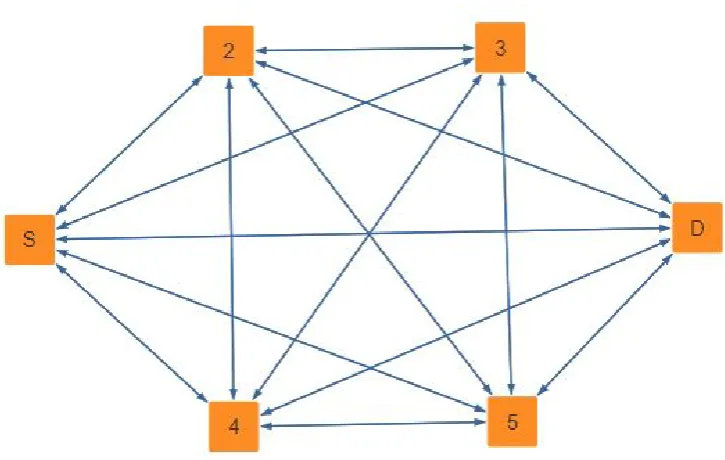
with the Complete Unicast Network (a set of 6 Nodes inclusive of a Source node
and a Destination Node with 3 VNFs to be placed among these nodes) as shown in
Figure 1, the following scenarios are tested. The links are shown below:
links = {<1,2>,<1,3>,<1,4>,<1,5>,<1,6>,<1,1>,
<2,1>,<2,3>,<2,4>,<2,5>,<2,6>,<2,2>,
<3,1>,<3,2>,<3,4>,<3,5>,<3,6>,<3,3>,
<4,1>,<4,2>,<4,3>,<4,5>,<4,6>,<4,4>,
<6,1>,<6,2>,<6,3>,<6,4>,<6,5>,<6,6>};
with their respective link costs as:
linkcost = [50,2,1,2,16,0,
50,50,10,3,1,0,
2,50,15,24,50,0,
1,10,15,19,7,0,
2,3,24,19,1,0,
16,1,50,7,1,0];
and the cost of placing the VNF at each Node:
vnfcost = [[3,3,3],
[10,18,10],
[10,10,10],
[18,10,40],
[18,20,10],
[16,25,30]];
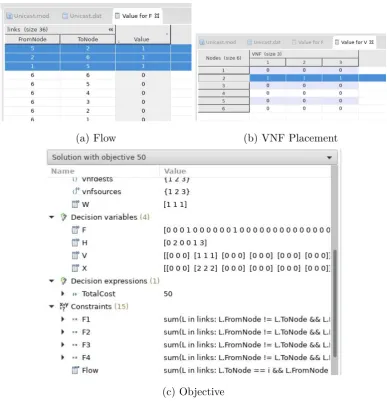
Case 1: No Precedence between VNFs and only VNF 1 and VNF 3 should be placed along the flow from S to D.
In this case, we observed that the Objective is 32, the placement of VNF 1 is
at node 2 and the placement of VNF 3 at node 5. While the path from S to D is
1−>5−>2−>6.
So here, the VNF 3 is placed first and the VNF 1 is placed next. The Figure 2
show the placement, path and the Objective.
Case 2: Precedence between VNFs is chosen as: V N F1−> V N F3−> V N2 Here the Objective is increased to 50, with the same path as the previous case
while the placement of VNFs are changed. Now, we have all the 3 VNFs placed at
Figure 1: Unicast Network
Case 3: This case is with no VNFs, so no Precedence in order to find the cheapest and the best path from S to D.
The resulted objective is very less and is 6 according to the link costs that are
shown above. The path from S to D is 1− > 5− > 6. The VNFs are not placed anywhere which satisfy our condition and the outputs are shown in Figure 4.
As we were able to get the expected outcomes from the Unicast model, we
expanded our interest to Multicast networks and the results from the Multicast
model are shown in the next section.
Multicast Model
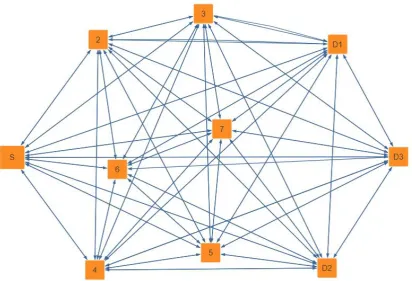
For testing of the Multicast algorithm, we examined a complete 10 Node network
with one Source Node and 3 Destination Nodes along with 3 VNFs as shown in
Figure 5. The links, link costs and vnf costs considered are as below:
links =
{<1,2>,<1,3>,<1,4>,<1,5>,<1,6>,<1,7>,<1,8>,<1,9>,<1,10>,<1,1>,
[image:24.595.104.467.91.321.2](a) Flow (b) VNF Placement
(c) Objective
Figure 2: Unicast Results with No Precedence between VNFs
<3,1>,<3,2>,<3,4>,<3,5>,<3,6>,<3,7>,<3,8>,<3,9>,<3,10>,<3,3>,
<4,1>,<4,2>,<4,3>,<4,5>,<4,6>,<4,7>,<4,8>,<4,9>,<4,10>,<4,4>,
<5,1>,<5,2>,<5,3>,<5,4>,<5,6>,<5,7>,<5,8>,<5,9>,<5,10>,<5,5>,
<6,1>,<6,2>,<6,3>,<6,4>,<6,5>,<6,7>,<6,8>,<6,9>,<6,10>,<6,6>,
<7,1>,<7,2>,<7,3>,<7,4>,<7,5>,<7,6>,<7,8>,<7,9>,<7,10>,<7,7>,
<8,1>,<8,2>,<8,3>,<8,4>,<8,5>,<8,6>,<8,7>,<8,9>,<8,10>,<8,8>,
<9,1>,<9,2>,<9,3>,<9,4>,<9,5>,<9,6>,<9,7>,<9,8>,<9,10>,<9,9>,
<10,1>,<10,2>,<10,3>,<10,4>,<10,5>,<10,6>,<10,7>,<10,8>,<10,9>,<10,10>};
[image:25.595.114.496.68.487.2](a) Flow (b) VNF Placement
(c) Objective
Figure 3: Unicast Results with VNF Precedence
50,50,10,3,1,7,8,9,10,0,
2,50,5,6,50,7,8,9,10,0,
1,10,5,1,7,7,8,9,10,0,
2,3,6,1,1,7,8,9,10,0,
1,1,50,7,1,7,8,9,10,0,
7,7,7,7,7,7,8,9,10,0,
8,8,8,8,8,8,8,9,10,0,
9,9,9,9,9,9,9,9,10,0,
10,10,10,10,10,10,10,10,10,0];
[image:26.595.97.485.68.482.2](a) Flow (b) VNF Placement
(c) Objective
Figure 4: Unicast Results without VNFs
[1,9,7],
[1,8,20],
[3,5,25],
[4,24,4],
[10,10,15],
[8,10,35],
[4,15,19],
[9,90,5],
[16,1,30]];
The similar scenarios that we considered while testing the Unicast model are
implemented here as well.
[image:27.595.114.494.68.418.2]Figure 5: Multicast Network
a) VNF 1 and VNF 2 for Destination 1 (D1)
b) Only VNF 3 for Destination 2 (D2)
c) VNF 1, VNF 2 and VNF 3 for Destination 3 (D3)
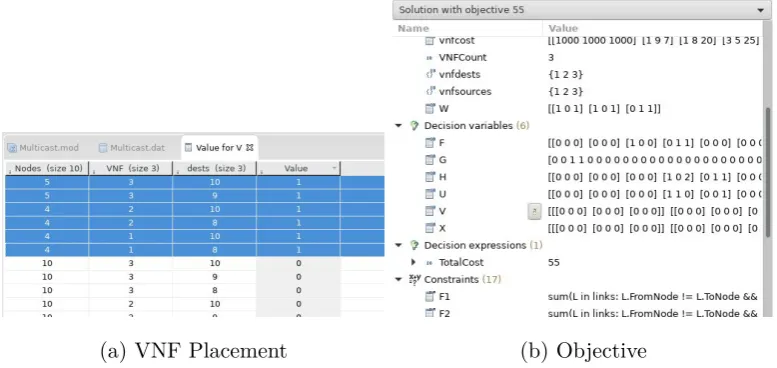
The CPLEX results showed that the placement of VNFs are according to the
requirement with an objective of 55 and the paths for each destination are:
D1: 1−>4−>8 with both VNF 1 and VNF 2 placed at node 4 D2: 1−>4−>9 with VNF 3 placed at node 5
D3: 1−>4−>5−>10 with VNF 1 and VNF 2 placed at node 4 and the VNF 3 placed at node 5
The results for this case from CPLEX are shown in Figure 6.
Case 2: With Precedence between VNFs asV N F3−> V N F1−> V N F2 and the VNF requirement for each destination is same as previous case.
The results are similar. The objective is 55, the VNF placements are same but
[image:28.595.82.495.82.363.2](a) VNF Placement (b) Objective
Figure 6: Multicast Results with No Precedence between VNFs
D1: 1−>4−>8 with both VNF 1 and VNF 2 placed at node 4 D2: 1−>4−>9 with VNF 3 placed at node 5
D3: 1−>5−>4−>10 with VNF 1 and VNF 2 placed at node 4 and the VNF 3 placed at node 5
showing that the precedence between VNFs is followed and the CPLEX outputs
are shown in Figure 7.
(a) VNF Placement (b) Objective
Figure 7: Multicast Results with Precedence between VNFs
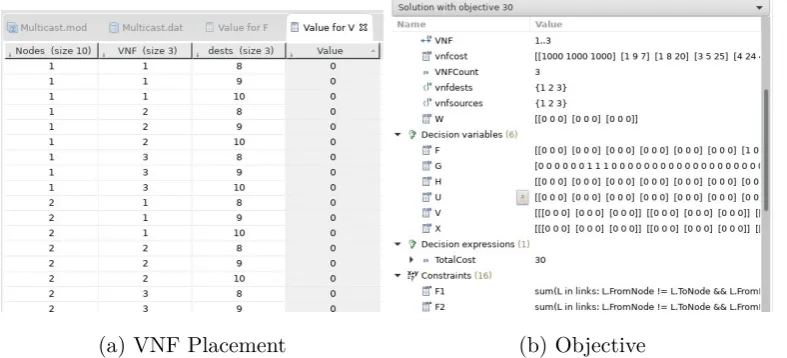
Case 3: In this case, no VNFs and hence no precedence relationship.
The outcome showed the lowest cost for the defined Multicast session with VNFs
are not placed at all as expected. The objective is 30 and the paths are:
[image:29.595.112.499.69.249.2] [image:29.595.110.499.457.641.2]D2: 1−>9 D3: 1−>10
The CPLEX results for this case are shown in Figure 8.
(a) VNF Placement (b) Objective
Figure 8: Multicast Results with No VNFs
NSF Network Model
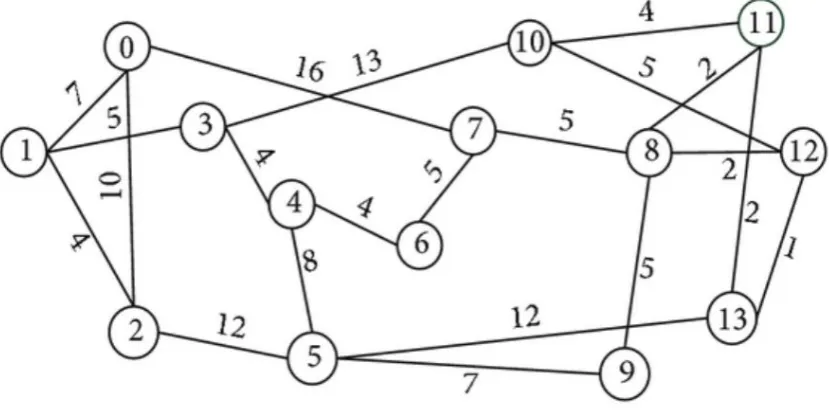
In addition to these network topology, we also considered NSF network topology for
our testing purposes. This is a 14 node and 21 bidirectional link model with links
and their costs are shown in Figure 9. This is extracted from reference.
We considered 3 VNFs and 3 destination nodes (11,12 and 13) with the Source
node as 0 while vnf costs at each node are assumed randomly like any other model
and they are shown below:
vnfcost = [[1000,1000,1000],
[1,9,7],
[1,8,20],
[3,5,25],
[4,24,14],
[10,10,15],
[8,10,35],
[image:30.595.97.491.168.347.2]Figure 9: NSF Network
[5,14,34],
[7,19,17],
[8,16,13],
[4,15,19],
[9,90,5],
[16,1,30]];
We have implemented this model in the similar cases as the previous model and the
different test scenarios are:
Case 1: No Precedence between VNFs and the VNF requirement for each Des-tination are as follows:
a) VNF 1 and VNF 2 for Destination 1 (D1)
b) Only VNF 3 for Destination 2 (D2)
c) VNF 1, VNF 2 and VNF 3 for Destination 3 (D3)
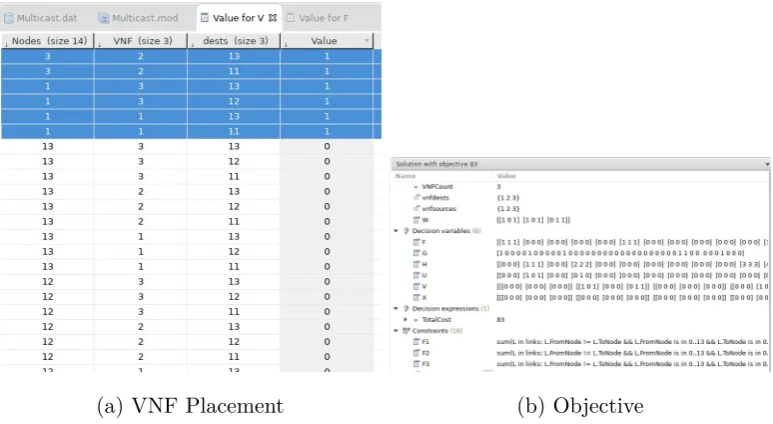
The results are similar and as expected. They are shown in Figure 10.
The output paths are:
D1: 0− >1− >3−> 10− >11 with VNF 1 and VNF 2 placed at nodes 1 and 3 respectively
[image:31.595.98.513.88.293.2](a) VNF Placement (b) Objective
Figure 10: NSF Network Model Results with No Precedence between VNfs
D3: 0−>1−>3−>10−>13 with VNF 1 and VNF 3 placed at node 1 and the VNF 2 placed at node 3
Case 2: With Precedence between VNFs asV N F2−> V N F1−> V N F3 and the VNF requirement for each Destination remains same.
The CPLEX outputs show that the paths are changed and the VNF locations
are also changed with a slight increase in the cost. These are shown in the Figure
11.
(a) VNF Placement (b) Objective
Figure 11: NSF Network Model Results with Precedence between VNfs
[image:32.595.98.485.70.282.2] [image:32.595.97.485.515.701.2]D1: 0−>2−>5−>13−>11 with both VNF 1 and VNF 2 placed at node 2 D2: 0−>2−>5−>13−>12 with VNF 3 placed at node 5
D3: 0−>2−>5−>13 with VNF 1 and VNF 2 placed at node 2 and the VNF 3 placed at node 5
Case 3: Here, we consider no VNFs so no precedence also.
As discussed before, this case gives the cheapest path to destinations from Source.
(a) Objective
Figure 12: NSF Network Model Results with No VNFs
The paths from Source to each destination are below:
D1: 0−>7−>8−>11 D2: 0−>7−>8−>12
D3: 0−>7−>8−>12−>13
We can see in every case, the cost of the duplicate links like 0− >7− >8− >
in this case are considered only once. As typically, the path is common from node
[image:33.595.177.430.229.442.2]6. Conclusion
In this report, we developed an algorithm to place VNFs along the path to the
desti-nations in Multicast Networks. We introduced the allocation of VNFs at nodes with
precedence in the Unicast network. We then advanced our algorithm to Multicast
networks. This algorithm is developed as a MILP model and the optimal solutions
that are obtained for each of the network topology that we considered are shown
in the previous section. The formulation is generalized and ensures an optimal
so-lution also by eliminating the calculation of the duplicate entries for paths or VNF
placements.
Moreover, observing all the cases that we considered for testing with different
network models, we can say that the defined Precedence relationships are followed
between VNFs and these VNFs are placed in the flows to each destinations with the
minimal cost.
With this, we can conclude that the algorithm that we designed for a Multicast
network model is capable of placing VNFs at the Nodes in the Flow by following
the Precedence relationship leading the lowest cost path to destinations.
As a part of our development in this algorithm, we have not included/observed
the performance of VNFs as it is out of the scope of this report. But as a future
improvement to this work, the performance optimization of VNFs can definitely add
Bibliography
[1] ETSI, “NFV: Architectural Framework.” https://www.etsi.org/deliver/
etsi_gs/NFV/001_099/002/01.01.01_60/gs_NFV002v010101p.pdf/.
[2] Wikipedia, “Network Function Virtualization.” https://en.wikipedia.org/
wiki/Network_function_virtualization/.
[3] https://www.electronics-notes.com/articles/
connectivity/nfv-network-functions-virtualisation/
virtualized-network-functions-vnf.php/.
[4] R. Mijumbi, J. Serrat, J. Gorricho, N. Bouten, F. De Turck, and R. Boutaba,
“Network function virtualization: State-of-the-art and research challenges,”
IEEE Communications Surveys Tutorials, vol. 18, pp. 236–262, Firstquarter
2016.
[5] S. Q. Zhang, Q. Zhang, H. Bannazadeh, and A. Leon-Garcia, “Routing
algo-rithms for network function virtualization enabled multicast topology on sdn,”
IEEE Transactions on Network and Service Management, vol. 12, pp. 580–594,
Dec 2015.
[6] T. T. H. Trung V. Phan, Linh H. Ngo and N. H. Thanh, “Optimizing resource
allocation for elastic security vnfs in the sdnfv-enabled cloud computing,” in2017
International Conference on Information Networking (ICOIN), pp. 163–166, Jan
2017.
[7] R. Ul-Mustafa and A. E. Kamal, “Design and provisioning of wdm networks with
multicast traffic grooming,”IEEE Journal on Selected Areas in Communications,
[8] A. M. Hamad and A. E. Kamal, “Optical amplifiers placement in wdm mesh
networks for optical multicasting service support,” J. Opt. Commun. Netw.,
vol. 1, pp. 85–102, Jun 2009.
[9] T. Omar, Z. Abichar, A. E. Kamal, J. M. Chang, and M. A. Alnuem,
“Fault-tolerant small cells locations planning in 4g/5g heterogeneous wireless networks,”