An Experimental Study of Bituminous
Pavement adding Electronic-Waste to Increase
the Strength Economically
Vikram J. Patel1, Hemraj R. Kumavat2, Ganesh V. Tapkire3
Assistant Professor, Department of Civil Engineering, R.C.Patel Institute of Technology, Shirpur, Maharashtra, India1
Assistant Professor, Department of Civil Engineering, R.C.Patel Institute of Technology, Shirpur, Maharashtra, India2
Assistant Professor, Department of Civil Engineering, R.C.Patel Institute of Technology, Shirpur, Maharashtra, India3
ABSTRACT: When Waste products are collected from each resident in the city, the waste should be sorted, Segregated Electronic waste should be crushed and use that material for plinth filling purpose, In this way all the electronic waste in the city will get dispose off in the same city. The main purpose of this study is to investigate the use of recycled plastic components of E-waste in construction applications. This is an alternative solution to administer the growing quantity of the E-waste.Several studies have verified that plastic can also be used in experimental works related to flexible pavements, bitumen and bituminous mixes are modified in order to improve the performance of bituminous concrete mixtures. The bitumen of 80/100 penetration grade is used as binder in present work and the physical properties of bitumen. All tests conducted on bitumen were in accordance with procedure laid down in Indian standards. The basic test properties on bitumen and modified bitumen indicates that the replacement of bitumen by waste plastic increases the penetration and reduces ductility values, whereas increases in softening point when about 5% and 10% by weight of bitumen content is replaced by waste plastic. If the Procedure of this research comes into existence, then the Environment issues with Electronic Waste can be resolved.
KEYWORDS:E-waste, Recycling, Bituminous, Experimental etc.
I. INTRODUCTION
Flow Diagram:
Our Innovative Idea of Management of Electronic Waste:
Collection: When Waste products are collected from each resident in the city, the waste should be sorted. Electronic Waste should be segregated from the waste and stored at a shed.
Segregation: Electronic waste should be segregated and the recyclable products should be removed out and sold in the market by the municipal authority.
Crushing: The Segregated Electronic waste should be crushed with the help of crushers and made in the form of small pieces of size ranging from 2cm-6cm.
II. RELATED WORK
1. Waste Rubber Tyres In Construction Of Bituminous Road:
Prof. Justo et al (2002), at the Centre for Transportation Engineering of Bangalore University compare the properties of the modified bitumen with ordinary bitumen. It was observed that the penetration and ductility values of the modified bitumen decreased with the increase in proportion of the plastic additive, up to 12 percent by weight. Therefore the life of the pavement surfacing using the modified bitumen is also expected to increase substantially in comparison to the use of ordinary bitumen. Shankar et al (2009), crumb rubber modified bitumen (CRMB 55) was blended at specified temperatures. Marshall‟s mix design was carried out by changing the modified bitumen content at constant optimum rubber content and subsequent tests have been performed to determine the different mix design characteristics and for conventional bitumen (60/70) also. This has resulted in much improved characteristics when compared with straight run bitumen and that too at reduced optimum modified binder content (5.67 %). Mohd.Imtiyaz (2002) concluded that the mix prepared with modifiers shows higher resistance to permanent deformation.
2. Industrial Waste In Flexible Pavement:
A test pit, each of size 3m long, 1.5m wide to an average depth of 0.8m is prepared . Out of which, 0.5m depth is for laying sub-grade, 0.15m is subbase and0.15m for base course. In the prepared test pit, the sand soil mixed with water at OMC is laid in10 layers such that each layer of0.05m compacted thickness amount to a total thickness of0.5msubgrade is laid in the excavated pit. On the prepared sand sub-grade murrum / fly ash sub base material mixed with water content at OMC in 2 layers, each of 0.075mcompacted thickness to a total thickness of 0.15m is laid. The reinforcement materials viz; waste plastics and waste Sand soil is used as a subgrade soil for all the tests. Out of six models flexible pavements three tests with murrumsubbase and other threetests with fly ash sub base were conducted in this study.
3. Use Of Waste Plastics And Waste Rubber Tyers:
Worldwide, sustainability is the pressing need of the hour in the construction industry and towards this end use of waste material in road construction is being increasingly encouraged so as to reduce environmental impact. In the high way infrastructure, a large number of originate materials and technologies have been invented to determine their suitability for the design, construction and maintenance of these pavements. Plastics and rubbers are one of them. Also considering the environmental approach, due to excessive use of polythenes in day to day business, the pollution to the environment is enormous. The use of plastic materials such as carry bags, cups, etc. is constantly increasing day by day. Since the polythenes are not biodegradable, the need of the current hour is to use the waste polythene in some beneficial purposes. The main aim of this study is to focus on using the available waste/recycled plastic materials and waste rubber tyres present in abundant which can be used economically and conveniently. The use of these materials as
Collection of Waste
Segrigation
of Waste Crushing
Handover
a road construction proves eco friendly, economical and use of plastic will also give strength in the sub-base course of the pavement.
III.LABORATORY TESTING AND RESULTS
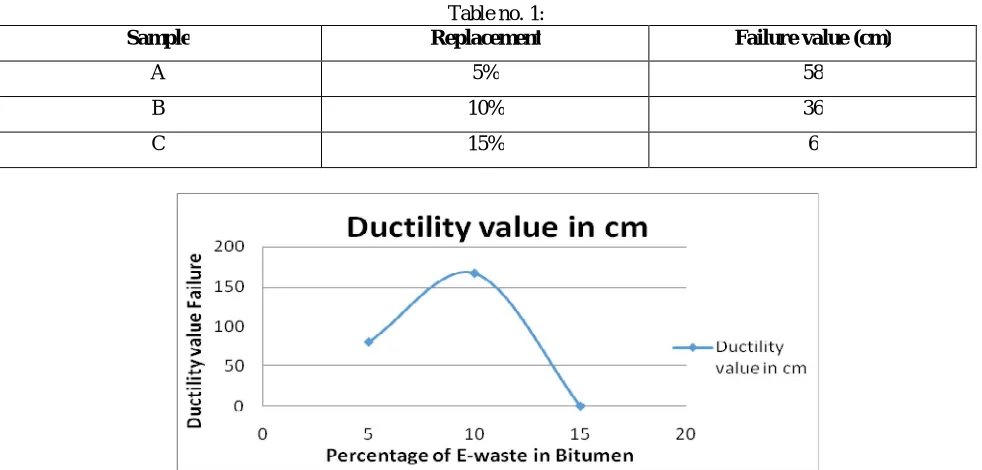
1. DUCTILITY TEST: Standard: IS: 208-1978.
Definition: The ductility of bituminous material is the distance in centimeters to which it will elongate before breaking when a briquette specimen of the materials is pulled at a specified speed and at specified temperature.
Figure:
Fig. 1: Ductility Testing Machine
Result:
Table no. 1:
Sample Replacement Failure value (cm)
A 5% 58
B 10% 36
C 15% 6
2. PENETRATION TEST:
Standard: IS 1203-1978
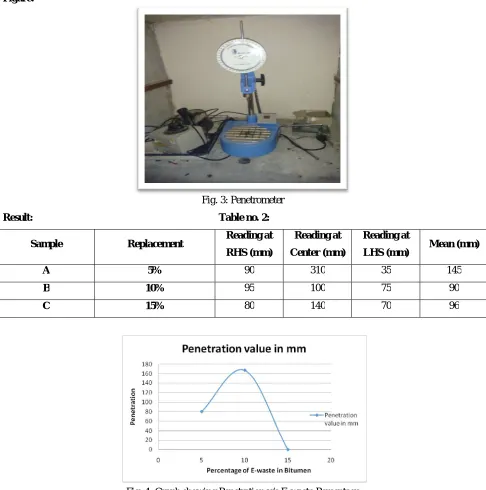
This test is done to determine the penetration of bitumen as per IS: 1203 – 1978. The principle is that the penetration of a bituminous material is the distance in tenths of a mm, that a standard needle would penetrate vertically, into a sample of the material under standard conditions of temperature, load and time.
Figure:
Fig. 3: Penetrometer
Result: Table no. 2:
Sample Replacement Reading at
RHS (mm)
Reading at
Center (mm)
Reading at
LHS (mm) Mean (mm)
A 5% 90 310 35 145
B 10% 95 100 75 90
C 15% 80 140 70 96
3. SOFTENING POINT:
Standard: IS: 1205-1978
Defination: This test is done to determine the softening point of asphaltic bitumen and fluxed native asphalt, road tar, coal tar pitch and blown type bitumen as per IS: 1205 – 1978. The principle behind this test is that softening point is the temperature at which the substance attains a particular degree of softening under specified condition of the test.
Figure:
Fig. 5: Ring and Ball Apparatus
Result:
Record the temperature at which the ball touches the bottom.
Table no. 3:
Sample Replacement
Temperature of
falling of ball of
first ring (0 C)
Temperature of
falling of ball of
first ring (0 C)
Mean
A 5% 60.5 61.2 60.85
B 10% 64 74.2 69.10
Fig. 6: Graph showing Softening Point v/s E-waste Percentage
4. VISCOSITY TEST FOR BITUMEN:
Standard:IS 1206-PART-2
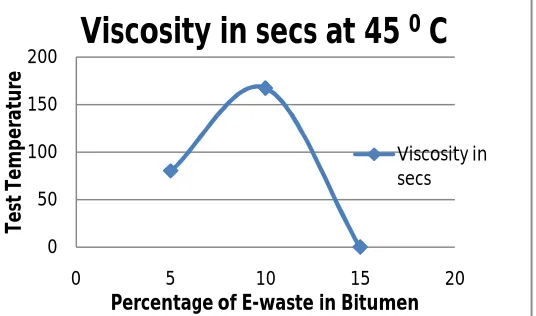
Defination:Viscosity is the inverse of fluidity. The degree of fluidity at the application temperature greatly influences the ability of bituminous material to spread, penetrate into voids and also coat the aggregate and hence affect the strength and characteristics of resulting paving mixes. At high fluidity or low viscosity, bitumen binder simply lubricates the aggregate particles instead of providing an uniform film thickness for binding action. Low fluidity or high viscosity does not enable the bitumen to coat the entire surface of aggregate in the mix easily and also resists the compactive effort and resulting mix is heterogeneous in character.
Result:
A) At 45 oC
Viscosity of cutback for 5% replacement bitumen = 92.31seconds. Viscosity of cutback for 10% replacement bitumen = 187.34seconds Viscosity of cutback for 15% replacement bitumen = Sample Failed
Fig. 7: Graph showing Test Temperature v/s E-waste Percentage
0 50 100 150 200
0 5 10 15 20
So ft e n in g P o in t
Percentage of E-waste in Bitumen
Softening value in
0
C
Softening … 0 50 100 150 200
0 5 10 15 20
Te st Te m p e ra tu re
Percentage of E-waste in Bitumen
Viscosity in secs at 45
0
C
Fig. 8: Graph showing Test Temperature v/s E-waste Percentage
Recommended Values:
Table no. 4:
IV.COST ANALYSIS
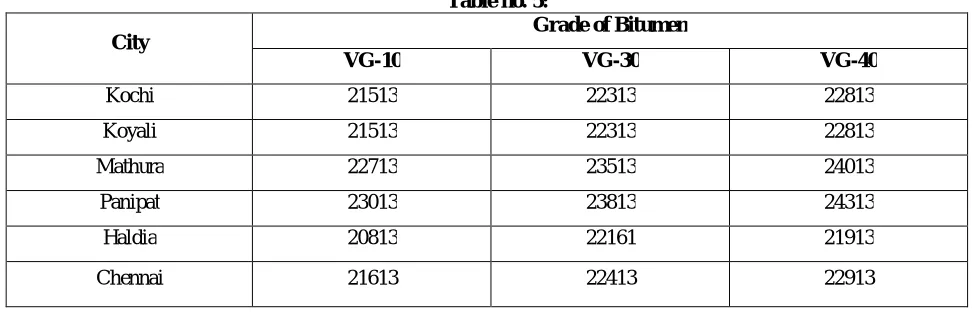
Cost Analysis for Bitumen: Bitumen is obtained from refineries across India. The major bitumen producing companies are Indian Oil, bharat Petroleum, Essar, Reliance Petroleum. The Prices varies as per the grade of bitumen. The prices also vary as per the respective company.
Following is the price of bitumen as per grade in various cities – Table no. 5:
City Grade of Bitumen
VG-10 VG-30 VG-40
Kochi 21513 22313 22813
Koyali 21513 22313 22813
Mathura 22713 23513 24013
Panipat 23013 23813 24313
Haldia 20813 22161 21913
Chennai 21613 22413 22913
0 50 100 150 200
0 5 10 15 20
T
e
st
T
e
m
p
er
at
u
re
Percentage of E-waste in Bitumen
Viscosity in secs at 60
0
C
Viscosity in secs
Cutback bitumen SC,MC,RC of
grades 0 1 2 3 4 5
Orifice size (mm) 4.0 4.0 10.0 10.0 10.0 10.0
Test Temperatures(°C) 25 25 25 25 40 40
Note:
1) Prices are taken from Indian oil Website as per 1 March 2016. 2) The Prices shown in the above table are given per MT
3) Additional Cost /Taxes imposed by the state are not added to the cost. The Above prices are exclusive of Excise duty and Local sales tax.
For the testing VG-30 grade bitumen was used.
Average price of VG-30 grade bitumen = Rs.22754 /MT Average price of VG-30 grade bitumen per Kg =Rs.22.754
If 1 Kg of bitumen is replaced with 10 % of electronic fiber waste, then 100 gram of bitumen is saved with this fiber. Cost of 1 kg of Electronic Fiber = Rs.5
Cost of 100 gm. of electronic fiber = Rs.0.5
Cost per kg after adding fiber= (cost per Kg) – (cost per 100 gram bitumen) + (cost of Electronic fiber) =22.754 – 2.754 +0.5
=20.5 rupees
Reduction in Cost= 22.754 – 20.5= Rs.2.254 /kg Cost reduction per metric tonne = Rs.2254 /MT
V. CONCLUSION AND DISCUSSION
The Test Conducted on Bitumen were held with precision and the results for 5%, 10% replacement with were successful. Bitumen with 10 % replacement can be used while paving of road. The test with 15% replacement were also conducted, but the results were not as per the standards hence, they were neglected from the report. If more research is done with 15% replacement, it is possible that, the test can be successful.
E-Waste management is a new concept .If the Procedure in the report comes into existence, then the Environment issues with Electronic Waste can be resolved. If this Procedure is implemented in every city then the electronic waste production can be minimized.
REFERENCES
[1] S.P.Kale, H.I.Pathan, “Recycing of Demolished Concrete and E-waste”,International Journal of Science and Research (IJSR) ISSN (Online): 23197064.
[2] Shubham Gupta, GauravModi,RahulSaini, VijayaAgarwala “A Review on Various Electronic Waste Recycling Techniques and Hazards due to its Improper Handling”. International Refereed Journal of Engineering and Science (IRJES) ISSN (Online) 2319-183X, (Print) 2319-1821 Volume 3, Issue 5(May 2014), PP.05-17.
[3] Pravin A. Manatkar, Ganesh P.Deshmukh “Use of Non-Metallic E-Waste as a Coarse Aggregate in a Concrete” IJRET: International Journal of Research in Engineering and Technology, eISSN: 2319-1163 pISSN: 2321-7308.
[4] P.K. Roy, Devansh Jain, Vijay Meshram “Use of Electronic Waste as a Partial Replacement of Coarse Aggregate in Concrete ” International Journal of Engineering Research-Online Vol.3., Issue.4., 2015 (July-Aug).
[5] Atul A. Pasalkar, Yogesh M. Bajaj, Amol A. Wagh, Jitendra D. Dalvi, “Comprehensive Literature Review on use ofWaste Tyres Rubber in Flexible Road Pavement”, (IJERT): International Journal of Engineering Research & TechnologyISSN: 2278-0181, Vol. 4 Issue 02, February-2015
[6] HP Bitumen Handbook XIV. IRC: SP: 53,(2002) „TentativeGuidelines on use of polymer and Rubber modified Bitumen in Roadconstruction‟,
Indian Road congress (IRC).
[7] Nuha S. Mashaan*, Asim Hassan Ali,MohamedRehanKarim andMahrezAbdelaziz (2012) “An overview of crumb rubber modifiedasphalt”.International journal of the physical sciences vol. 7(2), pp.166 - 170, .
[8] E-Waste in India Research Unit (Larrdis) RajyaSabha Secretariat New Delhi. [9] HIGHWAY Engineering‟ by S. K. Khanna and C. G. Justo.
[10] Transportation engineering‟ by N. L. Arora