Capture of DNA Sequences at Double-Strand Breaks
in Mammalian Chromosomes
Yunfu Lin and Alan S. Waldman
Department of Biological Sciences, University of South Carolina, Columbia, South Carolina 29208 Manuscript received November 30, 2000
Accepted for publication May 11, 2001
ABSTRACT
To study double-strand break (DSB)-induced mutations in mammalian chromosomes, we transfected thymidine kinase (tk)-deficient mouse fibroblasts with a DNA substrate containing a recognition site for yeast endonuclease I-SceI embedded within a functionaltkgene. To introduce a genomic DSB, cells were electroporated with a plasmid expressing endonuclease I-SceI, and clones that had losttkfunction were selected. Among 253 clones analyzed, 78% displayed small deletions or insertions of several nucleotides at the DSB site. Surprisingly,ⵑ8% of recovered mutations involved the capture of one or more DNA fragments. Among 21 clones that had captured DNA, 10 harbored a specific segment of the I-SceI expression plasmid mapping between two replication origins on the plasmid. Four clones had captured a long terminal repeat sequence from an intracisternal A particle (an endogenous retrovirus-like sequence) and one had captured what appears to be a cDNA copy of a moderately repetitive B2 sequence. Additional clones displayed segments of thetkgene and/or microsatellite sequences copied into the DSB. This first systematic study of DNA capture at DSBs in a mammalian genome suggests that DSB repair may play a considerable role in the evolution of eukaryotic genomes.
M
AMMALIAN genomes suffer a variety of types of tion is often in the form of gene conversions rather than crossovers (TaghianandNickoloff1997; Rich-damage each day. One type of Rich-damage is a DNAardsonet al.1998;Linet al.1999;JohnsonandJasin double-strand break (DSB), which may arise either
2000). The preferential induction of gene conversions spontaneously or may be induced by many agents
(re-may be viewed as a cellular mechanism to prevent poten-viewed in Bernstein and Bernstein 1991; Hoffman
tially deleterious rearrangements such as translocations. 1994; Camerini-Otero and Hsieh 1995; Shinohara
DSB-induced conversion tracts also tend to be short andOgawa1995;Wood1996). It has been estimated
(TaghianandNickoloff1997), which may also serve that cells of higher eukaryotes suffer more than eight
to minimize genetic change. genomic DSBs daily (BernsteinandBernstein1991).
In mammalian cells, DSB repair is frequently accom-Efficient repair of DSBs is critical for survival, since
plished by NHEJ of the DNA termini with no requifailure to do so can result in deleterious genomic
re-ment for a genetic donor sequence (RothandWilson arrangements, cell cycle arrest, or cell death (Huang
1986,1988;Derbyshireet al.1994;JacksonandJeggo et al.1996;Vamvakaset al.1997). Recent studies have
1995; Sargentet al.1997;Lianget al.1998;Lin et al. revealed that DSBs in higher eukaryotic genomes can
1999). Recently, we demonstrated that precise religa-be repaired by several different pathways, including
ho-tion of DNA termini with no accompanying loss or alter-mologous recombination, nonhoalter-mologous end-joining
ation of sequence is a common mode for DSB repair (NHEJ), or precise religation (RothandWilson1986,
in mammalian genomes (Lin et al.1999). 1988; Derbyshire et al. 1994; Choulika et al. 1995;
In contrast with the notion that genetic change ac-JacksonandJeggo1995;Sargentet al.1997;Taghian
companying DSB repair should be minimized, it has andNickoloff1997;Lianget al.1998;Linet al.1999;
been reported that NHEJ is sometimes associated with Haber2000). The various factors that may influence
the insertion of novel fragments of DNA into the DSB the relative contribution that each pathway makes to
in yeast (Moore and Haber1996a; Teng et al. 1996; DSB repair have yet to be elucidated.
Ricchetti et al. 1999; Yu and Gabriel 1999), plant DSB repair in mammalian cells is frequently
accom-cells (Salomon andPuchta 1998;Kirik et al.2000), plished with little genetic change. For example,
DSB-and mammalian cells (Sargent et al. 1997; Liang et induced intrachromosomal homologous
recombina-al. 1998; Van De Water et al. 1998). The sequences captured at DSBs had various sources, including micro-satellites, retrotransposable elements, and exogenous Corresponding author:Alan S. Waldman, Department of Biological
DNA sequences. However, other than a few examples
Sciences, University of South Carolina, 700 Sumter St., Columbia, SC
29208. E-mail: [email protected] of DNA capture in mammalian chromosomes
Inserted into theSstI site at position 963 of thetkgene (num-bering according toWagneret al. 1981) is a 24-bp oligonucleo-tide containing the 18-bp I-SceI recognition sequence. The inserted 24-bp sequence is 5⬘-GTAGGGATAACAGGGTAAT CAGCT-3⬘, with the I-SceI recognition site underlined. The 24-bp sequence was inserted into the SstI site as a double-stranded oligonucleotide with sticky ends compatible withSstI sticky ends. Insertion of the 24-bp sequence does not disrupt tkfunction.
Establishing cell lines for studying DSB repair:Mouse Ltk⫺ cells (5 ⫻ 106) were resuspended in 800 l of phosphate-Figure1.—DNA substrate for studying DSB repair. Shown buffered saline (PBS) and electroporated using a Bio-Rad is a schematic of plasmid pYL1, depicted in linear form as if Gene Pulser (set at 1000 V, 25F) with either 1g of pYL1 linearized at the uniqueClaI site in the vector. Plasmid pYL1 linearized with ClaI or 1 g of the isolated 2.5-kb BamHI contains atkgene on a 2.5-kbBamHI fragment. (The plasmid fragment of pYL1 containing the tkgene. Cells were plated also contains aneogene, which is not relevant to these studies.) at a density of 1 ⫻ 105 cells/75-cm2 flask. Two days after Inserted into thetkgene is a 24-bp oligonucleotide (hatched electroporation cells were fed with DMEM supplemented with segment) containing the 18-bp recognition site for yeast endo- hypoxanthine/aminopterin/thymidine (HAT; Sigma, St. Louis) nuclease I-SceI. PCR primers that flank the I-SceI site and are to select for stable transformants with atk-positive phenotype. positioned 1.5 kb apart are indicated. These primers were Cell lines that, on the basis of Southern blotting analysis, used to amplifytksequences from cells that had undergone appeared to contain a single integrated copy of the transfected
DSB repair for further analyses. DNA were used for further studies.
Recovery of DSB-induced tk-deficient mutants: Plasmid pCMV-I-SceI, kindly provided by Maria Jasin (Sloan Kettering), tioned in the literature, there has been no systematic contains a gene encoding I-SceI endonuclease under the con-trol of the cytomegalovirus promoter and expressible in mouse investigation of this phenomenon in mammalian cells.
cells (Rouet et al.1994). Prior to DSB induction, cell lines Previously, we studied DSB repair events that resulted
containing either pYL1 or theBamHI fragment of pYL1 were in a gain-of-function of a herpes thymidine kinase (tk) grown in HAT medium for 4 days to kill cells that had sponta-gene integrated into the genome of mouse fibroblasts neously mutated totk⫺. HAT selection was removed, and cells
were allowed to continue to grow in DMEM for 5 additional (Lukacsovichet al.1994;Linet al.1999). We observed
days before DSB induction. DSBs were induced by suspending that most DSB repair occurred with little genetic
5⫻106cells from the appropriate cell line in 800l of PBS change, and we did not observe any instances of DNA
containing 20g of pCMV-I-SceI and by electroporating the capture. Since the set of recoverable repair events in cells. For mock experiments, cells were electroporated with our previous work was restricted to gain-of-function PBS alone. After electroporation, cells were plated at a density of 105 cells/150-cm2 flask. The cells were grown in DMEM events, we did not have the opportunity to recover
muta-for 6 days under no selection and then refed with medium genic events (including DNA capture) even if they had
supplemented with 5g of trifluorothymidine (TFT)/ml to actually occurred. To undertake a more complete
exam-select fortk-deficient clones. Cells were refed with TFT-con-ination of the types of mutations that may be associated taining medium every 3 days forⵑ1 week until TFT-resistant with DSB repair, we developed a loss-of-tk-function assay (TFTR) colonies were picked. Individual TFTR clones were propagated further and genomic DNA was prepared from to monitor DSB repair. We now report that while the
clones as described (Linet al.1999). majority of recovered DSB repair events in the genome
Southern blotting analysis: Five micrograms of genomic of mouse fibroblasts results in minimal genetic change, DNA were used per lane in all Southern blots. DNA was trans-nearly 1 in 10 recovered DSB repair events is associated ferred to nitrocellulose filters and hybridized with a32P-labeled with the capture of endogenous or exogenous DNA probe specific for the herpes simplex virus type 1tkgene as
previously described (Lukacsovichet al.1994). sequences of up to several kilobases in length. Our
analy-PCR and DNA sequencing analysis:A segment of the tk sis of 21 cases of DNA capture in mammalian
chromo-gene spanning the position of the I-SceI-induced DSB was somes suggests that DSB repair may play an important amplified from genomic DNA isolated from TFTRclones using and ongoing role in the evolution of mammalian ge- the primers AL1 (5⬘-CCAGCGTCTTGTCATTGGCG-3⬘) and AW-22 (5⬘-CGGTGGGGTATCGACAGAGT-3⬘). AL1 is nucleo-nomes.
tide (nt) 308–327 of thetkgene, while AW-22 is nt 1786–1767 of the noncoding strand. PCR reactions used Ready-To-Go PCR beads (Amersham Pharmacia, Piscataway, NJ) and a MATERIALS AND METHODS
“touchdown” PCR protocol. The annealing temperature
ini-Cell culture:Mouse Ltk⫺cells were cultured in Dulbecco’s tially was set to 72⬚and was progressively decreased in steps modified Eagle medium (DMEM) supplemented with 10% of 2⬚ down to 62⬚ with two cycles at each temperature. An fetal bovine serum, 0.1 mmminimal nonessential amino acids additional 20 cycles were run at an annealing temperature of (GIBCO BRL, Gaithersburg, MD), and 50g of gentamicin 60⬚. PCR products were routinely processed with a Presequenc-sulfate/ml. Cells were maintained at 37⬚in a humidified atmo- ing kit (Amersham, Buckinghamshire, UK) and then
se-sphere of 5% CO2. quenced directly using sequenase kit version 2.0 (Amersham
DSB repair substrate:Plasmid pYL1 (Figure 1) is based on Pharmacia) using primer AW-28 (5⬘-TCTACACCACACAA the vector pJS1 (Liskayet al.1984), which is a derivative of CACCGCC-3⬘), nt 812–831 of thetkcoding strand, and primer pSV2neo (SouthernandBerg1982). Plasmid pYL1 contains AW43 (5⬘-GGCAAGGTCGGCGGGATGAG-3⬘), nt 1111–1092 a herpes simplex virus type 1 tk gene on a 2.5-kb BamHI of the noncoding strand. For several longer PCR products,
TABLE 1
Recovery of TFTRclones following DSB induction
TFTRcolony frequencies (⫻105)b
Cell linea 2 days 4 days 6 days Mock
1 ⬍0.3 1.0 42 1.3
2 2.3 3.3 138 1.3
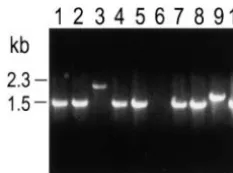
Figure 2.—Representative PCR analysis of DSB-induced
3 51 1.3
mutations. PCR was performed on samples of genomic DNA
4 181 1.7
isolated from cell line 5 and 9 representative TFTR clones
5 19.3 0.4
recovered from cell line 5 after electroporation with
pCMV-6 13 0.2
I-SceI. The pair of primers used were positioned as indicated in Figure 1. The parental cell line generated a 1.5-kb PCR
aCell lines 1 through 4 each contain a single integrated
product (lane 1). Most TFTRclones (lanes 2, 4, 5, 7, 8, and copy of pYL1 (Figure 1) while cell lines 5 and 6 contain an
10) displayed PCR products indistinguishable in size from that integrated copy of only the 2.5-kbBamHI fragment of pYL1.
of the parent. Two clones (lanes 3 and 9) displayed PCR For each cell line, 5 ⫻ 106 cells were electroporated with
products larger than that of the parent while 1 (lane 6) failed pCMB-I-SceI or, in the case of mock experiments, with PBS
to produce any PCR product. A total of 253 TFTR clones alone.
isolated from cell lines 1 through 6 were analyzed by PCR in
bCalculated by dividing the number of TFTR colonies by
a similar manner (see Table 2). the number of cells plated following electroporation. Cells
from lines 1 and 2 were grown for 2, 4, or 6 days after electro-poration before being exposed to TFT. Data presented for all other cell lines and for all mock electroporations are from
Small insertions and deletions associated with repair
experiments in which cells were grown for 6 days after
electro-of a genomic DSB: Southern blotting analysis per-poration before being exposed to TFT.
formed on 12 TFTR clones recovered following mock electroporations revealed that none of the clones
dis-RESULTS played bands that hybridize to atk-specific probe (data
not shown). This suggested that most clones recovered
Experimental scheme:Mouse Ltk⫺fibroblast cell lines
from mock electroporations arise from loss of most or all that contain a stably integrated copy of the DNA
sub-of the integrated construct and that loss sub-of the construct strate pYL1 or only the 2.5-kb BamHI fragment from
occurs more frequently than does point mutation oftk. pYL1 were isolated (Figure 1). This latter fragment of
To study the types of mutations associated specifically pYL1 contains a functional herpes simplex virustkgene
with repair of a genomic DSB,tksequences were PCR with an inserted 24-bp oligonucleotide containing the
amplified from genomic DNA isolated from a total of 18-bp recognition site for yeast endonuclease I-SceI. To
253 TFTRcolonies recovered from cell lines 1 through induce a genomic DSB in the integratedtkgene, cells
6 following electroporation with pCMV-I-SceI. Primers were electroporated with plasmid pCMV-I-SceI, which
were used that were positionedⵑ1.5 kb apart from one expresses endonuclease I-SceI in mammalian cells. Due
another and flanked the I-SceI recognition site originally to the large size of the I-SceI recognition site (18 bp),
present in the integrated tk gene (see Figure 1). As it is likely that only a single genomic DSB is induced by
expected, a PCR product of 1.5 kb was generated when expression of I-SceI. DSB repair events were recovered
parental genomic DNA was used as a template (Figure by selecting for cells that have losttkfunction and thus
2, lane 1). Among the TFTRclones, 196 (78%, Table 2) have gained resistance to the thymidine analog TFT.
produced PCR products that appeared to be 1.5 kb, Selection for loss-of-tk-function in principle should allow
similar to the parental product (see Figure 2, lanes 2, recovery of virtually any type of nonlethal DSB-induced
4, 5, 7, 8, and 10). Twenty-seven such PCR products mutation.
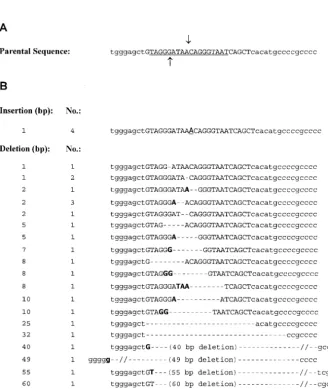
(from cell lines 1 and 2) were sequenced. Four of these
Recovery of TFTR clones following DSB induction:
sequences displayed an insertion of a single “A” at the Cell lines 1 through 4 contain the entire construct pYL1
I-SceI-induced DSB (Figure 3). The remaining 23 se-(Figure 1) and cell lines 5 and 6 contain only the
2.5-quences displayed small deletions of 90 bp or less in kbBamHI fragment of pYL1. Electroporation of each
the immediate vicinity of the I-SceI site, with 16 of 23 of the cell lines with pCMV-I-SceI brought about a
39-displaying loss of 10 or fewer base pairs (Figure 3). to 106-fold increase in the number of TFTR colonies
Capture of DNA sequences at a genomic DSB:
recovered compared with mock electroporations (Table
Twenty-one (8%) of 253 clones analyzed by PCR gener-1). Exposure of cells to TFT had to be delayed until 6
ated PCR products that were larger than the expected days postelectroporation to detect an increase in the
1.5 kb (see Figure 2, lane 3 and 9). The “large” PCR number of TFTRcolonies. We surmise that several days
products were suggestive of insertions of DNA fragments are required after disruption of thetkgene for
intracel-at the I-SceI-induced DSB. All cell lines except for cell lular levels of TK protein to diminish sufficiently to
prod-TABLE 2 ucts (Table 2). Since we analyzed only 18 TFT clones recovered from cell line 1 (Table 2) we could not
ex-DSB-induced mutations
clude the possibility that these putative insertion events occurred in cell line 1 as well.
Small Multiple
As summarized in Table 3, sequencing of the large
Cell deletions or DNA No PCR PCR
line insertionsa captureb product products
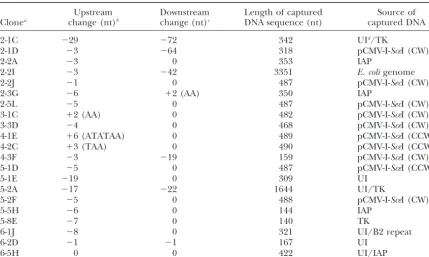
PCR products revealed that DNA fragments ranging from 140 to 3351 bp had been captured at the I-Sce
I-1 17c 1
induced DSB. In some clones, capture of DNA was
ac-2 38 7 8 1
companied by the deletion of 1–101 bp from the DSB
3 9 2 1
4 21 3 termini, while in a few cases capture of a DNA fragment
5 57 6 11 1 was accompanied by an additional insertion of several
6 54 3 11 2 nucleotides. The captured DNA fragments had various
Total 196 (77.5%) 21 (8.3%) 32 (12.6%) 4 (1.6%) sources and are described further below.
Capture of vector DNA: Ten of the 21 TFTR clones Classification of mutations is based on PCR products
gener-ated as described in Figure 2. that generated large PCR products contained a
cap-aDefined by a diagnostic PCR product that is
indistinguish-tured segment of pCMV-I-SceI. The captured fragments able in size from the parental 1.5-kb product (see Figure 2). of pCMV-I-SceI ranged from 159 to 490 bp. Nine of the Nucleotide sequences of 27 such clones are presented in
Fig-10 clones contained a continuous fragment from pCMV-ure 3.
I-SceI while 1 clone (2-2J) contained a 487-bp fragment
bDefined by a PCR product that is visibly larger than the
parental 1.5-kb product (see Figure 2). of pCMV-I-SceI with a 3-bp internal deletion. Curiously,
cNumber of clones recovered for each category.
in all clones that had captured a fragment of pCMV-I-SceI, one end of the captured DNA mapped in the 27 bp a perfect palindrome (5⬘-CAGAGGCCGAGGCCGCCTC
TABLE 3
DNA sequences captured at chromosomal breaks
Upstream Downstream Length of captured Source of
Clonea change (nt)b change (nt)c DNA sequence (nt) captured DNA
2-1C ⫺29 ⫺72 342 UId/TK
2-1D ⫺3 ⫺64 318 pCMV-I-SceI (CW)e
2-2A ⫺3 0 353 IAP
2-2I ⫺3 ⫺42 3351 E. coligenome
2-2J ⫺1 0 487 pCMV-I-SecI (CW)
2-3G ⫺6 ⫹2 (AA) 350 IAP
2-5L ⫺5 0 487 pCMV-I-SecI (CW)
3-1C ⫹2 (AA) 0 482 pCMV-I-SceI (CW)
3-3D ⫺4 0 468 pCMV-I-SceI (CW)
4-1E ⫹6 (ATATAA) 0 489 pCMV-I-SceI (CCW)
4-2C ⫹3 (TAA) 0 490 pCMV-I-SceI (CCW)
4-3F ⫺3 ⫺19 159 pCMV-I-SceI (CW)
5-1D ⫺5 0 487 pCMV-I-SceI (CCW)
5-1E ⫺19 0 309 UI
5-2A ⫺17 ⫺22 1644 UI/TK
5-2F ⫺5 0 488 pCMV-I-SceI (CW)
5-5H ⫺6 0 144 IAP
5-8E ⫺7 0 140 TK
6-1J ⫺8 0 321 UI/B2 repeat
6-2D ⫺1 ⫺1 167 UI
6-5H 0 0 422 UI/IAP
aThe first character of each clone name refers to the cell line (2 through 6) from which the TFTRclone was recovered.
bNumber of nucleotides deleted (⫺) or gained (⫹) upstream from position of the I-SceI cut site on the top
strand of the integrated pYL1 substrate (see Figure 3A). These changes are in addition to the captured DNA sequence. In the three cases involving the gain of several nucleotides (clones 3-1C, 4-1E, and 4-2C), the actual sequences added are indicated in parentheses. The added sequences may be derivatives of the 3⬘overhang sequence ATAA produced upon staggered cleavage of the integrated substrate with I-SceI.
cNumber of nucleotides deleted or gained downstream from the I-SecI cut site on the top strand of the
integrated pYL1 substrate (Figure 3A). The changes are in addition to the captured DNA sequence.
dUI: sequences of unidentified origin. These sequences are not present in GenBank or EMBL.
eRefers to orientation of captured fragment of pCMV-I-SceI. CW: clockwise, meaning that the SV40 origin
sequence is positioned to the left of the ColE1 origin as drawn in Figure 1. CCW: counterclockwise, opposite orientation.
GGCCTCTG-3⬘) of the SV40 origin of replication on pCMV-I-SceI (Figure 4). In 8 of the 10 clones, the other end of the captured fragment mapped in or near the ColEI replication origin on pCMV-I-SceI. Neither origin of replication should have been functional in the mouse Ltk⫺cells.
Cell lines 1 through 4 contain integrated vector se-quences from pYL1 that share substantial homology with vector sequences on pCMV-I-SceI, and so it seemed
possible that capture of a fragment of pCMV-I-SceI could Figure4.—DNA junctions within a palindromic sequence in the SV40 origin of replication. Shown at the top of the depend on homology. Cell lines 5 and 6 contain only
figure is one strand of a 27-bp perfect palindrome from the the 2.5-kbBamHI fragment of pYL1 and thus share no
SV40 origin of replication, with a 13-bp perfect direct repeat homology with pCMV-I-SceI. Two clones (5-1D and 5-2F) underlined. As indicated in Table 3, 10 TFTRclones had cap-isolated from cell line 5 had captured pCMV-I-SceI se- tured a fragment of pCMV-I-SceI. For each of these 10 clones, one end of the captured DNA mapped within the 27-bp perfect quences, indicating that such capture does not require
palindrome from the SV40 origin of replication on pCMV-significant homology.
I-SceI. Indicated is the position within the palindrome at which
Capture of retrotransposable elements into a
geno-the captured DNA in each clone was joined to genomic DNA.
mic DSB:Four clones (2-2A, 2-3G, 5-5H, and 6-5H) had Each captured DNA fragment includes the indicated nucleo-captured all or part of a long terminal repeat (LTR) tide and extends to the right so that none of the final repair
Figure5.—IAP LTR sequences captured at a chromosomal DSB. Shown are the IAP LTR sequences captured at the induced DSB in clones 6-5H, 2-2A, 2-3G, and 5-5H. Nucleotide identity among clones is indicated with a dash, while a nucleotide gap is indicated with a box (䊐). Captured sequences from clones 6-5H, 2-2A, and 2-3G display the typical three-domain structure, 5⬘ -U3-R-U5-3⬘, of an IAP LTR (Christyet al.1985), while the sequence from clone 5-5H is truncated within the U3 region. The borders between the U3, R, and U5 regions are indicated. As shown, clone 2-3G contains a complete U3 region (which begins with the sequence TGTT) while the other clones are missing the first several nucleotides of the U3 region. Indicated in boldface type are enhancer, “CAT box,” “TATA box,” and polyadenylation motifs that are typically found in IAP LTRs. The primer binding sequence is denoted. Underlined bases within the primer binding site are complementary to the 3⬘end of phenyalanine tRNA, which primes reverse transcription of IAP mRNA.
repetitive retrovirus-like sequence in the mouse genome 436 bp was atksegment mapping almost immediately upstream of the DSB. Clone 5-8E captured 140 bp of (Figure 5). Clone 6-5H additionally displayed 20 bp of
unknown origin immediately upstream from the IAP tk mapping 798 bp upstream from the DSB. The tk sequence captured in all three clones shared several sequence. For each of the four clones, 2-2A, 2-3G, 5-5H,
and 6-5H, there were at least 2 bp of homology at the base pairs of homology with DSB termini (see Figure 6). Clone 2-2I contained 3351 bp ofEscherichia coliDNA, IAP sequence/genomic DNA junction at one or both
ends of the DSB (Figure 6). presumably a contaminant that was inadvertently elec-troporated into cells.
For clone 6-1J, the captured DNA consisted of 106
bp of unknown origin followed by a 174-bp sequence The 309-bp insert of clone 5-1E was of unknown origin and contained the microsatellite-like sequence (GAGAA)9 having⬎98% homology to the B2 repeat sequence
fam-ily from the mouse genome. Immediately downstream (AAAGG)3(AAGGG)3at one end. In addition, the abun-dant microsatellite sequence (CCTTTCTT)8(CCTT)13 from the B2 sequence was a run of 41 consecutive A’s
and a polyadenylation signal was found 10 bp upstream (BeckmanandWeber1992) was present at the uniden-tified segment/tkgene junction in clone 5-2A, with the from the run of A’s. Thus, a portion of the DNA
cap-tured in clone 6-1J may have arisen from a B2 cDNA. two sequences joined at 4 bp of homology (CCTT). The insert in clone 6-2D was of unknown origin and
Capture of other sequences at a genomic DSB:Three
clones (2-1C, 5-2A, and 5-8E) had captured a segment displayed a 53-bp imperfect palindrome 6 bp from one junction with genomic DNA.
of the tk gene. The 5⬘-most 141 bp of the clone 2-1C
insert was of unknown origin while the 3⬘-most 201 bp Other DSB-induced rearrangements:Thirty-two TFTR clones among 253 (12.6%) did not generate any PCR was atksegment mapping 825 bp downstream from the
Figure 6.—Microhomology at junctions be-tween captured sequences and genomic DNA. Shown are the sequences at the sites of joining between captured DNA sequences and genomic DNA in several clones. For each junction de-picted, only the top strand from genomic DNA (top line of sequence) and from the source of captured DNA (bottom line of sequence) are shown. The underlined nucleotides represent the actual sequence determined at each junction. Mi-crohomologies at junctions are depicted in bold-face type and occur where the underlined se-quences for each junction overlap. As indicated in Table 3, captured DNA includes tkgene quences (clones 2-1C, 5-2A, and 5-8E), IAP se-quences (clones 2-2A, 2-3G, 5-5H, and 6-5H), and E. coligenomic sequences (clone 2-2I). We could not assess microhomologies at the junctions marked “N/A” because portions of the captured sequences had unidentified sources.
digestion of genomic DNA with BamHI (data not sovichet al.1994;Lin et al.1999) as well as the work of others (RothandWilson1986, 1988;Derbyshire shown). One clone failed to display any bands,
consis-tent with the loss of most or all of the integrated con- et al. 1994; Jackson and Jeggo 1995; Sargent et al. 1997;Lianget al.1998), it had been demonstrated that struct. Of the remaining three clones, one clone
dis-played twoBamHI fragments (8 and 1.5 kb). This clone NHEJ serves as a common mode for DSB repair in mammalian genomes. In our previous studies ( Lukac-may have arisen from a translocation or an insertion of
one or more fragments of DNA containing at least one sovichet al.1994;Linet al.1999), NHEJ in the genome of mouse Ltk⫺fibroblasts was often accompanied by the BamHI site. The remaining two clones each displayed
a single band (2.5 or 3 kb). Each of these clones may loss or gain of just a few nucleotides. Our previous work involved selection for a functionaltkgene, and so ge-have arisen from a deletion of a portion of the tk
se-quence or possibly from other more complex re- netic selection may have influenced the types of repair events recovered. In our current work we used a loss-arrangements. These clones were not studied further.
Another four clones (1.6% of the total) generated of-tk-function selection to study DSB repair and again found that NHEJ with concomitant gain or loss of a multiple PCR products (Table 2), which possibly
re-sulted from the partial amplification of the tk gene. small number of nucleotides is a commonly recovered repair event. (We are cognizant that since we do not These clones were not studied further. Taking into
ac-count all clones generating either no PCR product or know the number of cells in our experiments that actu-ally suffered a DSB, we do not know precisely what multiple PCR products, we inferred that at mostⵑ14%
of the recovered clones had undergone gross chromo- fraction of these cells was recovered.) Greater than 75% somal rearrangements. of thetk-negative clones recovered following DSB induc-tion were products of NHEJ with deleinduc-tion of ⬍90 bp from the DSB site, and more than half of all recovered DISCUSSION
events involved loss of no more than 10 bp (Table 2 and Figure 3). Our results are similar to those reported
Most DSB repair in mammalian chromosomes results
1998) as well as yeast (Krameret al.1994;Mooreand (Liang et al. 1998). DSB repair may thus provide a mechanism for the genesis and/or spread of microsatel-Haber1996b) in which it was shown that NHEJ is often
accompanied by small deletions or insertions. lite repeats in the evolution of mammalian genomes. Clones 2-2A, 2-3G, 5-5H, and 6-5H each displayed an
DSB repair in mammalian chromosomes may be
ac-companied by capture of DNA sequences: We found insert of an LTR region from an IAP sequence (Figure 5). IAPs are endogenous, retrovirus-like sequences re-thatⵑ8% of the recoveredtk-deficient clones had
cap-tured DNA fragments at the DSB site. Capture of DNA siding in the mouse genome atⵑ1000 copies (Leuders andKuff 1977). The LTR of an IAP consists of three fragments into genomic DSBs has been observed by
other groups studying DSB repair in yeast (Mooreand regions referred to as U3, R, and U5 (Christyet al. 1985). In clones 2-2A, 2-3G, and 6-5H, the presence of Haber1996a;Tenget al.1996;Ricchettiet al.1999;
YuandGabriel1999), plants (SalomonandPuchta continuous U3, R, and U5 sequences and a portion of the tRNA primer binding site at which cDNA synthesis is 1998;Kiriket al.2000), and mammalian cells (Sargent
et al.1997;Lianget al.1998;Van De Wateret al.1998). normally initiated suggests that the inserts were derived from plus strand strong-stop replication intermediates. Our current study of 21 cases of DNA capture in a
mammalian chromosome is the most complete such Clone 6-1J captured what appears to be a cDNA copy of a B2 repeat, a retrotransposable element found at study to date. We discovered that nearly 50% of the
clones with inserts (10 out of 21) contained a fragment ⵑ100,000 copies in the mouse genome (Krayev et al. 1982;Kasset al.1997). There have been other reports of pCMV-I-SceI (Table 3). For all 10 clones that captured
part of pCMV-I-SceI, one end of the captured DNA of capture of retrotransposons into genomic DSBs in mammalian cells (Sargentet al.1997;Tremblayet al. mapped in a 27-bp perfect palindrome the SV40 origin
of replication on pCMV-I-SceI (Figure 4); for 8 of these 2000). The apparently somewhat selective capture of retrotransposon-related sequences may be due to an clones, the other end of the captured fragment mapped
in or near the ColE1 origin. It is not presently clear abundance of such sequences in the nucleus.
Good evidence for capture of retrotransposition inter-what role the origins played in the capture mechanism,
although there is some evidence that palindromic struc- mediates into genomic DSBs in yeast has been presented (Moore and Haber 1996a; Teng et al. 1996; Yu and tures may be recombinagenic in mammalian
chromo-somes (seeWaldmanet al.1999). The question of how Gabriel1999). Inserts captured at an HO endonucle-ainduced DSB in yeast commonly contained LTR se-pCMV-I-SceI sequences are so efficiently recruited to
the DSB remains an intriguing issue, but recent work quences from the yeast retrotransposon Ty1. In striking concordance with our findings reported here for mam-suggests that transfected DNA in general may be
effi-ciently recruited to genomic DSBs (Y. Lin and A. S. malian cells, many of the Ty1 sequences captured in yeast resembled plus strand strong-stop replication in-Waldman, unpublished results).
Clones 2-1C, 5-2A, and 5-8E each contain a captured termediates. Our results would appear to challenge a recent inference (Kirik et al. 2000) that the origin of tksegment. The genesis of these clones is economically
explained by a one-sided invasion of a 3⬘DNA terminus sequences captured at DSBs differs strongly between lower and higher eukaryotes.
into thetkgene upstream or downstream from the DSB
at a site of microhomology, followed by extension of It is of interest to note that an abundance of solo LTRs from retrotransposons have been found dispersed the terminus via DNA synthesis using a portion of the
tk gene as template. This newly synthesized strand of through the genomes of higher and lower eukaryotes (Kimet al.1998;Liaoet al.1998;Jordanand McDon-DNA may then be joined by NHEJ to the other side
of the DSB either directly (clone 5-1E) or after first ald1999;GoodwinandPoulter2000). Our current work, and earlier work in yeast (Moore and Haber becoming joined to another sequence (clones 2-1C and
5-2A). Each of the junctions between the inserted tk 1996a;YuandGabriel1999), provides an explanation for the origin of solo LTRs, namely that they may be sequences and genomic DNA displays microhomology
of 1 to 3 bp (Figure 6). There have been previous reports genomic “scars” marking sites of DSB repair. It has also been observed that solo LTRs together with microsatel-of events that appear to have involved copying microsatel-of
geno-mic sequences into DSBs in mammalian (Sargent et lite sequences may be a general feature of meiotic re-combination hotspots in mammalian genomes ( Shiro-al. 1997; Tremblay et al. 2000) and plant (Salomon
andPuchta1998) genomes. Repair of DSBs may pro- ishiet al.1995;Liaoet al.1998). It seems plausible to propose that such recombination hotspots may be sites vide one mechanism for sequence duplication in the
evolution of eukaryotes. that are prone to DSB formation since DSBs are known to be recombinagenic (Lin et al. 1999 and references The repetitive sequence (GAGAA)9(AAAGG)3(AAG
GG)3was found at one end of the insert in clone 5-1E therein). The presence of solo LTRs and microsatellites at the hotspots could then be explained by DNA capture while the sequence (CCTTTCTT)8(CCTT)13was present
at the unidentified portion/tksequence junction in the since, as reported here, these are precisely two types of sequences that are commonly captured at DSBs. insert of clone 5-2A. Others have also reported capture
mamma-Krayev, A. S., T. V. Markusheva, D. A. Kramerov, A. P. Ryskov,
lian cells is undoubtedly safeguarded by DSB repair
K. G. Skryabinet al., 1982 Ubiquitous transposon-like repeats
pathways that generally minimize genetic change, the B1 and B2 of the mouse genome: B2 sequencing. Nucleic Acids diversity of sequence alterations that may be engen- Res.10:7461–7475.
Leuders, K. K., andE. L. Kuff, 1977 Sequences associated with
dered at a DSB implicates chromosome breakage as an
intracisternal A particles are reiterated in the mouse genome.
important catalyst for evolution. The seemingly efficient Cell12:963–972.
recruitment of extrachromosomal DNA to the site of a Liang, F., M. Han, P. J. RomanienkoandM. Jasin, 1998 Homology-directed repair is a major double-strand break repair pathway in
genomic DSB is a puzzle that warrants further
investiga-mammalian cells. Proc. Natl. Acad. Sci. USA95:5172–5177.
tion. Liao, D., T. PavelitzandA. M. Weiner, 1998 Characterization of
a novel class of interspersed LTR elements in primate genomes: We thank Tamas Lukacsovich for his efforts in the initial design of
structure, genomic distribution, and evolution. J. Mol. Evol.46:
DNA constructs and Barbara Criscuolo Waldman for helpful
com-649–660. ments on the manuscript. This work was supported by grants from
Lin, Y., T. LukacsovichandA. S. Waldman, 1999 Multiple path-the American Cancer Society (NP-949) and path-the National Institute of
ways for repair of DNA double-strand breaks in mammalian chro-General Medical Sciences (GM47110) to A.S.W.
mosomes. Mol. Cell. Biol.19:8353–8360.
Liskay, R. M., J. L. StachelekandA. Letsou, 1984 Homologous recombination between repeated chromosomal sequences in mouse cells. Cold Spring Harbor Symp. Quant. Biol.49:183–189.
LITERATURE CITED Lukacsovich, T., D. YangandA. S. Waldman, 1994 Repair of
a specific double-strand break generated within a mammalian Beckman, J. S., andJ. L. Weber, 1992 Survey of human and rat
chromosome by yeast endonuclease I-SceI. Nucleic Acids Res. microsatellites. Genomics12:627–631.
22:5649–5657. Bernstein, C., andH. Bernstein, 1991 Aging, Sex, and DNA Repair.
Moore, J. K., andJ. E. Haber, 1996a Capture of retrotransposon Academic Press, San Diego.
DNA at the sites of chromosomal double-strand breaks. Nature Camerini-Otero, R. D., andP. Hsieh, 1995 Homologous
recombi-383:644–646. nation proteins in prokaryotes and eukaryotes. Annu. Rev. Genet.
Moore, J. K., andJ. E. Haber, 1996b Cell cycle and genetic
require-29:509–552.
ments of two pathways of nonhomologous end-joining repair of Choulika, A., A. Perrin, B. DujonandJ.-F. Nicolas, 1995
Induc-double-strand breaks inSaccharomyces cerevisiae. Mol. Cell. Biol. tion of homologous recombination in mammalian chromosomes
16:2164–2173. by using the I-SceI system ofSaccharomyces cerevisiae.Mol. Cell.
Ricchetti, M., C. FairheadandB. Dujon, 1999 Mitochondrial Biol.15:1963–1973.
DNA repairs double-strand breaks in yeast chromosomes. Nature Christy, R. J., A. R.Brown,B. B.Gourlieand R. C. C.Huang, 1985
402:96–100. Nucleotide sequences of murine intracisternal A-particle gene
Richardson, C., M. E. Moynahan and M. Jasin, 1998 Double-LTRs have extensive variability within the R region. Nucleic Acids
strand break repair by interchromosomal recombination: sup-Res.13:289–302.
pression of chromosomal translocation. Genes Dev. 12:3831– Derbyshire, M. K., L. H. Epstein, C. S. H. Young, P. L. Munz
3842. andR. Fishel, 1994 Nonhomologous recombination in human
cells. Mol. Cell. Biol.14:156–169. Roth, D. B., andJ. Wilson, 1986 Nonhomologous recombination Goodwin, T. J., andR. T. Poulter, 2000 Multiple LTR-retrotranspo- in mammalian cells: role of short sequence homologies in the
son families in the asexual yeastCandida albicans. Genome Res. joining reaction. Mol. Cell. Biol.6:4295–4304.
10:174–191. Roth, D., andJ. Wilson, 1988 Illegitimate recombination in
mam-Haber, J. E., 2000 Partners and pathways: repairing a double-strand malian cells, pp. 621–653 inGeneric Recombination, edited by R.
break. Trends Genet.16:259–264. Kucherlapatiand G. R.Smith. American Society for
Microbiol-Hoffman, G. R., 1994 Induction of genetic recombination: conse- ogy, Washington, DC.
quences and model systems. Environ. Mol. Mutagen.23(Suppl. Rouet, P., F. SmithandM. Jasin, 1994 Expression of a site-specific
24): 59–66. endonuclease stimulates homologous recombination in
mamma-Huang, L.C., K. C. ClarkinandG. M. Wahl, 1996 Sensitivity and lian cells. Proc. Natl. Acad. Sci. USA91:6064–6068.
selectivity of the DNA damage sensor responsible for activating Salomon, S., andH. Puchta, 1998 Capture of genomic and T-DNA p53-dependent G1 arrest. Proc. Natl. Acad. Sci. USA93:4827– sequences during double-strand break repair in somatic plant
4832. cells. EMBO J.17:6086–6095.
Jackson, S. P., andP. A. Jeggo, 1995 DNA double-strand break Sargent, R. G., M. A. BrennemanandJ. H. Wilson, 1997 Repair repair and V(D)J recombination: involvement of DNA-PK. Trends
of site-specific double-strand breaks in a mammalian chromo-Biochem. Sci.20:412–415.
some by homologous and illegitimate recombination. Mol. Cell. Johnson, R. D., andM. Jasin, 2000 Sister chromatid gene conversion
Biol.17:267–277. is a prominent double-strand break repair pathway in mammalian
Shinohara, A., andT. Ogawa, 1995 Homologous recombination cells. EMBO J.19:3398–3407.
and the roles of double-strand breaks. Trends Biol. Sci.20:387– Jordan, I. K., andJ. F. McDonald, 1999 Comparative genomics
391. and evolutionary dynamics ofSaccharomyces cerevisiaeTy elements.
Shiroishi, T., T. Koide, M. Yoshino, T. SagaiandK. Moriwaki, Genetica107:3–13.
1995 Hotspots of homologous recombination in mouse meiosis. Kass, D. H., J. Kim, A. RaoandP. L. Deininger, 1997 Evolution
Adv. Biophys.31:119–132. of B2 repeats: the muroid explosion. Genetica99:1–13.
Southern, P. S., andP. Berg, 1982 Transformation of mammalian Kim, J. M., S. Vanguri, J. D. Boeke, A. GabrielandD. F. Voytas,
cells to antibiotic resistance with a bacterial gene under control 1998 Transposable elements and genome organization: a
com-of the SV40 early promoter. J. Mol. Appl. Genet.1:327–341. prehensive survey of retrotransposons revealed by the complete
Taghian, D. G., andJ. A. Nickoloff, 1997 Chromosomal
double-Saccharomyces cerevisiaegenome sequence. Genome Res.8:464–
strand breaks induce gene conversion at high frequency in mam-478.
malian cells. Mol. Cell. Biol.17:6386–6393. Kirik, A., S. SalomonandH. Puchta, 2000 Species-specific
double-Teng, S. C., B. KimandA. Gabriel, 1996 Retrotransposon reverse-strand break repair and genome evolution in plants. EMBO J.
transcriptase-mediated repair of chromosomal breaks. Nature
19:5562–5566.
383:641–644. Kramer, K. M., J. A. Brock, K. Bloom, J. K. MooreandJ. E. Haber,
Tremblay, A., M. JasinandP. Chartrand, 2000 A double-strand 1994 Two different types of double-strand breaks in
Saccharo-break in a chromosomal LINE element can be repaired by gene
myces cerevisiaeare repaired by similarRAD52-independent,
non-conversion with various endogenous LINE elements in mouse homologous recombination events. Mol. Cell. Biol. 14: 1293–
DNA double-strand breaks in toxicity and carcinogenesis. Crit. Long inverted repeats are an at-risk motif for recombination in
Rev. Toxicol.27:155–174. mammalian cells. Genetics153:1873–1883.
Van De Water, N., R. Williams, P. OckelfordandP. Browe, 1998 Wood, R. D., 1996 DNA repair in eukaryotes. Annu. Rev. Biochem. A 20.7 kb deletion within the factor VIII gene associated with 65:135–167.
LINE element insertion. Thromb. Haemost.79:938–942. Yu, X., andA. Gabriel, 1999 Patching broken chromosomes with Wagner, M. J., J. A. SharpandW. C. Summers, 1981 Nucleotide extranuclear cellular DNA. Mol. Cell4:873–881.
sequence of the thymidine kinase gene of herpes simplex virus