Generative Algorithm for Architectural Design
Based on Biomimicry Principles
Parag Sarwate1, Akshay Patil2
M. Arch (by research) Scholar, Department of Architecture and Planning, Vishveshvaraya Institute of Technology,
Nagpur, India1
Associate Professor, Department of Architecture and Planning, Vishveshvaraya Institute of Technology, Nagpur, India2
ABSTRACT: Generative algorithm is a tool that allows designers to explore possibilities of parametric design in realm of architecture. The aim of this paper is to understand and explore the application of generative modeling based on biomimicry principles to architectural design. It is also necessary to explore how the biological principles can be applied and realized in computational environment with the help of algorithmic approach. This paper outlines the relationship between biomimicry principles, generative algorithm and their architectural applications. The main contribution of this article is in combining the parametric tools of generative algorithms for the design parameters of built environment. The paper also investigates new strategies and tools for architectural design that are inspired from biological processes.
KEYWORDS: Biomimicry, Architecture, Generative algorithm, Parametric Modeling.
I. INTRODUCTION
Nature as inspiration is often combined with mathematics in order to move beyond the superficial inspiration and realize a design[1]. The fluid order in nature is characterized by repetition, growth and change with the fundamental rules that generate order in nature not being absolute but relative, flexible and soft [2]. Algorithmic generation is a method of generating order by setting a basic rule and allowing various external factors to interact with it and can yield “organic” patterns that resemble the natural world [1].
In contemporary architecture design, digital media is increasingly being used not as a representational tool for visualization but as a generative tool for the derivation of form and its transformation [4]. The use of computational techniques increasingly saturates development biology, from the acquisition, processing and analysis of experimental data to the construction of models of organisms. Similar to the biological processes, it is a process of shape/pattern development enabled by computation but in digital environment. But when it comes to algorithms it is not just about software’s and computers, they describe a process of logical thinking.
It became an integral tool in the design process. Computational Geometry became an interesting subject to study and combination of programming algorithms with geometry, yielded algorithmic geometries known as Generative Algorithms [5]. Although 3D software helped to simulate almost any space visualized, it is the Generative Algorithm notion that brings the current possibilities of design, like ‘parametric design’ in the realm of architecture. The field of algorithmic generation based on natural principles and processes and their application to architecture is what is of utmost importance to us.
II. APPLICATIONOFBIOMIMICRYTOARCHITECTURALCONTEXT
The nature has always been an inspirational source for architects and designers. This inspiration has given various highly efficient designs in various fields. One of the best concept in which, we see nature as the influential source of inspiration. Biomimicry means mimicry of biological processes. Biomimicry is a new science and design discipline that studies nature’s models and then emulates these forms, processes, systems and strategies to solve the problems of our time [6]. The core idea is creative and sustainable by necessity and it can be used as an ecological standard to judge the sustainability of our designs.
It is a fast growing and exciting field of study that seeks to understand how to integrate living and breathing organisms into a design process. Although various forms of biomimicry or bio-inspired design are discussed by researchers and professionals in various fields but practical application of biomimicry as an architectural design method remains largely unrealized and is a new emerging discipline within architecture seeking to use nature and it’s systems as an educational tool for sustainable design.
It is assumed that application of biomimicry principles in design is the most nature friendly medium to achieve maximum sustainability. However, biomimicry as a design method remains mostly unexplored. The available literatures and works definitely give us a clear idea about the outcome of biomimicry applications in terms of overall sustainability or regenerative potential. Hence the utmost need is to explore avenues of various applications on realistic fronts.
What Ramaswamy (2007) provides is a way in which to understand the different approaches used with architecture. While he does discuss all five approaches, his focus tends to be on interpretation; this appears to be largely due to the fact that there is a broad range of examples. Simulations can be seen in many examples, but is a superficial approach that does not do any real justice to the ideologies of biomimicry, and Ramaswamy points out that while they may copy form or appearance, they are often highly energy inefficient and involve complex processes of construction which are environment unfriendly. What interpretation offers is a wide range of examples that take attributes from nature such as geometry, structure and systemsand apply them in a manner which improves their performance. The ideal for Ramaswamy is replication and emulation but these require a conceptual leap, where buildings act as living organisms [7].
This paper will focus on how the campus or institute moves towards sustainability by adopting relevant biomimicry principles and approaches within their campus design. It seeks to demonstrate realistic picture of how institutes can achieve efficient campus design.Institutes are areas of innovation and learning. Institutes are also large economic engines that have huge impacts on the regions they inhabit. Therefore campus is the ideal location to test out concepts of sustainable development on a small scale.Well thought out campus design has the potential to incorporate a sustainable built environment which provides essential ecosystem services as well as social psychological and economic benefits. Campus design is a broad concept that includes the efficient built environment and overall master plan.
The basic objective of any institute or campus is to synthesize user needs. It should give a sense of community and a sense of belonging. The main challenges like circulation should be at ease and very efficient. There should be effective interaction and open communication between different buildings and users. Pedestrian and vehicular movements should be well organized and planned. Scale, size, proportion and form of the built environment should be as per use and need. And at the same time it should fulfill all the necessary requirements like daylight and energy consumptions. Lastly functional and visual ties of buildings, indoor and outdoor spaces should be justified as per context.
III.GENERATIVEALGORITHM
Scale is one of the main issues in biomimicry inspired design and nature as a source of idea to generate computational model. Some ideas in microscopic scales are not viable to transfer and mimic in the macro scale [8]. That is the reason biomimicry is still mostly unexplored on the actual scale. The evaluation of any physical outcome of biomimicry undergoes lots of experiments and tests to check if the idea is working on the desired scale or not. This issue can be treated efficiently with the help of generative algorithm and simulation.
Architects and designers are using Algorithms as the computational tool to do their task. An algorithm is a set of rules and instructions in a step by step procedure to calculate process data and do a defined task. For any piece of data as input, an algorithm will perform its predefined operations and calculate the results. In this manner, a design algorithm will also provide a design output if being fed by relevant input information. In conventional design systems, there are various parameters like site, program, building typology, facilities etc which should be considered during the design process. In algorithmic processes it is attempted to transfer these parameters as input information into algorithm to generate design solutions [5]. This process is currently known as algorithmic, parametric or generative design. This paper investigates how one can develop these generative algorithms for institute designs based on biomimicry principles.
The process of computation has three main steps. The first step is the form generation process and the result would be a digital geometry which is associated with certain external data. This is the aim of the algorithm which converts the natural morphogenesis of an organism to a digital one. The second step is fabrication. After developing geometry with algorithms it is necessary to build that geometry in the desired scale. If we want a real scale build environment based on biomimicry principles, then we have to introduce fabrication process in Computer-Aided Manufacturing (CAM). CAM made it possible to build such building profiles by using digital fabrication machines [5]. Moving from design to fabrication encompasses a critical point. Any built environment is a physical entity and the design generated in computational tool needs to analyze in every manner. This analysis might start from environmental analysis like sun exposure, shade, wind, rain etc. or structural behaviour, energy consumption and so on. It can help to improve design in various ways. This could result into a dynamic feedback loop which affects design process. These feedback loops could be considered for enhancing its behaviour and get more successful results.
Generative Algorithm is an experimental approach to create practical architectural solutions based on biomimicry principles.
Many of our design choices are controlled by laws and regulations, and certain decisions rule out or enable new options. As with algorithms, we too are controlled by if/then/or-else conditional choices. We make decisions based on validated data on algorithmic processes and those decisions guide us through the design process.
To work with complex objects, a design process usually starts from a very simple first level and then other layers are added; complex forms are comprised of different hierarchies, each associated with its own logic and details. These levels are also interconnected and their members affect each other. So this method of design deals with the huge amount of data and calculations and happens through the flow of algorithms. The point is that all these geometries are easily adjustable after the process. Designer always has access to the elements of design product from start point up to details. Actually, since the design product is the result of an algorithm, inputs of the algorithm could be changed and the result would also be updated accordingly.
Algorithm makes smart decisions for designers to achieve desired results. Algorithmic design process for architecture has three states of action:
• Input of data set
• The manipulation and analysis of the data set
There are various tools available to generate algorithmic design in architecture in the form of parametric software's, plug-ins, scripts and codes. In the fifth section we will see how form and geometry is generated with the help of this parametric software.
IV.METHODOLOGY
Biomimicry is a methodology in which biological systems, processes and elements are studied to draw analogies to be applied to design challenges in a sustainable manner.
This paper seeks to understand application of generative algorithm based on biomimicry principles to the architectural context. To achieve this, a case of institute is selected to fulfill the requirement of architectural context. Some issues are identified where biomimicry principles can be applied. Various examples of biomimicry principles are identified which are relevant to the context. Grasshopper is used as a computational tool for developing site plan grid. 3D Max is used for built forms.
V. EXPERIMENTALSTUDYANDRESULTSREVIEW
This section will develop the design challenges identified in the context appraisal (Section II). Adopting from relevant literature study, organisms/ecosystems that could solve these challenges will be identified. This will involve challenge to biology design spiral. The use of spiral involves identifying what the major challenges are and seeking organisms/biological systems that meet these challenges [9]. The process involves 6 stages as follows:
1. Identify: The challenge 2. Interpret: Design brief 3. Discover: Natural models 4. Abstract: Design principles 5. Emulate: Nature's strategies 6. Evaluate: Against life's principles
Fig.1.Design Spiral (Biomimicry Guild)
Life principles are interconnected so it is the purpose to optimize these strategies to create conditions conductive to life [10].
A. Stage 1: Identify - The design challenge
1. To design open and semi open spaces to achieve multiple interactions between users as well as buildings 2. User friendly spaces
3. Efficient accesses and connecting corridors
4. Segregation of spaces as per user needs and their convenience 5. To ensure that the framework introduces a ‘sense of place’ 6. Design in context of architecture
7. Form & scale as per the present & future needs
8. To promote self-sufficiency in places of work, energy production and minimising waste.
9. Any designs should look to provide relevant and productive landscapes as an additional ecosystem service 10. Open & enclosed spaces serve as functional & visual ties
11. Architecture of a campus
12. Efficient accesses and connecting corridors 13. Connectivity between formal or inform activities 14. To provide sustainable transport solutions
15. To ensure that the street patterns segregate pedestrian & vehicular movement
16. To minimise the use of private motor vehicles and promote mass transit, cycling and increase permeability. 17. Built environment shall be climate responsive
18. To minimize the consumption of energy and natural resources
19. To provide links to the ecological areas on the site and in the area surrounding
B. Stage 2: Interpret - Design Brief
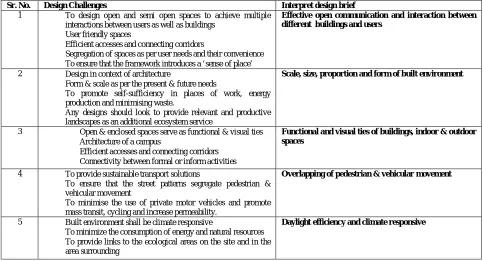
The next stage is to interpret design brief or design context of each of the challenges. This will allow some of the challenges to be grouped together and identify those that can be solved using nature. These are categorized in the below Table no 1.
TABLE I: DESIGN BRIEF INTERPRETATION
Sr. No. Design Challenges Interpret design brief
1 To design open and semi open spaces to achieve multiple interactions between users as well as buildings
User friendly spaces
Efficient accesses and connecting corridors
Segregation of spaces as per user needs and their convenience
To ensure that the framework introduces a ‘sense of place’
Effective open communication and interaction between different buildings and users
2 Design in context of architecture
Form & scale as per the present & future needs
To promote self-sufficiency in places of work, energy production and minimising waste.
Any designs should look to provide relevant and productive landscapes as an additional ecosystem service
Scale, size, proportion and form of built environment
3 Open & enclosed spaces serve as functional & visual ties
Architecture of a campus
Efficient accesses and connecting corridors
Connectivity between formal or inform activities
Functional and visual ties of buildings, indoor & outdoor spaces
4 To provide sustainable transport solutions
To ensure that the street patterns segregate pedestrian & vehicular movement
To minimise the use of private motor vehicles and promote mass transit, cycling and increase permeability.
Overlapping of pedestrian & vehicular movement
5 Built environment shall be climate responsive
To minimize the consumption of energy and natural resources
To provide links to the ecological areas on the site and in the area surrounding
Daylight efficiency and climate responsive
C. Stage 3: Discover – Natural models
Third stage is to discover natural models which would be suitable for the above 5 challenges. These natural models are adopted from AskNature.org, an open source library managed by Biomimicry 3.8 [9]. Shortlisted models for the 5 challenges are as follows:
Phyllotactic patterns mean literally the arrangement of leaves. The arrangement of leaves fall into 4 main categories: spiral, distochous, whorled, and multijugate.
Honeycomb: The honeycomb is a structure that consists of cells with the shape of hexagons. It is strong, stiff and light in weight. The shape makes efficient use of space.
Termite mound: The shape ranges from somewhat amorphous domes or cones usually covered in grass and/or woody shrubs, to sculptured hard earth mounds, or a mixture of the two.
Translucent cells: In translucent cell morphology, each cell of the system is aimed to respond to some of its environmental stimuli by its form and geometry.
Red Porifera or Sponges: Global geometry/form and cellular level present various features in order to live in marine condition.
Xanthus sponge (porous shell): A micro-marine organism called ‘Radiolaria’. It is a unicellular organism with a silicon pourous shell capable of covering various spaces with different geometries & conditions. Porous surface can capture good amount of daylight.
Cactus (EchinocactusGrusonii): The combined morphological features – hydrostatic & ribbed body help in reducing thermal heat gain through a combination of self shading and utilizing air flow.
Cactus (EchinocactusGrusonii): The combined morphological features – hydrostatic & ribbed body help in reducing thermal heat gain through a combination of self shading and utilizing air flow.
Namibian desert beetle, Stenocara: The beetle is able to capture moisture from the swift moving fog. Droplets form on the alternating hydrophilic – hydrophobic rough surface of the beetle’s back and wings and roll down into its mouth.
The sweet glands of many mammals aid thermoregulation through evaporative cooling. In case of body overheating, the air scoops on the sides of ants cool them through evaporative cooling process.
Fractal geometry: It is the study of mathematical shapes that display a cascade of never ending, self similar, meandering detail, as one observes them closely. Leaves, branching in trees, mountain edges, flood levels of a river, wave patterns, nerve impulses and other such natural forms and formations display this progression of self similar form. Apart from nature’s physical form, the way nature changes through time are also fractal.
Emergence & self organisation in ecosystems are the phenomena of novel and unexpected organisation in complex systems. Emergence appears through new relationships of control and constraint, allowing systems to become more complex. Ecosystems tend to be made up of distributed and decentralised networks of feedback loops dependent on relationships between organisms, and between living system and the rest of the environment, making them rapidly responsive and adaptable to change.
This kind of organisation, based on multiple feedback mechanisms, tends to incorporate high amounts and transfer rates of information.
Translating this into the built environment implies a system approach to architectural design where considering the facilitation of relationships of buildings or components is as important as designing the individual buildings themselves.
These ideas are not yet tested in realized built form.
D. Stage 4: Abstract – Design Principles
With the above examples of nature suitable for the design challenges, we can now abstract principles before emulating them within designs for the architectural design framework. These are as follows:
a. Emergence &self-organization:
Effective open communication and interaction between different buildings and users
Overlapping of pedestrian & vehicular movement
Site planning policies
Functional and visual ties of buildings, indoor & outdoor spaces.
Scale, size, proportion and form of built environment
Overlapping of pedestrian & vehicular movement
c. Cactus (EchinocactusGrusonii):
Minimize the consumption of energy and natural resources
Water storage
d. Phyllotactic patterns of leaves:
Scale, size, proportion and form of built environment
Movement & connectivity
e. Honeycomb:
Form of built environment
Site Planning
f. Xanthus sponge (porous shell): Radiolaria Built Form
Daylight efficiency
E. Stage 5: Emulate – Nature’s Strategies
In previous section, various organism and ecosystems are shortlisted and identified among the available examples for the architectural challenges. This section elaborates the application of these nature’s strategies into an architectural design. In this paper, the demonstration model focuses on site planning grid. How to achieve site planning, road networks, circulation and overall zoning will demonstrate below. In the previous stage abstract design principles, for site planning we can adopt characteristics of natural patterns like hexagon pattern and fractal geometry principles found in mathematics and nature.
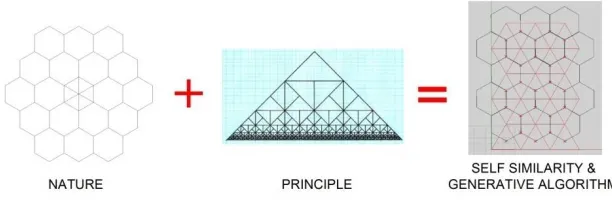
Fig. 2:The result of co-relation of Nature and self similarity
Figure 02 shows the pattern has been emerged after interlinking hexagonal grid with fractal principles. Center points of all hexagons are connected in the grasshopper tools and created a self-similarity based geometry. For architectural design output triangular geometry can be used for the road network and overall hexagonal grid can be used for zoning and division of spaces.
Figure 3 shows the algorithm script to create hexagonal grid. This is the initial stage to create desired geometry by adding and modifying parameters.
Fig4: The overlapping hexagonal grid [12]
Figure 4 shows the algorithm scripting in Grasshopper tool and its output in Rhino3D software. The grid is generated by considering various parameters.
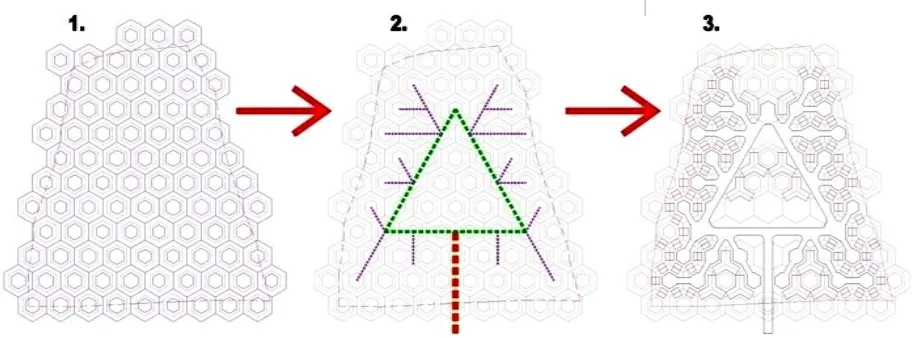
Fig 6: Grid Pattern and Design Evolution
(a) (b)
Fig7: The final output (a) Top view of site showing road network and buildings (b) 3D Modeling done in 3D Studio Max
VI. CONCLUSION AND FUTURE ENHANCEMENT
This paper is an investigation into the development of design method based on biological principles that are applied and correlated with computational design. It is important to materialize the architectural output based on application of biomimicry. It can be concluded that the stated methodological frameworks enable the designer to produce an efficient architecture in terms of sustainability. But at the same time this approach relies on very specific knowledge, skills and tools.
The advantage of this approach helps to generate vast possible options required for the various contexts. The technical implementation of algorithmic growth processes can derive various strategies and can achieve desired results. It can be concluded that it is easy to deliver biomimicry based design.
The demonstration model which is presented in this paper is still within the context of research and further exploration is necessary. It is evolved on the basis of certain data provided to the algorithm to materialize the design. The output can vary as per algorithm if we change the requirements, data and overall scripting method. But we can consider this biomimicry based design and simulation approach as a medium to achieve sustainability upto certain limit. The evaluation of the outcome in terms of sustainability is to be explored and analyzed.
REFERENCES
[1] Ito T., “Algorithms are Nothing More than an Opportunity to Create Architecture that Respires”, in The Japan Architect,no – 77, pp. 36–45, 2010.
[2] RianIasefMd, “Tree - Inspired Dendriforms and Fractal like Branching Structures in Architecture: A Brief Historical Overview”, Frontiers of Architectural Research, ELSEVIER, vol. 03, Issue no.3, pp. 298–323, Sept 2014.
[3] Hanafin S, “Growth & Replication: Exploring Façade Subdivision based on Natural Processes”, Thesis, Deakin University, 2011. [4] Kolarevic B., “Architecture in the Digital Age – Design & Manufacturing”, Spon Press Taylor &Fransic Group, New York, London, 2003. [5] KhabaziZubin, “Generative Algorithm Using Grassgopper”, Morphogenerism, 2012.
[6] Dr. InasHosug Ibrahim Anous, “Biomimicry, Innovative Approach in Interior Design for Increased Sustainability”, AIJRFANS, ISSN (Print): 2328-3777, ISSN (Online):2328-3785, 15-217, 2015.
[7] SakthivelRamaswamy, “Biomimicry – An Analysis of Contemporary Biomimitic Approaches”, SID Research Cell, CEPT University, 2007.
[8] Salma Ashraf Saad El Ahmar, “Biomimicry as a Tool for Sustainable Architectural Design”, Thesis, Graduate School of Engineering, Alexandria University, 2011 [9] Richard James MacCowan, “Can Principles of Biomimicry be Used for the Creation of an Urban Design Framework for Canvey Island?’, Thesis, Leeds
Metropolitan University, 2012. [10] Biomimicry 3.8, AskNature.org, 2008. [11] www.grasshopper3D.com
[12] www.youtube.com
[13] J. Benyus, “Biomimicry – Innovation Inspired by Nature”, Harper Collins, New York, 1998.
[14] M.P.Zari, “Biomimetic Approaches to Architectural Design for Increased Sustainability”, Sustainable building conference, Aukland, 2007. [15] www.biomimicryguild.com, 2007.
[16] P. George, “Biomimicry–inspired Learning Theories”, knowledgefederation.wiki.ifi.no, 2007.
[17] A. Marshall , S. Lozeva, “Questioning the Theory and Practice of Biomimcry, International Journal of Design and nature and Ecodynamics, 1-10, 2009. [18] D.C.Wahl, “Bionics vs. Biomimicry: From Control of Nature to Sustainable Participation in Nature”, WIT transactions on Ecology and the Environment, 289-298,
2006.