Particle Projection Using a Complex Langevin Method
Christopher R.Shill1and Joaquín E.Drut1
1Department of Physics and Astronomy, University of North Carolina, Chapel Hill, NC, 27599, USA
Abstract. Using complex stochastic quantization, we implement a particle-number pro-jection technique on the partition function of spin-1/2 fermions at finite temperature on
the lattice. We discuss the method, its application towards obtaining the thermal proper-ties of finite Fermi systems in three spatial dimensions, and results for the first five virial coefficients of one-dimensional, attractively interacting fermions.
1 Introduction
Calculating the thermodynamics of any quantum many-body system is a challenging but generally in-teresting problem for a variety of applications. By far the main roadblock in Monte Carlo calculations of such systems is the sign problem, whose impact affects fields ranging from ultracold atoms [1,2] to
QCD [3]. In the last few years, a concerted effort to tackle this issue has been taking place, as several
techniques have been put forward to that effect (see e.g. [4]). In this work, we make use of one of those
ideas, namely that of complex stochastic quantization (i.e. we use the complex Langevin approach) to explore the feasibility of particle-number projection in the calculation of the thermal properties of finite clusters and in the numerical determination of virial coefficients.
We begin by recalling that the equilibrium thermodynamics is encoded in the grand canonical partition function,
Z=tre−β( ˆH−µNˆ), (1)
where ˆHis the Hamiltonian, ˆNis the particle number operator,βis the inverse temperature, andµis the chemical potential. This in itself is nearly impossible to solve for essentially all interacting cases. To gain a better understanding, in particular in dilute regimes, we may expand aboutz = eβµ = 0,
wherez is the fugacity. Such a low-fugacity expansion is what we call the virial expansion. The corresponding coefficients accompanying the powers ofzin the expansion of the grand-canonical
partition functionZare theN-particle partition functions; specifically, for spin-1/2 fermions,
Z=
∞
n↑,n↓=0
zn↑
↑z
n↓
↓ Qn↑,n↓ (2)
To further analyze the thermodynamics of many-body systems we can study the grand-canonical potential,−βΩ =lnZ. Again, expanding in powers ofz↑ andz↓ we achieve an expansion about the
dilute limit. This yields,
−βΩ =lnZ=Q1
∞
n↑,n↓=1 bn↑,n↓z
n↑
↑z
n↓
↓ (3)
Wherebn↑,n↓ are the “virial coefficients” of order N = n↑+n↓. These are of particular interest as
they give access to the equation of state (EoS), and therefore to observables for these many-body systems (i.e. density, pressure, compressibility, etc.). Moreover, current experiments with ultracold atoms have gained increasing access to finely controllable parameters such as temperature, coupling, polarization, mass imbalance, and trap shape (harmonic, hard wall, lattices), which allows direct comparison of thermodynamic predictions in the dilute limit, which is the focus of this work.
In this contribution, we show our progress towards accessingQn↑,n↓for the universal regime called
the unitary Fermi gas [5], with the aim of characterizing properties of finite systems, i.e. those derived from the Helmholtz free energy−βF =lnQn↑,n↓ of finite clusters. Our second main goal is to use a
similar approach to compute virial coefficients,bn↑,n↓, at various orders for the one-dimensional Fermi
gas with attractive, short-range interactions. To that end, we use a variant of the complex Langevin method as a means of stochastic quantization.
2 Formalism
2.1 PreliminariesBelow, we will make use of the path integral representation of the grand-canonical partition function, namely
Z=
DσdetM[σ], (4)
whereσis a Hubbard-Stratonovich field representing a two-body interaction and the system is
as-sumed to be non-relativistic. The specific dynamics of the system at hand is encoded in the matrix
M[σ]. In particular for a two-species non-relativistic system, it is not difficult to show [6] that
detM[σ]=det(I+z↑U[σ]) det(I+z↓U[σ]), (5)
whereU[σ] does not depend on the chemical potential. The above equation is the source of the
so-called sign problem in polarized non-relativistic matter, asU[σ] is real for attractive interactions
butz↑ z↓leads to different determinants for each species (generally of different, fluctuating sign). In the sections below, we implement a method to compute canonical partition functions and virial coefficients, both based on the idea of particle projection, which is in essence a Fourier transform on
a variableφif the fugacity is replaced by takingz→ zeiφ. Such a transformation, which makesza
complex variable, introduces a phase problem in conventional lattice Monte Carlo approaches.
2.2 Complex Langevin and Stochastic Quantization
The idea of stochastic quantization is that a random process that obeys the Langevin equation
∂σ(θ) ∂θ =−
δS[σ]
To further analyze the thermodynamics of many-body systems we can study the grand-canonical potential,−βΩ =lnZ. Again, expanding in powers ofz↑andz↓ we achieve an expansion about the
dilute limit. This yields,
−βΩ =lnZ=Q1
∞
n↑,n↓=1 bn↑,n↓z
n↑
↑z
n↓
↓ (3)
Wherebn↑,n↓ are the “virial coefficients” of orderN = n↑+n↓. These are of particular interest as
they give access to the equation of state (EoS), and therefore to observables for these many-body systems (i.e. density, pressure, compressibility, etc.). Moreover, current experiments with ultracold atoms have gained increasing access to finely controllable parameters such as temperature, coupling, polarization, mass imbalance, and trap shape (harmonic, hard wall, lattices), which allows direct comparison of thermodynamic predictions in the dilute limit, which is the focus of this work.
In this contribution, we show our progress towards accessingQn↑,n↓for the universal regime called
the unitary Fermi gas [5], with the aim of characterizing properties of finite systems, i.e. those derived from the Helmholtz free energy−βF =lnQn↑,n↓ of finite clusters. Our second main goal is to use a
similar approach to compute virial coefficients,bn↑,n↓, at various orders for the one-dimensional Fermi
gas with attractive, short-range interactions. To that end, we use a variant of the complex Langevin method as a means of stochastic quantization.
2 Formalism
2.1 PreliminariesBelow, we will make use of the path integral representation of the grand-canonical partition function, namely
Z=
DσdetM[σ], (4)
whereσis a Hubbard-Stratonovich field representing a two-body interaction and the system is
as-sumed to be non-relativistic. The specific dynamics of the system at hand is encoded in the matrix
M[σ]. In particular for a two-species non-relativistic system, it is not difficult to show [6] that
detM[σ]=det(I+z↑U[σ]) det(I+z↓U[σ]), (5)
whereU[σ] does not depend on the chemical potential. The above equation is the source of the
so-called sign problem in polarized non-relativistic matter, asU[σ] is real for attractive interactions
butz↑ z↓leads to different determinants for each species (generally of different, fluctuating sign). In the sections below, we implement a method to compute canonical partition functions and virial coefficients, both based on the idea of particle projection, which is in essence a Fourier transform on
a variableφif the fugacity is replaced by takingz→ zeiφ. Such a transformation, which makesza
complex variable, introduces a phase problem in conventional lattice Monte Carlo approaches.
2.2 Complex Langevin and Stochastic Quantization
The idea of stochastic quantization is that a random process that obeys the Langevin equation
∂σ(θ) ∂θ =−
δS[σ]
δσ(θ) +η, (6)
will yield configurationsσthat are distributed according toe−S[σ]. Here,θis Langevin time andηis
gaussian random noise (see e.g. [3]). We assume our Hubbard-Stratonovich fieldσis real. However,
whenS[σ] is complex, the Langevin equation naturally implies that σ must be complexified into
σ =σR +iσI. Thus, stochastic quantization requires complexified fields and the (spacetime local) Langevin equation now has both real and imaginary parts,
σR(n+1) = σR(n)+KR(n)+√η(n), (7)
σI(n+1) = σI(n)+KI(n), (8)
where the Langevin time has been discretized asθ=n, andis the time step. Again,η, is the real Gaussian noise such thatη(n)=0. The drift terms are now specified as,
KR
a,x = −Re
δS
δσ σ→σR+iσI
, (9)
KI
a,x = −Im δS
δσ σ→σR+iσI
. (10)
2.3 Particle Projection Method
As a starting point, we use the auxiliary-field representation of the grand-canonical partition function on the lattice, which reads
Z =
Dσdet(I+z↑U[σ]) det(I+z↓U[σ]), (11)
whereσis the Hubbard-Stratonovich auxiliary field, andU[σ] encodes all the properties of the
Hamil-tonian of the system. Expanding in terms of the low-fugacity limit we rewrite
Z=
∞
n,m
zn
↑zm↓Qn,m. (12)
Particle projection consists in implementing delta functions that selectn↑andn↓ in the above sum, that isδn↑,n andδn↓,m. To that end, we first takeZ[z↑,z↓] → Z[z↑ei
φ↑,z
↓eiφ↓], such that our fugacity expansion ofZbecomes,
Z[z↑eiφ↑,z↓eiφ↓]=
n,m
zn
↑einφ↑zm↓eimφ↓Qn,m. (13)
We may thus project out the desired individual partition functionsQn↑,n↓ using a Fourier integral in
the usual way, namely
2π
0 dφ↑
2π
dφ↓
2πZ[z↑e iφ↑,z
↓eiφ↓]z−↑n↑e−in↑φ↑z−↓n↓e−in↓φ↓ = (14)
=
2π
0 dφ↑
2π
dφ↓ 2π
n↑,n↓
zn
↑einφ↑zm↓eimφ↓Qn,m
z−↑n↑e−in↑φ↑z−
n↓
↓ e−in↓φ↓ (15)
=
n↑,n↓
zn↑−n
↑ z
n↓−m
In practice, we may defineΦ =(σ, φ↑, φ↓) as a new auxiliary field variable and perform the Fourier integral as part of stochastic process (see below). For this purpose, we includeφ↑andφ↓as part of our action and integral as follows,
Qn,m=
DΦexp−Sn,m[Φ], (17)
where
Sn,m[Φ]=−lndet(I+z↑U[σ]) det(I+z↓U[σ])z−n
↑ e−inφ↑z−↓me−imφ↓
. (18)
From this point on, thermodynamic properties of finite clusters can be obtained in the usual way by formally taking derivatives ofQn,mwith respect to the desired source and computing expectation
values in the extended ensemble defined by the variableΦ.
2.4 Virial Projection
By definition, the virial expansion of the partition functionZcan be written as
lnZ[z]=Q1
∞
n=1
bnzn, (19)
wherezis the fugacity,bnare the virial coefficients andQ1is the single-particle partition function.
Based on the above expression, we may use Fourier projection to obtain the virial coefficients:
bn= 1
Q1
2π
0 dφ
2πe
iφnlnZ[z→e−iφ]. (20)
More generally, we may define the function
bn(ξ)= 1
Q1
2π
0 dφ
2πe
iφnlnZ[z→ξe−iφ]=b
nξn, (21)
where the last identity is easy to see from our first definition above.
This last equation, however, does not help in computing any of the above: while we have a path-integral form forZ, the presence of the logarithm makes a direct evaluation impractical. Nevertheless, inserting the path-integral form of the partition function and differentiating with respect toξwe obtain a more useful expression:
∂bn(ξ) ∂ξ =
1 Q1
2π
0 dφ
2πe
iφn DσP[σ, ξe−iφ] trM−1∂M/∂ξ, (22)
whereP[σ,z]≡detM[σ,z]/Z[z]. Using shorthand notation for the expectation value with respect to the above weightP,
∂bn(ξ) ∂ξ =
1 Q1
2π
0 dφ
2πe
iφntrM−1∂M/∂ξ
φ,ξ=nbnξ
n−1, (23)
In practice, we may defineΦ =(σ, φ↑, φ↓) as a new auxiliary field variable and perform the Fourier integral as part of stochastic process (see below). For this purpose, we includeφ↑andφ↓as part of our action and integral as follows,
Qn,m=
DΦexp−Sn,m[Φ], (17)
where
Sn,m[Φ]=−lndet(I+z↑U[σ]) det(I+z↓U[σ])z−n
↑ e−inφ↑z−↓me−imφ↓
. (18)
From this point on, thermodynamic properties of finite clusters can be obtained in the usual way by formally taking derivatives ofQn,mwith respect to the desired source and computing expectation
values in the extended ensemble defined by the variableΦ.
2.4 Virial Projection
By definition, the virial expansion of the partition functionZcan be written as
lnZ[z]=Q1
∞
n=1
bnzn, (19)
wherezis the fugacity,bnare the virial coefficients andQ1is the single-particle partition function.
Based on the above expression, we may use Fourier projection to obtain the virial coefficients:
bn= 1
Q1
2π
0 dφ
2πe
iφnlnZ[z→e−iφ]. (20)
More generally, we may define the function
bn(ξ)= 1
Q1
2π
0 dφ
2πe
iφnlnZ[z→ξe−iφ]=b
nξn, (21)
where the last identity is easy to see from our first definition above.
This last equation, however, does not help in computing any of the above: while we have a path-integral form forZ, the presence of the logarithm makes a direct evaluation impractical. Nevertheless, inserting the path-integral form of the partition function and differentiating with respect toξwe obtain a more useful expression:
∂bn(ξ) ∂ξ = 1 Q1 2π 0 dφ
2πe
iφn DσP[σ, ξe−iφ] trM−1∂M/∂ξ, (22)
whereP[σ,z]≡detM[σ,z]/Z[z]. Using shorthand notation for the expectation value with respect to the above weightP,
∂bn(ξ) ∂ξ = 1 Q1 2π 0 dφ
2πe
iφntrM−1∂M/∂ξ
φ,ξ=nbnξ
n−1, (23)
In practice, we do not need a continuous representation for the Fourier integral, particularly because we cannot include this as part of the stochastic process as in our particle projection method due to the logarithm between these integrals (i.e. the integral over the projecting angles does not appear in
the normalization ofP). Rather, we may use an exact discrete representation via the associated angle valuesφk=2πk/Nk, wherek=0, . . . ,Nk−1 andNkis the number of discretization points, i.e.
∂bn(ξ) ∂ξ =
1 Q1
1
Nk Nk−1
k=0
eiφkntrM−1∂M/∂ξ
φk,ξ=nbnξ
n−1, (24)
What is interesting about Eq. (23) is that, by using the complex Langevin method to determine the complex expectation value as a function ofφkandξ, followed by summing overφkwith appropriate
phases, we may have access tobnitself.
In this approach, varyingξcould be very advantageous, as we know the exactξdependence of the final result via the last identity of Eq. (23). To enhance the sensitivity of the approach, it is preferable to takeξto be as large as possible, since thebntend to be small numbers. However, we anticipate
that takingξ∼0.1 or larger could introduce considerable noise in the calculation. Thus, a priori (and ideally), we expect to find a window of values ofξmakes the approach viable. Our knowledge of the functional dependence mentioned above should connect the data points for allξwith a single curve. In fact, the expected dependence can be accounted for by plotting
bn= 1
nξn−1
∂bn(ξ)
∂ξ (25)
as a function ofξand fitting a constant. If the number of Fourier discretization points Nk is large
enough, we expect to see such a constant behavior beyond the statistical precision. We pursue such an approach below.
3 Results
3.1 Particle Projection Results
Figure 1: Running average over Langevin time,τ, where
τ0is the total number of Langevin time steps, of the total
particle numbers, nˆ↑ andnˆ↓. Separate runs are seen to converge to the expected particle number for the 2+1
case (blue) and the 6+3 case (red). The data corresponds
toV=Nx3,Nx=6,β=3.0, tuned to the unitary limit. The simplest and most important
verifi-cation of this method is computing the projected particle numbers for each fla-vor. The observable in the grand canon-ical ensemble is given by
Nˆ=tr(M−1[σ]∂M[σ]/∂z),(26) which is to be averaged over Langevin time. As Langevin time progresses, the running average for the particle num-bers of each flavor,n↑ andn↓, should converge to the selected values. This is demonstrated in Figure. (1), where we indeed verify that the method con-verges to the correct solutions. Fig-ure. (1) is computed in a relatively small spatial volume, V = 63, but at
β = 3.0, which implies Nτ = 60
lat-tice sites in the time direction. Computations for larger volumes (i.e. Nx =8,10,12) are needed to
limit finite-size effects. Likewise, larger values ofβare needed to extrapolate to the continuum limit
3.2 Virial Projection Results
As mentioned above, the goal of this method is to access the virial coefficientsbn by carrying out
calculations for varying values ofξ. A first step toward extractingbnis to show that the results over
the range ofξyield a constant value, at least in some window. Fig.2, shows results forbn(ξ) atβ=8.0
and 10.0, both at√βg=0.1. We find consistent results for up to ordern=5 forξ=0.05−0.1, but also
find statistical noise at smallerξ, which is particularly evident in the higher order virial coefficients;
the latter correspond to progressively higher frequencies in the Fourier projection. Nevertheless, the roughly constant behavior allows us to extract estimates ofbnup ton =5. Systematic effects in the
number of Fourier pointsNkand the Langevin timeT are currently under study. The data shown here
corresponds toNk=100 andT =20.
−0.4 −0.2 0 0.2 0.4 0.6 0.8 1
0 0.02 0.04 0.06 0.08 0.1
bn
ξ
b1
b2
b3
b4
−0.4 −0.2 0 0.2 0.4 0.6 0.8 1
0 0.02 0.04 0.06 0.08 0.1
bn
ξ
b 1
b2
b3
b4
b5
Figure 2: Virial coefficientsbn, forn=1, . . . ,5, as a function ofξ[see Eq. (25)], forNx=31,β=8.0 (left) and 10.0 (right), andλ=0.1.
Computing the above results for varying values of the coupling,λ∈[0.1,1.0], and averaging the
results over the consistent values (excluding outliers, which are dominated by noise), we obtain a first estimate ofbnvs. λ. An extrapolation of our answers toλ=0 allows us to compare with the exact
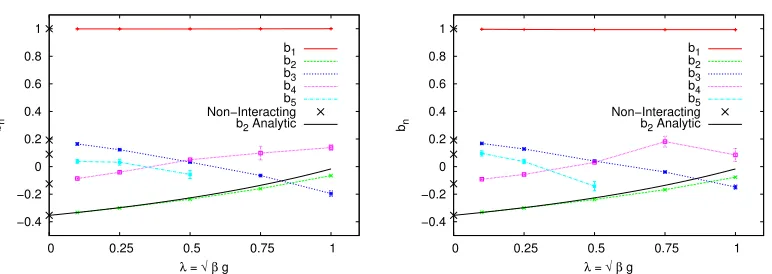
solutions for the non-interacting case. Extrapolating in the other direction, i.e. to largerλit may be possible to obtain approximate virial coefficients at strong coupling. These results for bn vs. λ at β=8.0 andβ=10.0 are shown in Fig.3, together with the exact solution forb2(λ) (see Ref. [7]).
Notice in Fig. (3) at low coupling our results match extremely well the analytical solution for
b2(λ), but that agreement deteriorates asλincreases. More statistics may be needed at larger coupling
to obtain more consistent results. Fig. (3) shows continuous results for most orders ofbn, but again
with inconsistencies at higher order asλincreases. Both are encouraging results that point to the
possibility of computing high-order virial coefficients and extrapolating to larger coupling with fair
accuracy. This approach, in that sense, complements the conventional, high-precision way to obtain virial coefficients, based on solving then-body problem and computing canonical partition functions.
4 Summary and conclusions
3.2 Virial Projection Results
As mentioned above, the goal of this method is to access the virial coefficientsbn by carrying out
calculations for varying values ofξ. A first step toward extractingbn is to show that the results over
the range ofξyield a constant value, at least in some window. Fig.2, shows results forbn(ξ) atβ=8.0
and 10.0, both at√βg=0.1. We find consistent results for up to ordern=5 forξ=0.05−0.1, but also
find statistical noise at smallerξ, which is particularly evident in the higher order virial coefficients;
the latter correspond to progressively higher frequencies in the Fourier projection. Nevertheless, the roughly constant behavior allows us to extract estimates ofbnup ton=5. Systematic effects in the
number of Fourier pointsNkand the Langevin timeT are currently under study. The data shown here
corresponds toNk=100 andT =20.
−0.4 −0.2 0 0.2 0.4 0.6 0.8 1
0 0.02 0.04 0.06 0.08 0.1
bn ξ b1 b2 b3 b4 −0.4 −0.2 0 0.2 0.4 0.6 0.8 1
0 0.02 0.04 0.06 0.08 0.1
bn ξ b 1 b2 b3 b4 b5
Figure 2: Virial coefficientsbn, forn=1, . . . ,5, as a function ofξ[see Eq. (25)], forNx=31,β=8.0 (left) and 10.0 (right), andλ=0.1.
Computing the above results for varying values of the coupling,λ∈[0.1,1.0], and averaging the
results over the consistent values (excluding outliers, which are dominated by noise), we obtain a first estimate ofbn vs. λ. An extrapolation of our answers toλ=0 allows us to compare with the exact
solutions for the non-interacting case. Extrapolating in the other direction, i.e. to largerλit may be possible to obtain approximate virial coefficients at strong coupling. These results for bn vs. λat β=8.0 andβ=10.0 are shown in Fig.3, together with the exact solution forb2(λ) (see Ref. [7]).
Notice in Fig. (3) at low coupling our results match extremely well the analytical solution for
b2(λ), but that agreement deteriorates asλincreases. More statistics may be needed at larger coupling
to obtain more consistent results. Fig. (3) shows continuous results for most orders ofbn, but again
with inconsistencies at higher order asλincreases. Both are encouraging results that point to the
possibility of computing high-order virial coefficients and extrapolating to larger coupling with fair
accuracy. This approach, in that sense, complements the conventional, high-precision way to obtain virial coefficients, based on solving then-body problem and computing canonical partition functions.
4 Summary and conclusions
In this contribution we have presented two calculations that use the complex Langevin approach to extract information about finite systems from finite-temperature, grand-canonical calculations. We focused on particle-number projection to obtain thermodynamics via canonical partition functions,
−0.4 −0.2 0 0.2 0.4 0.6 0.8 1
0 0.25 0.5 0.75 1
bn
λ = √ β g
b1 b2 b3 b4 b5 Non−Interacting
b2 Analytic
−0.4 −0.2 0 0.2 0.4 0.6 0.8 1
0 0.25 0.5 0.75 1
bn
λ = √ β g
b1 b2 b3 b4 b5 Non−Interacting
b2 Analytic
Figure 3: Virial coefficientsbn(λ) forn=1, . . . ,5, atβ=8.0 (left) and 10.0 (right), forNx=31. The
black crosses denote the non-interacting values at the continuum limit. Solid line shows the known continuum-limit result forb2(see Ref. [7]).
and to obtain virial coefficients. We have shown that both methods converge to reasonable results
within some constraints on various parameters.
More data are needed in order to estimate the free energy for various systems and particle numbers, and to further understand systematic effects. To extrapolate to the continuum limit, we must take
1 λT Nx (where λT = 2πβ is the thermal wavelength), which amplifies the computation
time for these calculations as bothβandNxmust be taken to be large. Due to this limitation, we
are exploring ways to optimize these calculations. We have shown, however, that particle projection using complex Langevin does converge to the correct state, and with the correct number of particles for each flavor.
Furthermore, our method for virial projection has yielded promising results for one-dimensional systems, demonstrating possibilities for computing higher order coefficients (i.e. b3,b4, and above)
as well as extrapolation to stronger values of the coupling. We are currently exploring finite-size effects of this method by varying the inverse temperature, β, and the volume. In addition, we are investigating the effects of varying the total number of Fourier pointsNk, as decreasing this number
likewise decreases the total run time of the simulation (linearly). Increased statistics (longer total Langevin time) is needed for improved accuracy for larger virial coefficients, and particularly for
larger values of the coupling.
Both particle projection methods have produced promising results that, with more in-depth study, may provide access to various observables in finite systems that remain unknown and may be directly compared with ultracold atom experiments. Looking beyond the latter, the ultimate goal is to perform full-fledged, finite-temperature calculations of finite nuclei with realistic interactions, for which the present work provides a proof of principle.
References
[1] S. Giorgini, L. Pitaevskii, S. Stringari, Rev. Mod. Phys.80, 1215 (2008) [2] I. Bloch, J. Dalibard, W. Zwerger, Rev. Mod. Phys.80, 885 (2008) [3] G. Aarts, J. Phys. Conf. Ser.706, 022004 (2016)
[4] C. Gattringer, K. Langfeld, International Journal of Modern Physics A31, 1643007 (2016) [5] W. Zwerger,BCS-BEC crossover and the Unitary Fermi Gas(Springer-Verlag, Berlin, 2011) [6] J.E. Drut, A.N. Nicholson, J.Phys.G40, 043101 (2013),1208.6556
[7] M.D. Hoffman, P.D. Javernick, A.C. Loheac, W.J. Porter, E.R. Anderson, J.E. Drut, Phys. Rev. A

![Figure 2: Virial coefficients bn, for n = 1, . . . , 5, as a function of ξ [see Eq. (25)], for Nx = 31, β = 8.0(left) and 10.0 (right), and λ = 0.1.](https://thumb-us.123doks.com/thumbv2/123dok_us/8052859.1341827/6.482.45.435.228.361/figure-virial-coecients-function-eq-nx-left-right.webp)