Attacks on a FPGA Implementation of LEA
Yongdae Kim1,2 and Hyunsoo Yoon1
1
Department of Computer Science, Korea Advanced Institute of Science and Technology, Daejeon, Korea
2
The Attached Institute of ETRI, Daejeon, Korea Email: [email protected], [email protected]
Abstract. The lightweight encryption algorithm (LEA) is a 128-bit block cipher introduced in 2013. It is based on Addition, rotation, XOR operations for 32-bit words. Because of its structure, it is useful for sev-eral devices to achieve a high speed of encryption and low-power con-sumption. However, side-channel attacks on LEA implementations have not been examined. In this study, we perform a power analysis attack on LEA. We implemented LEA with 128-bit key size on FPGA in a straight-forward manner. Our experimental results show that we can successfully retrieve a 128-bit master key by attacking a first round encryption.
Keywords: Power Analysis Attack, LEA, ARX, Correlation Power Anal-ysis
1
Introduction
A new category of cryptanalysis, known as a power analysis attack, was intro-duced by P. Kocher et al. in 1996 [1]. Power analysis attacks exploits not only intended information ( e.g., input and output from cryptographic devices), but also power consumption related to secret information (e.g., secret keys) from cryptographic devices [2]. This can be accomplished by efficiently comparing power analysis attacks to conventional cryptanalysis. Thus, investigating not only cryptographic algorithms, but also their concrete implemenations is criti-cal.
LEA does not contain S-Box components such as other block ciphers (e.g., AES). Instead, it employs ARX operations such as modular addition, rotation and XOR operations. Several studies have been conducted on side-channel at-tacks on ARX-based cryptographic algorithms [4], [5], [6]. In [5], the authors con-ducted an attack on the Skein algorithm using a 64-bit words addition operation. Although they failed to retrieve all subkeys, their experimental results showed that the modular addition in the Skein algorithm is vulnerable to side-channel attacks. The sutides in [4], and [6], investigated the ARX-based SHA-3 cryp-tographic algorithms, BLAKE and CubeHash. The researchers demonstrated theoretically the selection function and the number of power analysis that must be conducted. In addition, they implemented the algorithms on a microproces-sor. No previous study has conducted security evaluations on ARX-based block ciphers such as LEA, in a hardware implementation against power analysis at-tacks.
In this study, we demonstrate power analysis attacks on a hardware imple-mentation of LEA. We employ correlation power analysis [7], and present details on the method we use with the selection function for LEA. Based on the the selection function, we present a practical method for retrieving a 128-bit secret key during an attacking of the first round encryption of LEA. Our experimental results indicate that deploying countermeasures to prevent attacks on hardware implementations is essential.
2
LEA Algorithm
In 2013, Hong et al. introduced a new 128-bit block cipher, known as LEA, for lightweight encryption [3]. LEA is an ARX-based cryptographic algorithm and consists of three key sizes of 128, 192, and 256 bits. In this study, we focus on the 128-bit key length. LEA for 128-bit key length possesses 24 rounds, and thus, contains 24 round keys, denoted asRKi(0≤i≤23).
2.1 Structure of LEA
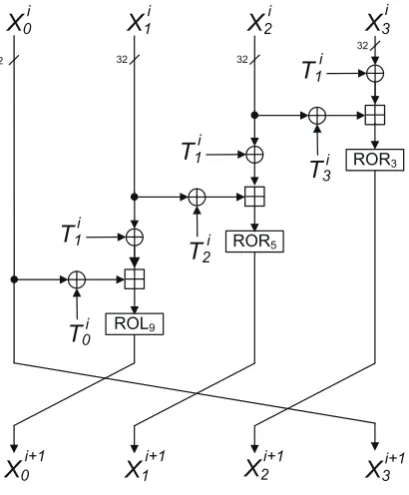
Fig. 1 shows that thei-th round function with a 128-bit key length.Ti
0,1,2,3
rep-resents four 32-bit sub-keys of thei-th round keyRKi. These keys are provided by the key scheduling component. Each round function is calculated as follows:
X0i+1←ROL9
(
(X0i⊕T0i)(X1i⊕T1i)
)
(1)
X1i+1←ROR5
(
(X1i⊕T2i)(X2i⊕T1i)) (2)
X2i+1←ROL3
(
(X2i⊕T3i)(X3i⊕T1i)
)
(3)
X3i+1←X0i, (4)
X
0X
1X
2X
3ROR3
T
3ROR5
T
2T
1ROL9
T
0X
0X
1X
2X
332 32 32
T
1T
132
i
i
i
i
i
i
i i i i
i+1 i+1
i+1 i+1
Fig. 1.LEA Structure
2.2 Key Schedule
In the key schedule of LEA, the following four constants are used:
δ[0] = 0xc3efe9db (5)
δ[1] = 0x44626b02 (6)
δ[2] = 0x79e27c8a (7)
δ[3] = 0x78df30ec. (8)
A 128-bit master key K is represented as a concatenation of 32-bit words as follows:
K= (T0−1, T1−1, T2−1, T3−1) (9)
Based on the master key, a 192-bit round key RKi = (T0i, T1i, T2i, T1i, T3i, T1i) is
generated for 0≤i≤23 as follows:
T0i←ROL1
(
T0i−1ROLi(δ[i mod 4])
)
(10)
T1i←ROL3
(
T1i−1ROLi+1(δ[i mod 4])
)
(11)
T2i←ROL6
(
T2i−1ROLi+2(δ[i mod 4])
)
(12)
T3i←ROL11
(
T3i−1ROLi+3(δ[i mod 4])
)
(13)
RKi←(T0i, T
i
1, T
i
2, T
i
1, T
i
3, T
i
Each 32-bit subkey of the round keys is calculated independently of other 32-bit subkey, so if we can retrieve a 32-bit subkey (e.g.T0i), then we can easily compute a part of a master key,T0−1.
3
Power Analysis Attack on LEA
In this section, we present how we retrieve a 128-bit master key by attacking the first round encryption. In this study, we use correlation power analysis (CPA) based on a linear relationship between measured power consumption and an intermediate value. The intermediate value is usually calculated by means of a selection function. There are several ways to map the value based on power model, such as the hamming weight, the hamming distance model, etc.
3.1 Selection Function
In this study, we use the hamming distance model as a selection function, because our target implementation is a hardware platform and the hamming distance model is usually well correlated for a hardware implementation [8].
The four 32-bit subkeys of the first round key,T0, T1, T2, T3, are our primary
targets for retrieval by CPA. For simplicity in the remainder of this paper, we omit the symbolito represent a round. Fig. 1 reveals that targeting only a single 32-bit subkey is difficult. Instead, we must target two pairs of subkeys for each CPA: (T0, T1), (T1, T2), and (T1, T3). In addition, we assume that plaintext and
ciphertext are known value. Therefore, we can calculate the hamming distance value between X0
0 and X01 = ROL9
(
(X0
0⊕T0)(X10⊕T1)
)
by deducing the
T0andT1values. We must then produce a 232×232hamming distance value for
every T0 and T1 value. However, applying this method to accomplish a power
analysis attack is not feasible.
Instead of calculating the 32-bit hamming distance value, we divide the sub-keys pair (T0, T1) into four 8-bit partial subkeys. We then produce four types of
8-bit hamming distance values for each z-th (0 ≤z ≤3) partial subkey hz as follows:
hz=ROR9(ROL9(X0[(8(0 z+1)−1)−8z])⊕
ROL9((X0[(8(0 z+1)−1)−8z]⊕T0[(8(z+1)−1)−8z])
(X1[(8(0 z+1)−1)−8z]⊕T1[(8(z+1)−1)−8z]))), (15)
whereXi[a−b] denotes a bit string cut from thea-th to theb-th bit ofXi. Each type of hamming distance value can be calculated by estimating two 8-bit partial subkeys. For example,h1is produced for all possible values ofT0[7−0]andT1[7−0]
from Eq. 15.
The number of possible candidates for the pair is 28×28 = 65536, derived from (T0[7−0], T1[7−0]) = (0,0),(0,1),· · ·,(0,255),· · ·,(255,255). Using hz, we can derive four 8-bit partial subkey from the lowest byte (T0[7−0], T1[7−0]) to the
highest byte (T0[31−24], T1[31−24]) sequentially by CPA. In addition, the
3.2 Key Guessing
Because of the number of possible key candidates for each pair is 65536, we must conduct CPA 65536 times for each key candidates. In addition, because of the structure of the LEA encryption, the hamming distance value is the same for two key pairs. For example, two pairs of keys, (T0[7−0], T1[7−0]) and (T0[70 −0], T1[70 −0]),
always produce the same hamming distance value. In other words, one additional pairs of values always exists that satisfies the following:
h1=h01
(X0[70 −0]⊕T0[7−0])
(X1[70 −0]⊕T1[7−0])
= (X
0
0[7−0]⊕T0[70 −0])
(X1[70 −0]⊕T1[70 −0]). (16)
We determined that a necessary and sufficient condition for Eq. 16 is (T0[70 −0], T1[70 −0]) = (T0[7−0], T1[7−0]) or (T0[70 −0], T1[70 −0]) = (T0[7−0]⊕27, T1[7−0]⊕27). To prove the
condition, we simplify the problem as the following theorem.
Theorem 1.
(a⊕x) + (b⊕y) = (a⊕z) + (b⊕w)mod 2n ,∀a, b∈ {0,1}n (17)
⇔(x=z andy=w)or (x⊕z= 2n−1 andy⊕w= 2n−1). (18)
Proof. i) First, we show that Eq. 18 implies Eq. 17 based on the as following:
(a⊕x) + (b⊕y) mod 2n
= (a⊕x) + (b⊕y) + 2n mod 2n
= (a⊕x) + 2n−1+ (b⊕y) + 2n−1mod 2n
= (a⊕x⊕2n−1) + (b⊕y⊕+2n−1) mod 2n = (a⊕z) + (b⊕w) mod 2n.
ii) Next, we prove that Eq. 17 implies Eq. 18 is equivalent to the following equation:
(x6=z ory6=w) and (x⊕z6= 2n−1 ory⊕w6= 2n−1)
⇒(a⊕x) + (b⊕y)6= (a⊕z) + (b⊕w) mod 2n ,∃a, b∈ {0,1}n (19)
Eq. 19 can be proved by contradiction. Four possible cases exist as follows:
– Case 1 : (x6=z) and (x⊕z6= 2n−1)
– Case 2 : (x6=z) and (y⊕w6= 2n−1)
– Case 3 : (y6=w) and (y⊕w6= 2n−1)
Case 1 We assume that Eq. 17 is true and letb bey andw. We then derive
(a⊕x) + (y⊕y) = (a⊕z) + (y⊕w), and
(a⊕x) + (w⊕y) = (a⊕z) + (w⊕w). (20)
By substitution, we derive the following:
(a⊕x)−(a⊕z) = (a⊕z)−(a⊕x) mod 2n
2·(a⊕x) = 2·(a⊕z) mod 2n. a⊕x=a⊕zmod 2n−1.
Finally, we derive x=z⊕2n−1 orx=z. However, this contradicts the
suppo-sition of the Case 1. Thus, the supposuppo-sition is false.
Case 2 We assume that Eq. 17 is true. From the proof of the Case 1, we then derivex=z⊕2n−1. If we letaasx, we then derive the following:
(x⊕x) + (b⊕y) = (z⊕2n−1⊕z) + (b⊕w) mod 2n
b⊕y= 2n−1+ (b⊕w) mod 2n
b⊕y= 2n−1⊕b⊕wmod 2n.
Therefore,y=w⊕2n−1 which is a contradiction of the supposition of the Case
2.
Case 3, 4 If we change xtoy, z to w, andato b, Casee 3 and 4 become the same as Cases 1 and 2, respectively.
4
Experimental Results
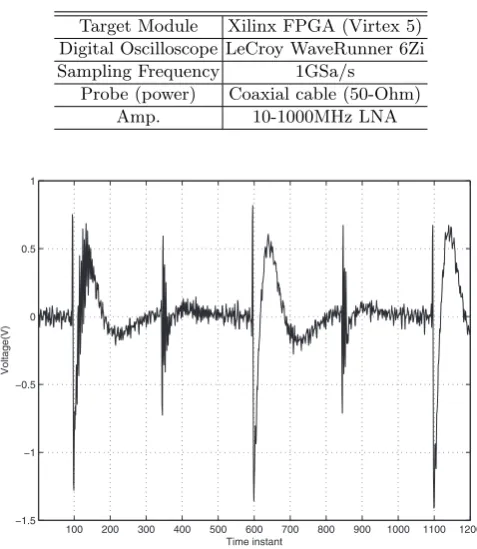
We implemented the LEA algorithm with 128-bit key length on the Side-channel Attacks Standard Evaluation BOard (SASEBO-GII) [9] in a straightforward manner. The LEA algorithm was processed by means of Xilinx FPGA (Virtex 5) on the board. In addition, the round keys were generated by an on-the-fly method. Thus, each round of the LEA was processed in a cycle. We captured power traces to include in the first two rounds of encryption. This was easily performed by determining the range of the first two rounds from the traces by observing two distinct power consumption patterns. Table 1 shows the details of our experimental environment.
Fig. 2 shows the power consumption trace that includes the first round of the LEA from our LEA implementation. We captured 50,000 traces using randomly generated plaintext. In addition, the number of sample points for power traces in each cycle is:
1×10⁹points/s
Table 1.Experimental environment
Target Module Xilinx FPGA (Virtex 5) Digital Oscilloscope LeCroy WaveRunner 6Zi Sampling Frequency 1GSa/s
Probe (power) Coaxial cable (50-Ohm) Amp. 10-1000MHz LNA
100 200 300 400 500 600 700 800 900 1000 1100 1200 −1.5
−1 −0.5 0 0.5 1
Time instant
Vol
tage(V)
Fig. 2.Power consumption from the LEA implementation
Fig. 3 (a) shows CPA results based on 50,000 power traces for (T0[7−0]|T1[7−0]).
The X-axis indicates time and the Y-axis indicates the correlation coefficient for each possible key guess. The black line represents correlation peaks for the correct concatenated two partial subkeys, whereas gray lines show wrong key guesses. Fig. 3 (a) shows that distinguishing the correct key is possible. Only one correct key seems to exist. However, another key exists that have the same value as the absolute value of the correlation coefficient shown in Fig. 3 (b). In addition, another key exists that has the same value of correlation as we mentioned in the previous section. We confirmed the theorem based on the result of CPA.
From Fig. 3 (b), the correct key pairs forT0[7−0]andT1[7−0]are (T0[7−0]|T1[7−0]) =
(0x2B,0xA3) and (T0[7−0]|T1[7−0]) = (0xAB,0x23), respectively, which have the
same absolute value of correlation, 0.08847. In the same manner, we retrieved two sets of key pairs for (T1[7−0], T2[7−0]), and (T2[7−0], T3[7−0]). We do not yet
know which is the correct key pair..
(a) (b) Time C o rre la ti o n C o e ff ici e n t Ab o so lu te Va lu e o f C o rre la ti o n Key Candidates
0 200 400 600 800 1000 1200 1 2 3 4 5 6 x 10⁴
0 0.01 0.02 0.03 0.04 0.05 0.06 0.07 0.08 0.09
Fig. 3.CPA Result : (a) Corelation on time domain, (b) Absolute value of correlation on key candidates
(a) (b) Time Ab o so lu te Va lu e o f C o rre la ti o n Ab o so lu te Va lu e o f C o rre la ti o n Key Candidates
1 2 3 4 5 6
x 104
0 0.02 0.04 0.06 0.08 0.1 0.12
1 2 3 4 5 6
x 104
0 0.02 0.04 0.06 0.08 0.1 0.12
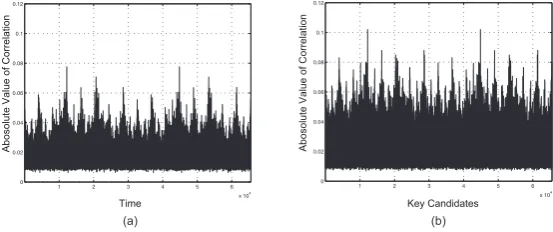
Fig. 4.CPA Result using two possible key candidates
two types of hamming distance values for the bit position [15−0] is feasible. The possible number of key pairs is 216. We used the hamming distance value for the bit position [15−0] instead of [15−8] to determine the next key pairs. This method usually increases the correlation value in CPA [10]. However, we deployed a method to identify correct key pairs at [7−0] and two possible correct key pairs at [15−8] simultaneously.
Fig. 4 (a) and (b) show the CPA results of (T0[15−8]|T1[15−8]) using (T0[15−8]|T1[15−8]) =
(0x2B,0xA3), and (T0[15−8]|T1[15−8]) = (0xAB,0x23), respectively. The peaks
in Fig. 4 (b) are higher than those in Fig. 4 (a). Therefore, we can determine the correct key for (T0[7−0]|T1[7−0]). The absolute value of the correlation is 0.102
and 0.077 in Fig. 4 (a) and (b), respectively. In addition, the overall value for all key candidates are higher in Fig. 4 (b) than in (a). Other key pairs at different bit positions (such as [15−8] and [23−16]) can be retrived in the same manner. Fi-nally, we retrieved a correctT0[23−0], T1[23−0], T2[23−0], T3[23−0] and two possible
correct key pairs for T0[31−24], T1[31−24], T2[31−24], T3[31−24]. We then calculated
5
Conclusion
LEA is 128-bit lightweight block cipher introduced in WISA 2013. However, the authors investigated security evaluation of LEA on a theoretical basis only. LEA can be implemented in various platforms having throughput and a small size. We first investigated its security strength against power analysis attacks on a hardware implementation. Our results showed that LEA implementation reamins vulnerable to power analysis attacks. According to our research, this is the first experimental result of an LEA hardware implementation. Based on our results, implementing LEA with countermeasures is essential. For a future study, we plan to investigate other types of platforms and compare performance between countermeasure and non-countermeasure implementations.
References
1. P. Kocher, J. Jaffe, and B. Jun, “Differential power analysis,” CRYPTO: Proceed-ings of Crypto, pp.388–397, 1999.
2. S. Mangard, E. Oswald, and T. Popp, “Power analysis attacks - revealing the secrets of smart cards,” Springer, 2007.
3. D. Hong, J. keun Lee, D. chan Kim, D. Kwon, K. Ryu, and D. geon Lee, “LEA: A 128-bit block cipher for fast encryption on common processors,” The 14th Inter-national Workshop Information Security Applications(WISA), pp.3–27, 2013. 4. M. Zohner, M. Kasper, M. Stottinger, and S. Huss, “Side channel analysis of
the SHA-3 finalists,” Design, Automation Test in Europe Conference Exhibition (DATE), pp.1012–1017, 2012.
5. C. Boura, S. L´evˆeque, and D. Vigilant, “Side-channel analysis of grøst and skein,” Proceedings of the 2012 IEEE Symposium on Security and Privacy Workshops, pp.16–26, 2012.
6. O. Benot and T. Peyrin, “Side-channel analysis of six SHA-3 candidates,” Inter-national Workshop on Cryptographic Hardware and Embedded Systems (CHES), pp.140–157, 2010.
7. E. Brier, C. Clavier, and F. Olivier, “Correlation power analysis with a leakage model,” International Workshop on Cryptographic Hardware and Embedded Sys-tems (CHES), pp.16–29, 2004.
8. F.X. Standaert, E. Peeters, G. Rouvroy, and J.J. Quisquater, “An overview of power analysis attacks against field programmable gate arrays,” Proceedings of the IEEE, pp.383–394, 2006.
9. Research Center for Information Security, “Side-channel Attack Standard Evalua-tion BOard (SASEBO),” http://www.rcis.aist.go.jp/special/SASEBO.