PERCEIVED EARNINGS FUNCTIONS AND EX ANTE RATES OF RETURN TO HIGHER EDUCATION - A CASE STUDY OF HONG KONG
by
WONG Kam Cheung, Andrew
A Thesis submitted in fulfilment of the requirements for the degree of
Doctor of Philosophy in
ABSTRACT
This thesis sets out to use Hong Kong as a case to examine the proposi tions of a) Human Capi tal Theory -that students take systematic forward-looking view of earnings prospects and b) Signalling/Screening Hypothesis - that students are aware of their abili ty and those who are capable would invest more in higher education. The perceived earnings functions and ex ante rates of return to higher education of the students are estimated. In the process, the factors which affect the demand for higher education are also explored.
The thesis shows that the majority of the Hong Kong Form V students, who were in their final year of schooling in secondary school education, were largely economically motivated for higher learning. The students were rather realistic in the estimation of their lifetime earnings in association with different levels of education. Other than levels of schooling, the variables of sex, home background, parents' education, students' ability and quality of institutions all have some bearings on the demand for higher education and expected lifetime earnings. The perceived ex ante rates of return to higher education, measured according to sex, ability, social background and quality of
institutions were similar to the private rates of return based on census data. This explains why higher education
in Hong Kong is in such a popular demand.
TABLE OF CONTENTS
CHAPTER 1 INTRODUCTION
1.0 Points of Interest 1
1.1 Related Studies in Hong Kong 13
1.2 The Study by Williams and Gordon and The Theme of
The Present Study . . . . . . . . 15
1.3 Organization of The Thesis . 18
CHAPTER 2 BACKGROUND
2.0 Introduction . . . .20 2.1 The Hong Kong Education System . . 20 2.2 The Selective Nature of The Education System 25 2.3 The Development of The Secondary Schools Entrance
Examination . . . 31 2.4 Effect of SSEA
&
SSPA and The Quality of Schools. 40CHAPTER 3 REVIEW OF LITERATURE
3.0 Introduction . . . 43
3.1 The Development of The Human Capital Theory 44 3.11 The productivity augmenting view 47 3.12 Specific training, general training and schooling 49 3.13 Methods in accounting for the differences in
lifetime earnings and the earnings function . 52
3.2
3.15 Ability adjustment and the study by Taubman and
Wales . . . 60 3.16 The private and social rate of return and the
calculation of expected rated of return . . . 65
3. 17 Summa ry . . 72
The Theory of Signalling/Screening 73
3.21 Conditional probabilistic beliefs 76 3.22 Signalling costs and productivity - the negative
correlation . . . 78 3.23 Two possible equilibrium and their implications. 81 3.24 The able students and the accumulation of
education . , . . . . 83 3.25 Education - productivity enhancement and mechanism
for sorting . . . 84
3.26 Summary . . 86
3.3 Studies on Ex Ante Rates of Returns and The Work by
Williams and Gordon . . . 87 3.31 The study by Bosworth and Ford 91 3.32 The study by Psacharopoulos and Sanyal 94
3.4 Summary 99
CHAPTER 4 RESEARCH METHODOLOGY
4.0 4.1
Introduction . . 101
The Theories . 102
4.11 The methods used by Williams and Gordon and the
ways data of perceived lifetime earnings are
4.2
4.3
4.12 Ways to calculate the earnings and the internal the present study . . . . . Areas of Investigation
expected lifetime rate of return in
4.21 Students' economic motivation and higher
112 · 117
learning . . . . . . . . . . . 118 4.22 Students' awareness of their ability and the
effect of ability on the demand for higher
learning . . . 119 4.23 Factors which affect the intention for higher
learning and the perceived lifetime earnings . . 122
Collection of Data 137
CHAPTER 5 ANALYSIS OF DATA AND STUDENTS' AWARENESS OF THEIR ABILITY
5.0 Introduction . . . 144 5.1 The Reasons Which Affect Students' Education
Intentions . . . 145 5.2 The Influence of The Factors on The Demand for
Higher Education . . . . . . 150
5.21 Father's occupation . · 157
5.22 Parents' education · 160
5.23 The quality of institutes, sex role and Art/
Science Stream . . . 164 5.3 Students' Awareness of Their Abilities and Their
Careers Intentions. . . . . . . . . 173 5.31 Two further indications of the association between
ability and careers intentions . . . . . 179
CHAPTER 6 REGRESSION ANALYSIS AND THE EX ANTE RATES OF RETURN
6.0 Introduction . 188
6.1 The Actual and Expected Earnings . 189 6.2 Influence of Home Environment. Cognitive Ability and
Quality of Schools on Lifetime Earnings . . . . 195 6.3 Earnings Functions and The Regression Analysis . . . . 200
6.31 Interactions of social background, ability and
quality of schools . . . 214 6.4 Perceived Private Rates of Return · . 222 6.5 Overseas Education and The Perceived Rates of Return
· . 227
6.6 Summary · . 230
CHAPTER 7 CONCLUSION
7.0 Whether Students are Motivated by Economic
Considerations for Higher Education . . . 233 7.1 The Extent to Which Students Are Aware of Their Ability
and The Effect Ability Has on The Capable Students in
The Pursuit of Higher Learning . . . 235 7.2 Support of the Human Capital Theory and Signalling
Hypothesis . . . 239 7.3 The Influence of Students' Socioeconomic Background,
Quality of Institutions, Sex and Abilities on The
Pursuit of Higher Education . . . 242 7.4 The Influence of Intended Education, Socioeconomic
Background, Quality of Institutions, Sex, Ability and
Others on The Perceived Lifetime Earnings . . . 245 7.5 The Perceived ex ante Rates of Return to Higher
Reference Appendix I Appendix II
. . 257 . 271
Table 1.1
Table 1.2 Table 1.3
Table 1. 4
LIST OF TABLES
Number of students in Form V and Sixth Forms as compared with 17-19 year-old population
Tracer study of student enrolment
Number of candidates qualifying in school examinations . . . .
Number of repeaters in HKCE
6 8
10 12 Figure 2.1 Education System of Hong Kong as at 1980 23a Table 2.1 Students population in day school 1950 - 1985 28 Table 2.2 Secondary School Entrance Examination 1962-1978. 34 Figure 3.1 Age Profiles of Earnings of Chinese Men, 1981 51a Table 3.1
Table 3.2
Table 3.3
Earnings difference in % between average high school graduates and graduates of given ability
level . . . . . ..62
% increase in extra earnings from education for
average high school graduates . . . 63 Estimate of % bias in coefficients on education
omitting maths ability and biography while all
other variables were held constant . . . 64 Figure 3.2 Investment in higher education and private returns
over the life cycle . . . . . 65a Figure 3.4 Informational feedback in the job market 77 Figure 4.1 Discounted expected lifetime earnings · 114
Table 4.1 The basic data · 141
Table 5.1 Main reasons given by students who intended to
study after F.V . . . . . . 146 Table 5.2 One sample Chi-square based on main reasons for
Table 5.4 Main reasons given by students who intended to
cease study after F.5 . . . . . . . 149 Table 5.5 Mean and standard deviations of the variables 151 Table 5.6 Correlation of the variables . . 152 Table 5.7 Tests that K-way and higher order effects are
zero 155
Table 5.8 The interactive effects of the variables 156 Table 5.9 Students' education intentions according to
father's occupation . . . . . . . 158 Table 5.10 Interactive effects of intention for education
and father's occupation . . . 159 Table 5.11 Students' education intentions according to
parents' education . • . . . . . . 162 Table 5.12 Interactive effects of intention for education
and parents' education . . . . . . 163 Table 5.13 Careers Intentions of students according to
Students' HKCE result quality of institutions
( in %) . • • • • • • • • • • • • • • • • • • • • 166 Table 5.14 Students' HKCE results according to sex in Arts
and Science subjects . . . . . 167 Table 5.15 Education intentions by quality of institutes
controlling for sex and streaming . . . 169 Table 5.16 A Comparison of HKCE results between Arts boys
students in high and middle quality institutes . 170 Table 5.17 Students' education intentions and their best five
subjects in HKCE . . . 175 Table 5.18 Interactive effects of the intention for education
and ability . . . . . 177 Table 5.19 A breakdown of students' careers intentions after
Form V according to the HKCE results . . . . 181 Table 5.20 The students' intentions for further education
and their choice of higher institutes . . . 183
Table 5.21 Confidence of Students in Careers Intentions
Table 5.22 A breakdown of students' further education intentions after Form V according to the HKCE
results . . . 184 Table 6.1 Mean expected earnings (HK$ per month) of Hong Kong
Form V students by education intentions . . . 190 Figure 6.1 Actual and Expected Relative Age-earnings Profile
of both Boys and Girls . . . , 191 Figure 6.2 Actual and Expected Relative Age-earnings Profile
of Boys . . . . . 192 Figure 6.3 Actual and Expected Relative Age-earnings Profile
of Girls . . . 193 Table 6.2 Expected average lifetime earnings (mean) of
students according to father's occupation, cognitive ability and career intentions Table 6.3 Expected average lifetime earnings (mean) of
students according to father's occupation, quality of school and education intentions
Table 6.4 Means and Standard Deviation of the variables in
197
199
the regression . . . . . . . . . 202 Table 6.5 Zero-order correlation matric for the entire
sample . . . . . . . . . 203 Table 6.6 Regression for log expected lifetime earnings and
other variables . . . . . . 213 Table 6.7 The influence of social class on expected lifetime
earnings 216
Table 6.8 The influencing of ability expected lifetime
earnings . . . . 219
Table 6.9 The influence of school quality on expected lifetime ea rni ngs . . . . . . . . 221 Table 6.10 Ex ante private rates of return to higher education
and the comparison with calculated rates from
census data for males . . . . . . 224 Table 6.11 Ex ante private rates of return by father's job
ability and quality of schools . . . 227 Table 6.12 Background of students for overseas education
Table 6.13 Comparison of expected average lifetime earnings (mean) between local (university intended) and
CHAPTER 1 INTRODUCTION
1.0 Points of Interest
Even since the emergence of Human Capi tal Theory which stresses the investment made in human resources to improve their productivity in the early 1960s, education has been linked wi th enhancement of productivi ty and economic growth. Many empirical studies on the role of education have concentrated on the supply side of the picture a phenomenon which reflects the fact that education is largely provided by the government in many countries. The literature is full of measurements of rates of return to education based on cross-sectional da ta (see Blaug, 1978). The consistently high social rates of return to education! in the 1960s and 1970s were often used as justification for the policy guidelines for quantitative expansion of educational opportunities over other investment projects as well as priority. areas within the educational system itself (Psacharopoulos & Woodhall, 1985). Behind all these studies, the individuals who would exercise rational maximizing behaviour in markets is often assumed. Little
attention has been given to understand this behaviour in the demand for education. Perhaps it is not easy for students to estimate the benefits associated with additional years of schooling. Even if expected net retu rn stream could be estimated, it does not necessarily follow that the students would take up the extra education because of the different subjective 'time preference rate' in interest (Blaug, 1972, 1983). The lack of ability or the disadvantaged home background of the students may further prevent them from taking up the benefits (Williams and Gordon, 1981). At any rate, very few studies have been devoted to investigating whether the students who pursue higher education actually take a forward-looking view of earnings prospects in the labour market2•
In the 1970s, among the cri tics of Human Capi tal Theory,
2
3
The Screening/Signalling hypothesis3 proponents
According to Blaug (1976), the studies by Campell
&
Siegel (1967), Galper&
Dunn (1968), Miller (1971) and Freeman (1971) in the United States were the only examples in the early part of the period which tried to establish that students were responsive to the earnings differentials.claimed that the main function of education is to sort individuals
credentials. by
It
their is
abilities with educational now generally accepted that educational institutions do screen. 'What is debatable is whether schools screen for some ex ante innate ability or for some ex post ability which includes the productivi ty-augmenting effects of education. From the point of view of ei ther the individual or the private employer the answer to this question is largely irrelevant. The individual will continue to invest in education as long as marginal benefi ts exceed marginal costs.' (Winkler, 1987). For the able students, the marginal costs have been low. Hence it is the high-ability students who would invest more in education. By investing in education, the able students are making a signal of their high productivity to the potential employers. To make the theory work, i t is assumed that students are able to know their ability.
be examined.
This seems a fruitful proposition for study.
Hong Kong has been a free market with limited government interference ever since it became a colony of Great Britain. It was referred to by Friedman (1979) as a prime example of a free market economy. But this is by no means the case in the provision of education. After a relatively free market for private schools in the 50s and the early 60s, the government gradually stepped up its influence in education. When the economy began to pick up in the 60s and 70s, the control of the government over the provision of education first in the primary schools in the late 60s and then on to the secondary education in the late 70s was established. Meanwhile, higher education places has been in great demand.
In the early 80s, only about 2% of the young people of the relevant age group (17 to 20) entered the universi ty4. The nine-year free and compulsory education
until Form III first introduced in 1979 has further
aggravated the si tuation. After Form III, over 90% of
the students stayed on up to Form V (Half-yearly
Statistics Report, Education Department, 1980-1985). In
November 1980, a Committee to Review Post-secondary and
Technical EducationS (hereafter CRE) was formed to
review the adequacy of the provision for higher learning
in Hong Kong until the year 2001. Its analysis showed
that in 1980 the overall ratio between application to
and places available at the University of Hong Kong was
3.5:1; the Chinese University of Hong Kong was 4.2:1 and
Hong Kong Polytechnic was 5.0:1 (CRE). Clearly, even
allowing for duplicate applications, each Higher
Institution was estimated to receive 3-5 times more
applications than the number of places available. The
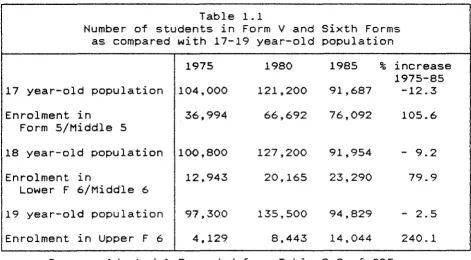
Committee assessed (Table 1.1) the rise of the number of
students in senior secondary against the population of
S
degree courses and 4% for non-degrees studies. A thi rd universi ty will be opened in early
1990s. The plan is to provide 14% of the
relevant age group for first degree and 6% for
non-degree studies in 2000. Despite this
expansion, Mr. Dominic Wong, the Deputy
Secretary for Education and Manpower
acknowledged that unti 1 mid 1990 Hong Kong would continue to suffer f rom a shortage of full-time places in higher education (SCMP, 4/3/1989).
The Committee to Review Post-secondary and
Technical Education published a report in
June, 1981. But the report was not publicly released.
the appropriate ages as follows:
Table 1.1
Number of students in Form V and Sixth Forms as compared with 17-19 year-old population
1975 17 year-old population 104,000
Enrolment in 36,994
Form 5/Middle 5
18 year-old population 100,800
Enrolment in 12,943
Lower F 6/Middle 6
19 year-old population 97,300 Enrolment in Upper F 6 4,129
1980 121,200
66,692
127,200 20,165
135,500 8,443
1985 % increase 1975-85 91,687 -12.3 76,092 105.6
91,954 - 9.2 23,290 79.9
94,829 - 2.5 14,044 240.1 Source: Adapted
&
Expanded from Table 2:2 of eRETable 1.1 shows that the number of students enroled in Form V, Lower and Upper Form VI rose very rapidly. The increase of student population in Form V from 1975 to 1985 was over 105% while in Upper Form VI, the increase was over 200% against a declining population6 in the relevant age brackets. But entrance to higher institutions of learning in Hong Kong has never been a
6 The population of Hong Kong is like the shape
straight forward process. There are hurdles to be cleared.
The government policy states that 'the government will provide subsidized sixth-form places for up to one third of students entering subsidized Form IV places two years previously. subject to sufficient numbers of suitable students seeking admission' (The White Paper on The Development of Senior Secondary and Tertiary Education, 1978). This was based on the suitability argument that for courses at post-Form V level, the students are required to obtain at least five Grade Es in the Hong Kong Certificate Education (hereafter HKCE which is equivalent to GCE 0 level in England and Wales) if they want to attempt the Chinese Universi ty matriculation or to obtain at least three Grade Cs (credits) if they want to apply for the matriculation of the University of Hong Kong. Although no pass standard is set for the HKCE, Grade E is normally considered as the passing standard. In 1981, the government released a
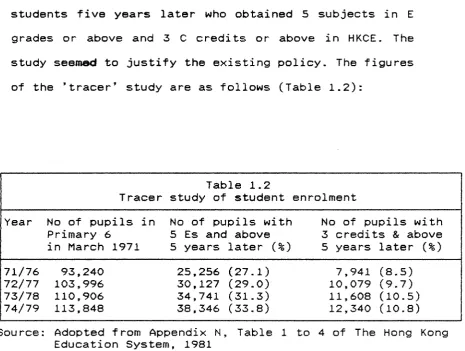
'tracer' study7 which compared the number of Primary 6 students in 1971, 1972 and 1973 and the number of Form V
students five years later who obtained 5 subjects in E grades or above and 3 C credits or above in HKCE. The study seemed to justify the existing policy. The figures of the 'tracer' study are as follows (Table 1.2):
Table 1.2
Tracer study of student enrolment
Year No of pupils in No of pupils with No of pupils with Primary 6 5 Es and above 3 credits
&
above in March 1971 5 years later (%) 5 years later (%) 71/76 93,240 25,256 (27.1) 7,941 (8.5) 72/77 103,996 30,127 (29.0) 10,079 (9.7) 73/78 110,906 34,741 (31. 3) 11,608 (10.5) 74/79 113,848 38,346 (33.8) 12,340 (10.8) Source: Adopted from Appendix N, Table 1 to 4 of The Hong KongEducation System, 1981
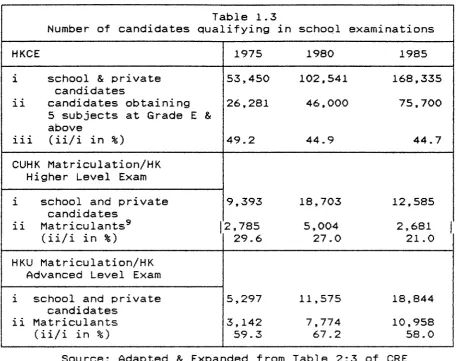
Hong Kong) and the Advanced Level Examination (hereafter AL which is the entrance examination for the University of Hong Kong) in 1975, 1980 and 1985. In the HKCE around 45% and 15% candidates obtained 5 E and 3 C respectively. In HL and AL, the passing rate was around 24% and 60% respectively. But because of the limited places available in the two universities, the number of students who actually entered the two universi ties was small. In 1985, the University of Hong Kong accepted around 1500 students (8% of the total number of applicants) , the Chinese Universi ty of Hong Kong admitted about 1300 (10% of the total applicants) and the Polytechnic let in 3608• making a total of only
about 3000 students.
Table 1.3
Number of candidates qualifying in school examinations
HKCE 1975 1980 1985
i school & private 53,450 102.541 168,335 candidates
ii candidates obtaining 26,281 46,000 75,700 5 subjects at Grade E &
above
i i i (ii/i in
%)
49.2 44.9 44.7CUHK Matriculation/HK Higher Level Exam
i school and private 9,393 18,703 12,585 candidates
ii Matriculants9 12 ,785 5,004 2,681
(ii/i in
%)
29.6 27.0 21.0HKU Matriculation/HK
i ii
Advanced Level Exam
school and private 5,297 11,575 18,844 candidates
Matriculants 3,142 7,774 10,958
(ii/i in
%)
59.3 67.2 58.0Source: Adapted
&
Expanded from Table 2:3 of CREFor Hong Kong students, one way to satisfy the stipulated requirements and to increase their chances of entering the university is to take the public examinations more than once. This has become a distinct
9
The number of matriculants are those students who satisfy the minimum requirements for entry defined by each university. For CUHK, it is 5 Grade Es including Chinese and English languages and for HKU, i t is 2 AL subjects (Grade E and above) and 2 OL (2 HKCE C Grades or above) or 3 AL passed.
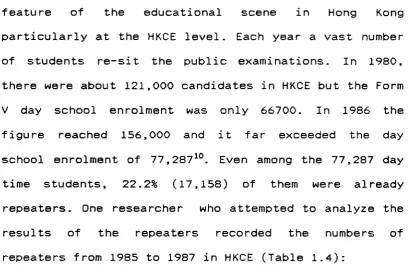
feature of the educational scene in Hong Kong particularly at the HKCE level. Each year a vast number of students re-si t the public examinations. In 1980, there were about 121,000 candidates in HKCE but the Form V day school enrolment was only 66700. In 1986 the figure reached 156,000 and i t far exceeded the day school enrolment of 77,28710• Even among the 77,287 day
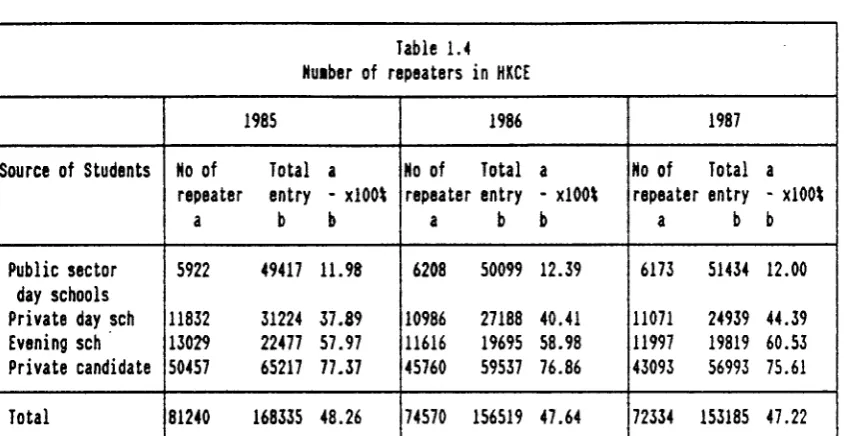
time students, 22.2% (17,158) of them were already repeaters. One researcher who attempted to analyze the results of the repeaters recorded the numbers of repeaters from 1985 to 1987 in HKCE (Table 1.4):
10 77,287 is the entry figure to CE examination
Table 1.4 HUlber of repeaters in HKCE
1985 1986 1987
Source of Students No of Total a No of Total a No of Total a repeater entry - xlOO% repeater entry - xlOO% repeater entry - xlOO%
a b b a b b a b b
Public sector 5922 49417 11.98 6208 50099 12.39 6173 51434 12.00 day schools
Private day sch 11832 31224 37.89 10986 27188 40.41 11071 24939 44.39 Evening sch 13029 22477 57.97 11616 19695 58.98 11997 19819 60.53 Private candidate 50457 65217 77.37 45760 59537 76.86 43093 56993 75.61 Total 81240 168335 48.26 74570 156519 47.64 72334 153185 47.22
Source: Adapted fro. Table 1 of Choi C.C. (1987) A Analysis of the Results of the HKCE Repeaters
The above figures disclose that for the past three
years from 1985 to 1987, almost half of the Form V
students repeated at least one time in the HKCE - the
gateway to matriculation classes and then higher
learning in the universi ties. The highest record for
repeating HKCE. according to the same researcher is
eight times! It is probable that those who repeatedly
sit for the HKCE do so in the hope of enhancing their
chances of entering higher institutions.
What made the students of Hong Kong so keen on the
pursuit of higher studies? In the setting of Hong Kong
where economic interests dominate, are students affected
abili ty? Do the high abili ty students intend to invest more in higher learning? Are students conscious of the differences in earnings associated with different levels of education? Can one then go further to construct the expected life-time earnings of the students? To what extent do their intentions for continuous education affect their expected life-time earnings? Other than the quantity of learning, to what extent are their expected lifetime earnings affected by the quali ty of schools? What are the effects of socio-economic factors?
This thesis attempts to answer these questions and Hong Kong is used as a case for the investigation.
1.1 Related Studies in Hong Kong
private rates of return to university education. He showed that investment in university education could yield a private rate of return of up to 25% and is higher than the social rate. Two years later, following a similar line of arguments and using both the 1976 bi-census and the 1981 bi-census data, Kwok (1984) mobilized Mincer's experience model and found that investment in university education yielded a private rate of return of 22% in 1976 and 21% in 1981. At the more general education level, Chung (1988) compared the economic return to general and vocational education and discovered that al though the private rate of return to the various fields of vocational and technical education varied, they were as a whole higher than general education. In 1976, they were 6.6% higher and in 1981
the difference was 11%.
1.2 The Study by Williams and Gordon and The Theme of The Present Study
Williams and Gordon injected economic factors in the analysis for the falling demand for higher education in England and Wales. The model could be equally applicable to study the rising demand for higher education in Hong Kong. In particular the following issues could be investigated:
A. The influence of students' economic motive in the pursuit of higher education.
B. The pattern of the demand for higher education from the expectations of the individuals.
c.
The analysis of earnings functions as perceived by students who are about to enter full-time working, post-secondaryll or university education.D. The evidence of the link between the private rates of return and the demand for higher education.
In addition, the following issues though not directly related wi th Williams and Gordon study will also be examined:
E.
F.
11
The extent of students' awareness of their own ability and
The different patterns of the demand for higher education among students of different abilities.
Hence in the present study, the economic factors in the individual's demand for higher education in Hong Kong will be investigated. Students' perception of economic benefits from higher learning will be explored. Whether students are aware of their own ability and the effects of different abilities on the demand for higher learning will be examined. Estimates will be made of the expected lifetime earnings of students wi th different careers intentions so that the internal rates of return to different levels of education could be calculated. To obtain a deeper understanding, the analysis will cover the abilities and the socio-economic and educational backgrounds of the individuals.
Perhaps it is necessary though relying on both
to point Human
out here Capital
1.3 Organization of The Thesis
The remaining chapters of the thesis are organized in the following way:
Chapter 2 gives a brief account of the Hong Kong education system and highlights the selective nature of the system since the 1950s. It is argued that this allocation of students into insti tutions of different qualities affects students' demand for higher education and their expected life-time earnings.
Chapter 3 reviews the li terature on Human Capi tal and the Screening/Signalling Hypotheses. Three similar cases on the studies of ex ante Rates of Return will be discussed.
Chapter 4 examines at some length the study by Williams and Gordon and compares 2 different ways the perceived lifetime earnings data are collected. It highlights the areas of investigations, gives the definitions of the variables in the analysis and describes how the data of the thesis are collected.
affect the demand for higher education. It examines also whether students are aware of thei r abili ty and whether students of high abili ty will invest more in
higher education.
Chapter 6 compares the actual earnings in the market with expected earnings of students and employs regression analysis to examine the different independent variables on the expected lifetime earnings of students of different careers intentions and abilities. The regressions will be fUrther broken down according to di fferent abili ties, different quali ty of schools and social background for greater analysis. Estimate will be made on the perceived internal rates of return to higher education in Hong Kong as well as overseas.
CHAPTER 2 BACKGROUND
2.0 Introduction
This chapter gives a brief sketch of the Hong Kong education system as background information. It then describes in details the development of the selective nature of the education system. It traces the origin of the Secondary School Entrance Examination and depicts how it gradually evolved over the years. SSEE was later replaced by the Secondary School Places Allocation (SSPA) but the selective nature of the system did not change. The quality of the secondary schools were developed over the years.
2.1 The Hong Kong Education System
conducted in bisessional schools. According to the Annual Summary of the Education Department, 1985-86, Table 1b, in 1986, about 7% (38,986) of the primary students were enroled in Anglo-Chinese schools where the medium of instruction is largely English, the remaining 93% (491,694) were in Chinese medium schools12. However, both types of primary schools follow a similar curriculum which is basically the teaching of the 3 Rs.
For a long time, at the end of Primary Six, students had to si t for the Secondary Schools Entrance Examination (similar to the former eleven plus examination of England). After 1978, this was replaced by the Secondary Schools Places Allocation, an aptitude test which examines the language (Chinese) and mathematics abilities of the students. According to the results of this test, students are assigned to secondary schools of different qualities. Since 1971. primary education became free and the attendance rate was close to 100 per cent.
Secondary education is five years and is divided into three years junior secondary (Form/Middle 1 to III) and two years senior secondary (Form/Middle IV to V).
There are three ways of classifying the secondary school education: according to the Teaching Curriculum, the Medium of Instruction or the Financial mode of Schools.
In March, 1986 over 92% (364,836) of the secondary students (Form/Middle I to V) were in 'grammar' schools which teach academic subjects like History, Geography,
Economics and Public Affairs, Integrated Science
other than the 3 basic subjects of Chinese, English and Mathematics. About 8% (30,853) were in technical and pre-vocational schools where the syllabi cover more practical subjects. Pre-vocational education is concentrated in the junior secondary level. Of the grammar schools, 90% of them were Anglo-Chinese schools which normally use English as the medium of instruction,
the remaining 10% were Chinese Middle schools where the medium of instruction is Chinese13• In terms of the
teaching medium, the technical and pre-vocational schools are categorized as Anglo-Chinese schools. In 1986, about 72.72% (287,749) of the secondary school students were in Government and Government Aided secondary schools (Form/Middle I to Form/Middle V) where
13 In 1987, the Education Department abolished
the main cost of education is borne by the government; 16% (63,496) were in government 'bought places' in about 50 Private Independent Schools (Form/Middle I to III), the fees of which are controlled by the government; the remaining 11.28% (44,444) were in senior education (Form/Middle IV
&
V) in the Private Independent Schools which are self-financed and the school fees are borne by the parents (Annual Summary, Education Department, 1985-86).In 1979, junior secondary education was made free and compulsory. In order to allocate students into Form/Middle IV, a test known as the Junior Secondary Education Assessment (JSEA) was imposed which examines the attainment of the students in English, Chinese and Mathematics14• In 1986, about 60% of the Secondary III students were assigned places in Secondary IV in government and aided schools. Of the remaining, the majority were enroled in Private Independent Schools and about 3% enroled into the 5 Technical Insti tutes in craft course.
Figure 2.1
Ed ... catlon Syste .. of Hong i<ong ns at 1980
POST - SEC.
HKU
CLHU(
COLLEGES POLYTECHNICS
~
COLL.
F.6
OFr
--0
__
S_E_N_IO_R_S_E_C_. _ _
m.o.
PREVOC.JUNIOR SECONDARY
...
, .... ,
... .
PRIMARY
<>~WDt~Ji~:,:~:~\::::::: ~::::::::::
~.: . : . : .
~.. , .. ' . I .
t t •I·.·:.'.·.·:.·:·:·· I' .
. :.;.: .: .. :.: .... I.'. ',' "
... '.' .'
, f • •:.:.:.:'::.: ,t::': II,',.:' .. :. tf:"
t':
t ' .I ' • " • • ' . ' " • • ' . ' . ' ' . t . '
Source: Cheng Kai Ming (987)
~ . ,'. ' .. ,'.
I,',',',' ,', { . .'
.:.:.
:
-:.
1."-:-:':-:-.
\':,',','.
,
...
C-:·:-:·,·
,
...
,','. '.
...
:-:->:-PT· PART-TIME
E· EMPLOYMENT
CRAFT COURSES
lRAIt JING CENmES
Fit JAHCING/GOVERtm'JG BOUY
o
ED
[I
UPGC
[ ] PRIVATE
At the end of secondary education, students sit for the Hong Kong Certificate of Education (HKCE) which is equivalent to GCE 0 Level. After Form V, the majority of students who are qualified follow a two-year Matriculation course leading to Advanced Level Examination (AL). Most of the tertiary institutions offer three year degree courses and accept students based on the AL resul ts15• There is also the one year
Middle VI course which prepares students for High ~evel
Examination (HL) for the Chinese University of Hong Kong which runs a four year degree course. Government policy since 1979 has been to provide Form VI education to one third of those who enroled in Form IV two years ago.
University education is very competitive. In 1987, the total number of intake by the 8 subsidized higher
15 In 1987, the higher institutes
University and Polytechnic Committee which offer three years degree include:
University of Hong Kong Hong Kong Polytechnic,
City Polytechnic of Hong Kong, Hong Kong Baptist College
under (UPGC) courses
The higher insti tutes which offer four years degree courses include:
Chinese University Lingnam College Shue Van College
of Hong Kong (under UPGC) (government subvented post-secondary college)
institutions stood at 12130. Among this figure, 5,469 were following a degree course (Education Commission Report No 3, Annex D). The figure for degree course is about 5% of the relevant age bracket.
2.2 The Selective Nature of The Education System
Though the education system of Hong Kong is similar to that of England and Wales, the historical development of Hong Kong and the traditional Chinese value on education have stamped certain features on the educational scene making it unique to Hong Kong.
One of these features is the selective nature of the system and the heavy weighting put on public examinations for the purpose of selection16• As a
consequence, schools of different qualities based on students' abili ties emerged. A detailed description of the selective nature and procedure of the educational system is included below to give a picture of how the schools in Hong Kong have gradually evolved to be
16
different in quality.
The early selection of students takes place when students ente r seconda ry school education. The measu re was first introduced in the 1950s and was a result of, in the words of the present Director of the Education Department, the "necessary conditions' of the time17•
In 1949 when the Communist regime was established in China, Hong Kong was flooded with immigrants from China. The population of Hong Kong jumped from a mere 1,750,000 in 1947 to 3,863,900 in 196918• Today it is
well over 5 million. Before 1950, the demand for education was slim. The 1954-55 Annual Departmental Report by the Di rector of Education reported the low application to the training colleges:
The number of applicants for entry in September, 1946 was disappointingly small and much of the material of inferior quali ty. . . .. A college less than half-full cannot expect that lively activi ty inseparable from proper training and it will remain less than half-full unless young men and women find teaching an attractive profession which at present,
17
18
Li, Y.T. (1979), 'The Development of Hong Kong Education System', a speech given to the principals of secondary schools in a seminar organized by the Education Department at Grantham College, November, 1979.
Figures obtained Year Books and Department.
from Hong the Census
Kong and
they most certainly do not.
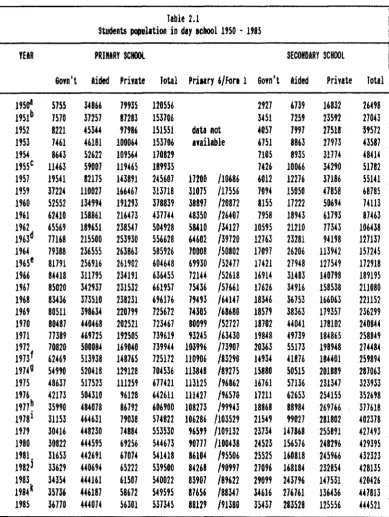
This was no longer the picture in the 1950s. The rapid increase of population had created a heavy demand for education many times more than the pre-1950 period. Table 1 records the changes in the number of day-time students in government, aided and private schools in the primary and secondary level from 1950 to 1985.
gradually. then accelerated in the late 70s. At the secondary level. the peak was in 1978. Entering the 80s,
the fall became very rapid.
Table 2.1
Students population in day school 1'50 - 1'85
YEAR PRlftARY SCHOOl SECONDARY SCHOOL
60,n't Aided PriYate Total Prilary 6/Forl 1 60,n't Aided Private Total 19504
sm
34866 7n35 120m 2927 6739 16832 26498 1mbmo
37257 87283 153706 34S1 725' 23592 27043 1952 8221 45344 979S6 151551 data not 4057 7997 27SU -m72 1953 7461 46181 100064 153106 available 6151 8863 21913 43581 1954 S643 52622 109564 170829 1105 8935 31114 484141955C 11463 59007 119465 189935 1426 10066 34290 51182
1957 19541 82115 143891 245601
moo
/10686 6012 12276 31186 551U 1959 31224 110021 166461 313118 31015 /17556 1094 15050 47858 68185 1960 52552134m 191m
318839 38891 /20872 8155 17222 50694 741131961 62410 158861 216m 437144 48350 /26407 1958 18943 61793 81463 1962
d 65569 189m 238541 504928 5S41O /34127 10595 21210 71343 106438 1963 17168 215500 253930 556628 64602 /39120 12163 23281 94198 121137 1964 79388 236555 263863 585926 10008 /50802 11097 26206 113942 157245 1965e 81791 256916 261902 604648 69930 /52417 17421 21948 121549 112918 1966 84418 311795 234191 636455 12144 /52618 16914 31483 140798 189195 1967 85020 342931 231532 661957 75436 /57661 17626 34916 158538 211080 1968 83436 313510 238231 696176 1'493 /64141 18346 36753 166063 221152 1969 80511 398634 220799
m672
m05 /68680 18579 38363 179357 236299 1970 80487 440468 202521 123461 S0099 /52721 18702 44041 178102 240844 1971 77389 469125 192505139m
93245/Uno
19848 49739 184865 258849 1m 70820 500084 169040 739944 1&3996 /73907 20363 55173 198948 2144841973f 62469 513938 148765 725112 110906 /83290 14934 41876 18UD1 259894 1914° 54990 520418 129128 704536 113848 /89275 15880
som
201889 281063 1975 48637517m
111259 671421 113125 /96862 16761 57136 231347 323933 1m 42173 504310 96128 642611 111427 /96570 17211 62653 254155 352698Source: Coapiled fro. the SUilary Reports, Education Oepartlent, 19S1-l986
a. Fro. 1950 to 1969, the figures include evening school students.
b. Starting froa 1951, technical (vocational) school students were included in the secondary schools. c. Data of 1956 and 1958 not included.
d. froa 1963, a special secondary course and a 3-year Hon-certificate Course were introduced. The toner was phased out 3 years later and the latter in 1m.
FI'OII 1964, a 5-year prilary education course was introduced which co-existed with the 6-year course. The new course proved to be very unpopular and was abandoned in 19".
e. Release of The White Paper: Education Policy.
f. Release of the Green Paper: Report of the Board of Education on the Proposed Expansion of Secondary School Education over the Hext Decade. g. Release of the White Paper: Secondary Education in Hong Kong over the Hext Decade.
h. Release of the Green Paper: Senior Secondary and lertiary Education : A Developaent Program for Hong Kong over the Hext Decade.
i. Release of the White Paper: The Developaent of Senior Secondary and Tertiary Education. j. Release of the Report by the OECD Visiting Panel: A Perspective on Education in Hong Kong. k. Foraation of the Education Coaaission in February.
In summary, Hong Kong has undergone rapid economic changes since 1950. From a city founded on entrepot trade, Hong Kong has become an export oriented industrial and financial centre. The economic policy of the day, other than the non-interference strategy which helped to promote trade and export, was the vigorous pursuit of economic growth and the maximization of profits. The government also persistently adopted a conservative estimation of revenue which resulted in continuous surplus over the years. One cri tic19
commented on Hong Kong government's conservatism in 1971:
'When a budget, which is already small in relation to the national income of the country, bears the weight of long-term investment in the public sector as well as yielding substantial su rpluses, it is inevitable that certain socially necessary services will be under-provided'
One of the 'socially necessary services' which was under-provided was education. While after World War II, many newly independent and developing countries experienced a rapid expansion of education, Table 1
19 Owen, N.C. (1971). Economic Policy in Hong
illustrates that the provision of education in Hong Kong since 1950 has been a slow process. It took 22 years to reach full provision for all in the primary while in the junior secondary, the period was 31 years. This slow provision of schooling particularly in the secondary level made admission to the government and aided schools very difficult. Under these circumstances, the selection through public examination was introduced and justified.
2.3 The development of the Secondary Schools Entrance Examination
and private primary schools2O
• Admission to government secondary schools and to a lesser extent, aided secondary schools was based on the result of this Examination (HK Education Department Annual Summary, 1959-60) .
In 1962, the Joint Primary 6 Examination was formally replaced by the Secondary School Entrance Examination (hereafter SSEE) which was intended for all the primary 6 students on a gradual basis. The Hong Kong Education Department Annual Summary, 1962-63 stated the intention:
The Secondary School Entrance Examination was held for the first time in 1962 for selection of pupils for promotion to secondary school places. This examination is open to many more pupils in private primary schools than the Joint Primary 6 Examination it has replaced. Heads of all registered primary schools were allowed to enter up to 60%, and, in cases where past examination results justified, up to 100% of their primary 6 pupils. The examination was also much simpler than the Joint Primary 6 Examination so that it consisted only of one paper each in Chinese, English and Arithmetic and was completed in one day as against four days~.
20
21
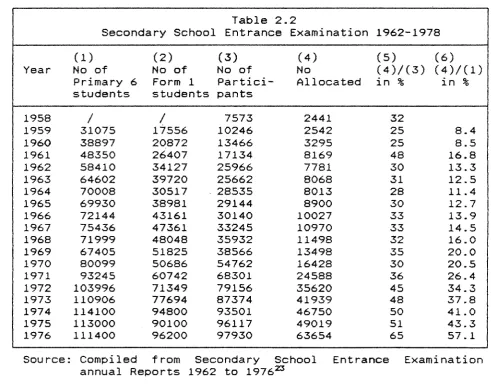
Like the previous Joint Primary 6 Examination, from the start, the three subjects of Chinese, English and Arithmetic in SSEE were attainment tests. Only a small percentage of the participating students passed this examination (until 1970 i t was around 30%) and were selected to study in the government, government-aided and private assisted~ secondary schools. Table 2.2 lists the number of primary 6 students from 1968 to 1976, (column 1 ) , Form I students (column 2), participants (column 3), allocated students (column 4),
which said:
• ... The expansion of subsidized primary education at a faster pace than secondary education has enabled most of the younger generation in Hong Kong to receive a basic education and to master essential skills of literacy and numeracy, but i t led to severe competition for secondary school places in the public sector, which has exerted an unhealthy influence on primary school teaching.'
Different from the Government-Aided Schools which received all current and recurrent expenditures from the government, the Private-Assisted Schools received only a capi tation grant from the government. In the late 1970s when junior secondary education was rapidly expanded, the government incorporated the majori ty of the Private-Assisted Schools (37 out of 41) into Government-Aided Schools.
the successful rate against participants (column 5) and the successful rate against the number of Primary 6 students (column 6). The table gives a picture of the severe competitiveness of the examination:
Table 2.2
Secondary School Entrance Examination 1962-1978
(1 ) (2) (3) (4) (5) (6)
Year No of No of No of No (4)/(3) (4)/(1) Primary 6 Form 1 Partici- Allocated in % in %
students students pants
1958
/
/
7573 2441 321959 31075 17556 10246 2542 25 8.4
1960 38897 20872 13466 3295 25 8.5
1961 48350 26407 17134 8169 48 16.8
1962 58410 34127 25966 7781 30 13.3
1963 64602 39720 25662 8068 31 12.5
1964 70008 30517 .28535 8013 28 11.4
1965 69930 38981 29144 8900 30 12.7
1966 72144 43161 30140 10027 33 13.9
1967 75436 47361 33245 10970 33 14.5
1968 71999 48048 35932 11498 32 16.0
1969 67405 51825 38566 13498 35 20.0
1970 80099 50686 54762 16428 30 20.5
1971 93245 60742 68301 24588 36 26.4
1972 103996 71349 79156 35620 45 34.3
1973 110906 77694 87374 41939 48 37.8
1974 114100 94800 93501 46750 50 41.0
1975 113000 90100 96117 49019 51 43.3
1976 111400 96200 97930 63654 65 57.1
Source: Compiled from Secondary School Entrance Examination annual Reports 1962 to 1976~
23
medium of instruction was also English and lastly the Chinese Middle Schools (Secondary School Entrance Examination Annual Reports 1962 to 1976).
All these schools offered grammar education. In the early period, only the government schools provided technical education for the successful candidates, but the number was negligible. Pre-vocational education of any large scale after Primary 6 was only gradually introduced after the 1970s. However, the pre-vocational schools which were mainly geared towards junior secondary education in practical subjects have never been popular with the pupils and the parents.
It was clear then in the early part of the SSEE history, the medium of instruction in secondary schools became the criterion of 'selection' for the academically capable students (later on when technical and pre-vocational education were available, it was the medium of instruction plus grammar education). The great majority of those who failed the Examination and those who were not selected in the first place to sit for the Examination simply ended up in the labour market24 or if
their families could afford it, studied in the Private Independent Schools where teacher qualifications, school facilities and teaching standard were low.
Over the years, elaborate methods had been applied to allocate the successful candidates to the Government, Aided and Private-Assisted secondary schools. At first, when the number of pupils was small, strict order of merits was followed. Gradually, when the number of candidates became quite large, a block system was introduced. The idea was to group students of approximately equal ability into a block. In 1971, in order to speed up the provision of junior secondary education, a 3-year assisted places scheme was introduced in the Private-Assisted secondary schools (the 'P 3' places). Later on 'P 3' places were also available in the Government and Aided secondary schools for the less academically capable students.
Y2 each with about 15000 pupils and the remainder (who were not allocated places) were placed in five blocks Z1, Z2, Z3, Z4 and Z5 each with about 9600 pupils (Secondary School Entrance Examination Annual Reports 1962 to 1977).
A government report prepared for the DECD Panel of Visitors in 1981 described briefly the operation of SSEE and reported the cri ticisms made on it (The Hong Kong Education System, 1981, p178-79):
'Until 1977 the selection of pupils for the then limi ted number of public-sector secondary school places was by public examination - the Secondary School Entrance Examination (SSEE). All candidates were required to take the examination in three basic subjects Chinese, English and Mathematics
-in one afternoon. Allocation was carried out -in "bands" in which parents' first choices were considered in strict order of merit, judged solely by performance in the SSEE. Before its aboli tion the SSEE was criticized on the grounds that it led to cramming in the three main academic subjects to the neglect of other areas of the curriculum, thus distoFting the aims of primary education; the fact that it was a public examination created widespread anxiety among children (and their parents); a child's future education was determined at the age of 11 in one single afternoon; and it led to certain secondary schools getting most of the academically able pupils.'
several devices which included flotation classes25 in the Gove r nme n t and Aided schools, school-building programme and buying places from the Private Independent Schools were employed (1974 White Paper: Secondary Education in Hong Kong Over The Next Decade). However, the SSEE system was not scrapped but only replaced by another one titled 'Secondary School Places Allocation' (hereafter SSPA) system because it was believed that a wide variety of secondary schools existed and the standard among them was uneven. Instead of the three academic subjects, the SSPA relied on Aptitude Tests to measure students' linguistic (Chinese) and numerical abilities.
Under the new system, students were grouped into 5 Bands of abilities in the 19 districts in Hong Kong. The Band 1 students who had the highest scores in the SSPA had the priori ty of choosing schools first and almost all chose the 'prestigious' Government and Aided grammar schools. On the contrary. the majori ty of the Band 5 students who scored the lowest in SSPA ended up mostly in the Private Independent Schools. Since 1978, it has
25
been the policy of the government to expand the aided schools sector with the result that many of the Band 5 students also end up in the aided secondary schools. This is particularly so in the new towns. So basically
the selective nature of the system is retained in SSPA and the quality difference between schools, in particular Aided and Private Independent Schools remains.
2.4 Effect of SSEA
&
SSPA and The Quality of schoolsqualifications, poor teacher ratio, large class size and inferior building all contribute to their overall substandard in facilities as well. On top of all these, it has been the government's policy to keep the school fees of private schools well below the cost of education to the government and aided schools26 thus making it very difficult for the private schools to improve their quality.
However, since the late 1970s, the Government began to rapidly expand the aided secondary schools (refer to Table 2.1). The private schools sector began to contract. In some new towns. there were only a few, if any, private schools. Many of the aided schools had to take in students of low banding. This somehow blurred the distinction between private independent schools and some aided schools.
This grouping of students strictly according to ability resembles the 'sponsored' mObili ty27 described
26
27
In 1985, the South China Morning Post revealed that the average cost of an aided secondary school to the government was HK$8,000 while a private secondary school (through the brought place scheme) was only HK$3,OOO.
by Turner (1960). Yuchtman & Samuel (1975) showed that in a system where 'sponsored' mobility prevails, the institutional factor is significantly stronger than interpersonal factors in affecting the pursuit of higher learning. Among other things, it is believed that the quality of schools the distinct feature of the educational system of Hong Kong, exercises immense influence on the intention of students for higher education.
CHAPTER 3 REVIEW OF LITERATURE
3.0 Introduction
This chapter is divided into three sections. The early part of the first section traces briefly some of the important aspects and developments of Human Capital theory. It highlights the producti vi ty augmenting view of the theory; describes Becker's specific and general training and the latter's relation with schooling. In the later part of application, i t introduces the earnings function, the independent variables and the limi tations in collecting the data of these variables. It discusses studies on the quali ty of schooling and ability adjustment two of the important variables included in the present study. Lastly it states the general methods in calculating the rate of "return to education.
potential employers. The concept of employers' conditional probabilistic beliefs, the informational feedback loop and the numerical explanation are presented. It shows the arguments that it is the capable students who would invest in more and more education for
their future gains. Lastly the influential proponent of the Hypothesis is briefly introduced.
work of Riley, an Screening/Signalling
The thi rd section summaries three pieces of study on ex ante. rates of retu rn. The one by Wi 11 iams and Gordon, upon which the present study is buil t, is an original research of a large scope with a sophisticated methodology. The work by Bosworth and Ford is included because of its discussion on the ways the lifetime earnings are estimated. The works by Psacharopoulos and Sanyal draw on data in developing countries and are therefore included for comparison.
3.1 The Development of Human Capital Theory
spend on themselves in diverse ways, not for the sake of present enjoyments, but for the sake of future pecuniary and nonpecuniary retu rns" is not a new one, nor is it conf i ned to education alone. Economis ts28 have poi nted out that as early as the 18th century, Adam Smith al ready called attention to the idea that an educated man was a sort of expensive machine.
In the 1950s interests in the subject rapidly grew and economists in UK and Europe already drew notice to the concept of education as an investment29• In 1960,
28
29
see for example
Bowman, M.J. (1968). The Human Investment Revolution in Economic Thought, in M. Blaug (eds) Economics of Education, Vol 1, Penguin Books: 101-34,
Blaug, M. (1970). An Introduction to the Economics of Education, Allen Lane, p2 and M. Woodhall (1987) 'Economics of Education: A Review" in G Psacharopoulos (ed.) Economics of Education Research and Studies, Pergamon Press: 1-8.
Williams (1982) observed that in the second half of 1950s, there had already been some writings on education by economists in Europe.
Theodore Schultz delivered his presidential 'Investment in Human Capital' (Schultz, 1961)
address and the bi rth of the subject was considered properly heralded. In the lecture, Schultz dispelled the deep-seated moral and philosophical taboo of treating human beings as capi tal goods; established the link of economic growth
wit~ human capital and analyzed the different categories
of human investments which included a) heal th, b) on-the-job training, c) formal education, d) study programme for adul t in agricul ture and e) migration. After that, for some years interests in the economics of education mushroomed throughout the world and stimulated a profusion of research and policy proposals. The much quoted bibliography by Mark Blaug is a good case in point. In 1966 when Mark Blaug first compiled the bibliography on economics of education, there were only 800 items. In 1970 it was expanded to 1350 and the third edition in 1978 contained over 2000 entries. Bowman
3.11 The productivity augmenting view
Much of the early work in the economics of
education~, observed Hansen (1970) concentrated on two
underlying themes:
(1 )
(2)
31
32
there are important links between education and productivity - and therefore income31 and the role of education can be explored fruitfully when viewed as an income-generating form of human capital~.
John Mace (1984) tried to differentiate Human Capi tal Theory f rom economics of education. For the former, he borrows a definition from Mark Blaug (1976) which states that human capital 'is the idea that people spend on themselves in diverse ways, not for the sake of present enjoyments, but for the sake of future pecuniary and nonpecuniary returns'. For economics of education he defined broadly as the application of the analytical tools of economics to education. Williams (1982) pointed out that it is Human Capi tal Theory which is the heart of the economics of education.
The neoclassical economic theory argues that wages are determined according to the worker's marginal contribution to the revenues of the firm, hence more productive workers will have higher income.
Incidently much of the criticism on the use of education per man indexes as measures of the quali ty of the labour force also lies in the two basic questions (Griliches 1970, p80): (1) Does education 'really' affect
This productivi ty augmenting view of schooling is
the 'classic stance' of the human capi tal concept and
has generated studies on the effect of education on
economic growth. Denison (1962) was among the pioneers
in the use of a production-function model~ to quantify
the contribution of education (the changing distribution
of school years) to economic growth in the US~.
However, it has not been easy in establishing direct
evidence for the productivi ty augmenting view of
education. Thus far, the only direct evidence came from
the agricultural sector. In the survey of 18 studies
conducted in developing countries, Lockheed et al (1980)
(2) Is 'education' and
measured correctly for hand?
its contribution
the purpose in
Blaug (1970, p93) pointed out that Denison never mentioned the concept of a production function in his book. Hence Denison can only
be said to have implicitly estimated an
aggregate production function.
Bowman (1980) drew from a number studies to compose a comparison of Education in Growth
Accounting, 1952-62 among a number of
countries. She observed that for most
countries education turned to be a minor
factor (her Table 3 p54). This was due to a)
the omission of educational 'maintenance'
were able to show that as a result of a farmer's completing 4 addi tional years of elementary education, farm productivity increases, on the average, by 7.4%.
3.12 Specific training, general training and schooling
In 1964. Gary Becker published in the supplement volume of the Jou rnal of Poli tical Economy his 'Human Capital' which deals with investment in on-the-job training and who will benefit therefrom. This key volume greatly advanced Human Capital Theory.
Before, it used to be believed that most forgone earnings (human capital investments) occurred in the schooling period. Bowman (1987) pointed out that schooling constitutes only one element in Human Capital Theory. Gary Becker (1962, 1975) argued that investments inhuman bei ngs took place also throughout the postschool years. The theory was further developed by Mincer (1962, 1974). The concepts of the general and specific training are distinguished as follows (Becker, 1975) :
heart surgery is portable when i t is not limi ted in the hospi tal in which the surgeon is trained;
b) specific training nonportable which enhances the futu re producti vi ty of the trainer in the firm which provides it; this includes orientation programme and rotation work among departments.
In fact, few people would acquire specific human capital without at the same time acquiring at least some form of general human capital. These specific Job-training investments would decline over a period of time. The individual would switch gradually from learning at a younger age to earnings at an older age until the investments reach zero, forming a concave lifetime earning profile. However, i t is not always easy to distinguish general training from specific one when the labour markets are not perfect. Ziderman (1978) commented:
Training provided under monopsony conditions, even if general in essence, becomes firm-specific in reality; conversely, training that may have been de
facto speci fic will be rendered general by
competitive entry. It is the potential mobility of trainees, not the generality of skills, as such that is critical to the training-investment decision of a firm.