172 | P a g e
SOFT COMPUTING TECHNIQUES FOR MAJOR
ROOF FALLS IN BORD AND PILLAR IN
UNDERGROUND COAL MINES USING MAMDANI
FUZZY MODEL
Singam Jayanthu
1, Rammohan Perumalla
21
Professor, Mining department National Institute of Technology, Rourkela, Odisha
2
M.Tech (R) student, National Institute of Technology, Rourkela, Odisha.
ABSTRACT
Roof falls are common problems in underground coal mines which may have serious effects on miners in the
form of injuries, disabilities or fatalities as well as other damages like production delay, interruptions in mining
operations, equipment breakdown events. Roof fall and side fall accidents accounted for about 21% and 15% of
all fatal accidents during the year 2014,2015 (DGMS 2015,2016). According to the importance of the problem,
different researchers were conducted to find the relationship between the area of major roof fall and the
effective parameters on occurrences of the roof fall in underground coal mines. So it is mandatory to continue
the study of different possible optimistic methods to evaluate the Roof fall area. Many modeling techniques are
being used by different investigators and researchers for developing different types of roof fall predictions. In
this study fuzzy logic was applied to predict area of major roof fall in coal mines. The predictive fuzzy model
was implemented on MATLAB 2014 using Mamdani algorithm and was developed based on expert’s knowledge
and data base including data sets collected from the mines. The obtained results from the fuzzy model and the
actual roof fall were compared it showed that the fuzzy model can predict the area of major roof fall effectively.
Keywords: Roof Fall, Coal Mines, Fuzzy Logic, Mamdani.
I. INTRODUCTION
173 | P a g e
machines, automatic motor regulator for vacuum cleaners with acknowledgment of external area condition and
mark of soiling, and forecast systems for early acknowledgment of earthquakes etc
[
1].II. FUZZY LOGIC
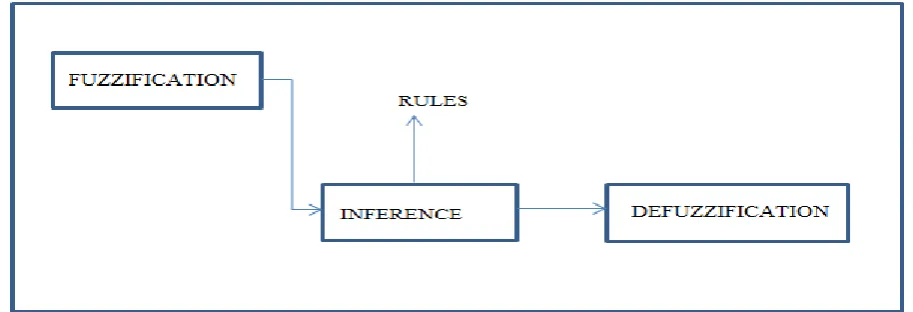
A fuzzy set is a class of objects without a precisely defined criterion of membership. The set is characterized by a membership function which assigns to each object a grade of membership ranging between zero and one [2]. It is to deal with the conception of the uncertainty due to imprecision and vagueness. This theory becomes an important tool in various engineering modeling and replaces the traditional methods of designing and modeling of a system. Imprecision here is meant in the sense of vagueness rather than the lack of knowledge about the value of a parameter. In fact, it is a natural way to deal with imprecision problems by definition of class which represents continuum grades of membership. Therefore, a much wider scope of applicability in the field of pattern classification and information process is accessible by fuzzy sets[1].Moreover, it performs numerical computation by using linguistic labels stipulated by membership functions. In this way, contrary to a classical set in which the elements belong to, or not belong to a set, a fuzzy set degree of membership for each element is assigned in the unit interval between 0 and 1. This theory can also be used for developing rule-based models which combine expert knowledge and numerical data. The typical block diagram of fuzzy logic with different levels is shown in below fig 1.
Fig 1: Block diagram a Fuzzy logic system.
2.1 Fuzzification Process
Fuzzy set performs numerical computation by using linguistic labels. Fuzzy set performs numerical computation by using linguistic labels. For each input and output variable selected, we define two or more membership functions (MF), normally three but can be more. As a first part of fuzzy logic system, crisp values of input and output variables should be converted to fuzzy values or linguistic information. first part of fuzzy logic system, crisp values of input and output variables should be converted to fuzzy values or linguistic information.
2.2 Knowledge Base
174 | P a g e
whereas the rule base contains a number of fuzzy if–then rules. IF premise (antecedent), THEN conclusion (consequent) [3]. The structure in expression is commonly referred to as the IF–THEN rule-based form; this form generally is referred to as the deductive form. It typically expresses an inference such that if we know a fact (premise, hypothesis, antecedent), then we can infer, or derive, another fact called a conclusion. This form of knowledge representation, characterized as shallow knowledge, is quite appropriate in the context of linguistics because it expresses human empirical and heuristic knowledge in our own language of communication.
2.3 Fuzzy Inference System
The fuzzy inference system (FIS), also known as the decision-making unit, performs the inference operations on the rules. In fact, fuzzy inference is the process of formulating an input fuzzy set map to an output fuzzy set using fuzzy logic. [4]. It is the process of making a crisp quantity fuzzy. It could be done this by simply recognizing that many of the quantities that we consider to be crisp and deterministic are actually not deterministic at all. They carry considerable uncertainty [3].
The center segment of a fuzzy logic system is the FIS part, which consolidates the facts got from the fuzzification with the rule base and directs the fuzzy reasoning procedure. There are a few FIS that have been utilized in different applications, and the most normally utilized incorporate the accompanying: The Mamdani fuzzy model, the Takagi–Sugenos–Kang (TSK) fuzzy model.
Among distinctive FISs, the Mamdani fuzzy model is one of the most regularly utilized as a part of fuzzy logic for fathoming numerous genuine issue. The Mamdani FIS was proposed by Mamdani to control a steam engine and boiler combination by set of linguistic control rules got from experienced human operators.
2.4 Defuzzification Process
Defuzzification is a procedure to extract a representative numerical (crisp) value of output from a fuzzy set. The application of the defuzzifier is to receive the fuzzy input and provide crisp output. In fact, it works opposite to the fuzzier. There are a number of defuzzification methods in the literature such as Centroid Of
Area (COA).
III. DETERMINING PARAMETERS FOR MAJOR ROOF FALL AREA PREDICTION
175 | P a g e
Table 1: Statistics of the collected mine data
S.No Parameter
Symbol
Min
Max
Mean
SD
1.
Area of exposure
(m
2)
AE
6000
11404
9291
2571
2.
Depth of cover
DC
61.5
120
91.3
27.82481
3.
RMR
RMR
58
58.1
58.01
0.05477
4.
Intersectional Span
IS
1.5
7.1
4.2
2.27
5.
Roof
Convergence (mm)
RC
0.5
1.5
1.12
0.445
6.
Area of major roof
fall
AMRF
1600 m
23400 m
22500 m
2670.82 m
2The purpose of the paper is to enhance the application of a Fuzzy model to mining industry predict the area of major roof fall in coal mines. The data from Indian coal mines were used. Results of the basic descriptive
statistical analysis performed on available database as shown in table 1
.
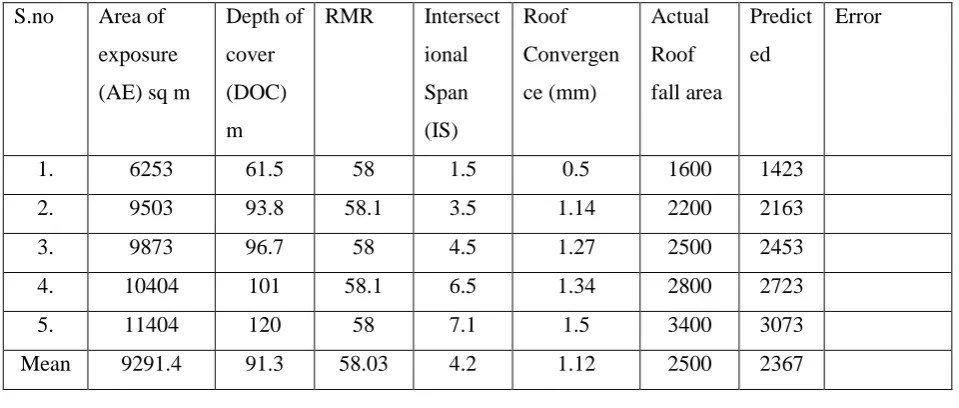
The selected parameters with their testing data and actual data is clearly shown in table 2. Each parameter with the calculation of mean, median, SD, actual and predicted values with error rate were also given in table2.
Table 2:
Testing data set used for evaluating proposed model.
S.no
Area of
exposure
(AE) sq m
Depth of
cover
(DOC)
m
RMR
Intersect
ional
Span
(IS)
Roof
Convergen
ce (mm)
Actual
Roof
fall area
Predict
ed
Error
1.
6253
61.5
58
1.5
0.5
1600
1423
2.
9503
93.8
58.1
3.5
1.14
2200
2163
3.
9873
96.7
58
4.5
1.27
2500
2453
4.
10404
101
58.1
6.5
1.34
2800
2723
5.
11404
120
58
7.1
1.5
3400
3073
176 | P a g e
Media
n
9873
96.7
58
4.5
1.27
2500
2453
SD
2571.4747
27.8248
1
0.05477
2.27
0.44533
670.82
625.56
R error
-
-
-
-
-
0.98477
R
2erro
r
-
-
-
-
-
0.9598
IV. FUZZY MODEL TO PREDICT AREA OF MAJOR ROOF FALL
Fuzzy logic is a logical system it is a prolongation of multivalued logic. It is a theory which relates to classes of objects with un sharp boundaries in which membership is a matter of degree. This theory occupies major portion in different engineering modeling and becomes substitute for traditional methods of designing and modelling of a system. In this model max min composition was selected. It is conception of defining the existence of a relational chain between elements of input and output. It is the most adoptable technique [5].
A
(1)
A
(2)
The proposed fuzzy models include five input variables – AE, DC, RMR, IS, RC and output variable – Area of major roof fall. It is shown in fig 2.
Fig 2: Schematic diagram of major Roof fall Fuzzy model.
177 | P a g e
µ
a=
0
Fig 3: Model of Trapezoidal membership function.
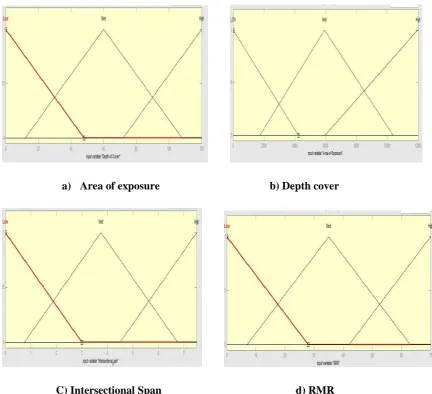
In the model trapezoidal membership functions were adopted for describing input and output variables because of their computational efficiency. In the figure a,b,c,d and e are the parameters of the linguistic values and x is the range of the parameters. The graphical pics of the membership functions of different input and output variables are shown in fig 4.
a)
Area of exposure b) Depth cover
178 | P a g e
e) Roof convergence
Fig 4: Fuzzy representation of input and output variables
The following next level of the Fuzzy inference system is the developing of the if–then rules, which are used to represent the fuzzy relationships between input and output fuzzy variables. In this paper for constructing the rule base of fuzzy model, a total of 80 rules were utilized based on experts’ experiences and data compiled from the
mines. The fuzzy model developed here can provide an estimate of area of major roof fall when proper input data were entered into model. For instance as can be seen in table 2 if the input parameters were entered into data like AE = 9503, DC = 93.8, RMR = 58.1, IS = 3.5, RC =1.14, the output predicted area of major roof fall is 2163 m2 whereas actual area of area of roof fall is 2200 m2.
V. RESULTS AND DISCUSSIONS
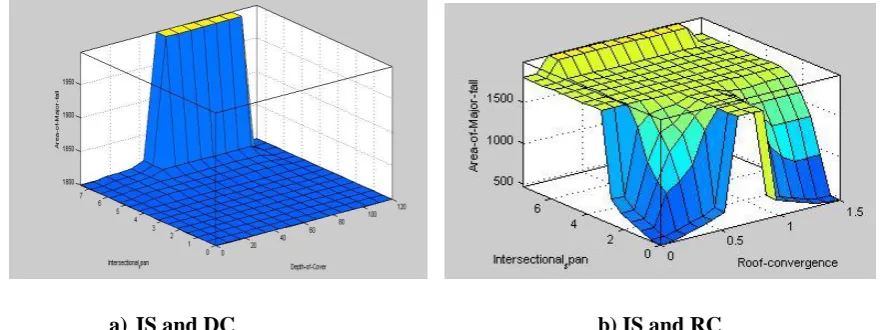
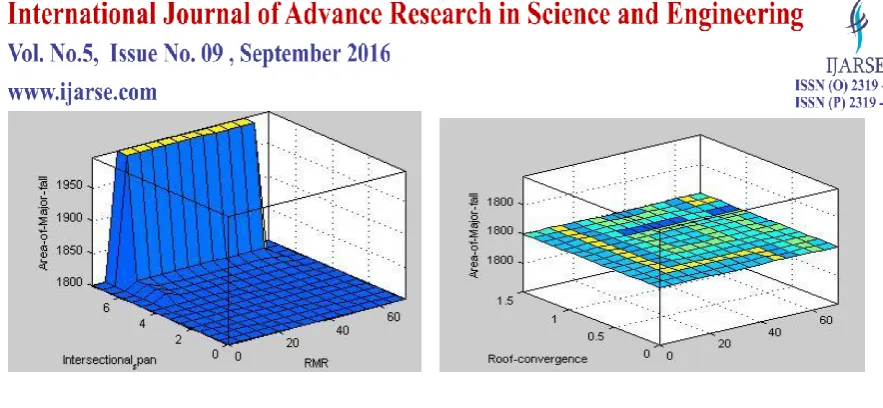
There are 05 data sets which were used for the model. The resultant output of the constructed proposed model each dataset is converted into qualitative information like Low, Medium, High. The constructed model predicted the area of major roof fall approximately in every case. The response plots from Matlab 2014 have been shown in fig 4 a-d. It can be concluded from the fig 4 the constructed fuzzy model is capable of predicting major roof fall area in the experimental.
179 | P a g e
c) IS and RMR d) RC and RMR
Fig 4 Surface plots of a area of major roof fall with Intersectional span IS and DC, b IS and RC, c IS and RMR, d RC and RMR.
Field as the rule covers larger decision surface. The results show that fuzzy logic is useful and powerful tool for estimating area of major roof fall in coal mines. The output of the fuzzy model can be taken into account as a preliminary assessment of area of major roof fall based on which mining under managers and engineers can take necessary decisions and mitigation measures for controlling and prevention of injuries, fatalities that occurs in mines.
VI. CONCLUSIONS
Roof falls are the regular hazard in coal mines and it is inherently complex and unvaticinate due to dubious and variability in mining and geological parameters. Hence in this paper using fuzzy logic method, a model was established for prediction of area of major roof fall.This model was constructed using five inputs: AE, DC, RMR,IS,RC. Total if - then 80 rules and Centre of area (COA) method for defuzzification process. The fuzzy results show that Fuzzy method is a useful and powerful tool for the safety of mining engineers. The significant advantage of fuzzy model is the human decision and cognizance can be effectively used for the prediction of area of major roof fall in coal mines. It is a lucid that the fuzzy model can be improved with big data that can be
obtained from larger recorded data.
VII. ACKNOWLEDGEMENTS
The authors would like to express their thanks to Coal India mine managers for their kind co-operation in permitting to visit the mines. They also thanks the editor of ICRISEM-16 for their co-operation and constructive suggestions. They also thank Mr. Datrika Srinivas Rao for his kind co-operation in guiding for Fuzzy model development.
REFERENCES
[1] Zimmermann, Hans-Jürgen. Fuzzy set theory—and its applications. Springer Science & Business Media, 2001.
180 | P a g e
[3] Research gate 2016, https://www.researchgate.net/topics.QuestionsAsked.html
[4] Bertoncini, CA., and Mark K. Hinders. "Fuzzy classification of roof fall predictors in microseismic monitoring." Measurement 43.10 (2010): 1690-1701.
[5] Rezaei, Mohammad, Abbas Majdi, and Masoud Monjezi. "An intelligent approach to predict unconfined compressive strength of rock surrounding access tunnels in longwall coal mining." Neural Computing and Applications 24.1 (2014): 233-241.
[6] Ataei, M., R. Khalokakaei, and M. Hossieni. "Determination of coal mine mechanization using fuzzy logic." Mining Science and Technology (China) 19.2 (2009): 149-154.
[7] Azimi, Y., et al. "Prediction of the blastability designation of rock masses using fuzzy sets." International Journal of Rock Mechanics and Mining Sciences 47.7 (2010): 1126-1140.
[8] Deb, D. "Analysis of coal mine roof fall rate using fuzzy reasoning techniques." International Journal of Rock Mechanics and Mining Sciences 40.2 (2003): 251-257.
[9] Ethesis Btech Siva Prasad 2013, http://ethesis.nitrkl.ac.in/5142/1/109MN0505.pdf
[10] Mohammad, R, et al. "Prediction of representative deformation modulus of longwall panel roof rock strata using Mamdani fuzzy system." International Journal of Mining Science and Technology 25.1 (2015): 23-30.
[11] Palei, Sanjay Kumar, and Samir Kumar Das. "Logistic regression model for prediction of roof fall risks in bord and pillar workings in coal mines: An approach." Safety Science / 47.1 (2009): 88-96.
[12] Razani, Mojtaba, Abdolreza Yazdani-Chamzini, and Siamak Haji Yakhchali. "A novel fuzzy inference system for predicting roof fall rate in underground coal mines." Safety science 55 (2013): 26-33.
[13] Ross, Timothy J. Fuzzy logic with engineering applications. John Wiley & Sons, 2009.
[14] Wen-Xiu, Li, and Li Hai-Ning. "Fuzzy system models (FSMs) for analysis of rock mass displacement caused by underground mining in soft rock strata." Expert Systems with Applications 36.3 (2009): 4637-4645.