International Journal of COPD
Dove
press
O r I g I n a l r e s e a r C h
open access to scientific and medical research
Open access Full Text article
Efficacy of indacaterol on quality of life
and pulmonary function in patients with COPD
and inhaler device preferences
Takeshi Ohno1
Shota Wada1
Souichirou Hanada1
Hirochiyo Sawaguchi1
Masato Muraki1
Yuji Tohda2
1Department of Respiratory Medicine
and Allergology, Nara Hospital, Kinki University Faculty of Medicine, Ikoma,
Japan; 2Department of Respiratory
Medicine and Allergology, Kinki University School of Medicine, Osakasayama, Japan
Correspondence: Masato Muraki
Department of Respiratory Medicine and Allergology, Nara Hospital, Kinki University Faculty of Medicine, 1248-1 Otoda-cho, Ikoma, Nara 630-0298, Japan
Tel +81 743 77 0880
Fax +81 743 77 0890
email [email protected]
Background: Indacaterol is a novel, once-daily, inhaled, long-acting b2-agonist for patients with chronic obstructive pulmonary disease (COPD). The study objective was to evaluate the efficacy of indacaterol on quality of life and pulmonary function in patients with COPD in a real-world setting, and also to evaluate its inhaler device (Breezhaler®), which is important for
both adherence and management.
Methods: Twenty-eight outpatients with COPD were treated with indacaterol (150 µg once daily for 8 weeks), and the effects on pulmonary function were evaluated using a question-naire survey with the modified Medical Research Council (mMRC) dyspnea scale and COPD assessment test (CAT) before and after treatment. Similar investigations were also performed separately among different baseline medications. Moreover, original questionnaire surveys for indacaterol and its device were performed.
Results: Overall, mMRC dyspnea scale and CAT scores significantly improved (1.96±1.04 to 1.57±1.07 and 17.39±8.23 to 12.82±8.42, respectively; P,0.05). Significant improve-ments in forced vital capacity (FVC) and forced expiratory volume in 1 second (FEV1) were also observed on pulmonary function tests (2.91±0.66 L to 3.07±0.65 L and 1.46±0.60 L to 1.58±0.59 L, respectively; P,0.05). Replacement therapy from salmeterol to indacaterol sig-nificantly improved mMRC and FVC values, but did not sigsig-nificantly improve CAT scores or other pulmonary functions. Add-on therapy with indacaterol significantly improved mMRC score, CAT score, FVC, and FEV1, regardless of whether tiotropium was used as a baseline treatment. All subjects in a questionnaire survey found the inhaler device easy to use. There were no serious adverse events leading to treatment discontinuation.
Conclusion: Indacaterol is thought to be effective and well tolerated as a bronchodilator for the management of COPD. Treatment with indacaterol in addition to a long-acting muscarinic antagonist was also useful.
Keywords: indacaterol, COPD, quality of life, respiratory function, device
Introduction
Chronic obstructive pulmonary disease (COPD) is a leading cause of morbid-ity and mortalmorbid-ity worldwide and results in an economic and social burden that is both substantial and increasing.1,2 It was reported that the overall lifetime risk of
physician-diagnosed COPD at 80 years of age was 27.6% in a longitudinal cohort study.3 Improvements in quality of life (QoL), such as exercise tolerance and physical
activity, and the improvement of pulmonary function in addition to the prevention of exacerbation are expected in the medication management of patients with COPD. The principal therapies for COPD management are inhaled medications. However, various devices for inhalation exist. Satisfaction with the inhaler device is also
International Journal of Chronic Obstructive Pulmonary Disease downloaded from https://www.dovepress.com/ by 118.70.13.36 on 22-Aug-2020
For personal use only.
Number of times this article has been viewed
This article was published in the following Dove Press journal: International Journal of COPD
Table 1 Clinical characteristics of the subjects (n=28)
Age (years) 75.7±7.0
Sex, male:female 26:2
Brinkman Index 1,190±562
Severity of airflow limitation
Mild 6
Moderate 12
severe 6
Very severe 4
Peak inspiratory flow; L/min (range)
With adaptor: A/A/D 78.2±20.7 (127–44) Without adaptor 182.0±58.9 (315–88)
Baseline medications
LAMA (tiotropium) 19
LABA (salmeterol) 10
Theophylline 2
ICs 7
Mucolytics 7
Long-term oxygen therapy 2
Asthma complications 2
Abbreviations: ICS, inhaled glucocorticosteroid; LABA, long-acting b2-agonist;
LAMA, long-acting muscarinic antagonist.
Dovepress
Ohno et al
positively correlated with improved adherence and clinical outcomes.4 Especially for elderly patients, it is thought
that the merits of these devices reflect treatment successes. Indacaterol (Onbrez®; Novartis Pharma, Tokyo, Japan) is a
novel, inhaled, long-acting b2-agonist (LABA) providing a fast onset of action5 and 24 hours of bronchodilation6–8 on
once-daily dosing. A dose of 150 µg of powder contained in a capsule is inhaled using its inhaler device (Breezhaler®;
Novartis Pharma).
In the present study, an evaluation of the efficacy of indacaterol on QoL (the modified Medical Research Council [mMRC] dyspnea scale and COPD assessment test [CAT] scores) and pulmonary function was performed for patients with COPD in an open study in a real-world setting. Additionally, similar analyses were investigated in a salmeterol-to-indacaterol replacement group and in an indacaterol add-on group based on the presence or absence of the long-acting muscarinic antagonist (LAMA) tiotropium. Finally, a questionnaire survey was conducted for the inhaler device, which is important for both adherence and management.
Materials and methods
Subjects
Twenty-eight outpatients with COPD who had been commuting to the Department of Respiratory Medicine and Allergology at Nara Hospital, Kinki University Faculty of Medicine, Ikoma, Japan, were enrolled. COPD was defined according to the Global initiative for chronic Obstruc-tive Lung Disease (GOLD) 2011 criteria.9 Subjects were
over 40 years old, had .10 pack-years of smoking status, and had stable disease with no exacerbations during the 3 months prior to the study. Twenty-six patients (92.9%) were men and the mean age was 75.7±7.0 years. Maximum inspiratory flow using an In-Check Oral Inspiratory Flow Meter® (Matsuyoshi
and Co, Ltd, Tokyo, Japan) was 78.2±20.7 L/min (using an adaptor for Diskus; A/A/D). The mean Brinkman Index was 1,175 (58.75 pack-years). Regarding the severity of airflow limitation,9 six patients were classified as mild (GOLD1),
twelve were moderate (GOLD2), six were severe (GOLD3), and four were very severe (GOLD4). Two patients were undergoing long-term oxygen therapy and two had bronchial asthma complications. As baseline medications, 19 patients were receiving tiotropium, ten were receiving salmeterol, two were receiving theophylline, seven were receiving an inhaled glucocorticosteroid, and seven were receiving mucolytics (Table 1). All patients were ex-smokers and were not on active smoking cessation pharmacotherapy.
Protocol (study design)
This study was performed in a real-world setting and was an open-label clinical trial with no randomization, no placebo group, and no blinding. All subjects visited the hospital in the morning and answered the mMRC and CAT questionnaires. A pulmonary function test using a CHESTAC-33 (CHEST MI, Tokyo, Japan) was performed 2–4 hours after the patients took their baseline medications. After receiving inhaler instructions from a pharmacist at the hospital, subjects started to inhale indacaterol (150 µg) once daily, starting the next morning. Eight weeks (±1 week) later, they visited the hospital at a similar time in the morning. Then, they answered the mMRC, CAT, and original question-naires for indacaterol (Onbrez) and the Breezhaler device (it was confirmed that no subjects experienced problems with Breezhaler usage during the visit). Spirometry was also performed 2–4 hours after indacaterol inhalation and after the administration of other morning medications. In addition, adverse events were investigated during the 8 week (±1 week) follow-up visit.
All ten patients taking salmeterol as a baseline controlling medication were switched to indacaterol. Other baseline medications, except for salmeterol, were continued.
Second, similar subanalyses were performed on the basis of different baseline medications: the groups treated with and without an LAMA (tiotropium) and the groups treated with and without an LABA (salmeterol).
The study protocol was approved by the Institutional Review Board at Nara Hospital, Kinki University Faculty
International Journal of Chronic Obstructive Pulmonary Disease downloaded from https://www.dovepress.com/ by 118.70.13.36 on 22-Aug-2020
CA
T
score
mMRC scale
0 1 2 3 4
Before After
A
P=0.00131.96 ± 1.04
1.57 ± 1.07
0 5 10 15 20 25 30 35 40
Before After
B
P=0.000317.39 ± 8.23
12.82 ± 8.42
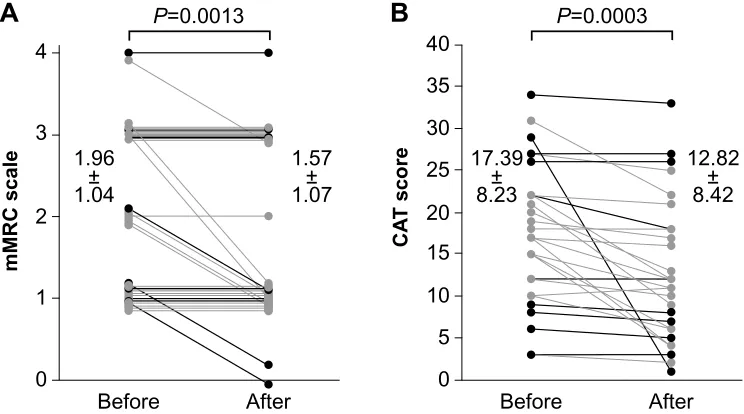
Figure 1 Comparison of mMRC dyspnea scale and CAT scores pre- and post-treatment with indacaterol. The mMRC dyspnea scale (A) and the CAT score (B) significantly
improved after treatment with indacaterol (P=0.0013 and P=0.0003, respectively).
Notes: Add-on group with indacaterol (n = 18) for gray lines. Replacement group with indacaterol (n = 10) for black lines.
Abbreviations: CAT,chronic obstructive pulmonary disease assessment test; mMRC, modified Medical Research Council.
Dovepress Efficacy of indacaterol in COPD management
of Medicine, and informed consent was obtained from all subjects.
Statistical analysis
Data are summarized as the mean ± standard deviation. Statistical differences before and after treatment with inda-caterol were assessed using paired t-tests. Statistical analy-ses were performed using JMP® version 10.0.2 statistical
software (SAS Institute Japan, Tokyo, Japan), and a differ-ence of P,0.05 was considered statistically significant.
Results
As one subject among the 28 patients could not perform the pulmonary function test after treatment, resulting from a mistake, their pulmonary function data were excluded from the analyses. In the questionnaire survey, some blank responses were also excluded from the analyses. All patients continued treatment with indacaterol during the study period, had no exacerbations, and did not require the use of a rescue inhaler.
Pre- and post-treatment mMRC dyspnea scale scores were significantly improved by treatment with indacaterol (1.96±1.04 to 1.57±1.07; P=0.0013) (Figure 1A). CAT scores also significantly improved from 17.39±8.23 to 12.82±8.42 (P=0.0003) after treatment with indacaterol (Figure 1B). Scores for each item on the CAT questionnaire are shown in Figure 2. Scores for questions one to seven of the total of eight questions were significantly improved (P,0.05). In pulmo-nary function tests, treatment with indacaterol significantly
improved forced vital capacity (FVC), forced expiratory volume in 1 second (FEV1), and flow at 25% forced vital capacity (V25) (P,0.05 for each) (Figure 3).
Subanalyses performed based on treatment with or without an LAMA (tiotropium) as a baseline medication are shown in Table 2. In patients treated with tiotropium, mMRC scale, CAT score, FVC, and V25 significantly improved (2.33±1.12 to 1.67±1.12, 13.78±4.99 to 10.22±4.87, 1.45±0.65 L to 1.64±0.56 L, and 0.17±0.10 L to 0.26±0.10 L; P,0.05 for each). In patients treated with tiotropium, mMRC scale score, CAT score, FVC, and FEV1 significantly improved (1.79±0.98 to 1.53±1.07, 19.11±8.99 to 14.05±9.53, 2.92±0.68 L to 3.08±0.66 L, and 1.47±0.60 L to 1.56±0.61 L; P,0.05 for each).
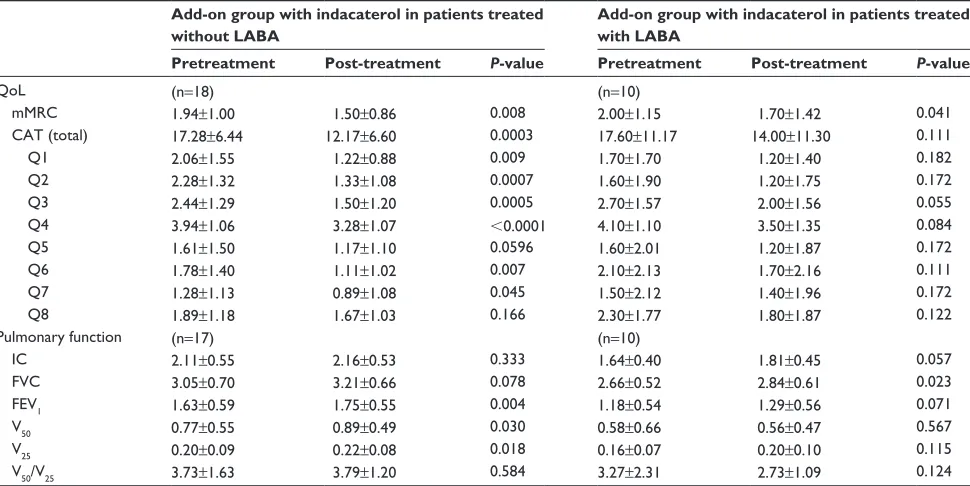
Subanalyses based on groups who had not been treated with salmeterol, those who received indacaterol add-on therapy (the add-on group), and those who had been treated with salmeterol and switched to indacaterol (replacement group) are shown in Table 3. In the add-on group, mMRC scale score, CAT score, FEV1, and V25 significantly improved (1.94±1.00 to 1.50±0.86, 17.28±6.44 to 12.17±6.60, 1.63±0.59 L to 1.75±0.55 L, and 0.20±0.09 L to 0.22±0.08 L; P,0.05 for each). In the replacement group, mMRC and FVC significantly improved (2.00±1.15 to 1.70±1.42 and 2.66±0.52 L to 2.84±0.61 L; P,0.05 for each).
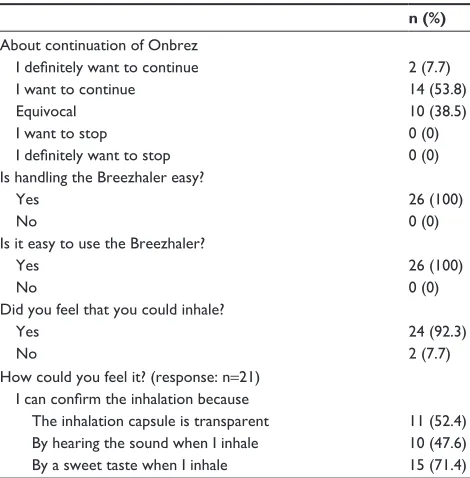
Original questionnaire surveys for indacaterol and the Breezhaler device were conducted, and responses were obtained from 26 subjects. A total of 61.5% of the total responded “I want to continue Onbrez”, and all subjects
International Journal of Chronic Obstructive Pulmonary Disease downloaded from https://www.dovepress.com/ by 118.70.13.36 on 22-Aug-2020
* * *
*
* * *
Q1: Cough
Q2: Phlegm (mucus) in the chest
Q3: Feelings of chest tightness
Q4: Breathless after walking up a hill or one flight of stairs
Q5: Limitations in activities at home
Q6: Confidence leaving home because of lung condition
Q7: Sleep
Q8: Energy *P<0.05
Items of the CAT questionnaire
0 1 2 3 4 5
Q1 Q2 Q3 Q4 Q5 Q6 Q7 Q8
Figure 2 Comparison of scores for each item of the CAT questionnaire pre- and post-treatment with indacaterol. Scores for questions one to seven of the total of eight
questions were significantly improved by treatment with indacaterol (*P,0.05 for each).
Abbreviation: CAT,chronic obstructive pulmonary disease assessment test.
1 1.5 2 2.5 3 3.5
IC
1.5 2 2.5 3 3.5 4 4.5 5
FVC
0.5 1 1.5 2 2.5 3 3.5
FEV
1
Before After Before After Before After
0 0.5 1 1.5 2 2.5
V 50
0.05 0.1 0.15 0.2 0.25 0.3 0.35 0.45
0.4
V25
1 2 3 5
4 6 7 8 9
V50 /V25
Before After Before After Before After
A B C
D P=0.0724 E P=0.0118 F
P=0.736
P=0.1164 P=0.0146 P=0.0013
1.94 ± 0.54
2.03 ± 0.53
2.91 ± 0.66
3.07 ± 0.65
1.46 ± 0.60
1.58 ± 0.59
3.40 ± 1.26 3.56
± 1.88 0.21
± 0.09 0.18
± 0.08 0.77
± 0.50 0.70
± 0.59
Figure 3 Pulmonary function tests pre- and post-treatment with indacaterol. The IC (A), FVC (B), FEV1 (C), V50 (D), V25 (E), and V50/V25 (F) pulmonary functions were
compared pre- and post-treatment with indacaterol. FVC, FEV1, and V25 were significantly improved by treatment with indacaterol (P,0.05 for each).
Notes: Add-on group with indacaterol (n = 17) for gray lines. Replacement group with indacaterol (n = 10) for black lines.
Abbreviations: IC,inspiratory capacity; FEV1, forced expiratory volume in 1 second; FVC, forced vital capacity; V25, flow at 25% forced vital capacity; V50, flow at 50% forced
vital capacity.
Dovepress
Ohno et al
International Journal of Chronic Obstructive Pulmonary Disease downloaded from https://www.dovepress.com/ by 118.70.13.36 on 22-Aug-2020
Table 2 Subanalyses based on treatment with or without LAMA
Add-on group with indacaterol in patients treated without LAMA
Add-on group with indacaterol in patients treated with LAMA
Pretreatment Post-treatment P-value Pretreatment Post-treatment P-value
Qol (n=9) (n=19)
mMrC 2.33±1.12 1.67±1.12 0.025 1.79±0.98 1.53±1.07 0.010
CAT (total) 13.78±4.99 10.22±4.87 0.018 19.11±8.99 14.05±9.53 0.003
Q1 0.89±0.93 0.78±0.83 0.173 2.42±1.61 1.42±1.12 0.009
Q2 0.89±0.93 0.56±0.73 0.040 2.58±1.50 1.63±1.42 0.003
Q3 2.78±1.20 1.78±0.97 0.020 2.42±1.46 1.63±1.50 0.002
Q4 3.89±1.17 3.22±1.30 0.011 4.05±1.03 3.42±1.12 0.005
Q5 1.11±1.27 0.78±0.67 0.173 1.84±1.80 1.37±1.61 0.060
Q6 1.78±1.56 0.89±0.78 0.034 1.95±1.75 1.53±1.74 0.021
Q7 1.22±1.64 0.89±1.54 0.173 1.42±1.50 1.16±1.42 0.048
Q8 1.22±0.83 1.33±0.87 0.827 2.42±1.46 1.89±1.52 0.038 Pulmonary function (n=8) (n=19)
IC 1.90±0.51 2.11±0.54 0.094 1.95±0.57 2.00±0.53 0.304
FVC 2.87±0.64 3.05±0.69 0.208 2.92±0.68 3.08±0.66 0.007
FeV1 1.45±0.65 1.64±0.56 0.034 1.47±0.60 1.56±0.61 0.010
V50 0.81±0.77 0.87±0.57 0.262 0.65±0.51 0.72±0.48 0.096
V25 0.17±0.10 0.26±0.10 0.014 0.19±0.07 0.20±0.08 0.204
V50/V25 4.17±2.20 3.41±1.44 0.098 3.30±1.73 3.39±1.21 0.366
Abbreviations: CAT, chronic obstructive pulmonary disease assessment test; FEV1, forced expiratory volume in 1 second; FVC, forced vital capacity; IC, inspiratory
capacity; LAMA, long-acting muscarinic antagonist; mMRC, modified Medical Research Council; QoL, quality of life; V25, flow at 25% forced vital capacity; VC50, flow at 50% forced vital capacity.
Table 3 Subanalyses in the indacaterol add-on and salmeterol-to-indacaterol replacement
Add-on group with indacaterol in patients treated without LABA
Add-on group with indacaterol in patients treated with LABA
Pretreatment Post-treatment P-value Pretreatment Post-treatment P-value
Qol (n=18) (n=10)
mMrC 1.94±1.00 1.50±0.86 0.008 2.00±1.15 1.70±1.42 0.041
CAT (total) 17.28±6.44 12.17±6.60 0.0003 17.60±11.17 14.00±11.30 0.111
Q1 2.06±1.55 1.22±0.88 0.009 1.70±1.70 1.20±1.40 0.182
Q2 2.28±1.32 1.33±1.08 0.0007 1.60±1.90 1.20±1.75 0.172
Q3 2.44±1.29 1.50±1.20 0.0005 2.70±1.57 2.00±1.56 0.055
Q4 3.94±1.06 3.28±1.07 ,0.0001 4.10±1.10 3.50±1.35 0.084
Q5 1.61±1.50 1.17±1.10 0.0596 1.60±2.01 1.20±1.87 0.172
Q6 1.78±1.40 1.11±1.02 0.007 2.10±2.13 1.70±2.16 0.111
Q7 1.28±1.13 0.89±1.08 0.045 1.50±2.12 1.40±1.96 0.172
Q8 1.89±1.18 1.67±1.03 0.166 2.30±1.77 1.80±1.87 0.122
Pulmonary function (n=17) (n=10)
IC 2.11±0.55 2.16±0.53 0.333 1.64±0.40 1.81±0.45 0.057
FVC 3.05±0.70 3.21±0.66 0.078 2.66±0.52 2.84±0.61 0.023
FeV1 1.63±0.59 1.75±0.55 0.004 1.18±0.54 1.29±0.56 0.071
V50 0.77±0.55 0.89±0.49 0.030 0.58±0.66 0.56±0.47 0.567 V25 0.20±0.09 0.22±0.08 0.018 0.16±0.07 0.20±0.10 0.115 V50/V25 3.73±1.63 3.79±1.20 0.584 3.27±2.31 2.73±1.09 0.124
Abbreviations: CAT, chronic obstructive pulmonary disease assessment test; FEV1, forced expiratory volume in 1 second; FVC, forced vital capacity; IC, inspiratory
capacity; LABA, long-acting b2-agonist; mMRC, modified Medical Research Council; QoL, quality of life; V25, flow at 25% forced vital capacity; VC50, flow at 50% forced vital capacity.
Dovepress Efficacy of indacaterol in COPD management
responded “Yes” for device ease of handling and ease of use. Furthermore, 24 subjects (92.3%) responded that they felt like they could inhale (Table 4).
Responses for reasons the patients felt they could inhale were obtained from 21 of those 24 subjects. Reasons included
(multiple answers were allowed) 71.4% responding “By the sweet taste when I inhale”, 52.4% responding “I can confirm the inhalation because the inhalation capsule is transparent”, and 47.6% responding “By hearing the sound when I inhale” (Table 4).
International Journal of Chronic Obstructive Pulmonary Disease downloaded from https://www.dovepress.com/ by 118.70.13.36 on 22-Aug-2020
Table 4 Questionnaire survey for indacaterol (Onbrez®) and the Breezhaler® device
n (%)
About continuation of Onbrez I definitely want to continue
I want to continue
Equivocal
I want to stop
I definitely want to stop
2 (7.7) 14 (53.8) 10 (38.5) 0 (0) 0 (0) Is handling the Breezhaler easy?
Yes no
26 (100) 0 (0) Is it easy to use the Breezhaler?
Yes no
26 (100) 0 (0) Did you feel that you could inhale?
Yes no
24 (92.3) 2 (7.7) How could you feel it? (response: n=21)
I can confirm the inhalation because The inhalation capsule is transparent
By hearing the sound when I inhale By a sweet taste when I inhale
11 (52.4) 10 (47.6) 15 (71.4)
Notes: Onbrez® (Novartis Pharma, Tokyo, Japan), Breezhaler® (Novartis Pharma,
Tokyo, Japan).
Table 5 adverse events
Adverse events n
Immediate coughing after inhalation (disappearance within 1 minute)
6
hoarseness 3
Dry mouth 2
Mouth discomfort 1
Dovepress
Ohno et al
The most frequent adverse event observed was coughing immediately after inhalation, in six patients. In addition, three reports of hoarseness and two reports of dry mouth were observed in four subjects. The two patients who com-plained of dry mouth were both treated with tiotropium as a baseline medication. However, these symptoms were mild and did not lead to discontinuation of indacaterol treatment. All patients continued treatment with indacaterol after the present study (Table 5).
Discussion
Once, it was considered that anticholinergics (muscarinic antagonists) demonstrated a greater bronchodilation effect than b2-agonists in patients with COPD.9,10 In fact, of the
long-acting bronchodilators, tiotropium showed a higher efficacy than salmeterol.11 However, indacaterol, a new
LABA, was shown to be at least as effective as tiotropium and with a faster onset of action.12 Indacaterol has shown a
powerful bronchodilation effect with a mechanism different
from that of the LAMAs, and its efficacy has been shown. Pharmacologic therapy in COPD is used to reduce symp-toms, reduce the frequency and severity of exacerbations, and improve health status and exercise tolerance.13 There
are several validated questionnaires to assess symptoms in patients with COPD. GOLD recommends the use of the mMRC questionnaire or the CAT. The well-known mMRC questionnaire assesses only disability resulting from breathlessness; however, the CAT covers a broader range of the impact of COPD on the patient’s daily life and well-being.13 In the present study, these two questionnaires were
used for the assessment of the patients’ QoL, and the efficacy of bronchodilation was assessed by spirometry. Because inhaler adherence is very important in the management of COPD,14 questionnaire surveys for indacaterol (Onbrez) and
its inhaler device (Breezhaler) were performed.
It has been reported that patients receiving indacaterol had clinically significant improvements in symptoms of dyspnea compared with placebo.15 Among the 23 eligible patients,
14 were receiving tiotropium 18 µg/day (by a Handihaler®),
and nine were receiving no therapy. Treatment with indacaterol improved both pulmonary function and QoL.16 Add-on therapy
with indacaterol also improved expiratory reserve volume and exercise capacity, although a significant difference was not noted in the improvement of FEV1.17 Overall, indacaterol
therapy improved the QoL of patients with COPD in the present study. In addition, FVC, FEV1, and V25 were improved in pulmonary function tests. Significantly more patients receiving indacaterol reported less need for a rescue inhaler (short-acting b2-agonist) than LABA recipients.18,19 In the
present study, no patients used a short-acting b2-agonist in a rescue capacity. Indacaterol might be a useful option, even for the treatment of acute exacerbations of COPD.20
Indacaterol was at least as effective as tiotropium in improving clinical outcomes.21,22 However, a comparison
of indacaterol and tiotropium under blinded conditions confirmed a statistically significant improved effect of indacaterol over tiotropium for dyspnea (transition dysp-nea index) and health status (the St George’s Respiratory Questionnaire).23 Furthermore, compared with tiotropium
monotherapy, indacaterol plus tiotropium provided greater bronchodilation and lung deflation (reflected by an increased resting inspiratory capacity).24 Regardless of the use or
nonuse of tiotropium, add-on therapy with indacaterol significantly improved mMRC scale score, CAT score, and FEV1 in the present study. These results support COPD guideline recommendations to combine bronchodilators with different mechanisms of action.
International Journal of Chronic Obstructive Pulmonary Disease downloaded from https://www.dovepress.com/ by 118.70.13.36 on 22-Aug-2020
Dovepress Efficacy of indacaterol in COPD management
Using trough FEV1 as a measure of therapeutic effect, indacaterol was superior to other b2-agonists, tiotro-pium, and placebo at weeks 12, 26, and 52. Indacaterol had a greater effect on the transition dyspnea index than salmeterol.25 Although this study did not consider the trough
value, the switch from salmeterol did not significantly improve pulmonary function, except for FVC. However, mMRC score was significantly improved, even in the present small sample size. Therefore, it is thought that indacaterol treatment contributed to improvements of QoL more than salmeterol.
Adherence is crucial for optimizing clinical outcomes in COPD, with nonadherence resulting in significant health and economic burdens.26 Adherence in patients with COPD
is affected by multiple factors associated with the patient, their clinician, and society.27 Patient-related factors include
health beliefs and self-efficacy. Treatment-related factors include each treatment requiring a different technique for administration, in addition to the need for multiple inhalers, and are especially burdensome for older COPD patients. In the present study, indacaterol and its device seemed to be regarded favorably by patients with COPD. These results may contribute to better clinical outcomes through satisfactory adherence.
The most frequently observed adverse event was coughing immediately after inhalation; hoarseness and dry mouth were also observed. However, these adverse events were mild and did not result in the discontinuation of indacaterol treatment. Indacaterol demonstrated excel-lent tolerability.
A limitation of the present study is the small sample size. There were no analyses of the patients’ adherence as distinguished from inhaler device preference; therefore, future investigations regarding inhaler adherence are needed. However, despite the small sample size and regardless of the quality of adherence, pulmonary functions and QoL were improved. In addition, there are no analyses comparing inhaler devices in the present study with other inhaler devices, and further studies are needed to better clarify patient preferences.
Conclusion
In summary, indacaterol is both safe and effective in the management of COPD. Furthermore, add-on therapy with an LAMA is also effective in improving clinical outcomes. The inhaler device is easy to use and was well regarded by the patients, which can contribute to medica-tion adherence.
Disclosure
The authors report no conflicts of interest in this work.
References
1. Lopez AD, Shibuya K, Rao C, et al. Chronic obstructive pulmonary disease: current burden and future projections. Eur Respir J. 2006;27: 397–412.
2. Mathers CD, Loncar D. Projections of global mortality and burden of disease from 2002 to 2030. PLoS Med. 2006;3:e442.
3. Gershon AS, Warner L, Cascagnette P, Victor JC, To T. Lifetime risk of developing chronic obstructive pulmonary disease: a longitudinal population study. Lancet. 2011;378:991–996.
4. Mäkelä MJ, Backer V, Hedegaard M, Larsson K. Adherence to inhaled therapies, health outcomes and costs in patients with asthma and COPD.
Respir Med. 2013;107:1481–1490.
5. Balint B, Watz H, Amos C, Owen R, Higgins M, Kramer B; INSURE Study Investigators. Onset of action of indacaterol in patients with COPD: comparison with salbutamol and salmeterol-fluticasone. Int
J Chron Obstruct Pulmon Dis. 2010;5:311–318.
6. Dahl R, Chung KF, Buhl R, et al. Efficacy of a new once-daily long-acting inhaled beta2-agonist indacaterol versus twice-daily formoterol in COPD. Thorax. 2010;65:473–479.
7. Bleecker ER, Siler T, Owen R, Kramer B. Bronchodilator efficacy and safety of indacaterol 150 µg once daily in patients with COPD: an analysis of pooled data. Int J Chron Obstruct Pulmon Dis. 2011;6: 431–438.
8. Kornmann O, Dahl R, Centanni S, et al. Once-daily indacaterol versus twice-daily salmeterol for COPD: a placebo-controlled comparison.
Eur Respir J. 2011;37:273–279.
9. Gross NJ, Skorodin MS. Role of the parasympathetic system in airway obstruction due to emphysema. N Engl J Med. 1984;311:421–425. 10. Schocken DD, Roth GS. Reduced beta-adrenergic receptor
concentrations in ageing man. Nature. 1977;267:856–858.
11. Vogelmeier C, Hederer B, Glaab T, et al. Tiotropium versus salmeterol for the prevention of exacerbations of COPD. N Engl J Med. 2011;364: 1093–1103.
12. Vogelmeier C, Ramos-Barbon D, Jack D, et al. Indacaterol provides 24-hour bronchodilation in COPD: a placebo-controlled blinded com-parison with tiotropium. Respir Res. 2010;11:135.
13. Global Initiative for Chronic Obstructive Lung Disease (GOLD). Global strategy for diagnosis, management, and prevention of chronic obstructive lung disease [updated 2013]. Available from: http://www. goldcopd.org/uploads/users/files/GOLD_Report_2013_Feb20.pdf. Accessed December 9, 2013.
14. Vestbo J, Anderson JA, Calverley PM, et al. Adherence to inhaled therapy, mortality and hospital admission in COPD. Thorax. 2009;64: 939–943.
15. Han J, Dai L, Zhong N. Indacaterol on dyspnea in chronic obstructive pulmonary disease: a systematic review and meta-analysis of randomized placebo-controlled trials. BMC Pulm Med. 2013;13:26.
16. Hataji O, Naito M, Ito K, Watanabe F, Gabazza EC, Taguchi O. Indacaterol improves daily physical activity in patients with chronic obstructive pulmonary disease. Int J Chron Obstruct Pulmon Dis. 2013;8:1–5.
17. Mroz RM, Minarowski L, Chyczewska E. Indacaterol add-on therapy improves lung function, exercise capacity and life quality of COPD patients. Adv Exp Med Biol. 2013;756:23–28.
18. Korn S, Kerwin E, Atis S, Amos C, Owen R, Lassen C; INSIST study group. Indacaterol once-daily provides superior efficacy to salme-terol twice-daily in COPD: a 12-week study. Respir Med. 2011;105: 719–726.
19. Feldman GJ. Improving the quality of life in patients with chronic obstructive pulmonary disease: focus on indacaterol. Int J Chron
Obstruct Pulmon Dis. 2013;8:89–96.
International Journal of Chronic Obstructive Pulmonary Disease downloaded from https://www.dovepress.com/ by 118.70.13.36 on 22-Aug-2020
International Journal of COPD
Publish your work in this journal
Submit your manuscript here:http://www.dovepress.com/international-journal-of-copd-journal The International Journal of COPD is an international, peer-reviewed journal of therapeutics and pharmacology focusing on concise rapid reporting of clinical studies and reviews in COPD. Special focus is given to the pathophysiological processes underlying the disease, intervention programs, patient focused education, and self management protocols.
This journal is indexed on PubMed Central, MedLine and CAS. The manuscript management system is completely online and includes a very quick and fair peer-review system, which is all easy to use. Visit http://www.dovepress.com/testimonials.php to read real quotes from published authors.
Dovepress
Dove
press
Ohno et al
20. Segreti A, Fiori E, Calzetta L, et al. The effect of indacaterol during an acute exacerbation of COPD. Pulm Pharmacol Ther. 2013;26(6): 630–634.
21. Donohue JF, Fogarty C, Lötvall J, et al. Once-daily bronchodilators for chronic obstructive pulmonary disease: indacaterol versus tiotropium.
Am J Respir Crit Care Med. 2010;182:155–162.
22. Mahler DA, Buhl R, Lawrence D, McBryan D. Efficacy and safety of indacaterol and tiotropium in COPD patients according to dyspnoea severity. Pulm Pharmacol Ther. 2013;26:348–355.
23. Buhl R, Dunn LJ, Disdier C, et al. Blinded 12-week comparison of once-daily indacaterol and tiotropium in COPD. Eur Respir J. 2011;38: 797–803.
24. Mahler DA, D’Urzo A, Bateman ED, et al. Concurrent use of inda-caterol plus tiotropium in patients with COPD provides superior bronchodilation compared with tiotropium alone: a randomised, double-blind comparison. Thorax. 2012;67:781–788.
25. Jiang FM, Liang ZA, Zheng QL, Wang RC, Luo J, Li CT. Safety and effi-cacy of 12-week or longer indacaterol treatment in moderate-to- severe COPD patients: a systematic review. Lung. 2013;191:135–146. 26. Lareau SC, Yawn BP. Improving adherence with inhaler therapy in
COPD. Int J Chron Obstruct Pulmon Dis. 2010;5:401–406.
27. Restrepo RD, Alvarez MT, Wittnebel LD, et al. Medication adherence issues in patients treated for COPD. Int J Chron Obstruct Pulmon
Dis. 2008;3:371–384.
International Journal of Chronic Obstructive Pulmonary Disease downloaded from https://www.dovepress.com/ by 118.70.13.36 on 22-Aug-2020