1384 | P a g e
Evaluation of SAR on Human Phantom due
to Circular SRR Loading
Garima Saini
1, Shyam Sundar Pattnaik
2 1National Institute of Technical Teachers Training & Research, Chandigarh (India)
1Research Scholar, IKG Punjab Technical University, Jalandhar (India)
2Biju Patnaik University of Technology, Rourkela, Odisha (India)
ABSTRACT
Utilization of mobile phones is increasing day-by-day. Latest technologies such as 3G, 4G, LTE, Wi-Fi/WLAN increase the interaction between mobile and human. Electromagnetic energy is emitted from mobile phone which cause harm effect and damage of human tissues. Effect on human tissues due to interaction with mobile phones can be evaluated with Specific Absorption Rate (SAR). In this paper,the effect of SAR is evaluated on six layer head phantom model. These six layer of phantom model are skin, CSF, bone, brain, fat, and dura. The SAR is evaluated with Split Ring Resonator (SRR) loading on Planar Inverted F Antenna (PIFA) at frequency of 3.5 GHz. For this, designed antenna patch is placed approx 4mm from six layer head model and HFSS is used for simulation of phantom model.
Keywords: Electromagnetic energy, Human tissue, Planar Inverted F Antenna (PIFA), Specific
Absorption Rate (SAR), Split Ring Resonator (SRR), Wi-Fi, WLAN.
I.
INTRODUCTION
In recent years, use of mobile phones increased and every cell phone radiates electromagnetic energy. This
electromagnetic energy affectsvarious layers of human body parts and tissues especially, on head tissues. This
radiating electromagnetic energy has heating effect which causes biological damage of molecular structure of
human head layers such as skin, fat, bone, brain, CSF, and dura.
Biological effect of radio frequency field can be calculated at various levels such as molecular, subcellular,
organ or whole body environment according to its effect [1]. These biological effect are classified by high level
(thermal), intermediate level (athermal) and low level (non thermal) effect [1-2]. These effects cause irreversible
damage if 1̊ C of temperature of human tissues are increased [3]. Temperature of human tissues has increased
due to heat dissipation through electromagnetic wave radiated by antenna systems [4].
In this paper, these effects areanalysed with Specific Absorption Rate (SAR). Six layer human head phantom
model is used to calclulate the SAR due to Planar Inverted F Antenna (PIFA). The value of SAR is calculated
with following equation.
Where σ is conductivity of body tissues, ρ is density of body tissues and E is electric field strength . SAR value
1385 | P a g e
value calculation i.e. local SAR and average SAR. Local SAR is calculated over small portion/tissue parts suchas 1gm or 10gm of tissues where as average SAR is calculated over the whole body or tissues.
Table 1: Maximum Standard Value of SAR
Level control Normal 1st Level control 2nd Level control
Whole body SAR(W/Kg) 2 4 >4
Partial body SAR(W/Kg) 2-10 4-10 >(4-10)
Head SAR (W/Kg) 3.2 3.2 >3.2
Local SAR (W/Kg)
Head 10 20 >20
Trunk 10 20 >20
Extremities 2 40 >40
In this manuscript for the analysis of SAR on human phantom, SRR array is loaded on PIFA. SRRhas
metamaterial propertiesand PIFA has low specific absorption rate value [5-7]. The paper justified that the
loading of SRR does not increases the SAR values. However, SRR are used to enhance the bandwidth and gain
of antenna [6-8].
II.
SIMULATION OF MODEL
HFSS is used for the simulation of phantom model which consist of head model and phone model. Six layers are
used for head model design and PIFA structure is used for the phone model. Small gap is provided between
head model and phone model to avoid the overlapping.
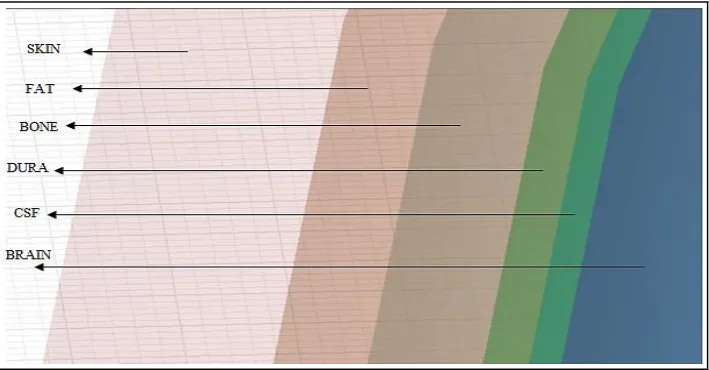
Head Model: Six layer human head model is used for simulation of SAR shown in figure 1. Human body
tissues have different values of dielectric properties i.e. permittivity and conductivity and these properties are
function of various variables such as frequency, geometry, size of tissues and water content. These tissues have
high water content which is function of frequency [3]. The phantom model is designed for normal human head
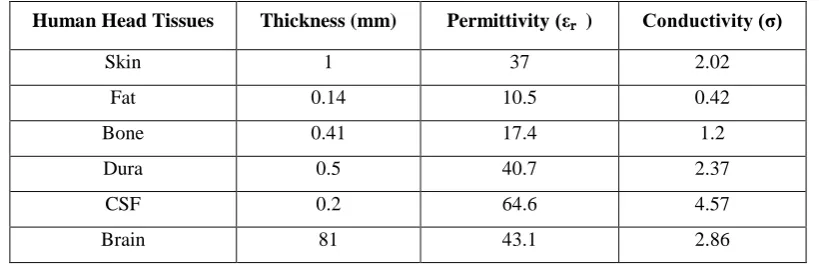
at 3.5 GHz frequency for normal body temperature. The parameter values of various layers are mentioned in
Table 2.
1386 | P a g e
Table 2: Tissue property and Thickness of Six Layer Human Head ModelHuman Head Tissues Thickness (mm) Permittivity (εᵣ ) Conductivity (σ)
Skin 1 37 2.02
Fat 0.14 10.5 0.42
Bone 0.41 17.4 1.2
Dura 0.5 40.7 2.37
CSF 0.2 64.6 4.57
Brain 81 43.1 2.86
Phone Model: Antennas are animportant part of phone model which has radiation properties and cause
irreversible damage of human head tissues. RT Duroid 5880 with εᵣ =2.2 is used as substrate to design the
PIFA. The dimension of PIFA is 10mm × 16mm. The height of antenna is 4mm. SRRs are loaded on the patch
of antenna. The PIFA is shown in figure 2 and the SRR is shown in figure 3.
Figure2: PIFA with operating frequency of 3.5GHz Figure3: Split Ring Resonator (SRR)
III.
RESULT
Effect of PIFA with SRR loading is observed by SAR evaluation at 3.5 GHz frequency. The value of SAR for
designed antenna is obtained. The values obtained for SAR and E-field of six layer human head is presented in
Table 3 and the simulated SAR and E field for six different layers of human head model is shown in figure 4
and figure 5 respectively.
Table 3: SAR and E-field of Six Layer Human Head
Human Head Tissues Simulated SAR
(W/Kg) E field (V/m)
Calculated SAR (W/kg)
Skin 1.4867 29.622 1.60277
Fat 0.28941 21.69 0.2191
Bone 0.55931 16.79 0.287
Dura 0.9727 21.69 0.9495
CSF 0.95008 11.931 0.646
1387 | P a g e
(a) Skin Layer(b) Fat Layer
1388 | P a g e
(d) DuraLayer(e) CSF Layer
(f) Brain
Figure4: SAR values over six layers of phantom model
(a) Skin Layer
1389 | P a g e
(c) Bone Layer(d) Dura Layer
(e) CSF Layer
(f) Brain
Figure5: E-Field over six layers of phantom model
Table 3 shows SAR simulated, E field and theoretically calculated SAR values. Simulated values of SAR for
skin layer, and brain is slightly less than calculated values. But for other layers simulated SAR values are more
1390 | P a g e
come first contact with phone radiation. Fat layer has lower SAR value and other layers values come betweenskin and fat layer values. The figure 5 shows that there is highest E-field for skin layer and lowest for CSF layer.
The E-field values for other layers lies between these values.
IV.
CONCLUSION
In this paper, SAR for PIFA is evaluated with SRR loading. The effect of SRR loading is also observed on SAR.
When any cell phoneis exposed, it start radiates/generated E field. This E field penetrate on human body/head
tissues and cause irreversible damage. SAR is an importantparamterefor mobile phones and therefore, the values
of SAR should be less than the threshold value.The paper justify that loading of SRR on PIFA does not cause
enhancement of SAR values above its specified standard values.
REFERENCES
[1] Helen N. Schwerdt, Félix A. Mirandaand JunseokChae, “Analysis of Electromagnetic Fields Induced in Operation of a Wireless Fully Passive Backscattering Neurorecording Microsystem in Emulated Human Head Tissue”, IEEE Transactions on Microwave Theory and Techniques, Vol. 61, No. 5, pp. 2170-2176, 2013.
[2] Prabir Kumar Dutta, PappuVankataYasodaJayasree and Viriyala Satya Surya Narayana Srinivasa Baba, “SAR reduction in the modelled human head for the mobile phone using different material shields”, Springer
Human-Centric Computing and Information Science, Vol. 2016, pp.1-22, 2016.
[3] Asma Lak and HomayoonOraizi, “Evaluation of SAR Distribution in Six-Layer Human Head Model”,
International Journal of Antennas and Propagation, Vol. 2013, pp.1-8, 2013.
[4] M. B. Manapati and R. S. Kshetrimayum, “SAR Reduction In Human Head From Mobile Phone Radiation
Using Single Negative Metamaterials”, J. of Electromagn. Waves and Appl., Vol. 23, pp. 1385–1395, 2009.
[5] Biswajeet Mukherjee, Pragati Patel, and Jayanta Mukherjee, “A Novel Hemispherical Dielectric Resonator
Antenna with Complementary Split-Ring Shaped Slots and Resonator for Wideband and Low Cross-Polar
Applications”, IEEE Antenna and propagation Magazine, vol. 57, No. 1, pp-120-128, 2015.
[6] Neha Yadav and Garima Saini, “Split Ring Resonator Based Wide Bandwidth Planar Inverted-F Antenna for
Wi-Fi/WLAN Applications”, International Journal of Control Theory and Applications, Vol. 9, No. 18, pp.
9027-9034, 2016.
[7] Garima Saini, S. S. Pattnaik, "Wideband planar Inverted-F antenna with Circular Split Ring Resonator
Loading”, International Conference on Engineering and Applied Science, pp. 220-227, 2016.
[8] Nornikman, BadrulHisham Ahmad, Mohamad ZoinolAbidinAbd Aziz, “Effect of Single Complimentary Split
Ring Resonator Structure on Microstrip Patch Antenna Design”, IEEE Symposium on Wireless Technology
and Application, pp. 239-244, 2012.
[9] Ferdows B. Zarrabi, Zahra Mansouri, RaheleAhmadian, Maryam Rahimi, and HamedKuhestani, “Microstrip
Slot Antenna Applications with SRR for Wimax/Wlan with Linear and Circular Polarization”, Microwave and
Optical Technology Letters, Vol. 57, No. 6, pp. 1332-1338, 2015.
[10] Nutan Reddy A, Raghavan S, “Split ring resonator and its evolved structures over the past decade”, IEEE
International Conference on Emerging Trends in Computing, Communication and Nanotechnology, pp.