Latest
XYZ
results from
e
+e
−colliders
Yu-Ping Guo1,a
1Johannes Gutenberg-University Mainz, Johann-Joachim-Becher-Weg 45, 55128 Mainz
Abstract.We present the recent progress on the charmonium-like states (or calledXYZ
states) from electron-positron colliders, including the results from BESIII, CLEO-c,
BaBar and Belle. This talk covers the observation of X(3872) from radiative decay of
theY(4260), the updated results ofY states from initial state radiation (ISR) process of
π+π−J/ψand π+π−ψ(2S) and also cross section measurement ofe+e− → π+π−h
c and
e+e−→ωχc
0, and the observation of charged and neutral charmonium-like states (Zcs).
1 Introduction
In the quark model, the mesons are composed from one quark and anti-quark, while baryons are composed from three quarks. But these are the lowest configurations, the hadrons with other con-figurations are not excluded. People believe that there are hadrons with no quarks (glue ball), with excited gluon (hybrid) or with more than three quarks (multi-quark state) [1]. Starting from the two B-factories, i.e., BaBar at SLAC and Belle at KEK, a large number of charmonium-like states were observed in the final states of a charmonium and light hadrons. These states could be the charmonium states, but they also have some strange properties, which makes them more like exotic states.
In this talk, the recent results on observation ofX(3872) from radiative decay ofY(4260), the new information ofY states, the observations ofZcstates. The results are mainly from electron-positron colliders including BESIII, CLEO-c, BaBar and Belle experiments. The BESIII and CLEO-c detector are working at charmonium region, the data taken can be used directly. While the two B-factories are working at the bottomonium region, the data taken there can be used to study charmonium states if an ISR photon which can lower the center of mass energy (CM) exist, or through B decays.
2 New information on
X
(3872)
TheX(3872) was first observed by Belle collaboration inB±→K±π+π−J/ψ[2]. Since its discovery, it has stimulated a lot of interest about its nature both from theoretical and experimental side. Combining the observation ofX(3872)→γJ/ψat BaBar and Belle and the angular analysis at CDF and LHCb experiments, the spin parity of theX(3872) was determined to beJP=1++[3]. Thus it could also be produced through radiative transition from the vector charmonium or charmonium-like states.
ae-mail: [email protected]
DOI: 10.1051/ C
Owned by the authors, published by EDP Sciences, 2014
/201
)
2
) (GeV/c
ψ
J/
-π
+
π
M(
3.8 3.85 3.9 3.95
2
Events / 3 MeV/c
0 5 10 15
Data Total fit Background
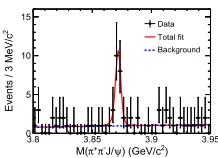
Figure 1. Fit to the summedπ+π−J/ψ invariant
mass spectrum. Dots with error bars are data, and the curves are the best fit.
(GeV)
cm
E
4 4.1 4.2 4.3 4.4 4.5
) (pb)
ψ
J/
-π
+
πγ
→
X(3872)
γ(
Bσ 0 0.1 0.2 0.3 0.4 0.5 0.6
data Y(4260) Phase Space Linear
Figure 2. The fit to σB[e+e− → γX(3872)] ×
B[X(3872) → π+π−J/ψ] with a Y(4260)
reso-nance, a linear continuum, or aE1-transition phase
space term.
2.1 Observation ofX(3872)ine+e−→γX(3872)
The processe+e− → γX(3872)→ γπ+π−J/ψhas been studied at BESIII experiment, with the J/ψ reconstructed using its decay into lepton pairsJ/ψ→e+e−, orμ+μ−[4]. The analysis was performed by using the data samples collected at the CM energy √s=4.009, 4.230, 4.260, and 4.360 GeV.
The π+π−J/ψ invariant mass spectrum was used to extract the mass and signal yields of the X(3872). Figure. 1 shows theπ+π−J/ψinvariant mass spectrum summed over all the energy points and the best fit results. ObviousX(3872) was observed with a statistical significance of 6.3σ, the mass of theX(3872) was measured to be (3872.1±0.8±0.3) MeV/c2. The product of the Born cross section times the branching fraction ofX(3872)→ π+π−J/ψas a function of CM energy are shown in Fig. 2 in dots with error bars. The cross section suggests that theX(3872) might come from the radiative transition ofY(4260). Taking the cross section ofe+e− → π+π−J/ψmeasured by BESIII [5] into account and assuming the branching fractionB(X(3872) → π+π−J/ψ) = 5%, the fraction R=σB[e+e−→γX(3872)]
σB(e+e−→π+π−J/ψ) is about 11%, which is a relatively large decay width.
3 The
Y
states
TheY-states in charmonium system are mainly observed at B-factories via ISR process. TheY(4260) was observed by BaBar collaboration in the e+e− → γISRπ+π−J/ψ process, and confirmed by CLEO [10] and Belle [11] experiments using the same method. BesideY(4260), in Belle data, an-other broad structure (calledY(4008)) near 4.008 GeV was observed. In thee+e− →γISRπ+π−ψ(2S) process, BaBar collaboration found a structure around 4.32 GeV [12], while Belle observed two struc-tures at 4.36 and 4.66 GeV in the same process [13]. Using full data sample, both BaBar and Belle experiments updated their analysis ofe+e−→γISRπ+π−J/ψ[14, 15] ande+e−→γISRπ+π−ψ(2S) [16]. TheY(4660) resonance was confirmed by BaBar experiment, while the discrepancy atY(4008) be-tween two experiments still exist. The foresee study at BESIII using data samples the this energy region may help to clarify this issue. The data samples collected with BESIII detector from 3.81 to 4.42 GeV are used to study to theY-states in thee+e−→π+π−hc[17] ande+e−→ωχc0process [18].
3.1 Update ofe+e−→γISRπ+π−ψ(2S)
0 10 20 30
4 4.5 5 5.5
M(π+π-ψ
(2S)) (GeV/c2
)
Entries/20 MeV/c
2
0 10 20 30
4 4.5 5 5.5
M[π+π-ψ(2S)] (GeV/c2)
Entries/20 MeV/c
2
Figure 3.Theπ+π−ψ(2S) mass spectrum from Belle measurement (dots with error bars) and the fits with sum of two (left) or three (right) BW functions.
(GeV)
CM
E
4.1 4.2 4.3 4.4 4.5 4.6 4.7
Born cross section (pb) 0
20 40 60
80 e+e-->π+π-J/ψ @ Belle @ BESIII
c
h
-π
+
π
->
-e
+
e
Figure 4. The Born cross section of e+e− → π+π−h
c from BESIII experiment, and those of
e+e−→π+π−J/ψfrom Belle experiment.
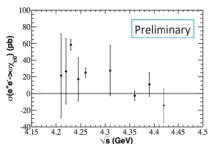
Figure 5.The Born cross section ofe+e−→ωχc0
at different energy points from 4.21 to 4.42 GeV.
fitting to the mass distribution corresponding to theψ(2S)→ π+π−J/ψdecay mode. The parameters
yield are consistent with Belle measurement [13], theY(4660) observed by Belle experiment was
confirmed.
Using 980 fb−1 data sample, Belle Collaboration also updated the analysis of e+e− →
γISRπ+π−ψ(2S) with the same two decay modes ofψ(2S) as used in BaBar paper [19]. Fitting to
the mass spectrum ofπ+π−ψ(2S) summed over two decay modes with two coherent Breit-Wigner
(BW) functions, the result shows in Fig. 3. The mass of the two structures are about 20 MeV smaller than previous Belle results [13]. Since there were some events accumulated around the mass region
ofY(4260), the fit withY(4260) included was also performed (right panel of Fig. 3). The significance
ofY(4260) was estimated to be 2.1σwith parameters fixed to the latest measurement from Belle [14].
3.2 Cross section ofe+e−→π+π−hcande+e−→ωχc0
BESIII studied the process ofe+e−→π+π−hcusing data samples taken at 13 energy points from 3.90
to 4.42 GeV [17]. Thehcwas reconstructed through its electric-dipole (E1) transitionhc → γηc,
whileηcwas reconstructed using 16 of its hadronic decay modes.
Figure 4 shows the Born cross sections of e+e− → π+π−hc at each energy points (solid dots
with error bars) and also the comparison withσB(e+e− → π+π−J/ψ) from Belle experiment [14].
TheσB(e+e− → π+π−hc) are at the same order of magnitude asσB(e+e− → π+π−J/ψ), but with a
difference line shape. There is a broad structure at high energy with a possible local maximum at
around 4.23 GeV. Since theY(4260) was established from the cross section ofe+e−→π+π−J/ψ, the
different line shapee+e−→π+π−hcmakes the understanding ofYstates more complicate.
Based on data samples collected at 9 CM energy points from 4.21 to 4.42 GeV, the production of
e+e− → ωχcJ(J =0, 1, 2) was studied at BESIII experiment [18]. e+e− → ωχc
) 2 ) (GeV/c ψ J/ ± π ( max M
3.7 3.8 3.9 4.0
2
Events / 0.01 GeV/c
0 20 40 60 80 100 ) 2 ) (GeV/c ψ J/ ± π ( max M
3.7 3.8 3.9 4.0
2
Events / 0.01 GeV/c
0 20 40 60 80 100 ) 2 ) (GeV/c ψ J/ ± π ( max M
3.7 3.8 3.9 4.0
2
Events / 0.01 GeV/c
0 20 40 60 80 100 Data Total fit Background fit PHSP MC Sideband
Figure 6. TheMmax(π±J/ψ) distribution and best
fit from BESIII.
) 2 ) (GeV/c ψ J/ π ( max M
3.7 3.8 3.9 4 4.1 4.2
2
Events / 0.02 GeV/c
0 10 20 30 40 50 60 70 ) 2 ) (GeV/c ψ J/ π ( max M
3.7 3.8 3.9 4 4.1 4.2
2
Events / 0.02 GeV/c
0 10 20 30 40 50 60 70 ) 2 ) (GeV/c ψ J/ π ( max M
3.7 3.8 3.9 4 4.1 4.2
2
Events / 0.02 GeV/c
0 10 20 30 40 50 60 70 data Fit Background PHSP MC
Figure 7. TheMmax(π±J/ψ) distribution and best
fit from Belle.
the first time at 4.23 and 4.26 GeV. Hereωwas reconstructed using its decay intoπ+π−π0final state, χc0was reconstructed viaπ+π−andK+K−decays. Figure 5 shows the cross section ofe+e−→ωχc0 at different energy points, the cross section peaks at 4.23 GeV, which indicates the enhancement of ωχc0does not arise fromY(4260).
4 Observation of charged charmonium-like states
The most important thing to identify an exotic state is to find a clear signature of it compared with the conventional meson states. The charged charmonium-like state is the most promising candidate for the exotic hadrons since it contains at least four quarks thus could not be a conventional meson.
In the study ofe+e−→ π+π−J/ψprocess at CM energies around 4.26 GeV, the BESIII and Belle experiments observed a charged charmonium-like state, theZc(3900) in theπ±J/ψmass spectrum [5, 14], which was confirmed with CLEO-c data at a CM energy of 4.17 GeV [20]. Shortly after, BESIII observed a chargedZc(3885) state ine+e− → π±(DD¯∗)∓ [21], a chargedZc(4025) state ine+e− → π±(D∗D¯∗)∓ [22], and a charged and neutralZc(4020) state in e+e− → π±,0(π∓,0h
c) [17, 23]. These states contain at least four quarks, carry electric charge and close to the threshold. The observation of these states may indicate a new class of hadrons has been observed.
4.1 Observation of theZc(3900)andZc(3885)
In the study of thee+e− →π+π−J/ψprocess using a 525 pb−1data sample taken at √s=4.26 GeV, BESIII experiment observed a structure near 3.9 GeV (named asZc(3900)) in the invariant mass spec-trum ofπ±J/ψwith a statistical significance larger than 8σ. An unbinned maximum likelihood fit to the distribution ofMmax(π±J/ψ), with possible interference neglected, as shown in Fig. 6, determined the mass and width ofZc(3900) to be (3899.0±3.6±4.9) MeV/c2and (46±10±20) MeV, respectively. The production ratio was measured to beR= σ(e+e−→π±Z∓c(3900)→π+π−J/ψ)
) 2 (GeV/c c h ± π M 3.95 4.00 4.05 4.10 4.15 4.20 4.25
) 2 Events/(0.005 GeV/c 0 20 40 60 80 100 120 ) 2 (GeV/c c h + π M 3.8 3.9 4.0 4.1
)
2
Events/(0.005 GeV/c 0
10 20 30 40 50
Figure 8. Sum of the
simultane-ous fit to theMπ±hcdistributions at 4.23, 4.26, and 4.36 GeV.
) 2 (GeV/c max | 0 π recoil M
3.85 3.9 3.95 4 4.05 4.1 4.15 4.2 4.25
) 2 Events/(0.01GeV/c 0 5 10 15 20 25 30 35 40 45
3.85 3.9 3.95 4 4.05 4.1 4.15 4.2 4.25 0 5 10 15 20 25 30 35 40 45
Figure 9. Sum of the
simultane-ous fit to theMmax(π0hc)
distribu-tions at 4.23, 4.26, and 4.36 GeV.
) 2 ) (GeV/c -π RM(
4.02 4.04 4.06 4.08
)
2
Events / ( 2.5 MeV/c 10 20 30 40 50 60 70 80 data total fit (4025) c Z comb. BKG PHSP signal WS
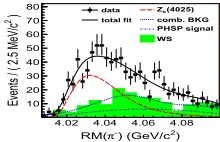
Figure 10. Fit to the π−
re-coil mass spectrum frome+e−→
(D∗D¯∗)±π∓process at 4.26 GeV.
observed. Fits to the mass spectrum with a mass-dependent-width BW function, the pole mass and width were determined to beM=(3885.9±1.5±4.2) MeV/c2andΓ =(24.8±3.3±11.0) MeV. The product of the Born cross section times the branching fraction ofZc(3885)→DD¯∗was measured to be (83.5±6.6±22.0) pb. Assuming theZc(3885) and theZc(3900) are the same state, the ratio of partial decay widths was determined to be Γ(Zc(3885)→DD¯∗)
Γ(Zc(3900)→πJ/ψ) =6.2±1.1±2.7. This ratio is much smaller than typical values for decays of conventional charmonium state above the open charm threshold. In the analysis, the quantum number ofZc(3885) has been studied by examining the pole angle distribution of the bachelor pion. The efficiency corrected fractional signal yield as a function of|cosθπ|from date agrees well with the flat expectation forJP=1+.
4.2 Observation of theZc(4020)andZc(4025)
In the process ofe+e−→π+π−hc, BESIII experiment also analysed the Dalitz plot ofπ+π−hcsystem at 4.23, 4.26, and 4.36 GeV. A structure around 4.02 GeV was observed in theπ±hcinvariant mass spectrum (named asZc(4020)) [17].
A simultaneous fit to theπ±hcmass spectrum in the three energy points using the same signal function with common mass and with was shown in Fig. 8. The fit yields a mass of (4022.9±0.8± 2.7) MeV/c2and a width of (7.9±2.7±2.6) MeV with the statistical significance larger than 8.9σ. The Zc(4020) is close to theD∗D¯∗mass threshold, and similar to theZc(3900), it contains more than just a pair of charm quarks. TheZc(3900) is not significant in this process, adding aZc(3900) with mass and width fixed to the BESIII measurement [5] in the fit, resulted in a statistical significant of 2.1σ(see inset of Fig. 8). The upper limits at 90% C.L. on the production cross section were determined to be σ(e+e−→π±Zc(3900)∓→π+π−hc)<13 pb at 4.23 GeV and<11 pb at 4.26 GeV. The cross section at 4.260 GeV is lower than that ofZc(3900)→π±J/ψ[5].
In the similar process,e+e−→π0π0h
c, withhcreconstructed by the same final states as ine+e−→ π+π−h
cprocess, the neutral partner ofZc(4020) was investigated at BESIII experiment using the same data samples at 4.23, 4.26 and 4.36 GeV. An obvious peak around 4.02 GeV was observed in theπ0h
c mass spectrum, as shown in Fig. 9. Apply a simultaneous fit to theMmax(π0hc) mass spectrum in the three energy points with width ofZc(4020) fixed to the value measured in the charged channel, the mass of neutralZc(4020) was determined to be 4023.6±2.2±3.9 MeV, which is consistent with the chargedZc(4020). The significance of neutralZc(4020) is large than 5σ.
MeV/c2, and a width of (24.8±5.6±7.7) MeV. The Born cross section ofe+e−→ (D∗D¯∗)±π∓was calculated to be (139±9±15) pb.
A series of charged charmoniu-like states have been observed or confirmed recently. These states all contain at least four quarks and close to the threshold. Besides these common features, the na-tures of these states are still not clear, the understanding of these states and the similar states in the bottomonium system may help to develop the QCD at non-perturbative region.
5 Summary
Dramatic progress has been made in the charmonium-like states from different experiments. Using full data samples, both B-factories updated their analysis about the charmonium-like states, some of them were confirmed while discrepancies still exist. BESIII experiment started to make effort to the charmonium-like states. Using scan data samples from 3.81 to 4.42 GeV, a various processes have been studies at BESIII. The observation of chargedZcstates together with otherZ states may indicate one kind of new hadrons has been observed. With more data taken at XYZ region at BESIII experiment in short term and more statistics at Belle II experiment, which is under construction, more results will surely improve the understanding of these states.
References
[1] N. Brambillaet al., Eur. Phys. J. C71, 1534 (2011)
[2] S. K. Choiet al.(Belle Collaboration), Phys. Rev. Lett.91, 262001 (2003)
[3] B. Aubert et al. (BaBar Collaboration), Phys. Rev. D 74, 071101 (2006); V. Bhardwaj et al. (Belle Collaboration), Phys. Rev. Lett. 107, 091803 (2011); A. Abulencis et al. (CDF Collaboration), Phys. Rev. Lett. 98, 132002 (2007); R. Aaij et al. (LHCb Collaboration), Eur. Phys. J. C72, 1972 (2012)
[4] M. Ablikimet al.(BESIII Collaboration), Phys. Rev. Lett.112, 092001 (2014) [5] M. Ablikimet al.(BESIII Collaboration), Phys. Rev. Lett.110, 252001 (2013) [6] B. Aubertet al.(BaBar Collaboration), Phys. Rev. Lett.102, 132001 (2009) [7] V. Bhardwajet al.(Belle Collaboration), Phys. Rev. Lett.107, 091803 (2011) [8] R. Aaijet al.(LHCb Collaboration), arXiv:1404.0275 [hep-ex]
[9] B. Aubertet al.(BaBar Collaboration), Phys. Rev. Lett.95, 142001 (2005) [10] Q. Heet al.(CLEO Collaboration), Phys. Rev. D74, 091104 (2006) [11] C. Z. Yuanet al.(Belle Collaboration), Phys. Rev. Lett.99, 182004 (2007) [12] B. Aubertet al.(BaBar Collaboration), Phys. Rev. Lett.98, 212001 (2007) [13] X. L. Wanget al.(Belle Collaboration), Phys. Rev. Lett.99, 142002 (2007) [14] Z. Q. Liuet al.(Belle Collaboration), Phys. Rev. Lett.110, 252002 (2013) [15] J. P. Leeset al.(BaBar Collaboration), Phys. Rev. D86, 051102(R) (2012) [16] J. P. Leeset al.(BaBar Collaboration), Phys. Rev. D89, 111103(R) (2014) [17] M. Ablikimet al.(BESIII Collaboration), Phys. Rev. Lett.111, 242001 (2013)
[18] Z. Q. Liu for BESIII Collaboration, talk at the 26th Rencontres de Blois, 2014, Blois, France [19] X. L. Wang for the Belle Collaboration, talk at the April APS meeting, 2014