Scholarship@Western
Scholarship@Western
Electronic Thesis and Dissertation Repository
May 2015
Professional Development Based On The Common European
Professional Development Based On The Common European
Framework of Reference for Languages And The New Ontario
Framework of Reference for Languages And The New Ontario
French Immersion Curriculum: A Case Study of Reflective Practice
French Immersion Curriculum: A Case Study of Reflective Practice
Tiffany H. Mui Supervisor Dr. Shelley Taylor
The University of Western Ontario Graduate Program in Education
A thesis submitted in partial fulfillment of the requirements for the degree in Master of Education
© Tiffany H. Mui 2015
Follow this and additional works at: https://ir.lib.uwo.ca/etd
Part of the Bilingual, Multilingual, and Multicultural Education Commons, Elementary Education and Teaching Commons, and the Pre-Elementary, Early Childhood, Kindergarten Teacher Education Commons
Recommended Citation Recommended Citation
Mui, Tiffany H., "Professional Development Based On The Common European Framework of Reference for Languages And The New Ontario French Immersion Curriculum: A Case Study of Reflective Practice" (2015). Electronic Thesis and Dissertation Repository. 2827.
https://ir.lib.uwo.ca/etd/2827
This Dissertation/Thesis is brought to you for free and open access by Scholarship@Western. It has been accepted for inclusion in Electronic Thesis and Dissertation Repository by an authorized administrator of
A Case Study of Reflective Practice (Thesis format: Monograph)
by
Tiffany Mui
Graduate Program in Education
A thesis submitted in partial fulfillment of the requirements for the degree of
Masters of Education
The School of Graduate and Postdoctoral Studies The University of Western Ontario
London, Ontario, Canada
ii
Abstract
In thismulti-phase case study, the teacher researcher aimed to determine how teachers can be assisted in implementing some principles of the Common European Framework of Reference
forLanguages/CEFR (Council of Europe, 2001) into their pedagogical practices for primary-aged children enrolled in early French Immersion programs. Through a series of interviews conducted over three phases and a five-month period, the researcher led the teacher participant through professional development (PD) to shed light on the PD needed for French Immersion and other FSL teachers to adopt key principles of CEFR-inspired pedagogy into their practice. The results suggest that PD should be offered at the board or provincial level for teachersto understand and be able to implement these pedagogical principles. Moreover, assigning early childhood educators who do not know French to work alongside full-day kindergarten French Immersion teachers impedes the ability of those immersion teachers who are familiar with principles of CEFR-inspired teaching to implement them. The results of this empirical study expand on previous research conducted on the feasibility of introducing the CEFR into Canadian FSL pedagogy. This ground-breaking research explores how educators grapple with a pedagogical innovation and the challenges they face when trying to implement it to meet their own and ministry goals.
Keywords
iii
Acknowledgments
I would like to take this opportunity to thank everyone who played a role in guiding me through writing my thesis.
To Dr. Shelley Taylor, my thesis supervisor, for helping me along, every step of the way, for being within an e-mail’s reach, and for putting her best efforts forth to make this the strongest research possible. I am grateful for her thoroughness and attention to detail, and for her experience in second language learning. Thank you, also, to my committee member, Dr. Farahnaz Faez. I appreciate her meticulous critical feedback provided and encouragement to expand my thinking.
An acknowledgment must go out to my teacher participant. Without her motivation and commitment to my study, this thesis never would have become a reality. Thank you for dedicating your time to my passion and for allowing me to help to create a mold for future professional development.
iv
Table of Contents
Abstract ...ii
Acknowledgments ...iii
Table of Contents ...iv
List of Tables...vii
List of Appendices ...viii
Chapter 1 ... 1
1 Introduction ... 1
1.1 Coming to the Research ... 2
1.2 The Research Problem ... 3
1.3 Research Goals ... 4
1.4 The Significance of the Research ... 6
1.5 Definitions ... 7
Chapter 2 ... 10
2 Literature Review ... 10
2.1 French Language Use in Canada... 10
2.2 Acquiring a Second Language ... 11
2.3 The Common European Framework of Reference for Languages... 16
2.4 Introducing the CEFR in Canada ... 21
2.5 The CEFR within the Canadian FSL Classroom ... 26
2.6 Application of the Literature ... 30
2.7 Overview of Canadian CEFR Research ... 32
2.7.1 The CEFR and Existing Professional Development ... 33
v
Chapter 3 ... 41
3 Research Methodology ... 41
3.1 Qualitative Research ... 41
3.2 Case Study... 42
3.3 Participants ... 43
3.4 Context ... 44
3.5 Methods ... 44
3.6 Timeline of Research ... 49
3.7 Data Collection... 52
3.8 Observations and Field Notes ... 53
3.9 Data Analysis ... 53
3.10 Ethics Approval ... 55
Chapter 4 ... 56
4 Findings ... 56
4.1 Phase 1... 56
4.1.1 Themes ... 56
4.1.2 Challenges ... 72
4.1.3 Summary of Phase 1... 86
4.2 Phase 2... 88
4.2.1 Themes ... 89
4.2.2 Challenges ... 94
4.2.3 Summary of Phase 2... 99
4.3 Phase 3... 100
4.3.1 Themes ... 100
4.3.2 Challenges ... 109
vi
Chapter 5 ... 114
5 Discussion... 114
5.1 Reflective Practice as Professional Development ... 114
5.2 Early Childhood Educator Language Barriers ... 117
5.3 Lack of Appropriate Resources ... 120
5.4 Lifelong Learners ... 123
5.5 Summary of Discussion ... 125
Chapter 6 ... 127
6 Summary... 127
6.1 Points to Consider ... 131
6.2 Limitations ... 132
6.3 Future Research Recommendations ... 133
6.4 Final Words ... 137
References ... 139
Appendix A: CEFR Levels A1 to B1... 144
Appendix B: Recruitment Letter ... 145
Appendix C: Phase 1 Initial Interview Questions ... 146
Appendix D: Phase 1 Final Interview Questions ... 147
Appendix E: Phase 2 Interview Questions ... 148
Appendix F: Phase 3 Interview Questions ... 149
Appendix G: Ethics Approval Notice ... 150
vii
List of Tables
Table 1: Possible Adjustments to Basic User Reference Levels (A1) ... 31
viii
List of Appendices
Appendix A: CEFR Levels A1 to B1... 144
Appendix B: Recruitment Letter ... 145
Appendix C: Phase 1 Initial Interview Questions ... 146
Appendix D: Phase 1 Final Interview Questions ... 147
Appendix E: Phase 2 Interview Questions ... 148
Appendix F: Phase 3 Interview Questions ... 149
Chapter 1
1
Introduction
This case study was designed to profile a teacher engaging with The Ontario Curriculum for French as a Second Language, French Immersion Grades 1-8 document (Ontario Ministry of Education, 2013) through reflective professional development (PD) encounters with a teacher
participant. This topic was explored through a case study involving two teachers, one of whom
was the researcher. The purpose of their work together was to: (a) inform the teacher participant
about the Common European Framework of References for Language (CEFR) and its inclusion of task-based language activities (TBLT), and whether (and if so, how) the framework was
supported through the new Ontario French as a Second Language (FSL) curriculum, and (b)
identify and document the strengths of (and challenges inherent in) her attempting to implement
aspects of the framework, which constituted a pedagogical innovation for FSL in Ontario. My
role within the study, as the researcher, was to work closely with the teacher participant. I was
seeking to influence the teacher participant to adopt CEFR-infused activities within her daily
practice while reporting on and analyzing her views. Our approach was to adopt a mentor/mentee
relationship, paving the way for PD ideas, encouraging discussion and reflective practice (Schön,
1983). The impact of the discussions between teacher and researcher was explored over three
research phases conducted over a five-month period, during which time the teacher participant
examined the value and significance of having a “critical friend” who could scaffold her
understanding of what the CEFR entailed and whether she could include some of its principles in
her FSLclassroom (Carr and Kemmis, 1986). Thus, the question being investigated is, “How can
teachers work together collaboratively to understand and draw on a pedagogical innovation such
1.1 Coming to the Research
French is one of Canada's official languages, and is spoken by nearly one-quarter of the
population (Kissau and Turnbull, 2008). The Canadian federal government promotes linguistic
duality in its citizens, in both French and English, and Canadians believe that it is important for
their children to learn a second language (L2). In fact, Vandergrift (2006) states that 86% of
parents want their children to learn another language. Among this 86%, 82% are Anglophones
and 75% believe that French should be a child's second language. Ninety percent of
Francophones believe that English should be the second language (Vandergrift, 2006). It is
evident that French is a valuable language to the Canadian population. To address this, the
Canadian government believes that there should be a way for each province and territory to link
its unique L2 programs to a common framework that can then be applied internationally, using
similar scales, and markers of achievement (Vandergrift, 2006).
As a teacher who has taught Kindergarten, Grade 1, and a combined Grade 1/2, I was
interested in delving further into the new curriculum to investigate whether it aligns with, or is
indeed infused with, the CEFR. The Ontario FSL curriculum specifically states that the
curriculum "recognizes that, today and in the future, students need to be critically literate in order
to synthesize information, make informed decisions, communicate effectively, and thrive in an
ever-changing global community" (Ontario Ministry of Education, 2013, p. 5). These stated
goals raise the question of what learning approach the curriculum proposes to ensure that young
learners develop holistic literary skills while gaining the necessary tools (fluency, accuracy,
vocabulary, comprehension in the L2, etc.) to thrive given the L2 expectations of their program
(i.e., to communicate effectively and clearly using an L2, to understand reading, writing, and
communities and societies with their knowledge of an L2.) (Ontario Ministry of Education,
2013).
I concentrated my efforts on conducting a case study that could be used not only for my
own benefit, but for other educators involved in French Immersion students' L2-learning
journeys. Throughout this research, the teacher participant and I adopted a mentor-mentee
relationship. Although she was a fairly new graduate and had a background in second
language/(L2) acquisition, she had not yet been formally introduced to tenets of the CEFR or
how to use its ethos within the classroom (i.e., the Common Reference Levels, task-based
learning and teaching/(TBLT), and the European Language Portfolio/(ELP) to maximize L2
learning). Having conductedthe research and background reading on the CEFR and task-based
language activities, I was able to offer her some insight into what the CEFR entails, through its
reference levels, the ELP and, as is noted in sections 4.1.1.2 and 4.3.2.2, I recommended possible
activities that she could build into her teaching. The conversations and information gathered
within this study will provide some insight into the future of the FSL program and the CEFR,
particularly for early learners, and will allow for other successful primary grade experiences.
1.2 The Research Problem
Canada is an officially bilingual country, and the FSL Document (2013) states that knowledge of
French "allows students to communicate with French-speaking people in Canada and around the
world, to understand and appreciate the history and evolution of their cultures, and to develop
and benefit from a competitive advantage in the workforce" (Ontario Ministry of Education, FSL
Document, 2013, p. 6). The problem that arises in French Immersion programs is that while
children's language instruction understandably follows the curriculum closely, their French
Therefore, ties between the proficiency they develop in the program and whether they eventually
gain a competitive edge in the workplace remain unclear. Faez, Majhanovich, Taylor, Smith, and
Crowley (2011) state that drop-out rates from FSL programs across Canada are high and there is
widespread dissatisfaction with French language proficiency levels among students, teachers,
and FSL programs. This dissatisfaction with proficiency levels, may arise from language being
taught in isolation (i.e. rote drilling of grammar concepts), a limited amount of time allotted to
authentic communication (i.e. choosing topics that truly interest students, not teachers), and the
way language is used in specific domains such as mathematics and social studies (Genesee,
1994). One goal identified by the Ontario Ministry of Education's FSL curriculum document
(2013) is to foster children's ability to communicate with others. This knowledge can be carried
with them in future endeavours in an L2, such as gaining a competitive advantage in the
workplace.
A true picture of students' abilities to conduct themselves in a French environment may
not be entirely evident by adopting a narrow perspective of the curriculum and traditional ways
of teaching and assessment. It was my intention for the teacher participant and me to discuss
potential activities that could extend students' thinking in their L2, using task-based language
activities and authentic language activities that align with the goals of the CEFR (and possibly
with the new FSL curriculum).
1.3 Research Goals
Through this case study, the teacher participant and I worked collaboratively over the course of
three phases of 6 interviews: four initially, one three months later and one five months later, to
document not only our partnership, but also the struggles, challenges and successes we
could be adopted in a French Immersion classroom setting. The ultimate goal of my research was
to see how a teacher could be assisted in implementing CEFR-based learning and teaching in her
classroom. The teacher needed to understand principles of the CEFR to be able to engage in
task-based teaching and promote learner autonomy. My role was to provide PD to a teacher in a
one-on-one setting to further her learning and overall knowledge of the CEFR.
It has been suggested that the CEFR promotes learner autonomy through its use of an
action-oriented approach to learning (Little, 2009). "Can Do" statements, such as level A1 for
written interaction, “I can write a short, simple postcard, for example sending holiday greetings. I
can fill in forms with personal details, for example entering my name, nationality and address on
a hotel registration form” (CoE, 2001, p. 26), stress students' independence and accountability
for their learning through reflections on their learning and engagement in authentic
communicative activities, like asking and answering questions (Saskatchewan Ministry of
Education, 2013). The Ontario FSL curriculum does not make any direct connections to the
CEFR or reference the Council of Europe throughout the entire document; thus, I hypothesized
that the new FSL curriculum guidelines may not obviously steer teachers in the direction of a
CEFR approach to L2 teaching. This approach provides authentic opportunities for students to
engage in spoken French interactions, and task-based teaching opportunities. Students gain
independence and fluency in an L2, while using self-assessment to determine where growth
needs to occur to continue building on prior knowledge in French. Teachers may encounter
challenges because of this lack of clarity within the curriculum document (Ontario Ministry of
Education, 2013). How, then, can teachers be assisted in implementing some principles of the
CEFR into their FSL pedagogy for primary-aged children in a French Immersion classroom?
participant have the potential to inform successful PD initiatives aimed at supporting FSL
teachers’ attempts to understand the CEFR and infusing aspects of it (e.g. task-based teaching,
self-assessment, and learner autonomy) in their pedagogical practices.
As a teacher researcher, I assisted in building the teacher participant’s knowledge of the
CEFR so that she could begin to understand the framework and principal goals of the document
(e.g. task-based learning, authentic spoken interactions, and developing learner autonomy). We
also discussed prospective activities that could be used in her future classroom to promote
French language acquisition on a deeper level1, and worked through the FSL curriculum
document auxiliary document (Ministry of Education, Ontario, 2013) to reconcile the FSL
teaching/learning expectations outlined by the Ontario Ministry of Education (2013), and by the
Council of Europe (2001), as set out in the CEFR. During the research process, the teacher and I
developed new ideas about practices that we could incorporate into our French Immersion
classrooms. We also engaged in discussions about challenges or successes that could arise with
the use of CEFR-based activities in conjunction with the FSL curriculum document (Ontario
Ministry of Education, 2013). We revisited these discussion topics during two separate ‘post’
phases (the first was three months after the initial interview sessions, and the second, five months
later).
1.4 The Significance of the Research
This research fills a gap in the literature as no previous Canadian studies have investigated the
CEFR in relation to how it could be tailored to full-day kindergarten French Immersion students.
1
The knowledge gained through this research is significant on various levels. The findings of this
research provide a clearer perspective of how PD needs to be structured. The research also
provides one L2 teacher’s voice and highlights the struggles of using a new document without
being given any direction. The timing of this study is appropriate because this is the first school
year in which the FSL curriculum document (Ontario Ministry of Education, 2013) is being
referred to within French Immersion classrooms. The participating teacher gained a better
understanding of how to develop a classroom promoting maximal L2 learning environment for
her FSL learners.
1.5 Definitions
The following terms are ones that will be used throughout this thesis. These terms are applicable
to this cases study and are typically referred to by French Immersion teachers.
“Can Do” Statements (Council of Europe, 2001): Each proficiency level in the CEFR contains
corresponding “Can Do” statements. These descriptors come from appropriate levels of the CEFR
grids for each of the communication skills: listening, reading, spoken production, spoken interaction,
and writing.
The Common European Framework of Reference for Languages (Council of Europe, 2001): This
teaching, learning, and assessment approach provides a common basis for the elaboration of
language syllabuses, curriculum guidelines, examinations, textbooks, and other resources across
Europe and in other countries. The framework provides teachers with the means to reflect on
their current practice to meet the real, individual needs of their learners. CEFR is an acronym
The Communicative Approach: This is an approach to language teaching that focuses on
meaning over form, emphasizes meaningful interactive activities, centres on communicative
language needs and, when possible, highlights authentic tasks within the context of a classroom
environment. The goal of the communicative approach centres on communicating in the target
language (Ministry of Education, 2013). This approach was adopted by the CEFR, which came
about as an extension of the communicative turn that began in the 1970-1980s. Canale and Swain
(1980) describe communicative competence in terms of three components: grammatical,
sociolinguistic, and strategic competence.
French Immersion: Within the context of Ontario, French Immersion is a program designed for
students to have the opportunity to acquire a high level of proficiency in French while continuing
with the development of their English language skills (x School Board, n.d.). The French Immersion program follows the same expectations as the English program where the only
difference is the language of instruction. It is an optional program where students are encouraged
to communicate in French as much and as consistently as possible. Students who do not speak
French as their first language receive instruction in French in school and are immersed in the
language and culture.
FSL: This is an acronym used to refer to French as a Second Language.
The Ontario Curriculum, French as a Second Language: This document replaces the 1998 and
2001 FSL curriculum documents (as well as previous versions). Beginning in September 2014,
all FSL programs in Ontario are based on the expectations and goals that are outlined in this
particular document (Ontario Ministry of Education, 2013). All FSL teachers within the province
Proficiency Levels (Council of Europe, 2001): A proficiency scale defines a series of ascending
bands of language proficiency. It may cover the whole conceptual range of learner proficiency,
or it may just cover the range of proficiency relevant to the sector or institution concerned. There
are six levels of language proficiency, ranging from A1 to C2 (CoE, 2001).
Task-Based Language Teaching: This is an approach to teaching that was developed as an
alternative method to traditional ways of teaching. The goal of this teaching process is to develop
learners’ linguistic and interactional competence as well as communicative competence by
engaging them in meaning-focused communication through the performance of tasks (Ellis and
Chapter 2
2
Literature Review
The following section explores French as an L2 beginning with the broad context of French use
within Canada, the acquisition of an L2, the CEFR, and then finally narrows in on French
teaching and learning within a Canadian classroom.
2.1 French Language Use in Canada
Canada has two official languages: English and French. They have been used in Canada for over
200 years, since 1763 when New France was surrendered to the British (Mougeon, 2013). At that
time, there were approximately 80,000 French and 20,000 British individuals who resided in
what is now known as Canada. Since 1941, French speakers fluctuated between 27% to 31% of
the population until 1961. By 1996, their numbers decreased to 23.5%. One reason for this
steady decline is that immigrants who come to Canada speak languages other than English or
French, and many of them adopt English. Also, French speakers adopt English when they live
outside of Quebec, Acadia and Franco-Ontarian regions (Henripin, 2013).
In 2011, Statistics Canada reported that nearly 10 million people indicated that they could
conduct a conversation in French; however, the overall percentage of French speakers in 2011
was 30.1%, a 0.6% decline from five years earlier (30.7%) (StatCan, 2014). Overall, however,
there has been a steady decrease in French speakers in Canada over the last 30 years. As stated
earlier, international immigration has had a strong impact on the presence of French within
Canada. In the last 20 years, approximately 235,000 immigrants have come to Canada each year,
proportion of these immigrants adopt the English language and use it at work and in their
everyday lives (StatCan, 2014).
It can be assumed that a large Francophone community will remain in Quebec, New
Brunswick and Ontario, but outside of these areas, the survival of such communities is much less
certain. In at least three provinces, British Columbia, Saskatchewan, and Newfoundland, the
population of French speakers is declining quite quickly (Mougeon, 2013). There are individuals,
however, who are working towards preserving the French language within educational settings.
Canadian Parents for French (CPF) was founded in 1977 as an organization to promote French
language learning opportunities for Canadian children. CPF has been linked to French
Immersion programs since its beginning, and its mission statement includes providing
educational opportunities for young Canadians to learn and use French. CPF members are mainly
Anglophones who want their children to have the educational opportunities that they were denied
or lacked (Canadian Parents for French, 2013). CPF provides educators, parents, and students
with a well developed website on bilingualism that presents relevant research related to their
mandate.
2.2 Acquiring a Second Language
Second language acquisition as an area of study began in the 1960s. There are a variety of
perspectives on L2 learning, which include theories from Chomsky (1959), Krashen (1985),
Long (1983), Swain (1985), VanPatten (1996), along with others. Chomsky (1959) argued that
L1 acquisition differed from other kinds of learning. He believed that the learning took place
inside the learner’s head and was driven by an innate capacity for language, for which Chomsky
coined the term, ‘language acquisition device’ (Chomsky, 1965). Krashen (1985) argued that
more developed than their interlanguage. Long (1983) posited that comprehensible input was
achieved through interaction and, in 1996, revised the Input Hypothesis saying that it was
feedback that learners received that allowed them to self-correct themselves through modified
output (Ellis and Shintani, 2014). Swain (1985) concurred, positing the output hypothesis.
VanPatten’s (1996) stance was that learners relied on default input processing strategies, unless
they were specifically taught to comprehend a sentence correctly. He proposed that to remedy
this, Processing Instruction was necessary (Ellis and Shintani, 2014).
According to behaviourist theories on second language learning, the first language (L1)
plays a role in second language (L2) learning, referred to as ‘interlanguage’ (Selinker, 1972) in
that the L1 has an influence on the creative construction of the L2 (Lightbown and Spada, 2013).
To further illustrate this point, L2 learning errors may parallel those of L1 learning, which is
viewed as the natural process of learning a language. In learning a language, there are three main
parts of L2 acquisition: a silent period, chunked speech, and the breakdown of chunked parts of
speech to discover grammatical properties. These three stages lead to L2 acquisition (Ellis and
Shintani, 2014). In addition to this, prior to mastering grammar, learners produce creative
utterances, structural simplification, and semantic simplification.
These types of language learning described above, as identified by Chomsky (1959),
Selinker (1972), Krashen (1985), Long (1983), Swain (1985), VanPatten (1996), Lightbown and
Spada (2013) and Ellis and Shintani (2014), relate to the CEFR’s notion that different
dimensions of language are interrelated in all forms of language use. Any act of language
learning or teaching is in some way concerned with these dimensions: strategies, tasks, texts, an
individual’s general competences, communicative language competence, language activities,
Another potent hypothesis is that L2 acquisition can take place if learners are constantly
exposed to the target language. I agree with Ellis and Shintani (2014) that use of the target
language should be maximized in class, and learners should be provided with or seek outside
opportunities to experience the language in different contexts. Instructed language learning
should also allow for ample opportunities for both structured L2 practice along with
learner-initiated conversations and social interaction.
French language acquisition begins at various ages for FSL learners. Some children come
from bilingual or multilingual households and receive monolingual and dual-language immersion
from very early on in their lives. With regard to immersion programming, there are monolingual
early immersion models that offer early-years experiences through one single language (i.e.,
French), and dual-language immersion programs that expose young children to two languages in
their early-years’ settings (Hickey and de Mejia, 2014). The latter are more common in the
United States, and the former are more common in Canada. Depending on parental preferences,
they may opt for immersion preschooling if they believe there are social, cultural or economic
benefits to exposing their child to learning a language early on (Russette, 2013; Russette and
Taylor, 2014). On the other hand, some parents may see early years immersion as low risk ‘test
cases’ (i.e., to see how their child fares when the academic demands are looser) (Hickey and de
Mejia, 2014). Young children are naturally motivated to take part in playful activities and are
less self-conscious about errors than older learners, making them better equipped to acquire an
L2. This is illustrated in the French Immersion play-based full-day kindergarten model (Ontario
Ministry of Education, 2010).
Bjorklund, Mard-Miettinen and Savijarvi (2013) examined a Swedish language
Swedish immersion environment (preschool and kindergarten). The focus of this research was on
interaction and discussion strategies young children used as they learned Swedish in everyday
interactions (Bjorklund et al., 2013). The researchers concluded that it is important to prepare
teachers to provide children with target language input. Teacher L2 output or the language
spoken by the teacher, should be provided explicitly throughout the day while in contact with
children, regardless of the activity. As students explore activity centres that allow them to create
and understand their own learning, they gain implicit knowledge. However, since early-years
students do not yet have the vocabulary to navigate their L2 learning environment, they need
explicit teaching to follow their self-selected initial learning. When teachers provide meaningful
L2 input, students are more likely to use their prior knowledge for L2 learning (Bjorklund et al.,
2013).
The Ontario Ministry of Education (2012) document titled Prologue: Acquisition of Oral Language as a Foundation for Literacy, discusses what educators need to consider when
planning instruction in French language classrooms: “Teachers create a classroom environment
where students participate in everyday communication, authentic activities, and meaningful tasks
that promote oral language rather than placing an emphasis on recall of vocabulary and language
structures” (Ontario Ministry of Education, 2012, p. 4). Communicative, authentic, meaningful
activities can contribute to implicit student learning and seem to take precedence within an L2
classroom rather than solely relying on explicit teaching such as rote grammar-related exercises.
As the Ontario Ministry of Education (2012) writes, students need to be engaged in their
activities and these tasks need to be relevant to them.
Environments created in French Immersion classrooms should promote risk-taking,
encouraged to listen and talk, share ideas, and become problem solvers even though they have
not yet attained linguistic accuracy” (p. 4). Teachers are advised to assist student learning by
drawing more out of learners’ personal experiences and making connections with students’ past
learning (Elementary Teachers’ Federation of Ontario, 2001). Students are viewed as more apt to
take risks with using their newly acquired language if it is done in an environment conducive to
risk-taking, such as safe, nurturing classrooms. The Ontario Ministry of Education (2012)
contends that it is crucial to present material to students only through the target language, a point
echoed by Hickey and de Mejia (2013). The latter authors argue that when teachers translate
material in the L1 to get past presumed weaknesses in the L2, these same teachers actually
hinder students’ L2 language acquisition. While there is a body of literature that would argue that
drawing on L2 learners’ L1 is useful, especially at the stage of “emergent bilinguals”, (Garcia,
2010), Hickey and de Mejia’s (2013) research suggests that teaching solely in the target language
helps to maximize fluency, confidence, and positive attitudes towards the language. Furthermore,
students interested in what they were learning understand and apply their new knowledge better
because they have a passion and desire for using the materials associated with the themes that
interested them. Nonetheless, teaching is context-bound. All classes are made up of different
students with different interests.
Clearly, teachers play a large role in facilitating L2 learning, which can also be supported
by using task-based language teaching. Task-based language teaching (TBLT), defined as a
process of teaching to develop learners’ linguistic, interactional, and communicative competence
through meaningful activities, is organized in a manner that allows for the development of
learners to engage in various roles and participant organization structures, even in the primary
grades (Lightbown and Spada, 2013).
For primary-aged students, examples may include meaningful tasks whereby learners can
link their language learning to engaging in activities within the classroom, such as singing songs,
playing games, dramatizing skits, engaging in conversations, describing a picture, or conducting
surveys. Educators need to be aware of how a task-based syllabus is implemented, with three
main tasks: pre-task, main-task, and post-task phases. Throughout TBLT, the teacher scaffolds,
orients learners to focus on meaning, builds student confidence in using the L2, encourages
learners to use the L2, and gives clear feedback to students. Willis (1996) writes that teachers can
take on different roles including an active role, or a passive or facilitator role. They can also
work as a task participant, working and learning alongside the students (Ellis, 2006).
2.3
The Common European Framework of Reference for
Languages
Background. The CEFR provides a foundation for this case study. The framework was
developed by the Council of Europe (CoE) in 2001, after three decades worth of research on
language teaching, learning, and assessment. The CoE has 47 member states and five observer
countries, which includes Canada (CoE, 2001). Though produced in the early 1990s, the CEFR
has been a work in progress since it was first introduced and is being continuously revised and
edited. The CEFR document has been translated to 37 languages. Among the 37 translations are
Arabic, Chinese, Japanese, and Korean (Faez et al., 2011). When it was first presented, the CEFR
was viewed as controversial; however, the framework encouraged reflection and led “to the
achievement of a consensus on the fundamentals and practices of language teaching, learning,
The goals of the CEFR are to provide guidelines on how to define levels of proficiency in
learners at each stage of their language learning, on an ongoing basis (Council of Ministers of
Education, 2010). Learners can be measured on the given scales throughout their lives; however,
the CEFR not only benefits learners, but educators and educational administrators alike, as the
framework gives them tools to reflect on their practice and allows for the “transparency of
courses, syllabuses, and qualifications, thus promoting international co-operation in the field of
modern languages” (Council of Ministers of Education, 2010, p. 3).
The way in which the framework is broken down (three broad divisions and then six
levels within these divisions) is useful in understanding the language acquisition of French
Immersion learners as they progress through the primary grades. The reference levels consist of
(1) Basic User: A1, A2; (2) Independent User: B1, B2; and (3) Proficient User: C1, C2. Each
level within the CEFR then has five categories that lay out what learners should be able to
achieve. These categories include what learners should understand when listening and when
reading, spoken interaction, spoken production, and writing, as basic, independent, or proficient
L2 users (Canadian Parents for French Ontario, 2010).
The CEFR is a tool used to define, track, and recognize progress in the language learning
process. Furthermore, CoE (2001) claims that the CEFR allows learners’ progress to be
monitored and measured at each stage of learning, on a lifelong basis. It is intended to describe
the abilities of language learners and how they can communicate through understanding,
speaking, and writing (Canadian Parents for French Ontario, 2010). The CEFR framework
groups learners into a variety of levels of languageproficiency based on their abilities to perform
The CEFR provides a basis for the understanding of language syllabuses, curriculum
guidelines, examinations, textbooks, and other resources, across Europe (CoE, 2011). It provides
countries with a way to universally assess language use based on reference levels. The CEFR
gives schools and employers a way to create a shared understanding of language in order to
determine the suitability for learning and work (Canadian Parents for French Ontario, 2010).
The goal is to make a transparent tool to promote international co-operation in the field of
modern languages (CoE, 2011).
Reference Tool. The principles of the CEFR include representing diverse languages and cultures
in Europe (and now internationally), facilitating communication and interaction among, for
example, Europeans of various mother tongues through a better knowledge of modern European
languages, and achieving greater alignment in the development of national policies regarding
modern language learning and teaching (CoE, 2001, p. 2). The Council of Europe (2001) has set
out a guide for reference users, divided into nine chapters and four appendices, called, Common European Framework of Reference for Languages: Learning, Teaching, Assessment.
Language Scales. The CEFR global scale is a chart of internationally-recognized language levels
that highlight specific and observable language behaviours within social or academic contexts.
These statements describe the language proficiency according to the learner’s performance
within real-world contexts (Ontario Ministry of Education, 2013).
The scales that are used to define levels of language proficiency are as follows: Basic,
Independent, and Proficient. Within these levels, they are subdivided into six global levels of
performance. These stages are classified as follows in my adaptation from Vandergrift’s
Basic User. Breakthrough (A1): ability to meet limited needs in highly predictable and easily recognizable situations by relying on rehearsed, organized situation-specific phrases.
Waystage (A2): ability to communicate in simple and routine tasks related to a limited range of common social situations, requiring a direct exchange of information on familiar and routine
situations.
Independent User. Threshold (B1): ability to participate simply but effectively in a variety of social situations necessary to normal everyday occurrences and interactional needs in a range of
contexts.
Vantage (B2): ability to hold more than one’s own in social discourse, e.g. effective argument in discussions, and using one’s greater awareness of the language for purposes of self-correction
and planning.
Proficient User. Effective Operational Proficiency (C1): ability to engage in fluent and
spontaneous conversations, ability to carry out complex work tasks and pursue university studies
in the target language.
Mastery (C2): ability to speak with precision, appropriateness, and ease.
Emergent learners, with their first exposure to an L2 environment in a kindergarten
classroom, would begin their language learning at A1. Students with little to no experience with
an L2 begin at the breakthrough stage and throughout their L2 journey, can work towards A2,
In addition to these levels, each global level can be further divided into sublevels to be
able to “suit local needs and yet still relate back to a common system” (CoE, 2001, p. 32). As an
example, Vandergrift (2006) writes, in situations where academic progress is slow, the Basic
level could be further divided to create multiple sub-levels, such as A.2.1, A.2.2. By dividing the
levels, this will give learners a clearer idea of where they are based on the levels (Vandergrift,
2006).
European Language Portfolio. The CEFR has been used for a variety of important assessment
initiatives, most notably the European Language Portfolio (ELP). This portfolio is a reporting
and pedagogical tool used by language learners to document their proficiency in all languages
learned, including their first, and allows them to reflect on their language learning and cultural
experiences. There are three specific parts to the portfolio, which include a language passport
discussing the language experiences, a language biography that describes experiences in each
language, and a dossier containing a selection of work that is representative of the learner’s
proficiency. The benefits to using the ELP are many, including the promotion of plurilingualism,
raising cultural awareness, and fostering the development of learner autonomy (CoE, 2001, p. 4).
This development of autonomy also works towards encouraging lifelong language learning
(Vandergrift, 2006).
The principles of the CEFR are intended to provide teachers and learners with a
transparent, coherent and comprehensive basis for understanding language syllabuses and
curriculum guidelines (CoE, 2001). The Ontario Ministry of Education’s new FSL curriculum
(2013) shows influences of the CEFR, though it is not explicitly stated. Thus, understanding the
and using the reference levels provided within the CEFR, can support educators in the
assessment of language proficiency.
2.4 Introducing the CEFR in Canada
The rationale behind the use of the CEFR within Canada begins with research conducted by
Vandergrift (2006). He determined that the CEFR was the most comprehensive and
comprehensible way to describe language proficiency and that this framework was flexible
enough for use in Canada (Canadian Parents for French, Ontario, 2010). Vandergrift (2006)
gives an overview of the need for a common framework for languages within Canada. He states
that establishing a framework could create a common understanding of what functional
proficiency of a language means (Vandergrift, 2006). Having a framework that can be applied to
various cities and provinces within Canada would assist L2 educators in understanding what is
expected of students in the French Immersion context, based on a continuum of progression
within the L2 program. Vandergrift (2006) writes that in order to apply the common framework
to Canadian education, it needs to be transparent and context-free to accommodate students of all
ages and goals. The framework should be comprehensive to apply to formal education,
employers and cultural institutions, flexible enough to allow each province or territory to connect
this common framework to a larger one, and discriminating to accommodate learners in various
academic contexts (Vandergrift, 2006).
Vandergrift (2006) argues that language learning is a lifelong task, with the ultimate goal
being the attainment of language proficiency. Similarly, the new FSL curriculum repeatedly
states that the goal of the document is to “motivate students to learn and to become lifelong
learners” (Ontario Ministry of Education, 2013, p. 13). Through developing the skills necessary
curriculum sets out to encourage students to see themselves as lifelong learners for personal
growth and for active participation as world citizens (Ontario Ministry of Education, 2013).
However, language learning is not limited to one point in time, one single assessment or
evaluation task; rather it is an improvement over a variety of learning opportunities that
contribute to students’ language proficiency (Vandergrift, 2006). Therefore, the CEFR provides a
perspective of language proficiency at identified levels with the focus on individual progress in
language performance, measuring progress at each stage of learning on a lifelong basis
(Vandergrift, 2006). Since language learning is so complex and unique to each student,
Vandergrift (2006) writes that a language framework should therefore be: theoretically grounded,
empirically validated, and congruent with teachers’ perceptions and experiences with language
learners. He also outlines various reasons as to why the CEFR, compared to other frameworks, is
applicable in the Canadian context for analyzing language acquisition (Vandergrift, 2006). These
include the CEFR as being a) theoretically grounded; b) empirically validated; c) face validity; d)
transparent and user-friendly; e) context-free/context relevant; f) comprehensive; g) flexible and
open.
Vandergrift (2006) outlines and compares language status, language policies, vision,
mobility, curriculum, learning design, learning content, and assessment in the European and
Canadian contexts. In a table form, Vandergrift (2006) demonstrates how the CEFR within the
Canadian context is similar to that of the European and encompasses Canada as a country with
two official languages, with schooling from kindergarten to grade 12, with multiple provinces
and territories. Therefore, it is evident why Canada has chosen to adopt some of the CEFR’s key
Using the CEFR within the Canadian context can be particularly beneficial to students
who move to other schools, since the data collected from each school can be understood at the
other as they are based on the same competencies. This could further assist students in getting
the appropriate assistance or enrichment, according to the CEFR levels. Schools could know
where to begin by simply looking at the reference levels, rather than starting over again using a
different diagnostic tool. Within my particular school board, there has been a lot of movement as
a result of accommodation reviews and boundary changes. The CEFR levels could help teachers
in situations like this get a sense of where their students are within their language learning
experiences.
The CEFR aims to promote reflection, which leads “to the achievement of a consensus on
the fundamentals and practices of language teaching, learning, and assessment” (Council of
Ministers of Education, 2010, p. 8). It is not a standardization tool, which indicates that it is
flexible and can be adjusted appropriately. It allows individual users of the framework to analyze
their own unique situations and make the choices that they feel are appropriate to them in their
own contexts, while still encompassing the key components of the framework (Council of
Ministers of Education, 2010). The reference levels must be specific to students from
kindergarten to grade 12 within the school context, and it is important to use the descriptors
based on a common theory of learning, language proficiency, and individual cultural competence
(Council of Ministers of Education, 2010). Descriptors need to be more specific and developed
to meet target objectives, such as FSL in a minority or majority setting. Teachers could create
assessments based on students’ level of language proficiency, and these descriptors could be
used to reflect learners’ stage of competence. Examples of more in-depth descriptors could
students could all have access to grade- and age-appropriate scales that they could use to classify
themselves. Examples of these are included in Appendix A.
Some jurisdictions across Canada are at very different stages of acceptance and
integration of the CEFR with their language programs. The Atlantic Provinces seem to be one of
the only multi-provincial organizations working to align the curriculum with the CEFR, creating
materials for teachers and administrators, developing pilot units for teachers, and learning about
how to implement CEFR-informed tests (The Canadian Association of Second Language
Teachers, 2011). Canadian Parents for French Ontario (2010) reports that Saskatchewan and
Nunavut’s progress in aligning the CEFR with their curriculum is going slowly. Other provinces,
such as Alberta and British Columbia have already implemented the CEFR. Alberta has been
using the CEFR to determine students’ levels of proficiency while British Columbia has set a
goal for French Immersion graduates to use the CEFR in new curricula for French, German,
Japanese, Mandarin, Punjabi, and Spanish programs (Canadian Parents for French Ontario,
2010).
Within Ontario, the CEFR is becoming more prevalent and teachers are more aware of
the CEFR and its benefits. Along with the new FSL curriculum document (Ministry of Ontario,
2013), the CEFR can be used in conjunction with the expectations as outlined by the province.
The CEFR can be referenced for planning, teaching, and assessment related to the curriculum
expectations, learning styles, needs, and experiences of all students. The two main hindrances to
the integration of the CEFR relate to the work required to ensure teachers are on board with the
framework (i.e. teachers would need to see the additional value that the CEFR adds to their
practices before changing how they teach) and how to integrate it into other language learning
The auxiliary document accompanying the new FSL curriculum document (Ontario
Ministry of Education, 2013) features a ten-year plan. Years 1, 5, and 8 will allow school boards
to create and submit to the Ministry an FSL plan that supports the provincial goals for FSL
(Ministry of Education, Ontario, 2013). The plan involves both the elementary and secondary
levels, and includes at least one measurable goal based on district needs for each of the
province’s three goals for FSL. In Years 4, 7, and 10, school boards will be responsible for
submitting a short progress report. The three provincial goals are as follows.
1. Increase student confidence, proficiency, and achievement in FSL.
2. Increase the percentage of students studying FSL until graduation.
3. Increase student, educator, parent, and community engagement in FSL.
(Ministry of Education, Ontario, 2013)
The purpose of this FSL plan would be to assist boards in thinking strategically about
FSL and planning in order to support the provincial goals. It is hoped that observing
developments in FSL over the course of ten years will assist the ministry to support continuity
and alignment in areas of effective instructional practices in FSL programs across Ontario and to
monitor trends in FSL education. An important component in the planning process is for each
school board to establish baseline data, which can be used to prioritize needs and provide a
foundation for measuring progress over time (Ministry of Education, Ontario, 2013).
In addition to this over-arching provincial plan, the Ontario Ministry of Education has
supported CEFR pilot programs in some school boards. A Southwestern Ontario research project
section. It is evident that the CEFR will be introduced and re-introduced in Canadian provinces
and that some are already adopting its practices.
2.5 The CEFR within the Canadian FSL Classroom
Majhanovich et al.'s (2010) report, Describing FSL Language Competencies: The CEFR Within an Ontario Context, presents research that was conducted in nine different school boards, across Ontario, and involved Core French and French Immersion teachers. Students were also
participants within the research. Teachers implemented CEFR-informed activities in the
classroom to observe the benefits of using such activities. Student self-assessments were sought
through questionnaires and reflections (Majhanovich et al., 2010).
The questionnaires that were developed for students asked them to reflect on their level
of language and cognitive development skills (Majhanovich et al., 2010). The results of using
CEFR-informed activities in the classroom demonstrated gains for both Core French and French
Immersion students in areas of learner autonomy, developing oral language ability, self-assessment
and increased student motivation, real-life applicability, and ease of parental communication
(Majhanovich et al., 2010). To determine the success of the CEFR activities, the teachers assessed
perceived changes in the learners’ oral proficiency.
In Majhanovich et al.'s (2010) research, as predicted, most teachers expressed the need
for additional PD opportunities to attend workshops and in-service sessions to help them to better
understand how to properly and further use parts of the CEFR in their classrooms. This is also
echoed in Ellis and Shintani's (2014) findings where teachers found a variety of difficulties when
opportunities to further understand the use and benefits of TBLT and the CEFR within teaching
and learning.
In Majhanovich et al.’s (2010) study, teachers were provided with kits, developed by a
group of experienced FSL teachers from the Thames Valley District School Board in Ontario.
These kits contained a series of activities related to the "Can Do" descriptors from the
appropriate levels of the CEFR for each of the communication skills within an L2: listening,
reading, spoken production, spoken interaction, and writing. The purpose of these kits, once
teachers were shown how to use them, was to promote CEFR-informed instruction in their
classroom. Teachers also received a teachers' guide for each level, which involved A1, A2, and
B1 levels (Majhanovich et al., 2010). The researchers of this study were interested in knowing
whether there would be any change in student attitudes and confidence following the use of
CEFR-informed activities (Majhanovich et al., 2010). Interestingly, comparisons between the
pre- and post-test scores did not show any changes in learners' attitudes (Majhanovich et al.,
2010).
TBLT also encourages students to be accountable for their own learning, whether through
individual experiences or social interactions. Students' roles change from 'language learners' to
'communicators', and they are reportedly more ready to take on the performance of tasks with the
knowledge they have gained through their L2 (Ellis and Shintani, 2014). Similarly, developing
learner autonomy is a key aspect of the CEFR approach. These researchers wanted to discover
teacher perceptions about learner independence (Majhanovich et al., 2010). The data indicated
that teachers were skeptical of their students' ability to take charge of their own learning.
However, this study supports the need for development of learner autonomy as a skill to be
French Immersion education in Ontario (Majhanovich et al., 2010). Within the study, researchers
discovered that teachers using CEFR-related activities allowed students to gain a clearer
understanding of their actual language ability.
In terms of teacher benefits, researchers discovered that teachers viewed CEFR-informed
instruction as promoting language use, collaborative dialogue, and languaging2 in a classroom in
ways that traditional, teacher-directed ways of teaching cannot achieve (Majhanovich et al.,
2010). The Council of Europe's (2001) goal of learner autonomy and L2 learning has two
significant pedagogical implications, which involve the need for working with teachers and their
beliefs about students' abilities, and also the need for working with students to show them how to
engage in student-directed learning and reflect on their own learning (Majhanovich et al., 2010).
Teachers involved in this research believed that the CEFR-based activities used in the classroom
increased learner autonomy, self-confidence, and motivation.
Within the CEFR, children can see themselves as co-learners within the classroom and
educators should strive to incorporate students' inputs within the program. For example, students
can drive the curriculum expectations in various directions, based on their interests. If students
are interested in simple machines, then a written narrative can be based on robots. If students are
working with the concept of money, they can have a classroom store using their own toys to
purchase. Student participation is what creates authentic learning and is what educators should be
interested in to grasp students' attention. Furthermore, students can be responsible for setting
their learning goals and determining their strengths and next steps.
2
Heydon and Wang (2006) argue that the curriculum should adopt a more ‘emergent
paradigm’ approach to learning and teaching, whereby children are contributing participants to a
curriculum and society at large, and are viewed as an important source of the curriculum. This
statement holds much truth, especially as children get older and gain more independence, which
is further supported by the CEFR. Students independently engaging in activities without much
direction allow them to apply themselves and to make use of their prior knowledge. Following
this, the teacher can then help students to identify the specific goals of the activities and to assist
the learners in naming their learning3 along with important concepts. Students are able to be
completely in charge of their own learning while the teacher facilitates learning. Allowing
students to take on an active role in their learning, such as providing contextual and real-life
language experiences, encouraging the use of prior knowledge, or allowing students to connect
their learning to their personal experiences, is what creates authentic learning for students and is
what the goal of FSL teaching should be.
As children are maturing into junior-aged students, they should be given the opportunity
to reflect on their learning. Heydon and Wang (2006) state that children are competent, confident
learners and can make a valuable contribution to society. French Immersion teachers can indeed
involve their students in curriculum planning through the use of the CEFR, specifically through
Language Portfolios. Though such portfolios are not deeply explored through this particular
research, Language Portfolios can allow students to see themselves as French-speaking
individuals who make a valuable contribution to society in upholding the ability to speak
3
bilingually. These portfolios can give students the confidence boost to be successful, not only in
the classroom, but also in their everyday environments. The portfolio is a collection of students'
outside-of-school L2 experiences. For example, a student could document a visit to Ottawa for
the Family Day weekend where she spoke French to a waiter in a restaurant. Students apply both
their implicit and explicit learning when they are able to use the knowledge gained within school,
in out-of-school contexts.
2.6 Application of the Literature
Vandergrift (2006) identifies one particular weakness of the CEFR that is of significance to my
research: it does not sufficiently discriminate for levels at the lower end of the framework. The
most basic level achieved, A1, according to the CEFR, does not differentiate enough for
beginning language learners (Vandergrift, 2006). This issue arose in my research, as will be
discussed in Chapter 3. Vandergrift (2006) argues that there needs to be further differentiation
for beginner users. The Basic User, A1 common reference descriptor reads as follows.
Can understand and use familiar everyday expressions and very basic phrases
aimed at the satisfaction of needs of a concrete type. Can introduce him/herself
and others and can ask and answer questions about personal details such as where
he/she lives, people he/she knows and things he/she has. Can interact in a simple
way provided the other person talks slowly and clearly and is prepared to help.
(Vandergrift, 2006, p. 17)
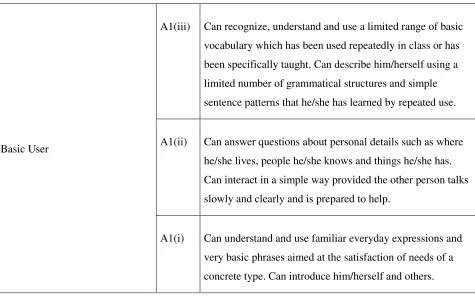
This reference level could perhaps be modified to an even more simple reference level, as shown
Table 1: Possible Adjustments to Basic User Reference Levels (A1)
A1(iii) Can recognize, understand and use a limited range of basic
vocabulary which has been used repeatedly in class or has
been specifically taught. Can describe him/herself using a
limited number of grammatical structures and simple
sentence patterns that he/she has learned by repeated use.
A1(ii) Can answer questions about personal details such as where
he/she lives, people he/she knows and things he/she has.
Can interact in a simple way provided the other person talks
slowly and clearly and is prepared to help. Basic User
A1(i) Can understand and use familiar everyday expressions and
very basic phrases aimed at the satisfaction of needs of a
concrete type. Can introduce him/herself and others.
A suggestion for emergent bilingual learners is that the Basic User Reference Levels for A1 be
broken down into smaller skill descriptors (Vandergrift, 2006). This will allow the teacher to
assist students in being successful in attaining each level instead of overwhelming both the
teacher and learner with too many expectations.
Another point to consider is that the CEFR seems to be more geared towards older
learners rather than elementary school-aged students. The ways in which the reference levels are
worded lend themselves to older learners, who are more cognitively able to comprehend the
language and have had more experience learning an L2 than immersion learners who are
emergent bilinguals. The language is more sophisticated, which is further illustrated by this
questions about personal details such as where he/she lives, people he/she knows and things
he/she has" (Vandergrift, 2006, p. 17). Based on my own teaching experience of working with
kindergarten-aged students for four years, I have yet to meet a beginner French Immersion
student (in junior kindergarten) who has received 100% French language instruction and can
provide this degree of personal details about him or herself. This level is more likely to be
achieved when a student has gained more experiential knowledge in the L2.
As Vandergrift (2006) suggests, this adapted table inTable 1 further breaks down the
beginner, basic user reference level to encompass smaller areas of language proficiency than
outlined in the CEFR. This table could be further modified and would be more applicable to
early-years learners.
Language learning and teaching are at the centre of the CEFR, and other components are
branched out from this milieu, such as teaching approaches, the curriculum, assessment, the
user’s/learner's competencies, the reference levels, the language use and the language
user/learner, and tasks and roles in language teaching. All of these concepts work together to
assist in the acquisition of language abilities, based on the CEFR (Council of Ministers of
Education, 2010).
2.7 Overview of Canadian CEFR Research
A number of studies have been conducted on the CEFR, all focusing on various aspects of the
principles of the communicative approach. There have been a few in particular that have shed
light on areas that could be of some relevance to my research. The following sections will
provide an overview of such studies and will aim to group and categorize them into clear
2.7.1 The CEFR and Existing Professional Development
The CEFR has been used in a variety of educational environments, including post-secondary
education. As the framework provides ideas for L2 teachers, there has been research conducted
where students in a teacher education program have been introduced to the CEFR. In the next
paragraphs, I will outline how researchers worked with university-aged students to explore an
Intercultural Development Index, reflexivity, and the ELP as identified in the CEFR and how
early immersion affected L2 learning in university.
Ragoonaden (2011) conducted a pilot study involving preservice FSL teachers in British
Columbia. This study focused on teachers’ intercultural development. An Intercultural
Development Index (IDI), a statistically valid tool to measure intercultural competence, was
administered to twelve preservice candidates. Intercultural competence refers to the ability to
communicate effectively and appropriately with people of other cultures (Ragoonaden, 2011).
The results were used as a basis to discuss the integration of intercultural competencies as
identified in the CEFR. The study contributes to future research involving preservice teachers
and further exploring intercultural competence.
Peguret (2014) set out to evaluate the circumstances that post-immersion students in their
first year of French language study in university encounter with varied L2 background and levels
of proficiency. What this study aimed to do was to assist students in surpassing the perceived
plateau level of communication. Peguret (2014) observed students’ use of reflexivity, relating specifically to a lack of engagement with learning strategies and long-term auto-regulation. This
study related to an instrumental understanding of language and language learning of 82 students
who provided insights into their use of strategies in an L2 through the analysis of two
extremely significant difference between students with a background in early immersion or
French schooling and those from other FSL programs. The former used fewer strategies in their
writing. This raises the question of how French Immersion students are applying their knowledge
to their written output. Peguret (2014) wanted to find out pedagogical approaches to reactive
students’ reflexivity and determine how to encourage students to reflect on their prior knowledge
of French learning.
The European Language Portfolio.Gagné and Thomas (2011) discuss their study, where the
CEFR and an EPL (Electronic Language Portfolio) philosophy were introduced in a teacher
education program in Ontario. There were supports given to students who were interested in
creating an EPL for their own learning. The main goal of the study was to foster common
learning of French language for future teachers. Gagné and Thomas’s work (2011) raised
awareness to individuals who taught French of the existence of a language portfolio (such as the
EPL) and created support between colleagues teaching French and other language instructors.
Similarly, another study that took place in a university setting was part of an education
course that was taken in conjunction with a French language course. Lemaire’s (2013) goal was
to assist French-speaking students living in Western Canada to reflect on their language
repertoire and identity. The study involved a review of LaPlante and Christiansen’s portfolio
(2001) and the ELP, and students were asked to identify their strengths and challenges to focus
better on their language development. Here, in this study, similar to that of Gagné and Thomas’
work (2011), students were at the forefront of the study and were involved in the co-construction
of learning French and delving into the language portfolio as set out by the CEFR. As in
Majhanovich et al.’s (2010) study, learner autonomy was still a focus, and continued well into