608 | P a g e
In cognitive radio network communication is done by
using hybrid relay approach for improving security and
reliability trade off
Anjali Khokhar
1, Dr.Jitender Khurana
2 1Research Scholar, Department of Electronics and Communication Engineering,
Baba Mastnath Universty Rohtak, Haryana. (India)
2
Head of Department, Electronics and Communication Engineering,
Baba Mastnath Universty Rohtak, Haryana. (India)
ABSTRACT
In Cognitive network transmitted parameters based on interaction with the environment in which it operates.
A relay network is a broad class of network topology commonly used in wireless networks, the source and
destination are inter connected by means of some nodes. Consider that cognitive radio network consisting of a secondary transmitter, a secondary destination and multiple secondary relays in the presence of a snoop. A relay network is a type of network used to send information between two devices. The selection criterion uses the end-to-end signal-to-noise ratio (SNR) and the effective capacity which is a function of both the end-to-end SNR and the channel capacity length. We build a relay selection approach for protecting the secondary transmitter-secondary destination transmission against the snoop with the aid of single-relay. According to implementation Hybrid relaying scheme implies a trade-off between the security and reliability of the secondary transmission in the presence of snoop attacks. Simulation results reveal that the optimal relay selection based on effective capacity performs better in terms of network outage probability compared to the selection based on the SNR alone.
Index Terms—Security-reliability trade-off, relay selection, intercept probability, outage
probability, Amplify Forward, Decode Forward ,cognitive radio
I.INTRODUCTION
To improve the spectral efficiency Cognitive radio is used. Different transmission schemes have been proposed
to provide the best performance in cognitive radio network. The secondary user (SU) transmits the data when a
spectrum hole is detected. Than data is transmitted simultaneously with the primary user (PU) under the same
frequency band. The end-to-end performance of cooperative relay communication is derived with single relay
and multiplr relay selection. The one best relay is selected to the data through secondary users under a fixed
interference threshold. However, all works consider the sensing and transmission separately. The sensing result
plays an important to effect on both the PU’s transmission and SU’s transmission. In practice the best relay
chooses for data transmission that was proposed in multiple relay cognitive networks, and data transmit only
609 | P a g e
II. METHODOLOGY
In this only the best secondary relays is chosen. By using secondary transmission we analyze both the intercept
probability and outage probability. We also evaluate the performance of direct transmission based method for
the purpose of comparison with the proposed relay selection schemes. The intercept probability requirement is
relaxed; the outage performance of the direct transmission, selection schemes improves.
Let H0 and H1 represent the event that the licensed spectrum is unoccupied and occupied by the primary base
station [1]. Moreover, let H denote the status of the licensed spectrum detected by spectrum sensing.
Specifically,
H = H0 represents the case that the licensed spectrum is deemed to be unoccupied, While H = H1 indicates that
the licensed spectrum is deemed to be occupied [3].
The probability (Pcd) of correct detection of the presence of primary base station and the associated false alarm
probability (Pfd) are denoted as
Pcd = Pr (H = H1/H1),
Pfd = Pr (H = H1/H0), respectively
The missed detection of the presence of primary base station will result in interference between the secondary
transmitter and secondary destination [5].
In order to guarantee that the interference imposed on the primary users is below a tolerable level, both the
successful detection probability Pcd and false alarm probability Pfd should be within a meaningful target range.
The input signal is the TDMA MIMO modulated signal effect of fading can be suppressed by diversity
technique. Diversity can be achieved with the help of Multiple Input Multiple output system [7]. In cognitive
radio network different users will have different SNR values.
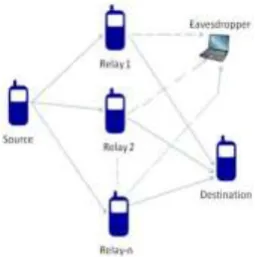
Fig 1:- A cognitive relay network consists of one source, one destination and number of relays in the presence
of a snoop.
The TDMA modulated MIMO signals are transmitted through a Rayleigh fading channel [1].
610 | P a g e
Single relay: In this the cognitive relay network both SD and E are assumed to be beyond the coverage area ofthe ST, and N secondary relays (SRs) are employed for assisting the cognitive ST-SD transmission. Multiple relay: In this the multiple SRs are employed for simultaneously forwarding the source signal xsto SD. To be
specific, ST first transmits xs to N SRs over a detected spectrum hole.
IV. PROPOSED MODEL
Multi-Hop Relay Selection is the most common relaying approach in the disquisition is to select a relay to help a
transmission from a sender to a destination. Here the MRC technique is used for relay selection. The clogging
free shortest path from source to destination is found by using the routing algorithm. When applied to multi-hop
networks, this method desires the repetition of the relay selection procedure for each hop from sender to
destination. However, such hop-wise harmony can reduce network capacity.
The operation of multi-hop relay selection approaches is as follows [6]: Potential relays access routing
information creating a limited image of the network beyond the adjacent wireless links. Relays may decide to
transmit overheard information to destinations, even in the absence of a direct link between the source and
destination. Relays may have received the information to be relayed directly from the source or from other
relays or intermediary nodes.
The destination node may receive more than two independent signals of the same packet e.g. via the selected
relay node, via the intermediary node and directly via the source. This extra spatial diversity increases
performance. We design a network with multiple nodes. First node behaves as a source and last node behave as
a destination. From source to relay, decode and forward technique is chosen. This will help to reduce the error
present in the transmitted signals, and retransmit to the next relay or destination. If the next node is a relay, then
decode and forward is chosen else if the next node is destination, then amplify and forward is chosen. Amplify
and forward is mainly used to amplify the received signals. So hybrid protocol is used to obtain secured data and
comparison between single and multiple relay can show by using graphs.
V.RESULT
From our proposed methodology the signal transmitted by single relay and multiple relay approach through
source to destination with and without hybrid approach.
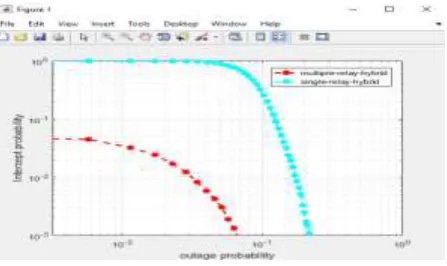
Fig 2:- Outrage Probability versus SNR of the single relay Vs multiple relay selection schemes for (Pcd, Pfd) =
611 | P a g e
Graph shows that as the spectrum sensing reliability (Pcd, Pfd) = (0.9, 0.1). Result shows that Single relay hybrid approach and multiple relay hybrid approach comparison that gives better result for security andreliability trade off.
VI. DISCUSSION
So that Cognitive network consisting of a secondary source, a secondary destination and multiple secondary
relays in the presence of a snoop. We examined the security and reliability performance of the single relay and
multiple relay hybrid approach assisted secondary transmissions in the presence of relay sensing and spectrum
sensing. The security and reliability of secondary transmissions are denoted in terms of IP and OP, respectively.
The above results and analysis shows the importance of including the relaying links and the combining
techniques into the performance analysis of cognitive networks. This is the novel approach to improve security
and reliability by using hybrid approach.
REFERENCES
[1] L. Fu, Y. J. A. Zhang, and J. Huang, “Energy efficient transmissions in MIMO cognitive radio networks,”
IEEE J. Sel. Areas Commun., vol. 31, no. 11, pp. 2420–2431, 2013.
[2] W. Bocquet, “A Power Allocation Scheme for MIMO OFDM Systems,” vol. 0022, no. 1, pp. 8–11.
[3] J. Shu and W. Guo, “Efficient Bandwidth and Power Allocation Algorithms for Multiuser MIMO-OFDM Systems *,” vol.
2009, no. September, pp. 504–510, 2009.
[4] Y. Zou, X. Wang, and W. Shen, “Optimal relay selection for physical-layer security in cooperative wireless networks,”
IEEE J. Sel. Areas Commun., vol. 31, no. 10, pp. 2099–2111, 2013.
[5] V. K. Shah and A. P. Gharge, “A Review on Relay Selection Techniques in Cooperative Communication,”
vol. 2, no. 5, pp.
65–69, 2012.
[6] Increasing uplink capacity via user cooperation diversity, 1998.
[7] Liu, Chen, and Blum, “Minimum error probability cooperative relay design,” IEEE Trans. Signal Process.,
2007.
[8] Tam, Lok, and Wong, “Flow-optimized asynchronous relay selection protocol for parallel relay networks,”
ICC apos;08. IEEE International Conference on Communications, pp. 1024–1028, 2008.
[9] Opportunistic network coded cooperation in wireless networks, 2007.
[10] Relay selection strategies for distributed space-time cooperative systems over wireless ad-hoc networks,
2006.
[11] On selection cooperation in distributed networks, 2006.
612 | P a g e
[13] Q. Zhao and B. M. Sadler, “A survey of dynamic spectrum access,” IEEE Signal Processing Mag., vol. 24,no. 3, pp. 79–89, May 2007.
[14] A. A. Alkheir and M. Ibnkahla, “Performance analysis of cognitive radio relay networks using decode and
forward selection ralaying over rayleigh fading channels,” in IEEE Global Telecommn. Conf. (GLOBECOM), 2011, pp. 1–5.
[15] Y.-C. Liang, K.-C. Chen, G. Y. Li, and P. Manhonen, “Cognitive radio networking and communications:
An overview,” IEEE Trans. Veh. Technol., vol. 60, no. 7, pp. 3386–3407, Sept. 2011. [16] J. G. Proakis, Digital Communications, 4th ed., New York, NY: McGraw-Hill, 2001.
[17] J. N. Laneman, D. N. C. Tse, and G. W. Wornell, “Cooperative diversity in wireless networks: Efficient
protocols and outage behavior,” IEEE Trans. Inf. Theory, vol. 50, no. 11, pp. 3062-3080, Dec. 2004.
[18] A. Sendonaris, E. Erkip, and B. Aazhang, “User cooperation diversity - part I: System description,” IEEE Trans. Commun., vol. 51, no. 11, pp. 1927-1938, Nov. 2003.
[19] J. N. Laneman and G. W. Womell, “Distributed space-time coded protocols for exploiting cooperative