Article
1
Conceptualising and Modelling e-Recruitment
2
Process for Enterprises through a Problem Oriented
3
Approach
4
Saleh Alamro 1, Huseyin Dogan 1,*, Deniz Cetinkaya 1, Nan Jiang 1, Keith Phalp 1
5
1 Faculty of Science and Technology, Bournemouth University, United Kingdom;
6
{salamro, hdogan, dcetinkaya, njiang, kphalp}@bournemouth.ac.uk
7
* Correspondence: [email protected]; Tel.: +44-1202-962491
8
9
Abstract: Internet-led labour market has become so competitive forcing many organisations from
10
different sectors to embrace e-recruitment. However, realising the value of the e-recruitment from a
11
Requirements Engineering (RE) analysis perspective is challenging. This research is motivated by
12
the results of a failed e-recruitment project conducted in military domain which is used as a case
13
study in this research. After reviewing the various challenges faced in that project through a
14
number of related research domains, this research focuses on two major problems which are the (1)
15
difficulty of scoping, representing, and systematically transforming recruitment problem
16
knowledge towards e-recruitment solution specification; and (2) the difficulty of documenting
17
e-recruitment best practices for reuse purposes in an enterprise recruitment environment. In this
18
paper, a Problem-Oriented Conceptual Model (POCM) with a complementary Ontology for
19
Recruitment Problem Definition (Onto-RPD) is proposed to contextualise the various recruitment
20
problem viewpoints from an enterprise perspective and to elaborate those problem viewpoints
21
towards a comprehensive recruitment problem definition. The POCM and Onto-RPD are
22
developed incrementally using action-research conducted on three real case studies: (1) Secureland
23
Army Enlistment, (2) British Army Regular Enlistment, and (3) UK Undergraduate Universities
24
and Colleges Admissions Service (UCAS). They are later evaluated in a focus group study against a
25
set of criteria. The study showed that the POCM and Onto-RPD provide a strong foundation for
26
representing and understanding the e-recruitment problems from different perspectives.
27
Keywords: enterprise recruitment; problem definition; e-recruitment
28
29
1. Introduction
30
Recruitment is a key strategic opportunity for achieving a competitive advantage over rivals
31
[1,2]. Given that talent is rare, valuable, difficult to imitate, and hard to substitute, organisations that
32
better attract this talent to fill their job vacancies should outperform those that do not [3].
33
Recruitment is the practice of attracting sufficient numbers of qualified individuals on a timely basis
34
to fill job vacancies with an organisation [4]. It is very important since it is the primary way of
35
influencing the performance and diversity of individuals in an organisation. It ensures the initial
36
high quality abilities of recruits necessary for work performance [5]. It also influences the
37
demographic composition of the workforce to meet the organisation’s strategic, legal and social
38
goals [6]. It is regarded as an essential means to influence post-hire employee retention [7].
39
The internet-driven global labour market combined with many forces, such as a higher
40
educational level of the new generations, strong economic situations and a low unemployment rate,
41
has become very competitive [8,9]. This, in turn, puts a great deal of pressure on organisations from
42
different sectors to change their traditional recruitment practices towards more innovative,
43
high-quality, customised, and timely e-recruitment solutions [9-11]. In the military sector, for
44
instance, the migration from old compulsory military recruitment to an all-volunteer force relying
45
on labour market has increasingly pushed the military organisations to get into the continuum
46
[8,12,13]. E-recruiting is defined as any recruitment practice that an organisation conducts using
47
web-based solutions [14,15]. Despite the different methods of e-recruiting, web recruiting (i.e. use of
48
corporate web site) is the most commonly used e-recruiting method [4]. E-recruiting can bring value
49
for organisations including being reliable in attracting a diverse and qualified group of job seekers,
50
agile in filling vacancies, cost-effective, rapidly responding to job seekers’ changing needs and
51
market opportunities, and flexible in normal and exceptional circumstances [16].
52
The current maturity of information and communication technologies (ICTs) and the recent
53
developments in design processes enable a relatively simple and reliable transforming of the
54
conventional recruitment practice into e-recruitment solution [13,17]. To be innovative, the focus
55
should be shifted from the e-solution space into the problem space where the desired effects (i.e.
56
requirements) that an organisation wishes to be brought by the e-solution in the recruitment practice
57
exist [18]. With the help of Requirements Engineering (RE), the RE activities of the e-solution must
58
be anchored to the domain knowledge of real-world recruitment problem so that the quality of the
59
e-solution to be delivered can then be analysed [19-22]. This front-end part of RE is called problem
60
definition [23] or problem description [24,25].
61
Problem definition refers to how problems or concerns are represented: what problem elements
62
should be included, what relationships among these elements are, and how these selections might
63
vary over problem types [23,24]. Such a problem representation is created for structuring problem
64
domain knowledge and orienting it towards RE in a systematic manner [26]. Hence, it offers an
65
established problem definition and serves as a basis for eliciting and reasoning about requirements
66
from different stakeholders perspectives [20,27]. For instance, relevant stakeholders using this
67
representation could be asked to identify the flaw, conflicts, incompatibility, and difficulties that
68
define a problematic situation thereby effectively and efficiently informing complete and consistent
69
requirements. As a result, the problem representation affects the quality of the requirements based
70
on which the e-solution systems are built. It has been argued that if stakeholders do not agree with
71
the choice of problem representation, it is unlikely that they will ever agree with any statement of the
72
requirements [19,24]. These poor requirements largely account for the cancellation of e-solution
73
development projects or the subsequent failure in building a successful e-solution [28,29].
74
However, in large-scale, trans-national and multi-demographical organisations that are
75
engineering-focused and need reliable and long-lasting e-solutions, it seems that problem definition
76
is very complex and prone to failure [21,26]. This research was originally driven by the challenges
77
faced in realising the value of a real e-recruitment project from the military sector referred to as
78
Secureland Army Enlistment. The project relates to the non-officer enlistment process in the
79
Secureland’s Army (SA). Three main challenges that are related to some knowledge gaps in the
80
research literature can be summarised as:
81
82
The difficulty in scoping recruitment problem [30,31];
83
The difficulty in representing and understanding of real-world recruitment problem [6,32]; and
84
The difficulty in systematically transforming the problem domain knowledge into the
85
specification of e-recruitment [21,22].
86
87
The practical problem addressed in this paper is that the ill-representation and understanding
88
of recruitment problem impedes the realisation of the value of e-recruitment. Therefore, the paper
89
proposes a Problem-Oriented Conceptual Model (POCM) for conceptualising and defining
90
recruitment problem root concepts from an enterprise perspective facilitated by an ontology
91
(Onto-RPD) to elaborate these concepts towards a comprehensive recruitment problem definition.
92
During this study, three case studies, including the Secureland Army Enlistment, are analysed, and
93
various problems are identified to develop the conceptual model and the corresponding ontology.
94
This work provides a valuable contribution into the understanding of recruitment problem from
95
different perspectives, and can deliver guidance in a systematic manner to inform the requirements
96
The paper is organised as follows: this section presents an introduction to the research study.
98
The literature review and background information are presented in Section 2. The case studies are
99
explained and analysed in Section 3. Based on these case studies, the POCM and Onto-RPD are
100
proposed in Section 4. The integration of the model into the recruitment RE process and the results
101
are discussed in Section 5. Finally, conclusions are drawn and future work is suggested in Section 6.
102
103
2. Recruitment and E-Recruitment
104
A great deal of research from both Human Resources (HR) and Industrial and Organisational
105
(I/O) psychology domains has been conducted to define recruitment. However, there has been no
106
consensus on its definition. Randall [33] states that recruitment is “the set of activities through which
107
the people and the organisations can select each other based on their own best short and long term
108
interests”. This definition highlights recruitment from the perspectives of the two key players:
109
organisation (i.e. employer) and people (i.e. job seekers). However, from an organisation-based
110
perspective, Barber [34] defines recruitment as “the practices and activities carried on by the
111
organisation with the primary purpose of identifying and attracting potential employees”. He
112
delineated three phases of recruitment: (a) generating applicants, (b) maintaining applicant status,
113
and (c) influencing job choice decisions.
114
Breaugh [7] distinguishes between two types of recruitment: internal in which a job applicant is
115
a member of the employing organisation; and external in which a job applicant is not a member of
116
the employing organisation. Internal recruitment is similar to employee promotion and move.
117
However, external recruitment is defined as the organisational activities that are intended to: (a)
118
bring a job opening to the attention of potential job candidates who do not currently work for the
119
organisation; (b) influence the number and/or the types of applicants to apply for the job opening; (c)
120
influence their interest in the position to stay until a job offer is extended; and (d) influence their
121
interest to accept a job offer [7]. Likewise, Rynes [35] states that recruitment is the activities designed
122
to influence the number and type of applicants who apply for a job and accept job offers. Another
123
definition stressing timing is the practice of attracting sufficient numbers of qualified individuals on
124
a timely basis to fill job vacancies with an organisation [4].
125
Saks [30] describes recruitment as “the set of actions and activities taken by an organisation in
126
order to identify and attract individuals to the organisation who have the capabilities to help the
127
organisation realising its strategic objectives.” This definition implicitly combines the activity of
128
selection in which the capabilities and qualifications of individuals are evaluated against who
129
apparently owns those capabilities that help the organisation in realising its strategic objectives. In
130
contrast to this, Gatewood et al. [6] defines another type of recruitment called hiring. Hiring refers to
131
the type of employment in which job offers are extended with no evaluation of the applicant’s
132
capabilities and qualifications [6]. This is often carried out when an organisation desperately needs
133
applicants to fill unskilled or semi-skilled positions within a limited time.
134
Looking to recruitment from a broad sense, Philips and Gully [36] define strategic recruitment
135
as “the practices that are connected across the various level of analysis and aligned with firm goals,
136
strategies, context, and characteristics.” They suggest that strategic recruitment overlaps with four
137
complex disciplines: Resource-Based Theory (RBT); Strategic Human Resources Management
138
(SHRM); Human Capital; and levels of analysis [36]. The work of Philips and Gully [36] highlights
139
the need to extend the focus on recruitment from a higher level of analysis as same as the SHRM
140
approach.
141
The review of the abovementioned recruitment definitions [4,6,30,31,33-36] gives insights into
142
the common and divergent characteristics of recruitment as follows:
143
It involves specific activities and actions that are undertaken to achieve particular outcomes;
144
It indicates the importance of generating a pool of applicants with desirable capabilities;
145
It addresses the interest of relevant stakeholders such as organisation and applicant to fill
146
It addresses the need to increase the probability that applicants will apply, stay, and accept a job
148
offer;
149
It indicates the overlap between recruitment and the selection activity by acknowledging that
150
those persons who are attracted to the organisation might/might not have the capabilities
151
desired. Hence, it is the purpose of selection to determine whether applicants have the required
152
capabilities;
153
It distinguishes between internal and external recruitment;
154
It distinguishes between recruitment and hiring;
155
It indicates the overlap between pre-hire outcomes of recruitment (e.g. filling vacancies by the
156
qualified applicants) and post-hire outcomes (e.g. employee retention and work performance).
157
It asserts the strategic focus on recruitment thereby making it clear that recruitment can and
158
should play an important role in helping an organisation achieve its strategic objectives.
159
160
In this research, we focus on recruitment as enterprise and analysis of different interests from
161
different enterprise stakeholders’ perspectives. We accept that the activity of selection is included
162
within recruitment. In addition, we focus on external recruitment rather than internal one;
163
recruitment rather than hiring; and pre-hire outcomes rather than post-hire outcomes.
164
E-recruitment is defined as the use of the internet to attract potential employees to an
165
organisation and hire them [37]. Dhamija [38] describes e-recruitment as “the practice whereby the
166
online technology is used particularly websites as a means of attracting, assessing, interviewing, and
167
hiring personnel.” E-recruitment could be defined as any recruiting process that an organisation
168
conducts using Web-based tools [14,15,]. There are some common methods of e-recruitment. First
169
method is Web recruiting (use of the organisation’s Web site) is the most commonly used
170
e-recruiting method [4,37]. A survey conducted in 2003 shows that 92% of Fortune 500 companies
171
had career web sites [39]. Another survey conducted by Lee [40] demonstrated that among Fortune
172
100 corporations, 94% have owned career web sites. The use of this method will continue to increase
173
[31]. The second method is the use of internet job boards [41,42] where organisations rely upon
174
third-party recruiters (e.g. CareerBuilder.com, Monster.com, and HotJobs.com). The third is social
175
media recruitment [43].
176
Despite the contributions of these recruitment methods are varied, the common advantages that
177
e-recruitment can offer are: savings in time, money, and resources; the outreach potentiality to a
178
diverse broader group of job seekers; establishing a brand identity; more communicative and
179
adaptive to job seekers’ changing needs and market opportunities, better service and applicant
180
satisfaction; and more flexible in normal and exceptional circumstances [4,16].
181
Recruitment is a foundational input of organisational effectiveness [5,36,44]. Competitive
182
advantage is rooted in the individual and organisational capabilities that are leveraged for strategic
183
execution [2]. Since recruitment influences these capabilities so that it is a key source of competitive
184
advantage [36]. Recruitment is the first entrance to influence the characteristics and quality of new
185
employees [5]. It has also implications for all other human resources activities [6]. For example, the
186
type of applicants attracted has implications for selection and training activities.
187
The e-recruitment has made a new competitive environment for organisations to rethink and
188
adapt technology to increase effectiveness and efficiency of recruitment practice. Combined with
189
various challenges such as the increased importance of human capital, the increased level of
190
qualifications with new generations, strong economic situations, and less unemployment rates
191
[8,16], recruitment has been marked as a top priority [30,43]. Research has offered evidence about the
192
rationale behind this increased interest in e-recruitment. First, the passive recruitment which implies
193
people to make themselves available to employers has outmoded. This may account for why many
194
organisations have been experienced substantive crisis in attracting high-quality employees [4].
195
Second, Scheweyer [45] reports that the demand of e-recruitment has been rapidly increasing due to
196
the competitive advantages it offers. This, in turn, has put a great deal of pressure on organisations
197
job choices which increasingly forces organisations to adopt more innovative ways to satisfy their
199
needs [43].
200
2.1 Problem-Oriented RE and Problem Definition
201
The concept of problem is central in research on systems and software engineering [24]. More
202
broadly, it presents in every study requires action-oriented thought [23]. Despite this centrality and
203
its widespread use, it is still not clearly defined. Osigweh [46] states that problem is a vague concept:
204
the more a word of 'problem' is used for everything, the less we know what it means. One common
205
definition is that it is a gap, difference, or disparity between what is and what might/should be
206
[23,47]. Another definition of Agre [48] is that a problem is an undesirable situation that is significant
207
to and may be solvable by some agent, although probably with difficulty. According to Landry [47],
208
the key characteristics of the presence of problem can be concluded as follows:
209
210
Problem is an unsatisfactory situation.
211
The existence of gap between preferences and reality.
212
The importance of closing this gap (i.e. solution).
213
The expected difficulty or uncertainty arising from where the means to close the gap are, either
214
not obvious or not immediately available.
215
A sense of minimal control (e.g. available resources) over situation or event.
216
Problem has an owner/solver.
217
Problem changes over time.
218
Problem has a boundary.
219
Interrelated with another construct "opportunity" which draws attention to potential goods,
220
instigating thoughtful problem solving activity.
221
222
Given that requirements defines a problem, RE can carry various synonyms terms such as
223
problem analysis [49], requirements analysis [50,51], or problem domain analysis [18]. Davis [49]
224
defines the term problem analysis as the activity that encompasses learning about the problem to be
225
solved, understanding the needs of potential users, trying to find out who the user really is, and
226
understanding all the constraints on the solution. However, according to Kotonya and Sommerville
227
[52], problem analysis cannot rely only on learning the details of a specific problem that requires
228
some kind of systems solution. Instead, it requires a focus on understanding the problem domain,
229
including business context and stakeholders’ needs, which necessitates an extensive elicitation task.
230
Therefore, Kovitz [50] defines the term requirements analysis as learning the problem and the
231
problem domain from the customer, and communicating this information to the rest of the
232
development staff by writing a requirements document. A quite similar definition of Kovitz [50]
233
comes from Bray [18] referred to as problem domain analysis. Bray [18] defines it as the achievement
234
of understanding problem domain and the documentation of the characteristics of that domain and
235
the problems (requiring solution) that exist within that domain. According to Wieringa [53], if RE is
236
to define a problem, then requirements should describe what the problematic phenomena are, what
237
the causal relationships between these phenomena are, by which norms these phenomena are
238
problematic, and which stakeholders have these norms. From a common sense, it can be said that all
239
aforementioned definitions obviously serve to introduce the concept of RE as problem definition,
240
learning about problem domain and finding out what the problems to be solved are.
241
A problem-oriented view of RE namely problem definition refers to how problems or concerns
242
are represented: what problem elements should be included, what relationships among these
243
elements are, and how these selections might vary over problem types [24,54]. Such a problem
244
representation is created for structuring problem domain knowledge and orienting it towards RE in
245
a systematic manner [22,26]. Hence, it offers an established problem definition and serves as a basis
246
for eliciting and reasoning about requirements from different stakeholders perspectives [22,27].
247
various elements that constitute a problem can be comprehensively included [55]. Hence, each
249
model has some advantages and limitations.
250
One key example of these approaches is goal modelling [56]. Goal modelling is based on the
251
premise that in collaborative work situations, people are aware of and share common goals and act
252
towards their fulfilment [26]. Hence, the problems associated with business structure, resources,
253
processes, and their supporting systems that inhibit the achievement of these goals can be defined
254
[56]. However, a real-world problem concerns the goals of humans which is not simple to model for
255
several reasons: (a) they are not known in advance; (b) they are often abstract and imprecise and can
256
evolve during the life of a project; and (c) the means that lead to goal achievement are not known
257
beforehand. Another example is the problem frames [24], in which frequently occurring problem
258
structures are identified and related to a problem frame. This frame captures the characteristics and
259
relationships of the parts of the world it is concerned with, and the concerns and difficulties that are
260
likely to arise. This helps to focus on the problem space instead of moving into the solution space.
261
However, it is criticised being limited in scope focusing on the objective aspects of software
262
problems [57].
263
A third problem representation technique is Enterprise Architecture (EA). The concept of EA
264
has evolved to address two key problems [58]. The first problem is to manage the increasing
265
complexity and change in IT systems [59]. The second problem is the increasing difficulty in
266
realising business value with those systems [58]. To solve these key problems, a bundle of EA
267
reference frameworks were proposed. According to Roger [58], the most leading ones are Zachman
268
Framework [27], The Open Groups Architecture Framework (TOGAF), and Federal Enterprise
269
Architecture (FEA). According to Zachman [59], today’s information age with the increased
270
complexity and change in the global market needs a holistic view that address the wide range of
271
business requirements rather than just focusing upon technical solutions. Hence, it is not an IT issue
272
[59-61]; however, it is a problem definition issue [18,53,59]. According to Zachman [59], an EA,
273
therefore, needs a structure (i.e. representation) that establishes a reference of problem definition
274
and guides the transformation process (i.e. methodology) towards the solution. Without such a
275
structure, transformation processes will be ad hoc, fixed and dependent on practitioner skills [59].
276
Despite the insights given by the Zachman’s framework (i.e. the importance of problem
277
representation), the framework has some limitations in regard to the recruitment research problem.
278
First, the framework lacks a step-by-step supportive process for enterprise engineering [58]. The
279
framework is a structure (i.e. problem representation) and not a transformation process [27]. Second,
280
the framework builds on the argument that the conventional architecture representations of the
281
manufacturing and constructions can be analogously applied into a complex real-world problem
282
(e.g. recruitment). According to Gaver [62], this conceptual argument is faulty and incomplete. In
283
general, a real-world problem is not an ordinary system, such as a machine or a building, to be
284
structured and engineered. In particular, recruitment problem has many social and subtle features
285
that cannot be easily represented in a reduced form as same as that of the Zachman’s framework.
286
These social features are often neglected or trivialised [63].
287
2.2 Representation of the Recruitment Problem
288
From the cognitive view, problems are conceptual entities that do not exist in the world, but
289
they must be externalised (i.e. expressed) so represented towards solution-oriented thought [23,54].
290
Problem representation enables problem domain knowledge which is, in turn, very crucially
291
important in problem solving [20,22]. This task is very difficult for a real-world problem due to the
292
various aspects that constitute it [21,24,26,64]. Hence, there is no reference model by which all these
293
various aspects can be comprehensively represented [55,65]. Therefore, recruitment problem can be
294
expressed by a chosen representation that is somehow grounded in reality; agreed on by all
295
stakeholders; and best suited for problem solving [47,64]. However, there are many criteria that have
296
been proposed for assessing the quality of such representation such as validity and generativity
297
[23,65]; abstraction [20,66]; viewpoints [66]; and expressiveness and communicativeness [65].
298
complexity of a real-world problem, the type of business, the type of project, the feature of analysis
300
[66-68].
301
There are a number of descriptive and prescriptive recruitment models proposed for
302
conceptualising recruitment problem. The most cited ones are Rynes’s [69] model for future
303
recruitment research, Saks’s [30] dual-stage model of the recruitment process, and Breaugh and
304
Starke’s [7] model for the organisational recruitment process. While these models address some
305
aspects of recruitment problems, they are strongly solution-oriented, focusing on what and how
306
rather than why. Ployhart [32] (p. 869) comments on the research-practice gap of recruitment saying
307
“it seems organisational decision makers do not understand staffing (recruitment) or use it
308
optimally.” We believe that because recruitment problem has never been completely represented, it
309
has never been correctly understood. In this regard, it has been widely reported that when
310
stakeholders ask for new features or capability, they quite often state their needs as an
311
implementation (i.e. solution-based) [57,70].
312
It has been widely suggested that a better representation of the recruitment problem should rely
313
in the first instance on an appreciation of its complexity [5,7,30,32]. This complexity stems from a set
314
of cognitive, social and organisational variables involved and the nature of their relationships
315
[7,31,34].
316
This paper proposes an established conceptualisation of recruitment problem that describes the
317
various problem elements and their relationships, and shows how these problem concepts might
318
vary over different types of recruitment problems. Hence, the depiction of the constituent elements
319
of recruitment problem and their overlapping relationships is the essence of the representation of
320
recruitment problem. This representation will help closing the knowledge gap in different ways. It
321
will support delaying of solution consideration until a good understanding of the problem space is
322
gained. It will also provide a means of analysing and decomposing problems into simpler
323
sub-problems that can be readily addressed. It will also help stakeholders to capture and share the
324
necessary problem domain knowledge, and this will be driven into the negotiation over trade-offs
325
and consideration of details of the solution support.
326
327
3. Research Methodology
328
The research approach used in this study is design science. According to Hevner et al. [71],
329
design science creates new artefacts for solving practical problems. These artefacts can be methods,
330
models, constructs, frameworks, prototypes or IT systems, which are introduced into the world to
331
make it different, to make it better [72]. Design science is, therefore, the process to generate these
332
artefacts and test hypotheses about them, i.e., artefacts that can, when introduced, solve problems
333
for a practice and change its future behaviour [73]. Hence, the solution needs to be evaluated to
334
assess its ability to solve a practical problem as well as to fulfil stated requirements [71]. In the
335
literature, different strategies and approaches have been presented for design science processes and
336
conducting solution assessment [71,72,74-76]. The design science research process carried out in this
337
research includes five research activities as defined by the design science method framework of [72].
338
These activities and their application are presented below.
339
3.1 Problem Explication
340
The first activity in the design science process is to explicate the practical problem that
341
motivates why the artefacts (i.e. in this case, the POCM (Problem-Oriented Conceptual Model) and
342
Onto-RPD (Ontology for Recruitment Problem Definition) need to be designed and developed. To
343
explicate this, a number of research activities and methods are used. First is the extensive review of
344
the SA e-enlistment project using document inspection to identify the various challenges that led to
345
the failure of that project. Second, in relation to those challenges, the literature related to recruitment,
346
e-recruitment, problem definition and representation approaches are reviewed to identify the central
347
issues and knowledge gaps in recruitment research. Third, a number of problem representation
348
and gaps. After the extensive analysis, two problems, among others, are defined as root causes of the
350
failure in the SA e-enlistment project.
351
The first problem is “the ill-defined scope of recruitment problem space.” The related
352
knowledge gap that motivates the research to fill is that “there is a lack of knowledge about
353
enterprise recruitment problem.” The second problem is “the ill-representation and understanding
354
of recruitment problem.” which impedes the realisation of the value of e-recruitment. The
355
knowledge gap related to this sub-problem is that “there is a lack of knowledge about how
356
recruitment problem is best represented.” Hence, the abovementioned artefacts are designed to
357
solve this problem.
358
3.2 Requirements Definition
359
The second activity in the design science process is to define the requirements of the POCM and
360
Onto-RPD. These requirements will be used as a basis to evaluate the resulting artefacts and also to
361
guide the construction process of them and any refinement steps. Based on the literature review, the
362
following requirements are selected:
363
R1. The artefact(s) should be comprehensive: Comprehensiveness is the degree to which the
364
artefact(s) offers complete knowledge [77,20]. According to Burton-Jones et al. [78],
365
comprehensiveness means the percentage of concepts in the artefact relative to the average for
366
the entire library of concepts in the domain of interest. Osada et al. [66] refer to this as the
367
amount of suitable information included in the artefact. This amount should be large enough
368
and suitable for complete knowledge. However, too huge amount of knowledge is confusing
369
and hard to deal with [66]. For this requirement, in the artefact of the POCM, we refer to the
370
knowledge of problems, sub-problems, and relationships. However, in Onto-RPD, we refer to
371
the knowledge of the various concepts and features related to the problems defined in the
372
POCM.
373
R2. The artefact(s) should be generic: Genericity is the degree to which the artefact(s) is shared and
374
sector/domain-independent [77]. The artefact(s) should be shared between diverse stakeholders
375
and activities [77]. Sector or domain independence means that the artefact is not specific to a
376
sector/domain [79,80]. Achieving this requirement facilitates capturing, transfer, and reuse of
377
domain knowledge from different domains [81]. Both the POCM and Onto-RPD shall not
378
require practitioners to be familiar with the sector or domain in which a recruitment practice is
379
applied.
380
R3. The artefact(s) should be consistent: Consistency is the degree to which the artefact(s) has
381
correct and accurate definitions compared to the existing domain knowledge [66,77]. It can be
382
also defined as the degree to which the artefact(s) constitute a coherent unit, i.e. all parts are
383
clearly related [79].
384
R4. The artefact(s) should be abstract/granular: Abstraction or granularity is the degree to which the
385
artefact(s) represents a core set of primitives that are partitionable in different levels [20,66,77].
386
Abstraction is one of the most important criteria in evaluating the representations (i.e. artefacts)
387
of domain knowledge [66].
388
R5. The artefact(s) should be perspicacious/generative: Perspicacity or generativity is the degree to
389
which the artefact(s) is easily understood by the practitioners so that it can be consistently
390
applied and interpreted across the enterprise [77,78,82]. It is also defined as the ability of the
391
artefact to promote effective decision making or judgement towards problem solving [23]. From
392
a RE perspective, it is defined as the ability of the artefact to promote effective requirements
393
elicitation [57,70].
394
R6. The artefact(s) should be minimal: Minimality is the degree to which the artefact(s) contains the
395
minimum number of objects (i.e. terms or vocabulary) necessary [77,83].
396
R7. The artefact(s) should be precise: Precision is the degree to which the artefact(s) has correct and
397
accurate definitions compared to the existing domain knowledge [66,77].
398
3.3 Design and Development
400
The third activity is to design and develop the artefacts that address the explicated problem and
401
fulfils the defined requirements. The POCM and Onto-RPD are jointly designed and developed
402
using Action-Research (A-R) [84] through the plan, act, observe, and reflect activities. The design
403
and development activities are explained in Section 4.
404
3.4 Demonstration and Evaluation
405
This activity is to use and assess how well the artefacts solve the practical problem taking into
406
account the previously identified requirements. In the demonstration phase, the POCM and its
407
corresponding Onto-RPD artefacts are used in real-life cases to prove their feasibility. In the
408
evaluation phase, the POCM and Onto-RPD are investigated whether they solved the problem of
409
research identified and fulfilled the defined requirements. The two phases, demonstration and
410
evaluation, were conducted using a focus group of experts from heterogeneous recruitment-related
411
domains over two sessions, one session for each phase. The demonstration and evaluation activities
412
are explained and the results are presented in Section 5.
413
3.5 Research Methods
414
This section describes the various research methods selected for developing the POCM and
415
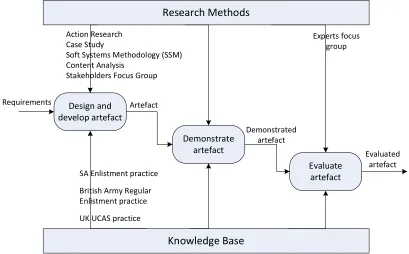
Onto-RPD artefacts and the rationale behind this selection. Figure 1 summarizes which research
416
methods are used during different stages of this research study.
417
418
Research Methods
Knowledge Base
Design anddevelop artefact
Demonstrate artefact
Evaluate artefact
Requirements Artefact
Demonstrated artefact
Evaluated artefact Experts focus
group
SA Enlistment practice British Army Regular Enlistment practice UK UCAS practice Action Research Case Study
Soft Systems Methodology (SSM) Content Analysis
Stakeholders Focus Group
419
Figure 1. Research methods used during design, develop, demonstrate and evaluate artefact phases.
420
3.5.1 Action-Research Method
421
A-R is a spiral process that allows action (change and improvement) and research
422
(understanding and knowledge) to be achieved at the same time [84]. It emphasises collaboration
423
between researchers and practitioners, and supports the practical problem solving as well as the
424
theoretical knowledge generation [84]. It has much potential for the information systems field being
425
a useful qualitative research method [85]. In regard to using it within the design science framework
426
adopted in this research, there is a growing consensus relates to the similarity between A-R and
427
along a string of important parameters. He suggested A-R being more closely combined with DS
429
rather than necessarily seeing it as qualitative research per se. He argued that although DS may be
430
seen as a research method that has been practiced within engineering and natural science, the
431
combination would improve the quality of research by combining between relevance and rigor [86].
432
According to Wieringa and Morali [87], DS research has established itself as an acceptable approach
433
to information systems research being combining a problem-solving cycle with a theory-building
434
cycle. To facilitate such combination, Baskerville et al. [88] integrated both A-R and DS with
435
Checkland’s Soft Systems Methodology (SMM) and developed a new approach called soft design
436
science research. Inspired by the work of Baskerville et al. [88], this work integrates A-R, DS, and
437
SSM in building the POCM and Onto-RPD artefacts.
438
3.5.2 Case Study
439
The research was established upon the case study of SA enlistment practice and developed by
440
using two other case studies (BA enlistment case study and UCAS case study). The study was driven
441
by the failure in realising the value of the SA’s e-enlistment project with the objective of investigating
442
the various recruitment problem concepts faced in that project and refine them with the concepts
443
derived from the other two case studies. The type of case studies is exploratory which is particularly
444
suited to the type of qualitative knowledge available with regards to this research [89]. This type of
445
case study is also used to explore those situations in which the intervention being evaluated has no
446
clear, single set of outcomes [89].
447
According to Yin [89], a case study method should be considered when: the focus of the study is
448
to answer “how” and “why” questions; no or little control over the behaviour of those involved in
449
the study; various contextual conditions are relevant to the phenomenon under study; or the
450
boundaries are not clear between the phenomenon and context. Likewise, the objective of this
451
research is to understand why it is challenging to realise the value of SA’s e-enlistment project and
452
how these challenges can be confronted. In addition, little control over those involved in the study
453
and related events is available, and various contextual issues and less clear boundaries between the
454
phenomenon and context exist. Case studies are relatively important when extracting the necessary
455
information and evaluating the artefacts developed. The artefacts were developed and refined
456
through the extraction of some instances from different case studies. A list of features that makes the
457
case studies appropriate is derived to guide the decision on case study selection.
458
3.5.3 Literature Review
459
The literature review is an essential part of an academic research project. The review is a careful
460
examination of a body of literature pointing toward the answer to the research question. The
461
purpose of the literature review is to test the research question against what already is known about
462
a certain subject. A good literature review will look at the research that has been done and
463
synthesize or pull together those elements that are similar or most pertinent to the theme that has
464
been chosen. For the purpose of this research, the literature reviewed assisted in investigating the
465
research gaps and central issues in recruitment domain in relation to the failure in SA e-enlistment.
466
In this context, the literature related to problem definition, problem representation, enterprise
467
architecture, requirement engineering, and best practices documentation and reuse was all
468
reviewed. Another use of literature review method was to define the various requirements based on
469
which the POCM and Onto-RPD were designed.
470
3.5.4 Document Inspection
471
In most cases, a significant amount of data that helps locating the problem is embedded in
472
documents. Furthermore, the initial information captured by document inspection method often
473
form the basis on which further research methods are selected. This method was intensively used to
474
capture knowledge about the SA e-enlistment project, including the mission and functions of SA, the
475
Secureland and the SA, previous work conducted on the SA e-enlistment project, and the challenges
477
faced in that project. It was also the main data source for building the models for the SA enlistment
478
practices (pre-2008 and post-2008) in pursuit of explicating the research problem.
479
3.5.5 Focus Group
480
Focus group is a research method used for idea generation or validation where several
481
informed participants share their point of view on a specific topic or problem. It can generate a
482
broader range of information, and deepen understanding of the topic under discussion. It can be also
483
used for validating and verifying the results gained from other research methods. The usefulness of
484
this method lies in: the ability of interviewing a large number of participants at one specific time
485
thereby saving much time and cost; and the elicitation of information and data from different people
486
perspectives. In this research, two focus groups were used in different stages. The first one was in
487
the “design and develop” phase. The second focus group was used during the phase of
488
“demonstrate and evaluate artefact” to evaluate the POCM and Onto-RPD against the set of
489
requirements defined in the “define requirements”.
490
491
4. Development of POCM and Onto-RPD
492
The development of POCM and Onto-RPD artefacts undergoes through three A-R cycles. In
493
each A-R cycle, a specific case study is used with a set of research methods for analysis. The artefacts
494
were not simply developed by a matter of consolidating partial vocabularies from the literature, but
495
through bottom-up analysis of data using many techniques associated with the development of
496
grounded theory.
497
The first A-R cycle is initiated by the analysis of the SA enlistment case study using the
498
Checkland’s Soft Systems Methodology (SSM) [90] as an approach (i.e. research framework): (1) to
499
capture the different worldviews of enterprise recruitment problem, (2) to develop the root problem
500
definitions and the multiple entities (i.e. participating roles) in enterprise recruitment, and finally (3)
501
to develop the first tentative POCM and Onto-RPD artefacts. The first version of the POCM and
502
early outputs of this research were presented in previous publications of the Authors [16,91].
503
Different problem analysis techniques such as Rich Pictures, CATWOE, 5 Whys, and Cause-Effect
504
analysis were used at this cycle. That version was later refined and supported by a corresponding
505
Onto-RPD for more elaboration using text analysis from the other case studies. In the second A-R
506
cycle, the BA enlistment case study is analysed using content/text analysis to capture the various
507
root recruitment problem concepts. These resulting concepts are used to refine the first tentative
508
POCM and Onto-RPD artefacts. The refined version of the POCM was and Onto-RPD presented in
509
[92]. Similarly, the third A-R cycle is to analyse and extract the concepts from the UCAS case study to
510
refine the second tentative POCM and Onto-RPD created in the second A-R cycle. To extract
511
recruitment problem concepts during all A-R cycles, different problem analysis techniques and
512
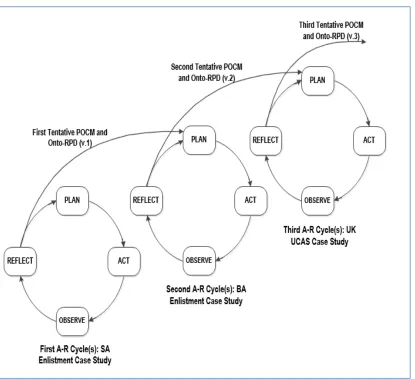
encapsulation guidelines are used. Figure 2 illustrates the incremental process of building the POCM
513
and Onto-RPD.
514
516
Figure 2. The process of artefact development.
517
518
The final improved versions of POCM, Onto-RPD, and root problem definitions are presented
519
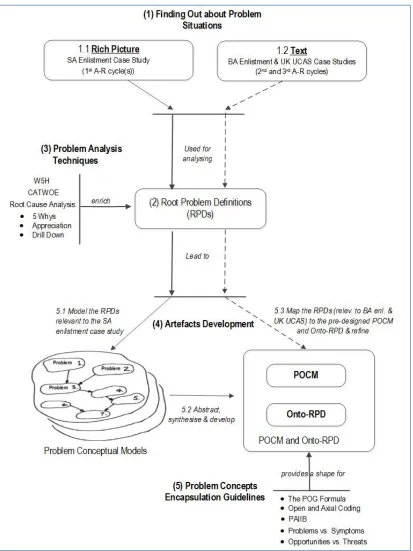
in this article. The methodological framework for exploring, capturing, and abstracting recruitment
520
problem, and building the POCM and Onto-RPD artefacts is presented in Figure 3. The framework is
521
inspired by Soft Systems Methodology (SSM) as an approach to understand and explore recruitment
522
problem as a learning system [64]. SSM, a well-known methodology, provides principles,
523
techniques, and guidelines to capture the various system worldviews in a problematic situation, and
524
then develop purposeful activity models (each built to encapsulate a single worldview) as
525
intellectual devices for learning and intervention [90]. According to Checkland and Poulter [64],
526
these principles, techniques, and guidelines of SSM can be both adopted and adapted for use in any
527
real situation.
528
530
Figure 3. The methodological framework for building POCM and Onto-RPD artefacts.
531
532
The POCM is a high-level Problem-Oriented Conceptual Model derived from the various root
533
problem definitions (RPDs) captured from the analysis of the three case studies. The constructs
534
comprising the POCM are the most common problem abstractions and their relationships that often
535
appear in a recruitment problem represented in reference to the proposed definition of recruitment
536
adopted. On the other hand, the Onto-RPD is a complementary ontology that conceptualises the
537
whole recruitment problem space and that helps understanding and defining a recruitment
538
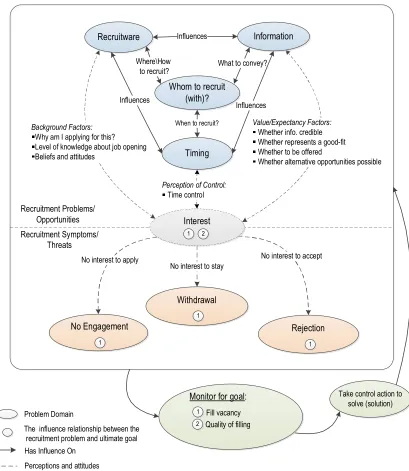
problem. The process of building these two artefacts is evolutionary through the analysis of the case
539
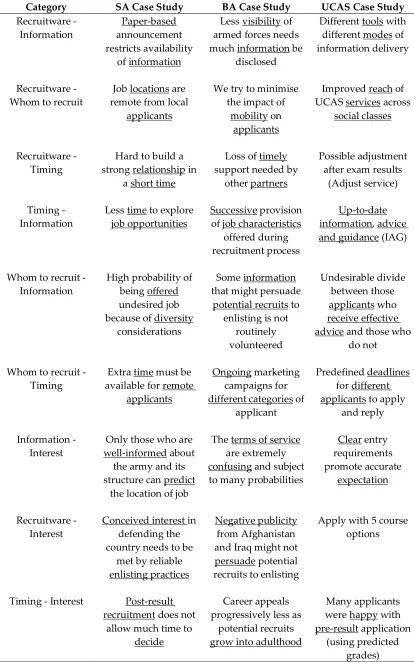
is illustrated in Figure 4. The problem types extracted from the three case studies to develop the
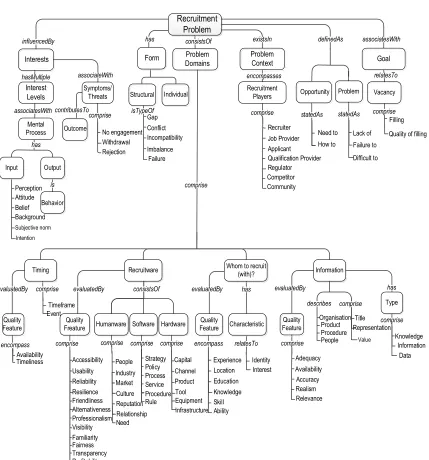
541
conceptual model are explained in Table 1. The ontology of recruitment problem definition is given
542
in Figure 5. Some of the selected definitions of root problem concepts within the POCM and
543
Onto-RPD are provided in Table 2.
544
545
546
Value/Expectancy Factors: Whether info. credible Whether represents a good-fit Whether to be offered
Whether alternative opportunities possible
Monitor for goal: Take control action to
solve (solution)
No Engagement
No interest to apply
The influence relationship between the recruitment problem and ultimate goal Problem Domain
Has Influence On
Withdrawal
Rejection
No interest to accept No interest to stay
Background Factors: Why am I applying for this? Level of knowledge about job opening Beliefs and attitudes
Perception of Control: Time control
Recruitment Problems/ Opportunities
Recruitment Symptoms/ Threats
Timing Recruitware
Whom to recruit (with)?
Information
What to convey?
Influences
Influences Where\How
to recruit?
When to recruit? Influences
1
1 1
1
Perceptions and attitudes
Fill vacancy
Interest
Quality of filling
2
1 2
547
Table 1. Mapping the types of problems from different case studies into the POCM.
549
Category SA Case Study BA Case Study UCAS Case Study
Recruitware - Information
Paper-based announcement restricts availability
of information
Less visibility of armed forces needs much information be
disclosed
Different tools with different modes of information delivery
Recruitware - Whom to recruit
Job locations are remote from local
applicants
We try to minimise the impact of
mobility on applicants
Improved reach of UCAS services across
social classes
Recruitware - Timing
Hard to build a strong relationship in
a short time
Loss of timely support needed by
other partners
Possible adjustment after exam results
(Adjust service)
Timing - Information
Less time to explore job opportunities
Successive provision of job characteristics
offered during recruitment process
Up-to-date information, advice and guidance (IAG)
Whom to recruit - Information
High probability of being offered undesired job because of diversity
considerations
Some information that might persuade
potential recruits to enlisting is not
routinely volunteered
Undesirable divide between those applicants who receive effective advice and those who
do not
Whom to recruit - Timing
Extra time must be available for remote
applicants
Ongoing marketing campaigns for different categories of
applicant
Predefined deadlines for different applicants to apply
and reply
Information - Interest
Only those who are well-informed about
the army and its structure can predict
the location of job
The terms of service are extremely confusing and subject to many probabilities
Clear entry requirements promote accurate
expectation
Recruitware - Interest
Conceived interest in defending the country needs to be
met by reliable enlisting practices
Negative publicity from Afghanistan and Iraq might not persuade potential recruits to enlisting
Apply with 5 course options
Timing - Interest Post-result recruitment does not
allow much time to decide
Career appeals progressively less as
potential recruits grow into adulthood
Many applicants were happy with pre-result application
551
552
553
Recruitment Problem Timing Quality Feature encompass evaluatedBy Availability Timeliness comprise Timeframe Event Information Organisation Product Procedure describes Title Representation Value comprise Type Knowledge Information Data comprise Quality Feature Adequacy Availability Accuracy Realism comprise evaluatedBy Relevance has comprise associatesWith influencedByWhom to recruit (with)? Characteristic Identity Quality Feature Location Education Experience encompass Knowledge Skill Ability evaluatedBy has People consistsOf Outcome No engagement Withdrawal Rejection associateWith relatesTo Recruitware Humanware People Industry Market comprise Software Reputation Culture Strategy Policy Process Service comprise Procedure Rule Hardware Capital Channel Product Tool Equipment Infrastructure comprise Quality Freature consistsOf Accessibility Usability Reliability Resilience Friendliness Alternativeness Professionalism Visibility comprise Familiarity Fairness Transparency Profitability evaluatedBy Perception Attitude Belief Background Subjective norm Intention Mental Process has Input Output Behavior is Symptoms/ Threats Vacancy Filling
Quality of filling
comprise relatesTo Recruiter Job Provider Applicant Qualification Provider comprise Regulator Recruitment Players encompasses Goal existsIn Problem Domains Problem Context comprise Interest Levels hasMultiple associatesWith definedAs Problem Lack of Failure to Difficult to statedAs Opportunity Need to How to statedAs contributesTo Individual Structural Interests has Gap Conflict Incompatibility Imbalance Failure isTypeOf Form Interest Relationship Need Competitor Community
554
Table 2. Selected definitions of root problem concepts within the POCM and Onto-RPD artefacts.
562
Terms Definitions
Applicant A person who is being considered for a job at an organization.
Hardware A general term that includes all physical elements (i.e. physical assets) used or produced by a recruitment actor that can be seen, touched, and controlled.
Humanware A general term that includes all human-related aspects that describe a recruitment actor and influence the use of hardware and software.
Information Described as a problem owned by all recruitment actors in which: their information revealed through controllable and non-controllable
communication fail to/need to influence the others’ interests assessed by a set of quality features (e.g. availability, adequacy, relevance, etc.) taking into account all influences of other problem domains. This problem domain can be referred to as Communicated Identity.
Interest Described as a problem owned by all recruitment actors in which: they perceive that recruitware, information, and timing fall short to influence the intentions to react positively assessed by a set of factors (e.g.
value/expectancy and background factors). This problem domain can be referred to as Conceived Identity.
Rejection / Withdrawal / no engagement
Described as problem owned by all recruitment actors in which their
behaviours/actions influence filling of vacancy. No engagement is when there is no action carried out by the actor; withdrawal is when the actor withdraw out of interaction); and rejection is when the actor send an actual rejection message to an offer.
Problem Context The area in which a problem exists.
Problem Domain A way of considering or conceptualising problem.
Quality Feature A distinctive attribute or characteristic possessed by someone or something.
Recruitment An enterprise system in which different players interact according to their interests to fill a job vacancy.
Recruitment Problem
A problematic situation with a recruitment practice regarded as undesired that needs to be defined to overcome.
Recruitware Described as a problem owned by all recruitment actors in which: their current attributes, shaped by a number of elements, fail to/need to influence the others’ interests assessed by a set of quality features taking into account the impact of the other problem domains. This problem domain can be referred to as Actual Identity.
Timing Described as a problem owned by all recruitment actors in which: the timings of events fail to/need to influence the others’ interests assessed by a set of quality features (e.g. availability, responsiveness, timeliness, etc.) taking into account all influences of other problem domains. This can be referred to as Timed Identity.
Whom to recruit (with)
5. Demonstration and Evaluation of POCM and Onto-RPD
563
In this section, the demonstration and evaluation of the POCM and Onto-RPD are presented.
564
5.1 Demonstration
565
In the demonstration phase, the POCM and its corresponding Onto-RPD artefacts are used in
566
real-life cases to prove their feasibility. The evaluation phase is an important part to examine how
567
well the POCM and Onto-RPD have contributed to address the practical problems explicated and
568
whether they have achieved the defined requirements. The two phases are conducted using one
569
focus group through two sessions.
570
The participants were selected from Bournemouth University (academic and practitioners) and
571
they had different recruitment-related experiences (e.g. HR, management, marketing, psychology,
572
sociology, etc.). The participants were identified using BU staff database and an invitation poster
573
based on the following conditions: participants should have at least 3 years of recruitment-relevant
574
experience and they should be either an academic expert (teaching staff or PhD students) or a
575
practitioner. After a careful survey of Bournemouth staff database, potential participants were
576
selected according to the expertise in recruitment. After the selection, they were invited using email
577
to participate in research with a chance of winning a 20 Pound voucher from Amazon. The poster
578
was supported with a chance of winning the voucher as well. The poster was distributed through
579
the boards around the public places at Bournemouth University. The purpose of the poster was to
580
widen participation and gain access to those cannot be reached through the BU staff database.
581
The number of selected participants through the poster was 9 while the number of those
582
selected through the BU staff database was 54. The total number of target participants was 63. A
583
group of 16 people accepted the invitation. The participants were then requested, as an assignment,
584
to write a short description of a recruitment problem case they faced. Only four problem cases were
585
collected. These cases were then revised and circulated to others being asked to comment on them
586
and define the potential problems with each case from their perspectives. The answers were
587
collected and prepared for use in the evaluation phase.
588
The demonstration session started by welcoming the participants and subsequently a number
589
of activities were conducted towards the achievement of session purpose. The themes of research;
590
the artefacts to be evaluated; the way by which this focus group research is conducted; the way the
591
research materials (templates) are used for answers and comments; and the four recruitment case
592
studies to be used in assessment were presented.
593
The purpose of this session was to demonstrate the POCM and Onto-RPD artefacts to the
594
participants and apply them to the recruitment cases described in the preparation phase to assess
595
their feasibility. Based on that, the participants were asked to loudly elaborate on each case study
596
(i.e. defining related potential problems) keying on the list of problem definitions presented with
597
each case. For a better elaboration, the participants were asked to use the journalist’s questions (e.g.
598
what, why, where, when, who, which, and how). Meanwhile, the participants were directed to the
599
POCM and Onto-RPD artefacts being asked to populate or relate their proposed problem definitions
600
to the concepts on the artefacts, or reversely to use the artefacts’ concepts for the knowledge retrieval
601
and define new recruitment problems.
602
At the end of the discussion on each case study, participants were given time to assess the
603
application of POCM and Onto-RPD artefacts to each case study, and answer a list of
604
semi-structured questions in the templates prepared for that purpose. The participants were also
605
asked to write down their comments and suggestions. The questions were to assess the feasibility
606
and contributions of the artefacts in the following:
607
Definition of key recruitment problem concepts embedded in a recruitment case study.
608
Inclusion and integration of many recruitment stakeholders’ perspectives.
609
Capturing and representation of the problem situational structure in each case study and its
610
relationships.
611
Better recruitment problem understanding and analysis towards solving recruitment problem.