© 2017, IJCSMC All Rights Reserved 170
Available Online atwww.ijcsmc.com
International Journal of Computer Science and Mobile Computing
A Monthly Journal of Computer Science and Information Technology
ISSN 2320–088X
IMPACT FACTOR: 6.017
IJCSMC, Vol. 6, Issue. 2, February 2017, pg.170 – 178
Visitor Gate Pass Management System
[1]
Harish Rapartiwar,
[2]Pushpanjali Shivratri,
[3]Omkar Sonakul,
[4]Prof. Ashwini Bhugul
[1][2][3][4]
Computer Engineering, Marathwada Mitra Mandal’s College of Engineering, Pune, India
Abstract— Visitor gate-pass management system is designed to replace traditional visitor registration and visitor information management activities in the premises, with this system we will able to expedite the visitor registration process, determine who is still inside of the premises after meeting and notify to the system. This is a review paper in which system solves the problem of appointments and it electively capturing all-relevant information about the visitors and that information is recorded in centralized database server, which provides data management and manipulation through searching for future purposes in the organization. The benefits of Visitor Gate pass Management System( VGMS) is enhancing the level of security enforced in premises, providing an organized view of visitor records and reducing the time spent on managing visitor information.
Index Terms— intermittent visitor, host, Multipurpose card (Mykad), SDLC Model.
I. INTRODUCTION
VGMS
provides an easy method for the front desk officer to search the ongoing visitor of the day. They will be timely notified of the current visitor visiting their department. Searching method is also faster and the system will give output that user needs.Currently, most organization is using the named method in keeping track all the incoming and out coming visitor records in each of the department. Problem raised when at curtain point of time the number of visitor visiting the department increasing and unable to manage and messed up. On top of that, a security issue also is the main issues in generating visitor pass in that particular organization.
Furthermore, the log register has been used to track all the visitor records and it is not enough. Log register is not an efficient way to keep records in several years, and in order to produce reports, retrieve or inquiry previous records especially 2-3 years back is very hard to get and taking a lot of time to retrieve the records and reports.
© 2017, IJCSMC All Rights Reserved 171
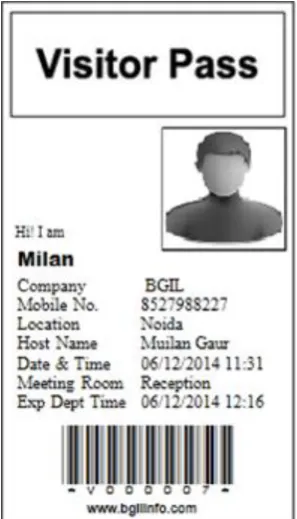
Figure 1: Sample of Visitor Card
PURPOSE AND SCOPE OF DOCUMENT
Achieving a secure environment is very important for all organizations as it is a matter of security. Our application would help such organizations to safeguard their organization from unwanted visitors. Thus, by use of minimum resources, our application would help an organization to keep a track of visitors and maintain a record of the same for future substantiation.
Overview of responsibility of developer Responsibilities of a developer are as follows:
Providing a user-friendly UI.
Sufficient fields for entry of visitor information. Storing it in a database.
Functionality for scanning visitor ID Functionality for printing gate pass.
Operations for maintenance of records and retrieval. Display function of ban list when needed.
System Requirement
A. Hardware Resources Required
Sr.No Parameter Minimum
Requirement
1 RAM 512MB
2 Disk 250MB
B. Software Resources Required
Platform:
1. Operating System: Pentium IV (or above) 2. Framework: ASP.NET 4.5
© 2017, IJCSMC All Rights Reserved 172
II. LITERATURE REVIEW
There are varieties similar systems available in the market when you search visitor management system in any of search engine available. Those systems come with various features to offer to their customer with different price range.
The Visitor Management system by applying the model of UTAUT was discussed by Norizan Anwar, Mohamad Noorman Masrek, Yanty Rahayu Rambli in year 2012. They proposed the system by adopting technology model (UTAUT) to determine the user acceptance of visitor application system. The main motto of this system was “Handling your visitor at your fingertips”.
Another system for Visitor Pass was discussed in the paper by Prof. Abhay Gaidhani, Suraj Sahijwani, Parag Jain, Shantanu Jadhav, Ankush Jain in year 2015. This paper aims to develop a system for Gate pass using Raspberry Pi. The main aim was to save paper with the help of Internet Connectivity to send SMS and Email for verification of user.
Digital Visitor Information Management System (VIMS) Application and Design. This application enables capturing new visiting record by auto-clock in/out, and assignment of visitor pass. Visitor information are recorded in a centralized database server, which provides data management and manipulation through searching and report generating. E-VIMS able to record visitor information during visitor registration by using visitor’s Malaysia Government Multipurpose Card (MyKad).
On the other hand, the decision to develop a visitor system may depend on the needs of an organization so in this review paper we have discussed a Visitor Gate Pass Management System to enhance level of security and manage visitor in any organization.
III. MODEL
A. System Development Life Cycle (SDLC) Model
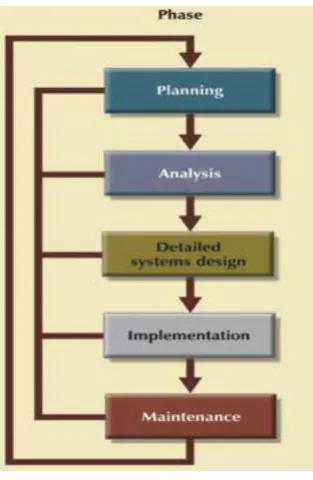
In this study, the development model of VGMS application software there are five phases involved: Planning, Analysis, Detailed System Design, Implementation and Maintenance. Figure 2 illustrate SDLC model that have been used in VGMS development.
The first phase of SDLC is planning in which the team is required to conduct meetings, initial information and feasibility study. Meanwhile in the second phase, which is analysis, user requirement is to be studied properly because it helps in overall SDLC. Evaluation of existing system and conduct logical system design need to be done. Furthermore, under the third phase, detailed system design is carried out by team mates based on the first and second phase input. After the completion of first three phases the team members proceed with system coding, testing and debugging of the system. To ensure that the system works according to the requirement of the user and suitability of the environment installation of the system is performed. The last phase is the maintenance phase in which the system is observed and maintained. If any additional requirements are demanded by the end user then according changes are performed over system in this last phase.
© 2017, IJCSMC All Rights Reserved 173
IV. OVERVIEW
VGMS is a Web application, which has all the information about visitors to the Organization. Every visitor has a mandatory host who is a employee. Each visitor has a unique visitor ID and a visit ID associated with him / her. System logs and tracks each visitor and visit and also facilitates the processing of Visit. Also it is the authentic record for Security staff on Visitors to the institute.
The Visitor Gate-Pass Management System (VGMS) is an integrated system for handling visitors which automates the workflow involving the host, admins, general administration, security and academic and non-academic visitors. The VGMS has been designed after studying the current workflow concerning visitors in the Institute. It is designed to simplify the administration and thereby provide a minimally intrusive experience to the visitor and the host.
The VGMS will set up three classes of visitors: long term visitors, intermittent visitors and short term visitors.
Long term visitors are issued ID cards, and like all valid recognized ID card holders (e.g., institute members) will have minimal interaction with the security at the gate. The VGMS
is an on-line simplification of the present system of internal emails and paperwork that accompanies the setting up of such a visit.
It is envisaged that intermittent visitors (such as person who has temporary work for over a certain project in organization) be issued temporary ID cards of limited, but long-term, validity (such as 4 months). A valid ID card of this kind will allow visitors to have minimal interaction with the security at the gate. The VGMS is designed to simplify the workflow that will be required to initiate the process of requesting such ID cards.
The remaining category, of short term visitors, consists of people who will continue to have to record their entry and exit into the organization, as they do now. The VGMS is designed to simplify the workflow surrounding such visits.
Visitor Classification
1. Short term Visitor is a visitor whose visit does not span a night. STGV is a specific class of ST visitors, where there will be Group lead's identity for the group members.
2. Long Term Visitor is a visitor whose visit duration spans more than a night.
3. Intermittent Visitor is one who frequently visits organization on a regular basis for considerable duration of say a few months.
Broad Categories of Visitors From the application point of view, the under mentioned visitors will fall into either Long term, Short term or Intermittent visitor
1. Collaborative research / Academic Visitors – Long term 2. Day visitors – Intermittent Visitor
3. Visitors from other organization – Transparent to gate and system (Self ID) 4. Daily wages staff - Intermittent Visitor
5. Contractors staff – Intermittent Visitor 6. Suppliers / Vendors - Short Term Visitor 7. Visiting Police - Short Term Visitor 8. Courier Personnel - Short Term Visitor 9. Tender related Visitors – Short Term Visitor 10. Group Visitors – Short Term Visitor
Types of visit: · Planned & Official
· Unplanned & Official · Planned & Unofficial · Unplanned & Unofficial
Entities Involved A. Visitor
© 2017, IJCSMC All Rights Reserved 174 Features
1. Web application for Visitor & Visit management 2. Target users – Visitor, Host & Security Staff
3. System design is mainly based on Visitor Classification.
4. Visitor details and photo maintained with a unique visitor ID with provision for partially planned visits. (Source is known but the exact name is not known for the visitor.)
5. Administrative processing of the visit for the visitor by Host concerned. 6. Notification of visitor’s arrival to host and security.
7. Customized Entry Pass for different visitor categories with photograph 8. Alerts for gate pass not returned at the security gate
9. Generation of email alert to security officer for foreign visitors 10. Grey-listing for some visitors with associated reason. 11. Report generation on visitor and visit data.
12. Different entities have limited edit / view access, only to data, for which they are authorized to access and act upon. Security and access control at module level.
Provision to expire records – Data ageing and Data removal 1. Short Term visitor details to expire in 2 years.
2. Long Term visitor details to expire along with their passport date of expiry and data has to be stored securely post-expiry.
3. Intermittent visitor data to expire in 2 years.
Figure 3: Enhanced Entity Relationship diagram
V. DATA ANALYSIS
A. Data Classification
1. Primary data: This is the data for which the visitor is the owner and hence the authentic source. E.g. Profile information, Permanent contact details, Visit Details.
2. Facilitating data: This is the data fed by the institute departments interacting with the Visitor Information System to facilitate the visit. E.g. Local contact details.
© 2017, IJCSMC All Rights Reserved 175
B. Data Manipulation
Under no circumstances primary data can be altered by anyone other than visitor. The administrator can lock the data once he/she is convinced that the primary data entry is over. Once a record is locked, even if the visitor wants to change the primary data, the administrator permission has to be sought to open the record again for editing.
C. Data Privacy
Since the application has all sensitive and personal information regarding the visitor, data privacy is utmost important and is taken care of. The data in totality is not made available to any entity other than the Visitor Information System administrator to even view. Organization staff who have access to the system have access to only that part of the visitor data which they need to know about and also on which they need to act upon. No other entity interacting with the system. For a full list of entities involved in the system operations, please refer to the Entities Involved Section.
D. Data Ageing & Storage / Removal
Data belonging to a long term visitor is more sensitive and hence this data has to be properly aged and stored securely. The data can expire alongside the date of expiry and post-expiry the data has to be stored securely and has to be protected against leakage and tampering. For Short term visitors and intermittent visitors, data can expire in two years.
E. Application & Data Security
All interdepartmental interfaces will have proper authentication and authorization to act upon the data made available to them. The login will be through secure sessions and over secure https protocol.
F. Major Modules
Administration Module
This module is normally used by the administrators at different departments who deal with the administrative work of guests on behalf of the host. This web application helps the department representatives to register the expected visitor online, process the visit and pass on the information to the security. Security and dept. can view the reports of the visitors for the date range. The dept. administrator can fill in secondary data for the visitor and also generate reports and initiate other interdepartmental communication for coordinating / facilitating arrangements.
Security Gate Module
The Security Gate module facilitates the admin staff at the security gate to register the visitor’s arrival with photograph and also send the notification to the host. The system can take in secondary real time data about the visitor, his co-visitors and belongings. Check-in and Check-out are processed by this interface Module.
VI. SYSTEM ARCHITECTURE
© 2017, IJCSMC All Rights Reserved 176 Module Description
Appointment Module: This module is for setting appointments of visitors
Security Module: This security module is installed at entrance of the premises or organization
Host Employee Module: The host employee can check the visitor details on web pages
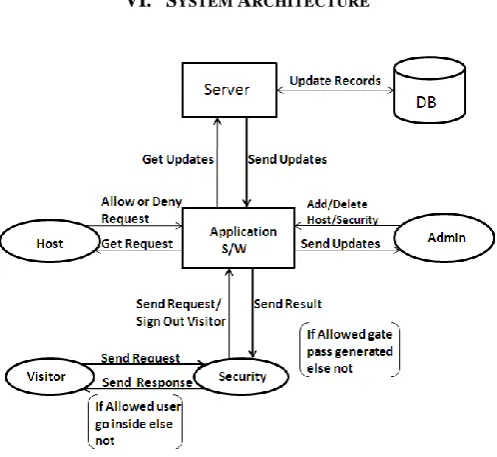
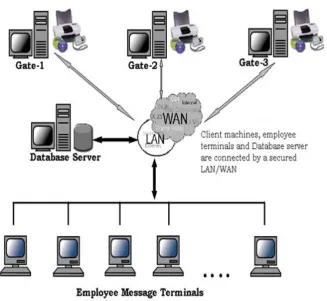
Purposed Solution Architecture
Figure 5: Purposed Architecture
Steps of Operation Appointment Generation by Office Employee.
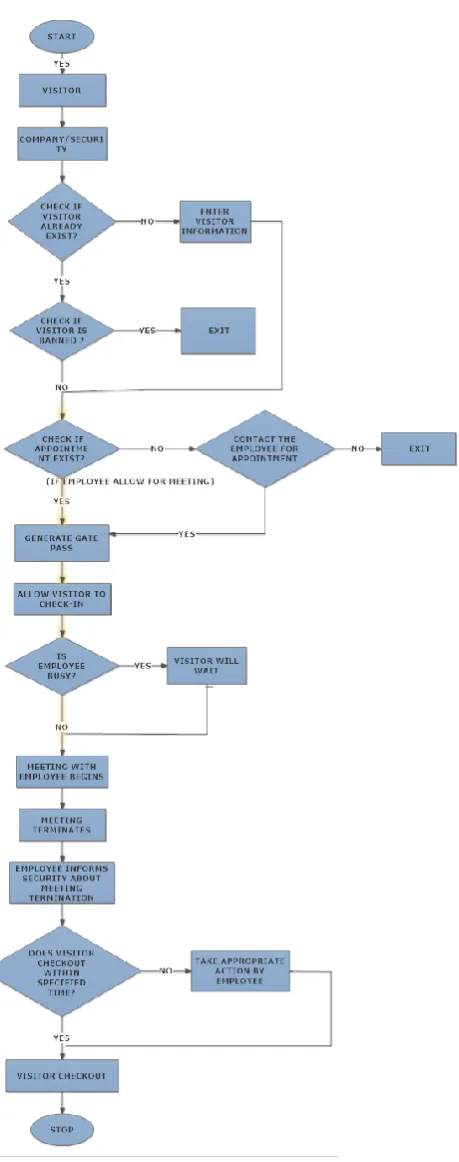
Security checks visitor’s panel, if appointment exists a Webcam captures the photo of the visitor at the entrance, the reception or security person enter the details of the visitor or Pre-scheduled appointment is displayed.
Information / message is sent via SMS to the officers PC by sending visitor details & photo, and wait for his approval. Officer decides to meet or forward or refuse the appointment or ask to wait.
If approve then software prints the Pass for visitor.
Interface flow
© 2017, IJCSMC All Rights Reserved 177
© 2017, IJCSMC All Rights Reserved 178
VII. CONCLUSION
The computer becomes important equipment to the organization to store the data and to process the data for any purpose. It also can be used to access and process any data and information needed easily and less in time. Therefore, it is hope that VGMS application system able to solve the problem according to these scopes:
By using VGMS, the organizations have an option in increasing the level of security enforced in their premises. VGMS enables free, secured, fast and easy visitor registration.
Computerized records give better management and manipulation of data, through searching and report generation. Its installation is easy and hence does not require professionals for the same.
The VGMS system is easy to maintain and use.
It gives reliable and efficient security protection on which one can rely. Unauthenticated and unwanted users cannot enter the commercial space.
Biometric functions can be coupled with the existing system to gain extra security.
Hence we can conclude that this system would prove to be an efficient system to obtain a Gate Pass in any organization. Using this system the usage of paper decreases drastically and gate pass can be obtained through SMS that proves to be more secure and easy process which also saves time in obtaining gate pass and thus makes procedure easy. Also higher authority can generate report directly from database rather than maintaining record of gate pass taken by each visitor „n‟ times.
R
EFERENCES
[1] Norizan Anwar, Mohamad Noorman Masrek, Yanty Rahayu Rambli, (2012),Visitor Management system by applying the model of UTAUT, Faculty of Information Management, Unerversiti teknologi MARA (UiTM) Selengor, Malaysia (IEEE).
[2] Prof. Abhay Gaidhani 1 , Suraj Sahijwani 2 , Parag Jain 3 , Shantanu Jadhav 4, Ankush Jain 5, (2015), System for Visitor Pass. Department of Computer Engineering, Sandip, Institute of Engineering Management, Nashik.
[3] M.N. Noorhuzaimi@Karimah, S. Junaida , A. Noraziah, K. Huei Chen Fakulti Sistem Komputer Kejuruteraan Perisian.(2009), Digital Visitor Information Management System (VIMS) Application and Design. Universiti Malaysia Pahang Karung Berkunci 12, 25000 Kuantan, Pahang.
[4] Seinivas Nidhra, Likith Poovanna, Vinay Sudha Eithiraj, (2012), Visitor Management Schedule System- An Intelligent Decision Support System, School of Computing, Blekinge Tekniska Högskola, Karlskrona, Sweden. [5] HaiyaHamood Al Ghaithi, Umapathy Eaganathan, (2016), A BRIEF STUDY AND IMPLEMENTATION OF