
Better Key Sizes (and Attacks) for
LWE-Based Encryption
Richard Lindner∗ Chris Peikert†
November 30, 2010
Abstract
We analyze the concrete security and key sizes of theoretically sound lattice-based encryption schemes based on the “learning with errors” (LWE) problem. Our main contributions are: (1) a new lattice attack on LWE that combines basis reduction with an enumeration algorithm admitting a time/success tradeoff, which performs better than the simple distinguishing attack considered in prior analyses; (2) concrete parameters and security estimates for an LWE-based cryptosystem that is more compact and efficient than the well-known schemes from the literature. Our new key sizes are up to10times smaller than prior examples, while providing even stronger concrete security levels.
Keywords: lattice-based cryptography, basis reduction, learning with errors
1
Introduction
Recent years have seen significant progress in theoretically sound lattice-based cryptography, resulting in solutions to many tasks of wide applicability. In the realm of encryption alone, for example, we now have public-key cryptosystems [AD97, Reg03, Reg05] with chosen-ciphertext security [PW08, Pei09], identity-based encryption [GPV08, CHKP10, ABB10], and a fully homomorphic cryptosystem [Gen09]. Much of this progress has been greatly aided by the use of simple and flexible average-case problems — namely, theshort integer solution (SIS) introduced by Ajtai [Ajt96] and thelearning with errors(LWE) problem of Regev [Reg05] — that are provably as hard as certain lattice problems in theworst case, and appear to require time exponential in the main security parameter to solve.
Forpracticalparameters, however, the concrete hardness of theSISandLWEproblems against algorithmic attacks is still far from a settled issue. This makes it difficult to assess the actual security and efficiency of cryptographic schemes that are based on these problems. The purpose of this paper is to shed further light on this issue, by considering new variants of known schemes and attacks, and analyzing their consequences in terms of key sizes and estimated security.
∗
Technische Universit¨at Darmstadt. Email:[email protected]. This work was supported by CASED (www.cased.de).
†
1.1 Our Contributions
We analyze the concrete security and efficiency of modern lattice-based cryptographic schemes, with a focus onLWEand public-key encryption. To start, we describe anLWE-based cryptosystem that has substantially smaller keys and ciphertexts than the more well-known systems in the literature (namely, the original system of Regev [Reg05] and its more efficient amortized variants [PVW08, GPV08]). Our scheme incorporates several techniques and perspectives from recent works; in particular, it is an instance of an abstract system described by Micciancio [Mic10] that generalizes all the schemes of [Reg05, PVW08, GPV08], and the system’s design and security proof (under theLWEassumption) combine a variety of techniques from recent works [Ale03, MR09, LPS10, Pei10] to yield asymptotic and concrete improvements in key size. While there are not any new techniques involved, to our knowledge the literature lacks a full description and analysis of the system, despite it now being an important target of study.
Our second main contribution is a new and stronger way of using existing algorithmic attack tools, such as lattice basis reduction and bounded-distance decoding with preprocessing, to analyze the concrete security of recent lattice-based cryptosystems. Our attack is directed specifically at theLWEproblem, and exploits some of its structural properties in ways that have not been attempted before in a cryptanalytic context. (Our attack also does not seem immediately applicable to other lattice problems, such as the unique shortest vector problem, that have been used for public-key encryption [AD97, Reg03, AD07].) Therefore, we believe that our analysis gives a more accurate assessment ofLWE’s concrete hardness than estimates derived from prior lattice attacks.
Applying our attack to the improved cryptosystem, we then propose concrete parameters and (conserva-tive) runtime estimates for modern commodity hardware. Despite our improved attacks, the resulting key sizes are still smaller than prior example parameters by factors as large as10, even for stronger security levels. (See Section 6 for full details.) For example, using parameters that can encrypt a128-bit payload and appear to be at least as secure as AES-128, we obtain public key sizes of about1,120kilobits, or about400kilobits assuming a public source of trusted randomness.
Clearly, the above key sizes are still too large for many applications, but this is a consequence of the quadratic overhead inherent to the use “standard” LWE. By using the compact “ring-based” variant of
LWEand cryptosystem from [LPR10] (which is related to the heuristic NTRU scheme [HPS98] and the theoretically sound line of works initiated in [Mic02]), we can immediately shrink the above key sizes by a factor of at least200. The resulting sizes of2-5kilobits are comparable to modern recommendations for RSA, and the cryptosystem itself is many times faster on modern hardware.
Our methodology. Here we briefly summarize our methods and main conclusions. Our approach involves a dedicated study of basis reduction for a certain family of random lattices, and a post-reduction decoding algorithm that to our knowledge have not been considered in prior analyses. (For a discussion of our approach in relation to prior works, see Section 1.2.)
Lattice-based cryptosystems in the line of works started by Ajtai [Ajt96] involve a family of so-called
q-ary lattices, which arem-dimensional integer lattices that containqZmas a sublattice, for some modulus
q ≥ 2. We study how basis reduction performs, in terms of its running time and the global properties of its output basis, on random lattices from this family. Our experiments yield reliable and theoretically well-behaved predictions about the basis quality that may be obtained using various amounts of computational effort.
Complementing our analysis of lattice basis reduction, we describe a new post-reduction attack on the
which is not strictly necessary to break the semantic security of mostLWE-based cryptosystems, our full attack turns out to be strictly preferable (for a very wide range of parameters used in cryptography) to the natural distinguishing attack ondecision-LWEthat has been considered in prior analyses [MR09, RS10]. Specifically, our attack can solve a search-LWEinstance, and hence decrypt a ciphertext, with the same or better advantage than the distinguishing attack, while using lattice vectors of lower quality and hence much less total runtime. The improvement is especially pronounced in the high-advantage regime, where the adversary needs relatively high confidence in the decrypted plaintext, such as might be required for breaking hybrid encryption.
Our post-reduction attack involves a simple extension of Babai’s “nearest-plane” algorithm [Bab85] that allows us to trade basis quality against decoding time, which to our knowledge has not been explored in a cryptanalytic context. The extension is related to Klein’s (de)randomized algorithm [Kle00] for bounded-distant decoding, but is simpler and specifically tailored to the known Gaussian distribution of the error vector. As we have already indicated, the quality/time trade-off dramatically affects the quality of basis required to solve anLWEinstance, and hence the running time of the attack.
Finally, we note that our analysis is entirely modular, and allows for substituting improved basis reduction algorithms (and their accompanying runtime and quality predictions) into the post-reduction attack.
1.2 Related Work
Several papers contain studies of the concrete hardness of lattice problems. Here we mention the ones most closely related to our work, which are aimed at calculating secure parameters for lattice-based cryptosystems, and describe the most important distinctions.
Gama and Nguyen [GN08] performed a comprehensive study of the behavior of basis reduction for various families of lattices. Their analysis is primarily focused on the best obtainable solutions to the Hermite-, Unique-, and Approximate-Shortest Vector Problems. The Hermite SVP is in particular an important problem in our work and other cryptanalyses. While Gama and Nguyen did not attempt to document the behavior of basis reduction on randomq-ary lattices (aside from the closely related Goldstein-Mayer distribution for enormousq), our experiments confirmed several of their findings for this family (as did the experiments in [MR09]). Gama and Nguyen’s study was aimed mainly at predicting the behavior of basis reduction, but did not include runtime predictions, nor did it investigate theuseof a reduced basis to solve bounded-distance decoding problems (such asLWE), where additional algorithmic ideas and trade-offs are possible.
The survey by Micciancio and Regev [MR09] proposed example parameters for various lattice-based schemes from the contemporary literature (which have larger keys than the one we describe here). Their parameters were derived using Gama and Nguyen’s conclusions about the (in)feasibility of obtaining various Hermite factors, and as such do not include concrete estimates of attack runtimes or success probabilities. Their security estimates are calculated using the natural distinguishing attack onLWEby finding one relatively short vector in an associated lattice; our attack succeeds with lower-quality vectors, making it even more effective. (It should be noted that the example parameters given in [MR09] were already known to offer moderate security at best.)
R¨uckert and Schneider [RS10] recently gave concrete estimates of “symmetric bit security” for many recent lattice-based schemes, incorporating concrete runtime estimates for various Hermite factors in random
Finally, we note that the best distinguishing attack againstLWEused in [MR09, RS10] may not always apply to our cryptosystem, because its parameters can be set so that relatively fewLWEsamples are published, and thus the attack is forced to use a suboptimal lattice dimension. We give further details in Sections 5.1 and 6.
2
Preliminaries
For a positive integerk, we use[k]to denote the set{1, . . . , k}. The base-2logarithm is denotedlg. We use bold lower-case letters (e.g.,x) to denote vectors over the realR. We use bold upper-case letters (e.g.,B) for ordered sets of vectors, and identify the set with the matrix having the vectors as its columns. We let
kBk:= maxikbik, wherek·kdenotes the Euclidean norm.
For an (ordered) set of linearly independent vectors B = {b1, . . . ,bk} ⊂ Rn, its Gram-Schmidt
orthogonalization Be is defined iteratively as bf1 = b1, and bei is the component of bi orthogonal to
span(b1, . . . ,bi−1) for i = 2, . . . , k. In matrix notation, it corresponds to the (unique) decomposition
B = QR, where the columns ofQ ∈ Rn×k are orthonormal (i.e., QtQ = I) andR ∈ Rk×k is right-triangular with positive diagonal entries; the Gram-Schmidt vectors are thenbie = qi·ri,i. For a set of linearly independent vectorsB={b1, . . . ,bk}, itsfundamental parallelepipedis
P1/2(B) :=B·[−1 2,
1 2)
k=
X
i∈[k]
ci·bi :ci ∈[−12,12)
.
AlatticeΛinRmis a discrete additive subgroup. In this work we are concerned only withq-aryinteger lattices, which are contained inZmand containqZm, i.e.,qZm ⊆Λ⊆Zm. Such a lattice is generated by a (non-unique)basisB={b1, . . . ,bm} ⊂Zmof linearly independent integer vectors, as
Λ =L(B) :=B·Zm=
X
i∈[m]
zi·bi :zi∈Z
.
The determinantdet(Λ)of such a lattice is its index as a subgroup ofZm, i.e.,det(Λ) =|Zm: Λ|. Equiva-lently, it is|det(B)|for any basisBofΛ.
2.1 Discrete Gaussians
For a latticeΛand a positive reals > 0, thediscrete GaussiandistributionDΛ,s overΛwith parameters is the probability distribution having supportΛthat assigns a probability proportional toexp(−πkxk2/s2)
to eachx ∈ Λ. For Λ = Zn, it is easy to see (by orthonormality of its standard basis) that the discrete Gaussian DZn,s is simply the product distribution of nindependent copies ofD
Z,s. There are efficient algorithms for sampling from a distribution within negligible statistical distance ofDZ,s, given anys >0. (See, e.g., [GPV08]: for arbitrarysthere is a rejection sampling algorithm, and for smallsone can compute a close approximation to the cumulative distribution function.).
We will need two tail bounds on discrete Gaussians.
Lemma 2.1([Ban93, Lemma 1.5]). Letc≥1andC =c·exp(1−c22)<1. Then for any reals >0and any integern≥1, we have
Pr
h
kDZn,sk ≥c·√1
2π ·s
√ n
i
≤Cn.
Lemma 2.2([Ban95, Lemma 2.4]). For any reals >0andT >0, and anyx∈Rn, we have
2.2 Learning with Errors
Thelearning with errors(LWE) problem was introduced by Regev [Reg05] as a generalization of the well-known ‘learning parity with noise’ problem, to larger moduli. The problem is parameterized by a dimension
n≥1and an integer modulusq ≥2, as well as an error distributionχoverZ(or its induced distribution overZq). In this work we will be concerned only with discrete Gaussian error distributionsχ=DZ,sover the integers, whereα:=s/q∈(0,1)is often called the (relative)error rate.
For ans ∈ Zn
q, theLWEdistributionAs,χ overZnq ×Zqis sampled by choosing a uniformly random a∈ Zn
q and error terme← χ, and outputting the pair(a, t=ha,si+emodq)∈ Znq ×Zq. Thesearch version of theLWEproblem is, given any desired number of independent samples(ai, ti)←As,χ, to finds.
Thedecisionversion ofLWEis to distinguish, with non-negligible advantage, between any desired number of independent samples(ai, ti)←As,χ(for a uniformly randoms∈Znq), and the same number of independent samples drawn from the uniform distribution overZnq ×Zq. It is often convenient to write these problems in matrix form as follows: collecting the vectorsai ∈Znq as the columns of a matrixA ∈Zn×mq and the (implicit) error termsei ∈Zand valuesti∈Zqas the entries of vectorse∈Zm,t∈Zmq respectively, we are given the input
A, t=Ats+emodq
and are asked to finds, or to distinguish the input from a uniformly random(A,t). TheLWEproblem may also be viewed as an average-case ‘bounded-distance decoding’ problem on a certain family of lattices: for A∈Zn×mq , define the lattice
Λ(At) ={z∈Zm:∃s∈Znq such thatz=Atsmodq}.
Then thetcomponent of theLWEinput may be seen as a perturbed lattice point inΛ(At), to be decoded.
Hardness of LWE. We recall several facts from the literature about the provable hardness ofLWE. The first is that for error distributionχ =DZ,α·q whereα·q ≥2
√
n, the search version ofLWEis at least as hard asquantumlyapproximating certain worst-case problems onn-dimensional lattices to withinO˜(n/α)
factors [Reg05].1 Moreover, for similar parameters and large enoughq, search-LWEis at least as hard as
classicallyapproximating the decision shortest vector problem and variants [Pei09]. For moduliqthat are sufficiently ‘smooth’ (i.e., products of small enough primes), the decision form ofLWEis at least as hard as the search form [Reg05, Pei09].
A particularly important fact for our purposes is that decision-LWEbecomes no easier to solve even if the secretsis chosen from the error distributionχ, rather than uniformly at random [MR09, ACPS09]. This may be seen as follows: given access toAs,χ, we can draw many samples to obtain
At=
At1 At
2
, t=
t1
t2
=
At1 At
2
s+
e1
e2
=Ats+emodq,
whereA2is uniform,eis drawn fromχ, andA1 ∈Zn×nq issquareandinvertible. (This follows by forming A1by greedily drawing samples that can form an invertible matrix, and disposing of any others untilA1is
complete.) We can then transformAandtinto
¯
At:=−At2·A−t1 modq, ¯t:= ¯Att1+t2= ¯Ate1+e2modq,
1
whereA¯ is uniform; therefore, we have effectively replacedswith the error vectore1. On the other hand,
note that whenA,tare uniformly random, then so areA¯,¯t.
In terms of lattices, the above may be interpreted as follows: using the bijections7→ At1sfromZnq to itself, we can see that the latticeΛ(At)defined above has as a basis the matrix
H=
I
qI −A¯t
.
(This basisHis a canonical representation ofΛ(At)known as the Hermite normal form. We have ordered the basis vectors so that the Gram-Schmidt vectors ofHare integer multiples of the standard basis vectors, where the first several have lengthq, and the remainder have length1.) BecauseAtsmodq∈Λ(At), we havet=Ats+e=emodH, which is
e−He1=
0 e2+ ¯Ate1
=
0
¯
t
modq.
In conclusion,¯t= ¯Ate1+e2is the unique canonical representative ofemodulo the latticeΛ(At).
Finally, assuming hardness of decision-LWE, a standard hybrid argument over the columns ofE(see, e.g., [PW08]) shows that( ¯A,A¯tE1+E2)is indistinguishable from uniform, where the entries ofE=
E1
E2
are chosen independently fromχ.
3
LWE-Based Encryption
Here we describe anLWE-based cryptosystem that is more space-efficient than the ones commonly known in the literature. It is an instance of an abstract system described by Micciancio [Mic10] that generalizes all the schemes of [Reg05, PVW08, GPV08], though a full description and analysis of the generalized system has not appeared in the literature. The security proof combines a number of techniques and perspectives from recent works [MR09, LPS10, Pei10] for the purpose of improved efficiency and a tight analysis. For completeness, we also briefly describe an efficient ring-based analogue of the system, which is described in full generality in the full version of [LPR10].
Despite being a generalization of priorLWE-based cryptosystems, the present scheme can actually be instantiated to have keys and ciphertexts that are smaller by a factor of aboutlgq, while simultaneously
improvingthe concrete security! The improved security comes from the smaller keys (for given security parametern), which allows for a relatively larger noise rate that makes theLWEproblem harder. The smaller keys come from a different style of security proof, which is very similar to the proofs for the coding-based cryptosystem of Alekhnovich [Ale03] and the subset sum-based cryptosystem of Lyubashevsky, Palacio, and Segev [LPS10]. In brief, the proof uses theLWEassumptiontwice(first on the public key, and then again on the ciphertext) to show that the adversary’s view in a passive attack is indistinguishable from uniformly random. By contrast, the proofs for priorLWE-based schemes involve a statistical argument on either the public key or ciphertext, but this requires larger keys. We point out that statistical arguments still appear necessary for many advanced applications ofLWE, such as identity-based encryption [GPV08] and others that use a ‘trapdoor basis,’ and we do not know whether comparably small keys and ciphertexts can be obtained for these schemes.
3.1 Cryptosystem
The cryptosystem involves a few parameters: an integer modulusq≥2and integer dimensionsn1, n2≥1,
encryption, respectively; and a message alphabetΣ(for example,Σ ={0,1}) and message length`≥1. We also require a simple error-tolerant encoder and decoder, given by functionsencode: Σ→Zqand
decode:Zq →Σ, such that for some large enough thresholdt≥1,decode(encode(m) +emodq) =m for any integere∈ [−t, t). For example, ifΣ = {0,1}, then we can defineencode(m) :=m· bq2c, and
decode( ¯m) := 0ifm¯ ∈
−bq4c,bq4c
⊂Zq, and 1 otherwise. This method has error tolerancet=bq4c. We also extendencodeanddecodeto vectors, component-wise.
To get the smallest public keys, our system makes use of a uniformly random public matrixA¯ ∈Zn1×n2
q that is generated by a trusted source, and is used by all parties in the system. If there is no trusted source, thenA¯ may be chosen by the user herself as part of key generation, and included in the public key.
• Gen( ¯A,1`): chooseR1 ←DZn1,s×`k andR2←DZn2,s×`k , and letP=R1−A¯ ·R2 ∈Znq1×`. The public key isP(andA, if needed), and the secret key is¯ R2.
In matrix form, the relationship between the public and secret keys is:
¯ A P · R2 I
=R1modq. (3.1)
• Enc( ¯A,P,m∈Σ`): choosee= (e1,e2,e3)∈Zn1×Zn2×Z`with each entry drawn independently fromDZ,se. Letm¯ =encode(m)∈Z
`
q, and compute the ciphertext
ct=ct1 ct2=et1 et2 et3+ ¯mt·
¯ A P I I
∈Z1 ×(n2+`)
q . (3.2)
(Note that the first ciphertext componentct1 can be precomputed beforePandmare known.)
• Dec(ct= [ct1,ct2],R2): outputdecode(ct1·R2+ct2)t∈Σ`.
Using Equation (3.2) followed by Equation (3.1), we are applyingdecodeto
ct1 ct2
·
R2
I
= (et+
0 0 m¯t
)· R1 R2 I
=et·R+ ¯mt,
where R =
hR1
R2
I
i
. Therefore, decryption will be correct as long as each |he,rji| < t, the error
threshold ofdecode. (We give a formal analysis in Section 3.2 below.)
For another perspective on this scheme as an (approximate) key-agreement mechanism, let`= 1for simplicity. By the discussion in Section 2.2, we can interpret key generation as reducing a Gaussian error vectorrmodulo a lattice defined byA, and publishing the result¯ Ar¯ 2−r1 modq. Likewise, we can view
encryption as reducing a Gaussian error vectoremodulo thedualof the same lattice, and publishing the resultet1A¯ +et2 modq. Using their respective private error vectors and the other party’s public message, the sender and receiver can both (approximately) computeet1Ar¯ 2 ∈Zq, whereas a passive adversary cannot. A
Ring-based analogue. We briefly describe a very similar scheme that is based on the decisionring-LWE
problem [LPR10]. For messages of length any`≤n=n1 =n2, and using the same values ofnandqas
above, the public and secret keys are up to annfactor smaller than in the above system, namelynlgqor
2nlgq bits at most, depending on the availability of a common trusted string. (The ciphertext size is the same, namely2nlgqbits.)
LetR =Z[x]/f(x)be a polynomial ring for some monic polynomialf(x)that is irreducible overZ; common choices includecyclotomicpolynomials such asf(x) =xn+ 1forna power of2. (See [LPR10] for efficiency and security properties of this and other cyclotomic polynomials, including degreesnthat are not powers of2.) Letq∈Zbe a sufficiently large integer modulus for whichf(x)splits into linear (or very low-degree) factors moduloq, and letRq =R/q=Zq[x]/f(x). Letχk, χebe error distributions overRthat are concentrated on ‘small’ elements ofR; see [LPR10] for what error distributions enable rigorous security proofs.
LetΣbe a message alphabet. The message encoder and decoder are functionsencode: Σn →Rqand
decode:Rq→Σn, such thatdecode(encode(m) +emodq) =mfor any ‘small enough’e∈R, e.g., one whose coefficients as a polynomial inZ[x]/f(x)are all in[−t, t)for some integer thresholdt≥1.
As above, the system uses a uniformly randoma ∈ Rq that can be generated by a trusted source, or chosen by the user.
• Gen(a): chooser1, r2 ←χk, and letp=r1−a·r2 ∈Rq. The public key isp(anda, if needed), and
the secret key isr2.
• Enc(a, p, m∈Σn): choosee1, e2, e3 ←χe. Letm¯ =encode(m)∈Rq, and compute the ciphertext
[c1=a·e1+e2, c2 =p·e1+e3+ ¯m]∈R2q.
• Dec(c= [c1, c2], r2): outputdecode(c1·r2+c2)∈Σn. By a straightforward calculation, decryption
will be correct as long ase1·r1+e2·r2+e3 is within the error threshold ofdecode; this holds with
high probability whenχk, χeare sufficiently concentrated.
The proof of security, under the decision ring-LWE assumption for noise distributionsχk andχe, is essentially identical to the proof of Theorem 3.2.
3.2 Parameters for Correctness
Here we give an upper bound on the Gaussian parameterssk,sein terms of the desired per-symbol error probability δ. For reasonably small values of δ, correctness for the entire message can effectively be guaranteed by way of a simple error-correcting code.
One small subtlety is that if a portion of the random vectoreused for encryption happens to be ‘too long,’ then the probability of decryption error for every symbol can be unacceptably large. We address this by giving a bound one, in Equation (3.4) below, which is violated with probability at most2−κfor some statistical parameterκ(say,κ = 40for concreteness). We then calculate the error probabilities assuming that the bound holds; the overall decryption error probability is then no more than2−κlarger. One can also modify theEncalgorithm to reject and resample anyethat violates Equation (3.4); the adversary’s advantage can increase by at most2−κ.
Lemma 3.1(Correctness). In the cryptosystem from Section 3.1, the error probability per symbol (over the choice of secret key) is bounded from above by any desiredδ >0, as long as
sk·se≤
√ 2π
c ·
t
p
(n1+n2)·ln(2/δ)
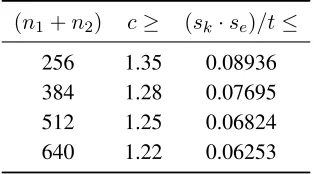
(n1+n2) c≥ (sk·se)/t≤ 256 1.35 0.08936 384 1.28 0.07695 512 1.25 0.06824 640 1.22 0.06253
Figure 1: Bounds on parameters for Lemma 3.1 using a per-symbol error probability ofδ = 0.01, wherecis determined so that the probability of choosing a ‘bad’ encryption vectoreis at most2−40.
Herec≥1is a value that depends (essentially) only onn1+n2; representative values are given in Figure 1.
Proof. As shown above in the specification of the decryption algorithm, thejth symbol of the message decrypts correctly if|he,rji| < bq4c. Recall that the entries of e ∈ Zn1+n2+` are independent and have
distributionDZ,se, andrj ∈Z
n1+n2+`is thejth column ofR=
hR1
R2
I
i
, where the entries ofR1andR2are
drawn independently fromDZ,sk.
To bound the error probability, lete¯∈Zn1+n2consist of the firstn1+n2entries ofe. Then by Lemma 2.1,
there is ac≥1such that
k¯ek ≤c·√1 2π ·se
√
n1+n2 (3.4)
except with very small probability (concrete values ofcare given in Figure 1). For any fixed¯esatisfying the above bound, observe that eachhe,rjiis independent and distributed essentially ash¯e, Dn1+n2
Z,sk i. 2 By
Lemma 2.2, for anyT ≥0we have
Prh h¯e, D
n1+n2 Z,sk i
≥T·skk¯ek i
<2 exp(−π·T2).
LettingT =t/(skke¯k), wheretis the error tolerance of our message encoding, and using the bound onk¯ek from above, we get the bound onsk·sefrom the lemma statement.
3.3 Security Proof
Theorem 3.2. The cryptosystem from Section 3.1 is CPA-secure, assuming the hardness of decision-LWE with modulusqfor: (i) dimensionn2with error distributionDZ,sk, and (ii) dimensionn1with errorDZ,se. Proof. It suffices to show that the entire view of the adversary in an IND-CPA attack is computationally indistinguishable from uniformly random, for any encrypted messagem∈Σ`. The view consists of( ¯A,P,c), where A¯ ∈ Zn1×n2
q is uniformly random, P ← Gen( ¯A,1`), and ct ← Enc( ¯A,P,m). First,( ¯A,P) is computationally indistinguishable from uniformly random( ¯A,P∗) ∈Zn1×(n2+`)
q under assumption (i) in the lemma statement, becauseP= ( ¯At)t·(−R2) +R1, andA¯tis uniform while the entries of both−R2
andR1 are drawn fromDZ,sk. So the adversary’s view is indistinguishable from(A,c)whereA= ( ¯A,P
∗) is uniformly random and c ← Enc(A,m). Now(A,c)is also computationally indistinguishable from uniformly random(A,c∗)under assumption (ii) in the lemma statement, becausec= (Ate1+ [ee23]) + [m0],
andAis uniform while the entries ofe1,e2, ande3are drawn fromDZ,se. 2
It should be noted that for some settings of the parameters, one of the two assumptions in Theorem 3.2 may be trueinformation-theoreticallyfor the number ofLWEsamples exposed by the system in an attack. For instance, ifn2 ≥ n1lgq andsk ≥ω(
√
logn1), then the public key( ¯A,P)is within a negligible (in
n1) statistical distance of uniformly random (by a suitable version of the leftover hash lemma), whereas the
corresponding ciphertexts are statistically far from uniform. These properties are important in, for example, the ‘dual’ cryptosystem and identity-based encryption scheme of [GPV08]. Conversely, the applications found in [PVW08, BHY09, ACPS09] have public keys that are far from uniform, but require that encryption under a ‘malformed’ (uniformly random) public key produces a ciphertext that is statistically independent of the encrypted message. These properties are achieved whenn1≥n2lgqandse≥ω(
√
logn2), again by the
leftover hash lemma.
4
Lattice Decoding Attacks
The most promising practical attacks on the cryptosystem from Section 3, and more generally onLWEitself, use lattice-basis reduction followed by a decoding phase using the reduced basis.3 In this section we analyze the performance of decoding as it relates to the quality of a given reduced basis. Then in Section 5 we analyze the effort required to obtain bases of a desired quality.
Before proceeding, we briefly explain how ourdecodingattack onLWEdiffers from thedistinguishing
attacks considered in other works [MR09, RS10]. In the latter, the adversary distinguishes (with some noticeable advantage) an LWE instance (A,t = Ats+e) from uniformly random, which is typically enough to break the semantic security of anLWE-based cryptosystem with the same advantage. To do this, the adversary finds a short nonzero integral vectorvsuch that Av = 0modq, which may be seen as a short vector in the (scaled) dual of theLWElatticeΛ(At). (Equivalently, the points ofΛ(At)may be partitioned into hyperplanes orthogonal tov, successively separated by distanceq/kvk.) The adversary then simply tests whether the inner producthv,tiis “close” to zero moduloq. Whentis uniform, the test accepts with probability exactly 1/2, but whent = Ats+efor Gaussianewith parameters, we have
hv,ti=hv,eimodq, which is essentially a Gaussian (reduced modq) with parameterkvk ·s. When this parameter is not much larger thanq, the Gaussian (modq) can be distinguished from uniform with advantage very close toexp(−π·(kvk ·s/q)2). For example, whenkvk= 4q/sthe distinguishing advantage is about
2−72. However, to distinguish (and hence decrypt a ciphertext) with high confidence, one needskvk ≤q/(2s)
or so, which usually requires a great deal more effort to obtain.
It is customary to include the inverse distinguishing advantage in the total ‘cost’ of an attack, so the computational effort and advantage need to be carefully balanced. For practical parameters, the optimal total cost of the distinguishing attack typically involves a very small distinguishing advantage (see Section 6), which may not be very useful in some settings, such as hybrid encryption.
Our decoding attack is stronger than the distinguishing attack in that it can actually recover the secret error vector in theLWEinstance (and hence decrypt the ciphertext) with the same or better advantage, while using lower-quality vectors. For all the parameter settings that we investigated, our attack yields a better total effort as a ratio of time/advantage, and it is significantly more efficient in the high-advantage regime. (See Section 6 and Figure 4 in particular for details.) The attack works by using an entire reduced basis (not just one vector), and by expending some additional post-reduction effort to find theLWEsolution. We also point out that unlike in basis reduction, the post-reduction effort is fully parallelizable.
3
The attack. Recall from Section 2.2 that anLWEinstance(A,t=Ats+e)may be seen as a bounded-distance decoding problem on a certain latticeΛ = Λ(At), whereAts∈Λ.
The standard method for solving a bounded-distance decoding problem on lattices is the recursive
NearestPlanealgorithm of Babai [Bab85]. The input to the algorithm is some lattice basisB={b1, . . . ,bk} (which for best results should be as reduced as possible) and a target point t ∈ Rm, and the output is a lattice pointv ∈ L(B)that is ‘relatively close’ tot. The precise guarantee is that for anyt ∈ span(B),
NearestPlane(B,t)returns the uniquev∈ L(B)such thatt∈v+P1/2(Be). In other words, ift=v+e for somev∈ L(B), the algorithm outputsvif and only ifehappens to lie inP1/2(Be).
The main drawback of this approach in attackingLWE is that in a reduced basis B, the last several Gram-Schmidt vectors ofBare typically very short, whereas the first few are relatively long. In such a case, the parallelepipedP1/2(Be)is very ‘long and skinny,’ and so the Gaussian error vectoreis very unlikely to land in it, causingNearestPlaneto produce an incorrect answer.
We address this issue by giving a generalized algorithm that admits a time/success tradeoff. It works just asNearestPlanedoes, except that it can recurse on somedi ≥1distinct planes in theith level of the recursion. In essence, the multiple recursion has the effect of making the parallelepipedP1/2(Be)wider in the direction ofbei by a factor of exactlydi.4 To capture the most probability mass of the Gaussian error distribution ofe, one should choose the multiplesdi so as to maximizemini(di· kbeik).5
The input to our NearestPlanesalgorithm is a lattice basis B = {b1, . . . ,bk} ⊂ Rm, a vectord =
(d1, . . . , dk)∈(Z+)kof positive integers, and a target pointt∈Rm. It outputs a set ofQi∈[k]di distinct lattice vectors inL(B), as follows:
1. Ifk= 0, return0. Else, letvbe the projection oftontospan(B).
2. Letc1, . . . , cdk ∈Zbe thedkdistinct integers closest tohbfk,vi/hbfk,bfki.
3. Return [ i∈[dk]
(ci·bk+NearestPlanes({b1, . . . ,bk−1},(d1, . . . , dk−1),v−ci·bk).
Note that the recursive calls toNearestPlanescan be run entirely in parallel. The following lemma is an immediate extension of the analysis from [Bab85].
Lemma 4.1. For t ∈ span(B), NearestPlanes(B,d,t) returns the set of allv ∈ L(B) such thatt ∈
v+P1/2(Be ·D), whereD = diag(d). The running time is essentially Q
i∈[k]di times as large as that of
NearestPlane(B,t).
Note that the columns ofBe·Dfrom the lemma statement are the orthogonal vectorsdi·bei, soP1/2(Be·D) is a rectangular parallelepiped with axis lengthsdi· kbeik.
4The algorithm of Klein [Kle00] also can recurse on more than one plane per iteration. Klein’s algorithm solves the general
bounded-distance decoding problem, and selects the planes at each stage probabilistically (though it can also be derandomized); its guarantee is related solely to the shortest Gram-Schmidt vector in the basis. Our algorithm is tailored specifically to the setting where we know the distribution of the offset vector; this allows the algorithm to recurse on exactly those planes that maximize the probability of success (over the choice of the error vector).
5One could further generalize the algorithm to search within an approximateballmade up of ‘bricks’ that are copies ofP
1/2(Be),
Success probability ofNearestPlanes. Whent=v+efor somev∈ L(B)and acontinuousGaussian e←Dsfor somes >0, the probability thatvis in the output set ofNearestPlanes(B,d,t)is
Prhe∈ P1/2(Be ·diag(d)) i
=
m Y
i=1
Prh|he,beii|< di· hbei,beii/2 i
=
m Y
i=1
erf di· kbeik √
π
2s
!
, (4.1)
which follows by the independence of the valueshe,beii, due to the orthogonality of the Gram-Schmidt vectorsbie. Wheneis drawn from a sufficiently widediscreteGaussian over the integer lattice (in practice, a parameter of6or more suffices), the above is an extremely close approximation to the true probability.
We conclude this section by giving an informal explanation for why the advantage of the decoding attack can potentially be much larger than that of the distinguishing attack above, given vectors of the same quality. In the distinguishing attack, using a vectorvof length (say)kvk ≈4q/simplies thathv,timodq
is distributed roughly asD4qmoduloq, whose statistical distance is only about2−72from uniform. A basis BofΛ(At)of equivalent quality haskbfmk=q/kvk=s/4, becauseΛ(At)lies in hyperplanes orthogonal tovand separated by distanceq/kvk. So even without using multiple recursion inNearestPlanes(i.e., letting everydm = 1), the corresponding term in Equation (4.1) iserf(
√
π/8)≈0.25; moreover, the remaining terms typically approach1very rapidly, sincekbeikusually increases quickly asidecreases. Lettingdi>1 increases the overall success probability even more at little added cost, and allows for obtaining a relatively large advantage without needing higher-quality basis vectors.
5
Basis Reduction and Experiments
In this section we present an analysis of lattice basis reduction on randomq-ary lattices arising fromLWE, and results of reduction experiments on various parameters. Our goal is to predict a conservative, but still useful, lower bound on the practical runtime of the lattice decoding attack described in Section 4 for a given set ofLWEparameters.
We found that the best practical lattice reduction algorithm currently available to us is theBKZalgorithm as implemented by Shoup in the NTL library [Sho], so this is what we used in our experiments. TheBKZ
algorithm is parameterized by a blocksize k between2 and the dimension of the lattice to be reduced. As the blocksize increases, the reduced basis improves in quality (i.e., it contains shorter lattice vectors, whose Gram-Schmidt lengths are closer together), but the runtime ofBKZalso rapidly increases, becoming practically infeasible fork≥30or so.
There has been some recent progress in the development of algorithms for finding short vectors in lattices, which can be used as subroutines to (or entire replacements of)BKZreduction. For example, Gama, Nguyen, and Regev [GNR10] recently proposed a new method called “Extreme Enum”, which is much faster than its predecessor, the Schnorr-Euchner enumeration [SE94]. There are also single-exponential time algorithms for the Shortest Vector Problem [AKS01, MV10b, MV10a], which can run faster in practice than Schnorr-Euchner enumeration in certain low dimensions; however, these algorithms also require exponential space. We were not able to evaluate the performance and effectiveness of all these approaches, leaving this for future work. TheBKZimplementation we use employs Schnorr-Euchner enumeration and, since theBKZ
framework uses the enumeration subroutine as a black box, we presume that new algorithms incorporating Extreme Enum and other approaches will soon be available for evaluation. (For a comparison of enumeration algorithms in practice, see the openSVP-challenge website.6)
6
0 2 4 6 8 10
20 40 60 80 100 120 140 160 180 i
log2(|~b_i|) fit alpha = -0.038000
0 2 4 6 8 10
20 40 60 80 100 120 140 160 180 i
log2(|~b_i|) fit alpha = -0.038000
0 2 4 6 8 10
20 40 60 80 100 120 140 160 180 i
log2(|~b_i|) fit alpha = -0.038000
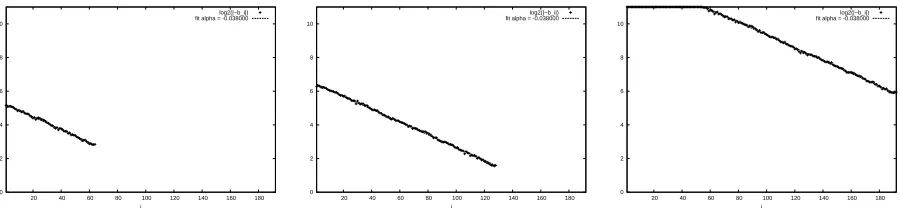
Figure 2: Logarithmic GSO lengths of threeLWE instances afterBKZ-20 reduction, which conform to the GSA assumption (modified with fixed upper and lower bounds on the Gram-Schmidt lengths). In all cases, the observed slope of the plot is very nearly the same, but other parameters vary. Parameters are
n= 32, q= 257, m= 64(left);n= 64, q= 257, m= 128(center);n= 32, q= 2053, m= 192(right).
In Section 5.1, we analyze the main properties ofBKZ-reduced bases forq-ary lattices that are relevant to our decoding attack. In Section 5.2, we use our experiments to estimate the runtime required to obtain bases of a desired quality. We point out that the rest of our analysis is independent of this estimate, and can easily be applied with other runtime estimates forBKZvariants or other approaches.
5.1 Basis Reduction forq-ary Lattices
We begin by reviewing some of the prior work on basis reduction, in particular as applied to theq-ary lattices that arise fromLWE.
The analysis of lattice reduction algorithms by Gama and Nguyen [GN08] identified theHermite factor
of the reduced basis as the dominant parameter in the runtime of the reduction and the quality of the reduced basis. A basisBof anm-dimensional latticeΛhas Hermite factorδm forδ≥1ifkb1k=δm·det(Λ)1/m.
For convenience, we callδtheroot-Hermite factor.
Another important concept is theGeometric Series Assumption(GSA), introduced by Schnorr [Sch03]. The GSA says that in aBKZ-reduced basisB, the lengthskbiekof the Gram-Schmidt vectors decay geometri-cally withi, namely,kbeik=kb1k ·αi−1for some0 < α <1. Our experiments on randomq-ary lattices adhere to the GSA very closely, with the exception that the Gram-Schmidt lengths are always upper- and lower-bounded byqand1respectively, owing to the special structure ofq-ary lattices (see Figure 2). For largeBKZblocksizes that correspond to effective attacks onLWE, these exceptional cases do not arise, and our bases conform to the GSA as ordinarily stated.
By combining the notion of Hermite factor with the GSA, we can predict the lengths ofallGram-Schmidt vectors in a basisB(of anm-dimensional latticeΛ) having root-Hermite factorδ. An easy calculation shows that under the GSA,
det(Λ) =
m Y
i=1
kbeik=αm(m−1)/2·δm
2
·det(Λ) =⇒ α=δ−2m/(m−1) ≈δ−2, (5.1)
where the approximation holds for largem.
We now turn toq-ary lattices that arise fromLWE. Recall from Section 2.2 thatLWEis a bounded-distance decoding problem on them-dimensional lattice
for someA∈Zn×m
q withm≥n. Because theLWEproblem allows us to ignore some of the rows ofAt (and the corresponding noisy inner products), a natural and important question is what ‘subdimension’m
makes a lattice attack most effective. This question was addressed in [MR09], where a simple calculation showed that for a desired root-Hermite factorδ, the subdimensionm=pnlg(q)/lg(δ)is optimal in the context of the natural distinguishing attack onLWE(as described at the beginning of Section 4). The analysis of [MR09] actually applies to the lattice
Λ⊥(A) ={x∈Zm:Ax=0modq},
which is the dualof Λ(At) up to scaling by aq factor, and the optimal subdimension m given above minimizes the length ofdf1=d1in a reduced basisDofΛ⊥(A)having root-Hermite factorδ. In our setting, by duality the same choice ofmmaximizeskbmfk=q/kdf1k, where the basisBofΛ(At)is the dual basis ofDinreverseorder.
In our decoding attack (and assuming the GSA), the form of the success probability given in Equation (4.1) as a product oferf(·)terms also strongly indicates that we should maximizekbmfk, and hence use the same subdimensionm = pnlg(q)/lg(δ)as above. We do not have a fully rigorous proof of this claim, since using a smallermdecreases the number of terms in the product, and hence could potentially increase the success probability. However, it seems unlikely that using a smallermwould improve the success probability by much (if at all). This is becausekbmfk=q/kd1kdecreases rapidly asmdecreases (see [MR09]), and
kbm−i]k ≈ kbmfk ·δ2(i−1)is a very close approximation for smalli, which are the Gram-Schmidt vectors that largely determine the success probability. Likewise, increasingmalso appears counterproductive, since it both decreaseskbfmkandincreases the number of terms in the product.
All of the above assumes that a cryptosystem exposes enoughLWEsamples (via its public keys and/or ciphertexts) to use the optimal subdimension. While this is always true of prior cryptosystems [Reg05, PVW08, GPV08], it is not necessarily the case for our cryptosystem in Section 3, due to its smaller keys and ciphertexts. In this case, the adversary should use the dimensionmcorresponding to the actual number of published samples (this rule applies to some of our parameters sets given in Section 6).
5.2 Extrapolating BKZ Runtimes
In order to assign concrete runtimes to the attacks we put forward, we need to predict the runtime required to achieve a given root-Hermite factorδin randomq-ary lattices.
Gama and Nguyen [GN08] observed that on random lattices generated according to a variety of models, the runtime required to achieve a given root-Hermite factorδin large dimensions (exceeding200or so) is largely determined byδ alone; the lattice dimension and determinant contribute only second-order terms. Our initial experiments confirmed this behavior for randomq-ary lattices, and so we extrapolated runtimes using a fixed set ofLWEparametersqandn, for a variety of valuesδthat correspond to sufficiently large optimal subdimensionsm=pnlg(q)/lg(δ)≈200. Our experiments were performed on a single 2.3 GHz AMD Opteron machine, using the single-precision floating-pointBKZimplementation from the standard NTL library [Sho]. (Practical attacks onLWEfor parameters beyond toy examples would require using at least quadruple precision, which would increase the running times by at least some constant factor, so our extrapolations are somewhat optimistic and hence conservative from a security point of view.)
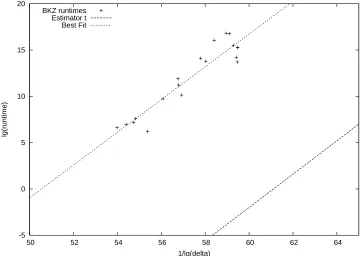
Figure 3 shows the results of our experiments and their extrapolations. Using the rule of thumb that obtaining a2kapproximation to the shortest vector in anm-dimensional lattice takes time2O˜(m/k)using
-5 0 5 10 15 20
50 52 54 56 58 60 62 64
lg(runtime)
1/lg(delta) BKZ runtimes
Estimator t Best Fit
Figure 3: Runtime ofBKZexperiments on randomq-ary lattices, with parametersn= 72,q= 1021, and
m=pnlg(q)/lg(δ0), i.e., the optimal subdimension with respect to a desired root-Hermite factorδ0. The
vertical axis istBKZ(δ) := lg(TBKZ(δ)), the logarithmic runtime required to obtain a vector with root-Hermite
factorδwhen runningBKZwith successively increasing blocksizes. The horizontal axis is1/lg(δ)for the actual root-Hermite factorδachieved by the reduction. For comparison, the graph shows the best-fit estimator
tBKZ(δ) = 1.086/lg(δ)−91, and our conservative lower bound estimatetBKZ(δ) = 1.8/lg(δ)−110.
confidence. Using least-square regression, the best linear fit to our data fortBKZ(δ) := lg(TBKZ(δ)), the log
runtime (in seconds, on our machine) ofBKZas a function ofδ, istBKZ(δ) = 1.806/lg(δ)−91. Since our
experiments were limited by resources and available time, and we expect to see further improvements in basis reduction techniques (such as those in [GNR10]), for analyzing concrete hardness we use a conservative lower bound estimate of
tBKZ(δ) := lg(TBKZ(δ)) = 1.8/lg(δ)−110. (5.2)
6
Cryptosystem Parameters
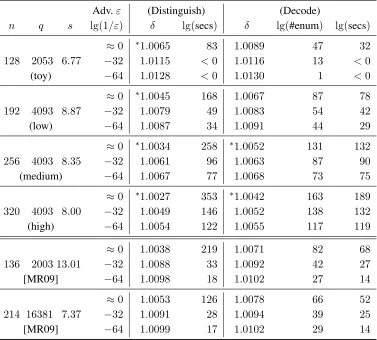
We now estimate the concrete security of, and compute the space requirements for, theLWE-based cryptosys-tem from Section 3 on a variety of parameters, and compare with the example parameters given in [MR09] for the cryptosystem described therein (which is essentially due to [PVW08]). Figure 4 provides the security estimates, and Figure 5 gives key and ciphertext sizes.
Instantiating the parameters. We set the cryptosystem’s parameters asn1 =n2 =nandsk =se=s for some positive integernands >0, so that the twoLWEhardness assumptions made in Theorem 3.2 are equivalent. In practice, though, distinguishing the public key and ciphertext from uniform are not equally hard, because the public key exposes fewerLWEsamples than the ciphertext does. In particular, the adversary cannot use the optimal subdimension in attacking the public key, making it quite a bit harder to break. This fact could allow us to use slightly smallerskand correspondingly largerseparameters to get slightly stronger overall security, but we elect not to introduce such complications at this point. (And arguably, the secret key ought to be better-protected than any individual ciphertext.)
We choose the modulusqto be just large enough (according to the bounds in Figure 1) to allow for a Gaussian parameters≥8, so that the discrete GaussianDZm,sapproximates the continuous GaussianDs
extremely well.7 Increasing the value ofqbeyond this threshold appears not to increase the concrete security of our cryptosystem, and (somewhat paradoxically) may even slightly decrease it! This is because theBKZ
runtime depends almost entirely on the root-Hermite factorδ, and by the constraints on our parameters (specifically,sk = se =s= O(
√
q)), theδyielding a successful attack on our system grows asqΘ(1/n), which increases withq(albeit very slowly).
Estimating the security. We analyze the distinguishing attack and our decoding attack (both described in Section 4), estimating the total runtimes for each of a few representative adversarial advantages. The attacks apply to a single key and ciphertext; by a standard hybrid argument, the advantage increases at most linearly in the number of ciphertexts encrypted under a single key.
For analyzing the basic distinguishing attack we rely on calculations from [MR09]. We first compute a boundβ = (q/s)·p
ln(1/ε)/πon the length of a nonzero vectorv∈Λ⊥(A)that would yield the desired distinguishing advantage (taken over the random choice of theLWEerror). We then compute the root-Hermite factorδ = 2(lg2β)/(4nlgq) that would yield such a vector, assuming that the attacker can use the optimal subdimensionm=pnlg(q)/lg(δ). (The value ofδfollows from the fact that in the optimal subdimension, a root-Hermite factor ofδ yields a vector of length 22
√
nlgqlgδ.) If the optimal subdimension for thisδ exceedsn1+n2+`= 2n+ 128(the number ofLWEsamples implicitly exposed by a ciphertext), then we
discard thisδand instead use the one for whichδm·qn/m=β, wherem= 2n+ 128. (Values ofδcomputed in this way are indicated in Figure 4 by asterisks.) We then calculate a lower bound on theBKZruntime using our conservative estimator from Equation (5.2).
In analyzing our decoding attack, we try various values ofδ, computing both the estimatedBKZruntime and the number of enumerations needed (assuming the GSA) to achieve the desired success probability according to Equation (4.1). If the number of enumerations does not exceed theBKZruntime (in seconds) by more than a216factor, we consider this to be an acceptable attack. (This216factor is somewhat arbitrary, but
7Note that the theoretical worst-case reduction [Reg05] forLWEasks thats≥2√n. However, the constant factors are not tight,
Adv.ε (Distinguish) (Decode)
n q s lg(1/ε) δ lg(secs) δ lg(#enum) lg(secs)
≈0 ∗1.0065 83 1.0089 47 32 128 2053 6.77 −32 1.0115 <0 1.0116 13 <0
(toy) −64 1.0128 <0 1.0130 1 <0
≈0 ∗1.0045 168 1.0067 87 78 192 4093 8.87 −32 1.0079 49 1.0083 54 42
(low) −64 1.0087 34 1.0091 44 29
≈0 ∗1.0034 258 ∗1.0052 131 132 256 4093 8.35 −32 1.0061 96 1.0063 87 90
(medium) −64 1.0067 77 1.0068 73 75
≈0 ∗1.0027 353 ∗1.0042 163 189 320 4093 8.00 −32 1.0049 146 1.0052 138 132
(high) −64 1.0054 122 1.0055 117 119
≈0 1.0038 219 1.0071 82 68 136 2003 13.01 −32 1.0088 33 1.0092 42 27
[MR09] −64 1.0098 18 1.0102 27 14
≈0 1.0053 126 1.0078 66 52 214 16381 7.37 −32 1.0091 28 1.0094 39 25
[MR09] −64 1.0099 17 1.0102 29 14
n q s Per-User Full Key Ciphertext Msg Key (P) (P&A)¯ (c) Expansion
128 2053 6.77 1.8×10⁵ 3.6×10⁵ 2.8×10³ 22.0 192 4093 8.87 2.9×10⁵ 7.4×10⁵ 3.8×10³ 30.0
256 4093 8.35 4.0×10⁵ 11.2×10⁵ 4.6×10³ 36.0 320 4093 8.00 4.9×10⁵ 17.2×10⁵ 5.4×10³ 42.0
136 2003 13.01 2.8×10⁶ 5.8×10⁶ 2.9×10³ 22.6 214 16381 7.37 2.4×10⁶ 6.4×10⁶ 4.8×10³ 18.7
Figure 5: Sizes (in bits) of public keys and ciphertexts for the cryptosystem described in Section 3; for comparison, the last two rows are for parameters given in [MR09]. In each case, the message size is`= 128
bits. The “message expansion” factor is the ratio of ciphertext size to plaintext size. Recall that in the ring-based system, the public key sizes are about a factor ofnsmaller.
seems to be a reasonable estimate on the number ofNearestPlanesenumerations that can be performed per second, especially with parallelism.) We list the largest value ofδfor which we found an acceptable attack, along with the corresponding runtime (which includes both theBKZandNearestPlanesphases).
Conclusions. We highlight a few notable conclusions from our analysis:
1. The decoding attack is always at least as good as the distinguishing attack for all reasonable advantages, and is vastly superior in the high-advantage regime. As an extreme example, decoding is more than
2160times faster when obtaining a large advantage against the “high security” (n= 320) parameter set. 2. For the “low security” (n = 192) parameter set, our key sizes are about 10 times smaller than
those in [MR09], while offering somewhat better security, and the “high security” parameters are approximately4-5times smaller. Note also that the ring-based scheme has key sizes about a factor ofnsmaller again.
3. For the “medium security” (n= 256) parameter set, the best runtime/advantage ratio is approximately
2120seconds, which translates on our machine to about2150operations. It seems reasonable to conclude that these parameters currently offer security levels at least matching those of AES-128. While we elect not to give precise “symmetric bit security” claims owing to the approximate nature of our predicted runtimes, rough figures could be derived using the heuristics of Lenstra and Verheul [LV01].
Acknowledgments
References
[ABB10] S. Agrawal, D. Boneh, and X. Boyen. Efficient lattice (H)IBE in the standard model. In
EUROCRYPT, pages 553–572. 2010. On p. 1.
[ACPS09] B. Applebaum, D. Cash, C. Peikert, and A. Sahai. Fast cryptographic primitives and circular-secure encryption based on hard learning problems. In CRYPTO, pages 595–618. 2009. On pp. 5 and 10.
[AD97] M. Ajtai and C. Dwork. A public-key cryptosystem with worst-case/average-case equivalence. InSTOC, pages 284–293. 1997. On pp. 1 and 2.
[AD07] M. Ajtai and C. Dwork. The first and fourth public-key cryptosystems with worst-case/average-case equivalence. Electronic Colloquium on Computational Complexity (ECCC), 14(97), 2007. On p. 2.
[Ajt96] M. Ajtai. Generating hard instances of lattice problems.Quaderni di Matematica, 13:1–32, 2004. Preliminary version in STOC 1996. On pp. 1 and 2.
[AKS01] M. Ajtai, R. Kumar, and D. Sivakumar. A sieve algorithm for the shortest lattice vector problem. InSTOC, pages 601–610. 2001. On p. 12.
[Ale03] M. Alekhnovich. More on average case vs approximation complexity. InFOCS, pages 298–307. 2003. On pp. 2 and 6.
[Bab85] L. Babai. On Lov´asz’ lattice reduction and the nearest lattice point problem. Combinatorica, 6(1):1–13, 1986. Preliminary version in STACS 1985. On pp. 3 and 11.
[Ban93] W. Banaszczyk. New bounds in some transference theorems in the geometry of numbers.
Mathematische Annalen, 296(4):625–635, 1993. On p. 4.
[Ban95] W. Banaszczyk. Inequalites for convex bodies and polar reciprocal lattices inRn. Discrete & Computational Geometry, 13:217–231, 1995. On p. 4.
[BHY09] M. Bellare, D. Hofheinz, and S. Yilek. Possibility and impossibility results for encryption and commitment secure under selective opening. InEUROCRYPT, pages 1–35. 2009. On p. 10.
[BKW03] A. Blum, A. Kalai, and H. Wasserman. Noise-tolerant learning, the parity problem, and the statistical query model. J. ACM, 50(4):506–519, 2003. On p. 10.
[CHKP10] D. Cash, D. Hofheinz, E. Kiltz, and C. Peikert. Bonsai trees, or how to delegate a lattice basis. In
EUROCRYPT, pages 523–552. 2010. On p. 1.
[Gen09] C. Gentry. Fully homomorphic encryption using ideal lattices. InSTOC, pages 169–178. 2009. On p. 1.
[GN08] N. Gama and P. Q. Nguyen. Predicting lattice reduction. InEUROCRYPT, pages 31–51. 2008. On pp. 3, 13, and 14.
[GPV08] C. Gentry, C. Peikert, and V. Vaikuntanathan. Trapdoors for hard lattices and new cryptographic constructions. InSTOC, pages 197–206. 2008. On pp. 1, 2, 4, 6, 10, and 14.
[HPS98] J. Hoffstein, J. Pipher, and J. H. Silverman. NTRU: A ring-based public key cryptosystem. In
ANTS, pages 267–288. 1998. On p. 2.
[Kle00] P. N. Klein. Finding the closest lattice vector when it’s unusually close. InSODA, pages 937–941. 2000. On pp. 3 and 11.
[LPR10] V. Lyubashevsky, C. Peikert, and O. Regev. On ideal lattices and learning with errors over rings. InEUROCRYPT, pages 1–23. 2010. On pp. 2, 6, and 8.
[LPS10] V. Lyubashevsky, A. Palacio, and G. Segev. Public-key cryptographic primitives provably as secure as subset sum. InTCC, pages 382–400. 2010. On pp. 2 and 6.
[LV01] A. K. Lenstra and E. R. Verheul. Selecting cryptographic key sizes.J. Cryptology, 14(4):255–293, 2001. On p. 18.
[Mic02] D. Micciancio. Generalized compact knapsacks, cyclic lattices, and efficient one-way functions.
Computational Complexity, 16(4):365–411, 2007. Preliminary version in FOCS 2002. On p. 2.
[Mic10] D. Micciancio. Duality in lattice cryptography. InPublic Key Cryptography. 2010. Invited talk. On pp. 2 and 6.
[MR09] D. Micciancio and O. Regev. Lattice-based cryptography. InPost Quantum Cryptography, pages 147–191. Springer, February 2009. On pp. 2, 3, 4, 5, 6, 10, 14, 16, 17, and 18.
[MV10a] D. Micciancio and P. Voulgaris. A deterministic single exponential time algorithm for most lattice problems based on Voronoi cell computations. InSTOC, pages 351–358. 2010. On p. 12.
[MV10b] D. Micciancio and P. Voulgaris. Faster exponential time algorithms for the shortest vector problem. InSODA, pages 1468–1480. 2010. On p. 12.
[Pei09] C. Peikert. Public-key cryptosystems from the worst-case shortest vector problem. InSTOC, pages 333–342. 2009. On pp. 1 and 5.
[Pei10] C. Peikert. An efficient and parallel Gaussian sampler for lattices. InCRYPTO, pages 80–97. 2010. On pp. 2, 5, and 6.
[PVW08] C. Peikert, V. Vaikuntanathan, and B. Waters. A framework for efficient and composable oblivious transfer. InCRYPTO, pages 554–571. 2008. On pp. 2, 6, 10, 14, and 16.
[PW08] C. Peikert and B. Waters. Lossy trapdoor functions and their applications. InSTOC, pages 187–196. 2008. On pp. 1 and 6.
[Reg03] O. Regev. New lattice-based cryptographic constructions. J. ACM, 51(6):899–942, 2004. Preliminary version in STOC 2003. On pp. 1 and 2.
[RS10] M. R¨uckert and M. Schneider. Selecting secure parameters for lattice-based cryptogra-phy. Cryptology ePrint Archive, Report 2010/137, 2010. http://eprint.iacr.org/. On pp. 3, 4, and 10.
[Sch03] C.-P. Schnorr. Lattice reduction by random sampling and birthday methods. InSTACS, pages 145–156. 2003. On p. 13.
[SE94] C.-P. Schnorr and M. Euchner. Lattice basis reduction: Improved practical algorithms and solving subset sum problems. Mathmatical Programming, 66:181–199, 1994. On p. 12.
[Sho] V. Shoup. Number theory library 5.5.2 (NTL) for C++. http://www.shoup.net/ntl/. On pp. 12 and 14.
![Figure 5: Sizes (in bits) of public keys and ciphertexts for the cryptosystem described in Section 3; forcomparison, the last two rows are for parameters given in [MR09]](https://thumb-us.123doks.com/thumbv2/123dok_us/1869541.1243220/18.612.138.475.71.211/figure-sizes-ciphertexts-cryptosystem-described-section-forcomparison-parameters.webp)
