ELECTROMAGNETIC COUPLING THROUGH ARBITRARY APERTURES IN PARALLEL CONDUCTING PLANES
J. Robertson, E. A. Parker, B. Sanz-Izquierdo and J. C. Batchelor
Department of Electronics
University of Kent at Canterbury Canterbury, CT2 7NT, UK
Abstract—We propose a numerical methodto solve the problem of coupling through finite, but otherwise arbitrary apertures in perfectly conducting and vanishingly thin parallel planes. The problem is given a generic formulation using the Methodof Moments andthe Green’s function in the region between the two planes is evaluated using Ewald’s method. Numerical applications using Glisson’s basis functions to solve the problem are demonstratedandcomparedwith previously publishedresults andthe output of FDTD software.
1. INTRODUCTION
The problem of electromagnetic coupling through arbitrary apertures in a perfectly conducting and vanishingly thin plane has been studied by Butler et al. [1, 2] was well as Harrington andMautz [3] using the equivalence principle to divide the problem into two sub-problems involving the radiation of magnetic sources on a ground plane. Using the continuity of the tangential component of the electric andmagnetic fields through the apertures, these authors were able to constrain the solution of these two sub-problems andobtain systems that couldbe reducedto linear equations thanks to the Methodof Moments [4].
to evaluate of the transmission through arbitrary apertures in parallel plates.
Rahmat-Samii [7], on the other hand, solved the similar problem of coupling through an arbitrary aperture into a two-parallel-plate region without assumptions as to the shape of the magnetic currents by using a Green’s function approach. As the author of this last work points out, however, a number of problems arise in the evaluation of the Green’s function: the series representing it is poorly convergent in general and diverges when the separation between the plates is a multiple of half the wavelength of the illuminating wave, making it difficult to put the methodto general use.
Fortunately, the popularization of Ewald’s summation method [8] by Jordan et al. [9] has made it possible to solve a number of problems initially affectedwith comparable convergence issues, such as the evaluation of the Green’s function for periodic point sources [10] or frequency selective surfaces [11]. Furthermore, since the methodof images often leads to a formulation of Green’s functions in terms of sums of the contribution of periodic images, Ewald’s method has allowedfor significant improvements in computational efficiency in non periodic problems such as [12], that describes a method for the fast and accurate calculation of the Green’s function in a rectangular cavity with six metallic walls.
In this paper, the problem of coupling through arbitrary apertures into a two-parallel-plate region, initially treatedby Rahmat-Samii [7], is revisitedandthe problems associatedwith the evaluation of the Green’s function are solvedby application of Ewald’s summation techniques. The methodis then generalizedto three-region problems, to allow for the evaluation of the coupling between two half-spaces separatedby a two-plates region. The motivation of this work has been its application to cascaded layers of finite arrays of slot type elements, usedas Frequency Selective Surfaces (FSS) for long wavelengths [13].
2. FORMULATION OF THE PROBLEM
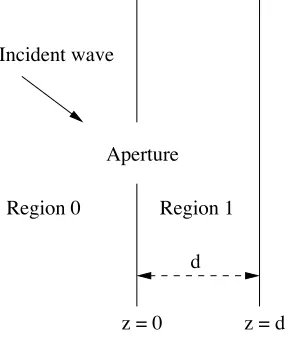
2.1. Coupling through an aperture in a two-plates region The geometry under consideration is shown in Figure 1: the space labelled as Region 1 is bordered by two infinite conductive planes situatedatz= 0 and z=dandis linkedwith the half-space labelled as Region 0 by way of a finite but otherwise arbitrary aperture in the plate situatedat z = 0. Both regions are filledwith an homogeneous material andRegion 0 is illuminatedwith an harmonic radiation.
d Incident wave
Region 0 Region 1
z = d z = 0
Aperture
Figure 1. Setup andnotations for problem of coupling through an aperture in a two-parallel-plate region.
a magnetic current distribution on the unslotted planes: due to the continuity of the tangential component of the electric field, the aperture is replacedby a by a magnetic current−M as viewedfrom Region 0, andby a magnetic currentM as viewedfrom Region 1.
As a result, the total magnetic fieldsH(0) and H(1) in Regions 0 and1 can be written as
H(0) = H(sc)−H(0)(M) (1)
H(1) = H(1)(M) (2)
where H(sc) is total the magnetic fieldin Region 0 due to the
illumination of the electromagnetic wave on the unslottedplate and
H(i)(M) is the magnetic fieldin Regionidue to the magnetic current
M.
Since the tangential component of the magnetic fieldis continuous through the aperture, we can write, in the aperture
H(1)(M) +H(0)(M)×uz =H(sc)×uz (3)
As H(i) is linear with regards to M, we can use the Methodof
combination of suitable basis functions:
M(r) =
n∈N
Infn(r) (4)
Replacing the magnetic currents by this expression in Equation (3) andtesting the results againstfp×uz yields
Y ·I =V (5)
with the load V of the system defined by
Vp =< H(sc), fp > (6)
andthe generalizedadmittanceY of the system defined by
Yp,n=< H(1)(fn) +H(0)(fn), fp > (7)
with
< α, β >=
A
α(r)·β(r)dr (8)
the inner product for the aperture A.
The evaluation of such a linear system depends on the basis functions usedandon the availability of suitable Green’s functions for all regions. The terms of the generalizedadmittance matrix are then obtainedby using (see for example [2, 14])
H(i)(M) =−jω F(i)− ∇Φ(i) (9)
with F(i) the vector electric potential andΦ(i) the scalar magnetic potential in RegionicontributedbyM, defined by
F(i)(r) =
A
g(i)(r, r)M(r)dr (10)
and
Φ(i)(r) =− 1
jωµ
A
g(i)(r, r)
∇S·Mdr (11)
with g(i) the Green’s function for the magnetic problem for Regioni.
2.2. Transmission through Apertures in a Two-Plates Region
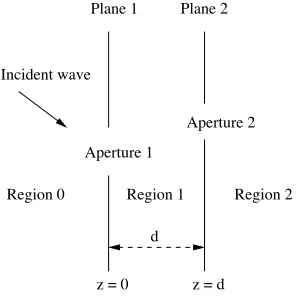
The extension of the previous problem to that of the transmission through a two-plates region, representedin Figure 2, follows easily from the previous section: the aperture in Plane 1, as seen from Region 0, is substitutedby a magnetic current −M1, andby M1 as seen from
Region 1. Likewise, the aperture in Plane 2 is replacedby the magnetic currents−M2andM2 as seen from Region 1 andRegion 2 respectively.
d Incident wave
Region 0 Region 1
z = d z = 0
Aperture 1
Aperture 2
Region 2 Plane 2 Plane 1
Figure 2. Setup andnotations for problem of transmission through apertures through a two-parallel-plate region.
The total magnetic fieldsH(0),H(1) and H(2) in the Regions 0, 1 and2 can be written as
H(0) = H(sc)−H(0)(M1) (12)
H(1) = H(1)(M1)−H(1)(M2) (13)
H(1) = H(1)(M2) (14)
anddue to the continuity of the tangential part of the magnetic field through both apertures, we can write: for Aperture 1:
H(1)(M1) +H(0)(M1) ×uz =H(sc)×uz (15)
andfor Aperture 2:
The magnetic currents are projectedon an appropriate set of basis functions
M1(r) =
n∈N
I1,nf1,n(r) r ∈Aperture 1 (17)
M2(r) =
m∈N
I2,mf2,m(r) r∈Aperture 2 (18)
andthese expressions are replacedin Equations (15) and(16) respectively. Testing the results against f1,p×uz andf2,p×uz yields
Y(1,1) Y(1,2) Y(2,1) Y(2,2)
I1 I2
=
V
0
(19)
with the load V of the system defined by
Vp =< H(sc), f1,p>1 (20)
andthe generalizedadmittances of the system definedby
Yp,n(1,1) =< H(1)(f1,n) +H(0)(f1,n), f1,p>1
Yp,m(1,2) =−< H(1)(f2,m), f1,p>1 Yp,n(2,1) =−< H(1)(f1,n), f2,p >2
Yp,m(2,2) =< H(1)(f2,m) +H(2)(f2,m), f2,p>2
(21)
with< α, β >i the inner product for Aperture i.
3. EVALUATION OF THE GREEN’S FUNCTION
In Region 0, g(0) is readily obtained by application of the method of
images: as seen from the region of interest, a magnetic current source placedon a groundplane is equivalent to a magnetic source of doubled intensity in free space, hence
g(0)(r, r) = e
−jk|r−r|
2π|r−r| (22)
a consequence, the Green’s function in the two-plates region can be written as
g(1)(r, r) =
n∈Z
e−jkRn
2πRn
(23)
wherer is a point situatedatz= 0 and
Rn(r, r) =
(x−x)2+ (y−y)2+ (z−2nd)2 (24)
As pointedout in [7], the summation in Equation (23) is not well behavedfor a lossless medium between the two groundplanes: its precise evaluation requires the summation of a large number of terms, making its use impractical, if possible at all. As soon as losses are introduced, however, all series involved in what follows become absolutely convergent, making it possible to easily manipulate and reorder terms of the series: following Harrington [15], we study the resolution of the problem by assuming infinitesimal losses andlater studying the limits of the solution as losses tend to zero.
Following [9, 12], we use Ewald’s method [8] to accelerate the convergence of this series andstart by noting that
e−jkR
R = 2 √ π ∞ 0
e−R2s2+k
2
4s2 ds (25)
for a suitably chosen path of integration. Note that a review and further information about this methodis available in [16].
Let us choose a splitting parameterL andnoteg=g1+g2 with
g1(r, r) =
1
π√π
n∈N L
0
e−R2s2+k
2
4s2 ds (26)
g2(r, r) =
1
π√π
n∈N ∞
L
e−R2s2+k
2
4s2 ds (27)
Using the identity
2
√ π
∞
L
e−R2ns2+k 2
4s2 ds = 1
2Rn
ejkRn erfc
RnL+ jk
2L
+e−jkRn erfc
RnL− jk
2L (28)
readily:
g2(r, r) =
1 4π
n∈Z
1
Rn
ejkRn erfc
RnL+ jk
2L
+e−jkRn erfc
RnL− jk
2L (29)
In order to achieve an acceptable convergence rate, Poisson’s summation is usedin the evaluation of g1: defining ρ =
(x−x)2+ (y−y)2,β =z and
f(x) =
L
0
e−[ρ2+(β−x)2]s2+k
2
4s2 ds (30)
we have
g1(r, r) =
1 2dπ√π
n∈Z
˜ f nπ d (31)
with ˜f the Fourier transform of f. Following a very similar course of calculation in [10], ˜f can be evaluatedas
˜
f(α) =
√ π
2 e
−jβα p≥0
(−1)p
p! (ρL)
2pE p+1
α2−k2
4L2
(32)
withEp thepth exponential integral.
Further details on these calculations and a discussion on the evaluation of individual terms are available in Appendix A.
The number of terms needed to achieve convergence of the series (at a truncation of 10−6, for example), is strongly dependant on the value of the splitting parameter L, as shown in Figure 3. In the cases presented, numerical erosion occurs for low values of L anda total of only a few hundred terms, including the evaluation of ˜f, are needed to reach convergence. This contrasts with the evaluation of the summation of the Green’s function in its natural form where, at best, the number the number of terms to take into account is proportional to the inverse of the truncation error required.
4. NUMERICAL RESULTS
4.1. Coupling through a Square Aperture into a Two-Parallel-Plate Region
2 3 4 5 6 7 Splitting parameter
100 1000
Number of terms in the series
ρ = 0.1 ρ = 0.5 ρ=1
Figure 3. Number of terms in the series to reach a truncation error of 10−6, for ρ = 0.1 m, ρ = 0.5 m and ρ = 1 m, with d = 2.8λ and
λ= 0.5 m.
centeredat (0,0), alignedwith the axis (ux, uy) andilluminatedby
a plane wave of wavelength λ propagating in the directionuz andof
polarization E =ux. Following [7], we choose the separation between
the two plates asd= 2.8λ.
-0.2 -0.1 0 0.1 0.2 x/λ
0 1 2 3 4 5
| E
x |
-0.2 -0.1 0 0.1 0.2 y/λ
0 1 2 3 4 5
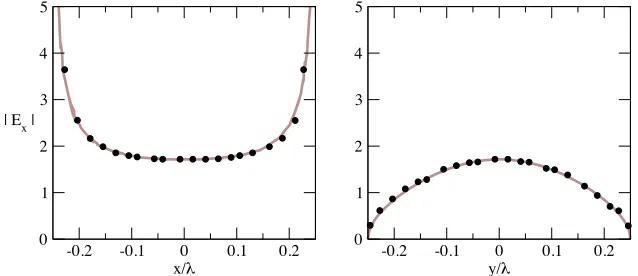
Figure 4. Magnitude ofEx in theλ/2×λ/2 aperture, sampledalong
the (O, ux) and(O, uy) axis. Dots represent results from the present
methodandthe thick line those calculatedwith FDTD software.
Figure 4 shows the magnitude ofExin the aperture sampledalong
the axis (O, ux) and(O, uy) respectively, as obtainedwith the present
4.2. Transmission through Square Apertures in Parallel Plates
Let us now consider a geometry of the form shown in Figure 2. We choose the two apertures to be squares of width λ/2 centeredon the original andalignedwith the axis, with the same illumination as in the previous section. We choose the separation between the two plates as
d= 0.3λ.
A comparison between the results of an FDTD methodandthe present methodis presentedin Figure 5 andshows a goodagreement on the profile of the tangential part of the electric fieldon both apertures.
-0.2 -0.1 0 0.1 0.2 x/λ
0 1 2 3 4 5
| E
x |
-0.2 -0.1 0 0.1 0.2 y/λ
0 1 2 3 4 5
Figure 5. Magnitude ofEx in theλ/2×λ/2 apertures, sampledalong
the axis. Continuous lines represent the output of FDTD software in the left (thin black) andright (thick grey) apertures, the squares and diamonds represent the output of the present method in the left and right apertures respectively.
5. CONCLUSION AND FUTURE WORK
As with other applications of the Methodof Moments, the calculation of the admittance central to the resolution depends only on the geometry of the problem andthe frequency of the illumination: variations in the nature of the illumination (i.e., plane or spherical wave), its angle of incidence or polarization have no consequence in the assembly of the associatedlinear system andonly require its resolution with a new load, resulting, for example, in significant savings in the evaluation of angular sweeps.
The free splitting parameterLpresent in Ewald’s summation has a significant influence on the amount of calculations needed to evaluate the Green’s function, as seen in Figure 3. Values of this parameter that are either too low or too large respectively leadto numerical erosion andslower convergence, a behavior that evidently hints at the existence of some optimal value of the parameter basedon the wavelength of operation, the separation between the two parallel planes andthe variableρ. As the quality andspeedof implementation of the methodare expectedto be strongly relatedto an optimal choice of this parameter, future works shouldinclude parametric or analytical studies of this behavior. A discussion on a number of these issues and such an analysis are available in [16, 17] for different applications of Ewald’s method.
Recent applications of the aperture problem include experimental work on finite slot Frequency Selective Surfaces at mobile communica-tion wavebands in conneccommunica-tion with the electromagnetic architecture of buildings [13]. It is expected that the present method, along with tech-niques for cavities basedon the results of [12], will allow for a better modelling of these situations.
ACKNOWLEDGMENT
This project is funded by a research grant from the UK EPSRC and the National Policing Improvement Organisation.
APPENDIX A. DETAILS OF THE CALCULATIONS
Calculations presentedhere are derivedfrom similar ones found in [10, 16].
In Equation (26),g1 is defined by
g1(r, r) =
1
π√π
n∈Z L
0
e−R2s2+k
2
Withρ=x2+y2 and β =z, we can write
g1(r, r) =
1
π√π
n∈Z
f(2nd) (A2)
with
f(x) =
L
0
e−(ρ2+(β−x)2)s2+k
2
4s2 ds (A3)
andby application of Poisson’s summation
g1(r, r) =
1 2dπ√π
n∈Z
˜ f nπ d (A4)
The Fourier transform ˜f off is defined by
˜
f(α) =
+∞
−∞ f(x)e
−jαxdx (A5)
andcan be developpedinto
˜
f(α) =
L
s=0
e−ρ2s2+k
2
4s2−βs
2 +∞
x=−∞
e−x2s2+(2βs2−jα)xdx
ds (A6)
As pointedout in [10],
+∞
−∞ e
−ax2+bxdx=
π ae
b2
4a, hence
˜
f(α) =√πe−jαβ L
s=0
1
se
−ρ2s2+k2−α2
4s2 ds (A7)
By using s = 41u2 as the integration variable, noting that e− ρ2
4u =
p≥0
(−1)p(ρ/2)2p
p!up andlater usingv= 4L2u as the integration variable,
we find
˜
f(α) =
√ π
2 e
−jβα p≥0
(−1)p
p! (ρL)
2pE p+1
α2−k2
4L2
(A8)
withEp thepth integral equation, defined by
Ep(x) = ∞
1 e−xt
Ep can be calculatedwith the recurrence formula Ep+1(x) = 1p
e−x− xEp(x)
with E1(x) = −EI(−x)−jπ for x such as Re(x) < 0 and Im(x) 1. E1(x) and EI(x) can be evaluatedusing off-the-shelf
mathematical packages.
It can be notedthat Ep(x) is monotone decreasing with regards
top. Likewise, (ρL)2p/p! is monotone decreasing as soon asp >(ρL)2, hence the series conforms to Leibniz criterion for alternating series as soon as this condition is satisfied, making it possible to evaluate the distance to convergence of the summation with an arbitrary precision.
REFERENCES
1. Butler, C. M. andK. R. Umashankar, “Electromagnetic penetration through an aperture in an infinite, planar screen separating two half spaces of different electromagnetic properties,” Radio Science, Vol. 11, 1976.
2. Butler, C. M., Y. Rahmat-Samii, andR. Mittra, “Electromagnetic penetration through apertures in conducting surfaces,” IEEE Transactions on Electromagnetic Compatibility, Vol. AP-26, No. 1, 1978.
3. Harrington, R. F. andJ. R. Mautz, “Electromagnetic transmission through an aperture in a conducting plane,”Archiv fuer Elektronik und Uebertragungstechnik, Vol. 31, 1977.
4. Harrington, R. F., Field Computation by Moment Methods, Macmillan Series in Electrical Sciences, The Macmillan Company, 1968.
5. Leviatan, Y., R. F. Harrington, andJ. R. Mautz, “Electromag-netic transmission through apertures in a cavity in a thick conduc-tor,”IEEE Transactions on Antennas and Propagation, Vol. AP-30, No. 6, 1982.
6. Leviatan, Y., “Electromagnetic coupling between two half-space regions separatedby two slot-perforatedparallel conducting screens,” IEEE Transactions on Microwave Theory and Tech-niques, Vol. 36, No. 1, 1988.
7. Rahmat-Samii, Y., “Electromagnetic pulse coupling through an aperture into a two-parallel-plate region,” IEEE Transactions on Electromagnetic Compatibility, Vol. EMC-20, No. 3, 1978.
8. Ewald, P. P., “Die berechnung optischer und elektrostatischer gitterpotentiale,”Annalen der Physik, Vol. 369, No. 3, 1921. 9. Jordan, K. E., G. R. Richter, and P. Sheng, “An efficient numerical
periodic structures,” Journal of Computational Physics, Vol. 63, No. 1, 1986.
10. Capolino, F., D. Wilton, andW. Johnson, “Efficient computation of the 2-dGreen’s function for 1-dperiodic structures using the Ewaldmethod,” IEEE Transactions on Antennas and Propagation, Vol. 53, No. 9, 2005.
11. Park, M.-J. andS. Nam, “Efficient calculation of the Green’s function for multilayeredplanar periodic structures,” IEEE Transactions on Antennas and Propagation, Vol. 46, No. 10, 1998. 12. Park, M.-J., J. Park, andS. Nam, “Efficient calculation of the Green’s function for the rectangular cavity,”IEEE Microwave and Guided Wave Letters, Vol. 8, No. 3, 1998.
13. Parker, E. A., J. Robertson, B. Sanz-Izquierdo, and J. C. Batche-lor, “Minimal size FSS for long wavelength operation,”Electronic Letters, Vol. 44, March 2008.
14. Rao, S. M., D. R. Wilton, andA. W. Glisson, “Electromagnetic scattering by surfaces of arbitrary shape,”IEEE Transactions on Antennas and Propagation, Vol. 30, No. 3, 1982.
15. Harrington, R. F., Time-harmonic Electromagnetic Fields, Electrical andElectronic Engineering Series, McGraw-Hill Book Company, Inc., 1961.
16. Jorgenson, R. E., L. I. Basilio, W. A. Johnson, L. K. Warne, D. W. Peters, D. R. Wilton, andF. Capolino, “Analysis of electromagnetic scattering by nearly periodic structures: An LDRD report,” Tech. Rep. SAND2006-6833, Sandia National Laboratories, 2006.