Available Online atwww.ijcsmc.com
International Journal of Computer Science and Mobile Computing
A Monthly Journal of Computer Science and Information Technology
ISSN 2320–088X
IMPACT FACTOR: 6.199
IJCSMC, Vol. 8, Issue. 11, November 2019, pg.81 – 86
Novel Approach to Design and
Implement a Multi-Language Convertor
using Machine Learning Techniques
Dr. Zamin Ali Khan
1; M. Haris
2; Syed Rizwan
3Department of Computer Science, IQRA UNIVERSITY, Pakistan
1
Abstract—This paper describes the multi-language translator application which fills in as a mediator connect for two people holding a conversation using various languages. This framework can translate any language which is written or spoken by a client to any language in which the client needs. To achieve this task, our system work on three separate models: voice to text conversion model, text to voice conversion model and translated model. Our translator will help the tourist and businessmen traveling to foreign countries with alien language which is the primary correspondence obstruction between the individual situated in various nations. It will be beneficial for them to find restaurants, toilets, hotels, libraries, etc.
Keywords—Translator, Machine learning, Model, Voice-to-text (vtt), Text-to voice (ttv).
I. INTRODUCTION
The improvements in the field of Science and Technology have made this world a Global village. Modern modes of transportation and communication have bridged the gap between different countries. Modern transportation facilities advanced enough to carry people from one side to the other side of the globe in hours and the communication is fast enough to carry the sound to anywhere in the world in seconds. Different countries have different cultures and without communication, the country is over closed that may cause disaster. As the human history have proven again and again ,the people who don’t share our culture our language we consider them as our enemies, and if we are not able to understand others, and express our feeling and emotions the xenophobia take place [2].
The difference of language proves to be the biggest barrier in bringing this inter connected world further closer to each other where people are bound with each other through economics and commercial interest [3].
read a sentence from Urdu and it will translate it into any foreign language. This translator will greatly help in making communication easier for the people.
II. METHODOLOGY
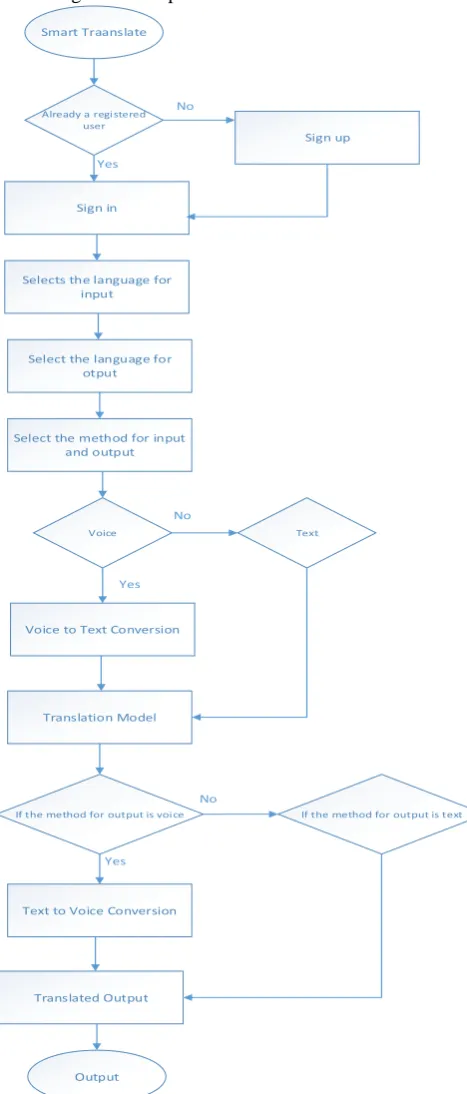
The methodology of multi-language translator application is presented in figure 1. This application depends on three main parts: text to voice conversion, voice to text conversion and translation model. First in the application, user will select how he wants to give the message (text or voice). If he selects the voice then the message goes first to vtt model which converts the voice into text and then translation model or if he selects the text then directly the message goes to translation model. In the last if the user wants output in text then it gives directly output or if the user needs in voice then the input from translated model go towards to ttv model which converts text into voice and then it gives an output.
Smart Traanslate
Already a regi stered user
Sign up
Sign in
Selects the language for input
Select the language for otput
Select the method for input and output
Text Voice
Voice to Text Conversion
Translation Model
Text to Voice Conversion
If the method for output is voi ce If the method for output is text
Translated Output No
Yes
No
Yes
No
A. Text to voice
Text to voice conversion model is a framework in which you input the text in any language which is first analysed then processed and understood and after that model converts the text in to voice. The model of text to voice is shown in figure 2.
Text and Phonetic Analysis
Prosody and Speech Generations Input Text
Voice
Fig. 2. Text to voice generation model
B. Voice to text:
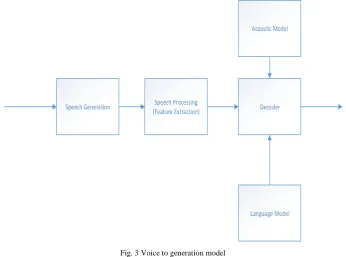
Voice to text framework is utilized for conversion of voice into text. In it voice is an input, then model extracts the features from that voice and after seeing acoustic and language model it decodes the information into text. The framework is shown in figure 3.
Acoustic Model
Speech Processing (Feature Extraction)
Speech Generation Decoder
Language Model
Fig. 3 Voice to generation model
C. Translated model:
Encode Decode
Context
Input
Output
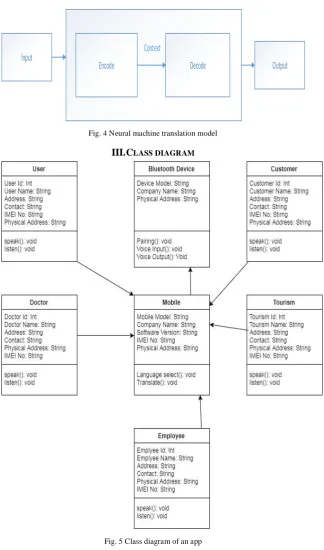
Fig. 4 Neural machine translation model
III.CLASS DIAGRAM
Fig. 5 Class diagram of an app
IV.FUNCTIONAL REQUIREMENT
A. Obstacle Avoidance
C. Do Not Translate Capability:
Cannot be capable of translating every word such as slang languages name of countries and human names. In this application, user can mark the proper nouns or the words which he or she does not want to translate. For example, the word “Pakistan” should not be translated.
D. Comprehensive Dictionaries:
For more perfect translation, specialized dictionaries can be downloaded that contain specific topics.
1) Driver and Passenger: Most of the times drivers find them self in situation where the passengers travelling with them don’t know the same language or at least not fluent in it, this makes it very difficult for them. Especially when the passenger doesn’t know the name of its exact destination.
2) Customer and Employee: Many times people from rural areas of Pakistan come to shop in urban areas to shop and find them self on the pity of others because they are not able to communicate effectively because of the language they speak are not understood by the salesman.
3) Doctors and Patients: Doctor is considered as a noble profession, they help people in the time of sorrow and grief, but sometimes they find themselves bounded by the scenario from helping people in need. For example whenever there is some kind of natural calamity when they have to travel from their region to some far reached and remote areas the barriers of language plays an important part.
4) Tourist: Whenever we plan our trip our first concern is language, we hope that we knew the language so that we could have been familiar the people, with their cultures could have introduced them to our culture and make the world free from xenophobia, we could have shop freely, could have visited any place of our.
V. APPLICATION USER INTERFACE
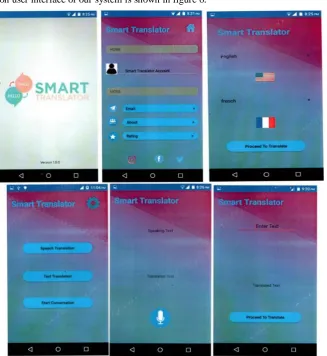
The application user interface of our system is shown in figure 6.
VI.COMPARISON
Table 1. describes the comparison among the different similar systems and propped system
TABLE I
COMPARISON AMONG PROPOSED AND OTHERS
Proposed design
[1] [4] [6]
More than 15 can be translated
Only Arabic is translated 4 language is translated 5 Indian regional languages
70% to 80% accuracy 70% to 80% 60% to 76% accuracy
- 1-2 sec to translate a
sentence
2-3 sec to translate a sentence 1-2 sec to translate a sentence
-
VII. CONCLUSIONS
The purpose of smart translation application is to connect people of different countries by breaking the language barrier. It will help tourist, passenger’s doctors, and even employees who are facing the language issue this system will definitely help them to communicate with each other. Through this application you can even learn new languages.
ACKNOWLEDGEMENT
This research work was supported and granted by Prof. Engr. Dr. M. Zamin Ali Khan, the Head of Computer Science Department in IQRA University, Karachi.
REFERENCES
[1] Lavie, L. Levin, T. Schultz, and A. Waibel, “Domain portability in speech-to-speech translation,” in HLT2001, San Diego, California, 2001.
[2] T. Schultz and A. Waibel, “Language independent and language adaptive acoustic modeling for speech recognition,” Speech Communication, vol. 35, no. 1-2, pp. 31–51, 2001.
[3] https://en.wikipedia.org/wiki/Translation
[4] A. Lavie, et al. “A multi-perspective evaluation of the NESPOLE! speech-to-speech translation system,” in Proceedings of ACL 2002 workshop on Speech-to-speech Translation: Algorithms and Systems, Philadelphia, PA., 2002
[5] A. Black, R. Brown, R. Frederking, R. Singh, J. Moody, and E. Steinbrecher, “Tongues: Rapid development of a speech-to-speech translation system,” in HLT2002, San Diego, California, 2002, pp. 2051–2054.