A Summary of Literature Pertaining to the Use of Concept
Mapping Techniques and Technologies for Education and
Performance Support
The Institute for Human and Machine Cognition 40 S. Alcaniz St.
Pensacola FL 32502 www.ihmc.us
prepared for
The Chief of Naval Education and Training
Pensacola FL 32500
July 2003
Principal Investigator: Alberto J. Cañas Research Team: John. W. Coffey Mary Jo Carnot Paul Feltovich Robert R. Hoffman Joan Feltovich
Table of Contents
List of Figures1. Executive Summary
1.1. Background and Theory Pertaining to Concept Maps
1.2. Educational, Business, and Governmental Uses of Concept Mapping 1.3. Limits on Our Ability to Report
1.4. Major Conclusions of this Report
2. Construction Methods and Styles for Concept Maps 2.1 Distinguishing Characteristics of Concept Maps 2.2 An Example Concept Map
2.3 A Basic Concept Map Construction Method 2.4. Variations on the Basic Method
2.5 Collaboration in the Construction of Concept Maps.
2.6 Facilitation in Map Construction: Human Facilitators and Computer Support 3. Applications in Educational Settings
3.1 Uses of Concept Maps as a Tool for Support of Learning
3.1.1 Identifying current understanding, misconceptions, conceptual change
3.1.2 Collaboration and Cooperative Learning 3.2 Assessment of Learning Using Concept Maps
3.2.1 The Utility of Using Concept Maps for Assessment 3.2.2. Methods of Scoring Concept Maps
3.2.3 Reliability and Validity of Concept Maps for Assessment 3.3 Uses of Concept Maps to Organize and Present Information
3.3.1 Concept Maps as “Advance Organizers”
3.3.2 Concept Maps for Course or Curriculum Development 3.3.3 Use of Concept Maps for Navigation Support
3.4 Evidence of Effectiveness of Concept Mapping for Education
3.4.1 Studies with Random Assignment of Learners to Conditions 3.4.2 Studies in which Classes were Randomly Assigned to Conditions 3.4.3 Studies that Utilized Extant Methods of Instruction
3.4.4 Studies in which an Alternative Educational Intervention was compared to Concept Mapping
4. Applications in Business and Government Settings
4.1 Concept-Mapping as a Technique for Eliciting Knowledge
4.1.1 Using Concept Mapping to Reveal Expert-Novice Differences. 4.1.2 Using Concept Mapping With Domain Experts to Support the Design
of New Technologies
4.1.3 Evaluation of Concept Mapping as a Method for Knowledge Elicitation (KE) With Experts
4.1.4 Using Concept Mapping as a Method in Software-Assisted Knowledge Acquisition (SAKA)
4.2 Concept Mapping for Knowledge Management 4.2.1 Brainstorming
4.2.2 Knowledge Sharing
4.2.3 Training and Performance Support 4.2.4 Institutional Memory Preservation 4.3 Other Examples from Industry
4.4 Other Applications in Military Settings 5. Software Support Tools
5.1 Introduction: Tool Types and Purposes 5.1.1 General Diagramming Tools 5.1.2 Visualization Tools
5.1.3 Knowledge/Memory Management Tools 5.2 Concept Mapping Tools
5.2.1 Commercial Tools
5.2.2 Research Tool
5.3 A Semantic Networking Tool 5.4 Mind Mapping Tools
5.5 Decision Making Tools/Group Organizers 6. Summary and Conclusions
7. References 8. Appendices
Appendix A - Other Mapping Systems
List of Figures
Figure 1. A Concept Map that describes Concept Maps.
Figure 2. A Concept Map pertaining to Mars Exploration Strategies.
Figure 3. A Concept Map in progress on Solar Radiation from Navy student Aerographers.
Figure 4. The final Concept Map on Solar Radiation from the Navy student Aerographers.
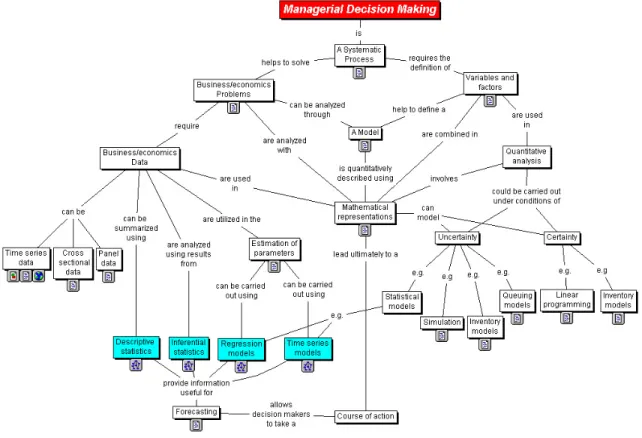
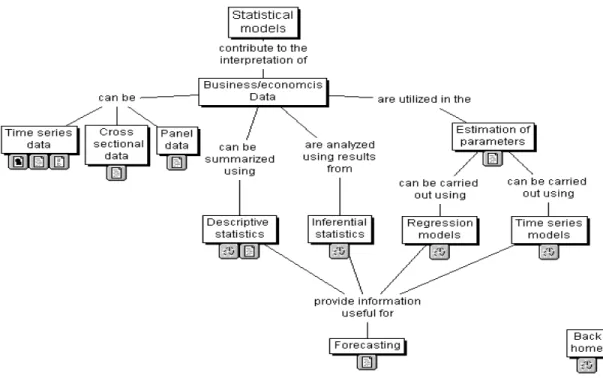
Figure 5. Top Level Map for Managerial Decision Making Figure 6. A Detailed Map pertaining to Statistical Models
Figure 7. Top Level Curriculum Map developed by Edmondson and colleagues. Figure 8. Example of Graphical Browser Screen from Carnot et al. 2001.
Figure 9. A Concept Map pertaining to People, Responsibilities and Activities in a Ear, Nose, and Throat Practice.
Figure 10. The Interface to El-Tech, a Performance Support System for Electronic Technicians.
Figure 11. A Depiction of a Global Process Knowledge Map. Figure 12. A Knowledge Map from TCU.
Figure 13. An Example of Fisher's style of Semantic Network Figure 14. A Cognitive Map made with Decision Explorer Figure 15. A Mind Map
1. Executive Summary
Concept Maps are diagrams that represent organized knowledge (Novak & Gowin, 1984). This report is a summary and integration of published literature on the uses of Concept Maps to support human learning and workplace performance. It contains a summary of studies pertaining to the effectiveness of Concept Mapping for these purposes, and a description of commercial products that support Concept Mapping and related activities. The main goal of this report is to identify and highlight areas of application of Concept Mapping for learning (training, knowledge sharing, etc.) and performance support (decision-aiding, knowledge preservation, etc.).
1.1. Background and Theory Pertaining to Concept Maps
Concept Maps are graphical representations of knowledge that are comprised of concepts and the relationships between them. We define a concept as a perceived regularity in events or objects, or a record of events or objects, designated by a label.
Concepts are usually enclosed in circles or boxes, and relationships between concepts are indicated by connecting lines that link them together. Words on the linking line specify the relationship between the concepts. The label for most concepts is a single word, although sometimes we use symbols such as + or %. Concept-link-concept triples form
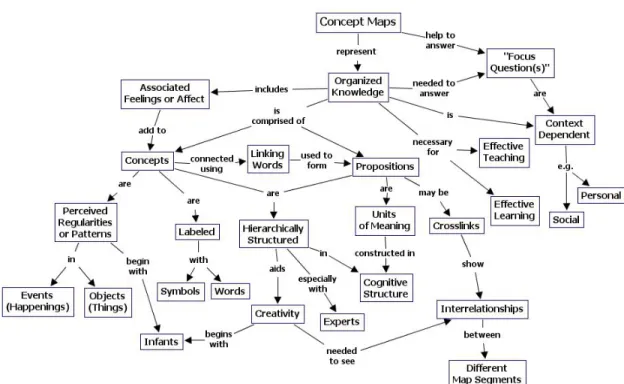
propositions, which are meaningful statements about some object or event. Sometimes these are called semantic units, or units of meaning. Figure 1 presents a Concept Map pertaining to Concept Maps.
Another characteristic of Concept Maps is that the concepts are represented in a hierarchical fashion with the most inclusive, most general concepts at the top of the map and the more specific, less general concepts arranged below. The hierarchical structure for a particular domain of knowledge also depends on the context in which that knowledge is being applied or considered. Therefore, it is best to construct Concept Maps with reference to some particular question we seek to answer, which we have called a
focus question. The Concept Map may pertain to some situation or event that we are trying to understand through the organization of relevant knowledge, thus providing the context for the Concept Map.
Also important and characteristic of Concept Maps is the inclusion of “ cross-links.” These make explicit relationships between or among concepts in different regions or domains within the Concept Map. Cross-links show how a concept in one domain of knowledge represented on the map is related to a concept in another domain shown on the map. In the creation of new knowledge, cross-links often represent creative leaps on the part of the knowledge producer. An example in Figure 1 is the proposition “Perceived Regularities or Patterns begin with Infants” which is cross-linked to the proposition “Creativity begins with Infants.”
A final aspect of the structure of Concept Maps is the inclusion of specific examples of events or objects. These can help to clarify the meaning of a given concept. Normally these are not included in ovals or boxes, since they are specific events or objects and do not represent concepts.
Figure 1. A Concept Map that describes Concept Maps.
Concept Maps were developed in the course of Novak’s research program in which he sought to follow and understand changes in children’s knowledge of science. Novak’s work was based on the learning psychology of David Ausubel (1968, 1978). The fundamental idea in Ausubel’s cognitive psychology is that learning takes place by the
assimilation of new concepts and propositions into existing concept and propositional frameworks held by the learner. This knowledge structure as held by a learner is also referred to as the individual’s cognitive structure.
One of the most fundamental goals in the use of Concept Maps is to foster meaningful learning. Ausubel made the very important distinction between rote learning
and meaningful learning, and stated that meaningful learning requires three conditions: 1. The material to be learned must be conceptually clear and presented with
language and examples relatable to the learner’s prior knowledge. Concept Maps can be helpful to meet this condition, both by identifying general concepts prior to instruction in more specific concepts, and by assisting in the sequencing of learning tasks though progressively more explicit knowledge that can be anchored into developing conceptual frameworks.
2. The learner must possess relevant prior knowledge. This condition can be met after age 3 for virtually any domain of subject matter, but it is necessary to be careful and explicit in building concept frameworks if one hopes to present detailed specific knowledge in any field in subsequent lessons. We see, therefore, that conditions (1) and (2) are interrelated and both are important.
3. The learner must choose to learn meaningfully. The one condition over which the teacher or mentor has only indirect control is the motivation of students to choose to learn by attempting to incorporate new meanings into their prior knowledge, rather than simply memorizing concept definitions or propositional statements or computational procedures. The creation of Concept Maps supports the incorporation of new meanings into prior knowledge.
Another very powerful use of Concept Maps is as an evaluation tool, thus encouraging students to use meaningful-mode learning patterns (Novak & Gowin, 1984; Novak, 1998; Mintzes, Wandersee & Novak, 2000). Concept Maps are also effective in identifying both valid and invalid ideas held by students. This use will be discussed further in another section. They can be as effective as more time-consuming clinical interviews for identifying the relevant knowledge a learner possesses before or after instruction (Edwards & Fraser, 1983).
There is an important relationship between the psychology of learning, as we understand it today, and the growing consensus among philosophers and epistemologists that new knowledge creation is a constructive process involving both our knowledge and our emotions or the drive to create new meanings and new ways to represent these meanings. Learners struggling to create good Concept Maps are themselves engaged in a creative process, and this can be challenging to many, especially to learners who have spent most of their life learning by rote. Rote learning contributes very little at best to our knowledge structures, and therefore cannot underlie creative thinking or novel problem solving. Concept Mapping is an excellent exercise for the promotion of creative thinking and identification of new problem-solving methods.
1.2. Educational, Business, and Governmental Uses of Concept Mapping
Concept Mapping has been put to many uses in education, business and government. One of the original uses in education was for the assessment of what a learner knows. Concept Maps can be used to externalize and make explicit the conceptual knowledge (both correct and erroneous) that students hold in a knowledge domain. The process of Concept Mapping for educational purposes can foster the learning of well-integrated structural knowledge as opposed to the memorization of fragmentary, unintegrated facts.
In educational settings, Concept Maps can also be used to organize instructional materials for individual courses or entire curricula. Concept Maps have been used to serve as navigational aids for hypermedia, as a scaffold for understanding, for consolidation of educational experiences, to improve affective conditions for learning, as an aid or alternative to traditional writing, and to teach critical thinking.
Concept Maps and Concept Mapping also have utility in corporate and governmental organizations. To the degree that these entities carry out education and training of their personnel, educational applications are pertinent here as well. Furthermore, Concept Mapping can be used for knowledge capture – for the elicitation of expert knowledge that an organization might wish to preserve and share with others. In
addition, Concept Mapping can be used in support of group processes such as brainstorming. A Concept Map’s concise, visual representation of knowledge “at a glance” can simplify the conveyance of understandings, and fosters discussion. Concept Maps can serve as a tool for reaching consensus through the creation and refinement of a Concept Map upon which members of a group can agree.
1.3. Limits on Our Ability to Report
A great deal of literature pertains to the use of Concept Mapping for educational purposes in educational settings. It is natural that this area would contain a large body of literature since it is in educational settings that Concept Mapping originated. The shear volume of this literature makes it infeasible to perform a truly comprehensive review in which each and every report is summarized in detail.
The opposite problem seems to exist in the uses of Concept Mapping tools and similar knowledge representations to enhance workplace performance. The use of such tools in competitive corporate settings is often viewed as an element of competitive advantage that companies are somewhat reluctant to share. For this reason, public literature pertaining to specific uses of Concept Mapping and similar strategies in business settings tends to be much less voluminous and somewhat more superficial and anecdotal than literature from educational settings.
1.4. Major Conclusions of this Report
Concept Maps differ from other types of mapping systems, such as Knowledge Maps, Conceptual Graphs, and Mind Maps because of: their grounding in Ausubel’s Assimilation theory of learning, their semantic and syntactical (structural) organization, the nature of concepts that comprise the nodes in a Concept Map, and the unconstrained nature of linking phrases. A standard procedure for Concept Map construction involves defining the topic or focus question, identifying and listing the most important or “general” concepts that are associated with that topic, ordering the concepts from top to bottom in the mapping field, and adding and labeling linking phrases. Once the preliminary Concept Map has been built, cross-links are identified and added, and a review of the map for completeness and correctness is performed.
Several alternative approaches to Concept Map construction exist. Some of these mapping variations are based on the use of software tools, the pre-specification of concepts and/or link labels, and individual versus collaborative mapping. Individually produced Concept Maps and those produced by groups can be made with the assistance of human or software-based facilitation. Many facilitation procedures are possible in Concept Map construction, ranging from support provided to novices who are learning to create Concept Maps, to support of a group of experts who work in conjunction with a facilitator or knowledge engineer.
Efficacy studies reveal that when Concept Mapping is used in a course of instruction, it is better that it be an integral, on-going feature of the learning process, not just some isolated “add-on” at the beginning or end. In this regard, Concept Mapping appears to be particularly beneficial when it is used in an on-going way to consolidate or
crystallize educational experiences in the classroom, for example, a lecture, demonstration, or laboratory experience. In this mode, learners experience an educational event and then use Concept Mapping in a reflective way to enhance the learning from the event. There is also indication that learning effects are enhanced when in the course of Concept Mapping learners adopt an active, deep and questioning approach to the subject matter. Such active, self-engaging, transformational interaction with learning material has been suggested to enhance learning in general (e.g., Feltovich, Spiro, & Coulson, 1993) and this appears to carry over to learning with Concept Maps as a tool.
When Concept Mapping is compared with other sorts of activities, such as outlining or defining concepts, that also can induce the learner to take a thoughtful, systematic approach to engaging subject matter, the positive benefit of Concept Mapping often diminishes (a finding noted also in the review by Horton, 1993). However, even in these situations, it appears that Concept Mapping is especially good, in comparison to other interventions, for the learning of relationships among concepts.
From several of the studies reviewed, there is indication that Concept Mapping may be particularly beneficial for lower ability learners, partly because it does induce the active, inquiring, orderly approach to learning that is likely a more natural part of the higher ability student’s approach to learning. On the other hand, when learners are not yet facile with constructing Concept Maps, there is some indication that the cognitive load of creating maps from scratch may hinder learning. When students are novice mappers, other “scaffolded” ways of interacting with Concept Maps, for example, filling in the blank content nodes of a Concept Map already containing the labeled relationships of a completed Concept Map, may be beneficial.
Numerous educational applications of Concept Mapping can be identified. Including as: 1) a scaffold for understanding, 2) a tool for the consolidation of educational experiences, 3) a tool for improvement of affective conditions for learning, 4) an aid or alternative to traditional writing assignments, 5) a tool to teach critical thinking, 6) a mediating representation for supporting interaction among learners, and 7) an aid to the process of learning by teaching. Several studies were examined in which Concept Mapping was used to identify students’ current understandings, misconceptions and conceptual change. Concept Maps have been used in collaboration and cooperative learning, and as a formal assessment tool. Concept Maps have been used to organize and present information, including use as an Advance Organizer, use by instructors for course or curriculum design, and use as a navigational aid in hypermedia.
A major lesson learned regarding the use of Concept Maps in educational settings is that the nature of the learner’s mental interaction with the subject matter to be learned during the building of the concept map is key to the learner’s achievement. The interaction cannot be passive if learning is to occur. Concept Mapping is greatly enhanced when a teacher (or other “facilitator” working with a learner), the learner him of herself, a device (e.g., computer generated prompts), or the nature of the interaction in a learning group promotes active inquiry and organization by asking questions, prompting for explanation and justification, requesting clarification, requesting
embellishment, encouraging connection among elements, encouraging the learner to formulate questions about the material, and so forth.
Another lesson is that with regard to scoring methods for Concept Maps, a number of methods have been developed which do not seem to be as indicative of the structure of knowledge as traditional Concept Map scoring methods, but rather are focused on the proposition or concept level. These methods may show greater agreement with traditional measures of achievement but basing assessment of achievement on the inclusion of simple propositions or concepts is unlikely to motivate learners to learn new information in a meaningful and structured way.
With regard to the use of Concept Maps for navigation, another lesson is that the structure of Concept Maps that are carefully constructed may assist learners in finding information more quickly. However, maps constructed to be effective in communicating the structure of information cannot be too complex. Training in concept mapping may be useful in helping learners use the linking phrases and concepts in the map more effectively for learning. However, to some extent the value of the map will depend on the user’s goals – whether those goals are to find the answer to a specific question or problem, or to learn more about the structure of a particular domain of knowledge. Map characteristics such as organization, color coding, and animation may be important in determining the utility of concept maps used for navigation; however these characteristics are largely unexplored, except in anecdotal evidence (and a few exceptions from TCU group).
Finally, both concept maps and collaborative learning have been shown to have educational benefits. Another lesson is that the two can be combined to produce synergistic beneficial effects. This can be useful in promoting collaborative activities among learners and in enhancing the process of knowledge construction. More active involvement in learning can be provided by the concurrent use of these techniques. Current technology and software have provided the capability of networked and remote collaboration. This makes the benefits of collaborative concept mapping more accessible for both educational and business uses. Appendix 2 provides a partial summary of these domains.
Concept Mapping has had widespread use as a knowledge elicitation (KE) tool. In terms of its yield of propositions that are informative about a domain, Concept Mapping is at least as efficient as other available KE methods. Concept Mapping is likely the most efficient method for generating models of domain knowledge. As a KE procedure, it has been successfully employed to form mediating representations and interfaces for intelligent software (i.e., knowledge-based systems and tutoring systems).
Software systems that have been developed using concept Mapping, and software systems that utilize Concept Maps (i.e., as interfaces) have generally been based on a satisficing criterion. Evidence of usefulness, usability, performance enhancement, or organizational effectiveness is not provided. However, this application of Concept Maps has a clear track record of successful demonstrations in a range of domains. Further
research is needed to demonstrate usefulness, usability, and net performance gain using Concept Map-based knowledge acquisition or Concept Map-based intelligent systems.
The recognition that the aggregate knowledge of an organization is a valuable asset that must be protected, maintained and augmented, has created a rapidly escalating interest in knowledge elicitation and representation, facilitation of brainstorming techniques through concise, graphical representations of knowledge, etc. The literature suggests that a variety of representation schemes are needed to capture the full gamut from conceptual knowledge to procedural knowledge. Clearly, it is important to choose “the right representation for the job,” but for many jobs, Concept Maps quite clearly have a role to play in the form of a simple, intuitive knowledge representation scheme.
Many of the studies pertaining to Concept Mapping uses in business and industry are preliminary. We believe this is so because many organizations are just now attempting to ramp up large-scale capabilities to preserve, generate and share knowledge. The quality of the work that is reported is variable. It is clear that it is difficult to require already over-worked employees to perform additional tasks pertaining to knowledge capture. On the other hand, clear successes such as those described by McNeese et al. (1990), suggest that uses of graphical tools such as concept maps have a part to play in knowledge generation, capture and representation.
The military studies illustrate a range of uses for Concept Maps in military settings. There is substantial overlap with the uses that have been identified in the civilian sector: teaching and learning, brainstorming, expertise capture for knowledge-based systems, etc. It is quite clear that group elicitation and brainstorming approaches could be quite useful for mission planning and other strategic and tactical planning.
Numerous graphical software packages and tool suites can be used as learning devices, for knowledge elicitation and representation, for brainstorming, etc. A number of these tools are general-purpose diagramming packages that allow the user to create many kinds of graphical representations. Other software tools are more special-purpose with specific capabilities such as the ability to advise the user or enforce creation of a specific type of diagram, to link to a database, to generate html representations of the maps they are used to create, etc.
With regard to software tools used to create Concept Maps and similar representations, two basic distinctions may be identified. The first distinction is between general drawing tools that can be used to create a variety of diagram types but do not provide guidance in the effective construction of any given type, and more special-purpose tools that cannot be used to create as many different types of diagrams. While the general tools offer flexibility, they typically do not provide guidance in the effective construction of any given type of diagram. The special purpose tools give more targeted help on the types of diagrams they can be used to create. They all have their own unique
characteristics with regard to how general or special-purpose they are, the sorts of diagrams they support, and the level of help they provide to the user.
The second distinction involves the quality of the representations themselves. A well-conceived software package that is used to create representations that are not particularly rich, or that do not fit the intended purpose of the user, may not be very useful. On the other hand, a powerful tool that is difficult to use or only supports a limited range of not particularly rich representations is not ideal either.
2. Construction Methods and Styles for Concept Maps
Numerous mapping systems have been developed that enable the graphical depiction of ideas and concepts, e.g., Concept Maps, Knowledge Maps, Mind Maps, Cognitive Maps, and Semantic Networks. Concept Maps differ from these other superficially similar types of representations in a variety of ways. Essentially, Concept Maps are defined by:
1. Their theoretical basis in Ausubel’s Assimilation Learning theory and constructivist epistemology
2. Their semi-hierarchical organization,
3. The use of unconstrained and meaningful linking phrases, and 4. The way concepts are defined.
The other similar representations are discussed in Appendix A. 2.1 Distinguishing Characteristics of Concept Maps
This chapter presents an elaboration of these distinguishing characteristics of Concept Maps, followed by some examples of Concept Maps. A standard method of Concept Map construction is presented along with variations, such as map facilitation procedures or interviews, and mapping by groups in collaborative settings, rather than by individuals.
Underlying Theory. Concept Mapping is grounded in a sound cognitive learning theory, Ausubel’s Assimilation Theory (Ausubel, 1968; Ausubel, Novak, & Hanesian, 1978). Assimilation theory posits that new knowledge can be learned most effectively by relating it to previously existing knowledge. Concept Maps may be viewed as a methodological tool of Assimilation theory that displays fundamental elements of the theory such as subsumption, integrative reconciliation and progressive differentiation. Semi-Hierarchical Organization. The basic motivation for the hierarchical arrangement of concepts in Concept Maps comes from Ausubel's notion of subsumption, that more general, superordinate concepts subsume more specific, detailed concepts. This theoretical notion translates to an arrangement of concepts from those that are more general toward the top of the page, with those that are more specific or detailed distributed beneath. In practice, the concepts in Concept Maps are not arranged in a strict hierarchy, but are arranged in a semi-hierarchical manner. Concept Maps allow for the representation of non-hierarchical relationships or cross-links, as well as other types of non-hierarchical arrangements.
Labeled Links. Another defining factor of Concept Maps is the use of linking phrases between concepts. Novak & Gowin (1984) state that a linking phrase should join concepts to form a meaningful proposition, which is a basic unit of knowledge according to the theory of meaningful learning and Ausubel’s Assimilation Theory. Concept mapping theory does not constrain the labels that can be used, allowing map makers more freedom and precision in describing the relationships among concepts. Researchers using other types of graphing methods have prescribed a limited number of linking phrases that,
they claim, can be used universally. Alternative policies regarding the use of linking phrases are described in the Appendix on other mapping systems.
Definition of Nodes. All of the graphing systems we have mentioned make some distinction between nodes and links. In Novak & Gowin’s (1984) seminal work on Concept Mapping, a concept is defined as a “perceived regularity in objects or events”. Though one must accommodate the fact that concepts can denote things that cannot be perceived (e.g., unicorns), this remains a good working definition. Typically a concept is expressed using one or just a few words, one of which is a noun or gerund. Other graphing systems maintain this definition of concept (e.g., Fisher, 1990; Jonassen, 2000; Herl, O’Neil, Chung & Schachter, 1999; O’Neil, 1999). However, the Mind Mapping methodology (Buzan & Buzan, 1996) allows for concepts (or nodes) that can be images, thoughts, ideas, or sentences. In Cognitive Mapping (Ackerman & Eden, 2001; Eden & Ackerman, 2001), the nodes are regarded as “ideas,” which can be sentences or paragraphs. In the Texas Christian University (TCU) version of Knowledge Mapping, (Bahr & Dansereau, 2001; Chmeilewski & Dansereau, 1998; Lambiotte, Skaggs & Dansereau, 1993; O’Donnell et. al., 2002; Rewey, Dansereau & Peel, 1991) which uses a restricted set of linking phrases, nodes are sometimes concepts in the sense that we understand them, and sometimes ideas or even entire paragraphs. Limiting node contents to concepts allows for a more explicit representation of the interrelationships among concepts, and is a defining characteristic of our notion of Concept Maps.
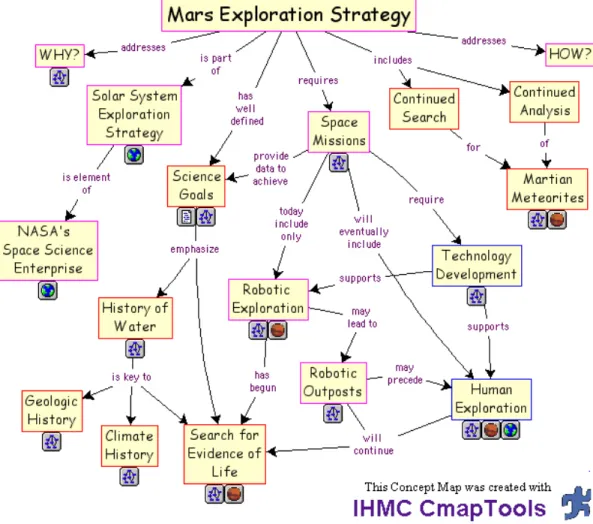
Figure 2. A Concept Map pertaining to Mars Exploration Strategies.
2.2 An Example Concept Map
This section contains an example of a Concept Map that illustrates their defining characteristics. Figure 2 presents a Concept Map that was created in work performed at NASA Ames research Center. The Concept Map was created by an expert in Mars exploration who had received minimal training in Concept Map construction, but who quickly became highly proficient at map creation.
The concepts in this Concept Map are surrounded by boxes, and the Linking Phrases reside on the directed arcs between the concepts. The linking lines are all labeled with Linking Phrases that make explicit the relationships among the concepts. The concepts are single words or short phrases rather than sentences or paragraphs. The Concept Map contains many concepts that are richly interconnected. Concept, link, concept triples read propositionally as in the proposition “Science Goals emphasize Search for Evidence of Life.” The Map includes several cross-links that illustrate the conceptual interconnectedness of the concepts. The proposition “Space Missions provide data to achieve Science Goals,” is an example of cross-linked concepts.
The Concept Map has a basic ordering of the concepts from general to specific from the top to the bottom, illustrating Ausubel’s notion of subsumption. At the top of the Concept Map, the most general, superordinate concept, “Mars Exploration Strategy” appears. Just below that are several concepts such as “How,” “Why,” “Continued Search,” and “Continued Analysis.” Further down in the map are more detailed concepts such as “Robot Exploration” and “Human Exploration.”
2.3 Construction Methods for Concept Maps
Concept Maps can be constructed by using a variety of methods. The method that is employed depends on the purpose of map construction. Concept Maps can be constructed either by hand or with the assistance of software that supports specific tasks or general diagramming. Concept Maps can be constructed by individuals or groups, either with or without facilitation.
A Standard Concept Map Construction Method. The Concept Mapping method defined by Novak & Gowin (1984) involves a series of steps.
1. Define the topic or focus question. Concept Maps that attempt to cover more than one question may become difficult to manage and read.
2. Once the key topic has been defined, the next step is to identify and list the most important or “general” concepts that are associated with that topic.
3. Next, those concepts are ordered top to bottom in the mapping field, going from most general and inclusive to the most specific, an action that fosters the explicit representation of subsumption relationships (i.e., a hierarchical arrangement or morphology).
4. Once the key concepts have been identified and ordered, links are added to form a preliminary Concept Map.
5. Linking phrases are added to describe the relationships among concepts.
6. Once the preliminary Concept Map has been built, a next step is to look for cross-links, which link together concepts that are in different areas or sub-domains on the map. Cross-links help to elaborate how concepts are interrelated.
7. Finally, the map is reviewed and any necessary changes to structure or content are made.
Figure 3 presents a Concept Map that illustrates several points regarding Concept Map construction. It is a Concept Map that is in-progress by Navy students. They started by identifying and entering many of the important concepts that they wanted to consider. Some of the concepts have been linked together by linking phrases. The concepts in the lower right portion that are not yet linked into other concepts are part what we call the “parking lot” where concepts for which relationships haven't been established are located. The students creating this Concept Map are on step 4 from the previous list. They have defined a question, “What is Solar Radiation?” They have identified and entered the basic concepts, distributed them from general to specific, and started linking them together.
Figure 3. A Concept Map in progress on Solar Radiation from Navy student Aerographers.
Figure 4 contains the final version of the Concept Map from Figure 3. Students have completed the process of identifying concepts, adding several more to the previous map. They have linked the concepts together, and identified cross-links. This map displays a good vocabulary of concepts for novice Aerographers, and a well-integrated set of linking phrases.
The long, sweeping links among “Greenhouse effect”, “Short waves,” and “Absorption,” illustrate the cross-links. Although the labeling of the cross-links could be improved, the fact that they are there at all indicates that the students had some sense that a relationship exists among these rather disparate concepts. Concept Mapping facilitates the learning process by allowing the instructor to identify missing or irrelevant concepts, trivial or incorrect linking phrases, etc. The Concept Map provides the basis for discussions between students and their instructors, to clarify relationships such as the one depicted, and generally to gain a better understanding of the subject matter.
Figure 4. The final Concept Map on Solar Radiation from the Navy student Aerographers.
It should be noted that the process described here contains descriptions of the activities that typically occur in a successful Concept Mapping effort. It is rare that the actual process unfolds in such a clearly proscribed, sequential fashion. Often, Concept Map creators simply jump right in, creating concepts and linking them together. As in the conduct of most processes, more initial thought and overall systematicity fosters better results. The next sections describe other methods of Concept Map construction.
2.4 Variations on the Standard Map Construction Method.
A characteristic of the standard method of Concept Map construction described above is that the only constraints are the structural format of the map (subsumption expressed in a semi-hierarchy), and the limits imposed by using appropriate concepts and linking words. This method is preferred because it allows the creator freedom in the representation of knowledge. Other methods of map construction have been used to serve a variety of goals, including ease of computer implementation, ease of construction by students and so forth. Researchers from CRESST have described and compared a number of Concept Mapping techniques (Ruiz-Primo et al., 2001).
Ruiz-Primo et al. (2001) suggested that the degree of control or directedness in map construction differs in different mapping tasks. Map builders can be given the structure of the Knowledge Map, and lists of concepts and linking words to use to fill in the slots in the graph (a fill-in task). At the opposite extreme, the creator may be required to provide all concepts and linking phrases (a graph-from-scratch task). Aside from encouraging the semi-hierarchical format, the method proposed in Novak & Gowin (1984) method is a low-directedness mapping task. Ruiz-Primo et al. (2001) have suggested that graph construction tasks that are low in directedness may provide clearer insights into differences among students’ knowledge structures.
Other Concept Mapping methods include variations designed to address specific tasks or settings. For example, Concept Maps can be constructed on the basis of interviews with students, experts, or other individuals. Concept Maps can be constructed by individuals or by collaborative groups, either in the same location or in remote locations, facilitated by computer networks. Concept Maps can be constructed with or without the use of a facilitator, either within a group or an individual setting. In either case, the facilitator may simply play the role of transcriptionist, or may actively promote elaboration or clarification of ideas in the Concept Map, and improvement of map structure. Concept mapping software has been designed to provide different types of facilitation for map construction, including online scoring and assessment of maps, or suggestions about improvements that may be made to the Concept Map.
2.5 Collaboration in the Construction of Concept Maps.
Although the standard method of Concept Mapping presumes that a Concept Map can be made to represent an individual’s current level of knowledge and understanding, in many cases Concept Maps can be constructed as part of a collaborative group process. Concept Mapping can facilitate the exchange of information in a group, can make the viewpoints of individual collaborators more clear, and can encourage participation in the collaborative process. In educational settings, collaborative Concept Maps have been used for group projects, and have been compared to other types of group projects such as posters (e.g., Van Boxtel, Van der Linden & Kanselaar, 1997, 2000). In business settings, Concept Maps have been used to facilitate discussions among different groups within a company. Creation of collaborative Concept Maps by experts has been used to preserve organizational knowledge (Huff & Jenkins, 2002; Johnson & Johnson, 2002) Other types of graphing methods have been used in business for the purpose of problem solving and project management.
Collaborative creation of Concept Map may take many forms. Sessions may be conducted face-to-face or at a distance, and may be synchronous (all participants working concurrently) or asynchronous (e.g.: one collaborator completes edits and then another collaborator edits). Collaborations in the construction of Concept Maps in any of the contexts described in the previous paragraph can be performed locally or at a distance and synchronously or asynchronously.
As in the case of individual map construction, a well-defined focus question must be formulated. One method of collaborative Concept Map construction entails group identification of concepts and their relationships. One means of improving efficiency in group Concept Map creation is by the identification of a group moderator and a recorder or “driver” who actually records the concepts and builds the Concept Map. Negotiation and compromise must take place in the group construction of a Concept Map. It should be noted that participants might have irreconcilably different opinions that are made evident by the process. Such differences can cause the mapping process to stall. In such cases, it is probably best to separate out the conflicting ideas into two Concept Maps, and continue in separate groups. An attempt to reconcile differences can be made when both positions are clearly mapped.
Another form of collaboration in Concept Map construction is allowing the user access to related maps in development by others. There are multiple ways to provide this capability, including searching for related maps on public servers and collaboration capabilities provided by a software system. Cañas, Hill, Granados, Pérez & Pérez (2003) describe the extensive networking provided by the CmapTools software in support of synchronous and asynchronous collaboration and sharing during Concept Map construction. A different form of collaboration is proposed by Cañas et al. (2001), whereby a Knowledge Soup stored in a shared server allows students from distant schools to share claims (propositions) derived from their concept maps regarding any domain of knowledge being studied.
The literature also contains descriptions of the use of collaborative Concept Mapping in business settings (Novak, 1998; Fraser & Novak, 1998). Other group graphing methods and problem-solving techniques have been used in business settings. For instance, the collaborative use of Decision Explorer “Cognitive Maps” (Ackerman & Eden, 2001; Eden & Ackerman, 2001), “QuestMaps,” (Conklin, 2002a; Conklin, 2002b; Conklin et al., 2002) and “Mind Maps” (Buzan & Buzan, 1996), suggests a growing interest in collaborative mapping techniques in business. However, our ability to describe the use of Concept Maps in business has been limited by the availability of literature pertaining to such uses, since confidentiality issues are significant in business settings. 2.6 The Facilitation of Concept Map Construction: Human Facilitators and Computer Support
Facilitation in the creation of Concept Maps can take several forms. A distinction can be made between assistance that is provided by human facilitators and assistance that is provided by the computer software that is used to construct Concept Maps. The nature of the facilitation depends on the goals of the mapping effort. If the goal is to use Concept Mapping in an educational setting to help students learn meaningfully, or for the assessment of structural knowledge, then the facilitator is essentially a teacher who must help the student learn how to make Concept Maps. Guiding students through the steps in the standard method described earlier and presenting examples of good Concept Maps are effective strategies to pursue this end.
If Concept Mapping is being used as a vehicle for knowledge elicitation, the facilitator plays a different role. In this case, the expertise resides within the expert, and the facilitator's role is to help create, or co-create with the expert, an explicit representation of that knowledge in a Concept Map. A facilitator in this setting may perform several functions including that of a knowledge elicitor, an interviewer who simultaneously creates a Concept Map reflecting the ideas that emerge from the interview, a “cheer leader” who encourages an effort to achieve clarity, consistency, and completeness, and even a monitor to encourage all the various group members to become involved in the mapping process.
When group Concept Mapping is being performed, it is desirable to allow the emerging Concept Map to be viewed by all participants by using computer software and a projector, or by creating a representation on a whiteboard or with Post-ItTM notes. Any of
the group members can facilitate insofar as they contribute to the attempt to refine the Concept Map. The role of a designated facilitator is to assist in the elicitation of knowledge and ideas from group members, and to assist in construction of a Concept Map representation that adequately represents the necessary information in a well-designed and readable Concept Map.
Another type of support might come from the software itself. Ideally, electronic facilitation might provide an individual with information about good Concept Mapping form and process (e.g., hierarchical structure in maps, the definition of focus questions, adequate distinction between concepts (nodes) and linking phrases, clear specification of linking phrases and so forth). Although this level of support may seem to be relatively basic, providing such feedback is a very difficult task to automate.
Tools may also provide differing amounts of support for users in terms of pre-defined concepts and links. As discussed earlier, the standard Concept Mapping procedure does not specify a set of linking phrases (though examples may be offered), to allow for the most comprehensive expression of knowledge. However, in many educational settings (such as those defined by Chung et. al., 2002) graphing and assessment procedures have led to the development of constrained map authoring systems, in which the concepts and linking phrases can be pre-defined based on expert analysis of the domain before student mapping. The graph construction process allows users to choose the concepts and linking phrases. This is a limited form of facilitation.
In addition, Concept Map systems might provide online access to WordNet, the Web or other related information directories, which may provide access to concepts and relationships that could or should be incorporated within a given Concept Map on a given topic. Cristea & Okamoto (2001) describe a course authoring system in which manual linking of course topics in a Concept Map can be aided by automatic linking of topics based on keywords defined in the course material. The instructor or course designer is then asked to verify these connections. Cañas et al. (2002) discuss a new capability in CmapTools that analyzes the map being constructed and uses its topology and semantics to mine the WWW and suggest concepts that the Concept Map creator might want to incorporate into the Concept Map. Leake et al. (2002) present a similar support mechanism that suggests linking phrases and related concept maps during the process of concept map construction using CmapTools, and suggests topics for new concept maps related to the one under construction (Leake et al. 2003). CmapTools also provides access to definitions, synonyms, and other terms related to a word in a concept or linking phrase (Cañas, Valerio, LaLinde-Pulido, Carvalho & Arguedas 2003). Clearly, Concept Map creation can be facilitated in a variety of ways that involve human intervention and machine assistance.
3. Applications in Educational Settings
The purpose of this chapter is to describe the many and varied ways that Concept Maps have been used in education. Before addressing educational uses of Concept Mapping, we note a few publications that have had a similar purpose.
In an ERIC digest publication, Plotnick (1997) reviewed uses of Concept Maps in education. This document provided a brief history of Concept Mapping, suggested potential uses of Concept Mapping in education, advantages of Concept Mapping (mostly based on visual representation), and advantages of computer support for Concept Mapping. These included the dynamic nature of linking, conversion of Concept Maps to other formats, and electronic storage. Uses for Concept Mapping Plotnick addressed include creativity, hypertext design (or design of other complex structures), learning, assessment, brainstorming, communication of complex ideas, and so forth.
White & Gunstone (1992) described uses of Concept Maps in education that are primarily based on assessment of changes in learner’s understanding. These uses might include assessment of understanding of a limited aspect of a topic, assessment of whether learners can make links among concepts and the changes that occur in these links, assessment of whether learners understand goals of instruction, identification of which concepts are perceived as key concepts by learners, and promotion of collaboration among learners.
Other overviews of educational applications of Concept Mapping include Pankratius & Keith (1987) and Novak & Gowin (1984). In addition, Good, Novak & Wandersee (1990) acted as co-editors for a special issue of the Journal of Research in Science Teaching (1990, Volume 27). A special double issue of the Journal of Interactive Learning Research (1997, Volume 8, Number 3/4) also focused on Concept Mapping. 3.1. Uses of Concept Maps as a Tool for Support of Learning
In this section, we concentrate on maps constructed by students to foster learning. As an overview, Concept Maps created by students can be used in several ways to facilitate meaningful learning. Novak & Gowin (1984, Chapter 2) pointed out that Concept Maps are a kind of schematic summary of what students know. They can be used to display students’ prior knowledge about a given topic, or they can be used to summarize what has been learned, for example, after reading an assignment or completing some other classroom lesson. In this regard, Concept Mapping is often used for note taking or as a study aid. Novak and Gowin noted that the act of mapping is a creative activity, in which the learner must exert effort to clarify meanings, by identifying important concepts, relationships, and structure within a specified domain of knowledge. The activity fosters reflection on one’s knowledge and understanding, providing a kind of feedback that helps students monitor their learning and, perhaps with assistance of teachers or peers, focus attention on learning needs. As a creative activity, Concept Mapping can also be used as a planning tool or as an alternative to essay writing.
From the volume of literature on the subject of uses of Concept Maps, it is easy to conclude that the most prevalent use of Concept Mapping is for teaching and learning. Many studies have shown that mapping yields benefits for learning (although some have not – see Horton et al., 1993, for a review of such studies). In the following sections, we will illustrate some of the ways of using Concept Maps that have been shown to enhance learning and discuss briefly the kinds of students that mapping seems to help most. A variety of uses of concept maps have been identified including:
• as a scaffold for understanding,
• for consolidation of educational experiences, • to improve affective conditions for learning, • as an aid or alternative to traditional writing, • to teach critical thinking, and
• as a mediating representation.
3.1.1 Identifying current understanding, misconceptions, conceptual change
What conceptual understandings students achieve in a new learning activity is highly dependent on what they already know. Concept Maps have been used to examine students’ prior knowledge, to track a student’s progression of knowledge throughout a course, to compare students at different levels of knowledge and so forth (Adamczyck & Willson, 1996; Cho, 1988; Hoz, Bowman & Kozminsky, 2001; Pearsall, Skipper & Mintzes, 1997; Songer & Mintzes, 1994; Troncoso, Lavalle, Curia, Daniele & Chrobak, 1998). Concept Maps have also been used to identify specific misconceptions in knowledge (e.g., Gonzalez, 1997; Regis & Albertazzi, 1996; Trowbridge & Wandersee, 1994), and to identify alternative educational approaches to address misconceptions (Kinchin, 1998; McNaught & Kennedy, 1997; Passmore, 1998). Teachers and students are often able to more clearly identify misconceptions within the context of a Concept Map.
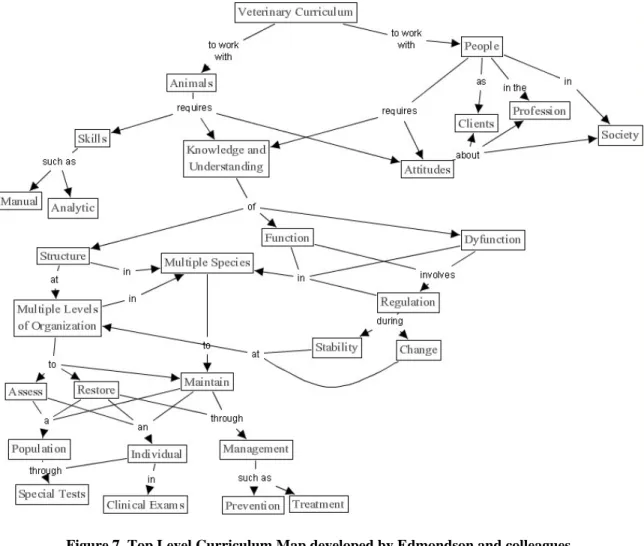
Lavoie (1997) found that using a reflective writing exercise in conjunction with Concept Mapping revealed additional misconceptions and provided more information about students’ understanding than did mapping alone. Kinchin, Hay, & Adams (2000) proposed that qualitative assessment of students’ Concept Maps is more appropriate than quantitative methods when the intent is formative assessment of student learning. Edmondson & Smith (1996) used Concept Maps in several different ways in a veterinarian curriculum. Faculty members were able to identify student misconceptions and adjust teaching to address these.
Another set of studies stands out because they are all related to teacher development (e.g., Bolte, 1999; Butler, 2001). Abd-El-Khalick & BouJaoude (1997) used Concept Maps in conjunction with questionnaires and interviews to study in-service teachers’ understanding of the structure, function, and development of their respective science disciplines. Beyerbach and Smith (1990) tracked pre-service teachers’ knowledge about the processes of teaching and learning, using Concept Maps teachers constructed throughout their final year of the teacher preparation program. Ferry, Hedberg and Harper (1998) suggested that Concept Mapping helps pre-service teachers to organize their knowledge and curriculum content in integrated frameworks. Jones, Carter & Rua (1999)
used teachers’ pre- and post-course Concept Maps, along with journal reflections and portfolios, to examine professional growth as a result of changes in conceptual understanding of content and pedagogical knowledge.
In contrast, Lang & Olson (2000) and Winitzky & Kauchak (1995) looked at pre-service teacher knowledge and the effects of practical experience, found decreases in complexity and organization of knowledge from pre-or early course to post-course Concept Maps. Finally, Morine-Dershimer (1993) used pre- and post- course Concept Mapping to assess conceptual change in pre-service teachers. She developed a scoring technique that enabled her to identify patterns of change associated with particular features of the educational environment, which, she suggested would be useful for course or program evaluation.
3.1.2 Collaboration and Cooperative Learning
The benefits of collaboration in Concept Mapping have been noted in a number of studies. For example, Esiobu, & Soyibo (1995) compared groups using both Concept Mapping and V-diagramming, individually or in small groups, as a summarization or study strategy at the end of regular classroom instruction, with a control group that used neither tool. Both treatment groups did better than the control group as measured by multiple-choice-question achievement tests, and showed some advantage for cooperative group learning. Roth and Roychodury (1993) used Concepts Maps to examine the quality of students understanding.
Other researchers have found that collaboration does not appear to benefit students. For example, Chung, O’Neil, and Herl (1999) examined team processes that occurred as students jointly constructed a Concept Map over a computer network. The quality of constructed maps was not related to teamwork processes. In another study looking at collaborative map construction, Herl, O’Neil, Chung, & Schachter (1999) found no benefit for collaboration. In this study, researchers looked at two conditions for knowledge mapping. In one group, students collaborated over a network to construct group maps. In the other group, students worked individually to construct maps using information from web searches. Students in the individual mapping condition showed significant improvement in mapping scores over the course of a year. Students in the collaboration condition did not show change.
The nature of the interaction among participants appears to have an influence on whether or not effects of collaboration are positive (Chinn, O’Donnell & Jinks, 2002; Van Boxtel, Van Der Linden and Kanselaar, 1997, 2001). Collaborative Concept Mapping promoted more debate and reasoning in the interaction among students. Although outcome measures indicated no significance difference between the two conditions, frequency of elaborative episodes in the discourse of Concept Mapping students was positively correlated with individual learning outcomes. Among other benefits of Concept Mapping, Baroody & Bartels (2000) and Baroody & Coslick (1998) also noted that when used collaboratively, Concept Mapping promotes questioning, discussion, and debate. Interestingly, Stoyanova & Kommers (2002) found that synchronous collaboration with Concept Mapping “provoked a more intense
collaboration”, and resulted in “a more dense conceptual representation” than did mapping in distributed or mediated groups. Chiu, Huang & Chang (2000) also looked at group interaction during collaborative web-based Concept Mapping. Using a system for interaction analysis based on systems by Rachel Hertz-Lazarowitz (1990; 1992) and by Noreen Webb (1989; 1995), researchers found that, in particular, a type of high-level interaction called complex co-operation correlated most highly with mapping performance.
In closing this section, we describe a few other collaborative activities using Concept Maps, which exemplify a range of uses. For example, students can collaborate to indirectly support each other’s learning. Cañas et al. (2001) described a computer-based collaboration environment, part of the CmapTools (Cañas, Hill Carff & Suri, 2003) software, designed to promote meaningful learning by means of a unique collaboration tool. The software allows students from distant schools to share claims (propositions) derived from their concept maps regarding any domain of knowledge being studied. Sharing takes place through the Knowledge Soup, a repository of propositions submitted by the students stored in a server. Propositions in the Soup that are found to be similar to those submitted by the student are displayed on the student’s screen. He or she can use these propositions from other students to enhance his or her concept map. In addition, the student can question or criticize propositions submitted by other students, leading to a peer-review type of environment, where students themselves are responsible for the validity of the propositions in the Soup.
Cristea and Okamoto (2001) described a Concept-Mapping environment that is designed to support collaborative course authoring. The authors believe the mapping process can be useful for course designers because of its theoretical basis, which suggests mapping leads to additional creativity, as well as effective externalization and visualization of ideas.
Finally, Francisco, Nicoll and Trautmann (1998) reported on the use of Concept Maps in college level chemistry classes. In review sessions before exams, participants were provided with a relatively large map and asked to work together to integrate information from other Concept Maps or topics. By repeating this process throughout the course, students built a collaborative, integrated view of the chemistry topics covered in the course.
3.2 Assessment of Learning Using Concept Maps
Concept Maps can be used in formative or summative assessment procedures. In formative assessment, learners may be asked to make Concept Maps at various points in the learning process, and teachers can use these maps both to assess the learners understanding and to modify the curriculum. Summative assessment can be used at the end of an instructional unit to determine a learner’s understanding of that unit, and to assign grades.
Concept Maps constructed as ongoing evaluation of knowledge within a course, or across instruction in a discipline can be useful in demonstrating the changes that occur in a student’s knowledge structure and the increasing complexity of knowledge structure that develops as students integrate new knowledge with existing knowledge. For example, Wallace & Mintzes (1990), described the use of Concept Maps as a way to demonstrate conceptual change. After instruction, all participants took a post-test, which included the same objective test taken as a pre-test and the construction of a Concept Map based on marine life zones. Results indicated that the experimental group showed small increases after instruction on the objective test. Other work on the utility of concept maps for assessment is presented in Markham & Mintzes (1994), Pearsall, Skipper & Mintzes (1997), and Martin, Mintzes & Clavijo (2000).
3.2.2. Methods of Scoring Concept Maps
The traditional method of Concept Map scoring was proposed by Novak and Gowin (1984), and is based on the components and structure of the Concept Map. Novak and Gowin’s system assigns points for valid propositions (1 point each), levels of hierarchy (5 points for each level), number of branchings (1 point for each branch), cross-links (10 points for each valid cross-link), and specific examples (1 point for each example). The number of hierarchical levels addresses the degree of subsumption, the number of branchings indicates progressive differentiation, and the number of cross-links indicates the degree of integration of knowledge. This scoring technique has proven to be time-consuming, but it does give a great deal of information about the creator’s knowledge structure. Some scoring techniques have been developed as extensions or variations of Novak and Gowin’s system. For example, Mintzes and colleagues (e.g., Pearsall, Skipper & Mintzes, 1997) score the same components of the map but weigh them differently. Some researchers are pursuing the possibility of providing automated assessment of the structural components of Concept Maps (Luckie, 2001, NSF proposal).
Ruiz-Primo & Shavelson (1996) describe methods to compare a student’s map to that of an expert. Expert maps may be constructed by a teacher, a domain expert or a group of teachers or domain experts. A comparison procedure must also be defined, and can range from propositional comparisons to holistic comparisons of structure. Computerized techniques can be used to simplify the comparison of maps, and this possibility has been explored by researchers at CRESST and other places (Chung, Herl, Klein, O’Neil & Schachter, 1997; Herl, O’Neil, Chung, Dennis & Lee, 1997; O’Neil & Klein, 1997). These automated scoring systems are typically based on propositional matching within limited sets of concepts and linking phrases. Holistic or structural comparisons are more difficult to automate, as they often require human judgment.
Some researchers have experimented with the combination of methods based on components, and methods based on comparison to a criterion (e.g., “expert”) map. One example of this approach is to use traditional component-based scoring combined with some comparison to a criterion map, by assigning more weight to propositions that were considered to be critical by experts. Rye & Rubba (2002) reported such a Concept Map scoring system that was based on components, but which used an expert map to weigh propositions in the student maps.
Two major concerns have arisen regarding scoring methods for Concept Maps. The first is that traditional methods such as those based on Novak and Gowin (1984) are time-consuming and require the input of an expert, either in terms of judging the validity and importance of map components, or in the construction of a criterion map. The second issue is concerned with psychometric properties of Concept Maps as an assessment tool, and pertains to the reliability and validity of Concept Map scores. This issue will be discussed in the next section
The first concern has been addressed in at least two ways: the development of computerized scoring methods and the development of simplified map scoring techniques (e.g., Chung, Herl, Klein, O’Neil & Schachter, 1997; Herl et al., 1997; O’Neil et al., 1997; Luckie, 2001). An example of a simplified Concept Map scoring scheme is provided by Shaka & Bitner (1996), which uses Novak and Gowin’s (1984) scoring scheme as a starting point, but provide simplified analysis of important map characteristics. In their approach, several map properties including propositions, branches, hierarchies, examples, cross-links and others are given a rating from 0 to 4, rather than being counted or characterized. This kind of simplification in scoring is probably typical of those utilized in Concept Map assessments. Another alternative that was proposed by Kinchin, Hay & Adams (2000), is to analyze maps in terms of their overall structure rather than in terms of a detailed analysis of concepts, links and propositions.
3.2.3 Reliability and Validity of Concept Maps for Assessment
Issues of reliability and validity of concept maps as assessment tools are integrally related to the concept map task and to the scoring system used (Ruiz-Primo & Shavelson, 1996). Traditionally, reliability issues related to the measurement of learning have not been concerned with consistency of scores over time (i.e., test-retest reliability) since actual knowledge is expected to change. Rather, the focus should be on inter-rater reliability (do people scoring the maps agree), and with the internal reliability of the measure. For example, Liu & Hinchey (1996), found relatively low correlations among different component scores in Novak and Gowin’s (1984) scoring system. However, the component scores for propositions, levels of hierarchy, cross-links, and examples may actually be measurements of different aspects of the structure and organization of knowledge. A variety of conclusions have been drawn relative to reliability measures, including that they are “reasonable” (Shavelson & Ruiz-Primo, 2000; West et al., 2000), better for proposition-based scores than for structural scores (Shavelson & Ruiz-Primo, 2000; Herl et al., 1999), and better as raters become more experienced (West et al. 2000). Concerns about validity have primarily focused on concurrent validity and construct validity. Concept maps have face validity to the extent that they directly represent Ausubel’s components of meaningful learning: subsumption, progressive differentiation, and integration of knowledge. Concurrent validity has been demonstrated in numerous experiments in which concept map scores have been demonstrated to change over the course of instruction (Martin et al., 2000; Pearsall et al., 1997; Wallace & Mintzes, 1990), or to differ among groups known to differ in their degree of knowledge
(Markham & Mintzes, 1994; West et al., 2000). Many of these studies have been discussed in previous sections.
Construct validity is a different concern, which refers to the extent to which concept maps correlate with other measures of meaningful learning. It has often been suggested that concept maps measure different aspects of knowledge than traditional assessment techniques which do not measure meaningful learning; thus it is not surprising to find moderate or low correlations with some other types of assessments (Novak, Gowin & Johansen, 1983). Shavelson & Ruiz-Primo (2000) suggested that scores gleaned from concept maps are moderately correlated with traditional assessments (average r = 0.50), which demonstrates that concept map assessments measure something that is related, but not identical, to traditional assessments. West et al. (2000) also suggested that the correlation of concept map scores with standardized exams for medical students is moderately high, with the highest correlation for the map component of specific examples.
A related concern is predictive validity, whether concept map scores can be used to predict performance on skills that would seem to be related. Although the degree to which concept map scores can predict other performance scores is necessarily variable, some researchers have found relatively high correlations with some skills. Rice, Ryan & Samson (1998), designed a map scoring system that was based upon propositions that were assigned points if they contained correct propositional information that appeared on standardized state and national assessments. This type of scoring system resulted in high predictive validity, for these national achievement measures.
Research by McClure, Sonak & Suen (1999), investigated the relationships between map scoring method and measures of reliability and validity. Several different scoring methods were evaluated, including holistic assessments, assessments based on the correctness of individual propositions, and assessments based on structural components similar to those proposed by Novak and Gowin. Inter-rater reliability varied for the scoring methods, with the best results for propositional-based methods. Validity of map scores was assessed by comparing student-constructed maps with a master or expert map, through the use of techniques assessing the neighborhood or interconnectedness of concepts. The question addressed was whether the map score was an assessment of changes in student knowledge. In nearly all cases, concept map scoring techniques resulted in significant correlations between student maps and the master map. The best technique, both in terms of inter-rater reliability and validity, was based on propositional analysis of the concept map. Structural and holistic measurements appeared to be more problematic in terms of evaluation and matching between maps.
Increasing interest in the use of concept maps for assessment is likely to generate more interest in the development of computer scoring techniques and better assessment of the reliability and validity of concept map scoring in general. The use of large-scale automated scoring procedures will require further elaboration and testing of map scoring techniques. While proposition-based methods are the easiest to generate and to match
across maps, these methods miss some of the most important structural characteristics of Concept Maps and should be applied with caution.
In previous sections we have presented a review of studies that employed Concept Maps as measures of conceptual change. We have described the types of scoring systems that have been used for Concept Maps (Ruiz-Primo & Shavelson, 1996), including traditional component-based measures such as Novak & Gowin (1984), methods based on comparison to a criterion or expert map, and methods which combine component-based and criterion-component-based assessment. These methods are often time-consuming and require human judgment, thus alternative simplified scoring schemes are often used. We have also addressed the reliability and validity of Concept Maps. These measures suggest that Concept Maps provide a different measure of abilities and knowledge than traditional assessment techniques. In general, the more specific the measure, the better the reliability and validity. Reliability and validity measures indicate that Concept Maps fall within acceptable ranges from the viewpoint of psychometrics (e.g., West et al; 2000; Shavelson & Ruiz-Primo, 2000).
In the following section, we will address other types of uses of Concept Maps, specifically those in which learners do not actively construct Concept Maps for either learning or assessment, but rather are presented with a constructed map. The pre-constructed map may serve several purposes – as a scaffold for learning that is provided by the instructor, as an organizer for a course or curriculum that is presented to the student as a learning guide, or as a navigation guide in hypermedia.
3.3 Uses of Concept Maps to Organize and Present Information
This section reviews the uses of concept maps and related representations as advance organizers, as aids for course and curriculum development, and as a means to provide navigation support in hypertext. These uses are not completely independent of applications as learning and teaching tools, as in many cases maps might have been used in the classroom as an advance organizer for lectures.
3.3.1 Concept Maps as “Advance Organizers”
Ausubel (Ausubel, 1968; Ausubel, Novak, & Hanesian, 1978) advocated the use of “advance organizers” to foster meaningful learning. Advance organizers are global overviews of the material that is to be learned. Ausubel suggested that advance organizers foster meaningful learning by:
• Prompting the learner regarding pre-existing superordinate concepts that are already in the student's cognitive structure, and
• Providing a context of the most general concepts into which the student can incorporate progressively differentiated details.
In theory, advance organizers are most effective if they make explicit the relationships among learned concepts that learners already know, thus providing a structure into which the new concepts can be integrated.
A Concept Map can be utilized as an advance organizer (Novak & Gowin, 1984; Novak, 1998; Willerman & MacHarg, 1991). Advance organizer Concept Maps might be