Efficient Public-Key Cryptography in the Presence of Key Leakage
Yevgeniy Dodis∗ Kristiyan Haralambiev† Adriana L´opez-Alt‡ Daniel Wichs§ September 15, 2010
Abstract
We study the design of cryptographic primitives resistant to a large class of side-channel attacks, called “memory attacks”, where an attacker can repeatedly and adaptively learn information about the secret key, subjectonlyto the constraint that theoverall amountof such information is bounded by some parameter `. Although the study of such primitives was initiated only recently by Akavia et al. [3], subsequent work already produced many such “leakage-resilient” primitives [53, 5, 47], including signature, encryption, iden-tification (ID) and authenticated key agreement (AKA) schemes. Unfortunately, every existing scheme, — for any of the four fundamental primitives above, — fails to satisfy at least one of the following desirable properties:
• Efficiency.While the construction may be generic, it should have someefficientinstantiations, based on standard cryptographic assumptions, and without relying on random oracles.
• Strong Security. The construction should satisfy the strongest possible definition of security (even in the presence of leakage). For example, encryption schemes should be secure against chosenciphertext attack (CCA), while signatures should beexistentiallyunforgeable.
• Leakage Flexibility. It should be possible to set the parameters of the schemes so that the leakage bound`can come arbitrarily close to the size of the secret keysk.
In this work we design the first signature, encryption, ID and AKA schemes which overcome these lim-itations, and satisfy all the properties above. Moreover, all our constructions are generic, in several cases elegantly simplifying and generalizing the prior constructions (which did not have any efficient instantia-tions). We also introduce several tools of independent interest, such as the abstraction (and constructions) oftrue-simulation extractableNIZK arguments, and a newdeniableDH-based AKA protocol based on any CCA-secure encryption.
∗
Computer Science Dept. NYU. Email:[email protected]. †
Computer Science Dept. NYU. Email:[email protected]. ‡
Computer Science Dept. NYU. Email:[email protected]. §
1
Introduction
Traditionally, the security of cryptographic schemes has been analyzed in an idealized setting, where an adver-sary only sees the specified “input/output behavior” of a scheme, but has no other access to its internal secret state. Unfortunately, in the real world, an adversary may often learn some partial information about secret state via various key leakageattacks. Such attacks come in a large variety and include side-channel attacks [48, 12, 9, 49, 60, 31], where the physical realization of a cryptographic primitive can leak additional informa-tion, such as the computation-time, power-consumpinforma-tion, radiation/noise/heat emission etc. The cold-boot attack of Halderman et al. [39] is another example of a key-leakage attack, where an adversary can learn (imperfect) information about memory contents of a machine, even after the machine is powered down. Schemes that are proven secure in an idealized setting, without key leakage, may become completely insecure if the adversary learns even a small amount of information about the secret key. Indeed, even very limited leakage attacks have been shown to have devastating consequences for the security of many natural schemes.
Unfortunately, it is unrealistic to assume that we can foresee, let alone block, all of the possible means through which key leakage can occur in real-world implementations of cryptographic schemes. Therefore, the cryptographic community has recently initiated the investigation of increasingly general (formally modeled) classes of leakage attacks, with the aim of constructingleakage-resilient cryptographic schemes that remain provably secure even in the presence of such attacks. Of course, if an adversary can get unrestricted information about the secret key (say, of an encryption scheme), then she can learn the key in its entirety and the security of the system is necessarily compromised. Therefore, we must first place some “upper bound” on the type or amount of information that the adversary can learn. The nature of such bounds varies in the literature, as we survey later. For this work, we only restrict theamount, but not thetype, of information that an adversary can learn through a key-leakage attack. In particular, we will assume that the attacker can learnany efficiently computable function of the secret key sk, subject only to the constraint that the total amount of information learned (i.e. the output size of the leakage function) is bounded by ` bits, where ` is called the “leakage parameter” of the system.1 Clearly, at this level of generality, the secret-key sizesmust be strictly greater than the leakage-parameter`.2Therefore, the quantity`/scan be thought as therelative leakageof the system, with the obvious goal to make it as close to1as possible.
Our model of leakage-resilience was recently introduced recently by Akavia et al. [3], but already attracted a lot of attention from the cryptographic community [53, 5, 47, 4]. In particular, as we survey later, we al-ready know many “leakage-resilient” primitives, including such fundamental primitives as signature schemes, encryption schemes, identification (ID) schemes and authenticated key agreement (AKA) protocols. Unfortu-nately, we observe that every existing scheme, — for any of the four fundamental primitives above, — fails to satisfy at least one of the following desirable properties:
• Efficiency.While the proposed construction may be based on some generic cryptographic primitives, — which is in fact preferable for modular design, — it should have someefficientinstantiations, based on standard cryptographic assumptions, and without relying on random oracles. We view this property as the main property we will strive to achieve.
• Strong Security. The construction should satisfy the strongest possible definition of security (even in the presence of leakage). For example, encryption schemes should be secure against chosenciphertext attack (CCA), while signatures should beexistentiallyunforgeable, etc.
• Leakage Flexibility.It should be possible to set the parameters of the schemes so that the relative leakage
`/sis arbitrarily close to1. We call such schemesleakage-flexible.
1
More formally, we allow adaptive measurements, as long as the sum of leaked outputs is bounded by`.
2
1.1 Our Results
In this work we design the first signature, encryption, ID and AKA schemes which simultaneously satisfy the efficiency, strong security and leakage flexibility properties mentioned above. Moreover, all our constructions are generic. This means that the actual construction is modularly defined and explained using natural simpler blocks, and its security against key leakage is also proven no matter how these simpler blocks are (securely) implemented. However, unlike the prior generic constructions, which did not have any known efficient instanti-ations (at least, with the desired security and flexibility we seek), ours are yet more general, which will allow us to obtain several efficient instantiations. Given this fact, it is not surprising that our contributions can be roughly split into two categories: “conceptual” contributions, allowing us to obtain more general (and, yet, conceptu-ally simpler) leakage-resilient constructions, and “concrete” contributions, allowing us to actuconceptu-ally instantiate our general schemes efficiently.
CONCEPTUAL CONTRIBUTIONS. As we will see, existing schemes (e.g., signature and CCA-encryption) could be largely divided into two categories: potentially efficient schemes, with someinherentlimitation not allowing them to achieve relative leakage approaching1(which also prevents us from using these ideas for our purposes), and more theoretical schemes [53, 47], achieving good relative leakage, but relying on the notion of simulation-soundnon-interactive zero-knowledge (ss-NIZK) [62]. Informally, ss-NIZK proofs remain sound even if the attacker can see simulated proofs of arbitrary (even false) statements. Unfortunately, it appears that the existing cryptographic machinery does not allow us to instantiate non-trivial ss-NIZK proofs efficiently.3 On the other hand, a recent breakthrough result of Groth-Sahai [38] showed that one can obtain efficient non-simulation-sound NIZK proofs for a non-trivial class of languages. While the techniques of [36] could be applied to Groth-Sahai proofs to achiehve ss-NIZKs, it is a non-trivial “exercise” and the resulting proofs aresignificantly less efficient, as the construction involves OR-proofs for Groth-Sahai languages. Therefore, our first idea was to try to generalize the existing constructions sufficiently, making them rely only on regular NIZKs, in the hope that such regular NIZKs can then be instantiated using the powerful Groth-Sahai techniques. In the end, this is indeed what we realized. However, in the process we also abstracted away an elegant notion of independent interest: true-simulation extractable(tSE) NIZKs. While quite similar to the notion of simulation-sound extractable NIZKs [36], it involves a subtle but rather important difference: whether the ad-versary has oracle access to simulated proofs for arbitrary (even false) statements or only true ones. Intuitively, both the Naor-Segev’s leakage-resilient CCA encryption [53] and Katz-Vaikuntanathan’s leakage-resilient sig-nature scheme [47] used the technique of encrypting a witness x for some relationR, and then providing a ss-NIZK proofϕthat the ciphertext cindeed contains the encryption of a valid witness x. The main reason for using this technique is to allow the reduction to extract a valid witness from any “new” valid pair(c∗, ϕ∗) produced by the attackerA(who saw many such valid pairs earlier). In this paper, we will abstract this property into the tSE notion mentioned above (of which the above mentioned technique is a specific example, where the pair(c, ϕ)together makes up a single tSE-NIZK proof). Moreover, we show that true-simulation extractability, as we abstract it, ispreciselythe right notion for generalizing and proving the security of the previous construc-tions. This has two positive effects. First, it makes the generic constructions of CCA-encryption and signatures somewhat more intuitive, both for proving and understanding. For example, the traditional “double-encryption” paradigm of Naor-Yung [54] for designing CCA-secure schemes from chosen-plaintext secure (CPA-secure) schemes, also used by [53] in the context of key leakage, can be stated as “CPA-encrypting messagemunder two keys and proving plaintext equality”. Using our more general “simulation-extractability view”, it is now stated as “CPA-encrypting m and proving that one knows the plaintext”. We believe that the latter view is not only more general, but also more intuitive as a way of explaining “CPA-to-CCA” transformation. It also follows the original intuition of Rackoff and Simon [61], who combine CPA-encryption with NIZK-POK to achieve CCA-encryption, but in the model where the sender also has a secret key. A similar discussion is true for our signature constructions.
3The work of [36] constructs ss-NIZK proofs for practical languages and uses them to construct group signatures, but the resulting
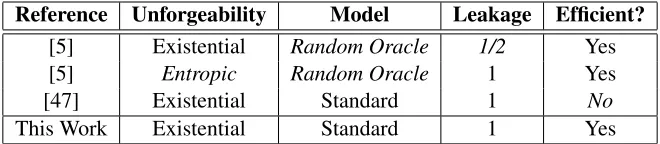
Reference Unforgeability Model Leakage Efficient?
[5] Existential Random Oracle 1/2 Yes
[5] Entropic Random Oracle 1 Yes
[47] Existential Standard 1 No
This Work Existential Standard 1 Yes
Table 1: Previous work on leakage-resilient signatures and results of this work
Reference Attack Model Leakage Efficient?
[3, 53] CPA Standard 1 Yes
[53] CCA Standard 1/6 Yes
[53] CCA Standard 1 No
This Work CCA Standard 1 Yes
Table 2: Previous work on leakage-resilient encryption and results of this work
Second, we show a generic way to build tSE-NIZKs whichavoids using (expensive) ss-NIZKs. Instead, our method uses regularNIZKs and anyCCA-secure encryption scheme.4 Perhaps surprisingly, given the current state-of-the-art NIZK and CCA schemes, the combination “CCA + NIZK” appears to be much more efficient in practice than the combination “CPA + ss-NIZK”.5 As a result, we were able to provide a general framework for building leakage-flexible signature and CCA-encryption schemes, eventually allowing us to efficiently instantiate our schemes (by avoiding using ss-NIZKs). We summarize our results for signature and CCA-encryption schemes in Tables 1 and 2, also comparing them to the best prior constructions. In all the tables, the “sub-optimal” entries (for efficiency, security, model or relative leakage of prior constructions) are written in italics, and most prior rows are also explained in the related work Section 1.2. For signatures, we stress that no efficient construction in the standard model was known prior to our work, for any non-trivial relative leakage fraction (let alone1).
Once we have efficient leakage-flexible signature schemes, we observe that the standard signature-based ID scheme, where the verifier asks the prover to sign a random message, easily extends to the leakage setting. Moreover, the resulting actively secure ID scheme inherits its relative leakage from the corresponding signature scheme, and satisfies the strongest notion of “anytime-leakage” [5] (see Section 6.1), where the leakage can occur even during the impersonation attack. We summarize our results for ID schemes in Table 3. Although our method is pretty simple, we notice that the other two popular methods of building ID schemes — the use ofΣ-protocols for hard relations analyzed in [5] (see first two rows of Tables 3), and the use of CCA-secure encryption (where the prover decrypts a random challenge ciphertext) — inherently do not allow us to obtain optimal results, even when instantiated with leakage-flexible hard relations or CCA-encryption schemes. See Section 6.1 for more details.
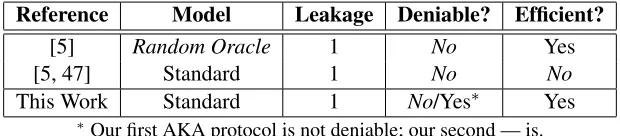
Finally, we summarize our results for AKA protocols in Table 4. We actually obtain two such protocols. First, similarly to the case of ID schemes, we can obtain resilient AKA schemes from any leakage-resilient signature scheme, as formally explained in [5]. The idea is to essentially sign every flow of a standard Diffie-Hellman-based protocol, but with a leakage-resilient signature scheme. We notice, though, that the resulting protocol is notdeniable. Namely, the transcript of the protocol leaves irrefutable evidence that the protocol took place. Motivated by this deficiency, we design another general AKA protocol based on CCA-encryption. The details are given in Section 6.2, but, intuitively, the parties encrypt the flows of the standard Diffie-Hellman-based protocol, effectively proving their identities by successfully re-encrypting the appropriate
4
This is OK for the signature application, but might appear strange for our CCA-encryption application, as we need “CCA to get CCA”. However, as a building block for tSE-NIZKs, we only needstandardCCA schemes (which are known), and as a result obtain
leakage-resilientCCA schemes.
5
Reference Security Model Leakage Efficient?
[5] Pre-Impersonation Standard 1 Yes
[5] Anytime Standard 1/2 Yes
[47] (implicit) Anytime Standard 1 No
This Work Anytime Standard 1 Yes
Table 3: Previous work on leakage-resilient identification schemes and results of this work
Reference Model Leakage Deniable? Efficient?
[5] Random Oracle 1 No Yes
[5, 47] Standard 1 No No
This Work Standard 1 No/Yes∗ Yes
∗Our first AKA protocol is not deniable; our second — is.
Table 4: Previous work on leakage-resilient AKA and results of this work.
flows. Although we do not formalize this, this protocols is “deniable”, because the transcript of the protocol can be simulated without the knowledge of parties’ secret keys. To the best of our knowledge, this protocol was not suggested and analyzed even in the leakage-free setting, where it appears interesting already. Here we actually show that our (new) deniable AKA protocol works even in the presence of leakage.
CONCRETECONTRIBUTIONS. As we explained above, we generically reduce the question of building efficient leakage-flexible ID schemes and AKA protocol to the question of efficiently instantiating our leakage-flexible signature and/or encryption schemes. Such instantiations are given in Section 5 (with most details in Ap-pendix C). We also explained how the latter instantiations became possible in our work, since we gave generic constructions of both primitives based on the new notion of tSE-NIZK, and then showed that satisfying this notion may be possible using ordinary NIZKs for appropriate languages, without relying on the expensive simulation-sound NIZKs. Unfortunately, efficient construction of (even ordinary) NIZKs, due to Groth and Sa-hai [38], are only known for a pretty restrictive class or languages in bilinear groups. Thus, obtaining aconcrete efficient instantiation still requires quite a substantial effort.
Specifically, all the building blocks have to be instantiated efficiently, and expressed in a form such that the resulting NP relation satisfies the severe limitations imposed by the Groth-Sahai NIZKs. For example, to build leakage-resilient CCA-encryption, we need to have an efficient leakage-flexible CPA scheme, a CCA scheme supporting labels and a one-time signature scheme, all connected together by an efficient NIZK for a complicated “plaintext equality” relation. Similarly, for leakage-resilient signature schemes, we need an efficient second-preimage resistant (SPR; see Definition 2.1) relation and a CCA scheme supporting labels, once again connected by an efficient NIZK for a complex relation. Not surprisingly, such tasks cannot typically be done by simply combining “off-the-shelf” schemes from the literature. At best, it requires very careful selection of parameters to make everything “match”, followed by a round of further efficiency optimizations. Usually, though, it requires the design of new primitives, which work well with other known primitives, to enable efficient NIZK. For example, in this work, we designed two new SPR relations (see Claims C.1 and C.2), since prior SPR relations did not appear to mesh well with our CCA encryption scheme. To emphasize the importance of the new SPR relations, we point out that combining previous constructions with Groth-Sahai proofs would require committing to the witness bit-by-bit in order to achieve full extractability.
1.2 Related Work
LEAKAGE-RESILIENCE ANDMEMORYATTACKS. Our model of leakage, sometimes called memory-attacks, was first proposed by Akavia, Goldwasser and Vaikuntanathan [3], who also constructed CPA secure PKE and IBE schemes in this model under thelearning with errors (LWE)assumption. Later Naor and Segev [53] generalized the main ideas behind these constructions to show that all schemes based onhash proof systems(see [19]) are leakage-resilient. In particular, this resulted in efficient constructions based on the DDH andK-Linear assumptions, where the relative leakage on the secret key could be made to approach 1. Moreover, [53] showed how to also achieve CCA security in this model by either: (1) relying on the generic (and inefficient) Naor-Yung paradigm where the leakage-rate can be made to approach1or (2) using efficient hash proof systems with leakage-rate only approaching1/6. Unfortunately, it seems that the hash proof system approach to building CCA encryption is inherently limited to leakage-rates below1/2: this is because the secret-key consists of two components (one for verifying that the ciphertext is well-formed and one for decrypting it) and the proofs break down if either of the components is individually leaked in its entirety.
The work of [4] generalizes [53] still further by showing how to construct leakage-resilient IBE schemes generically based onidentity-based hash proof systems, with several instantiations.
Leakage-resilient signature schemes in the model of memory attacks were constructed in the random-oracle model by [5, 47], and in the standard model by [47]. The random-oracle schemes are highly-efficient but suffer from two limitations. Firstly they rely on the Fiat-Shamir [29] transform which is only known to be secure in the Random Oracle model and is not sound in general [34]. Secondly, the schemes can only tolerate leakage which approaches 1/2 of the secret key. On the other hand, the standard-model schemes allow for relative-leakage approaching 1, but are based on generic simulation-sound NIZKs and do not come with an efficient instantiation.
The work of [5] also constructs identification (ID) schemes and authenticated-key agreement (AKA) pro-tocols. For ID schemes, two notions of security (we describe these in detail in Section 6.1) were considered: a weaker notion called pre-impersonation resilience and a stronger notion called anytime leakage-resilience. Although efficient schemes in the standard model were given for both notions, the leakage resilience could be made to approach1only for pre-impersonation leakage while, for anytime leakage, the given schemes can only tolerate a leakage-rate below 1/2. For AKA schemes, a construction was given based on leakage-resilient signatures (only requiring a weakened notion of security called entropic-unforgeability). Using the appropriate signature schemes, this yielded two types of constructions: efficient constructions in the random-oracle model and generic but inefficient constructions in the standard model (both of which have leakage-rates approaching1).
OTHER MODELS OF LEAKAGE-RESILIENCE. Several other models of leakage-resilience have appeared in the literature. They differ from the model we described in that they restrict the type, as well as amount, of information that the adversary can learn. For example, the work onexposure resilient cryptography[15, 24, 46] studies the case where an adversary can only learn some small subset of the physical bits of the secret key. Similarly, [43] studies how to implement arbitrary computation in the setting where an adversary can observe a smallsubset of the physical wires of a circuit. Most recently, [28] study a similar problem, where the adversary can observe a low-complexity (e.g. AC0) function of the wires. Unfortunately, these models fail to capture many meaningful side-channel attacks, such as learning the hamming-weight of the bits or their parity.
information that the attacker can get throughout the lifetime of the system. On the negative side, this model fails to capture many leakage-attacks, such as the cold-boot attack of [39], whereall memory contents leak information, even if they were never accessed.
Lastly, we mention several models of leakage-resilience which are strictly stronger than the memory-attacks model. Firstly, the Bounded-Retrieval Model [20, 25, 5, 4] imposes an additional requirement on leakage-resilient schemes, by insisting that they provide a way to “grow” the secret-key (possibly to many Gigabytes) so as to proportionally increase the amount of tolerated leakage, but without increasing the size of the public-key, the computational-efficiency of the scheme, or the ciphertext/signature/communication lengths. The work of [5] constructs “entropic” signatures, ID schemes and AKA protocols in this setting, while the work of [4] constructs PKE and IBE schemes in this model. A different strengthening is the auxiliary input model [22, 21] where the leakage is not necessarily bounded in length, but it is (only) assumed to be computationally hard to recover the secret-key from the leakage. The work of [22] constructs symmetric-key encryption in this model, under a strengthening of the learning parity with noise (LPN) assumption, while [21] constructs public-key encryption under the DDH and LWE assumptions. Yet another strengthening of the memory-attacks model, proposed by [33], is to require that there is a single scheme (parameterized only by the security parameter) which can tolerate essentially any amount of relative-leakage where the exact-security of the scheme degrades smoothly as the relative-leakage increases. In this model, [33] construct a symmetric-key encryption scheme.
2
Definitions of Leakage-Resilient Primitives
We model leakage attacks by giving the adversary access to aleakage oracle, which he can adaptively access to learn leakage on the secret key. A leakage oracleOskλ,`(·)is parametrized by a secret keysk, a leakage parameter
`, and a security parameterλ. A query to the leakage oracle consists of a functionhi :{0,1}∗ → {0,1}αi, to
which the oracle answers withyi = hi(sk). We only require that the functionshi be efficiently computable,
and the total number of bits leaked isP
iαi ≤`.
Definition 2.1(Leakage Resilient Hard Relation). A relation Rwith a randomized PPT sampling algorithm KeyGenis an`-leakage resilient hard relationif:
• For any(sk, pk)←KeyGen(1λ), we have(sk, pk)∈R.
• There is a poly-time algorithm that decides if(sk, pk)∈R.
• For all PPT adversariesAOλ,`sk(·)with access to the leakage oracleOλ,`
sk (·), we have that
Pr
h
R(sk∗, pk) = 1 | (pk, sk)←KeyGen(1λ), sk∗ ← AOλ,`sk(·)(pk)
i
≤negl(λ)
Notice that without loss of generality, we can assume thatAqueriesOλ,`sk(·)only once with a functionh
whose output is`bits.
Definition 2.2(Leakage Resilient Signatures). A signature schemeS = (KeyGen,Sign,SigVer)is`-leakage resilientif∀PPTAwe havePr[Awins]≤negl(λ)in the following game:
1. Key Generation: The challenger runs(vk, sk)←KeyGen(1λ)and givesvktoA.
2. Signing and leakage queries: AOskλ,`(·),Ssk(·) is given access to the leakage oracle Oλ,`
sk (·) and the signing oracleSsk(·). A query to the signing oracleSsk(·)consists of a messagem, to which the oracle responds withσ=Signsk(m).
Definition 2.3(Leakage Resilient CCA-Secure Encryption). We say that an encryption schemeE= (KeyGen,Enc,Dec) is`-leakage resilient CCA-secureif∀PPTAwe havePr[Awins]≤ 12+negl(λ)in the following game:
1. Key Generation: The challenger runs(pk, sk)←KeyGen(1λ)and givespktoA.
2. Decryption and leakage queries: AOskλ,`(·),Dsk(·)is given access to the leakage oracleOλ,`
sk(·)and the decryption oracleDsk(·). A query to the decryption oracleDsk(·)consists of a ciphertextc, to which the oracle responds withm=Decsk(c).
3. Challenge generation: A sends plaintextsm0, m1 to the challenger. The challenger choosesb $ ←− {0,1}, and sendsc∗ ←Encpk(mb)toA.
4. Decryption queries: ADsk(·)is given access to the decryption oracleD
sk(·)with the restriction thatA cannot sendc∗as a decryption query. Notice also thatADsk(·)isnotgiven access to the leakage oracle
Oskλ,`(·).
5. Aoutputsb0, and wins ifb=b0.
If an encryption scheme is0-leakage-resilient CCA-securewe simply refer to it as beingCCA secure.
Recall that we can define labeled CCA encryption in which a message is encrypted and decrypted according to a public label L. If an encryption scheme E = (KeyGen,Enc,Dec) supports labels, we use the syntax
EncL(m) to denote the encryption of message m under label L. Similarly, we use DecL(c) to denote the decryption of ciphertextcunder the labelL. In this case, we extend the correctness of encryption/decryption to requiring thatDecL(EncL(m)) = m. The security definition described in Definition 2.3 can also be easily modified as follows. A query to the decryption oracle now consists of a ciphertext cand a labelL, to which the oracle responds with m = DecLsk(c).In the challenge generation stage,A submits a labelL∗ as well as messagesm0, m1and the challenger computesc∗ ← EncL
∗
pk(mb)forb $
←− {0,1}. Finally, in the second stage of decryption queries we require that the adversary is allowed to ask for decryptions of any ciphertextcunder labelLonly subject to(L, c)6= (L∗, c∗).
Definition 2.4(Leakage Resilient CPA-Secure Encryption). We say that an encryption schemeE = (KeyGen,Enc,Dec) is`-leakage resilient CPA-secureif∀PPTAwe havePr[Awins]≤ 12 +negl(λ)in the game described above with the modification thatAdoes not have access to the decryption oracleDsk(·). If an encryption scheme is 0-leakage-resilient CPA-securewe simply refer to it as beingCPA secure.
3
Simulation Extractability
We start by briefly recalling the notion of non-interactive zero-knowledge (NIZK) [10]. For our purposes, it will be slightly more convenient to use the notion of(same-string) NIZK argumentfrom [63]. Note, however, that the definitions and constructions given in this section can be extended to the case of NIZK proofs.
LetRbe an NP relation on pairs(x, y)with corresponding languageLR ={y | ∃xs.t.(x, y) ∈R}. A non-interactive zero-knowledge (NIZK) argumentfor a relationRconsists of three algorithms(Setup,Prove,Verify) with syntax:
• (CRS,TK)←Setup(1λ): Creates a common reference string (CRS) and a trapdoor key to the CRS.
• π ←ProveCRS(x, y): Creates an argument thatR(x, y) = 1.
For the sake of clarity, we write ProveandVerify without theCRS in the subscript when the CRS can be inferred from the context. We require that the following three properties hold:
Completeness: For any(x, y)∈R, if(CRS,TK)←Setup(1λ), π←Prove(x, y), thenVerify(y, π) = 1.
Soundness: For any PPT adversaryA,
Pr
Verify(y, π∗) = 1
y6∈LR
(CRS,TK)←Setup(1λ) (y, π∗)← A(CRS)
≤negl(λ).
Composable Zero-Knowledge: There exists PPT simulatorSimsuch that, for any PPT adversaryAwe have
Pr[Awins]−12
≤negl(λ)in the following game:
• The challenger samples(CRS,TK)←Setup(1λ)and gives(CRS,TK)toA.
• The adv.Achooses(x, y)∈Rand gives these to the challenger.
• The challenger samplesπ0 ←Prove(x, y), π1 ←Sim(y,TK), b← {0,1}and givesπbtoA.
• The adv.Aoutputs a bit˜band wins if˜b=b.
We revisit the notion of simulation extractable NIZK arguments [64, 17, 56, 57, 36], and define a new prim-itive calledtrue-simulation extractableNIZK arguments. Apart from satisfying the three properties described above, an NIZK argument is simulation extractable if there exists a PPT extractor Ext which (when given an additional extraction trapdoor to theCRS) extracts a witnessx0 from any proofπ produced by a malicious proverP∗,evenifP∗has previously seen somesimulated proofsfor other statements. We make an important distinction between our new definition oftrue-simulation extractability, where all simulated proofs seen byP∗
are only of true statements, and the stronger notion ofany-simulation extractability, where P∗ can also see proofs offalsestatements. As we will see, the former notion is often simpler to construct and sufficient in our applications.
We extend our definition to f-extractability, where Extonly needs to output some function f(x0) of a valid witness x0. We further extend this definition to support labels, so that theProve, Verify, Sim, and
Extalgorithms now also take a public labelL as input, and the correctness, soundness, and zero-knowlegde properties are updated accordingly. If Π = (Setup,Prove,Verify) is an NIZK argument with simulator
Simand extractorExt, we write ProveL,VerifyL,SimL,ExtLto denote proof, verification, simulation, and extraction under labelL, respectively.
We start by defining a simulation oracleSIMTK(·). A query to the simulation oracle consists of a pair
(x, y)and a labelL. The oracle checks if(x, y) ∈ R. If true, it ignores xand outputs a simulated argument
SimL(TK, y), and otherwise outputs⊥. We now give a formal definition of true-simulation extractability.
Definition 3.1(True-Simulationf-Extractability). Letf be a fixed efficiently computable function and letΠ = (Setup,Prove,Verify)be an NIZK argument for a relationR, satisfying the completeness, soundness and zero-knowledge properties above. We say thatΠistrue-simulationf-extractable(f-tSE) with labels if:
• Apart from outputting a CRS and a trapdoor key,Setupalso outputs an extraction key: (CRS,TK,EK)←Setup(1λ).
• There exists a PPT algorithmExt(y, ϕ,EK)such that for allP∗ we havePr[P∗wins]≤negl(λ)in the following game:
1. Key Generation: The challenger runs(CRS,TK,EK)←Setup(1λ)and givesCRStoP∗. 2. Simulation queries: P∗SIMTK(·)is given access to the simulation oracleSIM
TK(·), which it can
3. Adversary Output: P∗outputs a tuple(y∗, L∗, ϕ∗). 4. Extraction: The challenger runsz∗ ←ExtL∗(y∗, ϕ∗,EK).
5. P∗wins if (a) the pair(y∗, L∗)was not part of a simulator query, (b)VerifyL∗(y∗, ϕ∗) = 1, and (c) for allx0 such thatf(x0) =z∗we haveR(x0, y∗) = 0.6
In the case whenf is the identity function, we simply say thatΠistrue-simulation extractable (tSE).
We give several variations of this new primitive. First, we define one-time simulation extractability, in which the adversaryP∗ is only givena singlequery to the simulation oracle SIMTK(·). Second, we define
the notion ofstrongsimulation extractability by changing the winning condition so thatP∗ is now required to output a new statement/argument pair instead of a new statement. More formally, condition 5a becomes: the tuple(y∗, L∗, ϕ∗)is new, that is, either(y∗, L∗)was not part of a simulator query, or if it was, the argument
ϕ∗is different from the one(s) given toP∗bySIMTK(·). We observe that we can generically construct strong
f-tSE NIZK arguments from (standard)f-tSE NIZK arguments if we additionally use a strongly-secure one-time signature. In particular, the prover now computes the standardf-tSE argument, signs it, and attaches the verification keyvk to the public label. To verify, we first check that the signature is valid and then verify the
f-tSE argument.
Finally, we say that an NIZK argumentΠisany-simultationf-extractable (f-aSE)(similar to the notion of simulation-sound extractability of [36]) if the adversaryP∗instead has access to a modified simulation oracle
^
SIMTK(·)that responds to all simulation queries without checking that R(x, y) = 1(and hence might also
give simulated arguments of false statements). In this work we do not make use of this variation, but state it here because as we will see, this notion has been implicitly used in prior works. However,f-aSE is a stronger notion thanf-tSE and isnot needed, as we will show thatf-tSE is sufficient in constructing leakage-resilient signatures and CCA-encryption.
4
Generic Constructions
In this section we give generic constructions of leakage-resilient hard relations (Section 4.1) , leakage-resilient signatures (Section 4.2), leakage-resilient CCA-secure encryption (Section 4.3). In the latter two we use the
f-tSE NIZK primitive that we defined in Section 3. Finally, in Section 4.4 we give a construction off-tSE NIZK arguments.
4.1 Leakage-Resilient Hard Relations
We begin by showing how to generically construct leakage-resilient hard relations from SPR relations. Infor-mally, we say that a relationRissecond-preimage resistant (SPR)if given a random(x, y)∈ Rit is difficult to findx0 6=xsuch that(x0, y)∈R. We formalize this in the following definition.
Definition 4.1(Second-Preimage Resistant (SPR) Relation). A relationR with a randomized PPT sampling algorithmKeyGenissecond-preimage resistantif:
• For any(x, y)←KeyGen(1λ), we have(x, y)∈R.
• There is a poly-time algorithm that decides if(x, y)∈R.
• For any PPT algorithmA, we havePr
(x0, y)∈R∧x0 6=x
(x, y)←KeyGen(1λ)
x0 ← A(x, y)
≤negl(λ).
6
In other words, the adversary wins if the extractor fails to extract a good valuez∗which corresponds to at least one valid witness
We define theaverage-case pre-image entropyof the SPR relation to beHavg(R) = He∞(X |Y), where the
random variables(X, Y)are distributed according toKeyGen(1λ). (We refer the reader to Appendix A.1 for the definition ofHe∞(X|Y).)
Theorem 4.2. If R(x, y) is an SPR relation, then it is also an `-leakage resilient hard relation for ` =
Havg(R)−ω(logλ), whereλis the security parameter.
The proof of Theorem 4.2 is given in Appendix A.1.
4.2 Leakage-Resilient Signatures
In this section, we give a generic construction of leakage-resilient signatures based on leakage-resilient hard relations and tSE-NIZK arguments. LetR(x, y)be an`-leakage resilient hard relation with sampling algorithm
KeyGenR(1λ). LetΠ = (Setup,Prove,Verify)be a tSE-NIZK argument for relationR supporting labels. Consider the following signature scheme:
• KeyGen(1λ) :Outputsk =xandvk= (CRS, y)where (x, y)←KeyGenR(1λ), (CRS,TK,EK)←Setup(1λ).
• Signsk(m) :Outputσ=ϕwhereϕ←Provem(x, y). (Note thatmis thelabelin the argument.)
• SigVervk(m, σ): OutputVerifym(y, σ).
Theorem 4.3. IfR(x, y)is an`-leakage resilient hard relation andΠis a labeled tSE-NIZK argument forR, then the above signature scheme is an`-leakage resilient signature scheme.
The proof of Theorem 4.3 is given in Appendix A.2.
4.3 Leakage-Resilient CCA-Secure Encryption
In this section, we give a generic construction of resilient CCA-secure encryption from leakage-resilient CPA-secure encryption and strong f-tSE NIZK arguments. Let E = (KeyGen,Enc,Dec) be an ` -LR-CPA secure encryption scheme and let Π = (Setup,Prove,Verify) be a one-time, strongf-tSE NIZK argument for the relation
Renc={ ( (m, r), (pk, c) ) | c=Encpk(m;r) }.
where f(m, r) = m (i.e. the extractor only needs to extract the message m, but not the randomness r of encryption). We show how to useE,Πto construct an`-LR-CCA encryption schemeE∗.
DefineE∗ = (KeyGen∗,Enc∗,Dec∗)by:
KeyGen∗(1λ): Outputpk= (pk0,CRS),sk =sk0where (pk0, sk0)←KeyGen(1λ), (CRS,TK,EK)←Setup(1λ).
Enc∗pk(m;r): OutputC = (c, π)wherec←Encpk0(m;r), π←ProveCRS((pk0, c),(m, r)). Dec∗sk(C): ParseC= (c, π). If the argumentπverifies outputDecsk(c), else output⊥.
Theorem 4.4. Assume thatE is`-LR-CPA secure, andΠis a strong one-timef-tSE NIZK argument for the relation Renc where, for any witness (m, r), we define f(m, r) = m. Then the schemeE∗ defined above is
`-LR-CCA secure.
4.4 True-Simulationf-Extractable (f-tSE) NIZK
Let f be any efficiently computable function, and let R(x, y) be an NP relation. We show how to con-struct an f-tSE NIZK argumentΨ from any labeled CCA-secure encryption scheme, and (standard) NIZK arguments. Let E = (KeyGen,Enc,Dec) be a CCA-secure encryption scheme supporting labels, and let Π = (SetupΠ,ProveΠ,VerifyΠ)be an NIZK argument for the relation
RΠ={( (x, r), (y, c, pk, L) )|R(x, y) = 1∧c=EncLpk(f(x);r)}
We definef-tSE NIZK argumentΨ(supporting labels) as follows:
• Setup(1λ) :OutputCRS = (CRSΠ, pk),TK=TKΠ,EK=skwhere (pk, sk)←KeyGen(1λ), (CRSΠ,TKΠ)←SetupΠ(1λ).
• ProveL(x, y;r): Outputϕ= (c, π)wherec←EncLpk(f(x);r), π←ProveΠ((x, r),(y, c, pk, L)).
• VerifyL(y, ϕ): Parseϕ= (c, π)and runVerifyΠ((y, c, pk, L), π).
Theorem 4.5. IfE is a labeled CCA-secure encryption scheme andΠis an NIZK argument for relationRΠ, thenΨis af-tSE NIZK argument for relationR.
The proof of Theorem 4.5 is given in Appendix A.4.
4.5 Comparison of Our Generic Constructions to Prior Work
The idea of using an SPR relation to construct a leakage-resilient hard relation was implicit in [5, 47], and explicitly described in [6] for the case of leakage-resilient one-way functions.
Our constructions of leakage-resilient CCA encryption and signatures from tSE NIZKs bear significant resemblance to prior constructions. In particular, we observe that an alternate construction of tSE NIZK to that of Section 4.4, could be achieved by using a CPA-secure encryption scheme instead of a CCA-secure one, and a ss-NIZK argument system [62] instead of a standard one. In fact, the resulting construction would yield an any-simulation extractable (aSE) NIZK argument. This instantiation of aSE NIZKs is implicitly used by [47], in their construction of leakage-resilient signature schemes. It is also used implicitly in the Naor-Yung “double-decryption” paradigm [54, 62, 50] for CCA security, which was also later used in [53] to construct leakage-resilient CCA-encryption. However, as we have seen, tSE is sufficient for constructingboth leakage-resilient signatures and CCA-encryption and thus, the stronger notion of aSE is not needed. Furthermore, given the current state of efficient encryption schemes and NIZK, the difference in efficiency between ss-NIZK and standard NIZK is significantly greater than the difference between CCA and CPA-secure encryption7, thus making tSE superior in both simplicity and efficiency.
We note that our construction of tSE NIZKs (based on CCA encryption and standard NIZKs) was implicitly used by [36] to construct signatures of group elements. It was also implicitly used by [14] to construct efficient CCA-secure encryption scheme with key-dependent message (KDM) security out of a CPA version of such scheme. Still, the abstraction of tSE has not been explicitly defined in prior work despite its apparent usefulness.
5
Instantiations
ASSUMPTIONS. We review several standard hardness assumptions on which we will base our constructions.
7
Decisional Diffie-Hellman (DDH). LetGbe a group of primer orderq. Letg1, g2 ←−$ Gandr, r1, r2 ←−$ Zq.
The decisional Diffie-Hellman (DDH) assumption states that the following two distributions are computation-ally indistinguishable:(G, g1, g2, gr11, g
r2
2 )and(G, g1, g2, g1r, gr2).
LetG1,G2,GT be groups of prime orderq and lete : G1 ×G2 → GT be a non-degenerate efficiently
computable bilinear map.
Symmetric External Diffie-Hellman (SXDH) [65, 11, 7, 30, 67]. The symmetric external Diffie-Hellman as-sumption (SXDH) is that the DDH problem is hard in both groupsG1 and G2. The assumption is clearly invalid for symmetric pairings (whenG1 =G2), but is believed to hold when there is no efficiently computable mapping betweenG1andG2.
K-Linear [42, 66] and DLIN [11]. LetG be a group of primer order q and let K ≥ 1 be constant. Let
g0, g1, . . . , gK $
←−Gandx0, x2, . . . , xK $
←−Zq. TheK-Linear assumption states that the following two
distribu-tions are computationally indistinguishable:(G, g0, g1, . . . , gK, gx11, . . . , g xK
K , g x0
0 ), and(G, g0, g1, . . . , gK, gx11, . . .,
gxK
K , g0X), whereX =
PK i=1xi.
Note that forK = 1, the K-Linear is the same as DDH, and that it does not hold when working with symmetric pairings. In that setting, the2-Linear assumption is usually assumed to hold, and is often referred to as the Decisional Linear (DLIN) assumption. Throughout this paper we assume theK-Linear assumption holds in bothG1andG2, which is the case when working with symmetric pairings, and slightly abuse notation whenK= 1and assume SXDH holds in that case.
OUR INSTANTIATIONS. We show efficient instantiations of the leakage-resilient signature and CCA-secure encryption constructions described in Sections 4.2 and 4.3, respectively. For each scheme, we give two instan-tiations based on bilinear maps: one secure under the symmetric external Diffie-Hellman (SXDH) assumption, and a second, secure under the Decision Linear (DLIN) assumption. The first can be used with asymmetric pairings, while the second applies to the case of symmetric pairings. We give details of all instantiations in Appendix C but give a high-level idea below.
Signatures. Recall that in order to instantiate the signature scheme from Section 4.2, we need a leakage-resilient hard relationR (which we will derive from an SPR relation) and a true-simulation extractable (tSE) NIZK argument, which we build from CCA-secure encryption and a standard NIZK argument for the relation {( (x, r), (y, c, pk, L) )|R(x, y) = 1∧c=EncLpk(f(x);r)}. We show our choice of instantiations for these components:
• CCA-Secure Encryption: Under both the SXDH and DLIN assumptions, we use efficient encryption schemes in the style of Cramer-Shoup [18, 66].
• NIZK Argument: We use the Groth-Sahai proof system [38], which can be instantiated both under SXDH and DLIN. See Appendix B for a brief description of the proof system.
• SPR Relation: Previous constructions of leakage-resilient primitives use the SPR functiongx1 1 g
x2
2 . . . gxnn.
However, this function has the problem that the witness lies in the exponent. This means that we cannot combine it with an encryption scheme for elements inG(unless each witness component is committed
bit by bit which, among other things, results in proofs growing linearly with the security parameter), and unfortunately encryption schemes for messages inZqcannot be combined with the Groth-Sahai system.
e(h1, x1) e(h2, x2). . . e(hn, xn) =e(y1, g), e(~1, x1)e(~2, x2). . . e(~n, xn) =e(y2, g), wheregis a generator ofG. We prove that this relation is SPR under the DLIN assumption.
To achieve(1−)|sk|leakage resilience, we letn(the number of witness components) in the SPR relation be inversely proportional to.
Theorem 5.1. Let G1,G2 be groups of primer order q. For any > 0, there exists a (1−)|sk|-leakage resilient signature scheme, secure under the SXDH assumption, using signatures consisting of (9/)(1 +
ω(logλ)/logq) + 24group elements and 2 elements in Zq. Similarly, for any > 0, there exists a (1−
)|sk|-leakage resilient signature scheme, secure under the DLIN assumption, using signatures consisting of (19/)(2 +ω(logλ)/logq) + 70group elements and 6 elements inZq.
CCA-Secure Encryption. Recall that for leakage-resilient encryption, we need leakage-resilient CPA-secure encryption, standard CCA-secure encryption and strong tSE NIZK, which we can get from combining regular tSE NIZK with a strong one-time signature. We build regular tSE NIZK from CCA-secure encryption and regular NIZK. We describe our choices for each of these below.
• LR-CPA-Secure Encryption: We construct a new leakage-resilient CPA-secure encryption scheme for our purpose in the style of ElGamal (similar to ones used in [53, 14] but making it more efficient).
• CCA-Secure Encryption: Under both the SXDH and DLIN assumptions, we use efficient encryption schemes in the style of Cramer-Shoup [18, 66].
• NIZK Argument: We use the Groth-Sahai proof system [38], which can be instantiated both under SXDH and DLIN. See Appendix B for a brief description of the proof system.
• One-Time Signature: We observe thatanystrong one-time signature secure under these assumptions can be used. Here, we opt for the scheme of [36], secure under the Discrete Log assumption (implied by both SDXH and DLIN), because its signature size is small, namely 2 elements inZq.
The leakage that our new CCA-secure encryption tolerates is the same as the leakage for the CPA-secure scheme. Informally, we achieve (1−)|sk|leakage resilience in the CPA-secure scheme by increasing the number of generators used in the public key and ciphertext. This number will be inversely proportional to.
Theorem 5.2. LetG1,G2be groups of primer orderq. For any >0, there exists a(1−)|sk|-leakage resilient encryption scheme, secure under the SXDH assumption, using ciphertexts consisting of(2/)(2+λ/logq)+15 group elements and 2 elements in Zq. Similarly, for any > 0, there exists a (1−)|sk|-leakage resilient encryption scheme, secure under the DLIN assumption, using ciphertexts consisting of(3/)(3 +λ/logq) + 34 group elements and 2 elements inZq.
6
Other Applications
6.1 Leakage-Resilient ID Schemes
Recall that, in an identification scheme, an honest prover chooses a public/secret key pair(pk, sk)and publishes
Leakage-resilient identification schemes were first studied and constructed in [5]. Two distinct notions of leakage-resilience were considered:pre-impersonationleakage andanytimeleakage. In the former notion, the attacker can only get leakage on the secret key during the learning stage, while in the latter notion, the adversary might also get some additional leakage during the impersonation stage, possibly after seing some “challenges” from the verifier (see [5] for formal definitions). It was shown in [5] that the Okamoto identification scheme [55], and in fact anyΣ-Protocol for an SPR hard-relation, is leakage-resilient. Moreover, for any >0, there is a generalization of the Okamoto ID scheme which is (1−)|sk|-leakage-resilient for pre-impersonation leakage. Unfortunately, due to the rewinding nature of the security proof, the scheme was only shown to be (1/2−)|sk|-leakage-resilient for anytime leakage.
We recall that a simple, well-known, identification-scheme based on signatures consists of the verifier choosing a random messagemand the prover replying withSignsk(m)which the verifier validates usingpk. It is easy to see that this scheme is leakage-resilient in theanytime leakage setting as long as the signature scheme is leakage-resilient (with the same bound`). Therefore, using our(1−)|sk|-LR signature schemes from Section 5 we get an efficient identification scheme with optimal leakage-resilience in the anytime leakage model.
Theorem 6.1. There exists a construction of`-LR identification schemes w.r.t. anytime leakage from any`-LR signature scheme, preserving the public-key size, secret-key size, and efficiency of the underlying signature.
Interestingly, another well-known identification-scheme based on CCA-encryption, consists of the verifier encrypting a random messagemand sendingc = Encpk(m) to the prover who decrypts and replies withm. Although this scheme seems secure w.r.t. pre-impersonation leakage if the encryption scheme is LR-CCA secure, it does not seem secure w.r.t. anytime leakage, since, in this setting, the leakage on the encryption secret-keycandepend on the ciphertext.
6.2 Leakage-Resilient Authenticated Key Agreement
Using our leakage-resilient signature scheme from Section 4.2 and our leakage-resilient CCA-secure encryption scheme from Section 4.3 (and instantiating them as described in Appendix C), we construct two(1−)|sk |-leakage resilient authenticated key agreement (AKA) schemes. We prove perfect forward security in the unauthenticated-links model. We refer the reader to [16, 5] for a detailed description of the model and def-initions of security, but give a high level idea of the problem and solution below.
MODEL ANDSECURITY DEFINITIONS. We consider the problem of two parties, Alice and Bob, who need
to establish a shared cryptographic key in the presence of an adversary, and want to have the guarantee that the privacy of such key is conserved. At the same time, Alice wants to be sure that she has exchanged a key with Bob, and similarly, Bob wants to be sure that he has indeed exchanged a key with Alice (and not an adversarial third party). In the leakage setting, the adversary is a “man-in-the-middle” attacker that has the power to learn arbitrary information about Alice’s and Bob’s long-term secrets skA, skB. We model this
by giving the adversary access to leakage oraclesOskλ,`
A,O
λ,`
skB, which he can accessbeforethe key-agreement
execution but not during. The adversary is also able to observe (and possibly intervene in) key exchanges between Alice and/or Bob, and other parties. Our constructions satisfy the notion ofperfect forward security, which guarantees that the privacy of a key is conserved even if the adversary learns theentirelong-term secret keysskA, skBafter the exchange had been completed and the key has been deleted from memory.
OUR CONSTRUCTIONS. Our first construction follows from directly applying the general result of [5], who show that any leakage-resilient signature scheme is sufficient to achieve leakage-resilient AKA. The protocol
both parties authenticate to each other by correctly decrypting a ciphertext encrypted with their corresponding public key. Intuitively, this achieves authentication since given a ciphertext encrypted under a certain public key, only the party in possession of the corresponding secret key is able to correctly decrypt the ciphertext.
Our second construction also satisfiesdeniability. Informally, this means that without knowing the long-term secrets of the parties participating in an execution of the protocol, it is possible to simulate a transcript of the execution that is computationally indistinguishable from the real transcript. We do not formalize the notion of deniability here, but it is easy to see that simulating a transcript of anEnc-DHexecution can be achieved by simply choosing all internal state variables and encrypting them using the parties’ public keys. Notice that AKA schemes that use signatures (in particular, theeSig-DHconstruction of [5]) do not satisfy deniability, since we cannot “simulate” a signature without knowing the signing key (which is the long-term key of the protocol).
The protocolEnc-DHcan also be used in the free setting using standard (not necessarily leakage-resilient) CCA-secure encryption. To the best of our knowledge this construction is newand is therefore of independent interest.
Theorem 6.2. Let E = (KeyGen,Enc,Dec) be an `-leakage resilient CCA-secure encryption scheme sup-porting labels. Then Enc-DH is an`-SK-secure key agreement protocol with perfect forward security in the unauthenticated-links model under the DDH assumption.
We notice that botheSig-DH andEnc-DH preserve the leakage-tolerance of the underlying signature and encryption scheme, respectively. Thus, plugging in our (1−)|sk|-leakage resilient signature scheme into
eSig-DHand our(1−)|sk|-leakage resilient CCA-secure encryption scheme intoEnc-DHyields two different constructions of (1−)|sk|-leakage resilient AKA. As described above, the latter construction also satisfies deniability.
Aknowledgments
We would like to thank Victor Shoup for helpful discussions.
References
[1] 44th Symposium on Foundations of Computer Science (FOCS 2003), 11-14 October 2003, Cambridge, MA, USA, Proceedings. IEEE Computer Society, 2003.
[2] M. Abe, G. Fuchsbauer, J. Groth, K. Haralambiev, and M. Ohkubo. Structure-preserving signatures and commitments to group elements. InCRYPTO, 2010. To Appear.
[3] A. Akavia, S. Goldwasser, and V. Vaikuntanathan. Simultaneous hardcore bits and cryptography against memory attacks. In O. Reingold, editor,TCC, volume 5444 ofLecture Notes in Computer Science, pages 474–495. Springer, 2009.
[4] J. Alwen, Y. Dodis, M. Naor, G. Segev, S. Walfish, and D. Wichs. Public-key encryption in the bounded-retrieval model. In Gilbert [32], pages 113–134.
[5] J. Alwen, Y. Dodis, and D. Wichs. Leakage-resilient public-key cryptography in the bounded-retrieval model. In Halevi [40], pages 36–54.
[6] J. Alwen, Y. Dodis, and D. Wichs. Survey: Leakage resilience and the bounded retrieval model. InICITS, 2009.
[8] M. Bellare, A. Boldyreva, and J. Staddon. Randomness re-use in multi-recipient encryption schemeas. In Y. Desmedt, editor,Public Key Cryptography, volume 2567 ofLecture Notes in Computer Science, pages 85–99. Springer, 2003.
[9] E. Biham and A. Shamir. Differential fault analysis of secret key cryptosystems. In B. S. K. Jr., editor, CRYPTO, volume 1294 ofLecture Notes in Computer Science, pages 513–525. Springer, 1997.
[10] M. Blum, P. Feldman, and S. Micali. Non-interactive zero-knowledge and its applications (extended abstract). InSTOC, pages 103–112. ACM, 1988.
[11] D. Boneh, X. Boyen, and H. Shacham. Short group signatures. In M. K. Franklin, editor, CRYPTO, volume 3152 ofLecture Notes in Computer Science, pages 41–55. Springer, 2004.
[12] D. Boneh, R. A. DeMillo, and R. J. Lipton. On the importance of checking cryptographic protocols for faults (extended abstract). In W. Fumy, editor,EUROCRYPT, volume 1233 ofLecture Notes in Computer Science, pages 37–51. Springer, 1997.
[13] D. Boneh, S. Halevi, M. Hamburg, and R. Ostrovsky. Circular-secure encryption from decision diffie-hellman. In D. Wagner, editor, CRYPTO, volume 5157 of Lecture Notes in Computer Science, pages 108–125. Springer, 2008.
[14] J. Camenisch, N. Chandran, and V. Shoup. A public key encryption scheme secure against key dependent chosen plaintext and adaptive chosen ciphertext attacks. In Joux [44], pages 351–368.
[15] R. Canetti, Y. Dodis, S. Halevi, E. Kushilevitz, and A. Sahai. Exposure-resilient functions and all-or-nothing transforms. In B. Preneel, editor, EUROCRYPT, volume 1807 of Lecture Notes in Computer Science, pages 453–469. Springer, 2000.
[16] R. Canetti and H. Krawczyk. Analysis of key-exchange protocols and their use for building secure chan-nels. In Pfitzmann [58], pages 453–474.
[17] R. Canetti, Y. Lindell, R. Ostrovsky, and A. Sahai. Universally composable two-party and multi-party secure computation. InSTOC, pages 494–503, 2002.
[18] R. Cramer and V. Shoup. A practical public key cryptosystem provably secure against adaptive chosen ciphertext attack. In H. Krawczyk, editor,CRYPTO, volume 1462 ofLecture Notes in Computer Science, pages 13–25. Springer, 1998.
[19] R. Cramer and V. Shoup. Universal hash proofs and a paradigm for adaptive chosen ciphertext secure public-key encryption. In L. R. Knudsen, editor,EUROCRYPT, volume 2332 ofLecture Notes in Com-puter Science, pages 45–64. Springer, 2002.
[20] G. D. Crescenzo, R. J. Lipton, and S. Walfish. Perfectly secure password protocols in the bounded retrieval model. In Halevi and Rabin [41], pages 225–244.
[21] Y. Dodis, S. Goldwasser, Y. T. Kalai, C. Peikert, and V. Vaikuntanathan. Public-key encryption schemes with auxiliary inputs. In Micciancio [52], pages 361–381.
[22] Y. Dodis, Y. T. Kalai, and S. Lovett. On cryptography with auxiliary input. In M. Mitzenmacher, editor, STOC, pages 621–630. ACM, 2009.
[24] Y. Dodis, A. Sahai, and A. Smith. On perfect and adaptive security in exposure-resilient cryptography. In Pfitzmann [58], pages 301–324.
[25] S. Dziembowski. Intrusion-resilience via the bounded-storage model. In Halevi and Rabin [41], pages 207–224.
[26] S. Dziembowski and K. Pietrzak. Leakage-resilient cryptography. InFOCS, pages 293–302. IEEE Com-puter Society, 2008.
[27] S. Faust, E. Kiltz, K. Pietrzak, and G. N. Rothblum. Leakage-resilient signatures. In Micciancio [52], pages 343–360.
[28] S. Faust, T. Rabin, L. Reyzin, E. Tromer, and V. Vaikuntanathan. Protecting circuits from leakage: the computationally-bounded and noisy cases. In Gilbert [32], pages 135–156.
[29] A. Fiat and A. Shamir. How to prove yourself: Practical solutions to identification and signature problems. In A. M. Odlyzko, editor,CRYPTO, volume 263 ofLecture Notes in Computer Science, pages 186–194. Springer, 1986.
[30] S. D. Galbraith and V. Rotger. Easy decision-diffie-hellman groups. LMS Journal of Computation and Mathematics, 7:2004, 2004.
[31] K. Gandolfi, C. Mourtel, and F. Olivier. Electromagnetic analysis: Concrete results. In C¸ etin Kaya Koc¸, D. Naccache, and C. Paar, editors, CHES, volume 2162 ofLecture Notes in Computer Science, pages 251–261. Springer, 2001.
[32] H. Gilbert, editor. Advances in Cryptology - EUROCRYPT 2010, 29th Annual International Conference on the Theory and Applications of Cryptographic Techniques, French Riviera, May 30 - June 3, 2010. Proceedings, volume 6110 ofLecture Notes in Computer Science. Springer, 2010.
[33] S. Goldwasser, Y. Kalai, C. Peikert, and V. Vaikuntanathan. Robustness of the learning with errors as-sumption. InInnovations in Computer Science (ICS), 2010.
[34] S. Goldwasser and Y. T. Kalai. On the (in)security of the fiat-shamir paradigm. InFOCS[1], pages 102–.
[35] J. Groth. Homomorphic trapdoor commitments to group elements. Cryptology ePrint Archive, Report 2009/007, updated version available athttp://www.brics.dk/∼jg/.
[36] J. Groth. Simulation-sound nizk proofs for a practical language and constant size group signatures. In X. Lai and K. Chen, editors, ASIACRYPT, volume 4284 of Lecture Notes in Computer Science, pages 444–459. Springer, 2006.
[37] J. Groth. Fully anonymous group signatures without random oracles. In K. Kurosawa, editor,ASIACRYPT, volume 4833 ofLecture Notes in Computer Science, pages 164–180. Springer, 2007.
[38] J. Groth and A. Sahai. Efficient non-interactive proof systems for bilinear groups. In N. P. Smart, editor, EUROCRYPT, volume 4965 ofLecture Notes in Computer Science, pages 415–432. Springer, 2008.
[39] J. A. Halderman, S. D. Schoen, N. Heninger, W. Clarkson, W. Paul, J. A. Calandrino, A. J. Feldman, J. Appelbaum, and E. W. Felten. Lest we remember: cold-boot attacks on encryption keys. Commun. ACM, 52(5):91–98, 2009.
[41] S. Halevi and T. Rabin, editors.Theory of Cryptography, Third Theory of Cryptography Conference, TCC 2006, New York, NY, USA, March 4-7, 2006, Proceedings, volume 3876 ofLecture Notes in Computer Science. Springer, 2006.
[42] D. Hofheinz and E. Kiltz. Secure hybrid encryption from weakened key encapsulation. In A. Menezes, editor,CRYPTO, volume 4622 ofLecture Notes in Computer Science, pages 553–571. Springer, 2007.
[43] Y. Ishai, A. Sahai, and D. Wagner. Private circuits: Securing hardware against probing attacks. In D. Boneh, editor,CRYPTO, volume 2729 ofLecture Notes in Computer Science, pages 463–481. Springer, 2003.
[44] A. Joux, editor. Advances in Cryptology - EUROCRYPT 2009, 28th Annual International Conference on the Theory and Applications of Cryptographic Techniques, Cologne, Germany, April 26-30, 2009. Proceedings, volume 5479 ofLecture Notes in Computer Science. Springer, 2009.
[45] A. Juma and Y. Vahlis. Protecting cryptographic keys against continual leakage. In T. Rabin, editor, CRYPTO, volume 6223 ofLecture Notes in Computer Science, pages 41–58. Springer, 2010.
[46] J. Kamp and D. Zuckerman. Deterministic extractors for bit-fixing sources and exposure-resilient cryp-tography. InFOCS[1], pages 92–101.
[47] J. Katz and V. Vaikuntanathan. Signature schemes with bounded leakage resilience. In M. Matsui, editor, ASIACRYPT, volume 5912 ofLecture Notes in Computer Science, pages 703–720. Springer, 2009.
[48] P. C. Kocher. Timing attacks on implementations of diffie-hellman, rsa, dss, and other systems. In N. Koblitz, editor, CRYPTO, volume 1109 of Lecture Notes in Computer Science, pages 104–113. Springer, 1996.
[49] P. C. Kocher, J. Jaffe, and B. Jun. Differential power analysis. In M. J. Wiener, editor,CRYPTO, volume 1666 ofLecture Notes in Computer Science, pages 388–397. Springer, 1999.
[50] Y. Lindell. A simpler construction of cca2-secure public-keyencryption under general assumptions. J. Cryptology, 19(3):359–377, 2006.
[51] S. Micali and L. Reyzin. Physically observable cryptography (extended abstract). In M. Naor, editor, TCC, volume 2951 ofLecture Notes in Computer Science, pages 278–296. Springer, 2004.
[52] D. Micciancio, editor. Theory of Cryptography, 7th Theory of Cryptography Conference, TCC 2010, Zurich, Switzerland, February 9-11, 2010. Proceedings, volume 5978 ofLecture Notes in Computer Sci-ence. Springer, 2010.
[53] M. Naor and G. Segev. Public-key cryptosystems resilient to key leakage. In Halevi [40], pages 18–35.
[54] M. Naor and M. Yung. Public-key cryptosystems provably secure against chosen ciphertext attacks. In STOC, pages 427–437. ACM, 1990.
[55] T. Okamoto. Provably secure and practical identification schemes and corresponding signature schemes. In E. F. Brickell, editor, CRYPTO, volume 740 of Lecture Notes in Computer Science, pages 31–53. Springer, 1992.
[56] R. Pass and A. Rosen. Concurrent non-malleable commitments. InFOCS, pages 563–572. IEEE Com-puter Society, 2005.
[58] B. Pfitzmann, editor. Advances in Cryptology - EUROCRYPT 2001, International Conference on the Theory and Application of Cryptographic Techniques, Innsbruck, Austria, May 6-10, 2001, Proceeding, volume 2045 ofLecture Notes in Computer Science. Springer, 2001.
[59] K. Pietrzak. A leakage-resilient mode of operation. In Joux [44], pages 462–482.
[60] J.-J. Quisquater and D. Samyde. Electromagnetic analysis (ema): Measures and counter-measures for smart cards. In I. Attali and T. P. Jensen, editors,E-smart, volume 2140 ofLecture Notes in Computer Science, pages 200–210. Springer, 2001.
[61] C. Rackoff and D. R. Simon. Non-interactive zero-knowledge proof of knowledge and chosen ciphertext attack. In J. Feigenbaum, editor,CRYPTO, volume 576 of Lecture Notes in Computer Science, pages 433–444. Springer, 1991.
[62] A. Sahai. Non-malleable non-interactive zero knowledge and adaptive chosen-ciphertext security. In FOCS, pages 543–553, 1999.
[63] A. D. Santis, G. D. Crescenzo, R. Ostrovsky, G. Persiano, and A. Sahai. Robust non-interactive zero knowledge. In J. Kilian, editor,CRYPTO, volume 2139 of Lecture Notes in Computer Science, pages 566–598. Springer, 2001.
[64] A. D. Santis and G. Persiano. Zero-knowledge proofs of knowledge without interaction (extended ab-stract). InFOCS, pages 427–436. IEEE, 1992.
[65] M. Scott. Authenticated id-based key exchange and remote log-in with simple token and pin number. Cryptology ePrint Archive, Report 2002/164, 2002.
[66] H. Shacham. A cramer-shoup encryption scheme from the linear assumption and from progressively weaker linear variants. Cryptology ePrint Archive, Report 2007/074, 2007.
[67] E. R. Verheul. Evidence that xtr is more secure than supersingular elliptic curve cryptosystems. J. Cryp-tology, 17(4):277–296, 2004.
A
Proofs of Theorems
A.1 Hard Relations
Before proving Theorem 4.2, we write a couple of definitions and a lemma that we will use in the proof.
Definition A.1(Min-Entropy). Themin-entropyof a random variableX, denoted asH∞(X)is:
H∞(X) =−log(maxxPr[X=x]).
Definition A.2 (Average-Conditional Min-Entropy [23]). Theaverage-conditional min-entropy of a random variableXconditioned onZ, denoted asHe∞(X|Z)is:
e
H∞(X|Z) =−logEz←Z h
max
x Pr[X=x|Z =z] i
=−logEz←Z h
2H∞[X|Z=z]i
Lemma A.3([23]). LetX, Y, Z be random variables whereZ takes values in a set of size at most2`. Then
e
We now proceed to prove Theorem 4.2.
Proof of Theorem 4.2: We assume, for the sake of contradiction, that there exists an adversaryAthat succeeds in breaking the security of leakage-resilient hard relationRwith non-negligible probability. We constructB that breaks the security of the SPR relation with non-negligible probability.
On input(x, y),Bemulates Aon inputy, responds toA’s leakage queries usingx. When Aeventually outputsx∗,Balso outputsx∗.
We know thatPr[R(x∗, y) = 1] = but we need to computePr[x∗ 6= x]sinceB only breaks the SPR property ifx∗ 6=x. Notice that:
Pr[Bsucceeds] = Pr[Asucceeds∧x6=x∗]≥Pr[Asucceeds]−Pr[x=x∗] =−Pr[x=x∗] Notice that the only information thatAhas aboutx comes fromyand the leakage queries. Let X, Y be the random variables forx, y respectively, and letZ be the random variable for the total leakage learned by A. ThenHe∞(X|(Y, Z))≥He∞(X|Y)−`and
Pr[x=x∗]≤2−He∞(X|Y)+` = 2−Havg(R)+`.
Assuming that`≤Havg(R)−ω(log(λ))we have thatPr[Bsucceeds]≥−2−ω(log(λ), which is non-neglibible.
A.2 Signatures
Proof of Theorem 4.3: Consider the following series of games.
Game 0: This is the leakage-resilient game in Definition 2.2. Let(m∗, σ∗=ϕ∗)be the message/signature pair thatAoutputs.
Game 1: We change the signing oracle in the way it answersA’s queries. Instead of giving a valid argumentϕ, it answers querymwith a simulated proofSim(TK, y, m). Game 0 and Game 1 are indistinguishable by thezero-knowledgeofΠ. Notice that the simulated arguments given toAas answers to leakage queries are always of true statements. As in the previous game, the winning condition is thatAproduces a valid forgery(m∗, σ∗), i.e.Verifym∗(y, σ∗) = 1andm∗was not part of a signature query.
Game 2: We change the winning condition: we say thatAwins iff it produces a valid forgery(m∗, σ∗)and
R(z∗, y) = 1where z∗ ← Extm∗(y, ϕ∗,EK). Game 1 and Game 2 are indistinguishable by the true-simulation extractabilityofΠ.
We have proven that|Pr2[Awins]−Pr0[Awins]| ≤ negl(λ). We need to show thatPr2[A wins] ≤
negl(λ). But notice that ifPr2[Awins]is non-negligible then this violates the security of the leakage-resilient hard relation R. In other words, we can create an adversary B that on inputy, generates(CRS,TK,EK) ←
Setup(1λ)and emulatesAon inputpk ← (CRS, y). BanswersA’s leakage queries using the leakage oracle Oskλ,`(·) and answers signing queriesmi by creating simulated argumentsSim(TK, y, mi). Eventually,Awill
output a forgery(m∗, σ∗ = ϕ∗). BrunsExtm∗(y, ϕ∗,EK) → z∗ and outputsz∗. Notice that the probability
thatBoutputsz∗such thatR(z∗, y) = 1(thus breaking the hardness ofR) is exactlyPr2[Awins]. Therefore, we must have thatPr2[Awins]≤negl(λ).
A.3 CCA-Secure Encryption
and adversarial leakage queries are answered using the correctly generated secret key sk. The games will differ in how the challenge ciphertextC is generated, and how the challenger answers decryption queries of ciphertextsC˜i= (˜ci,π˜i).
Game 1: This is the original`-LR-CCA attack game (in definition 2.3) against the schemeE∗where the chal-lenge ciphertext and the decryption queries are generated/answered correctly. In other words:
Challenge:c←Encpk(mb;r), π←ProveCRS( (pk, c), (m, r)). Decrypt using:Decsk(˜ci).
where mb is one of the messagesm0, m1 chosen by the adversary, and b is chosen randomly by the challenger.
Game 2: In this game theCRSforΠis generated together with a simulation trapdoorTKand the argumentsπ
are simulated usingSimTK(pk, c)so that:
Challenge:c←Encpk(mb;r), π←SimTK(pk, c). Decrypt using:Decsk(˜ci).
Games 1 and 2 are indistinguishable by theNIZK property of the argumentΠ.
Game 3: In this game theCRSforΠis generated together with a simulation trapdoorTKand an extraction trap-doorEK. The decryption queriesC˜i = (˜ci,π˜i)are answered by running the extractor on the arguments ˜
πi to extractf(mi, ri) =mi.
Challenge:c←Encpk(mb;r), π←SimTK(pk, c). Decrypt using:Ext((pk,˜ci),π˜i,EK).
Games 2 and 3 are indistinguishable by the strong one-time true-simulationf-extractability ofΠ. This is because the adversary only gets a single simulated argument of atruestatement(pk, c), and therefore cannot produce any new statement, argument pair(˜ci,π˜i)6= (c, π)for which the argumentπ˜iverifies but
the extractor fails to extract the correctmi.
Game 4: In this game, the challenge ciphertextcis generated by encrypting the message08so that:
Challenge:c←Encpk(0;r), π←SimTK(pk, c). Decrypt using:Ext((pk,˜ci),π˜i,EK).
Games 3 and 4 are indistinguishable by the `-LR CPA security of E. Recall that leakage queries are always answered using sk and so we need to rely on leakage-resilience here. However, CPA security now suffices since the decryption secret-keyskis never used otherwise in Games 3,4.
Notice that Game 4 is completely independent of the challenger’s bit b, and hence the advantage of any ad-versary in Game 4 is exactly0 (the probability of guessingb is exactly 12). Therefore, the advantage of any adversary in Game 0 must be at most negl(λ), since the games are indistinguishable, which concludes the proof.
A.4 True-Simulationf-Extractable (f-tSE) NIZK
Proof of Theorem 4.5: Correctness and soundness follow from the correctness and soundness properties ofΠ. We show that the zero-knowledge and true-simulation extractability hold as well.
Zero-Knowledge. We constructSimas follows: On input (TK, y) and labelL,Simletsc ← EncL(0)and
π ← SimΠ(y, c, pk, L), and outputsϕ= (c, π). By theCCA-securityofE and thezero-knowledgeofΠ, we have that the distribution of a simulated argumentSimL(TK, y)is computationally indistinguishable from a real argumentProveL(x, y;r).