© 2016, IJCSMC All Rights Reserved 688 Available Online at www.ijcsmc.com
International Journal of Computer Science and Mobile Computing
A Monthly Journal of Computer Science and Information Technology
ISSN 2320–088X
IMPACT FACTOR: 5.258
IJCSMC, Vol. 5, Issue. 3, March 2016, pg.688 – 692
Wireless Sensor Network Using Raspberry Pi
Sagar A. Kininge
1, Maithili S. Jha
2, Prasad R. Kumbhar
3Guided by – Mrs. L.K.Wani
Department Of Electronics and Telecommunication Engineering, Bharati Vidyapeeth‟s College Of Engineering Lavale, Pune-412115
E-mail: [email protected], 2 [email protected], [email protected]
Abstract— The main building block of Wireless Sensor Network (WSN) is sensor node consisted of four basic elements: the sensor unit, processing unit, communication and power units. In this paper we propose the use of Raspberry Pi which is cheap, flexible, fully customizable and programmable small computer board and abilities of its usage as WSN node and Sensor Web node. The Raspberry Pi brings the advantages of a Personal Computer to the domain of sensor network, which makes it the perfect platform for interfacing with wide variety of external peripherals. Comparative analysis of its key elements and performances with some of current existing wireless sensor nodes have shown that despite few disadvantages, the Raspberry Pi remains an inexpensive computer with its very successfully usage in sensor network domain and diverse range of research applications.
Keywords—Base station, Raspberry Pi, Sensor Node, Wireless Sensor Network, Zigbee.
INTRODUCTION
A wireless sensor network (WSN) is composed of spatially distributed nodes equipped with sensing devices to monitor and to measure characteristics of the physical environment at different locations. WSNs are designed and deployed for different purposes by various organizations. WSN based monitoring applications range from simple data gathering, to complex Internet-based information systems. In other words, the observations obtained from sensor networks may be helpful in many software
applications like environmental, industrial and meteorological monitoring, building and home automation, medicine, urban sensor networks, intelligent transportation, security, military defense.
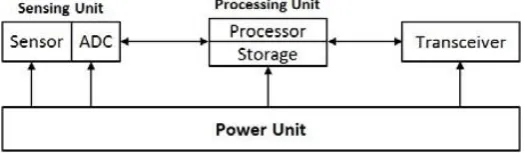
Sensor nodes, as building blocks of WSN, are consisted of four basic elements shown in Fig. 1: the sensor unit, processing unit, communication and power units.
© 2016, IJCSMC All Rights Reserved 689
Sensor nodes are small, low power single board computers with a radio for wireless communication. Number and types of sensors depends on the applications. Sensor nodes collect and transfer data using four stages: collecting the data, processing the data, packaging the data and communicating the data [2].
Currently in the market there are many commercially available sensor node platforms. In this work emphasis will be on Raspberry Pi computer making a comparative study of its performances and constraints with current popular wireless sensor nodes presented in [2, 3]. The main goal of this research is to define and present advantages and disadvantages of Raspberry Pi and abilities of its usage as a sensor node.
LITERATURE SURVEY
A sensor network is defined as being composed of a large number of nodes which are deployed densely in close proximity to the phenomenon to be monitored. Each of these nodes collects data and its purpose is to route this information back to a sink. The network must possess self-organizing capabilities since the positions of individual nodes are not predetermined. Cooperation among nodes is the dominant feature of this type of network, where groups of nodes cooperate to disseminate the information gathered in their vicinity to the user.
A Raspberry Pi is a Single Board Computer which runs on open-source Debian distribution of Linux operating system. Raspberry Pi is a small, powerful, cheap, hackable and education-oriented computer board introduced in 2012. This credit card-sized computer with many performances and affordable for 25-35$ is perfect platform for interfacing with many devices.
WHAT IS RASPBERRY PI ?
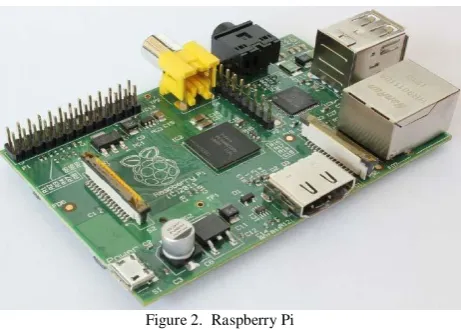
Raspberry Pi is a small, powerful, cheap, hackable and education-oriented computer board introduced in 2012 (Fig. 2). This credit card-sized computer with many performances and affordable for 25-35$ is perfect platform for interfacing with many devices.
Figure 2. Raspberry Pi
The Raspberry Pi board contains a processor and graphics chip, program memory (RAM) and various interfaces and connectors for external devices (Fig. 2). Some of these devices are essential, others are optional but all Raspberry Pi models have the same CPU named BCM2835 which is cheap, powerful, and it does not consume a lot of power [4]. Raspberry Pi operates in the same way as a standard PC, requiring a keyboard for command entry, a display unit and a power supply. SD Flash memory card normally used in digital cameras is configured in such a way to „look like‟ a hard drive to Raspberry Pi‟s processor. The unit is powered via the micro USB connector. Internet connectivity may be via an Ethernet/LAN cable or via an USB dongle (WiFi connectivity) [5, 6].
Like any other computer, the Raspberry Pi also uses an operating system and the “stock” OS is a flavor of Linux called Raspbian. Linux, as a free and open source program, is a great match for Raspberry Pi. On one hand, it keeps the price of the platform low, and on the other, it makes it more hackable. There are also a few non-Linux OS options available [5]. The additional hardware and software requirements can be achieved by already existing hardware modules and open source software.
What is Wireless Sensor Network?
© 2016, IJCSMC All Rights Reserved 690
wireless transceiver, and energy source. The microcontroller functions with the electronic sensors as well as the transceiver to form an efficient system for relaying small amounts of important data with minimal power consumption.
The most attractive feature of wireless sensor network is their autonomy. When deployed in the field, the microprocessor automatically initializes communication with every other node in range, creating an ad hoc mesh network for relaying information to and from the gateway node. This negates the need for costly and ungainly wiring between nodes, instead relying on the flexibility of mesh networking algorithms to transport information from node to node. This allows nodes to be deployed in almost any location. Coupled with the almost limitless supply of available sensor modules, the flexibility offered by wireless sensor networks offers much potential for application-specific solutions.
Sensor networks can offer better coverage than more centralized sensing technology. Utilizing node cost advantage and mesh networking, organizations can deploy more sensors using a wireless sensor network than they could using more traditional technology. This decreases the overall signal-to-noise ratio of the system, increasing the amount of usable data. For all these reasons and more, wireless sensor networks offer many possibilities previously unavailable with traditional sensor technology.
WSN WITH RASPBERRY PI
In this paper Wireless Sensor Network is established with the help of Raspberry Pi SBC, various nodes .
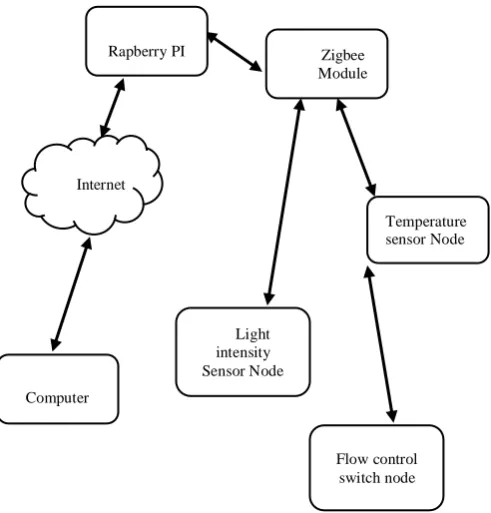
The block diagram consists of Raspberry Pi and Zigbee module to which we will connect different devices. The different devices will communicate with Raspberry Pi through Zigbee modules wirelessly. Raspberry Pi will be connected to the internet. We can control the devices from a remote location with the help of a computer via internet.
Block Diagram
Figure 5 : Block Diagram of System
Specifications-
Node Processor : Atmega 8L
Node Zigbee : Tarang Zigbee Module. Zigbee Module
Rapberry PI
Temperature sensor Node
Light intensity Sensor Node
Flow control switch node Internet
© 2016, IJCSMC All Rights Reserved 691 Node Sensors:DHT11, LDR for light intensity,NTC for tempreture.
Node Power Supply: 5V DC Power Supply with battery backup. Node Operating supply : 3.3 V DC.
OUTPUT ON SENSORWEB
Future Scope
Now a days, every region has internet connectivity. The internet service is low cost service. Thus remote monitoring of various devices and controlling such devices becomes economical. So we can expand this to control various parameters for low cost applications.
CONCLUSION
Based on the comparison of Raspberry Pi‟s key elements and performances with presented current existing wireless sensor nodes it is possible to summarize Raspberry Pi‟s pros and cons against to other systems:
• pros: processing power, memory, connectivity, multipurpose usage (USB), Linux, • cons: power consumption.
The analysis above performed has shown that beside the power consumption issue, Raspberry Pi is ultra cheap-yet-serviceable computer board. With support for a large number of input and output peripherals, and network communication it makes the perfect platform for interfacing with many different devices and using in wide range of applications. By coupling it with Wi-Fi it can communicate remotely what the Raspberry Pi makes very suitable for the construction of wireless sensor nodes and SensorWeb nodes. Moreover, Raspberry Pi can be used as processing node in WSN networks, not just as sensor node but also as controller. In addition, data processing and decision making can be based on artificial intelligence.
Further, The Linux operating system usage provides additional advantages of using Raspberry Pi as a SensorWeb node. Programming in high-level languages such as C, C++, Python, or Java, solution implementation is quite simple and it is enabled to a large number of users, opposed to micro controller programming which usually depends of development kit.
By installing the Web Server on the unit and providing access to the Internet, Raspberry Pi becomes complete and ideal system (hardware and software) for building SensorWeb nodes. One of the possible Raspberry Pi usage scenarios, which is already implemented, is creation of hardware device that has implemented sensor units and communicate with Raspberry Pi via peripheral devices or via GPIO (I2C) interface. The developed Raspberry Pi prototype SensorWeb node is based on Restful services and created in order to build the infrastructure that supports fast critical event signaling and remote access to sensor data via the Internet (the detection of critical events is performed using fuzzy logic). The final evaluation of this prototype and Raspberry Pi usage as wireless sensor node and SensorWeb is planned to be performed by its implementing in home automation and Internet of things projects what are directions of our future work.
ACKNOWLEDGEMENT
© 2016, IJCSMC All Rights Reserved 692
REFERENCES
[1] F. Ali, “A Middleware to Connect Software Applications with Sensor Web”, The International Journal of Technology, Knowledge and Society Volume 6, Number 5, pp. 27-35, 2010
[2] M. Maurya, S. R. N. Shukla, “Current Wireless Sensor Nodes (Motes): Performance metrics and Constraints”, International Journal of Advanced Research in Electronics and Communication Engineering (IJARECE), Volume 2, Issue 1, January 2013 [3]Memsic – Powerful Sensing Solutions, Available: http://www.memsic.com/wireless-sensor-networks, [15.12.2013]
[4] M. Schmidt, Raspberry Pi – A Quick Start Guide, The Pragmatic Bookshelf, 2012 [5] M. Richardson and S. Wallace, Getting started with Raspberry Pi, O‟Reilly, USA, 2013 [6] Raspberry Pi Getting Started Guide, RS Components, Vsn 1.0, 2012
[7] S. Monk, Raspberry Pi Cookbox, O Reilly Media, CA, 2014
[8] Introduction to home automation with the Raspberry Pi, Available: https://vancouver.hackspace.ca/wp/2013/11/03/introduction -tohome-automation-with-the-raspberry-pi-sunday-november-24th-2013/, [21.12.2013]