12
Journal of Advanced Research in
Business and Management Studies
Journal homepage: www.akademiabaru.com/arbms.html
ISSN: 2462-1935
An overview of OSH management systems in the water
service project
Mohamad Mahathir Mohamed Younos1, Mohamad Syazli Fathi1,∗
1 UTM Razak School of Engineering and Advanced Technology, Universiti Teknologi Malaysia, 54100, Kuala Lumpur, Malaysia
ARTICLE INFO ABSTRACT
Article history:
Received 7 July 2017
Received in revised form 15 July 2017 Accepted 15 August 2017
Available online 25 August 2017
Occupational Safety and Health (OSH) Management System is a part of the management system that facilitates the management of Occupational Safety and Health (OSH) risks. The water services industry is a high-risk industry that deals with complex engineering construction, chemical use, water supply and people. The increasing number of accidents and fatality, including those derive from risk-injury and work-related disease requires organisations to implement OSH Management System. This paper reviews the OSH Management System in the water services in Klang Valley. The finding shows that there is a need for OSH Management System due to the high impact towards the stakeholders and third parties, such as consumers, environment, authority and the top management. This paper concludes the reason on why OSH Management System is very important in relation to the lack of awareness towards safety, health and environment in the workplace area.
Keywords:
OSH management system, water services,
stakeholder, safety, occupational safety Copyright © 2017 PENERBIT AKADEMIA BARU - All rights reserved
1. Introduction
Water services play a significant role in a country’s economic development. It establishes the infrastructure required for socioeconomic development while being a major contributor to the overall economic growth [1-10]. Nevertheless, it is also one of the most hazardous industries [11-15]. The hazardous areas associated with the water services industry include physical, biological and environmental. In terms of physical hazards, people working in the water services industry are exposed to all kinds of physical hazards such as falls, accidents, working at height, working in confined space, as well as working with equipment and machineries. In addition, the workers are also exposed to complex engineering construction and chemical use. As a highly hazardous industry, water companies have the obligation to preserve the reputation of the industry from the increasing number of accidents and fatality issue always. This is where the OSH Management System comes into place. The establishment of OSH Management system is to make water services more efficient, a safe place for both employers and employees, as well as minimizing cost. It is proven that the most effective
∗Corresponding author.
E-mail address: Mohamad Syazli Fathi ([email protected])
Penerbit
Akademia Baru
13
strategy for the industry is to provide safe and healthy workplace by managing the cost of doing business through minimizing accidents and damage of properties. Therefore, it is mandatory for the water companies in the industry to provide a safe working environment for the workers, contractors, sub-contractors, consumers, as well as the third party according to OSHA 1994 and another legal requirement.
The construction industry especially SME tends to have a low awareness on the long-term benefits of safety practices, while the tendering process often gives little attention to safety, resulting in cost and corner cutting. The utility business is also not being systematically in term of OHS management system implementation and less efficient towards the issue regarding safety and health. According to Radhlinah [16], the construction industry can benefit from an improved attitude change that cultivates a vision for the future which elevates safety concerns and effectively integrates them into the overall management mix. Besides that, the high rates of damage are primarily because of insufficient or non-presence of an OHS management system and will lead the occupational accidents and injury happen because of the lack of awareness and the failure of OHS management system. The application of an ‘effective’ management can lead to safer systems of construction and reduce incidence of injuries and work-related diseases [17]. Therefore, there is a need as an effective action to integrate OSH management systems to prevent and reduce the numbers of accident and work-related.
2. Review of the OSH Management Systems
This paper reviews the OSH management systems for water services project to comply with the law requirement. All the expertise for the system is ISO standard. The OHSAS 18000 standard is built to conform to ISO 9001 and ISO 14001 in order to merge the integration of quality, environmental and occupational health, as well as safety management systems by the organization.
The OHSAS specification provides the need for an OSH management system, to allow the organization to oversee OSH risks and improve OSH key indicator. OSH performance indicators are used to measure and assess the status quo and the development in the main areas of OSH, such as occupational hazards and work-related ill-health; prevention in companies; and the performance of the public OSH infrastructure.
The OSH Management System is a synchronised and organised approach to dealing with health and safety risks. OSH Management Systems help companies to constantly improve their safety performance and compliance to health and safety legislation and standards. From here, they establish safer working environments that safeguard people at work by eradicating, or better handling, health and safety hazards. The cumulative alertness of complications and resolutions have been reflected by the progress of organization practices. At first, organisation of OSH focused on mechanical examinations, with the later addition of organisational, human factors and behavioural issues. Today, it is generally recognised that all these issues are vital and the administration of OSH needs a cohesive approach.
14
2.1 Water Services Industry
According to the Malaysia National Services Water Resources Management Plan (2016), water resources provide about 100 gallons of fresh, treated water every day for each person in this country, or close to 40 billion gallons per day nationwide. Rivers, lakes and wells are sources of water. Water is collected, filtered and treated before it is sold to residential, industrial, agricultural, and commercial areas, as well as for the public use. The water system is formulate based on the population area by a single operator or a huge system of reservoirs, dams, pipelines and treatment plants which may be a small plant in a rural area involving efforts of hundreds of people. Next, the figure 1 shown the operational process of the water treatment plant information in the standards practicing at Malaysia.
Fig. 1. Water Treatment Plant Information [18]
As previously mentioned, the water services industry is recognized as one of the most hazardous industry. The people working in the water services industry are exposed to all kinds of physical hazards such as falls, accidents, working at height, working in confined space, as well as working with equipment and machineries. In addition, the workers are also exposed to complex engineering construction and chemical use. Exposure to these hazards has made the implementation of OSH Management System a requirement for the industry to have a well-planned and well-placed standard in all its practices.
3. Occupational Safety Health Management Systems
3.1 Occupational Health and Safety Management System (OHSMS)
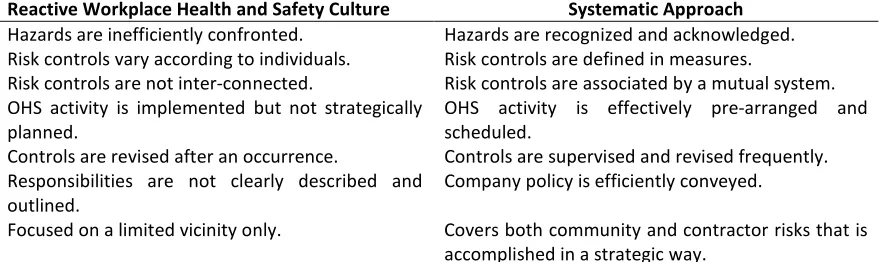
15 Table 1
Contrast Systematic Approaches with Reactive Workplace Health and Safety Culture
Reactive Workplace Health and Safety Culture Systematic Approach
Hazards are inefficiently confronted. Hazards are recognized and acknowledged.
Risk controls vary according to individuals. Risk controls are defined in measures.
Risk controls are not inter-connected. Risk controls are associated by a mutual system.
OHS activity is implemented but not strategically planned.
OHS activity is effectively pre-arranged and scheduled.
Controls are revised after an occurrence. Controls are supervised and revised frequently.
Responsibilities are not clearly described and outlined.
Company policy is efficiently conveyed.
Focused on a limited vicinity only. Covers both community and contractor risks that is
accomplished in a strategic way. Source: OHSMS: Strategic Issues Report (1999)
The systematic approach is a more favourable and preferable method compared to the reactive workplace health and safety culture. This is because the application of systematic approach is seen as a more positive form of approach. A possible approach to these issues is through a team building directly or indirectly from everyone involved as safety and health practices will have significant returns. Publicity campaigns, inspections, enforcements and ongoing seminar are the programs created in reducing the number of accidents. Improving communications and publicity for regulations and requirements and providing tangible recognition as financial incentives were included the role of OSH.
4. Conclusion
This paper presents a review on the need for OSH management system in the water services industry and to recognize the law-making requirements to take after by the business people, as well as the implementation of OSH management system in Malaysia. The establishment of OSH Management system is to make water services more efficient, a safe place for both employers and employees, as well as minimizing cost. It is proven that the most effective strategy for the industry is to provide safe and healthy workplace by managing the cost of doing business through minimizing accidents and damage of properties. The procedures and instruction are continuously safeguarding the safety of the workers and assuring healthy workplaces. The main goal for the values and regulation is to respond to accidents, sick health and injury at the workplaces towards expansion of safety society. Many establishments that have executed OSH management system have testified profited from improved working productivities, reduction in lost workdays, a decrease in accidents and medical claims, acknowledgment by back up plans and regulators and better labourer’s maintenance and contentment. Companies with convincing OSH management system receive constructive profits and advantages for their safety and health investment.
16
organization and as per required in OSH MP Plan 2016 to 2020 (OSH Transformation – Preventive Culture) by Departmental Occupational Safety Health Malaysia.
References
[1] ANSI (1996). The American Industrial Hygiene Association (AIHA). Occupational Health and Safety Management
System. Virginia, USA.
[2] Bateman, King, and Lewis (1994). The Handbook of Health and Safety At Work. London: Kogan Page Limited. 105
-107.Proceedings of the 6th Asia-Pacific Structural Engineering and Construction Conference (APSEC 2006), 5 – 6 September 2006, Kuala Lumpur, Malaysia.
[3] Bottomley, Bryan. Occupational health & safety management systems: strategic issues report. National Occupational Health and Safety Commission, 1999.
[4] British Standards Institution (1996). Guide to Occupational Health and Safety Management System. London, BS
8800.British Standards Institution (1999). Occupational Health and Safety Assessment Series (OHSAS) Specification. OHSAS 18001.
[5] Casadesus, Marti, Frederic Marimon, and Inaki Heras. "ISO 14001 diffusion after the success of the ISO 9001 model." Journal of Cleaner Production 16, no. 16 (2008): 1741-1754.
[6] Marimon, Frederic, Josep Llach, and Merce Bernardo. "Comparative analysis of diffusion of the ISO 14001 standard by sector of activity." Journal of Cleaner Production 19, no. 15 (2011): 1734-1744.
[7] Caborn, J. (2005). News from the ILO: ILO World Day for Safety and Health at Work 2005, G. Wilkinson, B.G. Dale,
Integrated management systems: A model based on a total quality approach. Managing Service Quality 11 (2001) 318-330.
[8] Cox, Sue, and Tom Cox. Safety, systems and people. Butterworth-Heinemann, 1996.
[9] Gadd, S. and Collins, A.M. (2002). Safety Culture: A Review of the Literature, Report No. HSL/2002/25, Sheffield: Health & Safety Laboratory, Human Factors Group, pp. 8-30.
[10] Morrow, David, and Dennis Rondinelli. "Adopting corporate environmental management systems:: Motivations and results of ISO 14001 and EMAS certification." European management journal 20, no. 2 (2002): 159-171. [11] Wilkinson, G., and B. G. Dale. "Management system standards: the key integration issues." Proceedings of the
Institution of Mechanical Engineers, Part B: Journal of Engineering Manufacture 214, no. 9 (2000): 771-780. [12] Hague, P., and Harris, P. (1993). Sampling and Statistics. London: Kogan Page Limited. Health & Safety Executive.
Managing Health and Safety (Five Steps to Success).
[13] International Labour Organization (2001). The Guidelines on Occupational Safety and Health Management System. ILO – OSH 2001.
[14] Comittee, Technical Affairs. "Systems in focus-guidance on occupational safety and health management systems." In ASSE Professional Development Conference and Exposition. 2003.
[15] Cqi. (2013). Integrated management systems [online]. UK: chartered quality institute.
Available: http://www.thecqi.org/knowledge-hub/resources/factsheets/integrated-managementsystems/ [16] Ahmad, Radhlinah Kunju. "Developing a proactive safety performance measurement tool (SPMT) for construction
sites." PhD diss., © Kunju Ahmad R., 2000.
[17] Davies, V. J., and Tomasin, K. (1996). Construction Safety Handbook. Thomas Telford.
![Fig. 1. Water Treatment Plant Information [18]](https://thumb-us.123doks.com/thumbv2/123dok_us/1203110.1151065/3.595.117.478.249.401/fig-water-treatment-plant-information.webp)