ZHU, LIANSHENG. Analyzing Longitudinal Data with Non-Ignorable Missing. (Under the direction of Dr. Sujit Ghosh and Dr. Subhashis Ghosal.)
efficiency. When the missingness does depend on the patterns, results based on simulated data suggest that both approaches yield accurate estimates if the underlying number of patterns is specified correctly. Otherwise the PI method leads to biased results whereas the JM approach still provides reasonably accurate estimates.
by
LIANSHENG ZHU
A dissertation submitted to the Graduate Faculty of
North Carolina State University
In partial fulfillment of the
Requirements for the degree of
Doctor of Philosophy
STATISTICS
Raleigh, NC
2006
APPROVED BY
Sujit Ghosh, Co-Chair Subhashis Ghosal, Co-Chair
Biography
Liansheng Zhu was born in Qidong, a coastal town in the Eastern China. He graduated
from Huilong High School at Qidong in 1994. He received a Bachelor of Sciences degree
in Chemistry and Chemical Engineering from Hunan University at Changsha, China in
1998. He obtained a Master’s of Sciences degree in Statistics from Kansas State University
at Manhattan, Kansas in 2003. He then joined the graduate program in the Department
of Statistics at North Carolina State University in August 2003. He is working as a
Acknowledgements
First, I would like to express my deepest appreciation to my wonderful advisors Dr. Sujit
Ghosh and Dr. Subhashis Ghosal for their guidance, training and support during this
research. It is my honor to have them as my advisors, to learn and get inspiration from
them. Also, I am grateful to the valuable suggestions and comments from Dr. Anastasios
Tsiatis and Dr. Hao Zhang on this research and their presence in my committee. Many
thanks also go to Dr. Jie Zhang in Novartis Pharmaceuticals from whom I got inspiration
to initiate this research. Finally, I want to thank my dearest parents, sister and brother,
for their endless love and support. Special thanks also go to my parents-in-law who come
Contents
List of Tables . . . vii
List of Figures . . . viii
1 Introduction . . . 1
1.1 A Motivating Study . . . 1
1.2 Notations and Definitions . . . 2
1.3 Models and Associated Methods for NIM Data . . . 3
1.3.1 Selection Models . . . 4
1.3.2 Pattern-mixture Models . . . 5
2 Proposed Statistical Methods . . . 8
2.1 The Pseudo-imputation (PI) Method . . . 8
2.1.1 Model Description . . . 8
2.1.2 Example . . . 9
2.1.3 Extension and Asymptotic Property . . . 11
2.2 Joint Modeling . . . 13
2.2.1 Model Description . . . 13
2.2.2 Prior Selection and Posterior Computation . . . 15
2.2.3 Model Selection . . . 16
2.3 Simulation Study . . . 17
2.3.1 Results based on Scenario 1 . . . 18
2.3.3 Sensitivity Analysis for the JM Approach . . . 26
2.4 Conclusions . . . 27
3 Modeling NIM Data using GAM. . . 29
3.1 Model Description . . . 30
3.2 Simulation Studies . . . 31
3.3 The JM Approach with GAM . . . 33
4 Application: CPCRA Aids Study . . . 42
4.1 Study Description . . . 42
4.2 Data Analysis Assuming a GLM . . . 43
4.3 Data Analysis Assuming a GAM . . . 44
5 Conclusions and Future Work. . . 47
5.1 Conclusions . . . 47
5.2 Future Work . . . 48
5.2.1 Pattern Finder . . . 48
5.2.2 Testing the MAR Assumption . . . 50
List of Tables
1.1 The typical data structure. (N A: missing data) . . . 3
2.1 Proportion of data simulated in the first scenario . . . 19
2.2 Comparison of Bias’s and SE’s of estimates for the scenario 1. FA: the
full-data analysis. PI3, PI6, and PI12: the pseudo-imputation methods
with 3, 6, and 12 patterns, respectively. . . 21
2.3 Comparison of two versions ofDIC’s. DIC1 (Spiegellhalter et al., 2002)
and DIC2 (Gelman et al., 2003). . . 22 2.4 Comparison of estimates and their SE’s for fixed effects in the R-model
from joint-modeling approach based on the scenario 1 . . . 23
2.5 Results of simulation for the joint modeling with the misspecification of
the distribution for random patterns. . . 26
4.1 Parameter estimates and their standard errors from analyzing aids data
by utilizing various methods. * indicates the fixed effect is significant at
the significance level α= 0.05 . . . 45 4.2 Parameter estimates and their standard errors from analyzing aids data
List of Figures
2.1 Parameter estimates from 4 methods under Scenario 1. FA, the full-data
analysis. LOCF, the last observation carried forward method. PI3, the
pseudo-imputation method with 3 patterns. JM3, the joint-modeling
ap-proach with 3 patterns. . . 20
2.2 Parameter estimates of fixed effects in the Y-model from joint-modeling
approach with different patterns under Scenario 1. . . 22
2.3 Partial parameter estimates under Scenario 2. . . 25
2.4 Comparison of results betweenJ ML and J MP with 3 patterns under Sce-nario 1. J ML, the joint model with the use of the logistic regression in the
R-model; J MP, the use of the probit regression in the R-model . . . 28
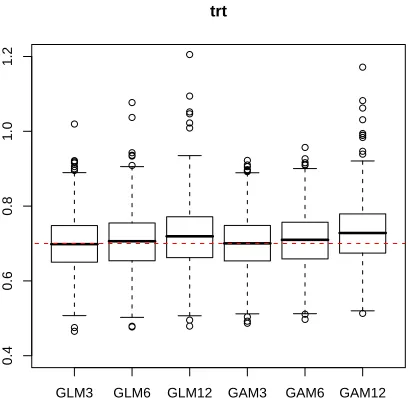
3.1 Parameter estimates for covariates “trt” (top) and “tscore” (bottom) in
the first simulation. GLM: the generalized linear model and GAM: the
generalized additive model at the first step of the PI method. 3, 6 and 12
indicated the number of patterns specified for both methods. The dashed
horizonal line indicates the true value of β. . . 36 3.2 Parameter estimates for covariates “age” (top) and “year” (bottom) in
the first simulation. GLM: the generalized linear model and GAM: the
generalized additive model at the first step of the PI method. 3, 6 and 12
indicated the number of patterns specified for both methods. The dashed
3.3 Parameter estimates for covariates “bfs1” (top) and “bfs2” (bottom) in
the first simulation. GLM: the generalized linear model and GAM: the
generalized additive model at the first step of the PI method. 3, 6 and 12
indicated the number of patterns specified for both methods. The dashed
horizonal line indicates the true value of β. . . 38
3.4 Smooth estimate of age . . . 39
3.5 Parameter estimates of treatment effects from the PI approach with
differ-ent modeling techniques. GLM: the generalized linear model and GAM:
the generalized additive model at the first step of the PI method. 3 and
6 indicated the number of patterns specified for both methods. The data
generation model is a GAM under Scenario 1. The dashed horizonal line
indicates the true value of β. . . 40 3.6 Parameter estimate of the treatment effect from the JM approach with
GAM when data generated by a GAM under Scenario 1. The dashed
Chapter 1
Introduction
In longitudinal studies, measurements of a response variable and some explanatory
variables for each subject are recorded repeatedly across time. The primary interest
is often the estimation of either the change in the response variables over time or the
effects of independent variables at the completion of studies. Longitudinal studies are
popular in epidemiological research. Besides that, they are gaining increasing popularity
in clinical trials of intervention dealing with chronic diseases. Although most studies are
well designed and every attempt is made to collect data on each subject at each of the
follow-up times, it is often unavoidable to have some measurements missing intermittently
and/or even have subjects dropped out prior to the completion of the study. The reasons
behind such missing may be study-related, for example, adverse event, competing risks,
lack of effectiveness of treatments, or even early recovery. It can also be non-study
related, e.g., accidental death or moving away. An example of a longitudinal study is
given in Section 1.1. Section 1.2 provides notations and definitions for model description.
Some statistical methods in literature dealing with non-ignorable missing are discussed
in Section 1.3.
1.1
A Motivating Study
According to the National Osteoporosis Foundation, vertebral fractures are the most
fracture, one out of five will suffer their next vertebral fracture within just one year,
potentially leading to a fracture “cascade”. There is a three-year clinical trial in which
binary outcomes (new fracture versus no new fracture) of vertebral fracture are measured
at the end of each year. Baseline measurements include patients’ age, Tscore (calculated
from bone mineral density), and baseline fracture status (0, 1, ≥ 2). Patients are
ran-domly assigned to either the treatment group or the placebo group. Some patients may
not have any post-baseline measurements and some patients may only have incomplete
post-baseline measurements. In this specific study, it was defined that if a fracture is
determined for the patient at the jth year, it will be assumed that his or her post jth
year outcome is a fracture as well since the vertebral fracture can not be cured (once
a fracture, always a fracture). Therefore, data from these patients are not counted as
missing even when there are no measurements available. That means the subjects are
considered as dropouts only if they do not experience fracture before missing. The
pri-mary analysis is to compare the intervention with the control on vertebral fracture based
on the population excluding patients without any post-baseline data. There is reason
to suspect that dropouts may depend on responses because subjects with new fractures
may be more likely to quit than those with no fractures. Hence, standard statistical
methods do allow the missing mechanism to depend on missing observations may yield
biased estimates and hence misleading conclusions might be drawn by the clinicians.
1.2
Notations and Definitions
Let Yij be the responses of theith subject measured at the jth time point, Xi denote
the vector of baseline covariates, andRij be the missing indicator variable fori= 1, . . . , n,
andj = 1, . . . , m. LetRij = 1 ifYij observed andRij = 0 otherwise. LetY be the matrix
of Yij’s andX andR be matrices of Xi’s, andRij’s. The variable Y can be expressed as
(Yobs, Ymiss), where Yobs denotes observed responses and Ymiss the missing ones.
Consider again the above example of the 3-year study. If subjects have at least one
post-baseline measurement, and then they are included in the analysis. Hence, there are
only three missing patterns since a monotonic missing mechanism (dropout) is observed.
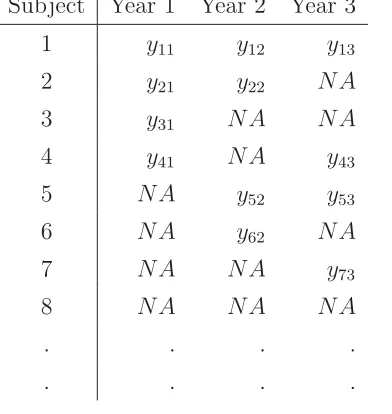
Table 1.1: The typical data structure. (N A: missing data)
Subject Year 1 Year 2 Year 3
1 y11 y12 y13
2 y21 y22 N A
3 y31 N A N A
4 y41 N A y43
5 N A y52 y53
6 N A y62 N A
7 N A N A y73
8 N A N A N A
. . . .
. . . .
can be eight possible missing patterns. A typical data structure is illustrated in Table 1,
where NA indicates a missing observation. In this illustration,R11= 1, R23= 0 etc.
In Rubin and Little’s taxonomy (1976, 1987), there are in general three missing
mechanisms that can be expressed in terms of the conditional distribution of R given X
and Y. Let f(U|V) denote the conditional distribution of U given V.
1. Missing completely at random (MCAR): f(R|X, Y) = f(R). One extension of
MCAR is defined as the covariate-dependent MCAR iff(R|X, Y) = f(R|X).
2. Missing at random (MAR): f(R|X, Y) = f(R|Yobs, X).
3. Non-ignorable missing (NIM): f(R|X, Y) =f(R|X, Yobs, Ymiss).
The third mechanism (NIM) which makes no restrictive assumption on missing
mecha-nisms is the main focus of our research.
1.3
Models and Associated Methods for NIM Data
It is generally difficult to model NIM data since the distributional assumptions about
otherwise. There is a large volume of literature devoted to reduce bias resulting from this
type of missing. Two widely used approaches are selection models and mixture models.
In mixture models, the joint density of repeated outcomes Y and missing indicator R,
conditional on covariates, X is written as f(Y, R|X) = f(Y|R, X)f(R|X) whereas for
selection models it is written as f(Y, R|X) =f(Y|X)f(R|Y, X).
1.3.1
Selection Models
Selection models, which were first introduced in the univariate setting by Heckman
(1976) appearing in the econometrics literature, require one to combine a model for the
full data with a selection model for missing indicators given data. Diggle and Kenward
(1994) extended Heckman’s work to multivariate normal data. Fizmaurice et al. (1996)
proposed multivariate logistic models for incomplete binary responses while Molenberghs
et al. (1997) introduced methods for analyzing longitudinal ordinal data with
non-ignorable missing. In practice, one can assume a generalized linear regression model
for the full-data using a suitable linear function to explain effects of covariates and a
logit or probit model for the selection model.
Selection models are intuitively appealing since the inference about parameter
es-timates of primary interest can be obtained directly from f(Y|X), and parameters in
f(R|Y, X) can be treated as nuisance parameters provided there are no common
para-meters in f(Y|X) and f(R|Y, X). However, some limitations do exist. For instance, for
continuous responses, the common assumption of multivariate normality is not easy to
verify when some responses are missing (Hogan et al., 2004). Moreover, the selection
model postulated to model the dependence of dropout process on unobserved responses
is not verifiable. Inference from selection models can be highly sensitive to model
as-sumptions (Little and Rubin, 2002). Finally, computations can be very intensive due to
general requirement of likelihood maximization and numerical instability occurs resulting
from the possibility of a flat likelihood about the parameters of primary interest (Hogan,
1.3.2
Pattern-mixture Models
Although the terminology of pattern-mixture models that are our main focus here
was first defined by Little (1993), the early application of mixture concepts can be traced
back to Rubin (1977). Conventionally, marginalization of results are often in need. For
example, Little (1993, 1994) and Molenberghs et al. (1998) first stratified the incomplete
data by missing patterns, then fitted distinct models within each stratum, and finally
summarized results over patterns. The general model can be written as
f(Y, R|X) =f(Y|R, X)f(R|X), (1.1)
where the distribution ofY, conditional onR andX, is multinomial and R is treated as
a covariate, and the distribution of R given X can be left unspecified or in a parametric
form. Marginalization over patterns is required to obtain estimates of parameters of
primary interest.
Traditionally, missing patterns are defined according to times to missing. For
ex-ample, there are eight patterns for a typical data set like the one shown in Table 1.1.
Without a doubt, it is often unavoidable that not all parameters are estimable because of
some missing observations. In other words, pattern-mixture models are under-identified
(Little 1993). Either restriction must be set for some patterns, additional assumptions
be made, or information need to be borrowed from observed data. To overcome the
under-identifiable problem, Wu and Bailey (1988, 1989) allow responses to depend on
missing indicators through individual random effects estimated from a general linear
mixed model, then average over the distribution of random effects that can be assumed
to be parametric or left unspecified. The model can be written as
f(Y, R|X) =
f(Y|b, X)f(R|b, X)dF(b), (1.2)
where b is the subject-specific random parameter vector. The variables Y and R are
linked throughband inference can be made based on (Y|b, X) by integrating outb. This
model is often called shared parameter (SP) model. Follmann and Wu (1995) extended
responses without any parametric assumption on random effects. Estimation of marginal
means for binary cases was described by Birmingham and Fitzmaurice (2002).
Guo et al. (2004) proposed a random pattern-mixture model for continuous data
in which they considered dropout patterns as random latent variables and determined
according to many factors, including times to missing, baseline covariates and/or
time-varying covariates. The key assumption of this model is that the longitudinal responses,
Y, are independent of the missing indicators, R, conditional on the pattern effects. The
proposed model is given by,
f(Y, R, b|X) =
f(Y|b, X, u, R)f(b|X, R, u)f(R|u, X)f(u|X)du
=
f(Y|b, X, u)f(b|X, u)f(R|u, X)f(u|X)du, (1.3)
wherebis the subject-specific random parameter vector anduis the latent variable vector
representing the random pattern effect. To obtain parameters of primary interest, one
requires marginalization over b and u which can be computationally difficult. To avoid
this task, a joint normal approach was adopted and maximum likelihood estimates were
derived by EM algorithm.
As will be seen, marginalization is often required. It may not be that problematic
if responses are continuous and/or the final parameter of interest is the marginal mean.
However, in situations where there are a number of covariates of interest in discrete
longitudinal data, methods for parameter-wise marginalized results can be very tricky.
For instance, suppose that there are two covariates, treatments and patients’ age, denoted
as X1 and X2, respectively. Also, suppose that there are two missing patterns. Then, a
logistic regression is usually fit for binary data conditional on each missing pattern,
P(k)= (1 + exp[−(β0(k)+X1(k)β1(k)+X2(k)β2(k))])−1. (1.4)
where k is the pattern indicator, 1 or 2. Obviously, β1(k) is the logarithm of odds ratio
between two treatments given the value of age and the pattern k. However, what we
need is a marginal parameter β1 to measure the effect of treatment irrespective of the
as β1(k)’s. The above methods that are available in the literature do not provide such
marginal parameter β1 such that the marginalized estimates of parameters are still of
meaningful representation as the conditional estimates based on patterns.
To resolve both the under-identifiability and marginalization problems, we propose
two approaches in the Chapter 2. The first one will be called the pseudo imputation (PI)
approach, an approximation method for estimating parameters at the marginal level.
Secondly, we extend the method proposed by Guoet al.(2004) to general cases by jointly
modeling Y and R within a Bayesian framework and will be called the joint-modeling
(JM) approach. Both methods are applicable to both discrete and continuous outcomes.
At this moment, it is assumed that a surrogate variable is observed and missing patterns
are known. Simulation studies are conducted to illustrate the proposed methods and
to compare them with some exiting methods. In Chapter 3, we extend our approaches
to accommodate more general situations and relax the assumptions in Chapter 2. In
Chapter 4, the proposed methods are illustrated using a real life data set from an aids
Chapter 2
Proposed Statistical Methods
Firstly it is assumed that a surrogate variable determining missing patterns is fully
observed. Then, we define Zi, that has a known distribution, as the design matrix of
missing patterns with the random effect ui. We further assume f(Rij|Yij, Xi, Zi, ui) =
f(Rij|Xi, Zi, ui), which means that the missing mechanism is conditionally MAR given
the latent variableui. For a given pattern, data often contain both observed responses and
missed ones, the problem of under-identifiability, which is encountered by the traditional
pattern-mixture models that use time to dropout as patterns, does not exist any more.
The models presented in this chapter are general enough in the sense of that we do not
require the assumption of monotonic or intermittent missingness pattern. The
pseudo-imputation (PI) method and its extension will be described in Section 2.1, followed by
the joint modeling (JM) method. In Section 2.3, simulation studies based on different
scenarios are carried out. Section 2.4 presents conclusions and some general remarks.
2.1
The Pseudo-imputation (PI) Method
2.1.1
Model Description
The first step is to estimate E(Yij|Xi, Zi) = µij and its corresponding variance within
each pattern for both observed and missing subjects. Standard methods can be used for
As it is well-known in the multiple imputation technique, more than one values are
sim-ulated for each missing point based on estimated E(Yij|Zi, Xi) and its variance that are
obtained at the first step. On the contrary, the pseudo-imputation method does not
im-pute the missing values but directly models estimatedE(Yij|Zi, Xi) or its transformation
in linear regression framework. By doing so, estimates of marginal parameters can be
obtained. In summary, the following three steps are needed to implement the PI method:
1. Given Zi, estimate µij by using a standard method (e.g., GLMM).
2. Transform the estimate, sayh(ˆµij), by using a desired functional form. For example,
logit for binary data and log for count data. By doing so,h(ˆµij) will be linear inβ.
3. Fit a linear model
E(h(ˆµij)|Xi) = XiTβ (2.1)
where the estimate of β is indeed at the marginal level.
Notice that the variance of estimates obtained at Stage 3 is under estimated since it
ignores the fact that a major proportion of variation has been reduced at Stage 1. Hence,
we need to derive the variance of estimates for fixed effects, denoted as var( ˆβ). In linear
models, var( ˆβ) = (XTV−1X)−1, where,
V =var(h(ˆµij)) =var(E(h(ˆµij)|Zi)) +E(var(h(ˆµij)|Zi)) (2.2)
If a linear mixed model is used at Stage 3 and u treated as random with mean 0 and
variance Ω, then E(var(h(ˆµij)|u)) = ZTΩZ+ Σ where Ω and the random error Σ can be
estimated at the third stage and E(var(h(ˆµij)|u)) at the first stage. Therefore, var( ˆβ)
can be obtained without much difficulty. Explicit steps to get parameter estimates and
their corresponding variance are demonstrated in the following example.
2.1.2
Example
For illustration we consider the binary data described in Section 1. The original data
variable. Now, we can rewrite (Yij, Xi) as
Yij(k) ={Yij :Si =k}
Xi(k) ={Xi :Si =k} (2.3)
Suppose the variable, baseline fracture status (BFS), is a good surrogate for responses
and missing indicators and hence it links Y and R. Then, we can have three patterns
corresponding toSi=BFSi =k,k= 1,2,3. Hence, the first step is to regressYij(k)onXi(k)
and obtain βˆ(k) and ˆµ(ijk). In this step, a logistic regression can be used since responses
are binary,
Yijk ∼Ber(Pij(k))
µ(ijk) =Pij(k) = [1 + exp(−Xi(k)β(k))]−1. (2.4)
For instance,Xi(k) = (1,Tscorei(k),yeari(k),trt(ik),age(ik))T. Notice that BFS is not included
in the model since there is only one level of BFS in each pattern by definition.
After obtaining the estimates of µ(ijk), ˆµ(ijk) at the first step, the second step is to
transform ˆµ(ijk) by the logit function, denoted ash(ˆµ(ijk)), which is linear in β. Obviously,
h(ˆµ(ijk)) = Xi(k)β(k). At the third step, the marginal estimate, ˆβ, will be obtained by using
a linear model for ˆµ(ijk) and all covariates,
E(h(ˆµ(ijk))) =XiTβ, (2.5)
where XiT = (1,Tscorei,yeari,trti,agei,BFSi)T. The variance ofh(ˆµ(ijk)) is given by
ˆ
V = ˆVar(h(ˆµ(ijk))) = ˆVar(E(h(ˆµ(ijk))|Si)) + ˆE(Var(h(ˆµij(k))|Si)). (2.6)
Since the logit function is used at the second step, h(ˆµ(ijk)) = Xi(k)βˆ(k). Hence,
ˆ
var(E(h(ˆµ(ijk))|Si)) = ˆΣ +STΩˆS
ˆ
WhereS is the vector of Si’s. The estimate of variance-covariance matrix for the
within-pattern variation and the between-within-pattern variance ( ˆΣ and ˆΩ can be obtained at the
third step while Var( ˆβ(k)) is available at the first step. LetV∗ be the matrix of Var( ˆβ(k)).
Therefore,var( ˆβ) = (XTVˆ−1X)−1 = (XT( ˆΣ +STΩˆS+V∗)−1X)−1.
2.1.3
Extension and Asymptotic Property
Previously, we assume there exists a desirable link function at the second stage of
the proposed method. However, it is not necessary. In the following, we are going to
construct the estimation equation and derive asymptotic properties in a general sense.
Denote the estimates of the predictive means obtained at the first stage to be ˆµk and nk
be the number of observations for the kth pattern. Notice that µk = µ under the true
model. Then the likelihood score equation for approximating β is
K
k=1
nk
∂µk(β)
∂β
Vk−1(ˆµk−µk(β)) (2.8)
and the variance of the maximum likelihood estimator for ˆβ can be estimated by
K
k=1
nk
∂µk(β)
∂β
Vk−1
∂µk(β)
∂β
T −1
(2.9)
Lemma 1. Suppose that β0 is the true parameter and that
(i) n12
k(ˆµk−µk(β0)) has asymptotic distribution N(0, Vk) for k = 1, . . . , K,
ii) ∂µ∂βk(β) and Vk for all k are continuous in the neighborhood ofβ0 and the inverse of the
limit of
1
n
K
k=1nk(∂µ∂βk(β))Vk−1(∂µ∂βk(β))T
exists. Then,
(a) βˆ is consistent for β0,
(b) n12( ˆβ−β0) has an asymptotic normal distribution.
is equal to 0 and some regularity conditions are satisfied. The regularity conditions for
consistency can be found in Serfling (Chapter 4, 1980), Huber (Lemma 2.1 and Theorem
2.2 in Chapter 6, 1981) , and van der Vaart (Theorems 5.7 and 5.9, 1998). Here, we only
check if the expectation condition holds. Clearly, as the expectation is with respect to
β0, E[(ˆµk−µk(β))|Zk] = 0 as the condition (i) in Lemma 1 holds. Hence, with respect
toβ0,
EKk=1nk(∂µk(β)
∂β )Vk−1(ˆµk−µk(β))|Zk = 0.
By conditional expectation, it results in
E{Kk=1nk(∂µk(β)
∂β )Vk−1(ˆµk−µk(β))}= 0.
Therefore, ˆβ is the consistent estimator of β0. To derive the large sample distributional
properties of the above estimator, one can follow the usual approach for the M-estimators
2.2
Joint Modeling
2.2.1
Model Description
We propose to use the following model,
µij =E(Yij|Xi, Zi, ui, β) = g1(XiTβ+Ziu1i) (2.10)
πij =E(Rij = 1|ui, Xi, Zi, α) =g2(XiTα+Ziu2i) (2.11)
ui ∼F(.) (2.12)
where g1 and g2 are monotone link functions, the random effects ui = (u1i, u2i) have a
bivariate distribution which can be left unspecified. Xi is a known design matrix. The
parameter vectors β and α are unknown and β is of primary interest. u1i and u2i are
correlated random effects with the design matrix Zi for dropout patterns. Here we call
Model (2.10) as the Y-model and Model (2.11) the R-model. With the key assumption
off(Y|R, X, Z, u1) = f(Y|X, Z, u1), the joint distribution ofY and Rwithufor random
pattern effects can be written as
f(Y, R, u|X, Z) =f(Y|R, X, Z, u)f(R|X, Z, u)f(u|X) =f(Y|X, Z, u)f(R|X, Z, u)f(u|X).
(2.13)
Lemma 2. The proposed model (2.10) - (2.12) captures the dependence ofR on Y.
Proof. Notice that, under MAR, f(R|Y, X) = f(R|Yobs, X) ⇔ f(Ymiss|Yobs, R, X) =
Notice that,
f(Y|R, X) =
f(Y, u|R, X)du
=
f(Y|u, R, X)f(u|X, R)du
=
f(Y|u, X)f(u|X, R)du
=
f(Y|u, X)f(R|u, X)f(u|X)
f(R|X) du
=
f(Y|u, X)f(R|u, X)f(u|X)du
f(R, u|X)du (2.14)
and
f(Yobs|R, X) = f(Yobs, Ymiss|u, X )f(R|u, X)f(u|X)dudYmiss
f(R, u|X)du (2.15)
Hence,
f(Y|R, X)
f(Yobs|R, X) =
f(Yobs, Ymiss|u, X)f(R|u, X)f(u|X)du
f(Yobs, Ymiss|u, X)f(R|u, X)f(u|X)dudYmiss (2.16)
which can not be free of R in general. Therefore, our proposed model does capture the
dependency of R onY which is the key assumption of NIM.
For the purpose of illustration, we investigate the dependence of R on Y through
a numerical example by using Monte Carlo approximation. Suppose the univariate
re-sponses,Yi ∼Ber(1, pi) andRi ∼Ber(1, πi), where logit(pi) = XiTβ,βT = (β0, . . . , β5) =
(−6.9,−0.5,0.7,0.04,1,1.8) are true values,XiT = (1,Tscorei,trti,agei,BFSi)T, logit(πi) =
−1.5−0.5xi + 0.5Yi and i = 1. . .100. Values of covariates are generated by the same way as in Section 2.3. By the data construction, R does depend on Y. Now, we would
like to see if our formulation captures the dependency. Equivalently, if ff(Y(Y|R=1,X) obs|R=1,X) =
f(Y|R=0,X)
f(Yobs|R=0,X), then the ratio is free ofR. Otherwise, it is not. Given values of parameters, Equation (2.14) can be approximated by
f(Y|R, X)
f(Yobs|R, X) ≈
N−1Nl=1f(Yobs, Ymiss|ul, X)f(R|ul, X)
whereul has the bivariate standard normal distributions with correlation coefficientρ=
0.6. For each given set of values of ul, terms inside of summand can be evaluated. By
repeating itN = 5000 times, ratios that can be obtained with respect toRare 0.0099 and
0.0027. Clearly, they are different. Hence, our proposed method captures dependency of
R on Y.
Let Dobs = (Yobs, X, Z, R) denote the observed data. Write D = (Y, X, Z, R) and
thus D is not fully observed. For simplicity, let us assume u has the bivariate normal
distribution with mean 0 and variance-covariance matrix Σu. We consider independent
priors for β, α, and Σu, so that π(β, α,Σu) = π(β)π(α)π(Σu). Then, the joint posterior
of θ = (β, α,Σu) is
π(β, α,Σu|Dobs) =
f(Yobs,ij|Xi, Zij, ui)f(Rij|Xi, Zij, ui)f(ui|Xi)
π(β, α,Σu).
(2.18)
In the above equation, β is the parameter of primary interest and α,Σu are considered
as nuisance parameters.
2.2.2
Prior Selection and Posterior Computation
The choice of prior distributions reflects information about unknown parameters. It
is desirable to pick mathematically manageable functions as prior distributions which
results in computationally convenient posterior distributions. Hence, conjugate prior
distributions are often desired. If responses are discrete as in our case, finding conjugate
priors can be hardly possible, particularly for parametersβandαin the proposed model.
Moreover, the data provide little information about the additional variance
compo-nents (Σu) for the latent variable - missing patterns. Therefore, the specification of a
proper prior for Σu might be a crucial element in this missing-data problem. This prior
distribution should carry some degree of information, capturing a reasonable amount of
variation between dropout patterns and association betweenf(Y|X, Z, u) andf(R|X, Z, u).
Intuitively, a Wishart distribution with the scale matrix Q and the degrees of freedom
η can be a good candidate as the prior for the inverse of Σu. For priors of β and α, we
chosen resulting in nearly a non-informative prior.
To sample from the joint posterior distribution π(β, α,Σu|Dobs), a standard Gibbs
sampling algorithm obtains samples from the following conditional distributions: 1)
[β|α,Σu, Dobs], 2) [α|β,Σu, Dobs], and 3) [Σu|β, α, Dobs]. Closed forms of the above three
full conditional posterior distributions are not available. However, if these full
condi-tional distributions are log concave functions, we can use the adaptive rejection sampling
(Gilks, 1992). By construction, the above condition holds. Therefore, direct sampling
or derivative-free adaptive rejection sampling algorithm (Gilks, 1992) can be adopted to
draw samples from each of the above three conditional posterior distributions.
Convergence of MCMC samples is often an issue for Bayesian computing. Fortunately,
it can be easily checked in WinBUGS by looking at trace plots with running multiple
chains. In our cases two chains mix quite well after a few thousand samples from each
chain. Initial samples can be discarded as burn-in samples and then remaining iterations
can be retained to obtain approximate posterior estimates of the desired parameters.
Density plots can be obtained to summarize posterior distributions. Literature on how
to deal with these issues in MCMC samples includes Brooks (1998), Cowles and Carlin
(1996), and Gilks et al. (1996).
2.2.3
Model Selection
The joint-modeling approach requires determination of the number of patterns.
Ini-tially, we assume the underlying number of patters are known. In reality, it remains
unknown and ultimately needs to be determined. It can be determined arbitrarily or in a
purely data-driven way. Hence, it is critical to assess model adequacy that is the matter
of model selection. Here, we consider a Bayesian model selection criterion, namely, a
deviance information criterion (DIC) proposed by Spiegellhalter et al. (2002). It can be
used with informative, uninformative, and improper priors.
DIC is defined as,DIC = ¯D(θ)+pD, whereθis the vector of all parameters involved in
the model,pDis the estimated effective number of parameters in the posterior distribution
given by pD = ¯D(θ)−D(¯θ), and ¯D(θ) is the posterior mean of the deviance and D(¯θ)
−2 logf(y|θ) wheref(y|θ) is the likelihood. DIC can be easily obtained in WinBUGS. It had been observed that this definition proposed by Spiegellhalter et al. (2002) can
hardly be utilized due to that the R2WinBUGS program is not able to call the deviance
function because of WinBUGS called from the outside of R2WinBUGS (Sturtz et al.,
2005). Actually, it is available in R2WinBUGS program now. Instead, Sturtz et al.
(2005) adopted the definition of pD introduced by Gelman et al. (2003, Section 6.7)
which is defined as the half of the posterior variance of the Bayesian deviance. In other
words, DIC = ¯D(θ) + 12Var(ˆ D(θ)). An additional advantage of choosing this definition
is that pD >0 even when ¯D(θ)< D(¯θ).
Gelman et al. (2003) noted that both definitions ofpD can be derived from the
asymp-totic χ2 distribution of the deviance relative to its minimum. A model with the smallest
DIC will be chosen. Since both DIC’s can be easily obtained by using WinBUGS, we
will compare their performance in later simulation studies.
2.3
Simulation Study
To study the performance of proposed methods, we conduct a series of simulation
studies covering different missing mechanisms. Data are simulated mimicking the study
described in Section 1.1. The full data are generated from the following model:
Yij ∼Ber(pij)
pij =1 + exp{−XiTβ}−1 (2.19)
where βT = (β0, . . . , β6) = (−7.5,−0.47,0.5,0.7,0.04,1.05,1.82) are true values of
para-meters for covariates XiT = (1,Tscorei,yeari,trti,agei,BFSi)T, i = 1, . . . ,600 index for
subjects,j = 1,2,3 the time points. The values of Tscore and age for each individual are
generated fromN(−2.7,0.52) andN(73,5.42), respectively. The values of yeari = 1,2,or
3, trti = 1 or 0, and BFSi = 1,2,or 3 are generated with equal probabilities. Then, a
sur-rogate variable, sayWij ∼N(SiTβ∗,1), whereβ∗T = (−5.25,−0.4,0.35,0.02,0.63,1.27,0),
and SiT = (intercepti,Tscorei,trti,agei,bfs1iI(BFSi = 1),bfs2iI(BFSi = 2),yeari)T.
example, subjects with the values of Wij’s within the first 1/3 of the ordered Wij’s are
allocated into the first group, or Zij = 1.
After data are simulated, we fit 9 models to each dataset. These model include the
full data analysis (FA), last observation carried forward (LOCF), pseudo-imputation (PI)
methods with 3 patterns (PI3), PI with 6 patterns (PI6), PI and with 12 patterns (PI12),
the joint modeling approach with 3 patterns (JM3), JM with 6 patterns (JM6), and JM
with 12 patterns (JM12), the shared-parameter model using the subject-specific random
effect as the link between Y-model and R-model. For the joint modeling approach,
u is modeled as to have the bivariate normal distribution with a mean vector of 0’s
and a variance-covariance Σu. The prior distribution for both β and α is assumed to
be N(0,10−4) and for the inverse of Σu we use the Wishart distribution with the
2-dimensional identity matrix as the scale matrix and the degree of freedom of 2. For
each scenario considered, 500 data sets are generated. Models for generating missing
indicators are described in the following sections.
2.3.1
Results based on Scenario 1
In the first scenario, the missing indicatorRij are generated using the following model:
Rij ∼Ber(πij)
logit(πij) =α0+α1 ∗trti+α2∗yeari+Zijui (2.20)
where trti, a subvector ofXi, denotes the treatment assignment, (α0, α1, α2) = (−3.3,−0.5,0.1),
and ui ∼ N(0,1.752). On average, 16% of data were found to be missing.
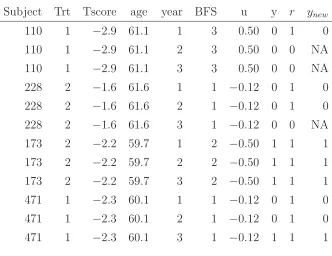
A portion of one simulated data set based on the first scenario is given in Table 2.1.
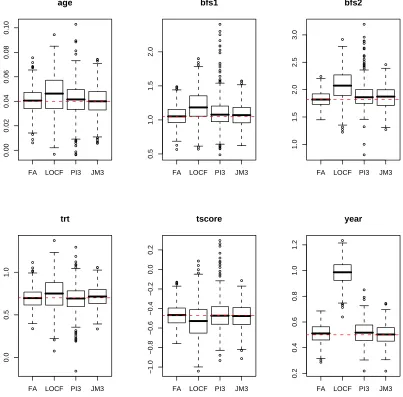
As shown, some subjects fail to comply after the first year, some after the second year,
and some complete the study. Figure 2.1 summarizes the results for the fixed effects in
the Y-model from the FA, LOCF, PI3 and JM3 approaches. The dash lines indicate
true values of parameters. The LOCF method produces substantially biased estimates
for almost every fixed effect. On the other hand, the pseudo-imputation method and the
Table 2.1: Proportion of data simulated in the first scenario
Subject Trt Tscore age year BFS u y r ynew
110 1 −2.9 61.1 1 3 0.50 0 1 0
110 1 −2.9 61.1 2 3 0.50 0 0 NA
110 1 −2.9 61.1 3 3 0.50 0 0 NA
228 2 −1.6 61.6 1 1 −0.12 0 1 0
228 2 −1.6 61.6 2 1 −0.12 0 1 0
228 2 −1.6 61.6 3 1 −0.12 0 0 NA
173 2 −2.2 59.7 1 2 −0.50 1 1 1
173 2 −2.2 59.7 2 2 −0.50 1 1 1
173 2 −2.2 59.7 3 2 −0.50 1 1 1
471 1 −2.3 60.1 1 1 −0.12 0 1 0
471 1 −2.3 60.1 2 1 −0.12 0 1 0
471 1 −2.3 60.1 3 1 −0.12 1 1 1
full-data analysis, when the number of patterns is correctly specified. Also, estimates
obtained from the pseudo-imputation method generally have larger variations than those
from the joint-modeling approach.
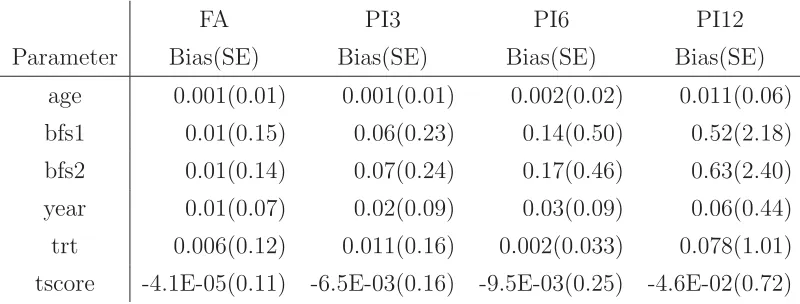
Table 2.2 shows biases and SE’s of estimates from the PI method with different
number of missing patterns. The biases and SE’s appear to be larger as the number
of patterns increases except that the estimate of the treatment effect has the least bias
when the number of patterns assumed to be 6. It implies that the PI method might
be very sensitive to the number of patterns chosen. When the number of patterns is
specified incorrectly, results can be very misleading, even if a right surrogate variable is
used and the missingness indeed depends on the random pattern variable controlled by
that surrogate variable.
Comparison of the joint-modeling approach with a different number of patterns and
the SP model is given in Figure 2.2. The estimates appear to be approximately unbiased
despite the fact that JM model is based on the wrong number of patterns. The SP
model provides acceptable results, compared with the JM model. The estimates based
FA LOCF PI3 JM3 0.00 0.02 0.04 0.06 0.08 0.10 age
FA LOCF PI3 JM3
0.5
1.0
1.5
2.0
bfs1
FA LOCF PI3 JM3
1.0 1.5 2.0 2.5 3.0 bfs2
FA LOCF PI3 JM3
0.0
0.5
1.0
trt
FA LOCF PI3 JM3
−1.0 −0.8 −0.6 −0.4 −0.2 0.0 0.2 tscore
FA LOCF PI3 JM3
0.2 0.4 0.6 0.8 1.0 1.2 year
Figure 2.1: Parameter estimates from 4 methods under Scenario 1. FA, the
full-data analysis. LOCF, the last observation carried forward method. PI3, the
Table 2.2: Comparison of Bias’s and SE’s of estimates for the scenario 1. FA: the
full-data analysis. PI3, PI6, and PI12: the pseudo-imputation methods with 3, 6, and 12
patterns, respectively.
FA PI3 PI6 PI12
Parameter Bias(SE) Bias(SE) Bias(SE) Bias(SE)
age 0.001(0.01) 0.001(0.01) 0.002(0.02) 0.011(0.06)
bfs1 0.01(0.15) 0.06(0.23) 0.14(0.50) 0.52(2.18)
bfs2 0.01(0.14) 0.07(0.24) 0.17(0.46) 0.63(2.40)
year 0.01(0.07) 0.02(0.09) 0.03(0.09) 0.06(0.44)
trt 0.006(0.12) 0.011(0.16) 0.002(0.033) 0.078(1.01)
tscore -4.1E-05(0.11) -6.5E-03(0.16) -9.5E-03(0.25) -4.6E-02(0.72)
but the biases are not substantial. It is expected as the SP model can be considered
as a special case of the JM approach in a way that each subject is a pattern. We now
turn to model selection, using two definitions of DIC as described in Section 2.2.3.
Results are presented in Table 2.3. Both versions of DIC’s pick the 3-pattern model
most frequently. Certainly, DIC’s perform quite well in picking up the true model with
high precision (about 90%). The SP model is never preferred by DIC, mainly because it
does not improve the precision of estimates but involves more random parameters than
needed to be estimated. In addition, the joint-modeling approach is able to accurately
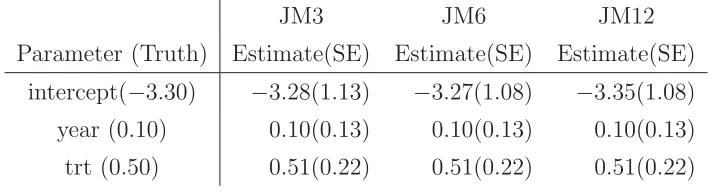
estimate fixed effects in the R-model, which other models do not provide. Results from the
JM approach are presented in Table 2.4. Obviously, the joint-model approach provides
accurate estimates regardless how many number of patterns are specified in the model
FA JM3 JM6 JM12 SP 0.00 0.02 0.04 0.06 0.08 age
FA JM3 JM6 JM12 SP
0.6 0.8 1.0 1.2 1.4 1.6 bfs1
FA JM3 JM6 JM12 SP
1.4 1.6 1.8 2.0 2.2 2.4 bfs2
FA JM3 JM6 JM12 SP
0.4
0.6
0.8
1.0
trt
FA JM3 JM6 JM12 SP
−0.8
−0.6
−0.4
−0.2
tscore
FA JM3 JM6 JM12 SP
0.2 0.3 0.4 0.5 0.6 0.7 0.8 year
Figure 2.2: Parameter estimates of fixed effects in the Y-model from joint-modeling approach with different patterns under Scenario 1.
Table 2.3: Comparison of two versions ofDIC’s. DIC1 (Spiegellhalter et al., 2002) and
DIC2 (Gelman et al., 2003).
JM3 JM6 JM12 SP
DIC1 89.4% 9.2% 1.4% 0%
Table 2.4: Comparison of estimates and their SE’s for fixed effects in the R-model from joint-modeling approach based on the scenario 1
JM3 JM6 JM12
Parameter (Truth) Estimate(SE) Estimate(SE) Estimate(SE)
intercept(−3.30) −3.28(1.13) −3.27(1.08) −3.35(1.08)
year (0.10) 0.10(0.13) 0.10(0.13) 0.10(0.13)
trt (0.50) 0.51(0.22) 0.51(0.22) 0.51(0.22)
2.3.2
Results Based on Scenario 2
In the second scenario, Rij’s are allowed to depend on responses and treatments and
are generated by the following model,
Rij ∼Ber(πij)
logit(πij) = α0+α1trti+α2Yij +α3yeari (2.21)
where (α0, α1, α2) = (−3,0.8,1.2,0.1). Again on the average about 16% of data are
missing. Notice that the true model generating the data in this scenario does not belong
to the class of models considered by JM and PI approaches. Moreover, unlike in the first
scenario, the true number of missing patterns is no longer known.
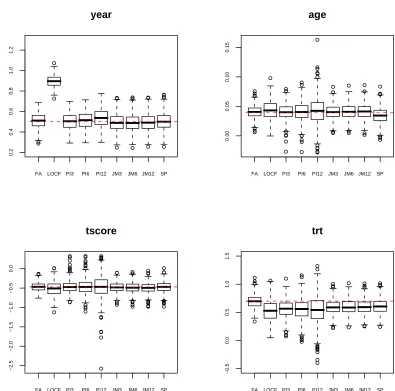
The simulation results based on Scenario 2 are shown in Figure 2.3, in which 4 fixed
effects are presented and there are no big difference among all models for the rest of fixed
effects. As expected, the LOCF approach produces highly biased estimates. Comparing
the PI approach and the JM method, we are able to see the same trend as in first
scenario. Estimates of the PI approach fluctuate as the number of patterns varies. The
JM approach provides stable estimates regardless of the number of patterns posited
in the model. Overall, estimates obtained from the PI method have more variations
than those from the JM approach. The SP model has the similar performance as the
JM model except that its parameter estimate for the variable“age” is more biased. As
expected, estimates of the treatment effects are moderately biased. However, the JM
approach reduces the bias by about 31% as compared to the estimate based on the
full-data analysis. Except the treatment effect, the JM approach appears to provide
unbiased estimates for other fixed effects despite the fact that the assumed model is not
correct. Hence, the JM approach is preferred over the PI method. With respect to model
selection, again both definitions of DIC’s have the similar preference. On average, the
JM approach with 3 patterns are selected 71.6%, 18.8% for 6 patterns, and 9.6% for 12
patterns. Therefore, the JM approach with 3 patterns might be the best model for this
FA LOCF PI3 PI6 PI12 JM3 JM6 JM12 SP
0.2
0.4
0.6
0.8
1.0
1.2
year
FA LOCF PI3 PI6 PI12 JM3 JM6 JM12 SP
0.00
0.05
0.10
0.15
age
FA LOCF PI3 PI6 PI12 JM3 JM6 JM12 SP
−2.5
−2.0
−1.5
−1.0
−0.5
0.0
tscore
FA LOCF PI3 PI6 PI12 JM3 JM6 JM12 SP
−0.5
0.0
0.5
1.0
1.5
trt
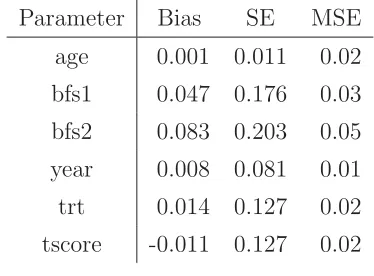
Table 2.5: Results of simulation for the joint modeling with the misspecification of the
distribution for random patterns.
Parameter Bias SE MSE
age 0.001 0.011 0.02
bfs1 0.047 0.176 0.03
bfs2 0.083 0.203 0.05
year 0.008 0.081 0.01
trt 0.014 0.127 0.02
tscore -0.011 0.127 0.02
2.3.3
Sensitivity Analysis for the JM Approach
Notice that it is assumed the random patternuhas the bivariate normal distribution
in the JM approach and f(R|X, u) follows a logistic-regression model. In this section,
sensitivity of the model will be assessed on these two respects.
First, we use the same model as the one in Scenario 1 with three patterns but ui is
generated by a mixture of two normal distributions given by N(µ1,Σ1) and N(µ2,Σ2)
with weights 2/3 and 1/3, respectively, where µ1 = (−1.5,0)T, µ2 = (1.5,0)T, Σ1 = 1,
and Σ2 = 3.06
For this scenario about 11.5% of data are missing. After data are generated, we fit
the JM with 3 patterns. The biases, standard errors (SE’s), and MSE’s of parameter
estimates are reported in Table 2.5. None of these biases is substantially large (≤ 5%).
Both SE’s and MSE’s are fairly small. Hence, the JM approach provides consistent
estimates of fixed effects in the Y-model even though the distribution of random effects
is misspecified.
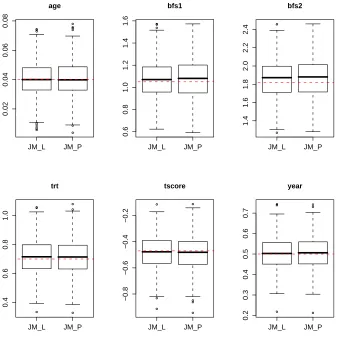
Second, we use the data simulated in Scenarios 1 with 3 patterns and fit the same
Y-model but a probit regression for the R-model instead of the logistical regression used
for data generation. In other words, the assumed R-model is not correct. Here, we only
consider 3 patterns in the simulation. Results are summarized in Figure 2.4. Apparently,
by the JM with a probit regression are slightly larger. Therefore, the JM generally
delivers robust estimates even when the model for the missing indicators are not correctly
postulated.
2.4
Conclusions
We proposed two approaches, the pseudo-imputation method and the joint-modeling
method, that are general enough in the sense that both methods can be applied to
contin-uous and discrete outcomes. Here, we assumed that a surrogate variable can be correctly
identified. Based on our simulation studies, we see that the LOCF approach provides
bi-ased estimates even when the missingness is not informative. The PI method performed
well only if the missingness depends on missing patterns and the underlying number of
patterns is correctly specified. When the number of patterns is incorrectly defined, the
PI method produces biased estimates. On the other hand, the JM method gives
approxi-mately unbiased estimates as long as the the missing depends on patterns even when the
number of patterns is not correctly specified. The SP model performs similarly in overall
as the JM model although it seems to produce comparatively more based estimates. In
cases of the missingness depending on the unobserved responses themselves, all methods
provide biased estimates but the JM based method reduces the bias substantially for the
estimate of the treatment effect. In terms of model selection, the DIC criteria picks the
right model about 90% for the joint-modeling approach. Furthermore, the JM approach
is not sensitive to mild model violations. Overall, the joint model approach is preferred.
In the cases of absence of a surrogate variable, patterns may be defined according
to available covariates but extreme care must be given since misspecification of patterns
may introduce serious bias and produce misleading conclusions. This issue is explained
JM_L JM_P 0.02 0.04 0.06 0.08 age JM_L JM_P 0.6 0.8 1.0 1.2 1.4 1.6 bfs1 JM_L JM_P 1.4 1.6 1.8 2.0 2.2 2.4 bfs2 JM_L JM_P 0.4 0.6 0.8 1.0 trt JM_L JM_P −0.8 −0.6 −0.4 −0.2 tscore JM_L JM_P 0.2 0.3 0.4 0.5 0.6 0.7 year
Chapter 3
Modeling NIM Data using GAM
A parametric generalized linear model may not be appropriate especially when some
measurements are non-ignorable missing. Also a specific parametric structure can not be
validated easily. Such parametric structures may lead to possible bias when the
under-lying model for the full data is nonlinear. Particularly, the generalized linear model used
in the first step for the PI approach may not produce reliable estimates of the predictive
means that will be used in latter steps. Therefore, final estimates might be biased and
inference will be misleading. Hence, instead of the generalized linear model, we consider
the use of the generalized additive model (GAM) proposed by Hastie and Tibshirani
(1990). As it is known, parameters in GAM can be difficult to interpret. However,
para-meters need not to be interpretable in the first step of the PI approach and hence we can
still apply GAM to obtain the predictive means for latter use. Moreover, in situations
that only the treatment effect or effects of other discrete covariates may be of primary
interest, estimations in terms of odds ratios can be obtained without much trouble. A
brief description about generalized additive models and model fitting techniques is given
in Section 3.1. Section 3.2 provides simulation results comparing a generalized linear
model and a generalized additive model within the PI method. Possibilities of fitting the
3.1
Model Description
Many nonparametric methods do not perform well when there is a large number of
independent variables in the model. The sparseness of data in this setting inflates the
variance of the estimates. The problem of rapidly increasing variance for increasing
di-mensionality is sometimes referred to as the curse of didi-mensionality . To overcome this
difficulty, Stone (1985) proposed additive models. These models estimate an additive
approximation to the multivariate regression function. The benefits of an additive
ap-proximation are at least twofold. First, since each of the individual additive terms is
estimated using a univariate smoother, the curse of dimensionality is avoided, at the
cost of not being able to approximate universally. Second, estimates of the individual
terms explain how the dependent variable changes with the corresponding independent
variables.
Hastie and Tibshirani (1990) proposed generalized additive models that extend the
traditional additive models (Stone, 1985) to accommodate more distribution functions.
These models assume that the mean of the dependent variable depends on an additive
predictor through a nonlinear link function. Generalized additive models permit the
response probability distribution to be any member of the exponential family of
dis-tributions. Many widely used statistical models belong to this general class, including
additive models for Gaussian data, nonparametric logistic models for binary data, and
nonparametric log-linear models for Poisson data.
The generalized additive models can be expressed as
E(Yi|Xi) =g(s0+
p
i=1
si(Xi)) (3.1)
where g(·) is a known link function, si(·)’s are smooth functions, and pis the number of
the predictor variables. The GAM can also be used to incorporate partial linear models
(Hastie and Tibshirani, 1986). This is achieved by replacing some smooth functions with
linear functions. Thus, parameters in linear functions in the GAM can be interpretable,
which makes it possible to draw inferences for some covariates if they are of primary
The estimating procedure for generalized additive models consists of two loops. The
local scoring algorithm is used in the outer loop and a weighted backfitting algorithm for
the inner loop. The local scoring algorithm uses a modified form of adjusted dependent
variable regression, as described for generalized linear models in McCullagh and Nelder
(1989), with the additive predictor taking the role of the linear predictor (Hastie and
Tibshirani, 1986). The backfitting algorithm (Friedman and Stuetzle, 1981; Hastie and
Tibshirani, 1986) is a general algorithm for an additive model using any
regression-type fitting mechanisms. This algorithm always converges for Gaussian distribution
(Hastie and Tibshirani, 1986). However, for other distributions, numerical instabilities
with weights may cause convergence problems. Even when the algorithm converges, the
individual functions need not be unique, since dependence among the covariates can
lead to more than one representation for the same fitted surface. A weighted backfitting
algorithm has the same form as for the un-weighted case, except that the smoothers
are weighted according to distribution functions. Both PROC GAM in SAS/STAT and
GAM in R package of MGCV can be used to fit these models.
3.2
Simulation Studies
The objective of the first simulation is to compare the performance of different models
used at the first step in the PI method. The model used in the Chapter 2 is a generalized
linear model (GLM) and we also use a generalized additive model (GAM) in this
sim-ulation. For simplicity, these two strategies are referred to as the PI-GLM method and
the PI-GAM method. At the second stage, we will still use a generalized linear model
as described in Chapter 2. Data are generated by using the same models described in
Chapter 2 under Scenario 1. The underlying Y-model follows a logistic regression and
the missing indicator depends on missing patterns. One thousand Monte Carlo samples
are simulated and the sample size for each sample is 1800.
Simulation results are summarized in Figures 3.1 − 3.3. When the configuration
of patterns is correctly known, both models yield precise estimates. When patterns
are misspecified, the PI-GAM method provides slightly more biased estimates than the
than estimates from the PI-GLM method. Thus, the methods appear to be approximately
unbiased. Also from the boxplots in Figure 3.1, we see that the sampling distributions of
the parameter estimates are very similar. Overall, the PI-GLM method and the PI-GAM
method have the similar performance in terms of parameter estimation. Hence, there is
no significant loss of efficiency to fit a GAM at the first step of the PI method even when
the underlying Y-model is a GLM.
In the second simulation study, the full data are generated from the following model
Yi ∼Ber(pi)
logit(pi) =β0+β1trti +f(agei) (3.2)
where βT = (β0, β1) = (−1.5,0.3) are true values of parameters and
f(age) = 0.001(age−20)(age−30)(age−40)I(age<40) + 0.1(age−40)I(age>40). The
values of age for each individual are generated from U nif orm(18,58). The surrogate
variable Wi = 0.7×logit(pi) +ei, where ei ∼ N(0,0.82). Patterns are determined in the
same way as in Chapter 2.
Notice that the model used to generate data in this simulation is determined according
to the real data from the AIDS study which we will analyze in the last chapter. To
simplify the simulation, we only include two independent variables, treatment (trt) and
age in the model. The treatment variable is binary and the age variable is continuous.
The curve of the spline function versus the corresponding covariate is given in Figure 3.4.
Obviously, the relation with age is non-linear.
Then, the missing indicator Ri is generated using the following model:
Rij ∼Ber(πij)
logit(πij) =α0+α1 ∗trti+Ziui (3.3)
where trti, a subvector of Xi, denotes the treatment assignment, (α0, α1) = (−3,1.7),
and ui ∼ N(0,0.752). On average, 15% of data were found to be missing.
As in the first simulation, a total of one thousand Monte Carlo samples are
method and the PI-GAM method to fit to each dataset. Difference from the first
sim-ulation is that we also fit the GLM and the GAM accordingly at the second stage. A
summary of results is presented in Figure 3.5. It is clear from Figure 3.5 that the PI-GAM
method provides more accurate estimates compared to the PI-GLM method.
In summary, the PI method with the GAM has similar performance even when the
un-derlying Y-model follows a generalized linear model. Moreover, it yields precise estimates
when the underlying Y-model is nonlinear. Hence, the PI-GAM method is preferred
uni-versally. In practice, the underlying distribution is unknown and missing data adds more
uncertainty. A good strategy would be to obtain the predictive mean by fitting a GAM
at the first stage of the PI method. Then plot the predictive mean versus covariates to
discover the potential data structure and fit the model accordingly. When the treatment
effect is of primary interest, we can fit the GAM within the PI method at both stages.
3.3
The JM Approach with GAM
It has been shown via simulation studies presented in Chapter 2 that the JM approach
performs better than other approaches. As the treatment effect is of primary interest,
one may prefer to adopt the JM approach with the GAM in the Y-model (Equation 2.8)
over the PI method. However, it is generally difficult, at least for practical statisticians,
to fit smooth functions within Bayesian framework since there is no existing program or
procedure available to resolve this task in r