ABSTRACT
WEIQI, ZHANG. An Exploratory Study of the Application of Laser Technology to Dress Design. (Under the direction of Dr. Traci A. M. Lamar).
The purpose of this research was to explore and classify dress designs created using
laser technology. The research methods used in this project included review and analysis
through literature review, content analysis of visual artifacts, analysis of survey responses,
and subjective evaluation. Literature was reviewed to assess the state of the art and to gain
expertise on defining categories for dresses made using laser technology. An image database
that consisted of 403 pictures of fabrics and garments involving use of laser technology was
established. Initial research steps were undertaken to develop a reliable system of
classification and observation for dresses created using laser technology. Later steps in this
research were targeted at verifying and refining the categorization system through collecting
survey responses and analysis of the survey data. Results demonstrated effectiveness in
general in classifying laser treated dresses and also served to further refine the defining
characteristics for each category. The final classification system includes three broad
categories: Dress Silhouettes, Surface Pattern Effects, and Primary Final Applications, and a
number classifications within each category. Within the category of Dress Silhouettes, the
classifications established were Trapezium, Calabash and H-Shape Silhouette; within the
category of Laser Surface Pattern Effect, the classifications established were Lace and
Hollow-out, Laser Engraving, Cutting and Recombining, and Combination of Hollow-out
and Engraving; within the category of Primary Final Application, the classifications
established were Primarily Decorative and Primarily Functional.
dress design as well as other textile and fashion applications, delineate the impact that laser
application has had on fabrics and textiles, and as a framework for further study of laser
application to fashion products. Also, the system of classification developed in this work can
be used as a tool for analyzing dresses designed using laser technology. Fashion design
beginners and professionals may use it as a reference to analyze or design a dress using laser
© Copyright 2016 Weiqi Zhang
An Exploratory Study of the Application of Laser Technology to Dress Design
by Weiqi Zhang
A dissertation submitted to the Graduate Faculty of North Carolina State University
in partial fulfillment of the requirements for the degree of
Master of Science
Textiles
Raleigh, North Carolina
2016
APPROVED BY:
_______________________________ _______________________________
Dr. Jane Anne Porterfield Dr. Andre West
_______________________________ Dr. Traci A. M. Lamar
DEDICATION
Dedicated To
My Parents
Wenyuan Zhang & Xiaohong Zhang
BIOGRAPHY
Weiqi Zhang was born on May 25, 1992, in Inner Mongolia province, People’s
Republic of China. In 2011, he became an undergraduate student in Donghua University in
Shanghai, China. In his senior year of college, he had a chance to participate the 3+X
program that is cooperatively offered by Donghua University and North Carolina State
University. Following completion of an undergraduate degree in textile engineering from
Donghua University, Weiqi was admitted to the Textile and Technology Management
program at NCSU. In the master program, Weiqi worked as a teacher assistant in laser
cutting lab. His current interests include surface pattern design, textile design and fashion
ACKNOWLEDGMENTS
I wish to acknowledge the time and support of many individuals and organizations. I
could not complete this work without them. First and foremost, I wish to sincerely thank my
advisor Dr. Traci Lamar for her constant support, motivation, and guidance throughout my
years at NC States. Dr. Lamar has believed in me and allowed me to accomplish goals I
never thought possible. Her unwavering dedication to her career, College of Textiles, and
most especially to her students is simply inspiring. Thank you for support and for all the
sacrifices that you make for your students. Thank you for being the most hardworking person
I have ever known.
Special thanks goes to my committee members, Dr. Andre West and Dr. Jane Anne
Porterfield, who took interest in my research and guided me through this journey by
providing valuable comments and recommendations.
I would also like to thank to the staff of College of Textiles, for all help and
suggestions during the course of my curriculum.
Finally, I really want to thank my family who are still in China and provide consistent
support and love over the distance. I am also very thankful to my friends both in China and in
the United States for their encouragement and advice. My research and my graduate studies
TABLE OF CONTENTS
LIST OF TABLES... vii
LIST OF FIGURES...viii
CHAPTER 1 INTRODUCTION...1
1.1 Purpose of Study...2
1.2 Rationale...3
CHAPTER 2 LITERATURE REVIEW...5
2.1 Introduction of Three Laser Technologies... 5
2.1.1 CO2 Gas Laser...5
2.1.2 Fiber Laser and Nd: YAG Laser...6
2.2 CO2 Laser Cutting Machine...7
2.3 The State of Laser Technology in Fashion and Textile Design...17
2.3.1 Applications of Laser Technology in Fashion Design... 18
2.3.1.1 Laser Engraving and Sustainable Design... 18
2.3.1.2 Laser Cutting... 23
2.3.2 Challenges of Laser Technology Applications in Fashion Design...28
2.3.2.1 Fabric Decoherence Problem...28
2.3.2.2 The Optimization of Cutting Parameters...29
2.4 Motif Sources in Laser Cut Surface Patterns ...33
2.4.1 Patterns of Bionic Elements...33
2.4.2 Patterns of Traditional Elements... 36
2.4.3 Patterns of European elements...41
2.5.4 Patterns of Punk Elements...43
2.5 Classifications of Dresses...45
2.5.1 The Type of Dresses According To the Dress Length... 45
2.5.2 The Type of Dresses According To the Dress Overall Look... 51
2.5.3 The Type of Dresses According To the Skirt Size... 52
2.5.4 The Type of Dresses According To the Skirt Silhouette...55
2.6 Summary...57
CHAPTER 3 METHODOLOGY...59
3.2 Preliminary Laser Cut Surface Pattern Effects Classification...63
3.3 Preliminary Dress Silhouette and Primary Application Classification...71
3.4 Developing Preliminary Categories...77
3.5 Refining Categories... 81
3.6 Developing Refining Categories...104
3.7 Development of Evaluation Tool ...106
3.8 Analysis of Response Data ... 108
CHAPTER 4 RESULTS AND DISCUSSION...136
4.1 Surface Pattern Effects... 136
4.1.1 Laser Engraving...136
4.1.2 Lace and Hollow-Out Effects... 137
4.1.3 Cutting and Recombining...138
4.1.4 Combination of Hollow-Out and Laser Engraving... 139
4.2 Dress Silhouettes... 140
4.2.1 Trapezium Silhouette...140
4.2.2 Calabash Silhouette... 142
4.2.3 H-Shape Silhouette... 145
4.3 Primary Final Applications...148
CHAPTER 5 CONCLUSION AND LIMITATION... 150
5.1 Conclusion... 150
5.2 Research Limitations... 151
CHAPTER 6 FUTURE RESEARCH...153
REFERENCES... 156
APPENDICES... 174
Appendix A: Brochure Description for Survey... 175
LIST OF TABLES
Table 2.1 Samples of fabric laser engraving... 32
Table 2.2 Types of dresses according to the dress length... 46
Table 2.3 Types of dresses according to the dress overall look... 51
Table 2.4 Types of women’s dresses according to the skirt size... 53
Table 2.5 Types of dresses according to the skirt silhouette... 55
Table 3.1 Results of the original category of surface pattern effect... 69
Table 3.2 Results of the original category of Dress Silhouette... 73
Table 3.3 Results of the category of Primary Final Application... 76
Table 3.4 Results of the Preliminary Categories... 79
Table 3.5 Results of the refined category of Surface Pattern Effect... 87
Table 3.6 Results of the refined category of Dress Silhouette...103
Table 3.7 Results of the Refined Categories...105
Table 3.8 Results of Group 1-4...110
Table 3.9 Integrated results of each image... 114
Table 3.10 Expected response for each category...111
LIST OF FIGURES
Figure 2.1 Three layouts of Universal Laser System control panel... 9
Figure 2.2 Laser etching onto the denim fabric... 13
Figure 2.3 File settings for laser engraving... 14
Figure 2.4 Sample of laser engraving on denim fabric...15
Figure 2.5 File settings for laser cutting... 16
Figure 2.6 Sample of laser cutting on denim fabric...16
Figure 2.7 Laser engraving diagram... 19
Figure 2.8 Denim jacket by Siena Baldi... 22
Figure 2.9 Laser cutting diagram...23
Figure 2.10 Images showing designs accomplished with slashing techniques...25
Figure 2.11 Images showing designs accomplished with hollowed-out techniques... 27
Figure 2.12 Denim fabric decoherence...29
Figure 2.13 Comparison of two nonwoven cotton fabrics...30
Figure 2.14 Photography works showing bionic elements of nature...34
Figure 2.15 Laser cut fashion and accessory design showing bionic elements of nature...35
Figure 2.16 Nonwoven cotton fabrics showing bionic elements of nature...35
Figure 2.17 Samples of dresses based on Chinese traditional patterns...38
Figure 2.18 Samples of Chinese traditional patterns... 38
Figure 2.19 Samples of Japanese traditional patterns...39
Figure 2.20 Samples of Russian traditional patterns... 40
Figure 2.21 Laser cut and engraved accessory designs based on traditional patterns... 40
Figure 2.22 Samples of European style pattern... 42
Figure 2.23 Laser etched European style pattern on polyester fabric...42
Figure 2.24 Punk style fashion...44
Figure 2.25 Types of dresses according to the dress length... 45
Figure 2.26 Types of dresses according to the skirt size... 53
Figure 3.2 Flow process of classifying the original surface pattern effect of images... 68
Figure 3.3 Flow process of classifying the original Dress Silhouette category and Primary Final Application category of dresses... 72
Figure 3.4 Image examples and Group A images in the Uncertain subcategory of the Surface Pattern Effect category... 83
Figure 3.5 Image examples and Group B images in the Uncertain subcategory of the Surface Pattern Effect category... 86
Figure 3.6 Typical examples of each silhouette in the original silhouette category... 91
Figure 3.7 Group A images in the Uncertain Silhouette category... 96
Figure 3.8 Group B images in the Uncertain Silhouette category... 97
Figure 3.9 Group C images in the Uncertain Silhouette category... 98
Figure 3.10 Group D images in the Uncertain Silhouette category...100
Figure 3.11 Group E images in the Uncertain Silhouette category... 101
Figure 3.12 Group F images in the Uncertain Silhouette category...102
Figure 3.13 Percentage of responses as expected for each category... 117
Figure 3.14 Images of dress silhouette below 85%... 121
Figure 3.15 Example images...122
Figure 3.16 Images of surface pattern effect below 85%... 127
Figure 3.17 Example Image...130
Figure 3.18 Images of primary final application below 85%... 134
Figure 4.1 Trapezium Silhouette model...140
Figure 4.2 Sample images of Trapezium Silhouette...142
Figure 4.3 Calabash Silhouette model... 143
Figure 4.4 Sample images of Calabash Silhouette...145
Figure 4.5 H-shape Silhouette model...146
Figure 4.6 Sample images of H-Shape Silhouette... 147
CHAPTER 1 INTRODUCTION
Fabric laser cutting is an important technology to the future of fashion and textile
design (Bogue, 2015; Gao et al., 2006). Since it has been used in fashion and textile
companies, the pace of its development has become faster and faster (Bogue, 2015; Gao et al.,
2006). Laser application to textile materials creates new opportunities like laser cutting, laser
marking, and laser engraving for fashion and textile design (Hengyin, 2007; Yuan et al.,
2012). In fashion and textile design areas, fabric laser cutting and laser engraving are
gradually being adopted by fashion and textile designers (Hengyin, 2007; Yuan et al., 2012).
Though the potential of laser application in textile and fashion design is significant, it hasn’t
been fully exploited by fashion and textile designers because of existing problems like the
unguaranteed and uncontrolled durability of some fabrics, optimization of carving parameters,
and limited knowledge about the design process and the application of the laser cutting
technology (Hengyin, 2007; Yuan et al., 2012). Therefore, the full potential of laser cutting
technology in fashion and textile design fields has yet to be explored.
Women’s dresses comprise a large part of clothing market (Sarkar, 2010). Even
though the rate of new dress designs is climbing higher and higher, designers never stop
exploring and developing new ideas (Sarkar, 2010). As a new technology, laser cutting can
the impact of laser application to textile and fashion products could inform the work of artists
and designers, academicians and practitioners alike.
1.1 Purpose of Study
The use of laser technology can expand the possibilities available to designers,
meaning that fashion design may possibly become more innovative and flexible (Hengyin,
2007; Yuan et al., 2012).
Laser technology is and has been appearing in haute couture and high-end fashion
(Hengyin, 2007; Yuan et al., 2012). However, the rest of clothing market has yet to broadly
adopt this new technology when creating new designs (Jie & Ripeng, 2015). This could be in
part because there are few references or guides about how to effectively make use of laser
technology for fashion design (Jie & Ripeng, 2015). For example, how to create and position
the surface pattern so that it can meet the requirements of this technology, and what designers
should pay attention to when they make a new design using laser technology.
This research is focused on exploring and classifying dress designs made using CO2
laser technology, which is a laser based on the carbon dioxide gas mixture (Yanabu, et al.,
1989; Patel, 1964). First, an image database that includes hundreds of pictures of garments
made using laser techniques was established. Next, through visual analysis of the image
made and some existing images were selected from the image database. Then a survey will
be used to verify or redefine categories. Categories were defined by dress silhouettes, surface
effects with the surface patterns, and primary final applications. Finally, the research will
generate and summarize a completed procedure which can show the whole process of
designing a dress using laser technology.
The results aim to guide the use of laser technology for textile and fashion. Results
also begin to delineate the impact that laser application has had on fabrics and textiles in the
field. The value of defined classification system can be used in the future as a system for
content analysis to study changes over time, works of a particular designer, true innovations
that happen that result in designs that no longer fit in the system, and the method developed
can be applied to developing systems for observing and classifying laser application to
different end products.
1.2 Rationale
With the speed of developing science, more and more small-scale laser cutting
machines are available for personal use (Hengyin, 2007; Yuan et al., 2012). Moreover, the
software that drives laser machines is also becoming easier to use (Hengyin, 2007; Yuan et
al., 2012). Therefore, laser cutting is poised to play an increasingly important role for fashion
innovative (Sarkar, 2010). Unique styles, fabrics, interesting surface patterns, and colors, etc,
are all important factors that can make a dress different (Sarkar, 2010). Laser technology can
enable surface patterns with great details, and fabric with unique texture (Hengyin, 2007;
Yuan et al., 2012). Furthermore, most fabrics can be treated with this technology, which is
good because designers can customize most existing materials to achieve unique artistic
CHAPTER 2 LITERATURE REVIEW
2.1 Introduction of Three Laser Technologies
The year 2015 is called “International Year of Light and Light-based Technologies”,
which proposes to commemorate the significant achievements of light science and its
enormous contributions to industrial production sector (Bogue, 2015; Gao et al., 2006). Laser
technology, as one of the most important light-based technologies, has rapidly developed an
efficient and advanced method of manufacture in different industries (Bogue, 2015; Yuan et
al., 2012).
The application of lasers in the industrial processing of materials is becoming more
and more significant and widespread (Bogue, 2015; Yuan et al., 2012). Different laser
sources determine the type of laser machines that best suit particular industries (Bogue, 2015).
There are three laser technologies among the many lasers produced now, which are the CO2
gas laser, fiber laser, and ND: YAG laser (neodymium-doped yttrium aluminum garnet)
(Hecht, 1986).
2.1.1 CO2 Gas Laser
The carbon dioxide laser (CO2 laser) is a laser based on a carbon dioxide gas mixture
which is stimulated electrically (Yanabu, et al., 1989; Patel, 1964). It was invented by Kumar
lasers have a relatively high efficiency and feature an exquisite beam quality (Yuan et al.,
2012). Centering on a wavelength of 10.6 micrometers to 9.4 micrometers, a beam of
infrared light can be produced by a CO2 laser, making CO2 lasers mainly suited for working
on non-metallic materials and most plastics (Bogue, 2015). Specifically, the CO2 laser is
suited for the following materials: wood, acrylic, glass, paper, textiles, plastics, films, leather,
stone, etc. (Yuan et al., 2012; Bogue, 2015). Therefore, carbon dioxide lasers are widely used
laser types (Yuan et al., 2012). The CO2 laser has become very advanced and it remains one
of useful lasers because of the highest-power continuous wavelength (Patel, 1964; Bogue,
2015).
2.1.2 Fiber Laser and Nd: YAG Laser
Fiber lasers and ND: YAG laser (crystal laser) both belong to the solid state laser
group (Wandera, 2006). Metals, coated metals, and plastics are the main materials that can be
used with these two light-based technologies (Wandera, 2006). Fiber lasers can output 1.064
micrometers wavelength and ND: YAG lasers have the same wavelength as fiber lasers
(Wandera, 2006). Because of this, they can both produce a minuscule focal diameter
(Wandera, 2006). However, it is impossible for CO2 lasers to a similar job with a 10.6 or 9.4
micrometers wavelength (Wandera, 2006). In other words, with the same average power, the
intensity of fiber lasers and crystal laser is much higher than that of CO2 lasers (Wandera,
output power than ND: YAG. Also, the cost per watt of CO2 output is about 50 percent that
of ND: YAG output (Wandera, 2006; Abela et al., 1982; White et al. 1998).
Fiber lasers can be used without maintenance at least 25,000 laser hours (Wandera,
2006). Unlike fiber lasers, crystal laser needs relatively expensive pump diodes (Wandera,
2006). They must be replaced after 8,000 to the 15,000 laser hours (Wandera, 2006). The
crystal itself also has a shorter service life than a fiber laser (Wandera, 2006).
2.2 CO2 Laser Cutting Machine
Typically, the CO2 laser cutting machine consists of four essential parts: central
control computer, carving control software (CAD/CAM software), electric control cabinet
and the electric machine (Jie & Ripeng, 2015). The carving control software is divided into
cutting control software and computer aided design software such as CorelDraw, Adobe
Illustrator, etc., which are mainly used in pattern design (Yuan et al., 2012; Zhou et al., 2009;
Jie & Ripeng, 2015). Vector patterns can be recognized and printed into cutting control
software to be further edited. After making sure the file is correct with cutting control
software, the machine is able to start the programmed operation (Yuan et al., 2012; Zhou et
al., 2009; Jie & Ripeng, 2015). In the cutting control software, cutting or engraving
parameters including cutting PPI (PPI means pixels per inch, which is a measure of the
according to the database or results of testing samples (Yuan et al., 2012; Jie & Ripeng,
2015). The next few paragraphs provide an example of one particular laser system.
Figure 2.1 (a), (b), and (3) are three layouts of the Universal Laser System control
panel. Designers can control each parameter by using the Defaults in the Materials Database
Function or adjusting according to the effect they need using Manual Control (“Universal
Laser Systems User Guide”, 2008). In Materials Database, the designer can find the material
to be used according to the category (“Universal Laser Systems User Guide”, 2008). In figure
2.1 (a), if the material is natural cotton fabric, the designer can directly choose Cotton in the
Fabric & Leather category, and the only thing to do is to measure the thickness of the
material, and control the intensity adjustment according to the final effect needs (“Universal
Laser Systems User Guide”, 2008). Figure 2.1 (b) is the defaults for cotton fabric in
Materials. If the defaults can’t meet the design requirements, Manual Control System is an
excellent choice. The designer can test samples by adjusting the Power, Speed, PPI and
Z-Axis to get the ideal setting (“Universal Laser Systems User Guide”, 2008). Also, the
designer can assign designs to different colors which mean different preset settings
(“Universal Laser Systems User Guide”, 2008). In this way, the operator can set unique
carving parameters in different parts of one pattern so that it is possible to achieve various
Figure 2.1 Three layouts of Universal Laser System control panel
(a) Material Database in the Universal Laser System control panel
(b) Defaults for cotton fabric in the Universal Laser System control panel
(a)
(c)
The Universal Laser System is used as an example of CO2 laser cutting. With this
system, the processes of laser etching are as follows. First, the designer creates a design for
laser etching and then converts the color mode of the design to greyscale using Adobe
Photoshop or Adobe Illustrator software (“Universal Laser Systems User Guide”, 2008). The
designer can adjust the contrast and levels to make the pattern clearer (“Universal Laser
Systems User Guide”, 2008). Third, the designer needs to input the design files into the
Universal laser system control panel (“Universal Laser Systems User Guide”, 2008). Next,
the designer needs to make sure the etching speed in the manual control option is optimized
because the fastest speed and specific PPI can guarantee the efficiency of processing
(“Universal Laser Systems User Guide”, 2008). After setting the correct power data, the
designer places the fabric on a honeycomb cutting table in a cabinet (“Universal Laser
Systems User Guide”, 2008). The designer needs to adjust the position of the pattern so that
the pattern can be etched in the correct place on the fabric (“Universal Laser Systems User
Guide”, 2008). The laser Focus View function can help when designer is trying to find the
location of the laser etching area (“Universal Laser Systems User Guide”, 2008). Last, the
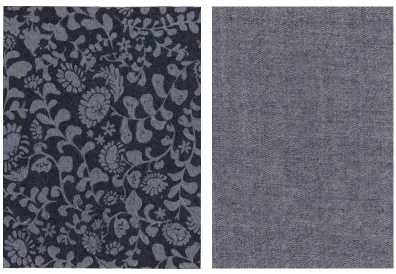
designer initiates laser etching of the surface pattern onto the fabrics. Figure 2.2 shows an
(a) Fabric Front (b) Fabric Back
Figure 2.2 Laser etching onto the denim fabric (Designed by Weiqi)
Continuing the example, the processes of laser engraving are similar to laser etching.
First, the designer creates a pattern design for laser engraving (“Universal Laser Systems
User Guide”, 2008). The pattern should consist of a single line so that the laser lens can
recognize and trace the line to engrave the pattern on the fabric (“Universal Laser Systems
User Guide”, 2008). Then the designer sets the color of each line to RGB blue using Adobe
Illustrator software in RGB color mode (see Figure 2.3) (“Universal Laser Systems User
control panel and confirms the engraving speed in the manual control (“Universal Laser
Systems User Guide”, 2008). After setting the correct power, the designer places the fabric
on a honeycomb cutting table in a cabinet and adjusts the position of the pattern using the
laser Focus View function (“Universal Laser Systems User Guide”, 2008). Last, the designer
clicks the Star button to laser engrave the surface pattern onto the fabric (“Universal Laser
Systems User Guide”, 2008). After washing, an engraved fabric shows great surface texture
(“Universal Laser Systems User Guide”, 2008). Figure 2.4 shows an example of laser
engraving for denim fabric with elevated power.
(a)Fabric Front (b) Fabric Back
Figure 2.4 Sample of laser engraving on denim fabric (Designed by Weiqi)
The processes of laser cutting and laser engraving are similar. The designer needs to
create a pattern that consists of a single line so that the laser lens can recognize and trace the
line to engrave the pattern on the fabric (“Universal Laser Systems User Guide”, 2008). The
difference in cutting and engraving is that the designer sets the color of each line to RGB red
using Adobe Illustrator software instead of RGB blue (see Figure 2.5) (“Universal Laser
Systems User Guide”, 2008). The remaining processes are the same. Here is an additional
Figure 2.5 File settings for laser cutting (RGB Red, 0.001 pt. stroke)
2.3 The State of Laser Technology in Fashion and Textile Design
“Techno-Fashion” is a familiar word in the 21st century (Hengyin, 2007; Yuan et al.,
2012). The combination of fashion and technology has become a hot topic in the
contemporary fashion industry (Hengyin, 2007; Yuan et al., 2012). Laser technology has
many advantages and has been applied widely in today’s textile manufacturing industry
widely (Yuan, Jiang, Newton, & Au, 2013). This is not only because it has high efficiency
and operability, but also because it has an endless potential for sustainability (Jie & Ripeng,
2015; Yuan, Jiang, Newton, & Au, 2013). Many different kinds of lasers can be applied to
the textile manufacturing industry and CO2 lasers are very common among all the laser
technologies with its various values (Jie & Ripeng, 2015; Yuan, Jiang, Newton, & Au, 2013).
As a dry and clean technology, the CO2 laser is a very efficient and suitable laser for textile
materials, which do not conduct heat and electricity, because they can absorb the
wavelengths of the CO2 laser efficiently (Jie & Ripeng, 2015; Yuan, Jiang, Newton, & Au,
2013; Zhou et al., 2009).
At the same time, the application of science and technology is running through
fashion designing, fashion production, marketing, etc. (Hengyin, 2007; Yuan et al., 2012). As
a high-tech means of processing, laser cutting is rapidly integrating into clothing and textile
possibilities which means that fashion design can be more multitudinous and changing
(Hengyin, 2007; Yuan et al., 2012). At present, laser technology applications are frequently
appearing in more and more haute couture and high-end fashion (Hengyin, 2007; Yuan et al.,
2012).
2.3.1 Applications of Laser Technology in Fashion Design
Laser technology can create a variety of artistic effects when it is applied to the
secondary processing of fashion fabrics (Hengyin, 2007; Yuan et al., 2012). With the rapid
improvement of laser technology, it has been widely used in the field of fashion design
(Hengyin, 2007; Yuan et al., 2012). The two primary applications of laser technology are
laser engraving and laser cutting (Hengyin, 2007; Yuan et al., 2012).
2.3.1.1 Laser Engraving and Sustainable Design
As Figure 2.7 shows, “laser engraving is the removal of material from the top surface
down to a specified depth (“Laser Engraving”, 2016).” The maximum etching depth and
speed of etching can be determined by the type of material and different levels of laser power
(“Laser Engraving”, 2016). Typically, shallow engraving is a faster process than deep
engraving (“Laser Engraving”, 2016). Furthermore, lower density materials have a more
rapid engraving speed than that of higher density materials, and increasing the laser power
Figure 2.7 Laser engraving diagram
CO2 lasers of 10.6-micron wavelength are mainly used for engraving non-metal
materials (“Laser Engraving”, 2016). Most of the CO2 laser energy can be reflected, so CO2
lasers are not typically used for metal engraving (“Laser Engraving”, 2016). “However, fiber
lasers with 1.06-micron wavelength can be used for shallow engraving into metal (“Laser
Engraving”, 2016)”.
Laser engraving is used as one main application of laser technology in fashion and
textile areas (Yuan et al., 2012; Zhou et al., 2009; Jie & Ripeng, 2015). Through the laser
burning process, the texture surface color can be removed by laser engraving, and multi-level
color effects can be generated on the fabric surface (Ondogan et al., 2000).
Laser engraving is environmentally friendly, so it is useful for sustainable design
(Yuan et al., 2012; Zhou et al., 2009; Jie & Ripeng, 2015). In modern textile and fashion
practice of sustainable design for most companies is still at an early stage (Yuan et al., 2013;
Xinjie, 2014). At the same time, enterprises and investors usually focus on the amount of
money that a company makes or how many honors one enterprise can earn (Herva et al.,
2014). The textile and fashion industries have a strong relationship with economic
development (Herva et al., 2014). But an enormous cost, including the high consumption of
resources, energy and heavy damage to the environment is behind the achievement of the
fashion industries (Herva et al., 2014). So sustainability has become more and more
significant for the apparel production industries (Herva, et al., 2014). Use of green energy
resources and adopt of manufacturing techniques as well as facilities with low waste and high
recycle rates would lessen the environmental and resource impact of the industries (Herva, et
al., 2014, Xinjie, 2014).
Denim is a popular fabric in today’s textile and apparel product market because of its
distinctive surface characteristic and structure, yet it has a negative environmental and ethical
impact (Yuan et al., 2012; Zhou et al., 2009; Jie & Ripeng, 2015). Reducing water
consumption in denim processing is important (Trotman, 2015). Guangdong, which is called
The Base of the Jeans Industry in China, has thousands of jeans companies (Pendle, 2015).
However, because many manufacturers lack enough advanced science, technology,
equipment and management skill, they are not doing well in protecting the environment
polluted with chemicals used for dyeing, printing, bleaching and washing, even heavy metals
can be found (Pendle, 2015). Some estimates suggest that producing one pair of jeans
requires more than 2,500 gallons of water, nearly a pound of chemicals and vast amounts of
energy (Pendle, 2015).
In 1999, sustainable denim design and eco-jeans design were predicted to be the new
jeans revolution (Berkhout & Smith, 1999). Designers have a deep love for utilizing each
characteristic of denim to explore and discover the unexpected (Dascalu, et al., 2000).
Consumers are seeking a more personalized lifestyle, encouraging designers to create unique
designs which can meet these needs (Dascalu, et al., 2000). Laser engraving offers new
possibilities for making production more straightforward and efficient with the minimal use
of water, bleach and chemicals (Dascalu, et al., 2000). Compared to the traditional printing
and dyeing methods, and washing processes, laser engraving treatment has the advantage of
energy saving and environmental protection (Dascalu, et al., 2000; Pendle, 2015). Figure 2.8
(a) and (b) show the laser etched denim jacket designed by Siena Baldi.
Laser technology also offers great versatility in customizing designs (Yuan et al.,
2012; Zhou et al., 2009; Jie & Ripeng, 2015; Xinjie, 2014). In addition to the denim fabric,
leather, polyurethane and other textile materials such as cotton, silk, polyester, etc. can also
clean and flexible with no use of water, and no effluent requiring disposal (Hengyin, 2007;
Yuan et al., 2012; Xinjie, 2014).
(a) Denim jacket for etching (b) Final product
2.3.1.2 Laser Cutting
As Figure 2.9 shows, “laser cutting is the complete removal and separation of
material from the top surface to the bottom surface along a designated path (“Laser Cutting”,
2016).” Laser cutting can be performed on a single layer material or multi-layer material
(“Laser Cutting”, 2016). When cutting multi-layer material, the laser beam can be precisely
controlled to cut through the top layer without cutting through the other layers of the material,
if desired (“Laser Cutting”, 2016).
Figure 2.9 Laser cutting diagram
Laser cutting can be used in selected sections of a garment to create some diverse
artistic effects such as an occasional broken appearance, tassels, etc. (Yuan et al., 2012; Zhou
smooth, which cannot be achieved by the traditional methods like tearing (Yuan et al., 2012).
The next sections illustrate applications of laser technology in fashion.
The first set of images (see Figure 2.10) show designs accomplished with slashing
techniques. Figure 2.10 (a) is a dress designed by Jolka Wiens. Jolka utilized laser cutting to
cut hundreds of strips on the neoprene fabric (“A Passion for Lasers”, 2015). Every strip is
cut finely and tidily. Figure 2.10 (b) is also a cool dress designed by Visbo De Arce, with an
elegant cut design on the back section (“Laser Cut Dress with Sculptural Rib Cage Details by
Visbo De Arce”, 2013). Visbo De Arce used laser cutting to cut two rows of strips. The
symmetrical strips on both sides resemble a sculptured rib cage (“Laser Cut Dress with
Sculptural Rib Cage Details by Visbo De Arce”, 2013). Figure 2.10 (c) is another dress
designed by Iris van Herpen. She utilized laser cutting to cut the fabric and create structural
and dimensional effects (“Laser Cut Dress with Graphic Surface Patterns”, 2015). Figure
2.10 (d) is a fabric texture design by Dion Lee. He cut the fabric and manipulated it to a
structural and dimensional design by twisting the stripes (“Neoprene Top with Cut & Twist
(a) (b) (c) (d) (a) Graduate dress designed by Jolka Wiens (“A Passion for Lasers”, 2015) (b) Laser cut dress designed by Visbo De Arce (“Dress with Sculptural Rib Cage Details”,
2013)
(c) Laser cut dress by Iris van Herpen (“Laser Cut Dress with Graphic Surface Patterns”, 2015)
(d) Fabric manipulation by Dion Lee (“Neoprene Top with Cut & Twist Spine Detail”, 2013)
Because of the high accuracy and small cutting aperture of laser cutting, it can also be
used to carve delicate and intricate patterns, which show a hollowed-out appearance (Yuan et
al., 2012; Zhou et al., 2009; Jie & Ripeng, 2015). The speed of laser cutting is also far faster
than the rate of traditional cutting methods (Zhou et al., 2009).
Figure 2.11 (a) shows elegant details of the cutting pattern for Vera Wang's bridal
dress. This pattern is very intricate with lots of curves (“A Close-Up Image of Silk”, 2011).
However, it can be easily and accurately cut by laser in a relatively short time (“A Close-Up
Image of Silk”, 2011). Figure 2.11 (b) is low rise legging by Blue Life Fit featuring laser cut
side panels and a neutral lining (“Blue Life Fit Laser-Cut Legging”, 2015). The pattern is
very delicate, creating a strong visual effect. Figure 2.11 (c) is a jacket designed by John
Richmond. The pattern on the jacket is all cut by laser cutting (“Truly Stunning Laser-Cut
Leather”, 2014). Each motif of the pattern for this jacket is tiny and fine so it is hard to use
traditional cutting method to get the same effect (“Truly Stunning Laser-Cut Leather”, 2014).
Figure 2.11 (d) is a coat designed by Tamas Walter. The pattern also consists of tiny motifs.
Besides using laser cutting to cut the pattern on the leather fabric, the designer also utilized
laser engraving to add some decorative lines (“AW13 Laser Cut Pattern by Tamas Walter”,
2013). Besides, the designer utilized laser engraving to remove some dark brown color
(“AW13 Laser Cut Pattern by Tamas Walter”, 2013). Through etching on the leather fabric,
(“AW13 Laser Cut Pattern by Tamas Walter”, 2013). As can be seen, laser cutting and laser
engraving can be combined as needed.
(a) (b) (c) (d)
(a) Laser cut floral pattern for Vera Wang's bridal dress (“A Close-Up Image of Silk”, 2011) (b) Urban Outfitters designed by Blue Life (“Blue Life Fit Laser-Cut Legging”, 2015) (c) Laser-cut jacket at John Richmond’s SS 2014 Show in Milan (“Truly Stunning Laser-Cut Leather”, 2014)
(d) Laser cut fashion by Tamas Walter (“AW13 Laser Cut Pattern by Tamas Walter”, 2013)
2.3.2 Challenges of Laser Technology Applications in Fashion Design
While the development of laser cutting and laser engraving have excellent prospects,
there are still some technical problems in some processes which have limited full integration
of lasers into fashion and textile companies (Jie & Ripeng, 2015).
2.3.2.1 Fabric Decoherence Problem
Laser cutting utilizes laser beams with high temperature that rapidly heat the surface
of the material to the evaporation temperature (Yanabu, et al., 1989; Jie & Ripeng, 2015).
The evaporation temperature causes a hole in the fabric, and each hole is connected in a line
which achieves cutting the fabric (Jie & Ripeng, 2015). While laser cutting features high
accuracy and efficiency, the position of yarns will move if the carved fabric has been used
for a long time. This will bring about threads slipping out from the fabric, called fabric
decoherence (Jie & Ripeng, 2015; Hengyin, 2007). Figure 2.12 (a) and (b) shows two pieces
of denim fabrics. Figure 2.12 (a) is the original piece. After being touched and rub several
times, (a) became (b), which illustrates the decoherence.
Fabric decoherence adversely affects people’s feeling of dressing as well as the
appearance of the garment (Jie & Ripeng, 2015). This situation happens often, especially for
2015; Hengyin, 2007). So, durability is one major factor that restricts the widespread use of
laser technology in the textile and fashion industry (Jie & Ripeng, 2015; Hengyin, 2007).
(a) (b)
Figure 2.12 Denim fabric decoherence (designed by Weiqi)
2.3.2.2 The Optimization of Cutting Parameters
In the process of laser cutting, with increasing complexity of the design, carving
defects happen more frequently (Jie & Ripeng, 2015). For example, if some lines in a pattern
have a large degree of angle change, it is easy to cause unequal levels of discoloration on the
material surface (Jie & Ripeng, 2015). This is because the laser beam will stay for a longer
time in the turning point, thus the defect is easy to generate (Jie & Ripeng, 2015). This defect
impact the quality as well as the appearance of fabrics (Jie & Ripeng, 2015). To reduce this
reduce the speed variation and power variation (Jie & Ripeng, 2015). Figure 2.13 is a
comparison of two nonwoven cotton fabrics which were cut at the same power but different
speed setting. By comparing with the sections in red and green circle of (a) to the sections in
red and green circle of (b), it can be clearly seen that (a) has less discoloration, because the
laser lens stayed longer in the turning point of the pattern.
(a) Cut using: Power: 25%, Speed: 100% (b) Cut using: Power: 25%, Speed: 50%
Figure 2.13 Comparison of two nonwoven cotton fabrics (designed by Weiqi)
To achieve the best effect for laser cutting or laser engraving, the designer needs to
test settings which have varying levels of intensities on the fabric (Jie & Ripeng, 2015;
that the best samples can be selected and the best laser setting data can be identified and
recorded for further reference (Jie & Ripeng, 2015; Hengyin, 2007).
For laser engraving, the power is also very critical (Hengyin, 2007). Table 2.1 shows
a collection of denim samples created through laser engraving. Laser engraving can give
denim fabric unique color removal effects (Jie & Ripeng, 2015). However, too much power
will cause excess laser energy to the denim fabric surface so that the fabric is damaged as in
Table 2.1 (f). At the same time, too little power will not allow the effect to be shown clearly
after washing as in Table 2.1 (a). Only accurate power can give the denim fabric best effect
Table 2.1 Samples of fabric laser engraving
No. (a) (b) (c)
Power 15% 20% 25%
Result
(Speed: 100%; PPI: 500; Z-Axis: off)
No. (d) (e) (f)
Power 30% 40% 50%
Result
(Speed: 100%; PPI: 500; Z-Axis: off)
Laser cutting also needs the correct power setting to cut the fabric totally (Jie &
Ripeng, 2015). It is necessary to get well-cut pieces so the edge can be neat and clear without
fabric surface so that the fabric can easily get burned (Jie & Ripeng, 2015). Too less little
power will not cut totally through the fabric (Jie & Ripeng, 2015).
2.4 Motif Sources in Laser Cut Surface Patterns
In the process of fashion design, surface pattern is often a critical in laser cut or
etched designs (Xinjie, 2014). Designers need to integrate the pattern type with the correct
laser method to be used (Xinjie, 2014). Selecting the appropriate approaches and parameters
according to the design of the surface patterns can help designers easily recreate the fabrics
that have novel aesthetics (Xinjie, 2014).
2.4.1 Patterns of Bionic Elements
Bionic elements are from nature (Xinjie, 2014). Nature gives us endless inspiration,
which mainly has three aspects (Xinjie, 2014). The first one is the shape or structural
elements of creatures, for example, the cascade structure and unique shapes of the wings of
insects (Xinjie, 2014; Lesley, 2002; Steed & Stevenson, 2012). In this case, designers can
carve out the structural elements, floral or animal shaped patterns, or relevant details on
fabrics (Xinjie, 2014; Lesley, 2002; Steed & Stevenson, 2012). The second aspect is the
pattern and gradient elements of creatures (Xinjie, 2014; Lesley, 2002; Steed & Stevenson,
2012), for example, some patterns on the wings of the butterflies display natural transition
design to be cut or engraved on the fabric, which can then show the similar effect as the
wings of the butterfly (Xinjie, 2014). The third aspect is surface texture elements (Xinjie,
2014; Lesley, 2002). The natural world is full of beautiful skin textures on animals, and flora
(Lesley, 2002). For example, designers can use various lines to show the texture of petals
(Xinjie, 2014). By cutting or engraving, the natural texture can be displayed directly on the
fabric (Xinjie, 2014). Figure 2.14 shows some photography works showing bionic elements
of nature. Figure 2.15 shows some laser cutting patterns reflecting bionic elements applied to
fashion and accessory design. Figure 2.16 shows three original pattern designs based on
bionic elements, which are cut in nonwoven cotton fabric by laser cutting.
(a) (b) (c) (d) (e) (f)
(a) Plant (“Plant photograph by Karl Blossfeldt”, 2013) (b) Leaf vein (“Green Nature Texture”, n.d.) (c) Dragonfly’s wing (“Fragile Beauty”, 2014) (d) Sea plants (“Okinawa Nature Photography”, 2011) (e) Butterfly’s wing (“Photography by tokyo-bleep”, 2015)
(f) Bird wings (“Monochrome Feather Textures”, n.d.)
(a) (b) (c)
(a) Laser cut top by Roger Rich (“FHM Collections Germany”, 2009) (b) Laser cut earrings by Jessica Coleman (“Wooden Dragonfly Wing”, n.d.) (c) Art fashion designed by Caterina Ciuffoletti (“Get out of Your Skin”, 2014)
Figure 2.15 Laser cut fashion and accessory design showing bionic elements of nature
2.4.2 Patterns of Traditional Elements
Traditional pattern plays a significant role in textile and fashion design (Xinjie, 2014;
Lesley, 2002; Steed & Stevenson, 2012). Different countries and areas have their traditional
patterns with different features (Lesley, 2002), as illustrated in the following examples. Some
traditional patterns of Chinese minorities usually feature solid color (Xinjie, 2014; Lesley,
2002). Blue, red, black and white are primary colors used (Xinjie, 2014; Lesley, 2002).
Figure 2.17 shows three dresses using traditional Chinese pattern and Figure 2.18 shows
three typical Chinese graphic patterns. Typically, Chinese patterns convey special meanings
(Xinjie, 2014). For example, birds and flowers mean prosperity and happiness, and fish mean
affluence (Xinjie, 2014). Figure 2.19 shows textiles of Japanese patterns and graphic
Japanese pattern designs. Figure 2.20 shows examples of Russian pattern designs.
There are also three main applications of using laser cutting and engraving in
traditional pattern design (Xinjie, 2014). The first way is to cut the traditional surface pattern
on the fabric quickly and accurately using laser cutting (Xinjie, 2014). The effect is very
similar to traditional Chinese paper cut, but laser cutting saves energy and time (Xinjie,
2014). Designers can cut each pattern on several fabrics in different colors or single color so
that they can get several pieces (Xinjie, 2014). Then designers can stitch or bond these pieces
on the garment to give it richer details and textures (Xinjie, 2014). The second application is
solid color can be easily and quickly applied to the fabric by laser engraving (Xinjie, 2014).
For some traditional patterns with multiple colors, the designer can enhance the color
contrast by adjusting the laser parameters like power and speed (Xinjie, 2014). The third
application is using laser technology to create accessories which can match the design of
fashion (Xinjie, 2014). To achieve the best effect in fashion look, designers often use
accessories (Xinjie, 2014). Designers can use laser cutting or laser engraving to create
accessories quickly and conveniently (Xinjie, 2014). Usually, wood, plastic, and some metal
materials are excellent for making accessories by laser cutting and engraving. Laser
application can achieve a highly ornamental effect (Xinjie, 2014). Figure 2.21 shows some
laser cut and laser engraved patterns about traditional elements, which are applied to
(a) (b) (c)
(a) Chinese paper cut dress top (“Chinese Paper Cut Dress Top”, 2009) (b) Chinese traditional dress by Yumei Tao (“Chinese Traditional Dress”, n.d.)
(c)Art dress designed by Guo Pei (“Miss Universe China”, 2012)
Figure 2.17 Samples of dresses based on Chinese traditional patterns
(a) (b) (c)
(a) Chinese traditional fish pattern (“Chinese Papercut Golden Fish”, 2009) (b) Chinese traditional animal pattern by Jiacai Yin (“Chinese Papercut Owl”, 2000)
(a) (b) (c) (a) Fabrics with traditional Japanese print (“Fabrics with traditional Japanese print”, 2011)
(b) Traditional Japanese patterns (“traditional Japanese patterns”, n.d.) (c) Colorful traditional Japanese patterns (“Colorful traditional Japanese patterns”, n.d.)
(a) (b) (c)
(a) Traditional Russian decorative pattern (“Traditional Russian decorative pattern”, n.d.) (b) Traditional Russian pattern (“Traditional Russian pattern”, n.d.)
(c) Linen table cloth and towels with traditional Russian print (“traditional Russian print”, 2003)
Figure 2.20 Samples of Russian traditional patterns
(a) (b) (c)
(a) Mandala leather cuff by RockBody (“Mandala Leather Cuff”, 2015) (b) Laser cut leather cuff bracelets by RockBody (“Laser Cut Leather Cuff Bracelets”, 2015) (c) Laser cut leather bracelet by RockBody (“Butterfly Laser Cut Leather Bracelet”, 2015)
2.4.3 Patterns of European elements
European style pattern usually features intricate curves and details (Xinjie, 2014;
Meller et al., 1991; Lesley, 2002). As a decorative pattern with delicate details, there are
three laser methods that can be used for textile and fashion products (Xinjie, 2014). Cutting
the whole European-style pattern on the fabric is the first method (Xinjie, 2014). Through
carving out the complicated and delicate pattern, the fabric of solid color can show intricate
surface texture (Xinjie, 2014). Second, designers can engrave the whole pattern directly on
the fabric (Xinjie, 2014). Because a tonal change of yellow can emerge on the fabric surface
after laser engraving, it is very suitable for the fabric with the European style pattern to give
an aged look to the style (Xinjie, 2014). The last method is the combination of these two
approaches (Xinjie, 2014). Sometimes, designers can carve out part of the Europe-style
pattern and engrave the rest of the design so that they can achieve a good visual balance
(Xinjie, 2014). Figure 2.22 shows several types of Europe-style graphic patterns. Figure 2.23
shows an original pattern design based on European style pattern, which is engraved on
(a) (b) (c) (d)
(a) Vintage gold European style pattern (“Vintage Gold Floral Pattern”, 2014) (b) Paisley European style pattern (“Paisley European Style Pattern”, 2014)
(c) European style pattern (“European Style Pattern”, 2011) (c) Black and white paisley pattern (“Black And White Paisley”, n.d.)
Figure 2.22 Samples of European style pattern
2.5.4 Patterns of Punk Elements
Fashion design with the punk style pattern is usually targeted to young people, and
shows more individuality, exaggeration, modernization, and innovation (Xinjie, 2014; Steed
& Stevenson, 2012). For punk style pattern, laser technology is widely applied in denim and
leather fabric. Figure 2.24 images (a), (b), and (c) show three fashion products using
(a) (b) (c)
(a) Women punk style T-shirt (“Skull Skeleton Punk Style Back”, 2012) (b) Punk style shirt (“Black And White Punk Style Shirt”, 2015)
(c) Punk style knitwear (“Punk style fashion”, 2014)
(d) (e) (f) (g)
(d) Punk style jeans with holes (“Skull Embroidery Men’s Jeans”, 2015) (e) Japan punk street style jeans (“Japan Punk street style jeans”, 2015)
(f) Punk style denim jacket (“Punk style denim jacket”, 2014)
(g) Crust punk style denim jacket (“Crust Punk Studded Denim Jacket”, 2010)
2.5 Classifications of Dresses
2.5.1 The Type of Dresses According To the Dress Length
According to the dress length, dresses can be classified into several types: Micro Mini
Dress, Mini (Mid-thigh) Dress, Above the Knee Dress, Knee Length Dress, Cocktail Length
Dress, Midi Dress, Long Dress, Maxi Dress, Evening Length Dress, and Floor Length Dress
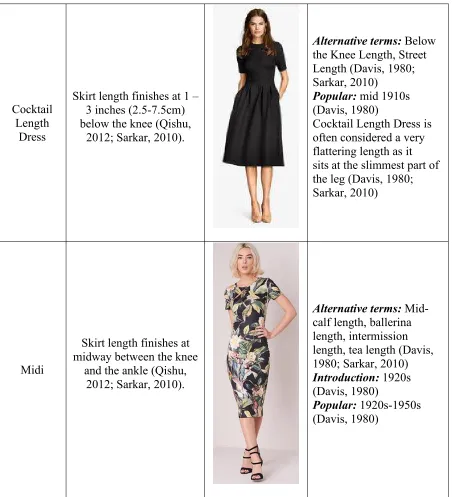
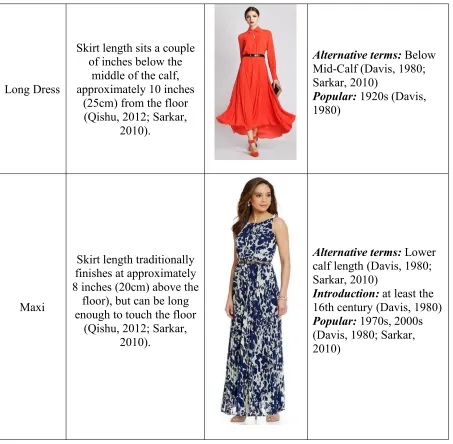
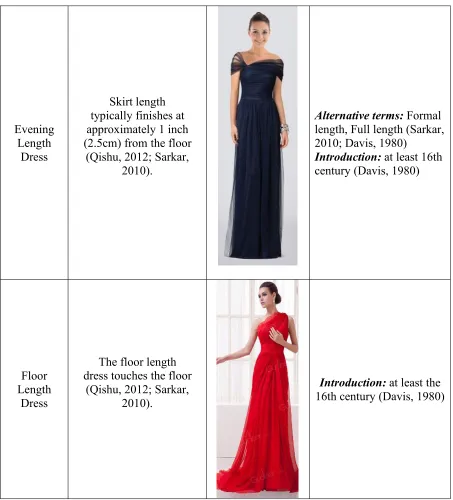
(Qishu, 2012; Sarkar, 2010). The Figure 2.25 and Table 2.3 that follow provide details on
Table 2.2 Types of dresses according to the dress length
Dress Type Skirt Length RepresentativeImage Others
Micro Dress
Skirt length is extremely short, typically finishes at less than 15 inches (about
40 cm) and can be as short as 8 inches (about
20cm) (Qishu, 2012; Sarkar, 2010).
Alternative terms:Belt Skirt (Sarkar, 2010) Introduction:1960s (Davis, 1980)
Micro dress may expose the underwear or buttocks of wearers (Qishu, 2012; Sarkar, 2010).
Mini Dress
Skirt length is very short, typically finishes at mid-thigh, approximately 15
inches (about 40 cm) (Qishu, 2012; Sarkar,
2010).
Introduction:5th century before the common era (Davis, 1980)
Popular:1960s (Davis, 1980)
Table 2.2 Continued
Above-the-Knee Length
Dress
Skirt length finishes at 1 to 2 inches (about 2.5-5cm) above the mid-knee
(Qishu, 2012; Sarkar, 2010).
Popular:1920s (Davis, 1980)
The Knee Length
Dress
Skirt length finishes at the middle of the wearer’s knee cap (Qishu, 2012;
Sarkar, 2010).
Table 2.2 Continued
Cocktail Length
Dress
Skirt length finishes at 1 – 3 inches (2.5-7.5cm) below the knee (Qishu,
2012; Sarkar, 2010).
Alternative terms:Below the Knee Length, Street Length (Davis, 1980; Sarkar, 2010)
Popular:mid 1910s (Davis, 1980)
Cocktail Length Dress is often considered a very flattering length as it sits at the slimmest part of the leg (Davis, 1980; Sarkar, 2010)
Midi
Skirt length finishes at midway between the knee
and the ankle (Qishu, 2012; Sarkar, 2010).
Alternative terms: Mid-calf length, ballerina length, intermission length, tea length (Davis, 1980; Sarkar, 2010) Introduction:1920s (Davis, 1980)
Table 2.2 Continued
Long Dress
Skirt length sits a couple of inches below the
middle of the calf, approximately 10 inches
(25cm) from the floor (Qishu, 2012; Sarkar,
2010).
Alternative terms:Below Mid-Calf (Davis, 1980; Sarkar, 2010)
Popular:1920s (Davis, 1980)
Maxi
Skirt length traditionally finishes at approximately 8 inches (20cm) above the
floor), but can be long enough to touch the floor
(Qishu, 2012; Sarkar, 2010).
Alternative terms:Lower calf length (Davis, 1980; Sarkar, 2010)
Table 2.2 Continued
Evening Length
Dress
Skirt length typically finishes at approximately 1 inch (2.5cm) from the floor
(Qishu, 2012; Sarkar, 2010).
Alternative terms:Formal length, Full length (Sarkar, 2010; Davis, 1980)
Introduction:at least 16th century (Davis, 1980)
Floor Length
Dress
The floor length dress touches the floor
(Qishu, 2012; Sarkar, 2010).
2.5.2 The Type of Dresses According To the Dress Overall Look
According to the dress overall look, dresses can be classified into three main types:
Barrel Overall Look, Fit and Flare Dress, Tiered Dress (Qishu, 2012; Sarkar, 2010; Davis,
1980; Hillhouse & Mansfield, 1948). Table 2.3 that follow provides details on this
classification.
Table 2.3 Types of dresses according to the dress overall look
Skirt Overall
Look Description RepresentativeImage RepresentativeDress
Barrel Overall Look
A straight dress in its simplest form is a rectangle of fabric,
either long or short, with an elastic waistband project (Qishu, 2012; Sarkar, 2010). This is the easiest type of skirt
to sew and it makes an ideal beginner's sewing project
(Qishu, 2012).
Barrel Dress / Tube Dress / Straight Dress /
Pencil Dress / Column Dress (Qishu, 2012; Sarkar, 2010; Davis, 1980; Hillhouse & Mansfield, 1948)
Fit and Flare Overall Look
Fit and flare overall look means a dress that fitly hugs the body through the bodice and right past the hip, where the skirt then flares away from the body project (Qishu, 2012; Sarkar, 2010). The
Fit-and-flare overall look can also accentuate a woman’s small
natural waist or even create the appearance of a tiny waist for women with less definition
project (Qishu, 2012; Sarkar, 2010).
Table 2.3 Continued
Tiered Overall Look
A tiered dress is a type of skirt in which the fabric is layered
all the way down the skirt, making it appear as if it is made up of different tiers project (Qishu, 2012; Sarkar, 2010). It often gives the skirt a
layered, ruffled appearance that can look very feminine and dressy project (Qishu,
2012; Sarkar, 2010).
Tiered Dress (Qishu, 2012; Sarkar, 2010)
2.5.3 The Type of Dresses According To the Skirt Size
According to the skirt size, dresses can be classified to several types: Tight Skirt,
Straight Skirt, Semi-tight skirt / semi-fitting Skirt, Flare Skirt, Half-circle Skirt / Semicircular
Skirt / Circular Skirt (Qishu, 2012; Sarkar, 2010). The Figure 2.26 and Table 2.4 that follow
Figure 2.26 Types of dresses according to the skirt size (Qishu, 2012)
Table 2.4 Types of women’s dresses according to the skirt size
Skirt Type Description Representative Image
Tight Skirt
Hip ease is approximately 4 cm. The skirt part closely hugs the hip. Skirt hem is short (Qishu, 2012; Sarkar,
Table 2.4 Continued
Straight Skirt
The overall look of straight skirt is similar with tight
skirt. Hip ease is also approximately 4 cm (Qishu,
2012; Sarkar, 2010). The different part is the skirt
bottom part that shows straight (Qishu, 2012; Sarkar,
2010).
Semi-tight skirt / semi-fitting Skirt
Hip ease is approximately 4 -6 cm (Qishu, 2012; Sarkar, 2010). The skirt hem is a little
bit wide and the structure of the skirt is simple, which is easy to walk (Qishu, 2012;
Sarkar, 2010).
Flare Skirt
Hip ease is more than 6 cm. The skirt hem is wider, which
resembles a trumpet (Qishu, 2012; Sarkar, 2010). The structure is also relatively
simple but shows more dynamic (Qishu, 2012;
Table 2.4 Continued
Half-circle Skirt / Semicircular Skirt / Circular Skirt
The skirt hem is larger, which shows more activeness and enthusiastic feeling (Qishu,
2012; Sarkar, 2010).
2.5.4 The Type of Dresses According To the Skirt Silhouette
According to the skirt silhouette, skirts can be classified to several types: X-Shape,
H-Shape, A-H-Shape, T-H-Shape, and O-Shape (Qishu, 2012; Sarkar, 2010; Davis, 1980; Hillhouse
& Mansfield, 1948). Table 2.5 that follow provides details on this classification.
Table 2.5 Types of dresses according to the skirt silhouette
Shape Name Basic Skirt Shape Description RepresentativeImage
X-Shape
The shape of the skirt part is like an X (Qishu, 2012). This shape is commonly seen in mermaid dresses, which can give
strongly elegant and beautiful feeling to people (Qishu, 2012;
Table 2.5 Continued
H-Shape
The H-shape skirt is the core shape for skirts (Qishu, 2012). It
has a simple structure with a fit hip part and straight skirt bottom
part (Qishu, 2012; Sarkar, 2010). This kind of skirt can give
people a grace and modest feeling, so it is
very suitable for business wearing (Qishu, 2012; Sarkar,
2010).
A-Shape
The A-shape skirt has a fairly wider bottom part which can show
more lovely and ethereal part of wearers
(Qishu, 2012; Sarkar, 2010).
T-Shape
The T-shape has a relatively tight waist, and it can stand out the
beautiful curve of hip part. It can show the
good shape of the wearer’s body (Qishu,
Table 2.5 Continued
O-Shape
The O-Shape skirt shows much of relaxation. This type of
skirt usually attracts people by its unique
and exaggerated features (Qishu, 2012;
Sarkar, 2010).
2.6 Summary
The literature review focused on two main parts, the applications of laser technology
in textiles and fashion, and classifications of dresses. In the first part, three technologies CO2
gas laser, fiber laser, and Nd: YAG laser, are introduced. These laser sources determine the
type of laser machines that best suit industries. Then an example of a CO2 laser cutting
machine was introduced by the Universal Laser System laser cutting machine. Next,
applications of laser technology in fashion design were introduced doing with two challenges
of laser technology applications in textiles: fabric decoherence problem and the optimization
of cutting parameters. At last, four types of surface patterns were introduced by illustrating
dresses based on the dress length, dress overall look, skirt size, and skirt silhouette were
introduced by giving representative images.
There is little published literature about application of laser technology in dress
design. None was found about classifications of dress made using laser technology, nor the
classifications of surface pattern effects made by the laser technology, or the final functions
of the fashion using the laser technology. This study analyzes applications of laser
technology in textile and fashion by looking at dress design. It seeks to provide a framework
for understanding how laser technology is used in design, which is useful to academics and
CHAPTER 3 METHODOLOGY
The purpose of this research was to explore and classify dress designs using CO2
laser technology. The methodology used to address this objective is presented in two sections.
The first section describes the progress of visual analysis to summarize the preliminary
category and the defined category for dress design using the laser technology. The second
section describes the analysis of the survey data for investigating more characteristics for
each refined category. The methodology includes development of image database, visual
analysis method, development of an evaluation tool, data collection method, and data
analysis method.
3.1 Developing an Image Database
Because there is limited literature regarding laser use in fashion, visual research is
especially needed. Visual analysis allows researchers to “make quantitative generalizations
about visual and other forms of representation, on the basis of reliable classification and
observation” (Van & Jewitt, 2004, pp. 10-34). Visual analysis begins with some precise
question about well-defined variables (Van & Jewitt, 2004). In this research, the variables
include types of dress silhouettes, types of surface pattern effects and primary final
applications. Through the literature review, there are three questions: As a new technology,
other traditional techniques. Is it possible that a reliable system of classification for dresses
designed using laser technology is different from the classifications of dresses without using
this technology. Systems introduced in literature review were developed without a specific
focus on laser treated dresses. Second, the literature introduced laser cutting and laser
engraving as well as four types of surface patterns in laser cutting design. It is unclear due to
the very limited literature if this is an adequate system of classifying laser treated dresses and
if it captures the many types of surface pattern effects a designer could apply to dress design.
Finally, there is no literature to indicate if the primary intents for dresses created using laser
technology is for function or is it primarily used for dresses created for decorative purposes.
Initial research steps were undertaken to develop a reliable system of classification and
observation for dresses created using laser technology, while later steps in this research were
targeted at verifying and refining categories.
For visual analysis, an image database is critical. By creating an image database, the
images to be used for research can be easily found. What’s more, an image database can help
the researcher to make the most of the image resources. Building the image database was
data collection for developing the system of classification. The images were collected and
stored so that they could be revisited and studied conveniently, it wasn’t intended for this
study to serve anyone but researcher in doing this work. In the future, it could be further
to make when creating an image database. First, a cloud drive is required because it provides
flexible access. Whenever a useful image is found online, it can be uploaded and saved
conveniently. In this research, Google Cloud Drive was chosen as the cloud storage tool to
house all of the images. Second, each image needs to be renamed. Often, when an image has
been downloaded from a web site, it has a generic file name that means nothing. The content
of the image, including keywords, the description of design, the information of the designer,
date, and other information can guarantee that each image downloaded has a correct citation.
It also allows the researcher to search images by description or keyword quickly. Finally,
backup copies of the image database are needed in case some images get broken or deleted.
In this research, besides Google Cloud Drive, a local folder which was updated with the
updating of the Google Cloud Drive was set up in the computer drive. There are two reasons
for duplicating. One is because it is faster to move and copy images in the local folder than
doing it on the internet. The other is because a copy of an image database can make the
resource safer in case one copy is missing or destroyed.
Each image was found and obtained online. Pinterest and Google Images were two
main search tools used to find the images. Key words searched include “laser cut fashion”,
“laser cut dress”, “laser cut fabric”, “laser cut design”, and “laser engraving design”. When
an image was found, the image was selected to view the information about the original
date, and description such as the materials used, cut method used, and inspiration source. By
looking through the information, there were three situations for determining if an image
could be included into the image database. First, images that had a detailed description
including use of laser technology could be added into the image database. Second, images
that had a brief title or simple information about using laser technology could be added into
the image database. Last, if an image had information about using a cut method, but not
saying whether the cut part was made by laser cutting or not, more considerations were
needed. Because laser cutting is a physical treatment (Xinjie, 2014), if the cut piece in image
could also be dealt with laser technology and achieve the same effect, it could be added into
the database. If not, or if the material in image the image can’t be treated with laser
technology, it was not added into the database. Information for each image that was added
into the database including designer, design purpose, design date, and brief description like
the materials used, cut method used. Information was recorded. The relevant information was
recorded in APA format, which could also be used for citations and reference list. At the
same time, rename the image was renamed using the most important information about the
image.
In this research, 403 images including clothes, fabrics, accessories, etc. which
featured use laser technology were found and compiled into the image database. According
to 2016, with most from 2010 to 2016. Not every image had no specific date, so some dates
are unknown. In 403 images, 48 dresses have two views: detailed view and entire garment
view both showing the same garment. Therefore, 355 unique pieces were represented in the