Durham Research Online
Deposited in DRO:08 May 2015
Version of attached le: Accepted Version
Peer-review status of attached le: Peer-reviewed
Citation for published item:
Yang, S. and Fitches, E. and Pyati, P. and Gatehouse, J.A. (2015) 'Eect of insecticidal fusion proteins containing spider toxins targeting sodium and calcium ion channels on pyrethroid-resistant strains of peach-potato aphid (Myzus persicae).', Pest management science., 71 (7). pp. 951-956.
Further information on publisher's website: http://dx.doi.org/10.1002/ps.3872
Publisher's copyright statement:
This is the accepted version of the following article: Yang, S., Fitches, E., Pyati, P. and Gatehouse, J. A. (2014), Eect of insecticidal fusion proteins containing spider toxins targeting sodium and calcium ion channels on
pyrethroid-resistant strains of peach-potato aphid (Myzus persicae). Pest Management Science, 71(7): 951-956, which has been published in nal form at http://dx.doi.org/10.1002/ps.3872. This article may be used for non-commercial purposes in accordance With Wiley Terms and Conditions for self-archiving.
Additional information:
Use policy
The full-text may be used and/or reproduced, and given to third parties in any format or medium, without prior permission or charge, for personal research or study, educational, or not-for-prot purposes provided that:
• a full bibliographic reference is made to the original source • alinkis made to the metadata record in DRO
• the full-text is not changed in any way
The full-text must not be sold in any format or medium without the formal permission of the copyright holders. Please consult thefull DRO policyfor further details.
Durham University Library, Stockton Road, Durham DH1 3LY, United Kingdom Tel : +44 (0)191 334 3042 | Fax : +44 (0)191 334 2971
1
Effect of insecticidal fusion proteins containing spider toxins targeting sodium and calcium ion channels on pyrethroid-resistant strains of peach-potato aphid (Myzus persicae)
Sheng Yang1, Elaine Fitches2, Prashant Pyati1 and John A. Gatehouse1*
1 School of Biological and Biomedical Sciences, Durham University, South Road Durham DH1 3LE, UK
2 Fera (Food and Environment Research Agency), Sand Hutton, York, YO41 1LZ, UK
* Corresponding author Phone; +44 191 334 1264 FAX; +44 191 334 1201
2
Abstract:
BACKGROUND: The recombinant fusion proteins Pl1a/GNA and Hv1a/GNA contain the spider venom peptides -amaurobitoxin-PI1a or -hexatoxin-Hv1a respectively, linked to snowdrop lectin (GNA). Pl1a targets receptor site 4 of insect voltage-gated sodium channels (NaCh) while Hv1a targets voltage-gated calcium channels.
Insecticide-resistant strains of peach-potato aphid (Myzus persicae) contain mutations in NaCh. The pyrethroid-resistant "kdr" (794J) and "super-kdr" (UKO) strains contain mutations at residues L1014 and M918 in the channel -subunit respectively, while the "kdr+super-kdr" strain (4824J), insensitive to pyrethroids, contains mutations at both L1014 and M918.
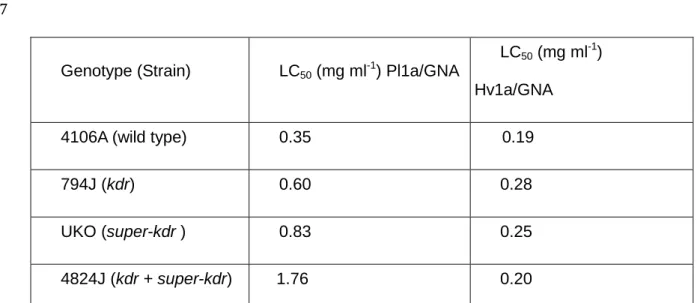
RESULTS: Pl1a/GNA and Hv1a/GNA fusion proteins have estimated LC50 values of 0.35
and 0.19 mg ml-1 when fed to wild-type M. persicae. For insecticide-resistant aphids, LC50
for the Pl1a/GNA fusion protein increased by 2- to 6-fold, correlating with pyrethroid resistance (wild-type < kdr < super-kdr < kdr+super-kdr strains). In contrast, LC50 for the
Hv1a/GNA fusion protein showed limited correlation with pyrethroid resistance. CONCLUSION: Mutations in the sodium channel in pyrethroid-resistant aphids also protect against a fusion protein containing a sodium channel-specific toxin, despite differences in ligand-channel interactions, but do not confer resistance to a fusion protein targeting calcium channels. The use of fusion proteins with differing targets could play a role in managing pesticide resistance.
Key words:biopesticide; insecticide resistance; Homoptera / Hemiptera; voltage-gated ion channels; fitness cost
3
1 INTRODUCTION 1
The peach-potato aphid, Myzus persicae (Sulzer) (Hemiptera: Aphididae), is a serious
2
worldwide insect pest of agricultural and horticultural crops, which, through its
sap-3
sucking feeding habit, can transmit viral diseases.1 Pyrethroids are a major class of
4
insecticides used to control this pest, but populations of M. persicae can rapidly
5
develop resistance to pyrethroids, leading to increased economic loss to agricultural
6
producers.2 Pyrethroids target the insect voltage-gated sodium channel, a large
trans-7
membrane protein composed of a single 260kDa polypeptide (the alpha subunit), which
8
contains four repeating and homologous domains (I–IV), with each domain being
9
constituted by six hydrophobic transmembrane segments (S1–S6).3 The insect sodium
10
channel is similar in structure to the vertebrate sodium channel, containing different
11
allosterically coupled receptor-binding sites for various neurotoxicants, but the two
12
types of channel are distinguishable in the pharmacology. Therefore insecticides such
13
as pyrethroids can be specific for insect sodium channels, showing no effect on
14
mammals.4,5
15
Pyrethroids are hydrophobic compounds, and are thought to bind to the
lipid-16
exposed interface formed by helices IIIS6, IIS5, linker helix IIS4-IIS5 and the IS4-IS5
17
linker,6,7 affecting the functional properties of the sodium channel. By preventing closure
18
of the sodium channel, pyrethroids cause paralysis in insects.5 However, with the
19
extensive use of pyrethroids, many insects have developed resistance to these
20
insecticides, associated with mutations in the sodium channel. The pyrethroid
21
resistance shown by M. persicae is typical of that seen in many species.8-10 In aphids
22
carrying the kdr mutation, there is a leucine to phenylalanine substitution (L1014F)
23
within segment 6 of domain II (IIS6) of the channel protein,11 which confers an
24
intermediate level of resistance to pyrethroids. In aphids carrying the super-kdr site
25
mutation, there is an additional methionine- to-threonine substitution (M918T) in the
26
linker between segment 4 and segment 5 of domain II (IIS4-IIS5 linker) of the sodium
27
channel protein,8 which makes M. persicae highly resistant to pyrethroids. Data
4
presented by Eleftherianos et al.1 shows that whereas the EC50 for a typical pyrethroid
29
insecticide on wild-type M. persicae is in the range 0.5 - 2.8 ppm, a homozygous kdr
30
mutation increases the EC50 by 20-75 fold, and a heterozygous kdr+super-kdr mutation
31
increases resistance by 100-500 fold. The emergence of insecticide resistance is one
32
factor driving a need for new specific environmentally benign pesticides, which could
33
be used in strategies to manage resistance to chemicals like pyrethroids more
34
effectively.
35
Spider toxin peptides have been suggested as environmentally friendly
36
biopesticides. Toxins have been isolated from a range of arachnids, and most are small
37
cysteine-rich proteins that principally target neuronal ion channels to cause paralysis of
38
the spider's prey.4,12 Toxins can be selected that are insect-specific, and have no effects
39
on members of other taxons. This advantage would make them ideal candidates for
40
use in pest control and crop protection, if a suitable delivery system which would get
41
around the problem of toxicity being dependent on injection into the body fluid of the
42
pest could be devised.13 Recombinant fusion proteins, containing insecticidal peptides
43
or proteins fused to a "carrier" protein are a method, which gives oral toxicity to
44
neuroactive toxins.14,15 The carrier protein transports the insecticidal peptide or protein
45
across the insect gut epithelium into the haemolymph, from which it can access the
46
central nervous system (CNS), which is the site of action. The mannose-specific lectin
47
from snowdrop (Galanthus nivalis agglutinin: GNA), which has been shown to transport
48
peptides into the insect haemolymph, is currently being used for making fusion proteins.
49
Fusion proteins containing GNA as a carrier possess good stability towards proteolysis
50
in the insect gut and high toxicity.16
51
-Amaurobitoxins, or -palutoxins, from the spider Pireneitega luctuosus, are a
52
family of four similar 36-37 residue peptides containing 8 cysteine residues which are
53
disulphide-linked to form a cysteine knot motif. Pl1a is specific for insect sodium
54
channels, causing paralysis, and has no adverse effects when injected into mice.17 The
55
toxin acts by binding to receptor site 4 in the sodium channel protein, which involves
5
the extracellular loops of S1-S2, S3-S4 of domain II.18 It affects the functional
57
properties of the sodium channel α subunit by shifting the voltage dependence of
58
activation, resulting in paralysis; the effect is similar to that produced by pyrethroids.5 A
59
Pl1a/GNA fusion protein has been shown to be an effective oral insecticide towards
60
insects of different orders, including aphids.19
61
Hv1a is a family member of insecticidal neurotoxins, which possess 36–37 residues,
62
from the Australian funnel web spider Hadronyche versuta.20 Hv1a arrests insect
63
voltage-gated calcium channels and has no negative effects on mammals.21-23 Hv1a
64
contains three disulfide bonds which shape an inhibitor cystine knot motif, which
65
confers chemical and thermal stablility and resistance to proteases.24,25 The highly
66
conserved C-terminal hairpin of Hv1a contains the key residues for insecticidal
67
activity.20 An Hv1a/GNA fusion protein has been described previously, and its oral
68
toxicity towards insects has been demonstrated.16
69
The present paper compares the toxicity of PI1a/GNA and Hv1a/GNA fusion
70
proteins towards wild-type and pyrethroid-resistant strains of M. persicae, and shows
71
that although the toxicity of PI1a/GNA is reduced by the kdr and super-kdr mutations in
72
the sodium channel, it retains some activity. However, the mutations confer no
73
resistance to Hv1a/GNA targeting calcium channels. This residual high insecticidal
74
activity makes Hv1a/GNA a potential biopesticide for controlling pyrethroid-resistant
75
aphids.
76 77
2 MATERIALS AND METHODS 78
79
2.1 Materials 80
Chemicals and reagents were of analytical grade and were supplied by Sigma or BDH
81
Chemical Company otherwise unless stated. Restriction enzymes and other molecular
82
biology reagents were supplied by Fermentas. A double stranded DNA incorporating a
83
sequence encoding the mature PI1a toxin (P83256), with codons optimised for
6
expression in Pichia pastoris, was designed by the authors, synthesized and supplied
85
by ShineGene Molecular Biotech, Inc. (Shanghai 201109, China;
86
http://www.synthesisgene.com/). Other oligonucleotides required for cloning were
87
supplied by Sigma Chemical Co. Recombinant snowdrop lectin was produced by the
88
authors by expression in Pichia pastoris, as described by Baumgartner et al. (2004).26
89
The mutant strains of peach-potato aphid, Myzus persicae (Sulzer) (Hemiptera:
90
Aphididae) were kindly provided by Prof. Linda M. Field (Department of Biological
91
Chemistry and Crop Protection, Rothamsted Research, UK). Strain 4106A has no
92
mutation ("wild type"). Strain 794J is homozygous for the mutation L1014F (kdr), and is
93
resistant to pyrethroids. Strain UKO is homozygous for the mutation M918L (super-kdr),
94
and shows enhanced resistance to pyrethroids. 4824J is homozygous for L1014F (kdr)
95
and M918T (super-kdr), and shows immunity to pyrethroids.1 Aphids were cultured on
96
fresh Chinese Leaf under conditions of 12h light, 12h dark, 18°C, 70% relative humidity.
97 98
2.2 Production of Pl1a/GNA and Hv1a/GNA fusion proteins 99
Assembly of expression constructs encoding Pl1a, PI1a/GNA and GNA and expression
100
of the recombinant proteins in the yeast Pichia pastoris have been described
101
elsewhere.19 The fusion proteins, which contained C-terminal (His)6 tags, were purified
102
by metal affinity chromatography, dialysed and lyophilised as previously described.14-16
103
Expression constructs for Hv1a and Hv1a/GNA and production of recombinant proteins
104
have also been described previously;16 the constructs used to express Hv1a and
105
Hv1a/GNA for this paper were modified by inclusion of a predicted pro-region for the
106
toxin.27 Other recombinant proteins were produced as previously described.15 Purified
107
proteins were analysed by SDS-PAGE for quantitation by comparison to standards run
108
on the same gel; proteins were also quantitated by using the BCA assay, and by
109
absorbance.
110 111
2.3 Bioassays on peach-potato aphid 112
7
Bioassay of aphids using liquid artificial diet was carried out as described by Prosser
113
and Douglas28. Adult aphids were transferred to control liquid diet, acclimatised for 24h,
114
and then neonate nymphs produced over the following 24h were transferred to
115
experimental diets, and allowed to develop to adult stage (8-9 days). 20 individuals per
116
treatment were used to perform the bioassays. Each assay was repeated 3 times.
117
Mortality was observed daily, and assays were continued until control aphids started to
118
produce nymphs. Nymphs were not counted but the presence or absence of progeny
119
was recorded. Effects of treatments on aphid growth were assessed by using Image J
120
Software to measure insect length.
121 122
2.4 Statistical analysis 123
Mortality data were analysed using survival curves, with a Kaplan-Meier test to
124
evaluate significance of differences (Origin 8.5 software). ANOVA analysis (with
125
Bonferroni-Dunn post-hoc tests) was carried out to determine any significant
126
differences between treatments in size parameters measured. Differences between
127
treatments were considered significant at a probability level p < 0.05. LC50 values for
128
different treatments were estimated by taking survival data for diets containing different
129
concentrations of fusion proteins (over a range of 0.125 - 2.0 mg ml-1) and fitting data
130
points to a sigmoidal dose-response curve by non-linear regression (Prism v. 5
131 software). 132 133 3 RESULTS 134 135
3.1 Toxicity of separate components of fusion proteins 136
Effects of toxins and GNA components of insecticidal fusion proteins on the strains of
137
peach-potato aphids (794J, UKO, 4824J and 4106A) were determined by bioassays in
138
which components were fed separately in liquid diet from neonate nymphs.
139
Concentrations were chosen to be equivalent to 1 mg/ml fusion protein. Results are
8
shown in Fig. 1. None of the treatments caused more than 30% mortality over a 7-day
141
period of development against a background of no mortality in aphids on control diet;
142
survival analysis showed that most differences to control were not significant (effect on
143
survival by difference in survival curve; p > 0.05). The GNA carrier protein showed
144
significant effects on M. persicae survival (difference in survival curve; p < 0.05), in
145
agreement with previous reports that this protein is weakly insecticidal towards aphids29;
146
it also caused growth retardation at the beginning in the bioassays,. although aphids
147
were able to recover from the effects and produced nymphs. There were no significant
148
differences in the effects of GNA between aphid strains. At the concentrations used,
149
the Hv1a toxin showed significant effects on M. persicae (30% mortality after 7 days;
150
effect on survival by difference in survival curve p<0.05), whereas Pl1a did not have a
151
significant effect, although both toxins have been shown previously to have some effect
152
on aphids when fed in diet. Once again, no significant differences between aphid
153
strains were observed in these assays. These data confirm previous observations that
154
the separate components of insecticidal fusion proteins have only limited insecticidal
155
effects when fed to M. persicae.
156 157
3.2 Toxicity of Pl1a/GNA recombinant fusion protein 158
Purified recombinant Pl1a/GNA fusion protein was fed to each M. persicae strain at a
159
range of concentrations, and survival curves were plotted for all treatments. Results for
160
feeding at 1 mg ml-1 are shown in Fig 2A. At this level, the fusion protein caused
161
complete mortality to strain 4106A (wild-type) after 7 days, but not in any of the
162
insecticide resistant strains, even after 11 days. The survival curves show significant
163
differences between strains 4106A (wild-type), 794J (kdr) and UKO (super-kdr) and the
164
controls not fed fusion protein (≥90% survival) (p < 0.05), confirming the insecticidal
165
activity of the treatment. However, the survival curve for strain 4824J (kdr + super-kdr:
166
90% survival over the assay) fed Pl1a/GNA at 1 mg ml-1 is not significantly different to
167
that for aphids fed control diet containing no fusion protein (p < 0.05). Survival curves
9
for strains 794J (kdr) and UKO (super-kdr), which both show 40% survival over the
169
assay, differ significantly from controls, from wild-type survival, and from strain 4824J
170
survival (p < 0.05). Growth retardation was observed in all aphids exposed to fusion
171
proteins, but was least in strain 4824J (Fig. 2B), where aphids were able to produce
172
nymphs during the assay period, as did the controls. No other aphid strain exposed to
173
treatment was able to produce nymphs. The data demonstrate a differential effect of
174
the fusion protein on the different aphid strains, with wild-type strains fully susceptible
175
to the toxin at this concentration, whereas the kdr and super-kdr strains are partially
176
tolerant, and the kdr + super-kdr strain is almost completely tolerant.
177
By analysing survival curves for aphids exposed to different concentrations of
178
Pl1a/GNA, LC50 values for the different strains could be deduced. The values obtained
179
range from 0.35 to 1.76 mg ml-1, and are shown in Table 1. There is a strong
180
correlation between insecticide resistance of aphid strains and the estimated LC50
181
values; wild-type susceptible aphids have the lowest LC50, and the order of insecticide
182
tolerance (wild-type < kdr < super-kdr < kdr + super-kdr) is reflected in the LC50 values
183
(wild-type < kdr < super-kdr < kdr + super-kdr). The kdr + super-kdr strain 4824J has
184
an estimated LC50 of 1.76 mg ml-1 for Pl1a/GNA; recombinant protein at 2.0 mg ml-1
185
caused significant effects on survival, and treatment with 2.5 or 3.0 mg ml-1 of
186
Pl1a/GNA resulted in complete mortality (Fig. 2C).
187 188
3.3 Toxicity of Hv1a/GNA recombinant fusion protein 189
An insecticidal fusion protein containing the calcium-channel specific toxin Hv1a was
190
used as a control to identify non-specific effects on sensitivity towards insecticidal
191
compounds in the pyrethroid-resistant M. persicae strains. Purified recombinant
192
Hv1a/GNA fusion protein was fed to each strain at a range of concentrations, and
193
survival curves were plotted for all treatments. Results for feeding at 1 mg ml-1 are
194
shown in Fig.3A. Hv1a/GNA fusion protein at this concentration caused complete
195
mortality to strains 4106A (wild-type) and UKO (super-kdr) after 6 days, and to strains
10
794J (kdr) and 4824J (kdr + super-kdr) after 9 days. The survival curves show
197
significant differences between all strains fed fusion protein and the controls not fed
198
fusion protein (100% survival over 11 days) (p < 0.05), in agreement with previous
199
assays showing that this fusion protein is insecticidal. Growth retardation was observed
200
in all aphids exposed to fusion proteins (Fig 3B), and no aphids exposed to treatment
201
were able to produce nymphs. Comparison of individual survival curves when
202
Hv1a/GNA was fed at 1 mg ml-1 suggested that strain 4824J (kdr + super-kdr) was
203
more tolerant to Hv1a/GNA than wild-type aphids (strain 4106A), (difference between
204
survival curves at p < 0.05) but that other differences were not significant. Assays at
205
other concentrations of Hv1a/GNA did not give consistently significant differences
206
between treatments, although the wild-type strain always showed greater susceptibility
207
to the fusion protein than the pyrethroid-resistant strains.
208
LC50 values for Hv1a/GNA in the different aphid strains were deduced by analysis
209
of survival curves for aphids exposed to different concentrations fusion protein. The
210
values obtained range from 0.19 to 0.28 mg ml-1, and are shown in Table 1. The
211
estimated LC50 values show no significant differences between any of the aphid strains
212
although the wild-type strain, 4106A, has a lowest LC50 value. The uncertainties in
213
estimated LC50 values are relatively large compared to the differences, but the fitted
214
dose-response curve for the wild-type strain differs significantly from the other curves
215
(p < 0.05), supporting the conclusion that this strain is more susceptible to Hv1a/GNA.
216 217
4 DISCUSSION 218
The insect sodium channel is a major target for conventional pesticides, such as
219
pyrethroids. The Pl1a toxin, which acts on the same target, could represent a novel
220
type of insecticidal component as a substitute to pyrethroids. The mode of binding of
221
this toxin would be expected to differ significantly from binding a small molecule
222
channel blocker like a pyrethroid, with contacts between the toxin and the channel
223
potentially extending over a wider area. However, Pl1a/GNA fusion protein exhibits
11
reduced toxicity towards pyrethroid-resistant peach-potato aphid (Myzus persicae)
225
strains, showing that the mutations, which remove sensitivity to pyrethroids, also affect
226
the binding of Pl1a. The mutations which give pyrethroid sensitivity are in domain II of
227
the sodium channel, with the mutation at L1014 in helix S6 and the mutation at M918 in
228
the linker between helices S4-S5. Changes to the spatial structure of domain II as a
229
result of these mutations presumably also disturb the binding of Pl1a to receptor site 4,
230
in domain II. However, although the bioassays show that mutations in domain II of the
231
insect sodium channel affect the insecticidal activity of the Pl1a/GNA fusion protein,
232
some toxicity is still observed, with a higher concentration of fusion protein required to
233
cause mortality in the pyrethroid-resistant kdr and super-kdr strains. This result implies
234
that either some interactions still exist between Pl1a and domain IIS6 or domain
IIS4-235
S5 linker of the mutated sodium channel, or that Pl1a also binds to other sites on the
236
sodium channel to cause inactivation. The extracellular loops of IIS1-S2, IIS3-S4 are
237
thought to be the main binding sites of Pl1a, which are distinct from the pyrethroid
238
binding site but contribute to receptor site 4 for toxins. The change in the spatial
239
structure of domain II as a result of the kdr and super-kdr mutations may have a
240
relatively small effect on toxin binding in the interaction between Pl1a and the sodium
241
channel but may prevent the toxin inactivating the channel. The greater effect on
242
channel structure caused by combining the mutations at L1014 and M918 would be
243
expected to affect Pl1a binding more than single mutations, in agreement with the lack
244
of sensitivity to Pl1a/GNA shown by aphid strain 4824J.
245
As expected, when fusion protein containing the calcium channel-specific toxin
246
Hv1a is fed to aphids, there is no evidence for significant differential sensitivity between
247
insecticide-resistant aphid strains, since the strains differ in mutations to the sodium
248
channel. However, the observation that wild-type aphids are more susceptible to this
249
toxin is unexpected. Mutations in sodium channels present in strains 794J, UKO and
250
4824J would be expected to result in a fitness cost to M. persicae, similar to that
251
observed both for other insect-resistant aphids of this species,30 and for other insect
12
species (e.g. when comparing insecticide-resistant and insecticide-susceptible German
253
cockroaches, Blattella germanica31) A fitness cost for insecticide resistance can be
254
inferred in M. persicae from population data; if there were no fitness cost, the
255
population of resistant M. persicae should be much larger than wild type before
256
selection occurs.32 The fitness cost would be expected to make insecticide-resistant
257
strains of M. persicae more susceptible to Hv1a/GNA, but this is not the case. Possibly,
258
other changes to the phenotype of insecticide-resistant aphids are affecting
259
susceptibility to this fusion protein; a transcriptomic study33 has suggested that
260
insecticide resistance in M. persicae is complex, and involves a broad array of
261
resistance mechanisms. The present results support that conclusion.
262
The kdr strain of M. persicae is resistant to all pyrethroids, showing 23-to 73-fold
263
increased resistance1 and the kdr +super-kdr strain is virtually immune to all the
264
pyrethroids.34 A fusion protein containing the sodium-channel specific Pl1a toxin can
265
cause 100% mortality towards pyrethroid-resistant aphids containing a single mutation
266
in the sodium channel if administered at concentrations increased only 3-fold, but is not
267
effective towards aphids containing a double mutation in the sodium channel. However,
268
insecticide-resistant aphids are still sensitive towards a calcium channel-specific toxin,
269
albeit at higher doses than wild-type aphids. These experiments demonstrate the
270
potential for fusion protein-based biopesticides to complement existing pesticides, and
271
to be used in the management of insecticide-resistant insect strains; the Hv1a/GNA
272
fusion protein is currently undergoing trials leading to commercial use as a biopesticide.
273 274
Acknowledgements 275
Work described in this paper has been carried out with funding from the Technology
276
Strategy Board (TSB; TS/I000690/1) and BBSRC China Partnership Scheme
277
(BB/G530409), which is acknowledged with gratitude. SY received support for his Ph.D.
278
programme jointly from the China Scholarship Scheme, and a Durham University
279
Doctoral Studentship; this funding is also gratefully acknowledged.
13
References 281
1. Eleftherianos I, Foster SP, Williamson MS and Denholm I, Characterization of the
282
M918T sodium channel gene mutation associated with strong resistance to
283
pyrethroid insecticides in the peach-potato aphid, Myzus persicae (Sulzer). Bull
284
Entomol Res98: 183-191 (2008).
285
2. McCaffery A and Nauen R, The insecticide resistance action committee (IRAC):
286
public responsibility and enlightened industrial self-interest. Outlooks on Pest
287
Management17: 11-14 (2006).
288
3. Catterall WA, From ionic currents to molecular mechanisms: the structure and
289
function of voltage-gated sodium channels. Neuron26: 13-25 (2000).
290
4. Vassilevski AA, Kozlov SA and Grishin EV, Molecular diversity of spider venom.
291
Biochemistry (Mosc) 74: 1505-1534 (2009).
292
5. Zlotkin E, The insect voltage-gated sodium channel as target of insecticides. Annu
293
Rev Entomol44: 429-45 (1999).
294
6. Du Y, Lee J, Nomura Y, Zhang T, Zhorov B and Dong K, Identification of a cluster
295
of residues in transmembrane segment 6 of domain III of the cockroach sodium
296
channel essential for the action of pyrethroid insecticides. Biochem J419:377-385
297
(2009).
298
7. Du Y, Nomura Y, Satar G, Hu Z, Nauen R, He SY, Zhorov BS and Dong K,
299
Molecular evidence for dual pyrethroid-receptor sites on a mosquito sodium
300
channel. Proc Natl Acad Sci U S A 110: 11785-11790 (2013).
301
8. Williamson MS, Martinez-Torres D, Hick CA and Devonshire AL, Identification of
302
mutations in the housefly para-type sodium channel gene associated with
303
knockdown resistance (kdr) to pyrethroid insecticides. Mol Gen Genet252: 51-60
304
(1996).
305
9. Martinez-Torres D, Chandre F, Williamson MS, Darriet F, Bergé JB, Devonshire
306
AL, Guillet P, Pasteur N and Pauron D, Molecular characterization of pyrethroid
14
knockdown resistance (kdr) in the major malaria vector Anopheles gambiae ss.
308
Insect Mol Biol 7: 179-184 (1998).
309
10. Kranthi KR, Jadhav DR, Kranthi S, Wanjari RR, Ali SS and Russell DA, Insecticide
310
resistance in five major insect pests of cotton in India. Crop Prot 21: 449-460
311
(2002).
312
11. Miyazaki M, Ohyama K, Dunlap DY and Matsumura F, Cloning and sequencing of
313
the para-type sodium channel gene from susceptible and kdr-resistant German
314
cockroaches (Blattella germanica) and house fly (Musca domestica). Mol Gen
315
Genet252(1-2): 61-68 (1996).
316
12. Rash LD and Hodgson WC, Review: pharmacology and biochemistry of spider
317
venoms. Toxicon40: 225–254 (2002). 318
13. Whetstone PA and Hammock BD, Delivery methods for peptide and protein
319
toxins in insect control. Toxicon49: 576-596 (2007).
320
14. Fitches E, Audsley N, Gatehouse JA and Edwards JP, Fusion proteins
321
containing neuropeptides as novel insect contol agents: snowdrop lectin delivers
322
fused allatostatin to insect haemolymph following oral ingestion. Insect Biochem
323
Mol Biol32: 1653-1661 (2002).
324
15. Fitches E, Edwards MG, Mee C, Grishin E, Gatehouse AM, Edwards JP and
325
Gatehouse JA, Fusion proteins containing insect-specific toxins as pest control
326
agents: snowdrop lectin delivers fused insecticidal spider venom toxin to insect
327
haemolymph following oral ingestion. J Insect Physiol50: 61-71 (2004).
328
16. Fitches EC, Pyati P, King GF and Gatehouse JA, Fusion to snowdrop lectin
329
magnifies the oral activity of insecticidal ω-hexatoxin-Hv1a peptide by enabling its
330
delivery to the central nervous system. PLoS One7: e39389 (2012).
331
17. Corzo G., Escoubas P, Stankiewicz M, Pelhate M, Kristensen CP and Nakajima T,
332
Isolation, synthesis and pharmacological characterization of
333
δ-palutoxins IT, novel insecticidal toxins from the spider Paracoelotes luctuosus
334
(Amaurobiidae). Eur J Biochem267: 5783-5795 (2000).
15
18. Cestèle S and Catterall WA, Molecular mechanisms of neurotoxin action on
336
voltage-gated sodium channels. Biochimie82: 883-892 (2000).
337
19. Yang S, Pyati P, Fitches E and Gatehouse JA, A recombinant fusion protein
338
containing a spider toxin specific for the insect voltage-gated sodium ion channel
339
shows oral toxicity towards insects of different orders. Insect Biochem Mol47:
1-340
11 (2014).
341
20. Tedford HW, Fletcher JI and King GF, Functional significance of the β-hairpin in
342
the insecticidal neurotoxin ω-atracotoxin-Hv1a. J Biol Chem 276: 26568-26576
343
(2001).
344
21. Fletcher JI, Smith R, O'Donoghue SI, Nilges M, Connor M, Howden ME, Christie
345
MJ and King GF, The structure of a novel insecticidal neurotoxin,
ω-atracotoxin-346
HV1, from the venom of an Australian funnel web spider. Nat Struct Biol 4:
559-347
566 (1997).
348
22. Tedford HW, Gilles N, Ménez A, Doering CJ, Zamponi GW and King GF, Scanning
349
mutagenesis of ω-atracotoxin-Hv1a reveals a spatially restricted epitope that
350
confers selective activity against insect calcium channels. J Biol Chem 279:
351
44133-44140 (2004).
352
23. Chong Y, Hayes JL, Sollod B, Wen S, Wilson DT, Hains PG, Hodgson WC, Broady
353
KW, King GF and Nicholson GM, The ω-atracotoxins: selective blockers of insect
354
M-LVA and HVA calcium channels. Biochem Pharmacol 74: 623-638 (2007).
355
24. King GF, Tedford HW and Maggio F, Structure and function of insecticidal
356
neurotoxins from Australian funnel-web spiders. Toxin Rev21(4): 361-389 (2002).
357
25. Saez NJ, Senff S, Jensen JE, Er SY, Herzig V, Rash LD and King GF,
Spider-358
venom peptides as therapeutics. Toxins2: 2851-2871 (2010).
359
26. Baumgartner P, Harper K, Raemaekers RJM, Durieux A, Gatehouse AMR, Davies
360
HV and Taylor MA, Large-scale production and purification of recombinant
361
Galanthus nivalis agglutinin (GNA) expressed in the methylotrophic yeast Pichia
362
pastoris. Biotechol Letts 25: 1281-1285 (2004).
16
27. Gatehouse JA, Yang S, Pyati P and Fitches EC, Pesticidal Fusion Protein
364
Improvements. UK Patent Applic. No.1321938.1 (2013).
365
28. Prosser WA and Douglas AE, A test of the hypotheses that nitrogen is upgraded
366
and recycled in an aphid (Acyrthosiphon pisum) symbiosis. J Insect Physiol 38:
367
93-99 (1992).
368
29. Down RE, Fitches EC, Wiles DP, Corti P, Bell HA, Gatehouse JA and Edwards JP,
369
Insecticidal spider venom toxin fused to snowdrop lectin is toxic to the
peach-370
potato aphid, Myzus persicae (Hemiptera: Aphididae) and the rice brown
371
planthopper, Nilaparvata lugens (Hemiptera: Delphacidae). Pest Manag Sci62:
372
77-85 (2006).
373
30. Castañeda LE, Barrientos K, Cortes PA, Figueroa CC, Fuentes-Contreras E,
Luna-374
Rudloff M, Silva AX and Bacigalupe LD, Evaluating reproductive fitness and
375
metabolic costs for insecticide resistance in Myzus persicae from Chile. Physiol
376
Entomol 36: 253–260. 377
31. Ang LH and Lee CY, Absence of a fitness penalty in insecticide-resistant German
378
cockroaches, Blattella germanica (L.)(Dictyoptera: Blattellidae). International
379
Journal of Pest Management57: 195-204 (2011).
380
32. Fenton B, Margaritopoulos JT, Malloch GL and Foster S P, Micro‐evolutionary
381
change in relation to insecticide resistance in the peach–potato aphid, Myzus
382
persicae. Ecol Entomol 35: 131-146 (2010).
383
33 Silva AX, Jander G, Samaniego H, Ramsey JS and Figueroa CC, Insecticide
384
resistance mechanisms in the green peach aphid Myzus persicae (Hemiptera:
385
Aphididae) I: A Transcriptomic Survey. PLoS ONE7: e36366 (2012).
386
34. Anstead JA1, Williamson MS, Eleftherianos I and Denholm I, High-throughput
387
detection of knockdown resistance in Myzus persicae using allelic discriminating
388
quantitative PCR. Insect Biochem Mol Biol34: 871-877 (2004).
389 390
17 391
392
Table 1. Estimated LC50 values for fusion proteins towards wild-type and pyrethroid
393
tolerant strains of M. persicae. Values were calculated from dose-response curves
394
fitted to survival data after 9 days' exposure to diets containing fusion proteins at
395
varying concentrations.
396 397
Genotype (Strain) LC50 (mg ml-1) Pl1a/GNA
LC50 (mg ml-1)
Hv1a/GNA
4106A (wild type) 0.35 0.19
794J (kdr) 0.60 0.28
UKO(super-kdr ) 0.83 0.25
4824J(kdr + super-kdr) 1.76 0.20
398 399
18
Figure Legends 400
Figure 1. Toxicity of fusion protein components towards M. persicae. Graph shows
401
survival after 7 days of pyrethroid-tolerant M. persicae strains (794J, kdr; UKO,
super-402
kdr; and 4824J, kdr+super-kdr) and wild type 4106A strain after feeding artificial diet
403
containing 0.4 mg ml-1 Pl1a, 0.46 mg ml-1 Hv1a or 0.6 mg ml-1 GNA. Survival on control
404
diet was 100% for all aphid strains over this interval. n = 20 aphids per replicate.
405 406
Figure 2. 407
(A): Toxicity of Pl1a/GNA fusion protein towards M. persicae. Graph shows survival
408
curves of pyrethroid-tolerant M. persicae strains (794J, kdr; UKO, super-kdr; and 4824J,
409
kdr+super-kdr), and wild type 4106A strain fed Pl1a/GNA at 1 mg ml-1. All aphid strains
410
on control diet showed survival similar to that presented for 4106A strain. n = 20 aphids
411
per replicate.
412
(B): Growth suppression by Pl1a/GNA fusion protein. Graph shows lengths of aphid
413
strains 794J, kdr; UKO, super-kdr; and 4824J, kdr+super-kdr and 4106A (wild type)
414
from neonate to adult (9 days) after feeding on artificial diet containing 1mg/ml
415
Pl1a/GNA (n=3 per treatment). 100 % mortality for strain 4106A prevented analysis for
416
day 9. Data for strain 4842J fed on control diet is shown, but all aphid strains fed on
417
control diet were of comparable size at each time point. 418
(C): Dose-response effects of Pl1a/GNA. Graph shows survival curves of 4824J
419
(kdr+super-kdr) M. persicae strain fed diets containing different concentrations of
420
Pl1a/GNA in the range 0 - 3.0 mg ml-1. n=20 aphids per replicate.
421 422
Figure 3.
423
(A): Toxicity of Hv1a/GNA fusion protein towards M. persicae. Graph shows survival of
424
pyrethroid-tolerant M. persicae strains (794J, kdr; UKO, super-kdr; and 4824J,
425
kdr+super-kdr) and wild type 4106A strain fed on diet containing 1 mg ml-1 Hv1a/GNA.
426
All aphid strains on control diet showed survival similar to that presented for 4106A
19
strain. n = 20 aphids per replicate.
428
(B): Growth suppression by PHv1a/GNA fusion protein. Graph shows lengths of aphid
429
strains 794J, kdr; UKO, super-kdr; and 4824J, kdr+super-kdr and 4106A (wild type)
430
from neonate to adult after feeding on artificial diet containing 1mg/ml Hv1a/GNA (n=3
431
per treatment). 100 % mortality for strains UKO, 4824J and 4106A prevented analysis
432
for day 9. Data for strain 4842J fed on control diet is shown, but all aphid strains fed on
433
control diet were of comparable size at each time point.
434 435 436 437 438