1
International Journal in Management and Social Sciencehttp://ijmr.net.in, Email: [email protected]
MANAGERIAL PERFORMANCE OF HEADMASTERS’ AT PRIMARY LEVEL: A PERCEPTUAL STUDY
Prof. M.S.R.SARMA*,
Director, M.R.College of Education, Fort, Vizianagaram-535002,Andhra Pradesh,
Dr. M.Narasimhamurty**
Assistant Professor, Andhra University Campus, Vizianagaram
In any primary school where staff, parents and management share common aims for their children, where human beings are respected, where the policies are in operation and where confidence is high such schools can be considered as effective. The schools which are well run and the quality of learning is high such schools can also be considered effective and progressive and the teachers working in those schools can be considered as role models. The schools where staff feels more committed for their professional improvement and work continuously and actively for the school development such schools can be considered as progressive schools. In the schools where teacher contributions are very high and rich, where teachers have proper and effective planning over all the school and class components where teachers can adopt suitable and appropriate teaching methods and evaluative methods such schools can be considered as effective and progressive. Enhancement of quality at primary level is one of the important tasks. The role of the head teacher will influence on the behavior and learning achievement of the students.
The functioning and management role of the Headmaster becomes thus the most crucial factor in the school system. His / Her managerial or functional aspects reflect the efficiency of the institution. The managerial aspects and role performance sets the tone of the institution determines the job satisfaction of teachers, and the student learning outcomes. If the students are performing to the best of their ability, one can almost point to the managerial role of the headmaster as the key to success.
2
International Journal in Management and Social Sciencehttp://ijmr.net.in, Email: [email protected] implementation at school level and to get quality results. SSA and the government interventions or inputs are having direct impact for the school progress.
Sarma (2005) studied managerial functions of headmasters at primary level, by selecting
the factors viz., effectiveness of the Headmaster, discipline, involvement of teachers, resource utilization, work-centered environment, support from other agencies like DIET, MRP, MEO, DPEP, management and parental involvement result in effective school functioning. These factors are crucial, and can be observed to make the school effective. The results yielded through this study are very much encouraging. Sarma (2006) conducted a study on the effective managerial factors at primary level found that implementation of the policies, assigning duties to teachers and more involvement of Head master/staff members in the curricular aspects are in low profile. With regard discipline and the maintaining the tone of the institute by the municipal, mandal and government management schools is average.With regard to the behaviour of the children – in the school, in the class, with their peer group and with others, it was average in all the institutions Out-of-school-hours behaviours of the students was low. With regard to involvement of teachers, all the Headmasters voiced a positive and high opinion. On the whole, the usage of time-table, and the seating arrangements at the class level were very poor. The time allocation for the preparatory work, planning for the class work, method selection and observation of class work were average as per the perceptions of the three different managements/headmasters.
Sarma (2012) studied on Perceptions of Teachers towards School Matters at Primary
Level: A Study. This study mainly intended to study the perceptions of school teachers on the important areas which causes for the progress of the school. The results yielded through this study were providing some useful avenues for further exploration. Narasimha Murthy (2010)
and Narasimha Murthy, Nirmala Jyothi, and Sarma(2015), studied the role performance
of the Headmasters areas as perceived by teachers at primary level and also studied the significant differencesof the respondents in their perceptions towards the role performance of headmasters at primary level. The results yielded are very much encouraging. Smith (2009)
found a positive correlation between principals' perceptions of the existence of core components and measures of student reading achievement. Brookins, (2010)found that district administrators perceived that they influenced student achievement indirectly and the major impact resulted from their direct support of school level leaders. School level leaders perceived that student achievement was influenced by their strategic efforts related to instructional leadership. Andrea Floyd (2011) noticed that a moderate positive correlation between teachers perceptions of principal leadership and school performance.
3
International Journal in Management and Social Sciencehttp://ijmr.net.in, Email: [email protected] and grants related, students performance related, maintenance of external relations and managerial skills. These factors are crucial, and can be observed to make the school effective. In the light of the above, the present study is mainly intended to know the effectiveness of primary school managerial factors through the perceptions of teachers working under the management of Mandal parishad.
The results yielded through this study may provide some useful avenues for further exploration.
Statement of the Problem
Managerial Performance of Headmasters at Primary Level: A Perceptual Study
OBJECTIVES OF THE STUDY:
*To study the managerial performance of headmasters as perceived by teachers.
*To study the significant differences in the perceptions of teachers on the managerial aspects basing on the demographic variables of teachers.
*To study the relationship between student achievement with managerial performance.
HYPOTHESES
1. The perceptions of teachers with regard to school matters will be high.
2. There is no significant difference in between the perceptions of teachers basing on their demographic variables towards managerial performance of headmasters.
3. There establishes no significant relationship with student achievement with managerial performance of headmasters.
SAMPLING AND SAMPLE DESIGN
The questionnaire was administered among the teachers of primary schools of Visakhapatnam district with a view to getting better results. Subjects were selected from 36 schools situated in Visakhapatnam district covering from one rural mandal who attended to the training programme organized at DIET. The investigator personally approached and distributed the questionnaires to respondents. The purpose and procedure for filling out the questionnaire was
explained to the teachers who acted as respondents.
4
International Journal in Management and Social Sciencehttp://ijmr.net.in, Email: [email protected]
TABLE SHOWING THE SAMPLE PARTICULARS
---
S. No. ITEM SAMPLE
---
1. Sex
Male 18(50%) Female 18(50%) 2. Age
Below 35yrs 12(33.3%) Above 35 yrs 24(66.7%)
3. Educational Qualifications Up to Graduation 18 (50%) Post graduation 18(50%) 4. Professional Qualifications
TTC/DEd 03(8.3%) B.Ed 33(91.7%) 5. Subject Category
Arts Subject 17(47.2%) Science Subject 19(52.8%) 6. Professional Experience
Below 15 yrs 21(58.3%) Above 15 yrs 15(41.7%)
7. School Strength ( Lowest:21, Highest:215)
Below 50 19(52.8%) Above 50 17 (47.2%) 8. Level of the school
PRIMARY 30(83.3%) UPPER PRIMARY 06(16.7%) 9. Grade of the School
B grade 29((80.6%)
B+ grade 07(19.4%)
DESIGNING OF MEASURING INSTRUMENT:
5
International Journal in Management and Social Sciencehttp://ijmr.net.in, Email: [email protected] response to any of the items indicates a high level of effectiveness rating and low score indicates a low level of effectiveness rating. The responses to the various statements by all the respondents, institution wise were carefully recorded and tabulated. A total score was computed for each respondent by summing up his score on each of the 80 items. The summated values range from 80 to 400.This scale operationalised as a complex scale consisting of 10 areas, Viz., physical facilities, school environment, school objectives, curricular issues, care and development of the students, staff related , financial and grants related, students performance related, maintenance of external relations and managerial skills.
DATA COLLECTION:
The investigator personally collected data pertaining to managerial performance of headmasters towards school related matters at primary level.
ANALYSIS OF DATA;
To study the perceptions of teachers on all the managerial aspects on school related matters the mean total scores of the variables was computed. Statistical techniques viz., percentages, means, and standard deviations, critical ratios, correlations were used.
ANALYSIS, RESULTS AND DISCUSSION
As the title indicates this part is concerned with the analysis of the data and presentation of the results according to the objectives and hypothesis formulated. Mean scores on the variables have been studied. The data pertaining to managerial performance of headmasters at primary level as perceived by teachers was used for analytical presentations.. This data also revealed that 11 schools (31%) were fallen in the category of below average level, 25 schools (69%) were fallen in the above average category level. On the whole it shows that the perceptions of teachers towards managerial aspects of the head masters at primary were encouraging.
The total perceptual score of teachers towards managerial aspects of the head masters at primary for the 80 items would range from 80 to 400, and within this range a score of 240 represents the UNCERTAIN response position of the respondents. Respondents may, therefore, be categorized as follows on the basis of their to tal perceptual score of the teachers:
(1) Low perceptual score : 71 to 240
(2) Average perceptual score : 241 to 280 (280 is the mid point of 240 to 320)
6
International Journal in Management and Social Sciencehttp://ijmr.net.in, Email: [email protected] The observed perceptual score in the sample varied from 255 to 341 and the average score for this entire sample was296, which is a moderate perceptual score of teachers towards school managerial aspects in terms of the above score classification.
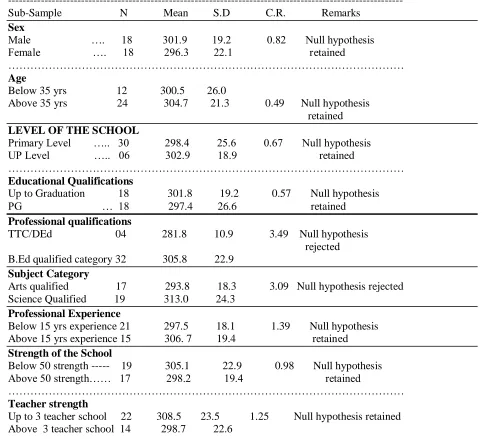
TABLE 2
Significance of the difference between the Means on the perceptual scores of various Sub-Samples
--- Sub-Sample N Mean S.D C.R. Remarks
Sex
Male …. 18 301.9 19.2 0.82 Null hypothesis Female …. 18 296.3 22.1 retained
………
Age
Below 35 yrs 12 300.5 26.0
Above 35 yrs 24 304.7 21.3 0.49 Null hypothesis retained
LEVEL OF THE SCHOOL
Primary Level ….. 30 298.4 25.6 0.67 Null hypothesis UP Level ….. 06 302.9 18.9 retained
………
Educational Qualifications
Up to Graduation 18 301.8 19.2 0.57 Null hypothesis PG … 18 297.4 26.6 retained
Professional qualifications
TTC/DEd 04 281.8 10.9 3.49 Null hypothesis rejected B.Ed qualified category 32 305.8 22.9
Subject Category
Arts qualified 17 293.8 18.3 3.09 Null hypothesis rejected Science Qualified 19 313.0 24.3
Professional Experience
Below 15 yrs experience 21 297.5 18.1 1.39 Null hypothesis Above 15 yrs experience 15 306. 7 19.4 retained
Strength of the School
Below 50 strength --- 19 305.1 22.9 0.98 Null hypothesis Above 50 strength…… 17 298.2 19.4 retained
………
Teacher strength
Up to 3 teacher school 22 308.5 23.5 1.25 Null hypothesis retained Above 3 teacher school 14 298.7 22.6
---7
International Journal in Management and Social Sciencehttp://ijmr.net.in, Email: [email protected] Looking at the average scores in Table 2, in the sample, there are no statistically significant differences in the perceptual scores between Male (average=301.9) and Female (average=296.3) respondents. The critical ratio (C.R.=0.82)being statistically insignificant. Therefore, the above mentioned findings corroborated our hypothesis.
The obtained value of critical ratio (C.R.= 0.49) shown in the Table 2, indicates that the difference between the mean scores of below 35 yrs (Mean= 300.5) and above 35 yrs (Mean= 304.7) respondents perceptions towards school managerial aspects was insignificant. Therefore, the findings corroborated our hypothesis.
The obtained value of critical ratio (C.R.= 0.67) shown in the Table 2, indicates that the difference between the mean scores of primary level (Mean= 298.4) and UP Level (Mean= 302.9) respondents perceptions towards school managerial aspects of the headmasters insignificant. Therefore, the findings corroborated our hypothesis.
The obtained critical ratio (C.R.= 0.57) shown in the Table 2, indicates that the difference between the mean scores of up to graduate qualified category (Mean= 301.8) and Post Graduate category respondents (Mean= 297.4) perceptions towards managerial performance of headmasters was insignificant. Therefore, the findings corroborated our hypothesis
From the above table we notice that the BEd qualified category respondents differed significantly than that of the TTC/DEd students. Looking at the average scores in Table 2, in the sample, The mean perceptual scores of BEd qualified was 305.8 and for DEd qualified was 281.8. The critical ratio (C.R.=3.49) being statistically significant. It shows that the higher the qualification , higher the perceptual value with regard to managerial aspects of the headmasters.
From the above table we notice that the Science qualified respondents perceived more than that of the Arts qualified respondents,. Looking at the average scores in Table 2, in the sample, The mean perceptual scores of Science qualified category was 313.0 and for Arts qualified was 293.8. The critical ratio (C.R.=3.09) being statistically significant. It shows that the science graduates are having high perceptual value towards the managerial cstrgories of the Headmasters than that of the Arts qualified.
8
International Journal in Management and Social Sciencehttp://ijmr.net.in, Email: [email protected] group of respondents (Average=306.7 ). The C.R. value is 1.39, which is statistically insignificant. Therefore, the above-mentioned findings corroborated our hypothesis.
Examining the results in Table 2, find that there are no significant differences in the mean scores between the respondents working in the below 50 school strength (Mean=305.1) and respondents working in the above 50 school strength (Average=298.2). The C.R. value is 0.98, which is statistically insignificant. Therefore, the above-mentioned findings corroborated our hypothesis.
Examining the results in Table 2, find that there are no significant differences in the mean scores between the respondents working in the TEACHER STRENGTH OF 3 teachers(Mean=308.5) and respondents working in the teacher strength of above 3 teachers (Average=298.7). The C.R. value is 1.25, which is statistically insignificant. Therefore, the above-mentioned findings corroborated our hypothesis.
TABLE 3
Correlation between managerial performance of head masters and Student Achievement
---Sl. No. Student Achievement --- Managerial performance of HMS
Effectiveness rating - 0.76 ** ---
Correlation was found in between student achievement (grades) with the managerial performance of the head masters effectiveness was highly correlated.
TABLE 4
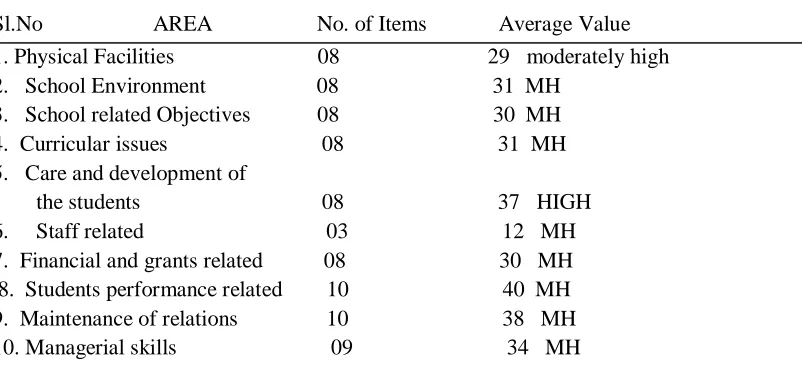
Managerial performance effectiveness aspects- area wise average values
--- Sl.No AREA No. of Items Average Value 1. Physical Facilities 08 29 moderately high 2. School Environment 08 31 MH
3. School related Objectives 08 30 MH 4. Curricular issues 08 31 MH 5. Care and development of
the students 08 37 HIGH 6. Staff related 03 12 MH
7. Financial and grants related 08 30 MH
8. Students performance related 10 40 MH 9. Maintenance of relations 10 38 MH
10. Managerial skills 09 34 MH
9
International Journal in Management and Social Sciencehttp://ijmr.net.in, Email: [email protected]
With regard to Students care and development of the students aspect the perceptions of the
teachers was high.
With regard to -physical facilities, school environment, school objectives, curricular issues, staff related , financial and grants related, students performance related, maintenance of external relations and managerial skills- the perceptions of the teachers was MODERATELYHIGH.
Conclusions:
On the whole, the key factors of primary schools as perceived by teachers were moderately high and encouraging. This implication indicates that the managerial aspects of the headmasters at primary level viz., physical facilities, school environment, school objectives, curricular issues, care and development of the students, staff related , financial and grants related, students performance related, maintenance of external relations and managerial skills- had have direct impact on the academic achievement. The managerial performance factors assumes highest importance at primary level to make the school effective. In view of this, it is suggested that the headteachers should plan, act, observe and reflect on the school aspects and also plan for the students academic achievement. It is also further suggested that the head teachers at primary level must maintain good relationship with the staff, students, parents, SMC and community for the school development. It is also further suggested that, the teachers must think practically and pragmatically and discuss with other members for the progress of the school. The better the role of the teacher in the school setting the better will be the school outcome. Hence, it is suggested that, the policy makers and the authorities must take up safety measures for the benefit of the school. Head masters should be given orientations on the school related issues and also to be exposed to some of the school case studies, where the performance is high. More supervision is needed for the strengthening and enhancement of quality at primary level.
REFERENCES
1. Andrea Floyd (2011).”The Relationship between Staff perceptions of Principal Leadership and School Performance”, Florida International University, Miami, Florida. 2. Brookins, Tyrone, (2010). “Perceptions of relationships between district and school level
Administrators on Student Achievement”, University of Minnesota, 2010. 133pp. ISBN: 978-1-124-27413-3.
3. Dissertation Abstracts International, (1989) Vol.49, No.7 January, 1989. p.1628-A. 4. Garrett,H.E,.( 1973), Statastics in Psychology and Education, Vakils, Feffer and Simons
(P) Ltd., Ballard Estate, Bombay, 2.. National Policy on Education ,1986.
5. In-service Teacher Education Package , Vol.1 for Primary School Teachers. NCERT, p.46. , 1988.
10
International Journal in Management and Social Sciencehttp://ijmr.net.in, Email: [email protected] 7. National Policy on Education, Programme of Action, Government of India, New Delhi,
1986, p.186.
8. Narasimhamurty, M., Nirmalajyothi ,T,and Sarma, M.S.R(2015 ), What Makes a Good Headmaster?, A.P.H. Publishing HouseDelhi,
9. RTA (2009), School management committees (SMC) is the major component taking predominant role in involving the community members in the ongoing programmes conducted both at the Mandal and the District level. Research, Evaluation and Studies Unit Technical Support Group for Sarva Shiksha Abhiyaan, Ed.CIL (India) Limited 10-B, I.P. Estate, New Delhi -110002.
10. Sarma, M.S.R. (2005). “Studies in Primary Education” The Associated Publishers, AMBALA Cantt. 2006, pp. 50-55.
11. Sarma.MSR, (200!), Effective Managerial Factors of Primary Schools: A Qualitative Study, The primary Teacher, NCERT, Vol.xxvi, No.3, July pp53-59.
12. . Sarma, MSR.( 2005), .School an Effective Learning Centre, Paper presented in the Plenary Session in AIAER18thAnnual Conference as International. Conference on Learning Centred Education. January 27-29,
13. Sarma , MSR, Paper presented on Tthe perceptions of teachers towarsds professional aspects in the AIAER International Conference, Tirninravur, Tamilnadu,Oct. 10-12,2005.
14. .Sarma, M.S.R.,(2006), Studies in Primary Education, The Associated Publishers, Ambala.,
15. Sarma, M.S.R., (2010), Effective Schools and Effective Research at Primary Level, The Associated Publishers, Ambala.,
16.Sarma,M.S.R.,(2010), Research paper submitted to the International Seminar cum Annual Conference on Teacher Empowerment and Institutional Effectiveness, 01-03 November,,M.M.N.College, Chitradurga, Karnataka.
17. Sarma M. S. R. (2012). “Perceptions of Teachers Towards School Matters at Primary Level: A Study”, BRICS, Journal of Educational Research,Jan/ March. 2012, Vol. 2, Issue. 1.