www.technology.matthey.com
Reviewed by Edwin Raj, Alex
Martinez Bonastre*
Johnson Matthey, Blounts Court, Sonning Common, Reading, RG4 9NH, UK
*Email: [email protected]
Introduction
“Nanopatterned and Nanoparticle-Modified
Electrodes” is the 17th monograph in the Advances in Electrochemical Science and Engineering series edited by Richard C. Alkire (University of Illinois, USA), Philip N. Bartlett (University of Southampton, UK) and Jacek Lipkowski (University of Guelph, Canada). This monograph covers the progress made in electrochemical nanoscience with an emphasis on applications in medicinal and analytical chemistry. There are ten chapters
authored by experts in the respective fields covering
areas including nanopatterned and nanoparticle
modified electrodes for analytical detection, surface spectroscopy, electrocatalysis and influence of
electrode structure on the properties.
Electrochemical Nanoscience
Chapter 1, ‘Surface Electrochemistry with Pt Single-Crystal Electrodes’ by V. Climent and J. Feliu (University of Alicante, Spain) is aimed at
the study of the interaction of molecules and ions with metal surfaces. The authors introduce the initial work completed by Jean Clavillier with the
use of flame annealing for the synthesis of single
crystals. This technique made a breakthrough in
the field of surface science and new readers to this field will find the description easy to follow. The
chapter describes preparation of single crystals in a good and detailed manner and the authors provide useful comments to prevent surface reordering or contamination, such as the preparation of Pt(111), Pt(100) and Pt(110) with or without the presence of oxygen. The chapter also describes the use of
electrochemical techniques in different electrolytes
as an elegant approach to characterise the electrode surface. The chapter also introduces and describes electrochemical methods such as charge displacement.
Chapter 2, ‘Electrochemically Shape-Controlled Nanoparticles’ is written by L. Wei et al. (Xiamen University, China). This chapter describes in detail the synthesis of metal nanoparticles of
high or low index facets with the use of different
electrochemical protocols and the mechanisms
that lead to the formation of different index facets.
The chapter also gives interesting examples of alloy nanoparticles with high index facets, for instance as single metals such as platinum, iron or copper and alloys such as palladium-platinum (for example Pd0.90Pt0.10), platinum-rhodium and
iron-nickel. The authors complement this interesting
“Nanopatterned and Nanoparticle-Modified
Electrodes”
chapter with a brief view on nanoparticles of metal oxides and chalcogenides.
Chapter 3, ‘Direct Growth of One-, Two-, and Three-Dimensional Nanostructured Materials at Electrode Surfaces’ is written by S. S. Thind and A. Chen (Lakehead University, Canada). The chapter describes the synthesis of one-dimensional (1D), two-dimensional (2D) and three-dimensional (3D) nanomaterials with a particular emphasis on the parameters that control catalyst morphology with the use of synthesis methods such as anodisation, hydrothermal, chemical vapour deposition (CVD) and thermal oxidation in addition to template methods such as porous anodic alumina (PAA) templates. A wide range of materials are reported such as nanorods, nanotubes (nanotube growth control), nanoplates, graphene oxide nanosheets,
nanodendrites and nanoflowers. The reader will find
this chapter easy to read and very informative for the synthesis of materials that can be applied to a wide range of technologies such as photocatalysis, sensing and fuel cells.
Chapter 4, ‘One-Dimensional Pt Nanostructures for Polymer Electrolyte Membrane Fuel Cells’ is written by G. Zhang and S. Sun (Le Centre Énergie Matériaux et Télécommunications, Canada). The authors describe the controlled synthesis of shaped controlled 1D Pt nanostructures, 1D nanowires/nanorods and nanotubes with the use of template-assisted or template-free chemical routes. The authors also give an easy to follow description of the use of electrospinning routes, metalorganic chemical vapour deposition (MOCVD) and nanochannel directed templating. The chapter
is complemented with the use of some of the approaches described as catalysts for the oxygen reduction reaction (ORR) of methanol, formic acid oxidation in rotating disk electrodes (not polymer electrolyte membrane fuel cells) and interesting comparisons are described such as Pt nanotubes and star-like Pt nanowires vs. Pt/C.
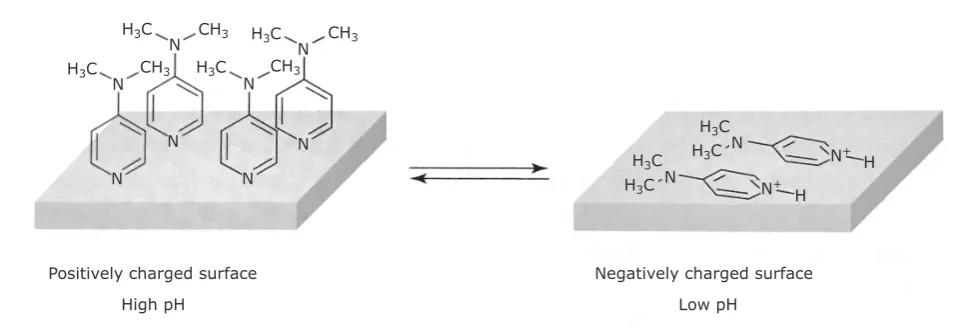
Chapter 5 by I. J. Burgess (University of Saskatchewan, Canada) discusses the capping agents for metal nanoparticle stabilisation and the formation of anisotropic gold nanocrystals. The multifunctional role of nanoparticle capping agents is discussed in reference to nature, bonding, functional groups and directed growth. Various experimental techniques including single-crystal gold electrode presentation, chronocoulometry and Black-integration, Gibbs surface excesses of acid/base forms of capping agent and co-adsorbed capping agents has also been described in good detail. A review of nanoparticle stabilisers such as citrate, quaternary ammonium surfactants and pyridine derivatives is included with cited examples. The role of 4-dimethylaminopyridine (DMAP) as a nanoparticle stabiliser has been described in
detail with information such as influence of pH
on the adsorption orientation and speciation, competitive adsorption and directed growth (Figure 1).
Chapter 6 by L. Mohammadzadeh et al. (Ulm University, Germany) is on the theoretical study of intercalation of ions in nanotubes with dimensions in the order of 1 nm for energy storage using a bottom-up approach starting from density functional theory (DFT) calculations for
Positively charged surface Negatively charged surface
High pH Low pH
H3C
H3C
H3C
H3C
N N
N+
N+
H H
H3C
H3C
H3C
H3C
N
N N
N N N
N N CH3
CH3
CH3
CH3
ions in nanotubes and subsequently explaining the results in terms of physical concepts. This chapter is a review of the authors’ own work in this area and the results discussed correspond to the insertion of single ions into gold and carbon nanotubes. It is also noted that both conducting and semiconducting carbon nanotubes (CNTs)
show little difference in their screening behaviour.
Insertion energies of anions and cations in CNTs and gold nanotubes (AuNTs) are also presented. Graphite nanotubes hardly showed any chemical interactions with the studied ions whereas chlorine is chemisorbed by gold atoms leading to deformation of gold lattice. A concise account of the work carried out by other groups has also been added towards the end.
Chapter 7, ‘Surface Spectroscopy of Nanomaterials for Detection of Diseases’ is written by J.-F. Masson and K. S. McKeating (University of Montreal, Canada). This chapter gives a good introduction to plasmonics and how this approach can be used for the detection of molecules via
the use of surface-enhanced Raman spectroscopy (SERS). The authors give a simple yet technical
description of the antenna effect of the plasmonic
structure and how this phenomenon can lead to
metal enhanced fluorescence of the molecules
placed on the plasmonic substrate. The reader will gain valuable insight into the capabilities of this technique as the chapter is documented with relevant examples which report well the combination of electrochemistry and SERS as a sensor device such as plasmonic biosensing for the detection of diseases.
Chapter 8 by P. N. Bartlett (University of Southampton, UK) on Raman spectroscopy at nanocavity-patterned electrodes focusses on the use of the latter as electrodes for SERS. This
is a well written chapter with an easy flow of
information through appropriate subheadings and illustrations. Topics covered include fabrication methods, plasmonics, Raman spectroscopy, SERS on nanohole arrays/sphere segment void (SSV) surfaces and other surface-enhanced phenomena. Each topic starts with basics and moves on to advances in the area which makes it an interesting read. Top-down and bottom-up fabrication methods
have been explained in sufficient detail. Bottom- up or self-organising routes offer cost efficiency as
they do not need sophisticated and expensive equipment. Plasmonics of nanohole arrays and SSV is also discussed. SERS enhancement on SSV surfaces (3D structures) are larger than nanohole
arrays (2D structures) due to confinement of
localised plasmons which the author’s research group has exploited to design SSV surfaces suitable for ultraviolet (UV), visible and near-infrared (IR) regions. Overall, this chapter provides a good understanding of how the optical properties of
nanocavity arrays can be systematically influenced by varying the geometry which will benefit both
subject enthusiasts as well as researchers in this area.
Chapter 9 by J. F. Li et al. (Xiamen University, China) on shell-isolated nanoparticle-enhanced Raman spectroscopy (SHINERS) on electrode
surfaces is an introduction to the benefit of
SHINERS, a new approach developed to overcome the material and morphology limitation of SERS (1). This approach is built on tip-enhanced Raman spectroscopy (TERS), which is non-contact, unlike
SERS, by replacing the tip with a film of gold
core - silica shell (Au@SiO2) nanoparticles (NPs).
The advantages of SHINERS over the previous SERS approach is explained with an illustrated example of how true C–O(Pt) stretching frequency was established in SHINERS spectra for CO adsorption on Pt(111) surface which was both downshifted and misleading in the corresponding SERS spectra.
The main benefit of the SHINERS approach is that
the measured Raman spectrum corresponds only to the sample and not the probe which is isolated due to a thin inert shell around NPs.
Synthesis and characterisation of shell-isolated nanoparticles (SHINs) is explained (Figure 2) along with an excellent summary of the applications of SHINERS in electrochemistry with illustrated examples. Application of SHINERS is limited in alkaline systems due to the solubility of SiO2- shell.
Another major challenge for SHINERS is in preparing pinhole-free shells, with shell thickness down to as low as 2 nm. Nevertheless, this chapter provides a compelling argument for the SHINERS technique and how the long-standing material/
morphology-specific limitations of SERS could be
overcome.
Chapter 10 by X. Shan et al. (Arizona State University, USA) on plasmonics-based electrochemical current and impedance imaging is an account of basic principles and applications of two relatively new electrochemical current
(EC) imaging techniques, specifically
the optical property of analytes. PEIM relies on the sensitivity of surface plasmonic resonance to electrode surface charge density which allows surface charge density vs. time imaging from which an interfacial impedance image is obtained. PECM and PEIM are faster compared to scanning electrochemical microscopy as the former are plasmonics-based techniques and do not need
scanning, instead requiring thin metal films as
electrodes. Several examples where PECM and PEIM have been applied are presented including detecting trace analytes, imaging local square-wave voltammetry, imaging electrochemical activity of single nanoparticles and mapping local quantum capacitance of graphene.
Conclusion
Overall this monograph is an interesting read and we believe, due to the range of topics covered in nanopatterned and
nanoparticle-modified electrodes with up-to-date information,
will make a valuable resource for researchers in electrochemistry, material science, spectroscopy, analytical and medicinal chemistry.
References
1. J. F. Li, Y. F. Huang, Y. Ding, Z. L. Yang, S. B. Li, X. S. Zhou, F. R. Fan, W. Zhang, Z. Y. Zhou, D. Y. Wu, B. Ren, Z. L. Wang and Z. Q. Tian, Nature, 2010, 464, 392
Au or Ag salt
Raman measurement
Sample NP synthesis
Au or Ag NPs HO
HO OHHO HOOHHO HOOH
N N N
Si Si Si
O
O O
O O
O O
O O
O O
O O
O
N N N
Si
Si Si
Si Si
Si
or ALD deposition Hydrolysing silicate solution
SHINs
Assemble
The Reviewers
Edwin S. Raj is a Principal Scientist in the Catalyst & Materials Group at Johnson Matthey, Sonning Common, UK. His current research activities are focused on conductive pastes for electronic, automotive and photovoltaic applications as well as investigating pigments for glass enamels.