DIVORCE AMONG WOMEN: A STATISTICAL ANALYSIS OF THE CAUSES
Dr. Laltanpuii Ralte, Assistant Professor Department of Public Administration
Mizoram University
Abstract
This study attempts to find the most significant factors which caused divorce by using multiple logistic regression analysis among 330 women Aizawl who had been or are still married. It was found that out of 15 variables, only 6 variables viz., women occupation, husband occupation, higher education, number of children, premarital birth and presence of children are significant. Out of these 6 variables, women education, husband occupation, higher education and presence of children have most significant impact in causing divorce among women.
Key words: Divorce; Mizoram; multiple logistic regression; socio-economic; marital histories.
I. Introduction
Divorce, according to Bohanna (1973), is a complex phenomenon in human relationship and it takes place in six stages, these are emotional divorce stage, economic divorce stage, legal divorce stage, co-parental divorce stage, community and psycho- divorce stages. Thus, Lands (1975) explained that divorce comes as a climax to a long story of unhappiness and it provides a legal way out of a situation which one or both parties have considered intolerable.
The Mizo society in pre-modern times was strictly based on what is known as an extreme patriarchal society. But today, Mizoram is the only state where women voters outnumber men (http://www.oneindia.com/guwahati/mizoram-the-only-state-where-women-voters-outnumber-men-1347273.html). In the Mizo society, a woman may lose her reputation if she commits adultery and she is termed as ‘Uire’ (adulteress). In such instances, if her husband does not forgive her, she has to leave her house empty-handed, with no claims of over her properties including her own children. In some cases, husbands may even take away the wife’s personal possessions.
According to the Shillong Times published on 10th March 2015, 2011 census revealed that Meghalaya, Mizoram and Nagaland are three states of the North East which have the dubious distinction of having more divorced or separated women in proportion to men and Mizoram attained the highest number of divorced or separated women with 6.9 percent. Four of the five states with the highest proportion of divorced or separated women in relation to those ever married (ranging from about 7% to 2%) are from North East – Mizoram, Meghalaya, Nagaland and Sikkim in that order.
Divorced Mizo women are now entitled to inherit property and are protected to a great extend from being divorced at the whims of their husbands under the newly enacted Mizo Marriage, Divorce and Inheritance of Property Act, 2014. The Act which disbands the customary law of the strictly patriarchal Mizo society allows divorced women to inherit property and also protects them from being divorced by their husbands at their will. (http://www.dnaindia.com/india/report-divorced-mizo-women-now-entitled-to-inherit-property-2039987).
II. Literature Review
The family that emerges from a marriage has some basic functions which makes it unique. Bilton, Bonnett, Jones, Sheard, Stanworth and Webster (1981) observed that in all societies the family must perform some basic functions involving conception and birth, regular intercourse, socialization and maintenance functions of providing economic support and physical protection for the children as they mature. In fact, each spouse is a source of emotional support and companionship for the other (Filani, 1985).
Ono (1998) finds that at low levels, women’s earnings help stabilize marriage by relieving economic pressure, especially if the husband does not earn much. At higher levels, in contrast, women’s earnings destabilize marriage by allowing the wives to leave. Sayer and Bianchi (2000) find otherwise: women’s earnings have little effect when husbands’ incomes are low but a strong protective effect on marital stability when husbands’ incomes are high.
Age at marriage is often found to have a considerable positive effect on marriage stability, both in a Western context (Murphy 1985, Martin and Bumpass 1989) and in African populations (Locoh and Thiriat 1995). Isiugo-Abanihe (1988) did not find a significant effect. I will test for a non-linear effect of age at marriage, because it can be assumed that the positive effect of age at marriage on marriage stability decreases with an increasing age at marriage.
In some cases the relationship between female education and divorce is found to be positive (Isiugo-Abanihe 1998). Under other circumstances its influence appears to be non-linear, with the lowest divorce rates observed among uneducated women and among the highest educational groups (Brandon 1990; Tilson and Larsen 2000, Takyi 2001).
London (1991) argue that this relationship may not be causal but can be explained because those who engage in premarital sex also have characteristics that detract from marital stability. Heaton (1993) questions interpretation of their results regarding selectivity, leaving open the possibility that a causal connection exists. The relationship between the nature of premarital sexual experience and marital stability has received less attention. Adult-child sexual contact is related to earlier initiation of sex and adolescent sexual activity (Browning&Laumann, 1997). By implication, forced sex may detract from subsequent marital stability. Research also indicates that having a birth before marriage detracts from marital stability (Billy, Landale, & McLaughlin, 1986).
According to Castro Martin (1991),women’s educational attainment and marital stability are also positively related. But which is contradicted to our finding that women educational attainment is inversely proportional to marital stability.
III. Methodology
The present study is based on primary data collected during the month of June, 2015. A total 330 ever married (women include those who are “married” and “divorced”) women between the ages of 17 to 55 years were interviewed in Aizawl. Detailed information on socio-economic and marital histories were collected with a structured questionnaire by well-trained researchers.15 variables with one response variable are taken into consideration, response was coded 1 if a woman had ever been divorced and 0 otherwise and processed through software R version 2.10.1 using χ2 – test and multiple logistic regression as techniques of analysis.
IV. Results & Discussions
Table 1: Distribution of divorced and union by socio-economic and marital histories
Variables Category Divorced Union Total χ2
Women Occupation(WO)
Pub. sector 25 77 102 0.032
(p=0.858)
Others 58 170 228
Duration of stay with
Parent(DSWP)
>25 28 122 150 6.143
(p<0.013)
≤ 25 55 125 180
Age at marriage(AM)
>25 26 118 144 6.833
(p<0.009)
≤ 25 57 129 186
Others 62 124 186 (p<0.000)
Cohabitation(Co)
Yes 4 25 29 2.179
(p=0.141)
No 79 222 312
Parents divorced(PD)
Yes 13 41 54 0.040
(p=0.842)
No 70 206 276
Premarital sex(PS)
Yes 33 81 114 1.333
(p=0.249)
No 50 166 216
Same race(SR)
Yes 23 91 114 2.291
(p=0.131)
No 60 156 216
Same religion(SRe)
Yes 82 236 318 1.871
(p=0.172)
No 1 11 12
Higher education(HE)
Wife 40 152 192 4.548
(p<0.033)
Husband 43 95 138
Age
Wife older 20 88 108 3.752
(p=0.053)
Husband older 63 159 222
No.of children(NoC)
>2 35 145 180 6.851
(p<0.009)
≤ 2 48 102 150
Premarital birth(PB)
Yes 17 19 36 10.456
(p<0.001)
No 66 228 294
Conflict (Con)
Yes 51 147 198 0.097
(p=0.756)
No 32 100 132
Children(Child)
Yes 69 231 300 8.114
(p<0.004)
From Table 1, the rate of divorce is visibly less among women who are working in the public sector, but not significant ( p=0.858). Longer duration of stay with parents has significant impact on divorce (p=0.013), For a consequences, higher age at marriage also significantly influenced divorce among women. Moreover, other factors like husband’s occupation, higher education, number of children, premarital birth of a child and having children also have significant impacts on divorce among women. Divorce is therefore significantly influenced by 7 out of 15 socio-economic and marital histories considered viz., duration of stay with parent, age of marriage, husband occupation, more educated wife than husband, number of children, premarital birth and having children.
Table 2: Logistic regression analysis of divorced women by enters method:
Variables β SE P-value Exp(β)
95% CI for Exp(β)
Lower Upper
WO .805 .389 .038 2.236 1.044 4.789
DSWP -.345 .501 .491 .708 .265 1.892
AM -.204 .510 .690 .816 .300 2.218
HO -1.026 .349 .003 .358 .181 .709
Co -.622 .614 .311 .537 .161 1.787
PD .073 .458 .873 1.076 .438 2.642
PS .706 .389 .070 2.026 .945 4.343
SR -.719 .390 .066 .487 .227 1.047
SRe 1.844 1.229 .133 6.319 .569 70.204
HE 1.033 .349 .003 2.811 1.418 5.570
Age .495 .363 .173 1.640 .806 3.340
NoC -.964 .407 .018 .382 .172 .847
PB 1.390 .600 .020 4.014 1.239 12.999
Con -.094 .350 .789 .910 .458 1.808
Ch -1.237 .585 .034 .290 .092 .913
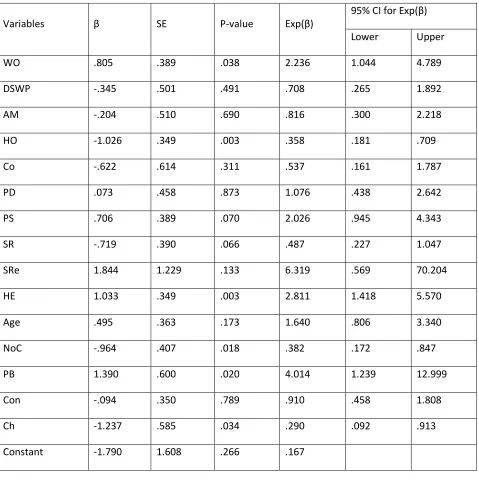
Table 2 shows that through multiple logistic regression model (enter method) 6 out 15 variables under study are identified that each has significant impact on the marital instability, controlling the impact of others, they are WO (woman’s occupation), HO (husband’s occupation), HE (higher education), NoC (number of children), PB (premarital birth of child) and Ch (children).
The odd ratio women occupation 2.236 indicates that a women working in the public sector has 2.2 times more chance to impact on marital instability, keeping other variables constant. If the husband is working in the public sector, there is 64.2% lesser chance of divorce than those husbands who are working in other sectors. A more educated wife has 2.8 times more chance to divorce than more educated husband as evidenced by the OR 2.811. Increasing number of children also reduces divorce by 61.8% than those have less number of children. Premarital birth also increase divorce by 4.01 times than those who have not. Children play very important roles in a family; presence of children also reduces divorce by 71% than those families without children.
Table 3: Logistic regression analysis of divorced women by stepwise method:
Steps Variables β SE P-value Exp(β)
95% CI for Exp(β)
Lower Upper
1
HO -1.075 .283 .000 .341 .196 .594
Constant -.693 .156 .000 .500
2
HO -1.167 .292 .000 .311 .176 .552
PB 1.294 .381 .001 3.647 1.727 7.702
Constant -.832 .164 .000 .435
3
HO -1.270 .298 .000 .281 .157 .503
HE .696 .273 .011 2.006 1.174 3.427
PB 1.249 .393 .001 3.488 1.615 7.537
Constant -1.092 .199 .000 .335
4
HO -1.280 .301 .000 .278 .154 .502
HE .734 .278 .008 2.084 1.208 3.595
PB 1.205 .410 .003 3.335 1.493 7.452
Ch -1.084 .435 .013 .338 .144 .794
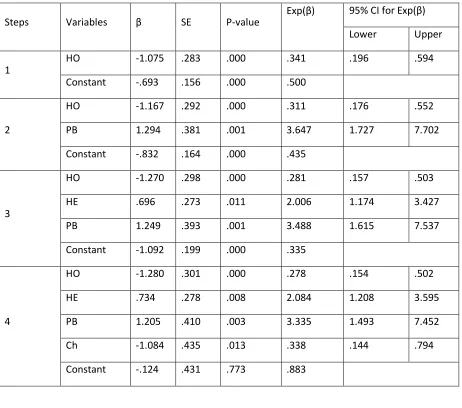
Further, multiple logistic regression analysis of divorced women by stepwise method ( forward wald) is also applied to identify the most significant variables which are indispensible to study divorce among women. In the final step, i.e., step 4, it is established that four variables viz., HO (husband’s occupation), HE (higher education), PB (premarital birth) and Ch (having children) have significant impact on divorce among women.
V. Conclusion
sReferences
Billy, J.O.G., Landale, N. S.,&McLaughlin, S. D. (1986). The effect of marital status at first birth on marital dissolution among adolescent mothers. Demography, 23(3), 329-350.
Bilton, T.; Bounett, K.; Jones, P.; Sheard, K; Stanworth, M.K. Webster A. (1981), Introductory Sociology, London: Macmillan.
Bohanna, P. (1973). The Six stations of divorce. In M.E. Lasswell & T.E. Lasswell (Eds.)- Love,Marriage, Family, 24 113-128.
Brandon, Anastasia. (1990). Marriage Dissolution, Remarriage and Childbearing in West Africa: a Comparative Study of Cote d'Ivoire, Ghana and Nigeria. Ph.D.diss., Philadelphia: University of Pennsylvania, 1990.
Browning, C. R., & Laumann, E. O. (1997). A life course perspective on adult-child sexual contact. American Sociological Review, 62(4), 540-560.
Dowerah,Simantik(2014).Divorced Mizo women now entitled to inherit property.
http://www.dnaindia.com/india/report-divorced-mizo-women-now-entitled-to-inherit-property-2039987 (6 December 2014).
E.J. Thomas(1993). Mizo Hamboo Hills Murmur Change: Mizo Society before and after independence (New Delhi: D.R. Chopra for M/s intellectual Publishing House, 1993), p.42
Filani, T.O. (1985). The effect 'of communication skill training and coguitive restructuring on marital adjustment of some Nigerians. The Nigerian Journal of Guidance and Counselling, 1, 16-24.
Heaton, T. B. (1993). Feedback: Comment on “Premarital sex and the risk of divorce.” Journal of Marriage and the Family, 55(1), 240-241.
Isiugo-Abanihe, Uche. (1998). "Stability of marital Unions and Fertility in Nigeria." Journal of Biosocial Science 30: 33-41.
Kahn, J. R.,&London, K. A. (1991). Premarital sex and the risk of divorce. Journal of Marriage and the Family, 53(4), 845-855.
Lands, P.H. (1975). Sociology (New ed.) U.S.A.: Ginn & Company.
Larsen, Ulla. (1989). A Comparative Study of the Levels and the Differentials of Sterility in Cameroon, Kenya and Sudan. In Reproduction and Social Organization in Sub-Saharan Africa, Ed. by Ron
Lesthaeghe. Berkeley: University of California Press, pp.167-211.
Murphy, M. J. (1985). "Demographic and Socio-economic Influences on Recent British Marital Breakdown Patterns." Population Studies 39: 441-460.
Ono, H. (1998). Husbands' and wives' resources and marital dissolution. Journal of Marriage and the family, 60(3), 674-689.
Sayer, L. C., & Bianchi, S. M. (2000). Women's economic independence and the probability of divorce. Journal of Family Issues, 21(7), 906-943.
Takyi, Bafffour. (2001). “Marital Instability in an African Society: Exploring the Factors that Influence Divorce Processes in Ghana.” Sociological Focus 32(1): 77-96.
Tilson, Dana, and Larsen, Ulla. (2000). "Divorce in Ethiopia: the Impact of Early Marriage and Childlessness." Journal of Biosocial Science 32: 355-372.
The only state where women voters outnumber men (2013).
http://www.oneindia.com/guwahati/mizoram-the-only-state-where-women-voters-outnumber-men-1347273.html ( 25 November 2013).
The Shillong Times(2015).Mizoram tops, Meghalaya stands second.